Disclosure: As an Amazon Associate, topratedkitchenware.com earns from qualifying purchases. Prices and availability change; check Amazon for the latest.
Where to buy
Check the latest price, availability and delivery on Amazon. Orders are placed on Amazon. We may earn a commission from qualifying purchases.
- Best overall: Sleep On Latex Pure Green Natural Latex Mattress Topper, Soft, 3 Inch, Queen — Check on Amazon
- Tempur-Pedic TEMPUR-Adapt + Cooling Mattress Topper, 3 Inch, Queen — Check on Amazon
- Talatex Latex Mattress Topper, 2 Inch, Queen — Check on Amazon
- ViscoSoft Serene Hybrid Lux Pillow Top Mattress Topper, 3 Inch, Queen — Check on Amazon
See 2 more Amazon options
- Sleep On Latex Pure Green Natural Latex Mattress Topper, Medium, 3 Inch, Queen — Check on Amazon
- ViscoSoft Active Cooling Copper Mattress Topper, 4 Inch, Queen — Check on Amazon
Read the full guide ↓
Disclosure: As an Amazon Associate, topratedkitchenware.com earns from qualifying purchases. Links to Amazon on this page are affiliate links; they cost you nothing extra. Listing details such as price and availability change often, so check the current Amazon listing before you buy.
Side sleeping concentrates your weight onto the two narrowest points of your body — the shoulder and the hip — and everything in this guide follows from that physics. A back sleeper spreads their weight across a broad surface; a side sleeper balances on two bony landmarks, and a sleep surface either lets those landmarks sink or it holds them up and lets the spine bend around them. A topper is the cheapest way to change which of those two things your bed does, and $400 is the ceiling of what a passive topper can be: at this budget the category tops out, and the six picks below are its best-verified forms, re-judged for the sleeper who spends the night on one shoulder. Every pick below is for the queen size in the thickness named, because toppers vary by size and thickness — check the current price on Amazon for the exact variant before you buy.
Two honesty notes belong up front. The first is about what this budget cannot buy, because it is the same list as the general $400 guide’s: a genuine wool topper and a true down topper both exist inside this budget, but neither could be tied to a live, buyable Amazon queen listing with a confirmed ASIN during our research, so both are named in this guide without links; and active temperature control — the water-circulating systems that hold a set temperature — sits well above this budget. The second note is about claims. A softer, deeper surface may well feel kinder to a shoulder or a hip. But no topper treats shoulder pain, hip pain or any other condition, and nothing in this guide is recommended for one. Pain that persists, or that arrives with numbness, tingling or weakness, belongs in a clinician’s office, not in a checkout — that sentence appears again in the mistakes and the FAQ.
For most side sleepers we would start with the Sleep On Latex Pure Green in its 3-inch soft build — the plush version of the thickest slab of certified natural latex that verifiably sells under $400 on Amazon — because it lets a shoulder sink while pushing back enough that turning over stays easy. Its medium sibling is in this guide too, charged honestly: it is the same excellent slab, and for a strict side sleeper it is simply too firm, holding the shoulder up instead of letting it drop. Between those two bookends sit the deepest foam cradle in the category, the airier Talalay-style latex, a pillow-top hybrid that testers singled out for shoulder and hip pressure, and the thickest engineered foam here, which earns its slot as bottoming-out insurance for heavier side sleepers.
In this guide
Quick Picks
| Buyer type | Pick | Why it stands out | Link |
|---|---|---|---|
| Best overall for side sleepers | Sleep On Latex Pure Green Natural Latex Mattress Topper, Soft, 3 Inch, Queen | Three inches of soft organic latex — the shoulder sinks, the surface pushes back | Check on Amazon |
| Best deep cradle | Tempur-Pedic TEMPUR-Adapt + Cooling Mattress Topper, 3 Inch, Queen | The most exact foam contour in the category — check the current price on Amazon | Check on Amazon |
| Best light, airy softness | Talatex Latex Mattress Topper, 2 Inch, Queen | Talalay-style latex in a genuinely soft build, cover included | Check on Amazon |
| Best pillow-top surface | ViscoSoft Serene Hybrid Lux Pillow Top Mattress Topper, 3 Inch, Queen | Plush fiber top over foam; testers praised its shoulder and hip pressure relief | Check on Amazon |
| Best for combination and heavier side sleepers | Sleep On Latex Pure Green Natural Latex Mattress Topper, Medium, 3 Inch, Queen | The hero latex in its firmer build — support first, sink second | Check on Amazon |
| Best bottoming-out insurance | ViscoSoft Active Cooling Copper Mattress Topper, 4 Inch, Queen | Four inches over a high-density base — the thickest build here | Check on Amazon |
How These Picks Were Chosen
Every pick below had to clear the same bar as the general $400 guide’s: a queen-size listing on Amazon whose ASIN we could verify from the listing itself, a tracker record or a catalog record for that exact product, and a listing we could verify for that exact product. Where a product failed that test, it is named in the ceiling section without a link rather than linked on a guess. The ELEMUSE goose down feather topper sits in the lower part of this budget band and was mirrored by an Amazon-fulfilled listing in our research, but its queen ASIN could not be confirmed from any record this session, so it is named unlinked as the first swap-in; a down-and-feather layer is, on paper, exactly the kind of surface softness side sleepers shop for, which is why its absence is worth stating rather than hiding. The Wow Futon organic merino wool topper failed the other half: its queen ASIN is verified and it sits in the middle of this budget band, but repeated crawls of the listing showed no featured offer, so wool is discussed honestly as a material this budget reaches on paper but cannot reliably buy on Amazon.
On top of that verification bar, this guide applied a side-sleeper filter, and it changed the ranking. The general guide’s hero — the Pure Green in medium — drops to fifth here, not because it got worse but because its firmness answers a different sleeper. What rose instead are the builds that give at the surface: the same latex in soft, the foam that cradles deepest, the latex with a published softness figure, and the pillow top. Thickness was judged against bottoming out rather than against luxury: a side sleeper compresses a topper at two points, deeply, so a build that is generous for a back sleeper can be used up entirely under one hip. The size discipline holds throughout: every pick is the queen, in the thickness named, and king sizes or thicker variants of several picks can sit above this budget — check the current price on Amazon for the size and thickness you select.
The 6 Best Mattress Toppers for Side Sleepers Under $400
Sleep On Latex Pure Green Natural Latex Mattress Topper, Soft, 3 Inch, Queen (80 x 60 x 3 Inch)
Who it suits: Strict side sleepers — and lighter bodies generally — who want real sink at the shoulder without memory foam’s slow, held feeling.
This is the general guide’s fifth pick promoted to the top, and the promotion is the whole argument of this page in miniature. The soft build of the Pure Green 3-inch — GOLS certified organic natural Dunlop latex, check the current price on Amazon; fulfilled by the maker — is what its medium sibling is for back sleepers, translated for the side of the bed. Three inches of soft latex gives a shoulder genuine room to drop: the surface yields under the point of the shoulder and the hip, then pushes back across the rest of the body, so the spine can run level instead of kinking around two held-up landmarks. And because latex responds instantly rather than holding a mould, changing position is a roll, not an excavation. At roughly 34 pounds in the queen it is also a reminder that latex is a serious material: this is not a pad you shake out, it is a slab you install.
The physics has a boundary, and the review should state it. Soft latex sinks, and sink is what a side sleeper is buying — but the total travel here is 3 inches over whatever the mattress below contributes. On a firm, flat mattress, that is the ideal arrangement: support underneath, give on top. On a mattress that is already soft, the same slab deepens the hammock and the hip drops too far; on a sagging mattress it follows the dip down. The cautions mirror the medium build’s: this ASIN is the bare topper with no cover included, so budget for a protector, and latex is simply wrong for anyone with a latex allergy. Durability argues the other way — natural latex is the longest-lived topper material in this category, routinely outlasting foam by years, which is the real value here.
- The soft build of the guide’s best material — 3 inches of GOLS organic Dunlop latex.
- Sink at the shoulder and hip with buoyant pushback — no held, moulded feeling.
- Check the current price on Amazon for the queen; fulfilled by the maker.
Honest limitation: Bare slab, no cover — and genuinely soft, which makes it the wrong purchase over a mattress that is already soft or sagging: it will deepen the problem it was bought to solve.
Choose it if you sleep mostly on your side, your mattress is firm and flat, and you want sink without memory foam’s slow response. Skip it if you have a latex allergy, sleep mostly on your stomach, or your bed already feels too soft.
Tempur-Pedic TEMPUR-Adapt + Cooling Mattress Topper, 3 Inch, Queen
Who it suits: Side sleepers who want the deepest cradle in the category — the shoulder swallowed, the hip held — and who will buy it on its sale cycle rather than at list.
If the latex hero is sink with pushback, this is sink without it, and for a strict side sleeper that is a legitimate preference rather than a flaw. The TEMPUR-Adapt + Cooling is 3 inches of genuine TEMPUR material — the denser, slower, more exact contour that every other memory foam in this category approximates — under a premium knit cover the maker describes as cool-to-the-touch and removable for washing. Memory foam’s party trick is precisely the side sleeper’s problem: it flows away from pressure points and holds the shape, so the shoulder drops into the material and stays dropped, with the load spread across the whole side of the body instead of balanced on the joint. No other pick in this guide cradles as completely. The trade is the mirror image of the latex pick’s virtue: turning over means climbing out of your own impression, combination sleepers who move often can find the material stubborn, and the surface sleeps warmer than latex — the cover feels cool at first contact and after each wash, which is a real comfort feature, and it is not temperature control.
Its pricing position needs the same plain statement the general guide gave it, because it is this tier’s clearest straddle. This pick moves between sale positioning inside this budget and typical and list positioning above it. It belongs in an under-$400 guide only while the live listing sits inside the budget; at full list it has left the budget, so check the current price on Amazon before you rely on it. Returns deserve the same discipline: Tempur-Pedic’s direct channel is famously restrictive with topper returns, so treat the purchase as governed by Amazon’s return window on the listing and check it before ordering — a feel this distinctive is exactly the kind you want an exit from.
- Genuine TEMPUR material — the deepest, most exact cradle available to a side sleeper here.
- Removable, washable cool-touch knit cover included.
- Check the current price on Amazon — this pick moves between sale positioning inside the budget and list positioning above it.
Honest limitation: It is a straddler: at its full list price this topper can sit over this guide’s budget, and the slow material that cradles a still sleeper resists a restless one — changing position takes effort.
Choose it if the listing shows a price at or under $400 and you sleep still, on your side, and want maximum contour. Skip it if the price has reverted toward list, you change position constantly, or you sleep very warm.
Talatex Latex Mattress Topper, 2 Inch, Queen
Who it suits: Lighter side sleepers who found Dunlop latex a touch dense and want the softer, airier latex feel — with the cover included and the spec sheet published.
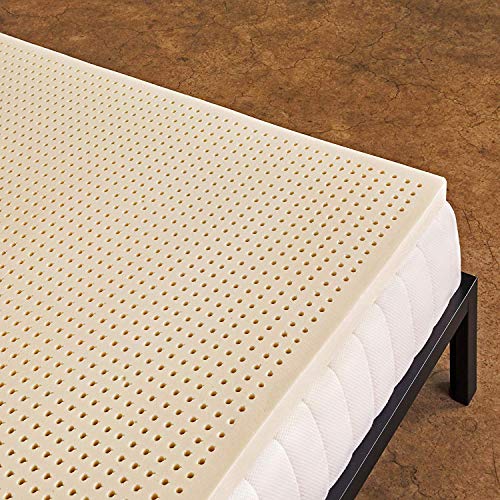
Talalay and Dunlop are the two ways of making latex foam, and they feel different: Talalay is whipped and flash-frozen before curing, which makes it softer, springier and more uniform — the latex most often compared to a pillow made of rubber. For a side sleeper, that first-touch softness matters, because the shoulder meets the surface before the deeper support engages. The Talatex is the Talalay-style entry that verifiably sells on Amazon in a queen, check the current price on Amazon, and unusually for this category its listing publishes its numbers: a density of 70 kg/m³ and an ILD of 23 to 26 for the 2-inch build — a genuinely soft reading, softer on paper than either Pure Green build’s character — plus an organic cotton cover included, which quietly closes the bare-slab gap both Dunlop picks leave open.
The side-sleeper caveat is thickness, and it is a weight question, not a quality question. Two inches is the moderate-change build: over a firm mattress, a lighter sleeper’s shoulder compresses it and still has mattress give beneath; a heavier sleeper can compress two inches of soft latex nearly to the mattress surface at the hip, at which point the hard bed underneath is the sleep surface — bottoming out, in the phrase this guide uses throughout. If you are on the heavier half of the range, the 3-inch picks above and below are the safer physics. The verification trail also deserves its sentence: the ASIN was read from the Amazon listing itself, but its pricing trail in our research was the thinnest in the guide, resting on roundup coverage rather than a direct listing capture. Check the current price on Amazon before you buy, and know the hero above is the documented fallback in the same material family if the live queen price sits above this budget.
- Talalay-style latex — the softer, airier latex build, with a published ILD of 23–26.
- Organic cotton cover included — the only latex pick here that arrives covered.
- Check the current price on Amazon for the queen.
Honest limitation: Two inches is the thinnest build in this guide, and heavier side sleepers can bottom it out at the hip over a hard mattress; its pricing trail is also the guide’s thinnest — roundup coverage, not a direct listing capture.
Choose it if you are a lighter side sleeper who wants latex’s bounce with the softest first touch and a cover in the box. Skip it if you are heavier, need a dramatic change in feel, or have a latex allergy.
ViscoSoft Serene Hybrid Lux Pillow Top Mattress Topper, 3 Inch, Queen
Who it suits: Side sleepers who want a plush, hotel-style surface over real foam support — and the easiest installation in this guide, a fitted skirt instead of straps and wrestling.
The dual-layer idea reaches its most finished form here. ViscoSoft’s Serene Hybrid line — sold on Amazon under the Hybrid Lux pillow-top listing — stacks gel-infused memory foam under a 1.5-inch down-alternative pillow top in a 300-thread-count cover, and it mounts with an 18-inch deep fitted skirt, so it goes on like a mattress pad. The ASIN was confirmed from a catalog record for this exact queen listing, For this guide’s lens, the relevant evidence is the hands-on record: independent testing of the Serene Hybrid found it genuinely good at taking pressure off shoulders and hips, particularly for side sleepers, while still feeling supportive rather than swampy — the pillow top gives the shoulder a soft first inch to land in, and the foam beneath decides how far the landing goes. Pricing runs on ViscoSoft’s frequent-sale rhythm, positioning this pick in the lower half of this budget — check the current price on Amazon for the 3-inch queen.
The honest counters are about what a fiber pillow top is. Down-alternative fill is the least durable material in this guide: it compresses with use, fastest exactly where a side sleeper loads it — under the shoulder and hip — so the plush first inch thins over the years even while the foam below holds up. The gel layer’s cooling is the usual first-contact story; the pillow top’s breathable fiber does more for perceived freshness than the infusion does. And the paperwork discipline from the general guide stands: ViscoSoft’s 90-day guarantee and 5-year warranty are brand-channel terms, while an Amazon purchase runs under Amazon’s return window plus the warranty — confirm both on the listing. The lookalike model names (Serene, Serene Hybrid, Hybrid Lux, Rescue) make variant discipline essential: confirm the listing you land on is the 3-inch queen pillow top.
- Two constructions in one: gel memory foam base plus a 1.5-inch down-alternative pillow top.
- Independent hands-on testing singled out its shoulder and hip pressure relief for side sleepers.
- Positioned in the lower half of this budget for the 3-inch queen — check the current price on Amazon.
Honest limitation: The pillow top’s fiber fill is the fastest-wearing surface in this guide and compresses where a side sleeper loads it most; the brand’s headline guarantee is a brand-channel term, not an Amazon one.
Choose it if you want a plush, conventional surface over foam support, with pad-style installation. Skip it if you want one honest material that will feel identical in five years, or you sleep very warm.
Sleep On Latex Pure Green Natural Latex Mattress Topper, Medium, 3 Inch, Queen (80 x 60 x 3 Inch)
Who it suits: Combination sleepers who land on their side but do not live there, and heavier side sleepers whose first problem is support — not strict side sleepers, and this review will not pretend otherwise.
Same slab as the hero, different answer — and the difference is the most instructive comparison in this guide. The medium build of the Pure Green 3-inch — GOLS certified organic natural Dunlop latex, fulfilled by the maker — check the current price on Amazon — is rated by the maker at about 4.7 lb/ft³ with a 34 lbf reading at 25% compression. For a back sleeper or a heavier body, that is the right physics. For a strict side sleeper, it is the wrong side of the line: the medium build keeps a bed’s character while softening its surface, which means the shoulder is held up closer to the mattress’s own plane, and the spine bends around it. The general $400 guide made this pick its hero; this guide demotes it to fifth, at full strength, because the keyword you searched is the lens that matters.
Who should still buy it? Two real groups. Combination sleepers, who spend part of the night on a side and part on a back or stomach, are poorly served by the deepest sink — a surface tuned entirely for the shoulder can leave the back under-supported and the stomach sleeper’s hips dropped; the medium build is the honest compromise, and its buoyant response makes the position changes these sleepers make all night genuinely easy. And heavier side sleepers, whose weight compresses soft builds toward bottoming out, may find the medium’s support is what keeps the hip from reaching the mattress below — sink you cannot use is not relief. The shared cautions stand: this ASIN is the bare topper, no cover, covered variants sit on separate ASINs, a 3-inch queen latex slab is heavy and floppy to handle, and it is entirely the wrong purchase for anyone with a latex allergy. The maker’s own listing copy is unusually honest that latex is heat-neutral and cannot always make a bed cooler; that honesty is kept here.
- Genuine natural Dunlop latex, GOLS certified organic — a full 3 inches; check the current price on Amazon.
- Firm enough to support heavier bodies and multi-position sleepers without bottoming out.
- The longest-lived material in this guide; check the current price on Amazon for the queen.
Honest limitation: For a strict side sleeper, this build is too firm: it holds the shoulder up instead of letting it sink, which is the exact failure this keyword is shopping to fix — that is why it ranks fifth here despite topping the general guide.
Choose it if you are a combination sleeper, a heavier side sleeper, or you disliked memory foam’s sink and want support first. Skip it if you sleep strictly on your side and your shoulder is the complaint — take the soft build at the top of this guide instead.
ViscoSoft Active Cooling Copper Mattress Topper, 4 Inch, Queen
Who it suits: Heavier side sleepers who want the thickest build under the ceiling — four inches between the hip and the mattress — and who understand exactly what “cooling” can and cannot mean here.
This pick’s case, through the side-sleeper lens, is arithmetic. Bottoming out is a depth problem: the hip compresses whatever it lies on, and if the compressible depth runs out, the hard mattress underneath becomes the surface. Four inches is the most depth in this guide. The Active Cooling Copper — also sold by the maker under the name The Climate — stacks 2 inches of copper-infused memory foam over 2 inches of high-density structural foam, in a removable, washable woven cover made with phase-change yarns, held down by an anti-slip mesh and adjustable straps. For the queen it sits at the top of this budget at list, with sale positioning lower in the band across the maker’s site, Target’s listing of the same topper, and review coverage — check the current price on Amazon before you buy. The 5-year warranty is the longest foam warranty in this guide, and the dense base is the layer that resists the packing-down that side loading accelerates.
Why last, then, if the depth is best? Because depth is only half the side-sleeper equation, and this build’s surface is its firmer half: the comfort layer is engineered foam over a deliberately structural base, so the shoulder’s first impression is support rather than give — a heavier sleeper sinks through the top layer into real depth, while a lighter side sleeper may never compress it enough to reach the soft part, and floats on a firm surface wondering what the money bought. The cooling needs its standing discipline, too: copper conducts heat better than foam alone and phase-change yarns absorb heat at first contact — both real, both modest, both saturated by the middle of the night. Buy this for construction and depth, not for refrigeration. Four inches also changes your sheet math; deep-pocket sheets are the safe assumption.
- The most depth here: copper comfort layer over a high-density base, 4 inches in total.
- Removable washable cover, anti-slip mesh and straps; 5-year warranty.
- At the top of this budget at list for the queen, with sale positioning lower in the band — check the current price on Amazon.
Honest limitation: Its surface is the firmest-feeling of the foam picks — lighter side sleepers may not compress it enough to get the relief they bought — and its cooling is conduction and first contact, which saturate; it is not temperature control.
Choose it if you are a heavier side sleeper whose previous toppers bottomed out, and you want depth plus the best hardware here. Skip it if you are lighter and need surface give first, expect a set temperature all night — that product sits well above this budget — or your sheets are shallow.
Comparison Table
| Pick | Material | Thickness | Price | Side-sleeper read | Link |
|---|---|---|---|---|---|
| Sleep On Latex Pure Green, Soft | Natural Dunlop latex, GOLS organic | 3 in | Check price on Amazon | Real sink with pushback — the strict side sleeper’s build | Check on Amazon |
| Tempur-Pedic TEMPUR-Adapt + Cooling | TEMPUR memory foam | 3 in | Check price on Amazon — can move above the budget at list | The deepest cradle; turning over takes effort | Check on Amazon |
| Talatex Latex Topper | Talalay-style latex | 2 in | Check price on Amazon | Softest first touch; lighter sleepers only — watch bottoming out | Check on Amazon |
| ViscoSoft Serene Hybrid Lux | Gel foam + down-alt pillow top | 3 in | Check price on Amazon — lower half of the budget | Plush landing over foam; the pillow top wears fastest | Check on Amazon |
| Sleep On Latex Pure Green, Medium | Natural Dunlop latex, GOLS organic | 3 in | Check price on Amazon | Support first — combination and heavier sleepers, not strict side | Check on Amazon |
| ViscoSoft Active Cooling Copper | Copper foam + high-density base | 4 in | Check price on Amazon — top of the budget at list | Most depth against bottoming out; firmest surface feel | Check on Amazon |
How to Choose a Mattress Topper for Side Sleepers Under $400
Diagnose before you soften. A topper fixes a mattress that is sound, flat and too firm for side sleeping. If your mattress sags in the middle or dips where you lie, a topper follows the dip down and the shoulder lands in the same hole, now softer. Lay a straight edge across the bed: if the middle sits visibly lower, the money belongs toward a mattress.
Buy sink, not softness. The two words are not synonyms. Softness is how the surface feels to a hand in the first second; sink is how far the shoulder and hip actually travel under your full weight at 3 a.m. A pillow top feels soft and may barely sink; a soft latex slab feels springy and sinks deeply. Side sleepers need the second property — judge every claim in a listing by whether it describes travel under load, not first touch.
Match the build to your weight; bottoming out is the failure to avoid. A topper is used up where you load it. Lighter side sleepers can take the 2-inch Talatex or any 3-inch pick here and still have travel in reserve. Heavier side sleepers compress soft builds completely at the hip — when the topper is fully compressed, you are sleeping on the mattress with an expensive sheet in between. If you are on the heavier half of the range, start with the 3-inch soft latex or the 4-inch ViscoSoft, and treat 2 inches of anything as a moderation, not a fix.
Choose your response type: pushback or cradle. Latex yields and pushes back, so position changes are easy and the surface feels alive; memory foam yields and holds, so a still sleeper is cradled and a restless one is resisted. Neither is better in the abstract — they are opposite answers to the same shoulder. Most disappointed buyers at this budget bought a beautifully made topper in the response type they dislike.
Re-do your pillow maths after the topper arrives. This is the step almost everyone misses, and it gets its own section below. When your shoulder sinks deeper into a new topper, the gap the pillow must fill grows, and the pillow that was right before can leave your neck bent downward all night. Plan for a loft change as part of the same purchase.
Check the size on the selector, not the headline. Every pick in this guide is the queen in the named thickness. King sizes, and thicker variants of several picks, can run above this budget — and a few listings in this category headline a smaller size. Confirm the size and thickness in the listing’s selector and check the current price on Amazon before checkout.
Read the trial terms where you actually buy. The long home trials and money-back guarantees in this category are generally brand-site offers. An Amazon purchase is covered by Amazon’s return window and the warranty stated on the listing — the Tempur-Pedic pick is the standing example, since the brand’s own topper return policy is restrictive. At this budget, the exit matters; confirm it before ordering.
Plan for the cover question. Bare latex should not sleep against a sheet alone for years; a washable protector over any topper extends its life and keeps the warranty conversation simple. If a cover in the box matters, the Talatex, the Tempur-Pedic and both ViscoSoft picks include one; the Pure Green slabs do not.
Respect the allergy lines. Three of the six picks are latex and are wrong for latex allergies; no certification logo changes that. Foam off-gassing, by contrast, is a temporary nuisance — air any new foam topper for 24 to 72 hours before first use.
Shoulder and Hip: Why Side Sleepers Need Sink, Not Just Softness
Lying on your back, your weight spreads across the whole back surface — shoulders, ribs, pelvis, calves — and pressure at any one point stays modest. Roll onto your side and the contact patch collapses to two landmarks: the point of the shoulder and the point of the hip, with the body’s weight funneled through both. For the spine to run level — the posture every sleep position is really trying to achieve — those two landmarks have to sink into the surface until the waist is supported and the neck can stay straight. A surface that will not let them sink holds the shoulder up, and the sleeper pays for it in geometry: the head tilts down toward the mattress or gets propped at an angle, and the top shoulder rolls forward. That is the entire mechanical case for a side-sleeper topper, and it is a comfort case — how the bed feels and how you wake up — not a medical one.
Sink has a floor, though, and the floor is your own weight. Every topper compresses under the hip until either the material’s resistance balances the load or the material runs out — fully compressed, the hip is effectively lying on the mattress, with the topper contributing nothing. Sleepers call that bottoming out, and whether it happens is a three-way product of your weight, the topper’s thickness and its density or firmness. It is why this guide ranks a 2-inch soft latex as a lighter sleeper’s pick and a 4-inch engineered foam as a heavier sleeper’s insurance, Before you buy, be honest about which side of that line you sleep on — it decides more than the brand does.
The materials divide by how they manage the sink. Memory foam flows: it softens with body heat, lets the shoulder descend slowly and holds it there, spreading load across the whole contact area — maximum cradle, minimum movement. Latex compresses and pushes back in proportion, so the shoulder descends against rising resistance and the surface keeps helping you move; the load spreads less completely, the freedom is greater. A pillow top over foam does the first inch with fiber — soft landing, no structure — and hands the real work to the foam below. There is no universal winner, only the match between a material’s behavior and a sleeper’s habits.
Your Pillow Is Half the Equation: Loft, Sink and the Gap
Here is the interaction nobody prints on the box. A side sleeper’s pillow has one job: fill the gap between the side of the head and the sleep surface, so the neck continues the spine’s line instead of bending. The size of that gap is set by your shoulder width minus how far the shoulder sinks into the bed. Change the sink and you change the gap. Add three inches of soft latex and let the shoulder drop two inches deeper than it used to, and the pillow that was perfect last week is now roughly two inches too thin: the head tips down toward the mattress all night, and the sleeper concludes the topper “hurt their neck” when the topper did its job and the pillow did not follow.
The fix is unglamorous: after the topper has fully expanded and you have slept on it two or three nights, reassess the pillow with fresh eyes. Lie on your side and have someone look from behind and check whether your neck runs straight from your spine to your head. Tipped down means more loft; tipped up means less — a sleeper can also end up over-propped if they bought loft for a gap the old mattress never let them sink into. Adjustable-fill and shredded-fill pillows earn their keep in this transition precisely because their loft is a dial rather than a fixed bet. And a boundary, stated as plainly as everywhere else in this guide: pillow and topper adjustments are comfort tuning. Neck or shoulder pain that persists, radiates, or arrives with numbness or tingling in the arm is not a bedding problem to iterate on — it is a reason to see a clinician.
What $400 Does Not Buy a Side Sleeper
Start with the two materials a side sleeper would most expect this budget to unlock, because their absence is the most instructive finding in this guide’s research. Wool first: a genuine wool topper is a real product at a real price inside this budget — Sleep & Beyond’s washable-wool myTopper and its organic myMerino both sit inside this budget for a queen, direct from Sleep & Beyond, and the Wow Futon organic merino queen has a verified Amazon ASIN and sits in the middle of this budget band. But every crawl of that Amazon listing showed no featured offer — no buyable price attached to the page — and no other wool topper produced a queen ASIN and a live Amazon price that met this guide’s standard. Down is the mirror image, and the nearer miss for this keyword, because a down-and-feather layer is surface softness in its purest form: the ELEMUSE queen — goose down blend over a baffle-boxed feather base, in a 400-thread-count cotton cover — sits in the lower part of this budget band, with an Amazon-fulfilled mirror listing noted in our research. What could not be confirmed is its queen ASIN, and this guide does not print links it cannot tie to the exact product. It is named here as the first swap-in: the day its queen ASIN verifies, it takes a slot in this guide. One warning travels with it, for whenever it lands: feathers displace sideways under a point load rather than cradling it, so a feather layer is a soft landing, not sink — it will never do the shoulder’s structural work the way foam or latex does.
Then the expensive illusion: active cooling. Water-circulating systems that hold a set temperature through the night — the Chilipad and Eight Sleep class — sit well above this budget for a queen. Everything in this guide cools passively or not at all: latex breathes, copper conducts until it warms through, phase-change yarns absorb a little heat at first contact, gel infusions moderate the first hour rather than the night. A side sleeper runs warmer at the contact patch than a back sleeper — more of the body pressed into the surface, less exposed to the air — so the temptation to buy the word “cooling” is understandable, and the physics is unmoved by it. If temperature control is what you actually need, save toward the active tier rather than buying a second passive topper. Finally, the boundary that outranks every product claim: nothing in this budget — nothing in this category at any level — treats shoulder pain, hip pain, night sweats or any other condition. A topper changes how a surface feels. Persistent pain, numbness or weakness is a clinician’s subject, and a listing that promises otherwise is telling you something about the listing, not the product.
Common Buying Mistakes
Buying the general guide’s hero. The medium Pure Green tops the general $400 guide and ranks fifth here, because firmness is a sleeper-specific property. A strict side sleeper who buys the medium build on its general reputation gets a superb topper that holds their shoulder up — the precise failure they were shopping to fix.
Confusing softness with sink. A hand pressed into a showroom surface measures first touch, not travel under load. Pillow tops and thin soft layers feel plush and can still leave the hip on the mattress; judge by thickness, density and build, and by your own weight against them.
Ignoring your weight class. Bottoming out is arithmetic, not bad luck. A 2-inch topper that transforms a lighter sleeper’s bed can be fully compressed under a heavier sleeper’s hip. The most common complaints in this category are physics reports from the wrong weight class.
Forgetting the pillow. A deeper-sinking bed widens the gap the pillow must fill. Keeping last year’s pillow on this year’s topper bends the neck all night and gets blamed on the topper. Re-check loft after the first few nights; it is part of the same purchase.
Expecting a topper to fix a sag. It will not, at $400 or any other price. Soft material over a dip makes a softer dip, and the shoulder lands in it. Diagnose the mattress and its foundation first.
Paying list for a straddler. Two picks in this guide live on a sale cycle — the Tempur-Pedic and the copper ViscoSoft both move between sale positioning inside this budget and list positioning at or above its top. If the live price has reverted, wait or choose another pick; check the current price on Amazon rather than assuming a sale is live.
Believing infusion claims at face value. Gel, copper, graphite and phase-change yarns are minor comfort tweaks with real but modest effects — conduction and first-contact absorption, not refrigeration, and certainly not circulation therapy. Buy the construction; let the infusions be a tiebreaker.
Treating a comfort purchase as a treatment. No topper in this guide treats shoulder pain, hip pain or any condition, and a listing’s pain-relief language is marketing this guide does not repeat. Pain that persists, or comes with numbness, tingling or weakness, needs a clinician — before the next bedding purchase, not after it.
Final Recommendation
For most side sleepers, buy the Sleep On Latex Pure Green in the 3-inch soft. It is the side-sleeper’s build of the most material this budget verifiably buys on Amazon — three inches of certified organic natural latex that lets a shoulder and hip sink while pushing back enough to keep position changes easy — and it will outlast every foam in this guide. If you sleep still and want to be cradled rather than buoyed, the Tempur-Pedic TEMPUR-Adapt + Cooling at its sale price is the deepest contour in the category — and only at its sale price. Choose the Talatex if you are lighter and want the airiest latex with a cover included, the Serene Hybrid Lux for a plush hotel surface that installs like a pad, the Pure Green medium if you are a combination or heavier sleeper who needs support ahead of sink, and the Active Cooling Copper if bottoming out has ended your previous toppers. Whichever you choose, confirm the queen size and thickness on the listing, check that the live price still sits under $400, give it three nights of air before you judge it — and then re-check your pillow’s loft against the new sink before you decide anything else. And if what you actually want is wool, true down or a set temperature, this guide’s honest answer is unchanged: $400 on Amazon is not where those live.
Frequently Asked Questions
Which topper in this guide is best for a strict side sleeper?
The Sleep On Latex Pure Green in its 3-inch soft build. It is the only pick here that combines real depth — three inches of travel for the shoulder — with a genuinely soft build, and its latex pushback means the sink does not come with memory foam’s held, hard-to-turn feeling. The Tempur-Pedic is the alternative answer for sleepers who prefer exactly that held cradle, at its sale price.
Why is the medium Pure Green ranked so low here when it tops the general guide?
Because the ranking lens changed, not the product. The medium build’s 34 lbf compression reading makes it an excellent softening layer for back sleepers, combination sleepers and heavier bodies — and for a strict side sleeper it holds the shoulder up instead of letting it sink, which is the failure this keyword is shopping to fix. Firmness is not a quality score; it is a match between a build and a body in a position.
How thick should a side sleeper’s topper be?
Three inches is the working answer for most, in a build soft enough to use the depth. Two inches moderates a firm mattress and suits lighter sleepers, but a heavier side sleeper can compress it fully at the hip — bottoming out — at which point the mattress underneath is the real surface. Four inches buys depth insurance, though in this guide the 4-inch pick’s firmer surface means lighter sleepers may not sink enough to benefit. Thickness only counts if your weight can use it and the build lets you.
Will one of these toppers fix my shoulder or hip pain?
No — and that answer is a rule of this guide, not a hedge. A topper is a comfort product: a surface that lets the shoulder sink may feel kinder than one that holds it up, and many side sleepers prefer it, but nothing here treats pain or any condition, and listings that promise relief are making claims we do not repeat. Shoulder or hip pain that persists, worsens, or comes with numbness, tingling or weakness deserves a clinician’s attention, not a more expensive topper.
Do I need a new pillow with a new topper?
Often, yes — or at least a loft adjustment. When your shoulder sinks deeper into a new topper, the gap between your head and the sleep surface grows, and a pillow sized for the old bed leaves your neck tipped downward. Sleep on the topper for two or three nights, then check whether your neck runs straight; an adjustable-fill pillow makes the correction easy. It is the most commonly skipped half of this purchase.
Can I buy a wool or down topper under $400 for side sleeping?
Not reliably on Amazon, as of our research. Wool toppers exist inside the budget direct from wool merchants — Sleep & Beyond’s queen toppers sit inside this budget band — but the one verified Amazon wool listing repeatedly showed no featured offer. The closest down product, the ELEMUSE down-and-feather queen, which sits in the lower part of this budget band, could not have its queen ASIN confirmed, so it is named in this guide without a link as the first swap-in. Note, too, that feather fill displaces under a shoulder rather than cradling it — surface softness, not sink.
Do copper and phase-change covers really cool a side sleeper?
Modestly and briefly. Copper conducts heat away from the surface until the slab warms through; phase-change yarns absorb heat at first contact and then they are done. Neither refrigerates, and no passive topper holds a set temperature — that requires an active, water-circulating system well above this budget. Side sleepers press more body area into the surface than back sleepers, so the warm-up is real; latex cools more honestly, by airflow, and even latex is heat-neutral rather than cold.
What if the topper does not help?
Give it several nights after full expansion before deciding — first impressions of compressed bedding are unreliable, and your pillow loft may need the adjustment described above before the setup is fairly judged. If the feel is still wrong, the return window on the Amazon listing is your protection, which is one more reason to read it before ordering: brand-site trials and guarantees generally do not follow the product onto Amazon. And if the real problem turns out to be a sagging mattress, let the topper go back and put the money where the problem is.
Related guides: