Disclosure: As an Amazon Associate, topratedkitchenware.com earns from qualifying purchases. Prices and availability change; check Amazon for the latest.
Where to buy
Check the latest price, availability and delivery on Amazon. Orders are placed on Amazon. We may earn a commission from qualifying purchases.
- Best overall: Talatex Latex Mattress Topper, 2 Inch, Queen — Check on Amazon
- Sleep On Latex Pure Green Natural Latex Mattress Topper, Medium, 3 Inch, Queen — Check on Amazon
- Sleep On Latex Pure Green Natural Latex Mattress Topper, Soft, 3 Inch, Queen — Check on Amazon
- ViscoSoft Serene Hybrid Lux Pillow Top Mattress Topper, 3 Inch, Queen — Check on Amazon
See 2 more Amazon options
- Tempur-Pedic TEMPUR-Adapt + Cooling Mattress Topper, 3 Inch, Queen — Check on Amazon
- ViscoSoft Active Cooling Copper Mattress Topper, 4 Inch, Queen — Check on Amazon
Read the full guide ↓
Disclosure: As an Amazon Associate, topratedkitchenware.com earns from qualifying purchases. Links to Amazon on this page are affiliate links; they cost you nothing extra. Listing details such as price and availability change often, so check the current Amazon listing before you buy.
A small bedroom changes the topper question. In a big room, a topper is a layer you add and forget. In a small one, it is a permanent piece of furniture that raises your sleep surface, has to live somewhere — and there is nowhere — and turns your bed into the room’s sofa, desk chair and reading chair whether it was designed for those jobs or not. So this guide re-judges the six best-verified toppers under $400 through the small-room lens: total sleep height first, because inches are the currency a small bedroom is shortest on; then where the topper lives when it is not being slept on, which at this size and weight is almost always “on the bed, forever”; then how the bed still works as a seat. Every pick here is the queen size in the thickness named — and that size discipline matters doubly in this guide, because most of these listings also sell twin and full sizes that would suit a small room. We will point you to the size selector on the listing to check the current price on Amazon for the size you need.
The material story is the same one the $400 tier tells everywhere: this is the ceiling of the passive topper category. The best latex, the Tempur-Pedic name on its sale cycle and the most engineered dual-layer foams all verify under $400. What does not verify is just as important: a genuine wool topper and a true down topper both exist at prices inside this budget, but neither could be tied to a live, buyable Amazon queen listing with a confirmed ASIN during our research, so both are named without links below rather than linked on a guess. Active temperature control — water-circulating systems that hold a set temperature — sits well above this budget. And a topper remains a surface fix in a small room exactly as in a large one: it softens a sound mattress, it cannot rebuild a sagging one, and nothing in this guide treats back pain or any other condition. If pain is persistent, or comes with numbness or weakness, that is a conversation for a clinician, not a checkout page.
For most small bedrooms we would start with the Talatex 2-inch latex topper — the only pick here that adds premium material at just 2 inches of height, with its cover included, so there is no separate protector to buy, store or find a shelf for. If your bed doubles as your sofa and you sit on it daily, the firmer Pure Green medium slab below is the better install. Below you will find the quick picks re-ranked by small-room situation, detailed notes on all six products, a comparison table with a small-bedroom note for each pick, a buying checklist ordered the way a small room demands, three sections on height, storage and airing out, the mistakes small-room shoppers make most, and the questions that come up again and again.
In this guide
Quick Picks
Short on time, or comparing several options at once? Each row below names a small-room situation and the product that suits it, with a link to the listing.
| Buyer type | Pick | Why it stands out | Link |
|---|---|---|---|
| Best for small rooms | Talatex Latex Mattress Topper, 2 Inch, Queen | Premium latex at only 2 inches of added height — and the cover is in the box | Check on Amazon |
| Best if the bed is also the sofa | Sleep On Latex Pure Green Natural Latex Mattress Topper, Medium, 3 Inch, Queen | Firm enough to sit on, durable enough to live on the bed for years | Check on Amazon |
| Best for side sleepers | Sleep On Latex Pure Green Natural Latex Mattress Topper, Soft, 3 Inch, Queen | The plush build of the hero latex — shoulders sink, but so does anyone sitting | Check on Amazon |
| Easiest install in a tight room | ViscoSoft Serene Hybrid Lux Pillow Top Mattress Topper, 3 Inch, Queen | Goes on like a mattress pad with a fitted skirt — no straps to fish under the bed | Check on Amazon |
| Best brand-name foam | Tempur-Pedic TEMPUR-Adapt + Cooling Mattress Topper, 3 Inch, Queen | Real TEMPUR contour with a washable cover — check the current price on Amazon | Check on Amazon |
| Most engineered — most height | ViscoSoft Active Cooling Copper Mattress Topper, 4 Inch, Queen | Densest foam build here, but 4 inches is a real claim on a small room | Check on Amazon |
How These Picks Were Chosen
The verification bar is the same one every guide in this series applies. Each pick is a queen-size Amazon listing whose ASIN we could verify from the listing itself, a tracker record or a catalog record for that exact product. Products that failed that test are named without links, and two near-misses document the rule at this tier. The ELEMUSE goose down feather topper is positioned inside this budget, but its queen ASIN could not be confirmed from any record, so it is the documented first swap-in, named unlinked. The Wow Futon organic merino wool topper has a verified queen ASIN, but repeated crawls of its listing showed no featured offer, so wool is discussed honestly as a material this budget reaches on paper but cannot reliably buy on Amazon.
On top of that bar, this variant applies the small-room filter. Each pick was re-judged on four questions a large room never asks. How many inches does it add to the total sleep height, and what does that do to getting in and out, to a loft or daybed clearance, and to sheets? Where does it live — because a 34-pound latex slab or a 4-inch foam stack does not roll into a small room’s nonexistent spare closet, so the honest answer is that it lives on the bed permanently, and it had better be durable enough and finished enough for that. Can you still sit on the bed — because in a small bedroom the bed is the sofa, and a topper that turns it into a marshmallow has cost the room its second piece of furniture. And how does it install and air out in a room where the bed may be pushed against a wall and the window may be the only ventilation? The ranking above is what those four questions did to the base guide’s order: the thinnest premium pick rose to the top, and the tallest one fell to the bottom.
The 6 Best Mattress Toppers for Small Bedrooms Under $400
Talatex Latex Mattress Topper, 2 Inch, Queen
Who it suits: Small-room sleepers who want a genuine material upgrade at the smallest possible cost in height — and anyone whose room has no shelf spare for a separate topper protector.
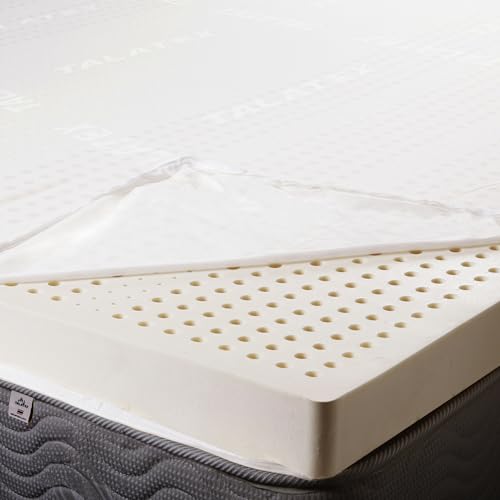
Two inches is the moderate-change thickness, and in a small bedroom moderation is the point. The Talatex is a Talalay-style latex topper — the softer, airier, springier way of making latex foam, whipped and flash-frozen before curing — positioned in the upper part of this budget tier — check the current price on Amazon. Its listing publishes its numbers, which is rare enough to deserve credit: a density of 70 kg/m³ and an ILD of 23 to 26 for the 2-inch build. On a small room’s tall bed — a 10- or 11-inch mattress on a storage frame, say — 2 added inches keep the sleep surface at a height you can still sit on to dress, keep a daybed’s back cushions proportionate, and keep standard deep-pocket sheets in the game more often than a 3- or 4-inch stack will. The feel is buoyant rather than enveloping: it takes the hard edge off a firm mattress and adds Talalay’s characteristic light pushback, without rebuilding the bed into something you sink out of.
The small-room clincher is what is in the box: an organic cotton cover, included. Every other premium pick in this guide either arrives bare or makes you glad you own a protector already; in a small bedroom, a cover you do not have to buy is also a cover you do not have to store, wash in rotation with a spare, or find room for. Latex also airs out faster and with less odor than new memory foam, which matters when the bedroom is also the living room and there is no spare space to exile a smelly slab to for three days. The honesty notes are the base guide’s, at full strength: check the current price on Amazon before counting on its position in this tier, as its positioning in this guide rests on roundup coverage rather than a direct listing capture — and latex is the wrong purchase for anyone with a latex allergy.
- Only 2 inches of added height — the gentlest claim on a small room’s vertical space.
- Published specs: 70 kg/m³ density, ILD 23–26; organic cotton cover included.
- Positioned in the upper part of this tier — check price on Amazon for the queen.
Honest limitation: Two inches moderates a mattress rather than transforming it, and check the current price on Amazon before you buy. If the current price has moved above $400, the Pure Green soft 3-inch below is the documented fallback in the same material family.
Choose it if your bed is already tall, your room has no storage to spare, and you want latex’s feel at minimum height. Skip it if you need a dramatic change in feel, have a latex allergy, or check price on Amazon shows it has moved above this budget.
Sleep On Latex Pure Green Natural Latex Mattress Topper, Medium, 3 Inch, Queen (80 x 60 x 3 Inch)
Who it suits: Small-room sleepers whose bed works a second job as the sofa — and who want the topper most likely to still feel like itself in five years of living on the bed full-time.
This is the base guide’s hero, demoted here on height alone and promoted on everything else. The Pure Green medium is a single 3-inch slab of natural Dunlop latex, GOLS certified organic, available on Amazon and fulfilled by the maker — check price on Amazon. The maker rates the medium build at about 4.7 lb/ft³ with a 34 lbf reading at 25% compression — a slab with enough depth and density to soften a hard bed without letting a heavier sleeper bottom out. For a small room, the decisive trait is the medium firmness: you can sit on this bed. Perch on the edge to tie shoes, sit up against the wall with a laptop, fold laundry on it — the surface yields under a sleeper and pushes back under a sitter, where the soft builds in this guide simply swallow anyone who sits down. If your bedroom is also your living room, that is not a detail; it is the difference between a topper and a lost sofa.
Durability is the second half of the case, and in a small room it is structural: this topper will never be stored, rotated out or rested — it lives on the bed permanently, taking sleeping, sitting and everything-else duty every day. Natural latex is the longest-lived topper material in the category, routinely outlasting memory foam by years, which is how its position in the upper part of this tier should be read. The maker’s own listing copy is unusually honest that latex is heat-neutral and cannot always make a bed cooler, and we have kept that honesty here. Two cautions belong in the open. This ASIN is the bare topper — no cover — and covered variants sit on separate ASINs, so budget for a protector and a place to keep its spare. And a 3-inch queen latex slab is heavy and floppy: getting it onto a bed that is pushed against a wall, in a room with no floor space to lay it out first, is a two-person job. Plan the install; do not improvise it.
- Genuine natural Dunlop latex, GOLS certified organic — a full 3 inches, positioned in the upper part of this tier.
- Medium firmness keeps the bed sittable — the small room’s second-job test.
- Check price on Amazon for the queen, fulfilled by the maker.
Honest limitation: It arrives bare, with no cover, adds a full 3 inches to your sleep height, and at roughly 34-plus pounds of floppy latex it is the hardest install in this guide in a tight room.
Choose it if you sit on your bed daily, dislike memory foam’s sink, and want the longest-lived layer here. Skip it if you have a latex allergy, your bed is already very tall, or you want plush contouring above all.
Sleep On Latex Pure Green Natural Latex Mattress Topper, Soft, 3 Inch, Queen (80 x 60 x 3 Inch)
Who it suits: Side sleepers and lighter bodies in small rooms whose bed is only a bed — no sitting, no working, just sleeping — and whose firm mattress needs a genuinely plush layer.
Same slab, different answer. The soft build of the Pure Green 3-inch — GOLS certified organic natural Dunlop latex, available on Amazon and fulfilled by the maker — check price on Amazon — gives a shoulder room to sink without memory foam’s slow, held feeling: the surface yields, then pushes back, so changing position at 3 a.m. is a roll rather than an excavation. For a side sleeper on a too-firm mattress, this is the most comfortable verified layer under $400, and it sits below its own medium sibling within this tier.
The small-room charge against it must be stated at full strength, because it is the mirror image of the medium build’s virtue: you cannot really sit on this bed. A soft 3-inch slab turns the mattress edge into a slope and the middle into a nest; perching to dress, sitting up to read, working from the bed — all of it happens in a hammock. In a studio or a small bedroom where the bed is the only seat, that is a genuine loss of function, and it is why this pick ranks below its firmer sibling here despite being the better pure sleeping surface for its sleeper. The remaining cautions mirror the hero’s: this ASIN is the bare topper with no cover included, at roughly 34 pounds in the queen it is a serious install against a wall, latex is wrong for anyone with a latex allergy, and soft latex on an already-soft mattress deepens the problem it was bought to solve — this pick assumes a firm, flat base bed.
- The soft build of the guide’s best material — 3 inches of GOLS organic Dunlop latex.
- Buoyant pressure relief for shoulders and hips, without memory foam’s held feeling.
- Check price on Amazon for the queen, fulfilled by the maker.
Honest limitation: Genuinely soft — the bed-as-sofa is gone, sitting happens in a hammock — and it is a bare, heavy slab with no cover, so the install and the protector are both on you.
Choose it if you sleep on your side, your mattress is firm and flat, and your bed never has to be a chair. Skip it if you sit or work on your bed, have a latex allergy, or your bed already feels too soft.
ViscoSoft Serene Hybrid Lux Pillow Top Mattress Topper, 3 Inch, Queen
Who it suits: Small-room sleepers who want a plush, conventional, hotel-style surface — and the one install in this guide that does not require reaching under the mattress.
Installation is a small-room problem nobody warns you about. Strap-down toppers need hands under all four corners of the mattress; in a room where the bed is wedged between walls, two of those corners are an expedition. The Serene Hybrid Lux mounts with an 18-inch deep fitted skirt instead — it goes on like a mattress pad, from the top, which in a tight room is the difference between a ten-minute job and a furniture rearrangement. The construction stacks gel-infused memory foam under a 1.5-inch down-alternative pillow top in a 300-thread-count cover; the ASIN was confirmed from a catalog record for this exact queen listing. Within this tier it sits toward the lower end — check the current price on Amazon — which in a small room can leave more of the budget for the storage furniture the room actually needs.
The trade-offs are the pillow top’s nature. A plush fiber surface is the worst sitting surface in this guide after the soft latex — fine for sleeping, saggy for perching — and a pillow top cannot be flipped or meaningfully spot-fixed once it packs down in the sleep zone, which on a permanently-installed small-room topper it eventually will. Read the paperwork the way this guide always reads it: ViscoSoft’s 90-day guarantee and 5-year warranty are the brand’s own terms, strongest on the brand’s own channel; an Amazon purchase runs under Amazon’s return window plus the warranty, so confirm both on the listing. And the gel layer’s cooling is the usual first-contact story — the breathable fiber face does more for perceived freshness than the infusion does.
- Two constructions in one: gel memory foam base plus a 1.5-inch down-alternative pillow top.
- 18-inch fitted skirt — installs from the top, no straps to fish under a wedged-in mattress.
- Positioned toward the lower end of this tier — check price on Amazon for the 3-inch queen.
Honest limitation: The pillow top is a poor sitting surface and the first part to pack down under permanent duty, and ViscoSoft’s lookalike model names (Serene, Serene Hybrid, Hybrid Lux, Rescue) make variant discipline essential — confirm the listing is the 3-inch queen pillow top.
Choose it if your bed is hard to get around, you want a plush conventional surface, and the budget matters. Skip it if you sit on the bed for hours daily, sleep very warm, or need the brand’s full trial terms — those live on the brand’s site, not Amazon.
Tempur-Pedic TEMPUR-Adapt + Cooling Mattress Topper, 3 Inch, Queen
Who it suits: Memory foam loyalists in small rooms who want the original material from the brand that invented the category — and who can give a new foam topper time and air to settle in a small space.
Every other foam in this guide is an interpretation of memory foam; this one is the source. The TEMPUR-Adapt + Cooling is 3 inches of TEMPUR material — the denser, slower, more exact contour that cheaper foams approximate — under a premium knit cover the maker describes as cool-to-the-touch and removable for washing. Its position in this guide depends on the current price: it is this guide’s clearest straddler. This pick belongs in an under-$400 guide only while check price on Amazon shows it within this budget; if the current price has moved above the budget, it has left the budget. Check the current price on Amazon before choosing it. What the premium buys is the most refined pressure contour in this guide and a genuinely washable cover — one less separate protector to store, which a small room notices.
The small-room charges are two. First, airing out: new memory foam has a smell, and in a small bedroom that is also your living space, 24 to 72 hours of airing is not an abstraction — it is your room smelling of foam while you live in it, with no spare room to exile the slab to. Latex picks above are noticeably easier in this respect. Second, sitting: memory foam’s slow sink is lovely under a sleeper and poor under a sitter — the edge gives way gradually and sitting up in bed means climbing out of your own impression. Neither charge is disqualifying; both are the kind of thing a small room feels more than a large one. And the standing cautions apply: Tempur-Pedic’s direct channel is restrictive with topper returns, so treat Amazon’s return window on the listing as the protection that governs, and read the cooling claim with discipline — the cover feels cool at first contact, which is a real comfort feature, and no passive cover holds a set temperature through the night.
- Genuine TEMPUR material — the reference contour every other foam here imitates.
- Removable, washable cool-touch knit cover included — no separate protector to store.
- Check the current price on Amazon for the queen — it belongs in this guide only while it stays within this budget.
Honest limitation: It is a straddler — if check price on Amazon shows it above this budget, this topper is over this guide’s budget — and new memory foam needs airing time that a one-room life feels keenly.
Choose it if check price on Amazon shows it at or under $400 and you want memory foam’s contour in its most refined form. Skip it if check price on Amazon shows it above this budget, you sit on the bed for long stretches, or you cannot tolerate a few days of new-foam smell in a small space.
ViscoSoft Active Cooling Copper Mattress Topper, 4 Inch, Queen
Who it suits: Small-room sleepers with a low bed and genuine height to spare, who want the densest, best-hardware foam build under the ceiling — and who have measured before falling for it.
The construction is the foam category showing its best work. The Active Cooling Copper — also sold by the maker under the name The Climate — stacks 2 inches of copper-infused memory foam over 2 inches of high-density structural foam, in a removable, washable woven cover made with phase-change yarns, held down by an anti-slip mesh and adjustable straps, with the longest foam warranty in this guide at 5 years. It sits at the top end of this budget tier — check the current price on Amazon for the queen. On a low platform bed or a futon frame, 4 inches of dense foam is a real transformation, and the dense base resists the packing-down that permanent small-room duty inflicts.
But in this guide it ranks last, and the reason is arithmetic, not quality: 4 inches is the largest height claim any pick makes on a small room. On a standard 11-inch mattress it takes the sleep surface to roughly 15 inches before bedding; on a tall storage bed it can push past comfortable sitting height altogether, strand a daybed’s proportions, and guarantee that only the deepest-pocket sheets in the drawer will stay on. The straps compound it — they are the best hardware here, and they need access under the mattress corners, which a bed wedged against a wall does not offer. The cooling discipline is the base guide’s: copper conducts and phase-change yarns absorb at first contact, both effects are real, both saturate, and by the middle of the night this is a well-built memory foam bed, not a refrigerated one. Buy it for density and hardware, in a room whose measurements allow it — not for its name.
- The most engineered foam here: copper comfort layer over a high-density base, phase-change cover.
- Removable washable cover, anti-slip mesh and straps; 5-year warranty.
- Positioned at the top end of this tier — check price on Amazon for the queen.
Honest limitation: Four inches is a lot of height — on an already tall bed it overshoots sitting height and standard sheets — and its straps need the under-mattress access a wedged-in bed may not give. The cooling saturates; this is premium foam, not temperature control.
Choose it if your bed is low, your sheets are deep, and you want the densest foam build here. Skip it if your bed is already tall, sits in a loft or daybed with clearance limits, or you expect a set temperature all night — that type of product sits well above this budget.
Comparison Table
| Pick | Material | Thickness | Price | Small-bedroom note | Link |
|---|---|---|---|---|---|
| Talatex Latex Topper | Talalay-style latex | 2 in | Check price on Amazon | Least height added; cover included — nothing extra to store | Check on Amazon |
| Sleep On Latex Pure Green, Medium | Natural Dunlop latex, GOLS organic | 3 in | Check price on Amazon | Best sitting support; lives on the bed permanently; bare slab | Check on Amazon |
| Sleep On Latex Pure Green, Soft | Natural Dunlop latex, GOLS organic | 3 in | Check price on Amazon | Best pure sleeping surface for side sleepers; worst for sitting | Check on Amazon |
| ViscoSoft Serene Hybrid Lux | Gel foam + down-alt pillow top | 3 in | Check price on Amazon | Fitted skirt installs from the top; pillow top packs down first | Check on Amazon |
| Tempur-Pedic TEMPUR-Adapt + Cooling | TEMPUR memory foam | 3 in | Check price on Amazon | Washable cover included; needs airing space and time | Check on Amazon |
| ViscoSoft Active Cooling Copper | Copper foam + high-density base | 4 in | Check price on Amazon | Most height added; straps need under-mattress access | Check on Amazon |
How to Choose a Mattress Topper for a Small Bedroom Under $400
Measure your total sleep height before anything else. Add frame height, mattress thickness and the topper, then sit on the result in your mind: feet flat on the floor, knees near a right angle. In a small room the bed is sat on constantly — to dress, to work, to fold laundry — and every topper inch raises that seat. A 4-inch topper on an 11-inch mattress on a storage frame is a climb, not a bed. If you sleep in a loft or on a daybed or trundle, treat the topper’s thickness as a clearance measurement, not a preference: the space above the bed and the mechanism below it are fixed, and the topper has to fit inside them.
Decide where the topper lives — the honest answer is “on the bed.” A queen latex slab weighs around 34 pounds and flops; a 4-inch foam stack is a bulky roll that no small closet swallows. None of the six picks here is a sometimes-topping you swap on for guests and store between visits. That permanence should drive the choice: pick for durability and for a surface you are happy to look at and sit on daily, and if a guest-only layer is what you actually need, a thinner, cheaper topper from a lower tier is the honest purchase.
Take the bed’s second job seriously. If the bed is your sofa, desk and dining chair, firmness is a furniture spec: medium latex keeps a sittable edge, pillow tops and soft builds do not. If the bed is only ever slept in, that constraint disappears and the soft picks come back into play. Name which room you actually live in before ranking feel.
Match the mounting to your access. Straps and anti-slip systems need hands under the mattress corners. If your bed is pushed into a corner or against two walls, a fitted-skirt design that installs from the top — the Serene Hybrid Lux here — saves a furniture-moving afternoon. If the bed floats in the middle of the room, straps are fine and hold better.
Name the problem first — a topper is still a surface fix. It softens a sound but firm mattress and evens out pressure at shoulders and hips. It cannot rebuild a sagging core: soft material over a dip makes a softer dip, in a small room exactly as in a large one. If the middle of your bed sits visibly lower than the edges, the money belongs toward the mattress.
Check the size on the selector, not the headline. Every pick in this guide is the queen, in the thickness named. These same listings sell twin and full sizes that may suit your room better: open the listing, choose your size, and check the current price on Amazon there. King sizes and thicker variants of several picks may sit above this $400 budget.
Do the sheet maths. Add the topper’s full thickness to your mattress and compare with your fitted sheets’ pocket depth. Three inches is the point where standard pockets start popping corners; four inches makes deep-pocket sheets mandatory. In a small room with one set of sheets in rotation, that is a real cost — count it in the budget.
Plan the airing before the box arrives. New foam off-gasses for 24 to 72 hours. In a small space, unbox near the open window, let the topper expand where it will live if you can, and expect the first nights to carry a smell — latex lightest, dense memory foam strongest. If you are sensitive to smells and your room is your whole home, that is a genuine point for the latex picks.
Read the trial terms where you actually buy. The long home trials in this category are generally brand-site offers. An Amazon purchase is covered by Amazon’s return window and the warranty on the listing — the Tempur-Pedic pick is the standing example, since the brand’s own topper return policy is restrictive. Confirm both before ordering, especially at this price and in a room where a return means manhandling a slab back into a box.
Respect the allergy lines. Half of this guide is latex and is wrong for latex allergies; no certification logo changes that. Foam off-gassing, by contrast, is a temporary nuisance handled by the airing plan above.
Total Sleep Height: The Measurement Small Bedrooms Run Out Of
Floor space gets all the attention in small-room advice, but the measurement a topper actually spends is vertical. A small bedroom’s bed typically starts higher than a large room’s, not lower: storage frames, drawers-under platforms and daybeds all trade height for the storage the room lacks, and 10- to 12-inch mattresses are now the default. Add a topper and the stack climbs fast. An 11-inch mattress on a 14-inch storage frame is already a 25-inch seat; a 3-inch topper makes it 28 — bar-stool territory, where feet dangle and getting in is a small climb — and the 4-inch pick makes it 29. The same topper on a low 6-inch platform is a gentle 21 to 22 inches and entirely comfortable. The topper did not change; the stack did. This is why this guide ranks by inches as much as by material, and why the 2-inch Talatex leads it: at this tier it is the only premium material that asks for almost no vertical budget.
Height also has hard limits that preference cannot negotiate. A daybed’s topper must leave the back cushions standing at a usable height or the sofa illusion collapses; a trundle’s mattress-plus-topper must clear the frame it slides under, a fixed mechanical gap; a loft bed’s sleeper must keep a safe distance from the ceiling and the guardrail must still rise above the sleep surface — every topper inch comes directly off that rail margin. Under-bed storage drawers do not care about height, but the fitted sheet does: total mattress-plus-topper depth is the number your sheet pockets must beat, and in a small room there is usually exactly one set of sheets to get it wrong with. Measure the stack you have, decide the stack you can live with, and let the difference choose your thickness — 2 inches if the bed is tall, 3 if it is average, 4 only if it is genuinely low.
Where Does a Topper Live? Storage, Seating and the Bed That Does Two Jobs
Every topper listing is photographed on a bed, but every topper also has a second life off it — rolled in a closet, stood in a corner, swapped for guests. In a small bedroom, that second life mostly does not exist, and it is better to admit it at the buying stage than at the unboxing stage. A queen latex slab is around 34 pounds of floppy rubber that does not roll small and should not be folded; a 4-inch dual-layer foam can be rolled with straps and determination into a cylinder that still wants a closet of its own. If your room has no such closet, the topper’s home is the bed, permanently — which quietly rewrites the buying criteria. Durability stops being a nice-to-have and becomes the whole value case, because the layer will take sleeping, sitting, working and laundry-folding duty without a rest day. A finished surface matters, because you will look at it all day. And a cover matters, because the thing cannot be taken off and shaken out over a balcony rail it may not have.
The seating half of the bargain deserves its own honesty. A bed in a small room is sat on more hours than many sofas, and toppers divide sharply on whether they allow it. Buoyant medium latex pushes back and holds an edge; slow memory foam lets a sitter sink and then holds the impression, so sitting up to read means perching in a crater of your own making; a pillow top feels plush for ten minutes and compressed for the tenth hour; a soft slab turns the whole surface into a nest that is wonderful horizontally and useless vertically. None of this makes the soft picks bad — it makes them single-purpose. The small-room mistake is buying a single-purpose topper for a double-purpose bed, and discovering the room has lost its chair.
Airing Out a New Topper in a Small Space
Compressed bedding arrives with two temporary problems — it needs hours to expand to full thickness, and new foam carries a manufacturing smell that fades over one to three days. In a large home the standard advice is trivial: unbox it in the spare room and close the door. A small bedroom has no spare room and no door to close, so the airing has to be planned like everything else. Unbox beside the open window, not across the room from it. Let the topper expand on the bed if you can sleep elsewhere the first night, or on the floor space you have cleared — and clear it before the box arrives, because a half-expanded queen slab in a small room is an obstacle course. Run whatever ventilation the room has; a fan in the window does more in an afternoon than a week of closed-door waiting. Judge the feel only after full expansion, which for the dense foams here can take the better part of two days.
The materials are not equal in this, and at this tier the difference is worth money. Natural latex has a mild rubber scent that most people stop noticing within a day and that never has the chemical edge of new memory foam; it is the easiest airing in this guide. The pillow-top hybrid airs through its fiber face relatively quickly. Dense memory foam — the Tempur-Pedic and the copper ViscoSoft — is the strongest and slowest, and in a one-room home that means sleeping in the smell for the first nights or sleeping somewhere else. None of this is a safety question; it is a comfort and logistics question, and it is one more reason the small-room ranking above is not the base guide’s ranking. If your room is your whole living space and your nose is sensitive, the latex picks are not just a feel preference — they are the practical choice.
Common Buying Mistakes
Buying thickness without measuring the stack. The most common small-room topper regret is a 4-inch layer on an already tall storage bed: a climb to get in, dangling feet to sit, and sheets that will not stay on. Measure frame plus mattress first; the topper’s inches are the last ones added and the first ones felt.
Expecting to store it between uses. A queen latex slab or 4-inch foam stack does not roll into a small closet. If the plan was “on for guests, away after,” this tier is the wrong purchase — buy a thinner, cheaper layer you can actually store, or accept a permanent install and choose for durability.
Softening the room’s only seat. A soft topper on the bed that serves as sofa, desk and dining chair removes the chair. If the bed works two jobs, firmness is a furniture decision — medium and buoyant beats plush and sinking.
Choosing straps you cannot install. Corner straps need access under the mattress. A bed wedged against walls makes two corners a wrestling match; in that room, a fitted-skirt topper that installs from the top is the honest choice.
Believing another size’s price. Every pick in this guide is the queen in the named thickness. Twin and full sizes exist on these listings; check the current price on Amazon for your size on the listing itself, and never assume it scales neatly from the queen.
Forgetting the sheets. Three inches of topper defeats standard sheet pockets; four defeats most deep ones. In a small room with one set in rotation, a topper that orphans your sheets has a hidden second price.
Expecting a topper to fix a sag. It will not, at $400 or any price. Soft material over a dip makes a softer dip. Diagnose the mattress and its foundation first — especially in a small room, where the topper money may be the mattress money.
Believing infusion claims at face value. Copper, gel and phase-change yarns are real but modest first-contact effects that saturate; none holds a set temperature, and none is circulation therapy. Buy the construction and the fit for your room; let infusions be a tiebreaker.
Judging the topper in its first hour. Compressed foam needs a day or two to expand and air. In a small room that is an annoying wait — and the alternative, returning a topper that had not finished opening, is worse.
Final Recommendation
For most small bedrooms, buy the Talatex Latex Topper in the 2-inch queen. It is the only pick that upgrades the material without spending the room’s scarcest resource: 2 inches of height instead of 3 or 4, a cover in the box instead of a protector to store, and latex’s quick, mild airing instead of days of foam smell in the room you live in. If your bed is also your sofa and you sit on it for hours daily, take the Sleep On Latex Pure Green in the 3-inch medium instead — the firmer slab is the one that keeps the bed’s second job, and it will outlast everything else here. Side sleepers whose bed is only a bed should take that same latex in soft. Choose the Serene Hybrid Lux when the bed is wedged in and only a fitted skirt will install, the Tempur-Pedic when check price on Amazon shows it within this budget and memory foam’s contour is the feel you know you want, and the Active Cooling Copper only when your bed is low enough to donate 4 inches. And if what you actually want is wool, true down or a set temperature, this guide’s honest answer stands: $400 on Amazon is not where those live. Whichever pick you choose, measure your total sleep height first, confirm the size and check the current price on Amazon, and give the topper its airing days before you judge it.
Frequently Asked Questions
How thick a topper can a small bedroom handle?
Work backwards from the total stack. Measure your frame height plus mattress thickness, then add the topper: a finished sleep surface around 21 to 25 inches suits most people for both sleeping and sitting. If your bed already totals 23 inches or more, the 2-inch pick is the honest ceiling; if it totals 18 or less, a 3- or even 4-inch topper fits the room. On daybeds, trundles and lofts, the furniture’s own clearances overrule the comfort maths — measure those gaps directly.
Can I store one of these toppers when guests leave?
Realistically, no — and this guide is ranked on that admission. A queen latex slab weighs around 34 pounds, flops rather than rolls, and should not be folded; a 4-inch foam stack rolls into a cylinder that still needs its own closet. In a small bedroom these are permanent installs. If you need a layer that genuinely stores away, shop the thinner, cheaper tiers and accept the simpler materials that come with them.
Will a topper ruin my bed as a place to sit?
It depends on the build, which is why this guide tests it. Medium latex stays sittable — it yields under a sleeper and pushes back under a sitter. Soft latex, pillow tops and slow memory foam all trade sitting away in different degrees: nests, sag and craters respectively. If your bed is your sofa, rank firmness as a furniture spec and start with the medium latex.
Why does this guide focus on queen when my small room needs a twin or full?
Because queen is the size our research verified for these picks. The same listings sell the smaller sizes; open the listing, select your size and thickness, and check the current price on Amazon there. Do not assume it scales down neatly from the queen: at this tier, smaller sizes are not always priced proportionally lower.
How do I air out a new topper when the bedroom is my whole home?
Unbox by the open window, let it expand on the bed or on cleared floor space, and run a fan if you have one. Latex airs fastest and mildest — usually a day; dense memory foam is the slowest, at two to three days. The smell is a temporary nuisance, not a defect, and judging the feel before full expansion misleads in both directions.
Will a $400 topper fix a sagging mattress?
No. A topper changes the surface, not the support, and soft material laid over a dip settles into the dip — at this budget exactly as at any other. If the middle of your bed sits visibly lower than the edges, the money belongs toward a mattress or a foundation repair. If the mattress is level but feels too hard, that is precisely the problem a topper solves, and this tier solves it best.
Can I buy a wool or down topper under $400 on Amazon?
Not reliably. Wool toppers exist inside this budget when bought direct — Sleep & Beyond’s queens are positioned inside this tier direct, and the Wow Futon organic merino queen is also positioned inside this budget — but that Amazon listing repeatedly showed no featured offer. The closest down product, the ELEMUSE down-and-feather queen, is also positioned inside this budget, but its queen ASIN could not be confirmed, so it is named here without a link as the first swap-in. Buy wool direct from a wool merchant, where the offers are real.
Will a topper help with back pain or night sweats?
A topper is a comfort product, not a treatment, and nothing in this guide is recommended for any condition. A softer or firmer surface may feel better or worse to any individual sleeper, and listings that promise pain relief are making claims this guide does not repeat. Persistent pain, numbness or weakness, or night sweats with no obvious cause, deserve a clinician’s attention rather than a bedding purchase.
Related guides: