Disclosure: As an Amazon Associate, topratedkitchenware.com earns from qualifying purchases. Links on this page are affiliate links; they cost you nothing extra. Prices and availability change often, so check the current Amazon listing before you buy.
Learning how to choose a countertop oven is mostly a matter of order: the buyers who end up happy decide things in the right sequence, and the buyers who return ovens decide them backwards — model first, kitchen later. This guide on how to choose a countertop oven gives you the sequence. The short answer is that five decisions decide everything: the size band your meals and pans demand, the type of oven your cooking needs, the control style your household will enjoy, the counter-and-clearance reality of your kitchen, and the cleaning design your habits can live with. Get those five right, in that order, and the model almost chooses itself from a short list of good ones. Get them wrong — particularly the counter measurement, which is the one decision that cannot be revised after delivery — and even the finest oven in the category becomes an expensive lesson. What follows is the background you need before comparing anything, the seven steps in full, the reference models worth choosing between, the mistakes that fill return queues, and three worked examples of real households running the method.
Key Takeaways
- Choose in order: meals and pans, then size, then type, then controls, then counter and clearance, then cleaning.
- Measure your largest everyday pan and your counter — with the manufacturer’s ventilation clearance included — before looking at a single model.
- Convection is the default for anyone who cooks; air fry is the default for anyone who crisps weekly.
- The right size is the smallest band that fits your regular cooking — bigger is not safer.
- Controls are temperament: dials for simplicity and many hands, digital for repeatability, presets for guided cooking.
- Every model in the category demands the same safety terms: heat-resistant surface, clear clearance, distance from flammables, emptied crumb tray.
What You Need to Know Before Comparing
Start with what a countertop oven actually is, because the name hides a spectrum. At one end sits the basic toaster oven: radiant elements, simple dials, toast and reheats for one or two people. At the other sits the premium smart oven: fan convection with intelligent element control, family capacity, and functions spanning air fry, dehydrate and proofing. Between them lie the convection countertop oven — the category’s centre — and the air fryer oven, its most popular modern form. These are not better and worse versions of one appliance so much as different appliances sharing a silhouette, which is why comparing models across the spectrum by feature lists produces nonsense: the right question is never which oven has most, but which kind of oven your household is shopping for.
Second, understand the three honest currencies of the category, because every choice spends them. The first is counter space, and it is spent permanently: the oven plus its required clearance, gone from your workspace for years. The second is capacity, which is really a statement about your meals — the trays, casseroles and pizzas of your actual week. The third is attention: every countertop oven asks for a little — crumb trays, wipe-downs, watched broiling — and models differ mainly in how gracefully they ask. Money, notably, is not on this list as a primary currency, because within a sensible tier the price differences buy refinement rather than different outcomes; the tiers are described in words throughout this guide for exactly that reason, and you should check the current Amazon listing for the figure that applies when you buy.
Third, know the category’s non-negotiables, because they constrain every step that follows. A countertop oven is a powerful heater in a small box. It needs a flat, heat-resistant surface. It needs the ventilation clearance its manufacturer specifies — at the sides, at the back, and most of all above — kept clear for its whole working life. It needs distance from anything flammable: no curtains, paper, towels, wooden utensils or packaging within reach of its shell and vents, and nothing stored on top of it, ever. And it needs its crumb tray emptied and its interior wiped on a rhythm, because accumulated crumbs and grease near hot elements are the category’s one real hazard. A kitchen that can offer those terms can host any oven in this guide; a kitchen that cannot should solve that problem first, because no model exempts its owner from the physics. The category context, if you want it before the method, is in the countertop oven review and the criteria are expanded in the countertop oven buying guide.
Finally, before comparing, settle your relationship with the full oven you already own. A countertop oven can be three different purchases wearing one name: a replacement, for small households whose range is old, absent or barely used; a deputy, for households whose range is fine but oversized for daily work; or an addition of capability, for households buying air frying or a second simultaneous oven. Each relationship implies a different right answer — the replacement must cover the household’s whole repertoire, the deputy can specialise in the everyday, and the capability purchase should be judged almost entirely on the new function. Naming which purchase you are making, out loud, before Step 1, prevents the most philosophical of the category’s mistakes: judging a deputy by a replacement’s standards, or paying a replacement’s price for a deputy’s work.
In this guide
How to Choose a Countertop Oven in 7 Steps
Step 1: Audit Your Actual Cooking
Before any product enters the conversation, write down what the oven will actually do. List the oven jobs of an ordinary fortnight: the trays, casseroles, pizzas, reheats, bakes and toasts, with rough quantities and how many mouths each feeds. Be honest about the difference between your cooking life and your cooking aspirations — the sourdough you will definitely start making this year has launched a thousand wrong purchases. This audit produces the two numbers that drive everything: your typical load, which sets the size band, and your function profile, which sets the type. Households that skip this step choose by showroom impressions and discover their real requirements across the first month of ownership, when the discovery is expensive. Households that do it find the remaining steps almost mechanical. Keep the list; you will test candidate ovens against it at the end.
Two refinements make the audit sharper. First, mark each job with who cooks it, because a meal cooked by a teenager and a meal cooked by the household’s baker place different demands on controls and capacity. Second, note the jobs you currently avoid because your present equipment makes them tedious — reheating in a microwave you hate, roasting in an oven that takes forever to preheat — because a countertop oven often earns its place precisely on the avoided list, and those jobs belong in the audit with an asterisk. An audit that captures both the cooking you do and the cooking you would do is the only honest foundation for the money you are about to spend.
Step 2: Measure Your Pans, Then Choose a Size Band
Take the largest vessel from your audit — the casserole, the tray, the pizza your household actually buys — and measure it, handles included. Your oven’s chamber must accept that vessel with air space on all sides: food pressed against a wall or an element cooks unevenly and can scorch, and a pan that barely fits will be wrestled, hot, at every use. Then place yourself in a band. Compact ovens serve one or two people and simple jobs, heat fastest and claim least counter. Mid-size ovens serve most couples and families and are the default band this method recommends unless your audit says otherwise. Large and wide-format ovens serve big families, batch cooks and entertainers, and should be chosen only when the audit shows weekly work at that volume. The discipline of this step is resisting the size-up instinct: an oversized chamber heats slower for small jobs, dominates the counter and spends your space currency on capacity you use twice a year, while the full oven still exists for those two occasions.
If your household straddles two bands — small daily cooking, one genuinely large weekly meal — the method’s ruling is to size for the daily cooking and let the weekly meal use the full oven, or split across both. The alternative, sizing for the peak, taxes every ordinary day for the sake of one, and the tax is paid in counter space, preheat time and the low-level irritation of an appliance that always feels too big for the job in front of it. The exception is the household with no full oven at all — the flat, the studio, the holiday home — where the countertop oven must cover the peak as well as the ordinary, and sizing up is not indulgence but necessity.
Step 3: Pick the Type — Basic, Convection, Air Fryer Oven or Smart
Now match type to your function profile. If the audit is toast, reheats and small portions for one or two, the basic toaster oven is not a compromise but the correct tool, and the wider field is compared in the best toaster ovens roundup. If the audit includes regular roasting and baking, convection is your baseline — the fan’s even heat is the difference between an oven that browns and a box that heats, and the type is surveyed in our guide to the best convection ovens. If crisp food is a weekly event — wings, chips, breaded things, roast vegetables with edges — the air fryer oven is the modern default, with the honest caveat that a basket fryer still crisps small batches a touch harder; the crossover models are in the best air fryer toaster oven combos. If you cook daily, bake seriously and will feel refinements in evenness, steadiness and finish, the smart and premium tier earns its place, as our best smart ovens guide shows. Choosing the type before the model is the single most protective habit in this method, because it shrinks the field from dozens of boxes to a handful of genuine candidates.
Expect the types to blur at the edges, because manufacturers blur them deliberately: convection models with an air fry button, toaster ovens with a fan, smart features on mid-tier boxes. When a model straddles types, classify it by its weakest relevant claim rather than its strongest marketing one. An oven whose air fry mode is an afterthought should be judged as a convection oven with a bonus, and bought only if it wins on that basis; an oven whose fan is feeble should not inherit the convection type’s reputation. The audit protects you here too — test the straddler against the specific jobs that made you choose the type, and let those jobs, not the badge on the box, decide.
Step 4: Choose Controls Your Household Will Enjoy
Controls are a daily relationship, so choose by temperament rather than by novelty. Dials suit households that value immediacy — many cooks, gloved or floury hands, guests who must not need instruction — and their approximation is a fair price for that simplicity, repaid by a short calibration period in the first week. Digital controls suit cooks who value repeatability: exact temperatures, countdowns, preheat signals and results that can be reproduced on Friday exactly as they happened on Tuesday, which bakers in particular should weight heavily. Guided preset systems suit less confident cooks and households happy to let the machine propose — choose a function, accept a sensible default, adjust the time — and they genuinely widen who in the house can cook well. Whichever style you favour, test three details on any candidate: whether the timer adjusts mid-cook without cancelling, whether markings or display read clearly in ordinary kitchen light, and whether the door and racks move with the solidity you want to feel several times a day for years.
One more control consideration is easy to miss in the shop and impossible to miss at home: how the oven behaves at the end of a cook and in the moments around it. A clear, audible-but-not-startling signal; a light that lets you judge browning without opening the door and dumping heat; a door that stays where you put it while both hands hold a tray; a cancel that actually cancels without a menu expedition. None of these appear on feature lists, and all of them are felt daily. If you can, handle the floor model. If you cannot, weight reviews that describe living with the machine over reviews that merely unbox it — the difference between those two kinds of review is exactly the difference between a specification and an appliance.
Step 5: Measure the Counter — With Clearance — and Audit the Surroundings
This is the step that decides returns, so do it with a tape and no optimism. Measure the counter run you intend to use, then subtract the oven’s footprint plus the ventilation clearance its manufacturer specifies at the sides, behind and above. What remains must still leave you a working kitchen. Check the surface: flat, stable, heat-resistant — stone, tile or metal ideally, with delicate laminates and wooden boards given a heat-proof base or a different plan. Check above: under-cabinet homes need the specified gap to the cabinet underside, because rising heat and steam damage finishes and adhesives over time. Check around: the clearance zone must be defensible against the ordinary drift of kitchen life — the paper towel holder, the cookbook, the utensil crock — because anything flammable settling beside a hot oven is the category’s classic accident. Check the socket: reachable directly, without the cord crossing the hot shell or trailing across a walkway, and not shared through a flimsy strip with other hungry appliances. If the audit fails, the correct move is a smaller band or a different position — never a hope that the manual exaggerates. It does not.
Do this step for the kitchen as it will be, not as it is in a tidied photograph. Counters accumulate: the fruit bowl migrates, the post lands by the kettle, a chopping board takes up residence. The oven’s clearance zone has to survive that ordinary entropy, which means choosing a position with natural boundaries — the end of a run, a corner by a wall — rather than a position that depends on everyone’s permanent vigilance. Also plan the landing zone: trays come out of this oven hot and need somewhere heat-safe to land within a step, every time, including when the sink is full and the board is busy. A position that passes the clearance test but fails the landing test will teach you the difference with a scorched worktop or worse.
Step 6: Judge Cleaning Design Like It Matters — Because It Will
By month three, cleaning design will influence your satisfaction more than any function on the box, so judge it now with fresh eyes. Look for a crumb tray that slides out from the front and covers the chamber’s fall zone; an interior finish that wipes clean rather than demanding scouring; racks and trays that fit your sink; door glass you can reach and corners you can get a cloth into. Ask how splatter-prone your audit’s cooking is — fatty roasts and air frying decorate an interior faster than toast and bakes — and weight easy-clean design accordingly. Then make the honest personal check: the routine itself (tray emptied weekly, interior wiped when cool after fatty cooks, racks washed before residue hardens) is small but eternal, and the full method is laid out in how to clean a countertop oven. If your household will not keep it, choose the most forgiving interior your tier offers and the size band you will actually enjoy maintaining — a neglected oven smokes, smells and eventually becomes a hazard, which makes this step a safety decision wearing a housekeeping hat.
Judge the exterior in this step too, because it is cleaned by the same household. Brushed finishes hide fingerprints better than mirror ones; smooth tops gather less dust than textured ones, though nothing may ever be stored on the top regardless of finish; control panels that wipe flat forgive splashes that dial clusters trap. And consider the crumb tray’s honesty test: on some models the tray is a token gesture narrower than the chamber, shedding crumbs into the mechanism at every removal. A tray that slides smoothly, covers the floor and empties without tilting debris across the counter is worth real money over the life of the oven — a sentence that sounds absurd in a showroom and obvious in a kitchen.
Step 7: Shortlist Two or Three Models and Test Them Against Your Audit
Only now — kitchen audited, pans measured, type chosen, controls preferred, counter verified, cleaning judged — should specific models enter. Shortlist two or three that satisfy every prior step, then run each against your Step 1 list, job by job: the Tuesday tray, the weekend bake, the reheats, the pizza. The model that handles your actual list with the fewest apologies is your oven, and ties are broken by the things you will touch daily — door feel, control clarity, interior finish. Resist the final-step upsell, in which a feature your audit never mentioned argues for a larger, richer model; the audit is the boss of this process precisely because showrooms and listings are designed to overrule it. The model-level judgements behind the shortlist in the next section are detailed in countertop oven reviews.
When the shortlist is genuinely tied — and between good models it often is — decide by ownership rather than by cooking, because the cooking will be fine either way. Which model’s trays and racks can you replace in three years? Which interior will you mind wiping least? Which control layout will the whole household, including its least technical member, run without a tutorial? Which brand’s support will still exist when a knob tires? These are unglamorous questions, and they are exactly the ones that separate the oven you are pleased with in year three from the oven you were pleased with in week one. Choose on them without embarrassment; you are buying an appliance, not a demonstration.
Where Budget Fits in This Method
Notice that money has not appeared as a step, and that is deliberate rather than evasive. Budget in this category works best as a boundary, set before Step 1, rather than as a criterion competing with the others — because the moment price leads, it distorts every judgement after it, pulling buyers toward discounted wrong sizes and discounted wrong types. Set the boundary by tier, in words: decide whether you are shopping at the entry, value, mid or premium level, based on how often the audit says the oven will work. Daily use collects refinements daily and justifies the higher tiers quickly; weekly use argues for the honest middle; occasional use argues for simplicity and a small footprint. Then run the seven steps inside that boundary and refuse to let a promotion drag you across it in either direction — a premium oven on sale is still the wrong purchase for a toast-and-reheats audit, and a value oven is still the wrong purchase for a household that bakes daily and will feel its compromises for years.
Within the boundary, spend in the order the method reveals: chamber and type first, because they decide what the oven is; controls second, because they decide how it feels; cleaning design third, because it decides how it ages; and functions last, because the audit — not the brochure — knows which ones you need. That spending order, followed inside an honest tier boundary, is the whole of sensible appliance economics for this category, and it protects you from the two classic financial errors: overspending on capability you will not use, and underspending on the qualities you will use every single day.
Gear for This Guide: The Reference Shortlist
Four models cover the decision points this method produces most often, spanning the premium, family, mainstream and small-space outcomes. Each is treated in prose and positioned by tier; check the current Amazon listing when you buy.
Breville Smart Oven Air Fryer Pro
The method’s premium outcome: choose it when your audit shows daily cooking and real baking, your counter passes Step 5 with room to spare, and your tier decision values evenness and finish. Its smart element control delivers the class’s most even results and its interior is the easiest to keep, which softens Step 6. Best for: keen cooks and bakers. Not suited for: tight counters or simple audits.
Households arrive at this pick through the method when two findings coincide: a baking-heavy audit and a counter audit with genuine room. If either finding is missing — the baking is aspirational, or the clearance is marginal — the method will route you elsewhere, and you should let it. This model’s virtues are real but they are virtues for a specific kitchen, which is the entire philosophy of choosing in order.

Ninja Foodi XL Prestige Countertop Oven
The family outcome: choose it when the audit is dominated by tray meals for several mouths against a clock, and your counter run — measured honestly in Step 5 — accepts its width plus clearance. Speed, capacity and presets are its argument. Best for: families. Not suited for: short counters, solo cooks, precision bakers.
The method reaches this pick through a single dominant audit finding — volume at speed — and it is worth noticing how rarely that finding survives Step 1 honesty in smaller households. If your trays feed two or three rather than five or six, the mid band will serve the same meals with counter to spare, and the method will say so. Trust its arithmetic over the appeal of the big tray.

Cuisinart TOA-65
The mainstream outcome, and the one this method reaches most often: mid band, convection and air fry, digital repeatability, family capacity in a moderate footprint. Choose it when your audit is varied and no single criterion dominates. Best for: couples and small families. Not suited for: the largest households or buyers wanting premium finish.
There is no shame in the method’s most common answer — quite the opposite. A varied audit with no dominant criterion is the statistical centre of how households cook, and this pick exists precisely for it. Buyers who feel they should want something more specialised should re-read their own Step 1 list before upgrading their ambitions; the list, not the showroom, is the authority the method recognises.
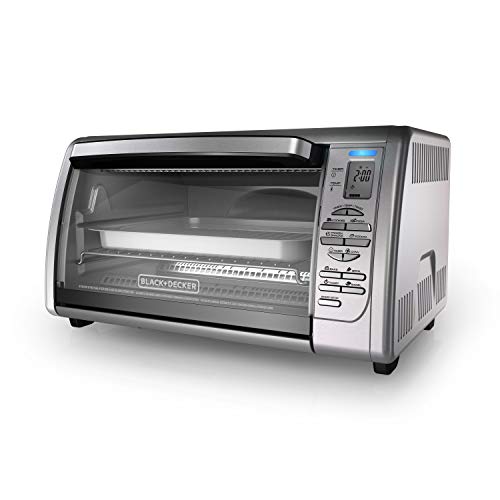
BLACK+DECKER Toaster Oven
The small-space outcome: choose it when the audit is honestly toast, reheats and portions for one or two, and Step 5’s tape measure rules out everything larger. It keeps the format’s core convenience at the smallest footprint and the simplest controls here. Best for: singles, studios, dorms. Not suited for: family cooking. Households torn between this and a basket fryer should also read the best air fryers that toast before deciding.
Arriving here through the method is a success, not a fallback: it means the audit and the tape measure agreed, and the household keeps its counter, its simplicity and its money for things it values more. The only failure mode at this pick is dishonesty at Step 1 — a family audit squeezed into a compact conclusion — and the method’s worked examples below show how visibly that failure announces itself.
Common Mistakes
The return queues of this category are filled by a short, repeating list of errors, every one of which the steps above exist to prevent. Choosing the model before the kitchen — falling for a box, then discovering the counter, the cabinet or the socket disagrees. Measuring the oven instead of the oven plus clearance, the single most common failure in the category. Buying capacity by headline claims rather than by your own pans, and ending with a chamber your casserole does not fit or a giant that heats two slices of toast. Paying for a function list your audit never mentioned while skimping on the evenness and controls you will use daily. Assuming air fry on the box equals a basket fryer in the hand, or the reverse — dismissing the oven format’s tray capacity without cooking a family batch in one. Ignoring cleaning design entirely, then meeting the crumb tray as an enemy in month two. And placing the oven where it fits visually rather than where it breathes safely, with clutter drifting into the hot zone over the following months. Each mistake is understandable; each is also entirely avoidable in an afternoon with a tape measure and an honest list.
Read the list once more and notice its shape: not one of these mistakes is about cooking. Nobody returns a countertop oven because the concept failed; they return it because a measurement, an audit or an honest conversation was skipped in favour of a product page. That is genuinely good news, because it means the outcome is almost entirely within the buyer’s control. The category itself is mature and its good models are honestly good; the variable is the choosing, and the choosing is what you have just been given, step by step.
Pro Tips
A few refinements from experienced owners, offered once the steps are done. Run the Sunday test before buying: walk your biggest ordinary weekly meal through the candidate’s chamber in your head, dish by dish, and let any awkwardness speak. If you bake, weight temperature steadiness over function count, and consider an inexpensive oven thermometer as a first accessory — knowing your own machine’s personality ends most baking mysteries in this category. If several people will cook, let the least technical of them try the controls in the shop; the interface that person can run unaided is the interface your household actually has. Buy the tray-and-rack ecosystem, not just the oven: established models with replaceable accessories age better than sealed bargains. And when the oven arrives, spend its first week cooking familiar food only — dishes whose correct result you know by heart — because calibration against the known is how an owner and an oven reach an understanding that lasts for years.
Two smaller tips deserve their own sentences because they save outsized grief. Photograph the counter position you measured, with the tape in frame, and keep it until the oven is installed; memory edits measurements in the direction of desire, and the photograph does not. And keep the packaging until the oven has cooked a full week of your audit’s jobs — not because the method expects failure, but because the one household in twenty whose kitchen surprises them will be very glad the box survived. Prudence after a good decision is not doubt; it is how good decisions stay cheap when the world disagrees.
How Long Should Choosing Take?
Longer than an impulse and shorter than a research project: an afternoon, honestly spent. The audit takes twenty minutes with a notebook. The measuring — pans, counter, cabinet gap, socket — takes fifteen with a tape. The type and controls decisions take as long as a household conversation, and the shortlisting is an hour’s reading at most, because the prior steps have already eliminated nearly everything. Buyers who spend weeks comparing models are usually not being thorough; they are compensating for steps they skipped, re-litigating size and type at the level of individual products where those questions cannot be settled. The method’s promise is that order creates speed: decide the questions in the sequence where they are cheap to decide, and the expensive-looking final choice becomes the easiest step of the seven.
There is one legitimate reason to pause mid-method, and it is worth naming: if Step 5’s audit reveals that no position in your kitchen passes — no surface with clearance, no run long enough, no cabinet gap that works — the correct output of the method is not a compromise purchase but a stop. Solve the kitchen first, or choose a smaller format entirely, or let the category wait. A method that cannot say “do not buy” is a sales funnel wearing a guide’s clothes, and this one would rather lose the sale than your trust — or your worktop.
Worked Examples: Three Households Run the Method
The first household is a couple in a city flat: two cooks, trays and casseroles four nights a week, reheats at lunch, a casserole dish that proves to be their largest everyday vessel, and one clear stretch of counter that passes the clearance audit for a mid-size oven. Their audit shows varied cooking with no dominant function, both cooks comfortable with technology, and a stated willingness to keep a cleaning rhythm. The method lands them in the mid band with convection and air fry, digital controls for repeatability — the Cuisinart TOA-65, with the Instant Omni Plus as the guided alternative if either cook prefers programs. The second household is a family of five in a suburban house: tray meals against a school-night clock, wings and pizzas weekly, baking rare, a long counter run with clearance to spare, and teenagers among the cooks. Capacity and speed dominate their audit; the wide-format Ninja Foodi XL Prestige is the method’s answer, its presets suiting the younger cooks and its tray ending the batch-cooking relay. The third household is a single cook in a studio, with a kettle, a board and very little else sharing the counter, cooking portions for one and valuing simplicity above range. The audit is short, the tape measure is decisive, and the method lands — happily, not apologetically — on the compact BLACK+DECKER, with the money saved spent on ingredients. Three households, three different ovens, one method: that consistency is the point. The value question underneath all three is examined in is a countertop oven worth it, and the balance of the category in countertop oven pros and cons.
A fourth household deserves a paragraph precisely because the method tells it to wait. A keen baker in a small flat falls for the premium tier, runs the steps honestly, and finds at Step 5 that the only counter run is beneath a low cabinet whose gap fails the specified clearance for every large model — and at Step 2 that her favourite baking dishes fit only the large band. The method’s output is not a smaller oven she will resent, nor a large one wedged into an unsafe gap; it is a pause, while she considers a counter rearrangement, a different position entirely, or keeping her baking in the full oven and choosing a compact model for reheats and toast. That pause is the method working at its best. Choosing well includes choosing not yet, and a guide that shows you a household walking away is showing you the moment the whole sequence exists for.
Countertop Oven: Troubleshooting the Steps That Commonly Go Wrong
Start with where people most often get stuck with a {p} and how to recover quickly. Most coverage of a countertop oven concentrates on the first week of ownership, yet the decisions that matter most tend to surface later, once the countertop oven has to earn its place in an ordinary weekday routine rather than a carefully staged first attempt. Write down the three jobs you expect it to do most often, in the order you actually do them, and judge every claim you read against that short personal list instead of against a generic ideal.
Finally, plan the first fortnight deliberately. Use the countertop oven for one familiar job first, so you have a baseline you trust, then introduce the harder cases one at a time and note what changes. Small adjustments to arrangement, timing, quantity or preparation usually close most of the gap between disappointing first results and the performance the design is capable of. That short learning period is also the fairest test of the failure points and fixes: if the routine has not settled by the end of it, the mismatch is real, and it is better to know while returning or exchanging is still straightforward.
Maintenance decides how long the good results last. Set a simple rhythm: a quick wipe or rinse after each use, a deeper clean on a fixed day, and a periodic check of the parts that move, seal or bear weight. A countertop oven that needs fiddly disassembly for basic care will be cleaned less often, and performance drifts long before anything actually breaks. Prefer designs where the parts that get dirtiest are the parts that are easiest to reach, and be honest with yourself about which cleaning steps you will genuinely keep up.
Troubleshooting is easier when you expect the usual failure points. With any countertop oven, the recurring problems tend to cluster in the same places: uneven results from overloading or poor arrangement, wear showing first on the parts handled most often, and small annoyances with lids, seals, handles, controls or fittings that only appear after repeated use. Before buying, look for whether those wear parts can be cleaned properly, replaced or worked around, and whether the instructions address them directly rather than pretending they never happen.
Measure before you commit. Note the footprint, the clearance above and behind the spot where the countertop oven will live, and the route you will carry it by when it is hot, full or awkward. A countertop oven that technically fits but blocks a cupboard door, crowds a neighbouring appliance or has to be dragged across a worktop every time will quietly fall out of use, whatever its merits on paper. In the Kitchen Appliances category especially, a few centimetres of clearance and a sensible storage plan separate a daily tool from a bulky regret.
Edge cases deserve a deliberate pass. Think about the odd shapes, the thicker or thinner than usual loads, the leftovers, the second helping and the guest with different preferences. A well-chosen countertop oven handles the exceptions gracefully, or at least predictably, while a poor match turns every exception into a workaround. List your two or three most common exceptions in advance and check, from the manual or the listing details, that nothing about them is ruled out by size, shape, material or care requirements.
Use a short decision checklist to finish. One, does it fit the space and the storage you really have. Two, does it handle your three most common jobs without a workaround. Three, do the edge cases you listed stay manageable. Four, can every wear part be cleaned or replaced without drama. Five, would you still choose it if a friend described the same drawbacks in their own kitchen. A countertop oven that passes all five is a sound buy; one that fails two or more is a compromise you are choosing with open eyes, which is a very different thing from being surprised later.
When you check listings such as Breville Smart Oven Air Fryer Pro, Ninja Foodi XL Prestige Countertop Oven and Cuisinart TOA-65 Digital AirFryer Toaster Oven, use them as worked examples: run through the same checks below on each one in turn, so the comparison stays honest and like for like rather than based on whichever listing happens to shout loudest.
Work through a realistic scenario, not a best case. Picture the busiest version of the job: more people to serve, less time than planned, ingredients or materials that are slightly out of the ordinary, and a clean-up waiting at the end. Ask how the countertop oven behaves at that upper edge, because a model that only shines on a small, simple load will disappoint precisely when you need it most. If the honest answer is that you would split the job into batches or fall back on an older method, factor that into the decision now rather than discovering it later.
One more check worth doing with any countertop oven is to read the care and safety instructions in full before the first use, not after the first problem. The manual for a countertop oven usually states plainly which materials, loads and cleaning methods are off limits, and most early disappointments trace back to a line in those pages that was skimmed. Five minutes with the instructions is the cheapest performance upgrade available in the whole Kitchen Appliances category.
Frequently Asked Questions
What size countertop oven do I need?
The size that fits your largest everyday pan with air space around it — no larger, no smaller. Work it out from your cooking, not from marketing: list your three most common oven jobs, measure their vessels, and choose the smallest band whose chamber accepts them comfortably. Compact serves one or two people and simple jobs; mid-size serves most couples and families; large and wide formats serve big households that cook at volume weekly. If your biggest regular meal fits only by crowding, that meal belongs to the full oven and you should size for the rest of your week instead. One warning bears repeating because it is the error this question most often conceals: do not size for the household you host twice a year. Size for the household that eats on Tuesday, and let the twice-a-year household borrow the full oven, a neighbour’s tray and a little patience — they will enjoy dinner just as much, and you will enjoy your counter every day in between.
Do I really need convection?
If you cook — roast, bake, crisp — rather than only toast and reheat, yes, treat convection as your baseline. The fan evens the heat, deepens browning and speeds cooking, and it is the feature that turns a toaster oven into an oven. The households that can skip it happily are the ones whose audit is genuinely toast, melts and reheats, and even they will notice convection reheats more evenly. Within any budget tier, a convection model is almost always the better long-term buy for a cooking household, because evenness is the quality you will taste in every meal.
How much clearance does a countertop oven need?
As much as its manufacturer specifies — the requirement varies by model, which is why this guide will not give you a universal figure to rely on. Plan for clear ventilation space at both sides and the back, and the most generous space above the unit, where heat and steam escape; keep that zone empty permanently, with nothing stored on top and nothing flammable nearby. Measure your counter with the clearance included before choosing a size band, and treat under-cabinet placements with particular care. The manual of the model you buy is the authority, and reading it before the oven arrives is part of choosing well.
Dials or digital — which is better?
Neither, in the abstract; better is the one your household will operate happily every day. Dials win on immediacy, simplicity and many-hands kitchens, and cost a little calibration. Digital wins on precision and repeatability — the same settings producing the same result — and rewards bakers and planners. Guided presets win for less confident cooks. The deciding test is human, not technical: picture the least enthusiastic cook in your house using the oven, tired, at the end of a long day, with wet hands and a hungry family asking questions. Choose the interface that person succeeds with, and the whole household’s results improve.
Can I put a countertop oven under a cabinet?
Sometimes — when the gap between the top of the oven and the underside of the cabinet meets the manufacturer’s specified clearance with room to spare. Heat and steam rise directly into that underside, and tight gaps mark finishes, soften adhesives and can damage stored contents above. If your measurement is marginal, do not negotiate with it: choose a smaller model, use a different stretch of counter, or place the oven on an open section. The kitchens that get into trouble with this category are rarely careless ones; they are optimistic ones, and the tape measure is the cure for optimism.
What is the most common mistake when choosing?
Choosing in the wrong order: model first, kitchen later. It produces the category’s signature regrets — the oven that does not fit its only counter, the chamber that rejects the family casserole, the premium machine whose functions the household never touches, the compact bought for a family of five. The fix costs an afternoon: audit the cooking, measure the pans, choose the type and controls, verify the counter with clearance, judge the cleaning design, and only then shortlist models. Every step in this guide exists because some version of that mistake fills a returns warehouse, and every step is cheaper than the return.
Related Guides
Apply the method with the countertop oven buying guide for criteria in depth, countertop oven reviews for model judgements, and the live roundups: the best toaster ovens, the best convection ovens and the best air fryers.