Every dishwasher purchase starts with a decision that has nothing to do with wash performance: the width of the opening the machine has to fill. Cabinetry decides this for you. A kitchen built around a standard dishwasher bay takes a 24-inch machine and nothing else, while a galley kitchen, a small apartment, a wet bar, or an accessible layout planned around lower counters may only offer an 18-inch slot — or no slot at all. Buyers who start by comparing cycles and racks before settling the width question end up researching machines that physically cannot go in their kitchen, and the return process for a plumbed appliance is nobody’s idea of a good week. This guide is therefore organised the way the decision actually happens. Width class comes first, with three 18-inch models and three 24-inch models reviewed separately, and only inside each class do the familiar contests begin: published noise figures, place-setting capacity, drying method, rack design, and energy certification. Read the half that matches your cabinetry, and treat the other half as background that explains what you gain or give up by being in your class at all.
One honesty note before the picks. This page may earn an affiliate commission when readers buy through links, and that commission is what funds the work behind it. The comparisons are built from manufacturer specifications, dimension drawings, cycle documentation, and published buying research — noise figures, capacities, and energy numbers exactly as the brands and the ENERGY STAR programme publish them — reasoned through carefully rather than gathered from running these machines in a test kitchen. Where a claim comes from a brand’s own literature, the text says so, so you can weigh it accordingly. Prices move constantly, so no figures are printed here; each pick closes with a prompt to check its current price on Amazon.
In this guide
Quick picks: best 18 and 24 inch dishwashers
| # | Product | Where to buy |
|---|---|---|
| 1 | Bosch SPX68B55UC | Check on Amazon |
| 2 | Frigidaire FFBD1831UB | Check on Amazon |
| 3 | Danby DDW1805EWP | Check on Amazon |
| 4 | Bosch SHX78CM5N | Check on Amazon |
| 5 | Fisher & Paykel DD24SAX9 | Check on Amazon |
Two width classes, two different appliances
An 18-inch dishwasher is not a shrunken 24-inch dishwasher, and treating it as one leads to bad expectations. The narrower tub holds fewer place settings — eight to ten in the models here, against twelve to sixteen in the standard class — but the real differences are structural. The 18-inch class exists because of constraints: kitchens where a six-inch strip of cabinet was worth more as storage, apartments and accessory dwelling units with compact runs of cabinetry, and accessible kitchens built to ADA guidance where a lower counter height pairs with a shorter machine. Two of the three 18-inch picks here are ADA compliant models, and that is not a coincidence. The class also contains the one machine in this guide that needs no cabinet opening at all, a portable that rolls to the sink, which makes the 18-inch class the natural home for renters as well.
The 24-inch class is the default for a reason. It is where the full feature ladder lives: third racks, the quietest published noise figures in the industry, the most aggressive drying systems, and capacities that swallow a family dinner plus the cookware that produced it. It is also where the strangest machine in this guide hides — a dishwasher built as a drawer rather than a tub, which keeps the standard 24-inch width while halving the height, and which suits a completely different loading habit from every door-and-racks model around it. If your opening is 24 inches wide, you are choosing among philosophies of loading and drying, not merely among feature lists.
Measuring matters more than any single specification in this guide. Measure the width of the opening at its narrowest point, not the width of the machine coming out, because old cabinets settle and flooring added later can pinch an opening at the front. Measure the height from the finished floor to the underside of the counter, since a tile floor laid over an old floor can steal the fraction of an inch a standard machine needs — one reason ADA-height models, which are built shorter, sometimes rescue an installation that a standard 24-inch tub cannot complete. Measure depth including the door swing and the space hoses and the power connection occupy behind the machine. Every model in this guide publishes a dimension drawing, and the drawing, not the headline width class, is the final authority on fit.
What to look for in either width class
Capacity, and what a place setting actually means
A place setting is a defined test load — dinner plate, smaller plate, saucer, bowl, cup, glass, and a set of cutlery — and manufacturers count how many of those standardised loads a tub holds. The count is honest as a comparison between machines, but it flatters real life, because real loads contain mixing bowls, sheet pans, tall stockpots, and the odd-shaped serving pieces no standard load includes. Read the numbers here as relative, not absolute: a 16-place-setting tub genuinely swallows far more than an 8-place-setting tub, but neither figure tells you whether your largest roasting pan fits. For that, look at rack adjustability and the published plate diameter a rack accepts, both noted in the picks where the makers publish them. Households of one or two who cook simply often find an 8-place-setting machine runs full loads more often, which matters because a dishwasher is most efficient — in water, energy, and detergent — when it runs full.
Noise figures, read properly
Noise is published in dBA, a weighted decibel scale, and the figure on a specification sheet is the maker’s own published value for that model. The scale is logarithmic, so small gaps are more meaningful than they look: a machine published at 42 dBA and one published at 52 dBA are not separated by a trivial margin, and in an open-plan space or a small apartment where the kitchen is also the living room, that gap decides whether the dishwasher runs during dinner or waits until everyone has gone to bed. Figures in the low forties are the current frontier for full-size machines. Figures in the low fifties are typical of value models and of the compact class, where there is simply less cabinet and insulation volume to work with. What a dBA figure cannot tell you is the character of the sound — a low hum and a sloshing spray read differently at the same measured level — so treat the number as a ranking tool inside this guide rather than a promise about your exact kitchen.
Drying systems are genuinely different technologies
The picks in this guide use four distinct drying approaches, and the differences show up most on plastics. Condensation drying, which Bosch calls PureDry on the smaller machine here, rinses with hot water and lets moisture condense on the cooler stainless tub walls; it uses no exposed heating element, so plastics can go anywhere, but lightweight plastic often comes out beaded with water. CrystalDry, on the larger Bosch, adds a zeolite mineral chamber that absorbs moisture and releases heat, and Bosch publishes that the system gets dishes up to 60 percent drier — a brand claim, stated as such, aimed squarely at the plastic problem. Heated drying, used by both Frigidaire models, runs an element to bake moisture off; it is the oldest approach, effective on ceramics and glass, and the reason some plastics are restricted to the top rack. Fan assisted drying, on the Fisher & Paykel drawer, circulates air after the wash to finish the load. None of these is a defect in the others; they are different trades among energy use, plastic safety, and how dry a lunchbox lid feels at unload time.
ENERGY STAR and water use
Every pick in this guide carries ENERGY STAR certification or appears in the programme’s listings, which means each model’s energy and water consumption was measured under the United States Department of Energy test procedure and beat the federal standard by a certified margin. The listings publish annual energy use in kilowatt-hours and water use per cycle, and those figures are quoted in the picks where they add something. Two cautions apply. First, the test cycle is a standard load, so a household that runs heavy cycles daily will see different real numbers. Second, certification says nothing about cleaning quality; it certifies consumption only. Treat it as a running-cost screen — a way to exclude thirsty machines — rather than a quality badge, and note that the drawer model here publishes strikingly low per-cycle water use largely because its loads are smaller, which is the honest way to read that figure.
Racks, third racks, and loading geometry
After width, loading geometry is where daily satisfaction is decided. A third rack — a shallow tray at the very top for cutlery, utensils, and small items — appears on both Bosch models here and changes how the lower racks can be arranged, because the cutlery basket it replaces no longer steals a block of lower-rack space. Adjustable middle racks, such as the RackMatic system on the Bosch pair, move up or down to trade stemware height above against pot height below, and the number of positions matters less than whether the adjustment is easy enough that you will actually do it mid-load. Fold-down tines help with wide bowls and cookware. The drawer model replaces the whole geometry question with its own answer: a single shallow drawer that loads from above at bench height, with foldable cup racks and a published plate diameter limit, brilliant for small frequent loads and genuinely limiting for tall stockpots. None of this appears in a headline specification, which is exactly why it deserves reading time here.
Controls, displays, and knowing the machine is running
Front controls, on both Frigidaire models and the Danby, put the cycle selection and progress display on the door face where a glance answers everything; the trade is a busier-looking door front and buttons within reach of curious small hands, which is why both brands fit control locks. Top controls, on both Bosch models, hide the panel on the door edge for a clean slab front, and because a hidden panel cannot be read mid-cycle, the machines project a light onto the floor to show they are running — a small feature that matters more than it sounds on a 42 or 44 dBA machine quiet enough to open by accident. The drawer has its controls on the drawer front with a keylock. Decide by kitchen: open-plan spaces with quiet machines benefit from the floor light, while households that run the dishwasher on delay timers and check progress often tend to prefer everything visible up front.
Sanitize options and filtration
A sanitize option raises the final rinse temperature to a certified level, and the Frigidaire models here carry NSF certification for theirs — the relevant claim is the certification, not the marketing language around it, and the picks say so where it applies. Households washing baby bottles, cutting boards that held raw chicken, or kit for someone immunocompromised get real value from a certified sanitize rinse; everyone else is buying peace of mind, which is fine as long as it is bought knowingly. Filtration splits into self-cleaning systems, which grind and flush food particles automatically, and manual filters that need rinsing under a tap every so often. The self-cleaning filter on the larger Frigidaire is listed in its ENERGY STAR entry; manual filters are noisier to own but let a machine run slightly more quietly, one of several small reasons the quietest machines tend to ask a little maintenance of you.
Tub material and interior build
Every pick in this guide has a stainless steel tub or interior, and that uniformity is itself a finding: at the level these machines compete, stainless has won. It resists the staining and odour retention that plastic tubs develop over years, tolerates the high rinse temperatures sanitize cycles use, and contributes to condensation drying, which depends on the tub walls cooling faster than the dishes. Where the interiors differ is in the rack hardware — nylon-coated racks are standard across the guide — and in how much adjustment the makers build in, which the loading section above covers. The practical point for buyers comparing a model here against a cheaper plastic-tub alternative elsewhere is that the tub is the one component that can never be upgraded or replaced economically; motors, pumps, and control boards can all be serviced, but the box they sit in is the machine. Buy the interior you can live with for a decade.
Cycle menus: which options earn their place
Cycle counts in this guide run from four on the Danby to eight or more on the larger Bosch once its app-delivered programs are counted, and the honest summary is that most households live on two: a normal or auto cycle for daily loads, and a heavy cycle for roasting pans and casserole dishes. The options that genuinely change outcomes are fewer than the menus suggest. A sanitize option with certification behind it matters to the households described earlier. A half-load or zone option matters in the compact class, where running a small load is routine rather than exceptional. Delay start matters wherever electricity pricing or household routine rewards running at night — and it pairs naturally with the quiet machines, since a delayed cycle that fires at midnight should not announce itself through a bedroom wall. Extra-dry options matter if your loads are plastic-heavy. Everything else on the menu is refinement; shop for the four options above and let the rest be a bonus.
Leak protection and installation realities
A dishwasher leak is a floor-ruining event, so containment systems deserve a line in any buying guide. The Bosch 18-inch model carries the brand’s 24/7 AquaStop Plus system, which uses sensors to detect leaks and contain them, and the drawer model publishes flood protection in its specification. Beyond features, installation realities differ sharply by pick: built-in models need a water supply, a drain connection, and either a hardwired junction or a cord kit, and the Bosch documentation notes the junction box for hardwiring is a separate accessory. The portable Danby needs none of that — it connects to the kitchen faucet with a quick-connect fitting and drains into the sink — but it borrows your faucet for the length of the cycle. Renters, and anyone whose lease forbids plumbing changes, should read that trade carefully, because it is the whole reason the portable exists.
The 18-inch class: small openings, real dishwashers
The three models below solve three different versions of the narrow-kitchen problem: a fully featured built-in for a permanent small kitchen, a straightforward ADA built-in with heated drying, and a portable for kitchens with no opening to fill. All three hold eight to ten place settings. None of them is a countertop novelty; each is a full dishwasher that happens to be narrow.

Bosch SPX68B55UC (18-inch class) — the full-featured compact
The SPX68B55UC is Bosch’s argument that an 18-inch opening should not mean a stripped machine. It is an 800 Series built-in with a bar handle and hidden top controls, a stainless steel tub, and a published noise figure of 44 dBA — a number that would be respectable in the 24-inch class and is remarkable in this one. Capacity is 10 place settings, the most in the 18-inch group here, and the loading system explains how: a standard third rack takes cutlery and utensils up top, and the RackMatic middle rack adjusts through multiple positions so tall glasses and deep pots can trade space. It is ADA compliant, built to the shorter height accessible installations need, and ENERGY STAR certified, with Bosch’s published figures listing annual energy consumption of 269 kilowatt-hours. Home Connect brings Wi-Fi control and remote start, the Favorite button stores a preferred cycle combination, and the 24/7 AquaStop Plus leak protection watches for water where it should not be, day and night. Drying is PureDry condensation drying, the Bosch baseline system.
Living with it, the detail owners tend to mention is the InfoLight: a small red beam projected onto the floor while a cycle runs, which exists because at 44 dBA a person standing in the same kitchen genuinely cannot always tell the machine is on. The V-shaped third rack leaves room beneath it for taller items in the middle rack, and the included lower-rack silverware basket can stay in place for overflow even with the third rack fitted. The Favorite button sounds minor on paper and becomes the most-pressed control in daily use, because one touch recalls the cycle and option pairing a household settles on rather than reselecting it every evening. Bosch also builds a Machine Care programme into the cycle list, a reminder that even the most sealed machine benefits from a periodic empty hot run to clear grease from its own plumbing.
Strengths
- 44 dBA published noise — the quietest figure in the 18-inch class and competitive with full-size machines
- A genuine third rack plus RackMatic adjustability, loading flexibility no other 18-inch pick here matches
- 10 place settings, the largest capacity in this class in the guide
- ADA compliant height and 24/7 AquaStop Plus leak protection as standard
Trade-offs
- PureDry condensation drying leaves lightweight plastics beaded with moisture more often than heated or mineral systems
- It sits at the premium end of the 18-inch class, priced by Bosch as a small 800 Series rather than as a budget compact
- Hardwired installations need a junction box that Bosch sells as a separate accessory
- Home Connect features are only useful once the machine is paired with a home network
Who it suits
This is the pick for a permanent small kitchen — a condo, a galley remodel, an accessible build — where the 18-inch opening is fixed for the long term and the machine will run daily for years. The quiet figure suits open-plan living, and the third rack suits households whose loads are heavy on utensils and cooking tools. If that describes your kitchen and the opening measures out, the Bosch SPX68B55UC is the compact to beat, so check price on Amazon.
Check price on Amazon: Bosch SPX68B55UC
Frigidaire FFBD1831UB (18-inch class) — the heated-dry ADA compact
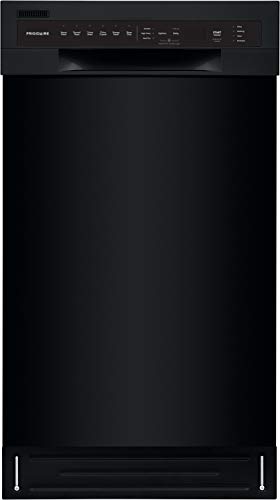
The FFBD1831UB takes the simpler road: front controls, a black finish, a stainless steel tub, and a specification sheet aimed at everyday usefulness rather than feature headlines. Capacity is 8 place settings, washed by a dual spray arm system that gives both racks their own arm — coverage that single-arm compacts cannot match on a crowded lower rack. The published noise figure is 52 dBA, squarely typical for the class. What lifts this model above generic compacts is the combination of heated drying and an NSF certified sanitize option: the heated dry system uses an element to finish dishes rather than relying on condensation, which suits households that unload straight into cupboards, and the sanitize cycle is certified to a recognised standard rather than merely named. It is ADA compliant, ENERGY STAR certified, and offers six cycles including Energy Saver, Heavy, and Rinse, with a 24-hour delay start. Everything is selected on the front panel, with cycle status visible at a glance.
The dual spray arm arrangement deserves a second look, because it shapes what this compact can be loaded with. Many small dishwashers wash the lower rack hard and the upper rack gently, which is why glasses on top so often emerge less clean than plates below. Giving the top rack its own spray arm evens that out, and it is part of why this model carries a sanitize certification credibly: temperature and coverage have to reach everywhere the load sits. The heated dry system pairs with a static vent, and the cycle list includes a dedicated Energy Saver program for lightly soiled loads, which in a two-person household is most loads. Nothing about the machine pretends to be smart, connected, or quiet for its class, and that plainness is the design: every control is a labelled button on the door, readable from across the room.
Strengths
- Heated drying plus an NSF certified sanitize option — a combination the condensation-dry compacts do not offer
- Dual spray arms serve both racks, improving coverage on full loads
- ADA compliant and ENERGY STAR certified, with front controls that need no explanation
- Six cycles and a 24-hour delay start cover the routines most small households actually use
Trade-offs
- 52 dBA is the joint-loudest published figure in this guide; in a studio or open-plan flat it will be heard
- 8 place settings and no third rack mean bulky cookware competes directly with plates for space
- This exact model code is the black finish; the stainless and white versions carry different suffixes and must not be confused at ordering
- Front controls are reachable by small children, making the control lock a feature to actually use
Who it suits
Choose the Frigidaire if your small kitchen feeds one to three people, you want dishes to come out dry enough to put away immediately, and you prefer pressing a labelled button on the door to configuring an app. It is also the natural fit for an accessible kitchen that wants front controls at a comfortable height. For a compact that keeps its promises simple and dries with heat, the FFBD1831UB earns its place, so check price on Amazon.
Check price on Amazon: Frigidaire FFBD1831UB


Danby DDW1805EWP (18-inch class) — the portable that needs no opening
The DDW1805EWP is the honest exception in this guide: an 18-inch dishwasher that does not install into cabinetry at all. It is a freestanding portable on easy-roll castors, finished in white, which connects to most kitchen faucets with a quick-connect fitting when a wash is needed and rolls back against a wall or into a corner when it is not. Inside, it is a real dishwasher — 8 place settings, a stainless steel interior and spray arm, an adjustable upper rack, and a silverware basket. Danby publishes four wash cycles (Heavy, Normal, 90 minute, and Rapid), a noise figure of 52 decibels, low water consumption of up to 3.5 gallons per wash, and ENERGY STAR compliance. Electronic controls with a display light keep operation simple. For a renter, a household in a listed building where plumbing cannot change, or a kitchen with genuinely no spare cabinet run, this is not a compromise purchase; it is the only category of machine that works at all, and Danby’s version is the established name in it.
The daily rhythm of a portable is worth picturing before buying one. The machine parks where it fits — against a wall, in a wide hallway, beside the counter — and when the sink fills with dishes it rolls to the faucet, the quick-connect fitting clicks onto the tap, and the drain hose hooks into the sink. A wash runs, the fitting comes off, and the machine rolls home. Households that adapt to that rhythm report it becomes as automatic as filling a kettle; households that expected a built-in’s invisibility find the ritual wearing. Danby’s adjustable upper rack and stainless interior keep the inside experience close to a built-in compact, and the 90-minute cycle exists precisely for the common portable scenario: a day’s dishes for two, washed while dinner cooks, with the faucet needed again soon after.
Strengths
- No cutout, no plumbing work, no landlord permission problem — it connects to the faucet and drains into the sink
- A full 8 place settings with a stainless steel interior, matching the built-in compacts on capacity
- ENERGY STAR compliant with published water use of up to 3.5 gallons per wash
- Castors make it storable in a corner, a pantry, or against a wall between uses
Trade-offs
- The kitchen faucet is occupied for the whole cycle, and the machine must be wheeled over and connected for every wash
- 52 decibels, the joint-loudest figure here, in a machine that stands in the room rather than behind cabinet insulation
- It takes floor space permanently, even if that space is only a parking spot
- Four cycles is a short list, and there is no sanitize or smart feature to grow into
Who it suits
This is the pick for renters, for temporary living situations, for cabins and secondary kitchens, and for anyone whose kitchen cannot be modified but whose sink is permanently full. It also suits a household testing whether a dishwasher earns its space before committing to a remodel. If the absence of a cabinet opening is your whole problem, the Danby DDW1805EWP is the direct answer, so check price on Amazon.
Check price on Amazon: Danby DDW1805EWP
The 24-inch class: the standard opening, three philosophies
With a standard opening confirmed, the choice widens. The three models below share a width and almost nothing else: a premium tub machine built around quiet and drying, a drawer that rethinks loading entirely, and an ADA-height front-control model that keeps the standard width while fitting under lower counters. Capacity runs from 7 to 16 place settings inside the same nominal class, which is the clearest proof in this guide that width alone settles very little.

Bosch SHX78CM5N (24-inch class) — the quiet flagship tub
The SHX78CM5N is the 800 Series at full size: a 24-inch built-in with a bar handle, hidden top controls, and the lowest published noise figure in this guide at 42 dBA. Capacity is 16 place settings across three racks, with a flexible third rack for cutlery and small items and a RackMatic middle rack that adjusts to three heights in nine positions, all riding on the EasyGlide system Bosch fits so loaded racks still move smoothly. The wash system is PrecisionWash, which uses intelligent sensors to monitor the load, with PowerControl directing extra spray intensity at the dirtiest zone of the bottom rack. Drying is the headline: CrystalDry uses a zeolite chamber to turn absorbed moisture into heat reaching up to 176 degrees Fahrenheit, and Bosch publishes up to 60 percent drier dishes as the result, a brand figure quoted here as the brand states it. The SHX78CM line appears in the ENERGY STAR listings at around 240 kilowatt-hours per year. Home Connect adds remote monitoring and start, and a light projected on the floor reports that a cycle is running, which at 42 dBA is genuinely necessary information.
Two details separate this machine in daily use from the merely well-specified. The first is PowerControl: the bottom rack’s spray arm varies its intensity by zone, so a crusted roasting pan parked at the back receives a harder wash than the plates at the front of the same rack, in the same cycle. The second is how the third rack and RackMatic interact — the flexible third rack has a foldable side so tall items can stand in the middle rack beneath it, which quietly solves the stemware-versus-stockpot argument that fixed interiors force. Add the floor-projected status light, which on this model also shows cycle time remaining, and the machine communicates without a visible control panel at all. It is a considered piece of engineering, and the review scores it as one: on the documented evidence, not on novelty.
Strengths
- 42 dBA — the quietest published figure in this guide, suited to open-plan homes and overnight runs
- CrystalDry addresses the classic condensation weakness, drying plastics far more thoroughly than the base system
- 16 place settings with a flexible third rack and nine-position RackMatic adjustment
- PrecisionWash with PowerControl concentrates cleaning where the load is dirtiest instead of treating the tub uniformly
Trade-offs
- It is the premium route in this guide, and its price tier reflects the full 800 Series feature stack
- Hidden top controls cannot be read mid-cycle without the floor light or the app
- The CrystalDry cycle is not the fastest route through a load; drying this thorough takes its time
- Sixteen place settings is more tub than a small household fills, and half-empty premium machines still use premium-machine resources
Who it suits
Families and keen cooks with a standard opening, an open-plan living space, and loads full of plastics, lunchboxes, and mixing bowls will get the most from this machine. It is the pick when the dishwasher runs during conversation, when drying quality matters as much as washing, and when the purchase is a ten-year decision rather than a stopgap. If your kitchen matches that description, the Bosch SHX78CM5N is the standard to measure others against, so check price on Amazon.
Check price on Amazon: Bosch SHX78CM5N
Fisher & Paykel DD24SAX9 (24-inch class) — the single DishDrawer
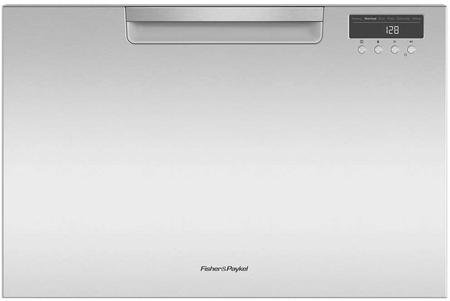
The DD24SAX9 keeps the 24-inch width and abandons everything else about the standard layout. It is a single DishDrawer: one drawer, roughly half the height of a conventional tub at 16 and an eighth inches, which opens and closes like a kitchen drawer and loads from above. Fisher & Paykel publishes 7 place settings, plates up to 11 inches in diameter, fold-down tines, and foldable cup racks. The noise figure is 43 dBA, remarkable for a machine of this size, and the efficiency numbers are the most striking in the guide: the model’s quick reference documentation lists ENERGY STAR status with energy use of 151 kilowatt-hours per year and water use of 1.81 gallons per cycle, figures that reflect the smaller loads a single drawer takes. Six wash programs run from Rinse and Fast through Delicate, Normal Eco, Normal, and Heavy, with fan assisted drying and the brand’s SmartDrive motor. Because a drawer can be installed at bench height, the format is ADA compliant in placement and kind to anyone who finds bending to a low tub genuinely difficult; a second drawer can be added later, in the same column or elsewhere in the kitchen, if one proves not enough.
The drawer’s party trick, less discussed than its ergonomics, is placement freedom. Because it occupies half a standard opening’s height, the space beneath or above it in the same column remains usable — a second drawer, a drawer-style microwave, or ordinary cabinet storage. Kitchens have been designed with one DishDrawer beside the sink at bench height and another near the dining side of an island, so clean dishes live where they are used. The wash itself uses a lid that lowers inside the drawer and a single spray arm under the rack, a mechanically simple arrangement the brand credits for the format’s reliability record, and the SmartDrive motor is a direct-drive design with few moving parts. Loading is the adjustment: plates stand in a shallow arc, bowls nest in the fold-down tines, and anything taller than the drawer’s published plate diameter simply belongs to a different machine.
Strengths
- Drawer loading at bench height removes the bending that a low tub demands — a real ergonomic difference, not a styling one
- 43 dBA published noise and the lowest per-cycle water figure in the guide
- Small loads run without the guilt of heating a full-size tub for six plates
- Installs flexibly: alone, paired with a second drawer, or at an accessible height
Trade-offs
- 7 place settings is the smallest capacity here; a family dinner plus cookware will not fit in one run
- The 11-inch plate limit and shallow drawer exclude tall stockpots and oversized platters
- Cost per place setting is high — you are paying for the format and the engineering, not for volume
- Fan assisted drying is gentler than the Bosch mineral system on stubborn plastics
Who it suits
Solo households, couples, and anyone who cooks small meals often will use this drawer daily and happily. It also suits cooks with back or mobility limits, and kitchens adding a second dishwasher near a prep zone or bar. Buy it as a lifestyle choice about how you load and how often you run, not as a capacity bargain. For the right household the Fisher & Paykel DD24SAX9 is the most likeable machine in this guide, so check price on Amazon.
Check price on Amazon: Fisher & Paykel DD24SAX9
Frigidaire FFBD2420US (24-inch class) — standard width, ADA height
The FFBD2420US solves a problem the other 24-inch picks cannot: a standard-width opening under a lower counter. It is a 24-inch front-control built-in in stainless steel, but built to ADA compliant height — noticeably shorter than a standard tub, which lets it fit accessible kitchens and older cabinetry where a full-height machine will not slide in. Frigidaire’s product literature rates capacity at 12 place settings and the published noise figure at 52 dBA. The wash system uses dual spray arms serving both racks, a Smart Wash system that senses the load and adjusts the cycle, heated drying, and an NSF certified sanitize option. Its ENERGY STAR listing records 240 kilowatt-hours per year and 3.2 gallons of water per cycle, with a stainless steel tub, heated dry, soil sensing, and a self-cleaning filter among the certified attributes. Six cycles include Normal, Energy Saver, China Crystal, Heavy, Quick, and Rinse Only, with a 24-hour delay start, all selected on a front panel that shows exactly what the machine is doing.
The Smart Wash system is the feature doing quiet work here: sensors read how dirty the load is and adjust the cycle accordingly, so a load of breakfast plates is not washed as though it were a lasagne dish, saving water and time on the easy days. The self-cleaning filter listed in its certification removes the monthly filter-rinsing chore that quieter machines impose, which suits households that want an appliance to disappear into the routine. Front controls show cycle progress without opening the door or reaching for a phone, and the China Crystal cycle gives stemware a gentler program than most value-tier machines bother to include. It is, deliberately, a machine with no learning curve: the specification reads like a checklist of what mainstream buyers ask for, answered at standard width and accessible height.
Strengths
- ADA compliant height at the full 24-inch width — the only pick here for lower counters that still takes family-size loads
- Heated drying and an NSF certified sanitize option at a mainstream specification level
- ENERGY STAR certified figures of 240 kilowatt-hours per year and 3.2 gallons per cycle are solidly efficient
- Front controls, a self-cleaning filter, and soil sensing keep daily operation and upkeep simple
Trade-offs
- 52 dBA matches the loudest figures in this guide; it will be audible in the room
- No third rack, so cutlery rides in a basket that takes lower-rack space
- The shorter tub that makes it fit also trims interior height for the tallest items
- Published capacity figures for this model vary between Frigidaire documents, so confirm the current specification sheet before relying on an exact count
Who it suits
Choose this model when the counter height, not the width, is your constraint: accessible kitchens, older homes with settled cabinetry, or a floor build-up that stole the standard clearance. It also suits buyers who want front controls, heated dry, and sanitize certification without stepping up to a premium tier. For a standard opening with a non-standard height, the Frigidaire FFBD2420US is the straightforward answer, so check price on Amazon.
Side by side: the six picks compared
The table collects the published headline figures in one place. Noise and capacity are the makers’ own published values, drying is the system each machine uses, and the final column is the honest one-line summary of who should be reading that row most closely.
| Model | Width class | Published noise | Capacity | Drying system | Best read on it |
|---|---|---|---|---|---|
| Bosch SPX68B55UC | 18-inch built-in | 44 dBA | 10 place settings | Condensation (PureDry) | The compact with a full-size feature set |
| Frigidaire FFBD1831UB | 18-inch built-in | 52 dBA | 8 place settings | Heated dry | The simple ADA compact that dries with heat |
| Danby DDW1805EWP | 18-inch portable | 52 dB | 8 place settings | Heated dry | The no-install answer for renters |
| Bosch SHX78CM5N | 24-inch built-in | 42 dBA | 16 place settings | CrystalDry mineral | The quiet flagship for big, plastic-heavy loads |
| Fisher & Paykel DD24SAX9 | 24-inch drawer | 43 dBA | 7 place settings | Fan assisted | The ergonomic drawer for small, frequent loads |
| Frigidaire FFBD2420US | 24-inch built-in | 52 dBA | 12 place settings | Heated dry | Standard width at an accessible height |
Read vertically, the table makes the guide’s argument on its own. Width class predicts almost nothing about noise — the second-quietest machine here is a drawer, and the joint-loudest is a full-width model. Capacity tracks width only loosely, since the drawer gives up half its height. And drying technology, which no headline figure captures, separates the two Bosch models from each other more than their shared badge suggests. The numbers narrow the field; the pick sections above are where the actual decision gets made.
Matching the class to your kitchen
A few recurring situations cover most readers. A small permanent kitchen in a condo or a galley remodel, with an 18-inch opening and daily use, points to the Bosch SPX68B55UC if the budget stretches, and to the Frigidaire FFBD1831UB if it does not — both are real built-ins that will outlast several sets of countertops. A rental, a dormitory-adjacent flat, or any kitchen you are forbidden to modify points to the Danby and only the Danby; it is the one machine here that leaves the kitchen exactly as it found it. An accessible kitchen splits two ways: an 18-inch opening takes either ADA compact, while a 24-inch opening under lower counters is the FFBD2420US’s whole reason for existing. A family kitchen with a standard opening and an open-plan room attached takes the SHX78CM5N, whose 42 dBA figure and 16 place settings were designed for exactly that house. And a household of one or two that cooks nightly and hates bending takes the DishDrawer seriously, possibly as the first of two. If you are planning a wider renovation and wondering whether a second dishwasher beats a bigger one, the drawer discussion above is the relevant one: two small machines in different zones beat one large one when loads are small and frequent. And where the same renovation reaches the refrigerator alcove, the measure-first discipline applies there too, along with a finish question the dishwasher does not raise — how well the surface hides fingerprints.
See also: best smudge proof refrigerators
Installation notes by class
Built-in models in both classes need the same three services — a hot water supply with a shut-off you can reach, a drain connection to the sink plumbing or disposal, and power, either hardwired or through a cord kit where the maker allows one. The differences are in the details. ADA-height machines exist because counter and floor heights vary; confirm the opening height against the model’s dimension drawing, including the adjustable feet range, before ordering. The Bosch 18-inch documentation notes its hardwire junction box is a separate accessory, so budget the small parts, not just the machine. The DishDrawer needs its drawer cavity and services arranged like a drawer installation rather than a tub slide-in, and its flexibility about placement height is a planning opportunity worth taking before cabinetry is finalised. The Danby needs a faucet its quick-connect fitting matches, a sink to drain into, and a parking spot within hose reach; check the fitting against your faucet type, since some designer faucets need an adapter or will not accept one at all. In every case, the published dimension drawing outranks the width class printed on the box.
Ownership: running costs and upkeep
The certified consumption figures in this guide translate into a simple ownership pattern: the drawer uses the least energy and water per cycle because it washes the least per cycle, and across a year of daily small loads its totals stay low for the same reason. The two Bosch models publish annual energy figures in the 240 to 269 kilowatt-hour range under the standard test assumptions, and the larger Frigidaire matches the lower of those numbers while moving more water per cycle than the drawer. None of these machines will dominate a household energy bill — a dishwasher’s hot water and electricity together are a modest line item next to heating and cooling — but the certified figures are the right way to compare models, because they were all produced by the same procedure.
Upkeep divides along the same lines as the features. Machines with manual filters ask for a rinse under the tap on a regular rhythm; the self-cleaning filter on the FFBD2420US removes that task. Spray arms benefit from an occasional check that their jets are clear of seeds and labels, whatever the brand. Rinse aid matters more to condensation and fan drying than to heated drying, because it is what persuades water to sheet off glass and plastic instead of beading, so owners of the Bosch pair and the drawer should keep the dispenser filled rather than treating it as optional. The Machine Care programme on the Bosch models, and an equivalent empty hot cycle on the others, clears grease from internal plumbing that cool eco cycles leave behind. None of this is onerous, but it is real, and the machine whose upkeep matches your habits will still be performing in year ten.
Frequently asked questions
Can an 18-inch dishwasher keep up with a family?
For a family of three that runs it daily, an 8 to 10 place setting machine usually keeps up, because the constraint is rarely total capacity — it is whether bulky cookware and plates compete for the same space on the same night. Larger families, or households that entertain weekly, will feel the narrower tub as a second load after every big meal. The honest test is your current sink at its worst evening: if one load in a standard machine barely contains it, an 18-inch model will not, and the width of your opening, not optimism, should settle the question.
Is the gap between 42 dBA and 52 dBA really noticeable?
Yes. Because the decibel scale is logarithmic, a ten-point gap is a large perceived difference, roughly the difference between a machine you can hold a conversation over without thinking about it and one you schedule around. In a closed-off kitchen with a door, 52 dBA bothers few people. In an open-plan space or a studio, the low-forties machines earn their premium every single evening. All figures here are the makers’ published values, so compare them as rankings rather than guarantees about your room’s acoustics.
Does every 18-inch dishwasher need a cabinet opening?
No, and the exception is in this guide. The Danby DDW1805EWP is a portable: it stands on castors, connects to the kitchen faucet with a quick-connect fitting for each wash, and drains into the sink. It needs floor space and a compatible faucet rather than cabinetry. Every other 18-inch model here is a built-in that needs a proper opening with water, drain, and power services roughed in.
Can a single DishDrawer replace a conventional dishwasher?
For one or two people, yes, and many owners prefer it, because small loads run promptly instead of waiting days to fill a tub. For a family, a single drawer at 7 place settings becomes the bottleneck after every shared meal, and the format only replaces a conventional machine when a second drawer joins it. Judge it by your largest regular load, not your average one.
What does ENERGY STAR certification actually tell me?
It tells you the model’s energy and water consumption was measured under the federal test procedure and certified below the standard’s thresholds — nothing about cleaning power, noise, or reliability. Use it the way this guide does: as a running-cost screen with published kilowatt-hour and per-cycle water figures you can compare across models, and let the wash systems, racks, and drying methods decide the rest.
Every recommendation in this guide descends from one measurement, so end with it: take the tape to your cabinetry before you fall for any feature list, because the best dishwasher in either class is a paperweight in the wrong opening. Width first, then noise, capacity, and drying — and the six machines above cover every honest answer that sequence produces.


