The best types of dishwashers are not ranked by a single winner, because the right type depends on your kitchen, your household, and how much space you have. A built-in dishwasher is the default for most homes, a portable model suits renters and small kitchens, a countertop unit works where no plumbing change is possible, and a drawer dishwasher fits kitchens that value flexible, small loads. This guide explains each type in plain terms, compares them honestly, and recommends six real machines, one or two for each type, so you can see what each category does best. The picks include a full-size Kenmore built-in, a portable BLACK+DECKER, two countertop models from COMFEE and EUHOMY, and two Fisher and Paykel drawer models, one single and one double.
In this guide
Quick picks: best types of dishwashers
| # | Product | Where to buy |
|---|---|---|
| 1 | Kenmore 24-Inch Built-In Dishwasher | Check on Amazon |
| 2 | BLACK+DECKER BPD8B 18-Inch Portable Dishwasher | Check on Amazon |
| 3 | COMFEE Countertop Dishwasher | Check on Amazon |
| 4 | Fisher & Paykel DD24SAX9 Single DishDrawer | Check on Amazon |
| 5 | Fisher & Paykel DD24DAX9 Double DishDrawer | Check on Amazon |
| 6 | EUHOMY Countertop Dishwasher | Check on Amazon |
Best Types of Dishwashers at a Glance
There are four main types of dishwashers sold today. Built-in dishwashers are installed under the counter and connected to the water supply and drain. They come in 24-inch full-size and 18-inch compact widths, hold the most dishes, and are the quietest type on average. Portable dishwashers stand on the floor, connect to the kitchen faucet with a hose, and roll away when not in use. They suit renters and kitchens without a dishwasher opening. Countertop dishwashers sit on the counter, use a small water tank or a faucet adapter, and wash a small load, which suits single people, dorms, and RVs. Drawer dishwashers pull out like a drawer rather than dropping down on a hinge, and they come as single or double units, so you can run a small load in one drawer while the other stays available. Each type has a real use case, and the wrong type is worse than a mediocre machine of the right type. If you are replacing a built-in, start with our guide to the best portable dishwashers for the portable side and our roundup of the best drawer dishwashers for the drawer side, then come back here to compare.
How the Picks Were Chosen
Each pick below represents one type clearly, with a verified listing and a title that states the brand, the model, and the type. The Kenmore 24-inch model stands for the built-in category, with a fingerprint-resistant stainless steel finish, a third rack, and a 49 dBA rating. The BLACK+DECKER BPD8B stands for portable dishwashers, with an 18-inch body and eight place settings. The COMFEE and EUHOMY models stand for countertop dishwashers, with water tanks, no-hookup operation, and six-place capacities. The two Fisher and Paykel DishDrawer models stand for drawer dishwashers, one single and one double, with stated model codes DD24SAX9 and DD24DAX9. Every pick was checked against the site product feed, and only machines whose titles match their brand and model appear with a link. Accessories, parts, and racks were excluded. The goal is not to crown one type, but to show what each type looks like at its best, so you can match the type to your kitchen before you compare brands.
The Six Picks, One or Two per Type
Kenmore 24-Inch Built-In Dishwasher

The Kenmore 24-inch built-in is the representative built-in dishwasher on this list, and it shows why the built-in remains the default choice for most homes. It is a full-size machine in fingerprint-resistant stainless steel, rated at 49 dBA, with a third rack, the UltraWash Plus system, and SmartWash. Built-in dishwashers hold the most, run the quietest on average, and look the most permanent, because they are plumbed in and finished to match the kitchen. The third rack is the feature that matters most in daily use: cutlery moves up top, and the middle and lower racks gain room for plates and pots. At 49 dBA this Kenmore is louder than premium quiet models, but it is acceptable in a closed kitchen or when the machine runs after dinner. If your kitchen has a standard 24-inch opening, a built-in like this one is the simplest and most capable choice, and it is the type to buy when you want maximum capacity with minimum fuss.
Key specs: Kenmore 24 in. Built-In Dishwasher – Fingerprint Resistant Stainless Steel | 49 DBA – 3rd Rack, UltraWash Plus, SmartWash
Strengths:
- Full-size 24-inch capacity with a third rack
- Fingerprint-resistant stainless steel finish
- UltraWash Plus and SmartWash for everyday loads
Trade-offs:
- 49 dBA is louder than premium quiet models
- Needs a standard built-in opening and plumbing
- Fewer premium features than higher-tier brands
Best for: households with a standard 24-inch dishwasher opening / Not suited for: renters who cannot modify plumbing
BLACK+DECKER BPD8B 18-Inch Portable Dishwasher
Check price on Amazon: Kenmore 24-Inch Built-In Dishwasher
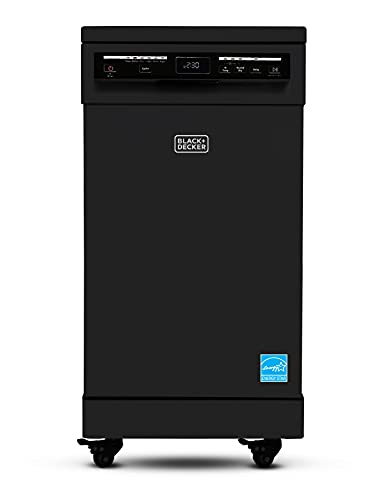
The BLACK+DECKER BPD8B is the portable dishwasher on this list, and it is the answer for kitchens without a dishwasher opening. It is an 18-inch Energy Star portable with eight place settings, on wheels, with a hose that connects to the kitchen faucet. Portable dishwashers suit renters, small apartments, and older homes where cutting a new opening is not practical. You roll the machine to the sink, connect the hose, run the cycle, and roll it back. Eight place settings is enough for one or two people, and the Energy Star rating keeps running costs reasonable. The trade-offs are real: you lose counter or floor space while it runs, you must connect and disconnect the hose each time, and the capacity is smaller than a built-in. But for a renter who wants a real dishwasher without modifying the kitchen, a portable model is the only practical option, and the BPD8B is a straightforward example.
Key specs: BLACK+DECKER 18-Inch Portable Dishwasher, Energy Star, BPD8B, Black | 8-Place Setting Capacity, Mobile Dish Washer
Strengths:
- No plumbing changes needed, connects to the faucet
- Rolls away when not in use, suits renters
- Energy Star rated with eight place settings
Trade-offs:
- Hose connection needed for every cycle
- Smaller capacity than a full-size built-in
- Takes floor space while running
Best for: renters and kitchens without a dishwasher opening / Not suited for: large households that need full-size capacity
COMFEE Countertop Dishwasher
Check price on Amazon: BLACK+DECKER BPD8B 18-Inch Portable Dishwasher
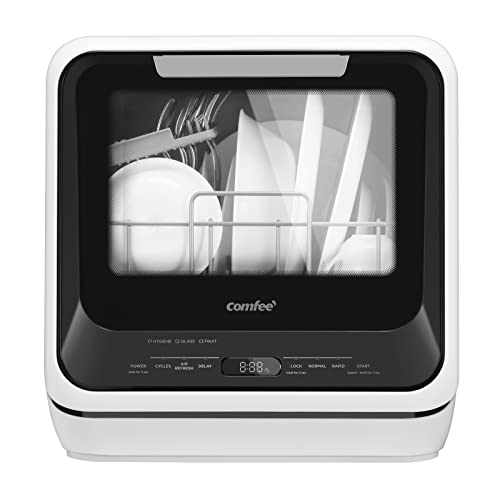
The COMFEE countertop dishwasher is the smallest type on this list, and it exists for situations where even a portable model is too much. It sits on the counter, uses a 1.32-gallon water tank, and needs no hookup, which makes it usable in dorms, RVs, and apartments where the faucet cannot take a portable hose. It offers six programs and six place settings, which is enough for one person or a couple who cook lightly. The no-hookup design is the key feature: you fill the tank, run the cycle, and empty the drain. Countertop machines are not a replacement for a full-size dishwasher, and they should not be judged as one. They are a way to stop washing by hand when space and plumbing are both limited. If you live alone, travel in an RV, or rent a room with a small kitchen, this type is worth considering before you dismiss dishwashers entirely.
Key specs: COMFEE Countertop Dishwasher Portable with 1.32Gal Water Tank, 6 Programs | No Hookup Needed for RVs, Dorm & Apartment
Strengths:
- No hookup needed, runs from a water tank
- Sits on the counter, suits dorms, RVs, and small apartments
- Six programs for a small machine
Trade-offs:
- Six place settings will not serve a family
- Counter space is taken while it runs
- Tank must be filled and emptied manually
Best for: single people, dorms, and RVs with limited space / Not suited for: households that cook large meals daily
Fisher & Paykel DD24SAX9 Single DishDrawer
Check price on Amazon: COMFEE Countertop Dishwasher
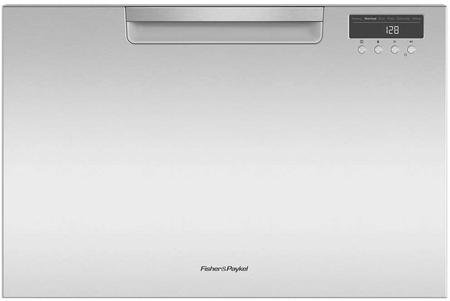
The Fisher and Paykel DD24SAX9 is the single drawer dishwasher on this list, and it shows how a drawer design changes daily use. Instead of a door that drops down, the DishDrawer pulls out like a drawer, so you load it from above without bending as far. A single drawer washes a small load efficiently, which suits one or two people, and it uses less water and energy than running a full-size machine half empty. The 24-inch stainless steel body fits a standard opening, and the full console gives the drawer a clean, built-in look. Drawer dishwashers are often bought in pairs, with two single drawers stacked, or as a single drawer in a small kitchen or a secondary kitchen. The main limitation is capacity: one drawer holds less than a full-size machine, so a large household will need the double version below or a conventional built-in. For a small household that values flexibility and easy loading, the single drawer is a thoughtful choice.
Key specs: Fisher Paykel DD24SAX9 24 in. Drawers Full Console Dishwasher in Stainless Steel
Strengths:
- Drawer design loads from above with less bending
- Small loads use less water and energy
- Fits a standard 24-inch opening in stainless steel
Trade-offs:
- One drawer holds less than a full-size machine
- Premium pricing compared with conventional built-ins
- Drawer seals and runners need regular cleaning
Best for: small households that run small loads often / Not suited for: large families that need maximum capacity per cycle
Fisher & Paykel DD24DAX9 Double DishDrawer
Check price on Amazon: Fisher & Paykel DD24SAX9 Single DishDrawer


The Fisher and Paykel DD24DAX9 is the double drawer version, and it is the drawer type at full capacity. Two drawers stack in a single tall unit, and each drawer runs independently, so you can wash a small load in one drawer while the other holds clean or dirty dishes. That independence is the real advantage of the double drawer: it behaves like two small dishwashers in one cabinet. It suits households that cook in stages, entertain often, or want to separate everyday dishes from delicate items. The Series 7 Contemporary styling gives the unit a modern look, and the stainless steel finish matches most kitchens. The trade-offs are cost and complexity: a double drawer costs more than a conventional built-in, and there are two sets of seals, racks, and controls to maintain. But for a household that values flexible loads and easy access, the double DishDrawer is the most versatile dishwasher type available, and it is the reason drawer dishwashers have a loyal following.
Key specs: Fisher & Paykel DD24DAX9 N Series 7 Contemporary Double DishDrawer
Strengths:
- Two independent drawers run small loads separately
- Flexible loading for entertaining and staged cooking
- Series 7 Contemporary styling in stainless steel
Trade-offs:
- Costs more than a conventional built-in
- Two drawers mean more seals and parts to maintain
- Each drawer still holds less than a full-size tub
Best for: households that entertain or cook in stages / Not suited for: buyers who want the lowest possible purchase cost
EUHOMY Countertop Dishwasher
Check price on Amazon: Fisher & Paykel DD24DAX9 Double DishDrawer

The EUHOMY countertop dishwasher is the second countertop pick, and it adds a detail the COMFEE model does not state: a 40 dB noise level. At 40 dB it is quieter than most full-size machines, which matters when the dishwasher sits on the counter a few feet from where you eat or work. It offers six programs, including Normal, ECO, Quick, and a baby-care cycle, with no hookup needed. The baby-care cycle is a useful detail for parents who want a hot wash for bottles and small items. Like all countertop machines, it is limited by capacity and counter space, and it will not replace a built-in for a family. But as a second dishwasher, a dorm machine, or a small-apartment solution, a quiet countertop model is a practical choice, and the 40 dB rating makes this one stand out in a category where noise is rarely stated. If you work from home in a small space, that quietness is worth weighing.
Key specs: EUHOMY Countertop Dishwasher Portable, 6 Programs with 40 dB, No Hookup | 6 Programs (Normal, ECO, Quick, Baby Care)
Strengths:
- 40 dB rating, unusually quiet for a countertop model
- Six programs including a baby-care cycle
- No hookup needed, portable by design
Trade-offs:
- Six place settings will not serve a family
- Counter space is taken while it runs
- Small tank means frequent refills for heavy use
Best for: small apartments and home offices where quiet matters / Not suited for: large households that need full-size capacity
Comparison Table
Use this table to compare the picks at a glance before reading the detail in each section below.
| Pick | Key Specs |
|---|---|
| Kenmore 24 in. built-in | 24 in., 49 dBA, 3rd rack, UltraWash Plus |
| BLACK+DECKER BPD8B portable | 18 in., 8 place settings, Energy Star, faucet hookup |
| COMFEE countertop | 1.32 gal tank, 6 programs, no hookup |
| Fisher & Paykel DD24SAX9 single drawer | 24 in., single DishDrawer, stainless steel |
| Fisher & Paykel DD24DAX9 double drawer | Double DishDrawer, independent drawers |
| EUHOMY countertop | 40 dB, 6 programs, no hookup |
Check price on Amazon: EUHOMY Countertop Dishwasher
Buying Guide: Choosing the Right Type
Choose the type before you choose the brand. If your kitchen has a standard 24-inch opening with water and power, buy a built-in. It holds the most, runs the quietest, and looks the most permanent. If your kitchen has an 18-inch opening, buy an 18-inch built-in rather than forcing a portable model into the space. If you rent and cannot modify plumbing, buy a portable model that connects to the faucet, and check that your faucet accepts the adapter. If you have no floor space for a portable model and no opening for a built-in, buy a countertop model with a water tank, and measure the counter height under your upper cabinets before ordering. If you run small loads often, entertain, or want easy loading without bending, consider a drawer dishwasher, single for a small household and double for a larger one. In every case, check the width, the height, the depth, and the connection type before ordering. A machine that does not fit is worse than no machine, because returns on installed appliances are slow and costly. Also check the noise rating. Built-in machines near 42 to 45 dBA are quiet, portable and countertop machines vary widely, and a stated decibel rating is always better than no rating. For sizing help, our guide to the best 18 and 24 inch dishwashers covers the two standard widths in detail, and our roundup of the best compact dishwashers for home covers small-space options more broadly.
How to Use and Care for Each Type
Built-in dishwashers need the least attention day to day: load, add detergent, run, and clean the filter monthly. Portable dishwashers need the hose connected and disconnected each time, and the faucet adapter should be checked for leaks regularly. Countertop dishwashers need the tank filled and the drain emptied, and the tank should be cleaned to prevent odors. Drawer dishwashers need the drawer seals wiped and the runners kept clean, because a drawer that does not close fully will not wash well. Across all types, the same habits matter: scrape plates rather than rinsing them fully, load with spray arms clear, use the right detergent dose for your water hardness, and run a cleaning cycle regularly. If you have hard water, consider a filter on the supply line. Clean filters and regular cleaning cycles do more for results than any single feature.
Common Mistakes When Choosing a Dishwasher Type
The most common mistake is buying a type that does not fit the kitchen. A portable dishwasher in a kitchen with no floor space is a burden, and a countertop dishwasher in a household of five is a toy. The second mistake is ignoring capacity. Count place settings honestly: a couple that cooks daily needs more than six place settings, and a family needs a full-size machine. The third mistake is forgetting the connection. A portable model needs a compatible faucet, a countertop model needs counter space and a power outlet, and a built-in needs plumbing. The fourth is choosing on looks alone. A drawer dishwasher looks elegant, but it holds less per drawer than a conventional machine, and a fully integrated built-in looks clean but needs a custom panel. The fifth is ignoring noise. A countertop machine on the counter is closer to your ears than a built-in under the counter, so a stated decibel rating matters more, not less. Match the type to the kitchen first, then compare machines within that type.
Built-In vs Portable vs Countertop vs Drawer: Side by Side
The four types differ in capacity, noise, installation, and cost, and the differences are worth stating plainly. A built-in dishwasher holds twelve to sixteen place settings, runs at 39 to 49 decibels in most models, needs a plumbed installation, and costs the most to buy and install. It is the only type that suits a family that cooks daily, because it is the only type with the capacity and the quietness for heavy use. A portable dishwasher holds about eight place settings, runs at a moderate noise level, needs no installation beyond a faucet adapter, and costs less than a built-in. It suits renters and small households, and it is the only type that can move with you. A countertop dishwasher holds about six place settings, runs at 40 to 55 decibels depending on the model, needs a counter and a power outlet, and costs the least. It suits single people and small spaces, and it is the only type that works with no plumbing at all. A drawer dishwasher holds about seven place settings per drawer, runs at a moderate noise level, needs a plumbed installation like a built-in, and costs the most per place setting. It suits households that run small loads often and value easy loading. The right comparison is not which type is best, but which type matches your kitchen and your household. A family that buys a countertop machine will be disappointed, and a single person who buys a double drawer unit will have paid for capacity they never use. Match the type to the household first, then compare machines within that type on noise, capacity, and features.
Installation and Space Planning by Type
Each type needs different space and services, and planning them before ordering avoids the most common installation problems. A built-in dishwasher needs a 24-inch or 18-inch opening, a water supply, a drain, and a power connection, and the opening must be measured for width, height, and depth, including the space for the door to open. Check whether the machine is hardwired or plugged, and confirm the water line and drain hose reach their connections. A portable dishwasher needs floor space to stand, a faucet that accepts the adapter, and a power outlet, and it needs a path to roll to the sink without blocking a doorway. Check the faucet thread before ordering the adapter, because some modern faucets need a special fitting. A countertop dishwasher needs a flat counter with enough height under the upper cabinets, a power outlet, and space for the door to open, and it needs a sink nearby for filling the tank or draining. Measure the height under your cabinets, because some countertop models are too tall for low cabinets. A drawer dishwasher needs the same opening and services as a built-in, plus clearance for the drawer to pull out fully, which is more depth than a drop-down door needs. Check the drawer travel and confirm that nothing blocks the drawer path. In every case, measure twice, confirm the services, and keep the manual and the installation kit until the machine has run its first cycle without a leak.
Noise, Capacity, and Features: What the Numbers Mean
Dishwasher specifications are full of numbers, and three of them matter more than the rest. The decibel rating tells you how loud the machine is, and it is the number that affects daily life most. A machine rated at 39 to 42 decibels is barely audible, and you can run it while people talk in the same room. A machine at 44 to 48 decibels is noticeable but easy to live with, especially in a closed kitchen. A machine at 50 decibels and above is clearly heard, and it is best run overnight or when the kitchen is empty. Treat the rating as a real specification, not marketing, and compare it across models before comparing anything else. Place settings tell you how much the machine holds, and one place setting is roughly a dinner plate, a bowl, a glass, a cup, and cutlery for one person. A full-size machine holds twelve to sixteen place settings, a compact holds eight, and a countertop holds about six. Count honestly: a household that cooks daily and entertains needs more place settings than a household that eats out often. The third number is the cycle count, which tells you how many wash programs the machine offers. Six cycles cover the normal range from light to heavy, and more cycles add options like sanitizing, half-load, and express washes. A machine with too few cycles may not have a gentle option for delicate items, and a machine with too many may have programs you never use. Beyond the numbers, check the tub material, because a stainless steel tub resists staining and handles high-temperature drying better than a plastic tub, and check the rack layout, because a third rack changes daily loading more than any cycle count. Compare noise, capacity, cycles, tub, and racks, in that order, and the right machine will stand out.
Renters, Landlords, and Shared Kitchens
The right dishwasher type often depends on who owns the kitchen, not just on how big it is. Renters cannot cut a new opening or change the plumbing without the landlord’s permission, which makes a portable or countertop dishwasher the practical choice. A portable model connects to the faucet and rolls away, and a countertop model needs only a counter and an outlet, so both can move when the lease ends. Before buying, check the lease for any clause about appliances, and check that the faucet accepts an adapter, because some modern faucets need a special fitting that costs extra. Landlords face the opposite question: a built-in dishwasher adds value to a rental and attracts better tenants, but it needs professional installation and maintenance. A landlord who installs a built-in should choose a durable, simple model with a stainless steel tub, because it will survive tenant turnover better than a budget machine with a plastic tub. Shared kitchens, in a shared house or a small office, need a different logic again: the machine will be used by many people with different habits, so a simple, durable built-in with a clear cycle selection is better than a feature-dense model that nobody learns to use. A drawer dishwasher can suit a shared kitchen, because one drawer can run while the other is loaded, but the higher cost needs a reason. In every case, match the type to the living arrangement first, then compare machines within that type. A renter who buys a built-in cannot install it, and a landlord who buys a countertop machine for a family rental has bought the wrong scale.
A Quick Decision Checklist
Before you buy, answer five questions. First, what width fits your kitchen: 24 inches, 18 inches, or a countertop only. Second, can you change the plumbing: if not, portable or countertop is the answer. Third, how many place settings do you wash on a normal day: six, eight, or twelve and more. Fourth, how much does noise matter: a machine on the counter is closer to your ears than a machine under it. Fifth, how often do you run small loads: if the answer is often, a drawer dishwasher earns its cost. Five answers, one type, and the rest is comparing machines within that type. Write the answers down before you shop, and take them with you, because a showroom has a way of making every machine look like the right one.
Final Recommendation
For most homes, the built-in remains the best type: the Kenmore 24-inch model above is a solid, full-size choice. For renters, the BLACK+DECKER BPD8B portable is the practical answer. For dorms, RVs, and single-person apartments, a countertop model like the COMFEE or the quiet EUHOMY is the right scale. For households that run small loads often and value easy loading, the Fisher and Paykel DishDrawer, single or double, is the most flexible type available. There is no single best type of dishwasher, only the type that fits your kitchen, your household, and your habits. Measure first, count place settings honestly, and choose the type before you fall in love with a brand.
Frequently Asked Questions
What is the best type of dishwasher for most people?
A 24-inch built-in dishwasher suits most homes because it holds the most, runs quietly, and is plumbed in permanently. It is the default choice when the kitchen has a standard opening.
Are portable dishwashers any good?
Yes, for the right situation. A portable dishwasher washes as well as a small built-in, and it is the only practical option for renters who cannot modify plumbing. The trade-off is capacity and the need to connect a hose for each cycle.
How many dishes does a countertop dishwasher hold?
Most countertop dishwashers hold about six place settings, which suits one or two people. They are not a replacement for a full-size machine in a family household.
What is a drawer dishwasher?
A drawer dishwasher pulls out like a drawer instead of dropping down on a hinge. Single drawers wash small loads efficiently, and double drawers run two independent loads, which suits households that cook in stages or entertain often.
Can I install a built-in dishwasher myself?
Many handy homeowners can, but the job involves water, drain, and electrical connections. If you are unsure about any of those, hire a professional, and confirm the opening dimensions before ordering.


