
Where to buy
Check the latest price, availability and delivery on Amazon. Orders are placed on Amazon. We may earn a commission from qualifying purchases.
- Best overall deal: Nordic Ware Naturals Half Sheet, 2-Pack — USA Pan Bakeware Half Sheet Pan is the strongest nonstick deal in this guide.
Disclosure: As an Amazon Associate, topratedkitchenware.com earns from qualifying purchases. Links to Amazon on this page are affiliate links; they cost you nothing extra. Listing details such as price and availability change often — and during Black Friday Week they change by the hour — so check the current Amazon listing before you buy.
Bakeware is the quiet winner of Black Friday. The headline appliances get the advertising, but the sheet pans, racks and mats in this guide are the tools a kitchen uses weekly for decades, they are small enough to ship cheaply and stock deeply, and their sale prices — on items that cost tens of dollars to begin with — routinely represent the best percentage value of the whole event. Amazon Black Friday Week runs Nov 19–30, 2026, with Black Friday on Nov 27 and Cyber Monday on Nov 30. Every price below is a dated sighting from our research, printed so you know what each item actually sells for before the event’s noise starts. Prices move hourly during the event, and the only number that counts is the live price when you check it. Where a sighting comes from price tracking earlier in the year rather than a fresh November check, this guide says so in plain language — bakeware prices are small, and honesty about them should be easy.
The six picks are built around the half sheet pan, because the half sheet is the foundation pan of the home kitchen: cookies, sheet-pan dinners, roasting vegetables, toasting nuts, catching drips under a pie. Around that foundation we have chosen the two pans a baker actually needs — bare aluminum for browning and longevity, coated aluminized steel for release — plus the silicone mat that makes both easier to live with, a single-pan listing for shoppers who need exactly one, a pan-and-rack set for roasting and cooling, and a three-piece set that covers the smaller sizes. Every pick is made in the USA except the French-made Silpat, every pick is a specific verified Amazon listing, and none of them is a gadget you will use twice and store forever.



In this guide
Quick Picks
Short on time? These are the six bakeware listings to watch during Black Friday Week, with the price each was spotted at during our research. Check the live price — it may have moved in either direction since.
| Product | Why it’s a deal | Deal price sighting | Check on Amazon |
|---|---|---|---|
| Nordic Ware Naturals Half Sheet, 2-Pack | The professional-standard bare aluminum half sheet, sold as a pair | Spotted at $35.00 on Nov 19, 2026 | Check on Amazon |
| USA Pan Bakeware Half Sheet Pan | Heavy aluminized steel with a silicone nonstick coating and fluted surface | Spotted at $29.99 on Nov 19, 2026 | Check on Amazon |
| Silpat Premium Non-Stick Silicone Baking Mat, Half Sheet | The original fiberglass-core mat that replaces parchment for years | Spotted at $17.49 on Nov 19, 2026 | Check on Amazon |
| Nordic Ware Natural Aluminum Commercial Baker’s Half Sheet, Single | The same Naturals pan as a single — the listing to buy when you need one, or when it is the discounted one | Spotted at $17.49 on Nov 19, 2026 | Check on Amazon |
| USA Pan Bakeware Half Sheet Pan and Bakeable Cooling Rack Set | Pan plus an oven-safe rack that fits it — roasting, crisping and cooling in one set | Last tracked at $32.91 — check the live Black Friday price | Check on Amazon |
| Nordic Ware Naturals 3-Piece Set — Half, Jelly Roll and Quarter Sheets | Three sizes of the same bare aluminum construction for varied bakes | Spotted in the $36–$45 range in fall 2026 checks — check the live price | Check on Amazon |
How These Deals Were Chosen
We limited this guide to bakeware a working kitchen uses constantly, from makers with published specifications, and to Amazon listings whose identity we could verify from at least two independent sources — manufacturer model numbers, retailer listings, or price-tracking records. That verification step matters more in bakeware than in almost any category, because Amazon’s bakeware listings are thick with lookalike pans borrowing famous names in their titles, multipacks whose counts change between headline and detail, and dimensions quoted outside in one place and inside in another. Every pick below names its material, its construction and its real cooking surface, so what arrives is what you meant to order.
Prices are dated sightings, each recorded in the product’s verification notes with its source. Four picks carry fresh November 2026 sightings from live price checks around the start of Black Friday Week. Two picks — the rack set and the three-piece set — carry honestly labelled older tracking figures, because their live event prices could not be verified to this guide’s standard; they are included because both are exactly the kind of set that gets cut mid-event, and a watcher needs the correct listing and a fair anchor price in hand. We did not bake with these pans for this guide. We compared published construction — gauge and material, rim design, coating type and temperature ceiling — which are the properties that decide how a pan behaves for the decade you will own it.
The 6 Bakeware Deals to Watch
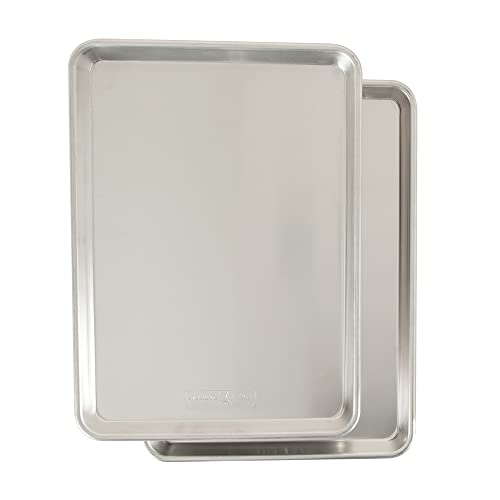
Nordic Ware Naturals Half Sheet, 2-Pack
Who it’s for: Almost every home baker and cook — this is the default sheet pan purchase, and the pair is the right quantity.
Ask a professional kitchen which sheet pan to buy and this is the answer, unchanged for years: pure natural aluminum, an encapsulated galvanized steel rim that resists the warp-and-pop lesser pans perform in a hot oven, and nothing else — no coating to scratch, blister or wear out, because there is no coating at all. Bare aluminum is light in color, so cookie bottoms brown evenly instead of scorching the way dark pans scorch them, and it conducts heat the way baking recipes quietly assume a pan does. The exterior measures about 17.9 by 12.9 inches with a cooking surface of roughly 17.1 by 12.1 inches, it is made in the USA, and it carries a lifetime warranty. The two-pack is the correct format because baking is a two-pan activity: one tray in the oven, one being loaded, cookies rotating, vegetables for dinner while a dessert cools.
The pair was spotted at $35.00 on Nov 19, 2026 in live price checks at the start of Black Friday Week — a per-pan price that undercuts most single coated pans while buying the longer-lived tool. This is the rare Black Friday recommendation with no strategic subtlety: if you do not own good half sheets, buy this pair when its live price is at or near the sighting, and the question is settled for years. If you already own a pair, a second pair at the same price is the least regrettable duplicate in the kitchen — holiday baking consumes four sheets without trying.
Honest limitation: Bare aluminum is hand-wash in practice — the dishwasher will not harm its performance but permanently dulls and discolors the finish — and acidic foods left sitting on it can mark it. It is also not nonstick: delicate bakes want parchment or the Silpat below between food and pan.
Choose it if you want the pan professionals use, for the longest service life, at a fair event price. Skip it if dishwasher-only cleanup is non-negotiable in your house — the coated USA Pan below tolerates your routine better.
USA Pan Bakeware Half Sheet Pan
Who it’s for: Bakers who want genuine nonstick release without fluoropolymer coatings, and who bake sticky, sugary, cheesy things often.
USA Pan builds the other half of the half-sheet answer. The pan is heavy-gauge aluminized steel with two signature details: a fluted, corrugated surface that increases airflow under food and adds structural rigidity against warping, and the company’s Americoat silicone coating — a nonstick layer made without PTFE, PFOA or BPA, which is the combination shoppers hunting for nonstick-without-the-chemistry-questions are actually looking for. Cookies release, roasted vegetables release, and cheese that would weld itself to bare aluminum lifts off. The baking surface is about 17.25 by 12.25 inches, the rims are reinforced, it is made in the USA, and it carries a lifetime warranty against defects. In this guide’s division of labor, the Nordic Ware is the browning pan and this is the release pan; serious bakers own both and reach by recipe.
It was spotted at $29.99 on Nov 19, 2026 in live price checks for the set listing at the start of the event — pricing that puts a coated, US-made, heavy-gauge pan at the level of the flimsy imports it will outlast several times over. One discipline protects that value: respect the coating. The published temperature ceiling for this pan is 450°F, and metal utensils and stacked storage without protection are how silicone coatings die young. Bought at its sighting and treated like a coated pan rather than an indestructible one, it is the best nonstick value in this guide.
Honest limitation: The 450°F ceiling rules out the hottest roasting and broiler work that bare aluminum shrugs off, and every coating is a consumable on a long enough timeline — years of service, not the effectively unlimited life of the uncoated Nordic Ware.
Choose it if release matters more than maximum heat and you will honor the temperature ceiling. Skip it if your sheet-pan cooking is mostly 475°F roasting and pizza work — buy the bare aluminum pair instead.
Silpat Premium Non-Stick Silicone Baking Mat, Half Sheet
Who it’s for: Cookie bakers, candy makers, and anyone tired of buying parchment paper by the roll for a pan they already own.
Silpat is the original silicone baking mat — food-grade silicone cast over a fiberglass mesh core, made in France — and the construction is the product. The fiberglass core is why a genuine Silpat lies perfectly flat, distributes heat evenly, and survives thousands of uses while thin all-silicone mats curl, stain and tear. Sized at 11-5/8 by 16-1/2 inches, it drops into a standard half sheet and turns it into a release surface for the stickiest work in baking: macarons, tuiles, caramels, cheese crisps, roasted garlic. Nothing sticks, the mat wipes clean, and it rolls or lies flat for storage. Paired with the Nordic Ware above, it quietly replaces parchment for everything except the highest-heat roasting.
It was spotted at $17.49 on Nov 19, 2026 in price checks at the start of the event — the level at which the arithmetic becomes silly, because a single mat at that price displaces years of parchment purchases. Two honest cautions belong with the recommendation. First, genuine Silpat stock on Amazon comes and goes; this listing has been observed temporarily unavailable in recent checks, so if it is in stock at its sighting during the event, do not assume it will still be there on Nov 30. Second, buy the listing in this guide and confirm the Silpat branding on arrival — the category is full of imitators trading on the name, and the fiberglass core is the part they imitate worst.
Honest limitation: Never cut on it — a knife severs the fiberglass core and retires the mat — and keep it out of direct broiler contact. It also has a faint tendency to hold onto strong odors across its long life; a baking-soda wash is the standing remedy.
Choose it if you bake cookies or sticky items weekly and own a half sheet it can live in. Skip it if your pan is not a true half sheet — measure first, because a mat that overhangs its pan defeats its own purpose.
Nordic Ware Natural Aluminum Commercial Baker’s Half Sheet, Single
Who it’s for: Shoppers who need exactly one good pan — a replacement, a first pan, a toaster-oven household scaling up — and deal-watchers who understand listing arithmetic.
This is the same Naturals pan as our top pick — same natural aluminum, same encapsulated steel rim, same lifetime warranty, same US manufacture — sold as a single through its own long-standing Amazon listing. It earns a separate place in a Black Friday guide for a reason that has nothing to do with the pan and everything to do with how Amazon prices bakeware: the single and the two-pack are independent listings with independent discounts. In some sale windows the pair is the obvious buy; in others, the single is cut harder, and two singles cost less than the pair. A guide that listed only the two-pack would leave that money on the table in exactly the weeks when it matters.
The single was spotted at $17.49 on Nov 19, 2026 in price checks as the event opened — precisely half the pair’s sighted price, which makes the opening-week arithmetic a tie and the rest of the event a live comparison. The shopping rule is mechanical: when you are ready to buy, open both listings, compare the per-pan live prices, and buy the cheaper route to the quantity you need. It takes thirty seconds and it is the purest form of the skill this whole guide teaches. If you need one pan, buy one pan — the single exists so that nobody buys a pair out of a vague feeling that pairs are always better value.
Honest limitation: Everything said about the two-pack applies — hand-washing to protect the finish, no coating to release delicate bakes — plus one more: at equal per-pan prices the two-pack is one shipment and one package, so the single only wins when its live price genuinely undercuts the pair’s per-pan price or when one is truly all you need.
Choose it if you need one pan, or its live price beats the pair’s arithmetic during the event. Skip it if you need two or more pans and the pair’s per-pan price is equal or lower — take the pair.
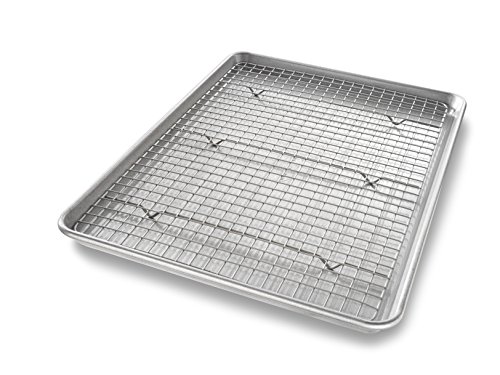
USA Pan Bakeware Half Sheet Pan and Bakeable Cooling Rack Set
Who it’s for: Roasters and fryers — anyone who cooks bacon in the oven, crisps wings, roasts on a rack, or cools cookies in quantity.
The rack is the sheet pan’s most useful partner, and this set pairs USA Pan’s coated half sheet with a bakeable rack that nests inside it. Raised on the rack, food cooks in moving air on all sides: bacon renders and crisps without swimming, chicken skin dries and browns, breaded cutlets stay crisp underneath instead of steaming against the pan. Out of the oven, the same rack becomes the cooling rack cookies need and the resting rack roasted meats deserve. The rack is oven-safe — the detail that separates a bakeable rack from a cooling-only rack, and the one to verify on any set you compare against this one — and the pan carries the same aluminized steel and silicone coating as the USA Pan pick above.
Price honesty for this pick is explicit: the set was last tracked at $32.91 in price-tracking records from earlier in 2026, and we could not verify a fresh November event price to this guide’s standard, so the table prints the tracked figure labelled as such rather than a sighting dressed up as current. The set is here because pan-and-rack bundles are classic mid-event discount items, and $32.91 is your anchor: a live price at or under it during Black Friday Week is a fair buy, and anything dramatically above it is the listing trading on the season. Check the live price, compare it against buying the pan and a rack separately, and let the arithmetic decide.
Honest limitation: The pan inherits the coating’s 450°F ceiling, which caps the hottest rack-roasting work, and a fitted rack is one more item to wash and store — households that never roast on a rack are buying the pan alone at a bundle’s price.
Choose it if oven bacon, wings and rack roasting are weekly events in your kitchen. Skip it if your rack would live unused — the standalone USA Pan above is the same pan without the passenger.
Nordic Ware Naturals 3-Piece Set — Half, Jelly Roll and Quarter Sheets
Who it’s for: Bakers whose work spans sizes — a half sheet for cookies, a quarter sheet for a small batch or a toaster oven, a jelly roll pan for bars and rolls.
A kitchen with only half sheets is a kitchen that heats a big pan to toast a handful of nuts. This set extends the Naturals construction — natural aluminum, encapsulated steel rims, US manufacture, lifetime warranty — across the three sizes home baking actually cycles through: the half sheet that anchors this guide, a jelly roll pan sized for Swiss rolls, bar cookies and smaller roasts, and a quarter sheet that fits toaster ovens and single-serving bakes and becomes, in most kitchens, the most-used pan of the three within a month. Buying the sizes as a set also buys consistency: same material behavior, same browning, same care routine, nested storage.
The set was spotted in the $36–$45 range in verified fall 2026 checks, and this guide prints that range honestly rather than a single invented figure; treat the top of the range as your ceiling anchor and the live price as the decision. During the event, compare the set’s live price against the sum of the sizes bought as singles — sets are discounted as units, singles are discounted as listings, and which route is cheaper flips from week to week. If the set’s live price lands near the bottom of its spotted range, it undercuts assembling the same three pans piecemeal in most scenarios.
Honest limitation: A set is only a deal if you will use all three sizes — a committed half-sheet-only baker is subsidizing two pans that will store the one they use. The jelly roll’s shallower profile also makes it a poor substitute for the half sheet in high-volume roasting, whatever the footprint suggests.
Choose it if your baking genuinely spans sizes, especially if a toaster oven shares your counter. Skip it if you bake one size of thing repeatedly — put the same money into a second two-pack of half sheets.
Comparison Table
| Product | Material | Best use | Price sighting | Link |
|---|---|---|---|---|
| Nordic Ware Half Sheet, 2-Pack | Natural aluminum | Everyday baking and roasting, best browning | Spotted at $35.00 on Nov 19, 2026 | Check on Amazon |
| USA Pan Half Sheet | Aluminized steel, silicone coating | Sticky bakes, easy release, up to 450°F | Spotted at $29.99 on Nov 19, 2026 | Check on Amazon |
| Silpat Half Sheet Mat | Silicone over fiberglass mesh | Cookies, candy, delicate bakes | Spotted at $17.49 on Nov 19, 2026 | Check on Amazon |
| Nordic Ware Half Sheet, Single | Natural aluminum | One-pan needs, price-comparison route | Spotted at $17.49 on Nov 19, 2026 | Check on Amazon |
| USA Pan Pan and Rack Set | Aluminized steel, silicone coating | Rack roasting, crisping, cooling | Last tracked at $32.91 — check live price | Check on Amazon |
| Nordic Ware 3-Piece Set | Natural aluminum | Multi-size baking, toaster ovens | Spotted in the $36–$45 range, fall 2026 | Check on Amazon |
How to Shop Black Friday Without Overpaying
Compare per-pan arithmetic, not package prices. This category sells the same pan as singles, pairs and sets on separate listings, each discounted independently — this guide lists a single and a pair of the identical pan for exactly that reason. Thirty seconds of division at the moment of purchase is the most reliable saving in bakeware.
Buy construction, not coatings with countdown timers. A bare aluminum pan at a modest discount outlives three novelty-coated pans bought cheap. During the event, spend on gauge, rim construction and material — the properties still working in ten years — and let the decorative finishes chase someone else.
Anchor with the sightings here. You now know the fair event level for each pick: $35 for the Nordic pair, about $30 for the coated USA Pan, $17.49 for the mat. A listing priced at its anchor is a buy; a listing dressed in sale graphics at well above its anchor is a regular price wearing a costume.
Mind the small-item stock pattern. Bakeware ships cheap and stocks deep, so most picks survive the full window — the exception is branded specialty stock like the genuine Silpat, which was observed flickering in and out of availability before the event. If your pick is the mat and it is in stock at its sighting, buy it then.
Check dimensions on every listing, every time. “Half sheet” should mean roughly 18 by 13 inches outside — but confirm the cooking surface and your oven’s interior, especially for older and countertop ovens. The cheapest pan is the one that fits; the most expensive is the one that almost does.
Common Mistakes
- Buying dark nonstick sheet pans for cookies and wondering why the bottoms scorch — light aluminum is the browning standard for a reason.
- Putting bare aluminum in the dishwasher and mourning the finish. The pan still works; the shine does not come back.
- Exceeding a coated pan’s temperature ceiling under the broiler, then blaming the coating for failing at a job it never claimed.
- Cutting on a silicone mat, or buying an imitation mat without the fiberglass core and concluding that mats do not last.
- Paying a bundle price for a set containing sizes you will never use, when the sizes you need are cheaper as singles that week.
- Assuming a rack in a set is oven-safe. Cooling racks and bakeable racks are different products; verify before the first roast.
- Stacking coated pans bare in the cupboard. A sheet of parchment or a cloth between them is the difference between a coating that lasts years and one that lasts months.
Final Recommendation
Start with the Nordic Ware two-pack at or near its $35.00 sighting — it is the foundation purchase of this category, the pan set most kitchens should have bought years ago, at its fair event price. Add the USA Pan if your baking runs sticky and you want release without fluoropolymer coatings, and add the Silpat the moment you find it in stock at its sighting, because it is the pick most likely to vanish mid-event. Buy the single Nordic listing instead of the pair whenever its live per-pan price wins the comparison, consider the rack set if you roast on a rack weekly, and take the three-piece set if your baking spans sizes. Bakeware rewards the unglamorous strategy: verified listings, honest anchors, per-pan arithmetic. Run that play and this is the category where Black Friday money works hardest and lasts longest.
Building a Sheet-Pan Setup Around How You Really Cook
Sheet pans look simple, and that simplicity is deceptive, because the pan you reach for daily has to serve roast vegetables on Monday, cookies on Wednesday, a tray of nachos at the weekend and a reheated slice without complaint in between. The picks in this guide are variations on that workhorse theme, and choosing well starts with your oven and your habits rather than with any single pan’s reputation. Measure your oven’s interior width and depth, allowing room for air to circulate around the pan, and confirm that the standard half sheet size genuinely fits with the door closed — most ovens take it easily, but compact and older ovens deserve the check. Then count how often you cook two trays at once, because that single habit decides whether a two-pack, a three-piece set or a single premium pan is the sensible core of your setup.
Think in terms of a small system rather than a single pan. A bare pan handles roasting and reheating. A fitted rack turns the same pan into a setup for crisping, draining and cooling. A liner — silicone or parchment — turns it into an easy-release baking surface for cookies and pastries and makes cleanup nearly effortless. The guides’ picks combine these elements in different proportions, and the best purchase is the combination that covers your weekly cooking with the fewest pieces left idle in the cupboard. A baker who roasts vegetables nightly and bakes monthly needs a different balance from a cookie baker who roasts twice a month, even though both are shopping the same shortlist.
Storage is the quiet constraint in bakeware. Flat pans stack well, but sets with racks and multiple sizes need a vertical slot, a deep drawer or a cabinet where they can stand without becoming a clattering excavation every time one is needed. If storage is awkward, fewer, better pieces that nest cleanly will serve you better than a larger set that lives in a pile. Decide where the pans will live before they arrive, and be honest about whether a third size will be used or merely stored. Bakeware is inexpensive compared with most kitchen purchases, which makes it easy to overbuy during a sale; the cost that matters is cupboard space, and that budget is fixed.
Bare Metal, Coated Pans and Liners: What Each Does Best
Bare aluminum is the traditional sheet-pan material for good reasons: it heats evenly, browns reliably, tolerates high heat including the broiler, and shrugs off metal utensils and years of hard use without a coating to protect. Its trade-off is that delicate foods can stick without a liner or a little fat, and acidic foods left sitting on it can pick up off flavours, so it rewards prompt washing. Coated pans answer with easy release and easy cleaning for everyday baking, at the cost of a heat ceiling, gentler utensil rules and a surface that will eventually wear. Neither is the correct choice for everyone; the honest answer is that many good kitchens keep both, using bare pans for high-heat roasting and broiling and coated pans or liners for cookies and cakes.
Silicone liners deserve a clear-eyed assessment. A quality liner gives cookies an even, gently browned base, releases without greasing, washes easily and replaces a steady consumption of parchment over its life. It is not the tool for high-heat roasting where direct contact and hard browning are the goal, and it should be kept away from direct broiler heat and from knives. Used for its strengths — baking, reheating delicate items, lining a pan under sticky glazes — it earns its place. Parchment remains the better choice for very high heat, for wrapping and for jobs where you want to lift food out in a sling. Owning a liner does not retire parchment; it reserves parchment for the jobs parchment does best.
Racks, Cooling and the Second Life of a Good Pan
A fitted rack multiplies what a pan can do. On the rack, food roasts with air on all sides, so wings, bacon and breaded items crisp underneath instead of steaming in their own juices. Off the heat, the same rack becomes a cooling station for cookies and bakes, a draining rest for fried food, and a glazing station where excess can drip cleanly into the pan below. If you choose a set with a rack, confirm it sits flat and stable in the pan and that its grid is fine enough for the foods you cook most. A rack that rocks or sags will be used once and abandoned, while a well-fitted one quietly becomes one of the most reached-for tools in the kitchen.
Washing, Warping and Making Pans Last
Most sheet-pan damage happens in the first minute after cooking. A hot pan plunged into cold water can warp with a bang, and a warped pan rocks on the rack, pools oil at one end and bakes unevenly forever after. Let pans cool a little before washing, or add warm water rather than cold to a hot pan. Heavy-gauge pans resist warping far better than thin ones, which is one of the real differences the picks in this guide embody, but no gauge enjoys thermal shock. Wash bare aluminum promptly after acidic or salty foods, dry it rather than leaving it to drain for hours, and accept the gradual darkening that comes with use — it is cosmetic, and many bakers find seasoned, darkened pans brown more eagerly than bright new ones.
For coated pans, protect the surface that protects your food. Use wooden, silicone or nylon tools, avoid cutting in the pan, wash with a soft sponge rather than an abrasive pad, and respect the heat ceiling in the listing and packaging, especially under the broiler, which is where coatings are most often destroyed in a single careless minute. Silicone liners wash in warm soapy water, dry fully before storing, and should be stored flat or rolled rather than folded sharply. Store pans with a cloth or a sheet of parchment between coated surfaces if you stack them, so rims and bases do not abrade each other in the cupboard. These are small disciplines, but bakeware bought well and kept well is measured in decades, not seasons.
How the Picks in This Guide Differ in Daily Life
The two-pack bare pan pick is the foundation purchase: two identical, hard-working pans that let you roast on one and prep on the other, or run a double batch of cookies without waiting. The single coated pan pick suits bakers who prioritise release and easy washing for everyday trays and are happy to observe its heat limits. The liner pick is an upgrade to pans you already own as much as it is a purchase in itself, transforming existing trays into non-stick baking surfaces. The pan-and-rack set is the roaster’s and crisper’s choice, and the multi-size set suits smaller ovens, toaster-oven households and cooks who scale recipes up and down and want a pan proportioned to each job rather than one size asked to do everything.
If you are choosing between two of these with a limited budget, prioritise the gap in your current kitchen rather than the largest headline saving. A kitchen with one tired, warped pan gains most from the two-pack. A kitchen with sound pans but constant sticking and scrubbing gains most from the liner or the coated pan. A kitchen that roasts meat and vegetables weekly gains most from the rack set. Sale pricing can make every option look urgent, but bakeware is a category where the right piece at an ordinary good price outperforms the wrong piece at a spectacular one, every week of the year.
More Questions Buyers Ask Before They Order
How many sheet pans does a home kitchen actually need?
Two half sheets cover the great majority of home cooking: one in the oven while the next tray is prepped, or two side by side for a crowd. Add a quarter sheet if you regularly cook small amounts, reheat single portions or use a countertop oven, because a right-sized pan heats faster and cleans easier than a large one used for a small job. Beyond that, extra pans should have a named job — a dedicated cookie rotation during big baking days, for example — rather than being bought simply because a set made them cheap. Named jobs get used; vague extras get stored.
Why do my pans darken, and should I scrub them bright again?
Darkening is polymerised oil and honest use, and on bare pans it is harmless and even helpful for browning. Aggressive scrubbing back to showroom brightness costs effort, scratches surfaces and achieves nothing for the food. Clean pans so they are free of grease, residue and odour, and let the colour tell the story of a working kitchen. The exception is a coated pan whose surface is flaking or a liner that stays sticky or smelly after a thorough wash — those are wear, not seasoning, and they are the signs that a piece has reached the end of its useful life.
Can I use these pans for cooking under a countertop oven or air fryer setting?
Only if the pan’s size genuinely fits with clearance on all sides, because a pan that blocks airflow defeats the very circulation that makes those modes work, and a pan touching the walls or elements is a safety problem, not a bargain. Smaller sizes from a multi-piece set are the natural fit for countertop ovens. Check the fit with the door closed and the rack in its usual position, and leave room to remove the hot pan with mitts on. If the fit is marginal, use the oven the pan was sized for and let the countertop appliance do the jobs its own tray handles well.
A Realistic First Month With New Bakeware
New pans reveal themselves quickly if you give them a fair rotation. In the first weeks, run each new piece through its intended work and one stretch assignment: roast vegetables hard on the bare pan, bake a batch of cookies on the liner or coated pan, crisp something fatty on the rack, and reheat leftovers on whichever piece is nearest. Notice where food browns fastest, whether your oven runs hotter at the back — most do, and rotating a pan halfway through is a habit, not an admission of defeat — and how each piece washes up after its messiest job. By the end of the month you will know your pans’ characters the way you know a good knife’s balance, and you will reach for the right one without thinking. That fluency, more than any single feature, is what a well-chosen bakeware purchase actually buys, and it is why a modest set of the right pieces outperforms a large set of pieces whose differences you never learned.
One last practical note on oven habits that protect both pans and results. Preheat fully before a tray goes in, because a pan placed in a climbing oven bakes unevenly no matter how good its gauge. Use the middle rack as your default and learn your oven’s hot spots by rotating trays halfway through longer bakes rather than blaming the pan for an oven’s character. Set hot pans down on a trivet or a wooden board, never on a cold stone worktop or a wet cloth, both of which invite warping and, on a worktop, damage. And when a bake is finished, move the food off the hot pan promptly if it will continue cooking in the residual heat — a small timing habit that separates bakers who trust their pans from bakers who wonder why the bottoms are always a shade darker than the tops.
Keep a simple note, after your first few bakes, of the rack position, temperature and timing that suited each pan in your particular oven. Ovens vary more than recipes admit, and that small record removes guesswork from every future bake, letting the pans in this guide deliver the same reliable result in your kitchen that they were chosen to deliver in the first place.
Frequently Asked Questions
When do bakeware Black Friday deals run in 2026?
Amazon Black Friday Week runs Nov 19–30, 2026, with Black Friday on Nov 27 and Cyber Monday on Nov 30. Bakeware offers rotate across the window rather than concentrating on one day, so the sightings in this guide are anchors for checking the live price whenever you shop during the event.
Is bare aluminum or nonstick better for a sheet pan?
They do different jobs. Bare aluminum browns most evenly, tolerates any oven temperature and lasts effectively forever, but releases nothing. A silicone-coated pan like the USA Pan releases sticky foods cleanly within its 450°F ceiling, at the cost of a coating that ages. Most serious bakers own one of each and choose by recipe.
What size is a half sheet pan?
Roughly 18 by 13 inches outside — the Nordic Ware in this guide measures about 17.9 by 12.9 inches externally with a cooking surface near 17.1 by 12.1 inches. It is the largest sheet that fits most home ovens, which is why it is the category’s standard size.
Is a Silpat worth it over parchment paper?
For frequent bakers, yes: a genuine fiberglass-core Silpat lasts for years of regular use, lies flat, and releases delicate bakes parchment can tear on. At its spotted event price, one mat displaces a great deal of parchment. Occasional bakers who roast more than they bake can reasonably stay with paper.
Why does this guide list the same pan twice?
Because the single and the two-pack are separate Amazon listings with independent sale pricing. In some windows two singles undercut the pair; in others the pair wins. Listing both, with the comparison rule, is how a shopper captures whichever discount the event is actually offering.
Can these pans go under the broiler?
The bare aluminum Nordic Ware pans can handle broiler heat. The coated USA Pan cannot — its ceiling is 450°F — and the Silpat should be kept away from direct broiler contact. Match the tool to the job rather than learning the ceiling from a ruined coating.
Related guides:
- Best Stand Mixer Under $300
- Best Duvet Insert Under $100
- Best Dresser Under $300
- Best Comforter Under $200