Disclosure: topratedkitchenware.com is reader-supported. When you buy through links on our site, we may earn an affiliate commission from Amazon and other retailers, at no extra cost to you.
Where to buy
This guide to the best 24 volt solar battery options links four genuine deep-cycle storage batteries — all true 24-volt LiFePO4 units whose titles name solar service — and covers two small 24-volt hobby packs as prose-only entries, because a battery that runs a ride-on car is not a battery that stores a house’s sunlight. The four linked picks span the real decision in this category: three 100Ah units with different documented strengths, and one very large 314Ah unit for serious off-grid capacity.
- dumfume 24V 100Ah LiFePO4 Lithium Battery
- Qwenoer 22.2V-24V 10Ah Lithium Battery Pack — prose-only, a small ride-on and DIY pack, not solar storage
- Xeanerol 24V 5Ah Lithium Battery — prose-only, an RC and LED pack whose title does not mention solar at all
- yeagulch 24V 100Ah LiFePO4 Lithium Battery
- Dyness 24V 100Ah LiFePO4 Lithium Battery
- yeagulch 24V 314Ah LiFePO4 Lithium Battery
Read the full guide ↓ for the detailed reviews, the storage sizing maths, and the controller and charging checks that decide whether a solar bank thrives or quietly underperforms for a decade.
A solar battery is a promise made to the evening. Panels produce when the sun shines; life happens around the clock; the best 24 volt solar battery is the device that stands between those two facts, absorbing the day’s surplus and handing it back after dark without complaint, thousands of times. That duty — a deep discharge most days, a full recharge whenever the weather allows, for years — is the most demanding routine in the battery world, and it is why solar storage is a category of its own rather than a use you improvise with whatever battery happens to be charged.
Twenty-four volts is the classic voltage of the serious small solar system: the cabin, the workshop, the off-grid home’s first bank, the larger RV installation. It is high enough to keep currents and cable costs civilised between panels, controller, battery, and inverter, and modest enough to stay in the world of widely available, reasonably priced equipment. The batteries that serve it must be deep-cycle by design, lithium iron phosphate by the current consensus, protected by a management system that understands daily cycling, and honest about their capacity, because a solar bank is sized by arithmetic and punished by optimism.
This guide reviews the four verified batteries that meet that description, compares them on the documented details that actually separate them, and deals honestly with the two small packs that share the voltage and nothing else. If your project touches the water as well as the roof, the companion guide at Best 24 Volt Trolling Motor Battery covers the same battery class in propulsion service, and many readers building a dock-and-cabin system will find the two guides describe one shared bank.
Key Takeaways
- Four picks are linked, all true 24-volt LiFePO4 deep-cycle batteries with solar named in their titles: dumfume 100Ah, yeagulch 100Ah, Dyness 100Ah, and yeagulch 314Ah.
- The three 100Ah units each store 2560Wh. Choose between them on documented details: a stated waterproof rating and certifications, an explicit multi-system use list, or stated expansion connections and a stated design lifetime.
- The 314Ah unit stores 8038.4Wh with a 200A BMS — a different scale of system, for buyers whose load audit demands it, not a default upgrade.
- Two small 24-volt packs are prose-only: neither is deep-cycle storage, and one does not mention solar in its title at all.
- Size a solar bank in watt-hours from a written load audit, then confirm the charge controller’s lithium profile and voltage before the battery, not after.
In this guide
Quick Picks
| Pick | Badge | Why it is here | Link |
|---|---|---|---|
| dumfume 24V 100Ah LiFePO4 | Best Overall for 24V Solar Banks | True 24V storage with certifications and a waterproof rating stated, for banks that live in sheds, boats, and cabins alike. | Check on Amazon |
| Qwenoer 22.2V-24V 10Ah Lithium Pack | Best for Ride-On and DIY Projects | A small li-ion pack with charger and bare leads for ride-on cars and bench electronics. | Prose-only — not deep-cycle storage |
| Xeanerol 24V 5Ah Lithium Battery | Best for RC and LED Projects | A compact pack with fast charger for RC cars, LED strips, and CCTV. | Prose-only — no solar use stated |
| yeagulch 24V 100Ah LiFePO4 | Best Cross-Over Storage Pick | True 24V storage whose stated world spans solar, off-grid, RV, marine, and trolling — one battery, several systems. | Check on Amazon |
| Dyness 24V 100Ah LiFePO4 | Best Documented Expansion Path | States 4P2S connection up to 20.48kWh and a 10-year lifetime, for banks designed to grow. | Check on Amazon |
| yeagulch 24V 314Ah LiFePO4 | Best High-Capacity Pick | 8038.4Wh in a single 24V unit with a 200A BMS, for large off-grid loads. | Check on Amazon |
How These Picks Were Chosen
We built this shortlist from a verified research pool checked through the Amazon Creators API, so every voltage, capacity, energy figure, and feature in this guide traces to a real listing title. We then applied the filters a solar installer would: the battery must be a true 24-volt unit, because controllers and inverters are chosen for a system voltage and admit no improvisation; it must be deep-cycle, because daily cycling destroys anything else; and solar service must be part of its documented purpose, because a battery’s stated world is the best public evidence of how its maker designed and supports it.
Four batteries passed cleanly, and the interesting work was separating them, because on headline numbers the three 100Ah units are near-identical: same voltage, same capacity, same 2560Wh, same 100A-class management. The separation lives in the documented details. One states a waterproof rating and two certifications. One states the widest cross-system use list in the pool. One states its expansion topology and a design lifetime in years. And the fourth pick breaks the pattern entirely on scale, offering more than three times the energy in a single case with a doubled management rating. Those documented differences, not invented ones, structure the reviews below.
The two prose-only picks failed the duty test in instructive ways. The Qwenoer pack’s title does mention solar panels — among ride-on cars, LED strips, and CCTV cameras, in the hobby sense of a small panel topping up a small pack. That is a real and pleasant use, and it is not storage for a 24-volt solar system in any sense a system designer would recognise; a 10Ah non-deep-cycle pack cannot cycle daily for a cabin. The Xeanerol pack does not claim solar at all. Both are reviewed fully and unlinked, because they will appear in your searches and deserve an honest label when they do. This guide is research-led, claims no hands-on testing, and prints no prices or fixed ratings, which change constantly on marketplace listings; check the latest price on Amazon for any pick you shortlist.
The 6 Best 24 Volt Solar Battery Options, Reviewed Honestly

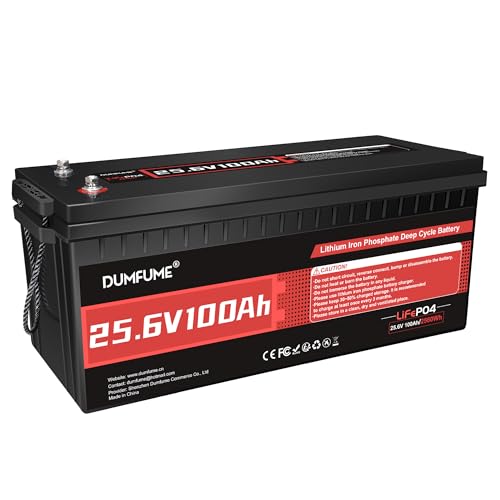
dumfume 24V 100Ah LiFePO4 Lithium Battery
Badge: Best Overall for 24V Solar Banks
Strengths
- A true 24-volt, 100Ah, 2560Wh deep-cycle storage battery in a single case, with a built-in 100A BMS — the standard building block of a 24V solar bank.
- UN38.3 and UL1973 certifications are stated in the title, the strongest public evidence in this guide that a design passed standardised safety testing.
- An IP65 waterproof rating is stated, which matters for banks installed in sheds, garages, boat cabins, and other honest, unconditioned spaces.
Trade-offs
- The title does not state an expansion topology, so buyers planning a multi-unit bank should confirm series and parallel limits on the current listing.
- 2560Wh is one building block, not a whole off-grid house; most homes will plan around several units or the larger pick below.
- Low-temperature cutoff protection is stated, which is correct and necessary, but it means a freezing battery room will pause charging until it warms.
Spec box (from the verified listing title): Voltage 24V; Capacity 100Ah; Energy 2560Wh; BMS 100A built in; Stated cycles 15000 deep cycles; Low-temperature cutoff protection stated; Waterproof rating IP65 stated; Certifications UN38.3 and UL1973 stated; Stated uses include RV, marine, solar, and off-grid.
For the typical 24-volt solar installation — a cabin system, a workshop bank, a serious RV setup — this is the default recommendation, and its case rests on evidence rather than adjectives. The core numbers are exactly the class standard, delivered in one sealed unit that needs no pairing discipline. Around those numbers sits the documentation a careful buyer wants: named certifications indicating laboratory-tested safety behaviour, and a waterproof rating that acknowledges where solar batteries actually live. Not in climate-controlled laboratories, but in the shed by the panels, the locker under the berth, the garage wall by the inverter.
In daily solar service, what you are buying is a discharge curve and a protection system. The curve, as with all lithium iron phosphate storage, stays usefully flat through most of the bank’s capacity, so an inverter sees steady voltage from dusk until deep in the night rather than the long sag of a lead-acid evening. The protection system watches current, temperature, and cell behaviour while you ignore the bank entirely, which is the correct relationship between a homeowner and a storage battery. The stated cycle figure is best read as design intent — a battery built to be cycled daily for years — and the low-temperature cutoff as the one behaviour you must plan around, by siting the bank somewhere that does not freeze hard, or accepting paused charging on the coldest mornings.
Its honest limitation is documentation, not capability: where the Dyness pick below prints its expansion scheme in the title, this one does not, so a buyer designing a growing bank should verify parallel limits on the live listing before committing to a multi-unit plan.
Best for: standard 24V solar banks in cabins, workshops, RVs, and boats that want certified, sealed simplicity / Not suited for: buyers who need a stated multi-unit expansion scheme confirmed before purchase
Check on Amazon to see the current listing for the dumfume 24V 100Ah LiFePO4, confirm expansion limits and dimensions, and read the most recent owner feedback.
Qwenoer 22.2V-24V 10Ah Lithium Battery Pack
Badge: Best for Ride-On and DIY Projects
Strengths
- A genuine 24-volt-class li-ion pack with its own matched 25.2V 2A charger included.
- Bare leads and a cable connector make it a friendly component for DIY builds, LED installations, and CCTV backup.
- Its title does list solar panels among its uses — in the small-scale sense of a hobby panel keeping a small pack topped up.
Trade-offs
- It is not a deep-cycle battery. Daily deep cycling, the defining duty of solar storage, is outside its design.
- 10Ah is roughly a twenty-fifth of one linked pick’s capacity; it cannot store a system’s day in any meaningful sense.
- Hobby construction and connectors are not made for permanent installation in a power system.
Spec box (from the verified listing title): Voltage 22.2V-24V; Capacity 10Ah; Chemistry li-ion; Charger 25.2V 2A included; Connection bare leads wire with cable connector; Stated uses include kids’ ride-on cars, DIY projects, solar panels, LED light strips, and CCTV cameras.
There is a version of solar this pack genuinely serves: the garden light controller, the gate camera, the small panel on a shed roof keeping a light strip alive. At that scale — a panel, a pack, a modest load — it is a complete and likeable kit, charger included, and we have no quarrel with it. The quarrel is only with scale confusion. A 24-volt solar system, the subject of this keyword, moves thousands of watt-hours a day through equipment that costs real money and serves real needs. Inserting a 10Ah hobby pack into that conversation is like offering a water bottle as a rain tank: same substance, wrong universe.
It stays in this guide, unlinked and plainly labelled, because search results will offer it to you under this keyword’s voltage, and because its presence sharpens the definition of the real picks. When a battery’s title leads with ride-on cars, believe it. Buy it for the workbench and the toy box, where it will serve happily for years.
Best for: ride-on cars, DIY electronics, LED strips, CCTV backup, and hobby-scale solar gadgets / Not suited for: solar storage in any 24V system
Xeanerol 24V 5Ah Lithium Battery
Badge: Best for RC and LED Projects
Strengths
- A compact, genuine 24-volt li-ion pack supplied with a 2A fast charger and cable connector.
- Honestly marketed: its title names RC cars, LED strips, CCTV, and DIY projects, and claims nothing it is not.
- Light enough for portable and model applications where deep-cycle batteries would be absurd.
Trade-offs
- Its title does not mention solar at all; there is no reading of it that makes it a solar battery.
- 5Ah is the smallest capacity in this guide by a wide margin.
- No deep-cycle design is stated or should be inferred.
Spec box (from the verified listing title): Voltage 24V; Capacity 5Ah; Chemistry li-ion; Charger 2A fast charger included; Connection cable connector; Stated uses include 24-volt DIY projects, RC cars, LED light strips, and CCTV cameras.
The Xeanerol pack is the guide’s shortest review because there is the least to argue about. It is a tidy little hobby battery that makes no solar claim whatsoever, and it appears under this keyword for one reason only: a search engine matched its voltage to your question. We include it so that the match comes with an explanation attached. In its own world of radio-controlled cars and light strips it is a complete, sensibly priced-looking kit — though we print no prices, its class is the modest end of the battery world — and its maker deserves credit for a title that describes it truthfully.
For a solar buyer, its function here is purely calibrating. Set its 5Ah beside the 100Ah and 314Ah storage batteries below and the category’s scale becomes physical rather than abstract. Storage is measured in days of a household’s life; this is measured in laps of a model car. Both are legitimate. Only one belongs in this guide’s links.
Best for: RC cars, LED strips, CCTV, and small DIY projects / Not suited for: solar storage or any system duty
yeagulch 24V 100Ah LiFePO4 Lithium Battery
Badge: Best Cross-Over Storage Pick
Strengths
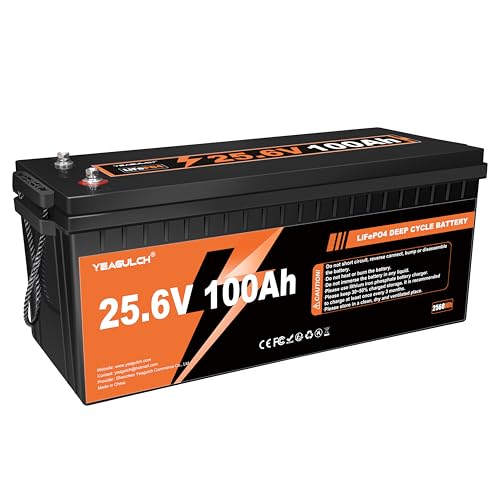
- A true 24-volt, 100Ah, 2560Wh deep-cycle storage battery with a built-in 100A BMS and low-temperature cutoff protection.
- Its stated world is the widest in this guide — trolling motors, off-grid, solar, RV, and marine — which suits owners whose battery serves several systems across a year.
- UN38.3 and UL1973 certifications and a stated 15000+ deep-cycle figure match the class leaders on documented evidence.
Trade-offs
- No waterproof rating is stated in the title, unlike the dumfume pick; site it in a dry enclosure if the installation is exposed.
- No expansion topology is stated in the title, so multi-unit plans need confirmation on the current listing.
- A generalist’s documentation is broad rather than deep on any single application, solar included.
Spec box (from the verified listing title): Voltage 24V; Capacity 100Ah; Energy 2560Wh; BMS 100A built in; Stated cycles 15000+ deep cycles; Low-temperature cutoff protection stated; Certifications UN38.3 and UL1973 stated; Stated uses include trolling motors, off-grid, solar, RV, and marine.
Some buyers own one system. Others own a small fleet of them — a cabin bank in summer, an RV that travels in autumn, a boat that fishes in spring — and for those owners a battery documented for all of those worlds has a practical charm beyond its specification. This yeagulch unit is that battery in this guide: identical core numbers to its 100Ah rivals, the same certifications, the same cold protection, and a use list that reads like a year in the life of an outdoors household. If your 24-volt bank will migrate, or if you simply refuse to buy three near-identical batteries for three near-identical jobs, this is the pick that understands you.
As pure solar storage it gives up nothing on the numbers. The daily cycle duty is the same, the inverter sees the same flat discharge curve, and the protection system does the same quiet work. What you trade away, against the dumfume, is a stated waterproof rating; against the Dyness, a stated expansion scheme. Both trades are about documentation rather than demonstrated capability, and both can be checked on the live listing in a minute. Weigh them by your installation: a dry indoor battery room forgives the first, and a single-unit bank never tests the second.
Best for: owners whose 24V battery serves solar plus RV, marine, or off-grid duty across the year / Not suited for: exposed installations where a stated waterproof rating is required
Check on Amazon to see the current listing for the yeagulch 24V 100Ah LiFePO4, confirm expansion limits and dimensions, and read the most recent owner feedback.

Dyness 24V 100Ah LiFePO4 Lithium Battery
Badge: Best Documented Expansion Path
Strengths
- The title states its expansion plainly: 4P2S connection up to 20.48kWh, the clearest growth path documented in this guide.
- A stated 10-year lifetime frames the purchase as infrastructure, which is how a solar bank should be bought.
- Core numbers match the class: 24V, 100Ah, 2560Wh, a smart 100A BMS, and deep-cycle design for marine, RV, and solar service.
Trade-offs
- Its stated cycle figure, 4000+ deep cycles, is lower on paper than the 15000-class figures elsewhere in this guide; read all such figures as manufacturer claims under differing test conditions, not as a league table.
- No waterproof rating or named certifications are stated in the title, so the evidence file is thinner than the dumfume pick’s.
- A bank designed around its expansion scheme commits you to this model family for future units.
Spec box (from the verified listing title): Voltage 24V; Capacity 100Ah; Energy 2560Wh; BMS smart 100A; Stated cycles 4000+ deep cycles; Stated lifetime 10 years; Expansion 4P2S connection up to 20.48kWh; Stated uses include marine, RV, and solar.
Solar systems grow. The cabin gains a fridge, the workshop gains a freezer, the array gains two panels in a good year — and the bank that was generous in year one is rationing by year three. The Dyness pick is the guide’s answer to that biography: a standard 100Ah building block whose maker states, in the title itself, exactly how far the block can be multiplied — a 4P2S arrangement reaching 20.48kWh, which is whole-house-backup territory at 24 volts. A buyer can design the conduit runs, the bus bars, and the battery shelf for the final system today, and populate it over time, which is how infrastructure is supposed to work.
The stated 10-year lifetime deserves its balanced reading. It is a design-life statement, not a measurement, and it sits alongside a cycle figure more conservative than its rivals’ headline numbers. One honest way to read that combination is as a maker quoting the modest end of its expectations; another is as differing test conditions across brands. Either way, the correct response is the same: treat cycle and lifetime figures as soft evidence, lean on the hard numbers — voltage, capacity, energy, BMS rating, expansion topology — and let the bank’s architecture, which this pick documents best in class, carry the decision.
Best for: growing off-grid systems that want a stated expansion path and infrastructure framing / Not suited for: buyers who rank named certifications and waterproof ratings above expansion documentation
Check on Amazon to see the current listing for the Dyness 24V 100Ah LiFePO4, confirm the expansion details, and read the most recent owner feedback.

yeagulch 24V 314Ah LiFePO4 Lithium Battery
Badge: Best High-Capacity Pick
Strengths
- 8038.4Wh in a single 24-volt unit — more than three of the 100Ah picks combined, with no parallel wiring or balance management between units.
- A 200A BMS doubles the class-standard current ceiling, suiting larger inverters and heavier simultaneous loads.
- UL 1973 and UN38.3 certifications and low-temperature protection are stated, and the use list spans solar, backup power, and off-grid alongside marine and RV.
Trade-offs
- Scale cuts both ways: this is a heavy, substantial unit that needs a planned location, a strong shelf or floor position, and a two-person lift.
- Capacity you do not use is money stored on a shelf; a load audit that ends at 2560Wh should buy a 100Ah pick instead.
- One large unit concentrates risk exactly as one small one does, only larger — a failure darkens a bigger system.
Spec box (from the verified listing title): Voltage 24V; Capacity 314Ah; Energy 8038.4Wh; BMS 200A; Stated cycles 15000+ deep cycles; Certifications UL 1973 and UN38.3 stated; Low-temperature protection stated; Stated uses include trolling motors, RV, marine, solar, backup power, and off-grid.
Every category has a pick that ends an argument, and in this guide it is this one. A single battery storing over eight kilowatt-hours at 24 volts, protected by a 200A management system, replaces what used to be a wall of lead-acid or a small committee of lithium units, and it does so with one set of terminals and one protection brain. For the off-grid home whose audit genuinely lands in this territory — refrigeration, water pumping, lighting, communications, and a margin for the grey week — it converts a complicated bank design into a single purchase and a single installation.
The discipline this pick demands is honesty in the audit. Eight kilowatt-hours is a commitment: of money, of floor space, of charging capacity, because a bank this size needs an array and controller combination that can actually refill it in a reasonable number of sun hours, or it becomes a very large battery that lives half-charged. Buy it when the maths says so — the sizing section below shows the maths — and it will feel less like an expense than like the day the system stopped needing your attention. Buy it on ambition alone and it will feel like a monument. The battery is superb either way; only the fit changes.
Best for: large off-grid homes, serious backup systems, and high-load 24V installations with a real load audit behind them / Not suited for: cabins and RVs whose honest audit ends at one 100Ah unit
Check on Amazon to see the current listing for the yeagulch 24V 314Ah LiFePO4, confirm dimensions and weight, and read the most recent owner feedback.
Comparison Table
| Pick | Badge | Voltage and capacity (from listing title) | Key stated features | Link |
|---|---|---|---|---|
| dumfume 24V 100Ah LiFePO4 | Best Overall for 24V Solar Banks | 24V, 100Ah, 2560Wh | 100A BMS; IP65 stated; UN38.3 and UL1973 stated | Check on Amazon |
| Qwenoer 22.2V-24V 10Ah Pack | Best for Ride-On and DIY Projects | 22.2V-24V, 10Ah | Charger included; bare leads; hobby uses stated | Prose-only |
| Xeanerol 24V 5Ah Pack | Best for RC and LED Projects | 24V, 5Ah | Fast charger included; RC and LED uses stated | Prose-only |
| yeagulch 24V 100Ah LiFePO4 | Best Cross-Over Storage Pick | 24V, 100Ah, 2560Wh | 100A BMS; 15000+ cycles stated; solar and off-grid stated | Check on Amazon |
| Dyness 24V 100Ah LiFePO4 | Best Documented Expansion Path | 24V, 100Ah, 2560Wh | Smart 100A BMS; 4P2S to 20.48kWh stated; 10-year lifetime stated | Check on Amazon |
| yeagulch 24V 314Ah LiFePO4 | Best High-Capacity Pick | 24V, 314Ah, 8038.4Wh | 200A BMS; 15000+ cycles stated; UL 1973 and UN38.3 stated | Check on Amazon |
How to Choose a 24 Volt Solar Battery
Everything in solar storage follows the load audit, so do it on paper before you look at a single listing. List every load the bank must serve, its power draw, and its honest hours of daily use; multiply, add, and you have your daily watt-hour requirement. Then decide your autonomy — how many sunless days the bank should bridge — and multiply again. That final figure, compared against 2560Wh per 100Ah unit and 8038.4Wh for the large pick, is your shortlist written by arithmetic rather than by hope. Most disappointments in off-grid power are born in this step, where optimism quietly halves a number it should have doubled.
Next, match the charging side to the storage side. Your array and charge controller must be able to return a day’s usage in a day’s sun, at the bank’s voltage, with a lithium charge profile the controller genuinely supports — not a lead-acid profile with the label changed. Controller current, panel configuration, and cable sizes all follow from the bank you choose, which is why the battery decision comes early in a system design and why a stated expansion path, like the Dyness pick’s, is worth real money to anyone whose loads will grow: the bank can scale without redesigning the room it lives in.
Finally, weigh the environmental and evidentiary details. Site the bank where it will not freeze hard, because low-temperature charge protection — correctly — pauses charging below freezing; a battery room that dips briefly is fine, a bank in an unheated shed at altitude needs thought. Prefer named certifications where the documented record otherwise ties. And remember that these same batteries often serve the rest of a property’s 24-volt life: the cross-over pick’s stated world is a hint that one bank design can cover cabin, RV, and boat, a consolidation the disconnect and protection discussion at Best 24 Volt Trolling Motor Battery Disconnect Switch complements for the marine side of such a system.
How to Install, Configure, and Live With a 24V Solar Bank
Installation is a chain, and the battery is its middle link. Panels feed a charge controller; the controller feeds the bank; the bank feeds an inverter and any direct DC loads; protection — fuses or breakers sized to the cables — guards each junction. Mount the battery secured, ventilated as its maker directs, with terminals covered and cable runs short, thick, and protected. Commission in order: controller first, programmed with the lithium profile and the 24-volt system voltage before the panels are connected, so the bank never sees an unconfigured charge source. Then watch the first full cycle — a sunny day’s charge, an evening’s discharge — and confirm the system behaves as the audit predicted. That one observed cycle teaches more than a month of specification reading.
Living with the bank is mostly a matter of not interfering. Lithium iron phosphate asks for no watering, no equalisation rituals, no ventilation for charging gases in normal service. Keep the space dry, keep connections tight with an annual check, keep firmware and monitoring habits if your equipment offers them, and let the management system do the watching it was built for. In winter at a seasonal property, follow the maker’s storage guidance — typically a partial state of charge, disconnected, somewhere that does not freeze hard.
Troubleshooting follows the pattern. Problem: the bank never reaches full on sunny days → the array or controller is undersized for the loads, or the controller’s profile is wrong; audit loads first, settings second, hardware last. Problem: charging stops on cold mornings → low-temperature protection is working; warm the battery space and confirm charging resumes. Problem: the inverter alarms under a heavy load that used to be fine → check connections for looseness or corrosion before suspecting the battery, and confirm the load sits within the BMS ceiling of your pick. Owners migrating from the cell-level hobby world sometimes ask how these complete batteries relate to the cells discussed at Best 37 Volt 18650 Battery and Best 37 Volt 18650 Rechargeable Batteries; the practical answer is that a solar bank is a sealed, managed system, bought and serviced as a unit — its engineering is precisely what you are paying for.
Why LiFePO4 Won Solar Storage
A decade ago this guide would have been about lead-acid, and the sizing maths would have included the rule that only half a bank could be used without damaging it. Lithium iron phosphate changed the category on three axes at once: usable capacity, because the bank can be cycled deeply as a routine rather than an insult; cycle life, because daily cycling is the design case rather than the abuse case; and temperament, because the chemistry is the most thermally forgiving of the lithium family, which matters in a box that lives in a shed. Its costs are the purchase price, the freezing-charge restriction, and the need for electronics that speak its language. For a system that cycles daily for a decade, the exchange has proven itself so thoroughly that the remaining lead-acid arguments are mostly about very small or very rarely used systems — a fair position, honestly held, and not the position of this keyword.
Daily Cycling: The Life a Solar Bank Actually Lives
It helps to picture the bank’s ordinary Tuesday. Dawn finds it at whatever depth the night’s loads reached — the fridge’s cycles, the lights, the pump. The array wakes, the controller begins returning energy, and by early afternoon on a decent day the bank is full and the surplus is either used opportunistically or simply not harvested. Evening draws it down again. That unglamorous loop, repeated three hundred days a year, is the entire job, and it explains every design feature this guide has emphasised: deep-cycle construction because the discharge is deep, a management system because nobody watches a Tuesday, cold protection because some Tuesdays are in January, and a cycle figure quoted in the thousands because the arithmetic of daily use demands thousands.
It also explains the ownership psychology that separates happy solar households from frustrated ones. The happy ones sized for the grey week, not the golden one, and treat a full battery at noon as the system idling correctly rather than as wasted sunshine. The frustrated ones sized for the brochure day and spend winter rationing. Every pick in this guide can serve either household; the audit decides which household you are. Do the audit in writing, in winter numbers, and the bank you buy will feel generous for a decade. Skip it, and no battery at any capacity will feel like enough.
Pairing Panels, Controller, and Bank Without Bottlenecks
A solar system is a chain of rates, and the slowest link sets the day’s harvest. Panels produce what their rating and the sky allow; the controller can only pass the current it is rated for, at the system voltage you configured; the bank can only accept charge within its management system’s limits and its own appetite, which tapers as it fills. Buyers routinely discover a bottleneck a season late — an array expanded onto a controller already at its ceiling, or a large bank whose refill time exceeds the available sun even in June. The 314Ah pick makes the point sharply: its 8038.4Wh is a genuine asset only behind an array and controller combination that can return a day’s draw in a day’s light, and the honest system designer checks that pairing on paper before the battery is ordered, not after the first disappointing week.
The practical sequence is therefore: audit the loads, choose the bank, then size the array to refill the bank’s daily draw with margin in your worst generating month, then choose a controller that handles that array at 24 volts with a true lithium profile and headroom to spare. Each step constrains the next, and the battery — this guide’s subject — is correctly the second decision, not the first and never the afterthought. Systems designed in that order tend to disappear into the background of a household’s life, which is the highest compliment off-grid equipment can earn.
Common Buying Mistakes
- Sizing from hope instead of an audit. Write the loads down, multiply honestly, and add autonomy. The arithmetic is the design.
- Buying capacity the array cannot refill. A huge bank behind a small array lives half-charged and disappoints daily. Size both sides together.
- Ignoring the controller’s lithium profile. A 24V bank needs a controller that genuinely supports lithium charging at 24 volts, configured before connection.
- Treating a hobby pack as storage. Correct voltage, wrong everything else. Deep-cycle design is the price of admission to this category.
- Siting the bank where it freezes. Low-temperature protection will pause charging to protect the cells. Site thoughtfully and the protection never has to speak.
- Comparing cycle claims as a league table. Figures come from differing manufacturer test conditions. Compare hard specifications first.
Final Recommendation
Start with the dumfume 24V 100Ah (Check on Amazon): the class-standard building block with the strongest documented evidence file — named certifications and a stated waterproof rating — for the cabins, workshops, and RVs that make up most 24-volt solar. Choose the Dyness 100Ah instead when the system will grow, because its stated expansion path to 20.48kWh is a plan you can build around. Choose the yeagulch 100Ah when the same battery must also live a marine, RV, or trolling life across the year. And choose the yeagulch 314Ah when, and only when, a written load audit says the system needs eight kilowatt-hours in a single unit — at which point nothing else in this guide will do. The two small packs, bought for their ride-on cars and RC benches, will be perfectly happy; just never ask them to hold up a household’s evening.
Frequently Asked Questions
How big a solar battery does a cabin need?
It depends entirely on the load audit. A lights-and-laptops cabin may live well on a single 2560Wh unit; a cabin with refrigeration, pumping, and entertainment loads will land at two or more units, or the 314Ah class. Write the loads down and multiply by hours and autonomy days — the audit, not a rule of thumb, gives the answer.
Can I add more batteries to my 24V bank later?
Yes, within the manufacturer’s stated limits — which is why stated expansion documentation matters. The Dyness pick states a 4P2S path to 20.48kWh in its title. For other picks, confirm parallel and series limits on the current listing, and add units of the same model, ideally close in age.
Why do all the 100Ah picks store exactly 2560Wh?
Because watt-hours are volts multiplied by amp-hours: 24 volts times 100 amp-hours, with the small variations of nominal voltage rounding, lands at about 2560Wh for every honest battery in the class. It is a useful check — a listing whose energy figure disagrees with its own voltage and capacity deserves a second, slower read.
Will a 24V solar battery charge in winter?
It will discharge happily in the cold, but charging below freezing is restricted for all lithium batteries, and the linked picks state low-temperature cutoff protection that enforces this. Site the bank somewhere sheltered from hard freezes, and short winter days become a capacity question rather than a safety one.
Can the same battery serve my solar bank and my boat?
The cross-over pick in this guide is documented for exactly that double life, and many owners do move a bank seasonally. Treat the moves kindly — secure mounting in both homes, correct chargers in both, and a disconnect in the marine installation — and a single battery can serve two systems honestly.
How long does a 24V solar battery take to pay attention to, day to day?
Almost none, and that is by design. A correctly sized and configured lithium bank asks for an occasional glance at its state of charge, an annual check of connections, and shelter from hard freezes. Owners coming from lead-acid, with its watering schedules and corrosion rituals, often report that the strangest part of lithium ownership is how little of it there is. The work moved to the beginning — the audit, the sizing, the configuration — which is exactly where this guide has tried to put your attention too. Spend your effort there, in the planning week, and the following decade of evenings, winters, and grey weeks will mostly take care of themselves, which is all anyone has ever honestly wanted from a battery.
What charge controller does a 24V lithium bank need?
One rated for a 24-volt system with a genuine lithium iron phosphate charge profile, sized to your array’s current. Configure the profile before connecting the bank. The battery’s management system is a safeguard layered under correct charging equipment, never a replacement for it.