Disclosure: topratedkitchenware.com is reader-supported. When you buy through links on our site, we may earn an affiliate commission from Amazon and other retailers, at no extra cost to you.
Where to buy
Every linked pick in this guide to best and worst air fryers is listed on Amazon, where you can check the latest price on Amazon, confirm the exact variant and read the current listing details before ordering. Listings and bundles change, so match the full model name on the listing to the pick reviewed below. Orders are placed on Amazon under its normal delivery and returns terms.
- Best Trusted All-Rounder: Cuisinart French-Door Air Fryer Toaster Oven TOA-FD70 — Check on Amazon
- Cuisinart Air Fryer Toaster Oven TOA-55 — Check on Amazon
- Gourmia French Door Toaster Oven Air Fryer — Check on Amazon
- Ninja Prestige Smart XL Countertop Oven DT501 — Check on Amazon
- Chefman 6 Quart Dual Basket Air Fryer — Check on Amazon
- Ninja Foodi DualZone XL 10 Qt Air Fryer DZ401 — Check on Amazon
Read the full guide ↓
A guide to the best and worst air fryers owes you two things: a best list worth trusting, and an honest account of what ‘worst’ actually looks like in this category — without inventing faults for real products. So here is the deal this guide makes. The six picks below are the best side: verified machines from established brands, each reviewed with its real limitations. The worst side is handled as it should be — as a set of attributes, design shortcuts and buying traps to avoid, drawn from how this category genuinely disappoints people: chambers that cook unevenly, coatings that cannot survive cleaning, capacities that lie by omission, and feature lists padded to justify a tier. No specific product in this guide is labelled defective, because this guide has no evidence that any of them is.
That framing is more useful than a name-and-shame list, because the worst air fryer for you is rarely a famous dud — it is a decent machine bought for the wrong job, or a cheap design whose shortcuts meet your exact habits. The reviews below therefore stress limitations as hard as strengths, and the dedicated worst section gives you a checklist to apply to any machine, including ones not in this guide. For the basket-format cut of the same market, see Best Basket Air Fryers; for the simplicity-first cut, Best Basic Air Fryers.
Read the best six as candidates and the worst section as armour. Between them, you should be able to walk into any listing in this category and know within a minute whether you are looking at a strong machine or a disappointing one wearing good photography.
Key Takeaways
- The best six are linked and reviewed with honest limitations; the worst side is a checklist of attributes and traps, not invented faults.
- The commonest real-world disappointment is a mismatch: the wrong format or size for the household’s actual cooking.
- Design shortcuts that age badly: hard-to-clean interiors, fragile coatings treated roughly, and doors or drawers that loosen.
- Capacity honesty varies — judge by tray area, basket size per zone, and fit claims you can visualise.
- Preset counts are the most padded specification in the category; functions you will use beat functions you can count.
- A machine’s worst enemy is usually its owner’s cleaning habits — buy designs that make cleaning easy.
In this guide
Quick Picks
Six picks, one shortlist. The table below is the whole guide to best and worst air fryers on one screen; the detailed reviews that follow explain the reasoning, the trade-offs and the kitchens each machine actually suits.
| Pick | Badge | Format (from listing title) | Best for | Amazon |
|---|---|---|---|---|
| Cuisinart French-Door Air Fryer Toaster Oven TOA-FD70 | Best Trusted All-Rounder | Format: French-door air fryer toaster oven, stainless steel (TOA-FD70) | households wanting a trusted-brand French door oven for daily mixed use | Check on Amazon |
| Cuisinart Air Fryer Toaster Oven TOA-55 | Best Classic Workhorse | Format: countertop air fryer toaster oven combo, stainless steel (TOA-55) | households wanting a powerful, conventional oven with easy crumb clean-up | Check on Amazon |
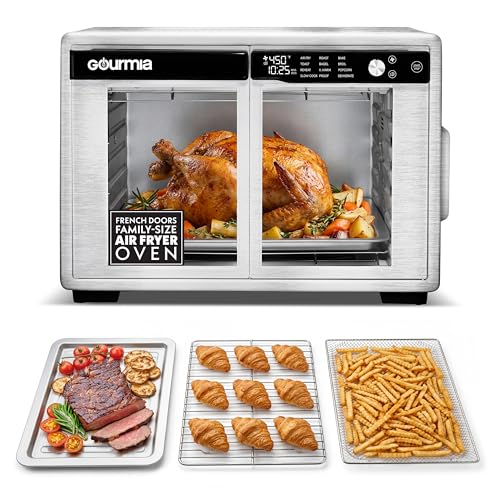
| Gourmia French Door Toaster Oven Air Fryer | Best Clean-Up Design | Format: French door toaster oven air fryer combo, stainless steel | family breakfasts and tray cooking with easy dishwasher clean-up | Check on Amazon |
| Ninja Prestige Smart XL Countertop Oven DT501 | Best Power Pick | Format: XL countertop oven, stainless steel (DT501) | households wanting a second-oven replacement that air fries | Check on Amazon |
| Chefman 6 Quart Dual Basket Air Fryer | Best Small Dual Basket | Format: dual basket air fryer, black, digital controls | couples and small households cooking two foods at once | Check on Amazon |
| Ninja Foodi DualZone XL 10 Qt Air Fryer DZ401 | Best Family Basket Pick | Format: dual basket air fryer, grey (DZ401) | families wanting two large independent baskets | Check on Amazon |
How These Picks Were Chosen
The best side was selected from the verified pool for balance across the category’s real formats: French door and classic countertop ovens from established brands, and the two dual basket designs that represent basket cooking at small and family scale. Each had to show concrete, checkable specification in its listing title — capacities, fit claims, power, functions — because vague listings are themselves one of the worst-side traits this guide warns against.
The worst side was assembled differently: from the recurring failure patterns of the category as a whole — uneven chambers, misleading capacity framing, coating and cleaning traps, preset padding and format mismatch. No product-specific defect is claimed anywhere in this guide, and no prices or fixed ratings are printed. Specs come from the verified titles, checked on 2026-11-20. Readers who want the size-first version of the best list can compare Best Basket Air Fryers for the drawer-format ranking.
The 6 Best Options for best and worst air fryers

Cuisinart French-Door Air Fryer Toaster Oven TOA-FD70
Badge: Best Trusted All-Rounder
Strengths
- French doors in stainless steel from an established kitchen brand
- A named pizza function and 12-inch pizza fit cover a family staple
- Seven honest functions with no preset padding
Trade-offs
- No quart figure in the listing title
- French doors need side clearance as well as front
- A toaster-oven first design means air frying shares a generalist chamber
Key specs (from the verified listing)
- Capacity (per listing title): fits a 12-inch pizza
- Format: French-door air fryer toaster oven, stainless steel (TOA-FD70)
- Functions: 7 — air fry, toast, bake, broil, roast, pizza, warm
The Cuisinart TOA-FD70 brings an established toaster-oven lineage to the air fryer oven format, dressed in stainless steel with French doors and an artisan design label. Its seven functions — air fry, toast, bake, broil, roast, pizza and warm — read like a greatest-hits list of what countertop ovens actually do all week, and the fit claim is the household one that matters: a 12-inch pizza. French doors suit kitchens where a pull-down door would crowd the worktop, opening sideways instead of toward the cook. In daily use this is the generalist’s generalist: morning toast, lunchtime reheated pizza that stays crisp, evening roasted vegetables, all from one chamber. Its honest limitation is that specialisation cuts the other way — a dedicated basket machine crisps a small load faster, and the title states no quart capacity for volume comparisons. Buyers who want a trusted-name oven that air fries as part of a balanced repertoire, and who value the French door format, will find this the most conventional, confidence-inspiring shape in the pool.
On the best side, the FD70 represents the trusted-format ideal: a known brand, French doors, seven honest functions and a pizza fit claim you can test with a tape measure. Its place here also illustrates a worst-avoidance principle — nothing about it is experimental. The limitation to weigh is the generalist chamber: dedicated baskets crisp small loads faster, and no title capacity figure is given.
Best for: households wanting a trusted-brand French door oven for daily mixed use / Not suited for: buyers comparing strictly on stated quart capacity

Cuisinart Air Fryer Toaster Oven TOA-55
Badge: Best Classic Workhorse
Strengths
- 1800W and a stated 450°F maximum give it real high-heat ability
- A removable crumb tray makes the daily clean-up genuinely easier
- 0.6 cu. ft. and 12-inch pizza fit describe a full family oven size
Trade-offs
- A pull-down door format rather than French doors
- Capacity stated in cubic feet, which cross-shoppers must translate
- A generalist chamber crisps small loads slower than a basket
Key specs (from the verified listing)
- Capacity (per listing title): 0.6 cu. ft. interior; fits a 12-inch pizza
- Format: countertop air fryer toaster oven combo, stainless steel (TOA-55)
- Power (per listing title): 1800W; maximum temperature 450°F
- Cleaning: removable crumb tray; convection capability
The TOA-55 is Cuisinart’s classic-format entry: a stainless steel, 0.6 cubic foot air fryer toaster oven with 1800W of power, convection, a 450°F maximum temperature and room for a 12-inch pizza. The specification worth dwelling on is the removable crumb tray, an unglamorous feature that decides how an oven ages in a real kitchen — crumbs and drips that can be emptied in seconds get emptied, and ovens that are easy to keep clean keep cooking well. Power and temperature figures in the title are equally concrete: this is a full-strength oven, not a warmed-up toaster. In use it covers the seven-function everyday repertoire with the confidence of a mature product category. Its honest limitations are format ones: a conventional pull-down door, a capacity expressed in cubic feet that quart-trained shoppers must translate, and the generalist chamber’s slower crisping of small loads compared with a basket machine. For buyers who want proven, conventional and powerful, it is a cornerstone pick.
The TOA-55 earns its best-side place as the anti-worst design: its removable crumb tray directly answers the category’s commonest slow failure, the grease-choked interior. Add stated power, stated maximum temperature and a stated interior volume, and you have the specification honesty the worst side of this guide teaches you to demand.
Best for: households wanting a powerful, conventional oven with easy crumb clean-up / Not suited for: shoppers who want French doors or basket speed
Gourmia French Door Toaster Oven Air Fryer
Badge: Best Clean-Up Design
Strengths
- 9-slice capacity describes family toast and tray loads clearly
- Dishwasher-safe trays reduce the clean-up friction of oven cooking
- Digital display with adjustable time and temperature keeps control precise
Trade-offs
- Capacity given in slices rather than quarts or litres
- French doors need lateral clearance on the counter
- A newer model line than the longest-running names here
Key specs (from the verified listing)
- Capacity (per listing title): 9-slice capacity
- Format: French door toaster oven air fryer combo, stainless steel
- Presets: 12 cooking presets; digital display; adjustable time and temperature
- Airflow: FryForce 360° (per listing title); trays are dishwasher-safe
The Gourmia describes its size the way breakfast cooks think: 9-slice capacity, behind French doors, in stainless steel with a digital display. Its FryForce 360° branding describes convection airflow intended to surround food, and its 12 presets sit in the sensible middle — enough guided help for common foods without the bloat of a hundred-program library. The detail that will matter on day thirty is the dishwasher-safe trays: oven-format air frying produces greasy trays, and trays that go straight in the dishwasher get cleaned properly instead of wiped apologetically. Adjustable time and temperature on a digital display keep manual control precise for cooks who ignore presets entirely. Its honest limitations are description and format: slices are an intuitive but imprecise capacity unit for non-toast foods, and French doors need side clearance that tight counters may not have. For family households that toast, tray-cook and air fry in roughly equal measure, it is a well-aimed, clean-up-friendly oven.
The Gourmia’s best-side credential is dishwasher-safe trays — clean-up design again — plus a sensible 12 presets and a family-readable 9-slice capacity. Its honest limitation is lineage: a newer model line than the heritage names here, so its long-term story is unwritten. That is a caveat, not a fault, and the guide states it as such.
Best for: family breakfasts and tray cooking with easy dishwasher clean-up / Not suited for: counters without side clearance for French doors

Ninja Prestige Smart XL Countertop Oven DT501
Badge: Best Power Pick
Strengths
- Fit claims are concrete: a 12 lb turkey and 20 cookies describe real loads
- 1800W gives it full oven power for roasting as well as frying
- Ninja’s XL oven format suits households replacing a second oven
Trade-offs
- XL footprint demands a serious counter commitment
- Ten functions still include overlap for simple cooks
- Its scale is unnecessary for one or two-person snacking
Key specs (from the verified listing)
- Capacity (per listing title): fits a 12 lb turkey; bakes 20 cookies
- Format: XL countertop oven, stainless steel (DT501)
- Functions: 10-in-1 — including air fry, bake, toast, pizza, reheat
- Power (per listing title): 1800W
Ninja’s Prestige Smart XL states its size in food, not just volume: it fits a 12 lb turkey and bakes 20 cookies, claims any holiday cook can visualise instantly. As a 10-in-1, 1800W stainless steel oven it is built to be a household’s second oven that also air fries — roasting a bird, baking a batch, toasting, pizza and reheating all sit in its everyday repertoire. That positioning matters: this is the pick for households whose air fryer decision is really an oven decision, where the air fry function must perform inside a chamber sized for celebration-scale food. The power figure supports the ambition; 1800W is full countertop-oven strength. Its honest limitations are the familiar XL ones: a substantial footprint, more functions than a minimalist cook will use, and sheer overcapacity for a single person’s fries. Judged on its own terms — a powerful, capacious, brand-name oven with air frying built in — it is one of the strongest all-rounders in this pool.
The DT501 represents best-side specification practice: it tells you what fits — a 12 lb turkey, 20 cookies — and what powers it, 1800W, instead of hiding behind adjectives. Its worst-side risk is purely mismatch: an XL oven bought by a small household becomes the resented appliance in the corner, which is a buying error, not a machine error.
Best for: households wanting a second-oven replacement that air fries / Not suited for: small counters or mostly solo cooking

Chefman 6 Quart Dual Basket Air Fryer
Badge: Best Small Dual Basket
Strengths
- Viewing windows on both baskets — rare in basket format
- Sync Finish ends two different cooks at the same moment
- Dishwasher-safe nonstick baskets make clean-up painless
Trade-offs
- 3Qt per basket limits each individual food’s batch size
- 6 quarts total is the smallest capacity in this pool
- Windows steam up with very wet foods
Key specs (from the verified listing)
- Capacity (per listing title): 6 quart total — 2 independent 3Qt baskets
- Format: dual basket air fryer, black, digital controls
- Basket features: easy view windows, Sync Finish, Hi-Fry, auto shutoff
- Cleaning: nonstick baskets are dishwasher safe (per listing title)
Chefman’s dual basket machine brings the oven world’s best trick to basket format: windows. Each of its two independent 3Qt baskets has an easy view window, so you can watch fries brown without pulling the drawer and losing heat — a small feature that changes how relaxed basket cooking feels. Sync Finish coordinates the two baskets to end together, Hi-Fry is there for a final high-heat crisp, and auto shutoff covers safety. The nonstick baskets are dishwasher safe, which keeps the dual basket format’s extra washing from becoming a burden. At 6 quarts total it is the smallest machine in this pool, and that is its honest framing: this is a two-to-three-person, two-component-meal machine, not a crowd feeder. Each 3Qt basket takes a modest batch, and big single items are out of the question. For couples and small households who cook a protein and a side at once and value watching progress without opening anything, it is arguably the most thoughtfully featured small dual basket here.
The Chefman dual basket is the best side’s small-format champion, with windows that prevent the open-to-check habit that ruins basket cooks. Its limitation is arithmetic: 3Qt per basket is small, and a household that reads ‘6 quart dual’ as ‘6 quart per side’ will be disappointed — a capacity-reading trap this guide’s worst section flags explicitly.
Best for: couples and small households cooking two foods at once / Not suited for: large families or big single items

Ninja Foodi DualZone XL 10 Qt Air Fryer DZ401
Badge: Best Family Basket Pick
Strengths
- Two full 5 Qt baskets — the largest per-basket size in this pool
- Match Cook turns both baskets into one 10 Qt cooker
- IQ Boost directs power where a basket needs it
Trade-offs
- A wide machine that needs real counter width
- Still a basket: no wide trays or whole pizzas
- Two large baskets are a lot of washing for a tiny meal
Key specs (from the verified listing)
- Capacity (per listing title): 10 Qt total — 2 independent 5 Qt baskets
- Format: dual basket air fryer, grey (DZ401)
- Functions: 6-in-1 — air fry, roast, broil, bake, reheat, dehydrate
- Basket features: Match Cook and IQ Boost (per listing title)
The DZ401 is the DualZone idea at full size: 10 quarts split into two independent 5 Qt baskets, the largest per-basket capacity in this pool. That per-basket figure is the one that matters — a 5 Qt basket takes a family portion of wings or fries on its own, so the two-foods-at-once trick works at family scale rather than couple scale. Match Cook mirrors settings across both baskets for a single 10 Qt batch, and IQ Boost apportions power intelligently when both baskets run different programs. The six functions mirror its smaller sibling: air fry, roast, broil, bake, reheat, dehydrate. In practice this is the basket machine for households that outgrew a single drawer but do not want an oven’s preheat times or footprint shape. Its honest limitations are width and format: it is a broad appliance, and no basket — however large — takes a sheet pan, a wide casserole or a whole pizza. For family two-zone cooking, though, it is the basket-format ceiling in this group.
The DZ401 closes the best six as the family basket standard: two honest 5 Qt baskets, stated plainly. It demonstrates the best-side version of capacity honesty — per-basket figures in the title — against which vaguer listings should be measured. Its limits are format limits: width on the counter, and no tray cooking, ever.
Best for: families wanting two large independent baskets / Not suited for: wide tray or pizza cooking
Comparison Table
| Pick | Brand | Capacity (per listing title) | Standout point | Amazon |
|---|---|---|---|---|
| Cuisinart French-Door Air Fryer Toaster Oven TOA-FD70 | Cuisinart | fits a 12-inch pizza | French doors in stainless steel from an established kitchen brand | Check on Amazon |
| Cuisinart Air Fryer Toaster Oven TOA-55 | Cuisinart | 0.6 cu. ft. interior; fits a 12-inch pizza | 1800W and a stated 450°F maximum give it real high-heat ability | Check on Amazon |
| Gourmia French Door Toaster Oven Air Fryer | Gourmia | 9-slice capacity | 9-slice capacity describes family toast and tray loads clearly | Check on Amazon |
| Ninja Prestige Smart XL Countertop Oven DT501 | Ninja | fits a 12 lb turkey; bakes 20 cookies | Fit claims are concrete: a 12 lb turkey and 20 cookies describe real loads | Check on Amazon |
| Chefman 6 Quart Dual Basket Air Fryer | Chefman | 6 quart total — 2 independent 3Qt baskets | Viewing windows on both baskets — rare in basket format | Check on Amazon |
| Ninja Foodi DualZone XL 10 Qt Air Fryer DZ401 | Ninja | 10 Qt total — 2 independent 5 Qt baskets | Two full 5 Qt baskets — the largest per-basket size in this pool | Check on Amazon |
Read the table by role, not by row order: the right machine for best and worst air fryers is the one whose capacity, controls and standout point match the work described in the reviews above.
How to Choose the Right Model for best and worst air fryers
Choose from the best side by job, not by rank. Ovens — four of the six here — suit trays, pizzas, dishes and mixed family cooking; dual baskets suit two-food meals cooked at different settings. The worst purchases in this category are overwhelmingly format errors: an oven bought by a fries-and-wings household that hates preheating, or a basket bought by a tray cook who needed width. Name your three most-cooked foods and let them vote.
Audit any candidate against the worst checklist before money moves: Is capacity stated in a unit you can verify? Can the interior and trays actually be cleaned? Are the functions ones you will use monthly? Does the brand sell replacement trays and racks? A machine that passes those four questions is very unlikely to become your worst purchase, whatever its badge.
Weight limitations by your habits, not by their existence. Every pick here has honest limitations — that is what makes the reviews credible. A limitation only matters if it intersects your life: per-basket size matters to families, footprint matters to small kitchens, preset simplicity matters to cooks who hate menus. The build-quality angle on the same six-machine market is developed in Best Built Air Fryers.
Finally, distrust superlatives in listings, including the ones in this guide’s badges. Badges are navigation aids. The decision should rest on the specification you verified, the format your cooking needs, and the clean-up design your household will actually maintain.
How to Use, Clean, and Troubleshoot — Avoiding the Worst Outcomes
Most ‘worst air fryer’ stories are really ‘worst routine’ stories. This how-to covers the usage and care habits that keep a good machine on the best side of the line.
- Preheat briefly and cook in a single layer — the two habits behind most best-side results and most worst-side complaints.
- Shake baskets or turn tray food halfway; uneven browning blamed on machines is usually unturned food.
- Match the load to the format: trays and dishes in ovens, shakeable chunks in baskets, nothing wet-battered in either.
- Wipe interiors and empty crumb trays after greasy cooks, before residue bakes into the smoke-and-smell stage.
- Treat coatings gently — soft sponges, no metal scourers, no harsh aerosol sprays inside the chamber.
- Give the machine ventilation space every cook, not just the first, and let it cool before covering or moving it.
Troubleshooting
Problem: results are uneven — some pieces burnt, some pale: The load was crowded or unturned. Cook less per batch, spread food with gaps, and shake or turn at the halfway point; check that the tray or basket is seated correctly so airflow matches the design.
Problem: everything tastes of old grease: The interior needs a real clean, not a wipe: wash trays and baskets, clean the crumb tray, wipe the interior walls, and run a short empty cycle. Old residue flavours every new cook.
Problem: the machine seems weaker than when it was new: Before concluding decline, deep-clean it and check the vents for blockage. Built-up grease and blocked airflow imitate failing elements remarkably well; a clean machine often recovers its original performance.
The Worst Air Fryers: Attributes and Traps to Avoid
The worst machines in this category share recognisable traits. Capacity stated only in photographs, with no quart, fit or dimension figure you can verify. Interiors that cannot be reached for cleaning, paired with no crumb management, guaranteeing the grease-choke decline. Function lists in the dozens where the underlying machine is ordinary — padding that signals a maker selling numbers instead of cooking. Doors and drawers that feel loose on day one; they do not tighten with age. And brands with no visible spare parts channel, so a worn tray ends the machine’s life.
The worst purchases add buyer-side traps to that list. Buying a format your cooking does not use. Reading dual basket totals as per-basket capacity. Choosing by a fixed star figure or a price headline instead of by specification and fit. Skipping the counter measurement and discovering the door cannot open. None of these require a villainous manufacturer — they require only an unchecklisted buyer, which is why this guide gives you the checklist. Apply it to the picks here too; they were chosen partly because they pass it. For the basket-format version of the same audit, Best Biggest Air Fryers shows how size claims should be evidenced.
Why This Guide Does Not Name ‘Worst’ Products
It would be easy, and wrong, to pin ‘worst’ labels on specific models without evidence. Products get revised, listings change, and one household’s disappointment is another’s perfect fit — the XL oven gathering dust in a solo flat would be the hardest-working appliance in a family kitchen. Defect claims require testing data this guide does not have and will not invent.
What a guide can do honestly is what this one does: recommend the strongest verified options with their limitations stated, and arm you with the attribute checklist that identifies weak designs and bad matches in the wild. That combination serves the search intent better than a theatrical name-and-shame list, and it keeps every claim on this page defensible. If you came here hoping to be talked out of a specific tempting listing, run it through the checklist above — it will do the talking. Readers focused on build quality as the positive version of this audit should continue to Best Built Air Fryers.
Baking in an Air Fryer: Small Batches, Real Results
Air fryers bake better than their reputation suggests, provided you respect the format: small batches, lower temperatures than a conventional oven recipe states, and an eye kept on top-browning, because the element sits close above the food. Cookies, muffins, small cakes, scones and reheated pastries all succeed; the oven-format picks in this programme’s guides add width for trays and dishes, while baskets handle ramekins and small tins that physically fit with air space around them.
Two adjustments make most recipes work: reduce the stated temperature modestly and check several minutes early the first time, noting the result for your machine. Light-coloured tins brown more gently than dark ones, and a loose foil shield rescues a top that is racing ahead of its centre. Keep notes and the air fryer becomes the small-batch bakery you use while the big oven stays cold — which, for two cookies’ worth of craving, is exactly the right tool.
Dehydrating and Low-Heat Tricks Worth Knowing
Machines with low temperature settings — dehydrate functions appear across this category — open a quieter repertoire: apple and banana slices, herb drying, citrus for drinks and decorations, tomatoes concentrated into something between fresh and sun-dried, and jerky for households that make it. Low heat is a different discipline from frying: thin, even slices, space between pieces, patience measured in hours, and no expectation of crisp speed.
Food safety deserves its sentence here: follow tested guidance for meat jerky temperatures and storage, refrigerate anything you are unsure about, and treat home dehydrating as preserving-lite rather than true long-term preservation unless you are following a validated method. For fruit, herbs and vegetables the stakes are lower and the rewards are immediate — a low-heat function, once tried, tends to move from novelty to habit surprisingly fast.
Reading an Air Fryer Listing Like a Reviewer
A listing is an argument, and reviewers read it for what it avoids. Capacity should appear in a unit you can test — quarts per basket, tray dimensions, pizza diameter, cubic feet — and its absence is information. Functions should be enumerable and relevant; a count without a list is padding. Power and temperature range, where stated, tell you the machine’s real envelope, and materials statements tell you what the maker is willing to be held to.
Photographs argue too: look for the machine on a real counter beside familiar objects, baskets open and loaded, trays beside the pans you own in your mind’s eye. Then read the maker’s own support pages for spares and manuals — the unglamorous documents that predict ownership better than any launch copy. Apply that reading to every pick in this guide as well; they were chosen partly because their listings survive it.
Warranty, Spares and the Second-Year Questions
Most appliance regret arrives in year two, so shop for year two on day one. Check that the maker sells the parts that wear — baskets, crisper plates, trays, racks — and that the manual is downloadable and intelligible. Note the warranty’s length and, more importantly, its mechanism: who do you contact, what do you ship, what does the process look like for a machine too big to post casually? A brand with a clear, staffed answer to those questions is selling ownership, not just hardware.
Keep the receipt, the serial number and a note of where you bought the machine together — a phone photo of each takes a minute and saves an hour later. Register the product if the maker offers it. These tiny administrations are the difference between a repairable hiccup and a replacement purchase, and they are the least exciting, most valuable paragraphs in this entire guide.
Cooking Times and Temperatures: A Practical Starting Chart in Words
New owners want a chart; experienced owners carry a feel. Bridge the two with starting points you adjust by eye: frozen fries want high heat and a shake, fresh fries a few minutes longer, wings high heat until the skin renders and crisps, chicken thighs slightly lower and longer so the centre cooks before the surface darkens, vegetables hot and fast in a single layer, fish gentle and brief, reheated pizza moderate heat until the base crisps and the cheese re-melts. Thickness changes everything — a doubled wing takes meaningfully longer than a single one — which is why times are starting points and eyes are instruments.
Temperature discipline matters more than time precision. Air fryers run hot and fast compared with conventional ovens, so recipes written for ovens usually need a modest temperature reduction and a time reduction, checked early the first time you convert them. Keep a notebook page for your five staple foods with the settings that worked in your machine; within a month that page will be worth more than any printed chart, because it describes your appliance, your portions and your taste rather than a test kitchen’s averages.
Frozen Foods in the Air Fryer: Where the Format Shines
Frozen food is the air fryer’s home turf, because the format’s fierce, dry heat does exactly what frozen coatings need: it sets the outside before the inside steams it soft. Fries, nuggets, breaded fish, spring rolls and frozen vegetables all cook from frozen without defrosting, in a single layer, with a shake or turn at the halfway point. The rules are the usual ones with extra emphasis — space between pieces matters doubly when every piece is shedding frost moisture, and the first shake should come a little earlier than you think.
Two cautions keep frozen cooking honest. Raw frozen meats that are thick — burgers, chicken portions — need a food thermometer’s confirmation, not a timer’s optimism, because surfaces brown long before centres are safe. And very icy, frost-heavy items benefit from a quick shake-off of loose frost before cooking, which reduces the steam that softens coatings. Treat those two habits as standard and frozen food becomes the most reliable weeknight category the machine owns.
Reheating: The Quiet Superpower You Will Use Weekly
Ask long-term owners what their air fryer does most and reheating beats frying. The format restores crisp foods instead of sogging them: pizza regains a crisp base and melted top, fries come back with their edges, roast vegetables revive, and fried chicken reheats with its coating largely intact. Moderate heat, a few minutes, a single layer — that is the whole technique, and it outperforms a microwave on anything that was ever crisp, while beating a full oven on speed for small portions.
Reheating is also where format choice shows daily. Baskets reheat small portions fastest; ovens reheat family trays at once and handle mixed leftovers on different racks. Either way, the habit changes household economics quietly: leftovers people actually want to eat get eaten, takeaway extras survive to a second meal, and yesterday’s roast becomes today’s lunch without apology. When owners say an air fryer paid for itself, this unglamorous function is usually a large part of the story.
Accessories Worth Owning — and the Ones to Skip
The useful accessory list is short and boring: a rack that adds a second layer for dehydrating or gentle items, parchment liners sized for your basket or tray for sticky foods, a pair of silicone-tipped tongs, and an instant-read food thermometer, which is less an accessory than a safety instrument. A small spray bottle for oil — filled with your own plain oil — replaces aerosol cans and gives you the light, even coating that low-oil cooking loves.
Skip the bundles. Giant accessory kits pad their counts with tools you already own and gadgets for foods you will never make, and their materials are rarely documented as carefully as the machine’s own parts. Buy accessories one at a time, when a real recipe asks for them, sized exactly to your model, from the maker or a reputable seller. Your cupboard, your coatings and your cooking will all be better for the restraint.
Meal Prep and Batch Cooking With an Air Fryer
Air fryers reward a prep rhythm: a protein batch, a vegetable batch and a grain-adjacent batch across an hour gives a household three days of mix-and-match meals. The format’s speed makes sequential batches practical — each load is minutes, not the oven’s long commitments — and dual baskets or large ovens collapse the sequence further by running components together. Season in families rather than singles: one marinade across chicken and vegetables, one spice blend across proteins, so the week’s meals taste related rather than random.
Store prepped components separately and reheat them in the air fryer itself, which restores texture instead of steaming it away in a microwave. Keep a simple rotation — cook double of anything that reheats well, freeze in portions, and let the machine’s reheat function close the loop. Batch cooking fails when it produces food nobody wants twice; air-fried components, properly crisped again, are the exception that makes the system stick.
Common Buying Mistakes
- Reading a dual basket’s total capacity as the size of each basket.
- Buying by preset count — the most padded number in the category.
- Choosing a format your three most-cooked foods do not fit.
- Skipping the counter and door-clearance measurement for oven formats.
- Letting grease build up until the machine smokes, then blaming the machine.
- Trusting any guide — including ones with ‘worst’ in the title — that states product defects or ratings it cannot evidence.
Final Recommendation
From the best side, start with the Cuisinart FD70 for trusted all-round oven duty, or the Ninja DZ401 if your cooking is two-food family meals in baskets. The TOA-55 is the specification-honesty pick, the DT501 the power pick, the Gourmia the clean-up pick, and the small Chefman the couples’ dual basket.
Start your shortlist with the Cuisinart French-Door Air Fryer Toaster Oven TOA-FD70, and compare it against the Cuisinart Air Fryer Toaster Oven TOA-55 before deciding — between them they cover the two most common use patterns in this guide.
From the worst side, take the checklist with you to every future listing: verifiable capacity, cleanable design, honest functions, available spares, and a format that matches your cooking. A buyer with that checklist rarely buys the worst air fryer — and usually ends up owning one of the best.
Frequently Asked Questions
What makes an air fryer one of the worst?
Usually a combination of unverifiable capacity claims, interiors that cannot be cleaned properly, padded function lists on ordinary hardware, loose doors or drawers, and no spare parts support. More often still, it is a decent machine bought in the wrong format or size for the household.
Why does this guide not name specific worst models?
Because defect claims need evidence, and this guide does not invent it. Instead it reviews six strong verified picks with honest limitations and gives you the attribute checklist that identifies weak designs and bad matches on any listing.
What is the most common air fryer buying mistake?
Format mismatch: buying a basket machine for tray cooking, or a large oven for a fries-and-wings household that resents preheating. Naming your three most-cooked foods before shopping prevents most of it.
Are cheap air fryers always a bad buy?
No. A simple, honestly specified machine from a supported brand can serve a small household well for years. The risk zone is not a tier but a pattern: vague specifications, uncleanable designs and no parts support at any price.
How do I check a listing against the worst checklist quickly?
Ask five questions: Is capacity stated in a verifiable unit? Can I see how the interior and trays clean? Would I use these functions monthly? Does the brand sell spares? Does the format fit my most-cooked foods? Five yeses is a strong listing.
Can a good air fryer become a bad one over time?
Yes — through neglected cleaning. Grease build-up causes smoke, odours, uneven cooking and flavour transfer that owners read as machine failure. Regular crumb tray emptying and interior wiping prevent most of that decline.