Disclosure: topratedkitchenware.com is reader-supported. When you buy through links on our site, we may earn an affiliate commission from Amazon and other retailers, at no extra cost to you.
Where to buy
Sold on Amazon. Read the full guide ↓
- Tastyle Mini Single Serve Coffee Maker (K310IC)
- Keurig K-Express (Evergreen)
- Keurig K-Express (Mint)
- Hamilton Beach FlexBrew Advanced 4-in-1
- Ninja Single Serve Coffee Maker (PB051)
- Keurig K-Elite (Brushed Silver)
Shoppers who search for the best coffee makers with frother america’s test kitchen are usually asking a very specific kind of question. They do not just want a list; they want the methodical, criteria-first evaluation style that test kitchens are known for: define what good performance looks like, measure every contender against the same standard, and report the trade-offs without fear or favour. This guide adopts that method honestly. It also has to begin with a disclosure in the same spirit: none of the six verified picks in this pool has a built-in milk frother in its verified listing. They are single-serve brewers, and the milk drink in this story comes from pairing one of them with a separate frother or steam wand alternative. A test kitchen would tell you that on page one, so we do.
That pairing approach is not a consolation prize. In methodical testing, separate frothers routinely outperform the built-in frothing attachments bundled with inexpensive machines, because a dedicated frother is designed for one job: heating milk while incorporating controlled amounts of air for foam that ranges from liquid latte silk to dry cappuccino froth. A strong base brewer plus a good separate frother is the combination many careful reviewers land on, and it has a second advantage: when one half of the system wears out, you replace one appliance, not the whole coffee station. So this guide evaluates each pick the way a test kitchen would evaluate a base brewer for milk drinks: extraction quality and consistency, temperature stability, cup-size flexibility for splitting shots between drinks, and how the workflow fits around a frother running beside it. Readers comparing neighbouring options may also find our guide to Best Coffee Makers With Frother Reddit worth a look before deciding.
What follows therefore reads a little differently from a standard round-up. Each review states what the machine does well as a milk-drink foundation, where it falls short, and who should pair it with a frother at all. The buying guide defines the test criteria in full, the how-to section covers frothing technique with whatever device you choose, and the final recommendation names the strongest base brewers plainly. If you wanted a single appliance with a frother bolted on, the honest answer is that it is not in this verified pool, and the sections below explain how to get the same drinks, usually better, from a two-piece setup.
Key Takeaways
- None of the verified picks includes a built-in frother; the test-kitchen solution is a strong base brewer plus a separate frother, which usually foams better anyway.
- For milk drinks, judge a base brewer on extraction strength, temperature, and cup-size control, since milk dilutes everything.
- The Ninja PB051, with four brew styles and grounds or pods, is the most flexible milk-drink foundation in this pool.
- Brew a smaller, stronger coffee base for lattes and cappuccinos; large weak cups disappear under milk.
- Judge frothing by texture, not volume: glossy, pourable microfoam beats stiff, bubbly foam for taste and latte art.
In this guide
Quick Picks
| Pick | Badge | Why it is here | Check price |
|---|---|---|---|
| Tastyle Mini Single Serve Coffee Maker (K310IC) | Best All-Round Base Brewer | Brews both pods and your own grounds, so format flexibility comes in a mini footprint | Check on Amazon |
| Keurig K-Express (Evergreen) | Best for Bright Kitchens | Full K-Express feature set: three brew sizes plus Strong Brew | Check on Amazon |
| Keurig K-Express (Mint) | Best Compact Milk-Drink Base | Complete K-Express feature set in a light, retro-leaning mint finish | Check on Amazon |
| Hamilton Beach FlexBrew Advanced 4-in-1 | Best for Mixed Households | Brews pod packs or grounds, so nobody in the household is locked into one format | Check on Amazon |
| Ninja Single Serve Coffee Maker (PB051) | Most Versatile Base Brewer | Largest reservoir in this guide at 56 oz, removable for easy filling | Check on Amazon |
| Keurig K-Elite (Brushed Silver) | Best Premium Pod Platform | Keurig’s more premium single-serve platform, positioned above the K-Express line | Check on Amazon |
How These Picks Were Chosen
The evaluation framework borrows the habits of a good test kitchen. First, criteria were fixed before rankings: extraction strength and consistency for the coffee base, brew temperature behaviour, range of cup sizes, format flexibility across pods and grounds, reservoir practicality for households making several milk drinks, and counter workflow beside a frother. Second, every pick was assessed from its verified listing data, checked on 2026-11-20, with no specification accepted that the listing does not support. Third, weaknesses were recorded with the same care as strengths, including the pool-wide absence of built-in frothers, which is reported rather than smoothed over. If your shortlist is still open, the companion guide to Best Coffee Makers With Google Assistant covers the adjacent trade-offs in the same detail.
Two limits of method deserve the test-kitchen treatment as well. This is research-led evaluation, not laboratory testing with thermocouples and refractometers, and it makes no claim to be affiliated with any publication; the keyword’s phrase describes the style of evaluation readers are looking for, and this guide aims to honour it. And as throughout this series, prices and ratings are excluded, because a methodical buyer should decide on performance criteria first and check the current market afterwards, not the other way around.
The 6 best coffee makers with frother america’s test kitchen — detailed reviews
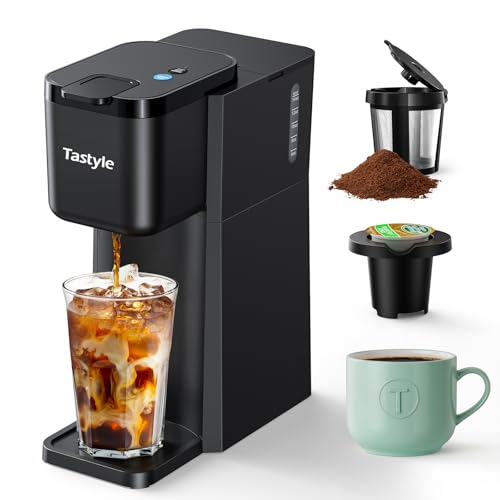
Tastyle Mini Single Serve Coffee Maker (K310IC)
Badge: Best All-Round Base Brewer
Strengths
- Brews both pods and your own grounds, so format flexibility comes in a mini footprint
- Hot and iced modes cover year-round drinking in one small machine
- Wide 6 to 14 oz size range suits everything from a small strong cup to a full travel mug
Trade-offs
- Mini format means water is handled per brew rather than stored in a large tank
- Brand support and accessory availability are thinner than the big-name rivals
- Iced mode still needs a cup full of ice and benefits from stronger settings to avoid dilution
Key specs from the listing
- Format: single-serve, K-Cup pods and ground coffee
- Brew sizes: 6 to 14 oz
- Drinks: hot and iced coffee
- Power: 120V
- Includes: recipe book (per listing title)
- Version: K310IC, 2.0 version
The Tastyle K310IC is the small machine in this guide that refuses to pick a side. It brews K-Cup pods when convenience wins and ground coffee when flavour or cost wins, across a 6 to 14 oz range, and it adds a dedicated iced coffee function that most mini brewers skip entirely. For a dorm, an RV, a first apartment, or a travel kit, that combination is unusually complete: one compact appliance covers a hot morning cup, an afternoon iced coffee, and the transition from pod convenience to bagged beans as tastes and budgets change. The included recipe book in the listing is a small but telling touch, aimed at drinkers who want to experiment with iced drinks rather than just replicate a café order. The trade-offs are the usual mini-machine ones. Water is managed brew by brew, back-to-back drinks for a group will feel slow, and a smaller brand means a thinner accessory ecosystem than Keurig’s. Judge it as a flexible personal brewer and it makes a strong case. Judge it as a household’s only machine and the capacity ceiling will find you out.
As a milk-drink base, the Tastyle’s appeal is its size range and grounds mode. A small, strong grounds brew at the 6 oz end of its range concentrates the coffee enough to stand up to frothed milk, and its iced function pairs naturally with cold foam for summer drinks. It is a one-drink-at-a-time foundation, so it suits a solo latte drinker far better than a brunch crowd, but within that role its flexibility is genuinely test-worthy.
Best for: small households that want pods and grounds in one mini machine, plus proper iced coffee / Not suited for: heavy multi-drinker households that need a large reservoir and fast back-to-back brewing

Keurig K-Express (Evergreen)
Badge: Best for Bright Kitchens
Strengths
- Full K-Express feature set: three brew sizes plus Strong Brew
- 42 oz removable reservoir suits a two-person household
- Evergreen finish is a deliberate style choice for green-accented kitchens and hides coffee splashes well
Trade-offs
- Colour is the only difference from other K-Express listings
- Pod-only brewing with no included grounds option
- No timer, no auto-start, and no app or voice control
Key specs from the listing
- Format: single-serve K-Cup pod brewer
- Brew sizes: 3 brew sizes
- Reservoir: 42 oz, removable
- Feature: Strong Brew button
- Cup fit: travel mug friendly
- Pods: works with all K-Cup pods
The Evergreen K-Express pairs the standard K-Express platform with a deep green finish that has become a genuine kitchen trend colour. Under the colour, nothing changes: three brew sizes, a Strong Brew button for a more intense cup, a 42 oz removable reservoir, and room for a travel mug under the spout. That consistency is worth stating plainly because colour-variant listings sometimes imply more difference than exists. What you are choosing here is how the machine looks on your counter for the next several years, and Evergreen works particularly well in kitchens with plants, brass or wood accents, and anyone who finds an all-black-and-steel counter run a bit joyless. In daily use the platform’s virtues are routine ones: pods keep the process measured and repeatable, the tank size means refills are a weekly rather than daily chore for light drinkers, and the Strong Brew setting rescues larger cup sizes from tasting washed out. Its limits are the platform’s limits too. It brews pods only, it offers no scheduling, and the coffee will never have the bloom-and-pour character of a manual method. As a fast, good-looking, low-effort brewer, though, it is a coherent package.
The Evergreen K-Express brings one tool that matters for milk drinks: the Strong Brew button. Milk is a diluent, and a standard pod brew at a large size can vanish under it; a smaller size on Strong Brew keeps the coffee present. The 42 oz reservoir helps households making several drinks. Beyond that it is a standard pod platform, consistent and fast, with the format’s ceiling on extraction control fully in force. For a closely related angle on this category, see our coverage of Best Coffee Makers With Grinder.
Best for: K-Express convenience in a deep green finish for style-led kitchens / Not suited for: anyone choosing on features rather than looks; the platform is identical across colours

Keurig K-Express (Mint)
Badge: Best Compact Milk-Drink Base
Strengths
- Complete K-Express feature set in a light, retro-leaning mint finish
- 42 oz removable reservoir and three brew sizes cover most solo and couple routines
- Strong Brew button helps larger cups keep their body
Trade-offs
- Identical internals to every other K-Express colour
- Light finishes show coffee drips more, so the drip tray needs regular wiping
- Pods only, with no grounds basket in the box per the listing
Key specs from the listing
- Format: single-serve K-Cup pod brewer
- Brew sizes: 3 brew sizes
- Reservoir: 42 oz, removable
- Feature: Strong Brew button
- Cup fit: travel mug friendly
- Pods: works with all K-Cup pods
Mint is the fourth K-Express colour in this guide, and the honest summary is short: same brewer, different wardrobe. Three brew sizes, the Strong Brew button, a 42 oz removable reservoir, and travel mug clearance are all present, and the brewing experience is indistinguishable from the black, Warm Stone, and Evergreen versions. The mint finish leans retro and pairs naturally with cream, white, and pastel kitchens, small apartments, and anyone building a softer look than the usual black appliance block. One practical note cuts the other way: light colours show coffee splashes and drip-tray drips more readily than dark finishes, so this is the version for someone who wipes the counter as they go. In the cup, expect the standard K-Express profile. Fresh pods, the right brew size for your mug rather than the largest by default, and the Strong Brew setting for dark roasts will get the best from it. If you are choosing between K-Express colours, choose on looks alone and do not expect a performance difference. If you are choosing between the K-Express and the grounds-capable machines in this guide, that is the real decision, and it turns on format, not finish.
Mechanically identical to the Evergreen, the Mint K-Express earns the same milk-drink assessment: use the Strong Brew setting, choose a modest cup size, and the base will hold its own in a latte. The colour is its distinction, and in a test-kitchen frame that counts for little, but in a real kitchen where the frother and brewer live on display, a matched, liked setup gets used and maintained more. Consistency of routine is an unglamorous performance factor.
Best for: the K-Express platform in a light, retro mint finish for bright kitchens / Not suited for: anyone who hates wiping drip trays; light finishes show coffee splashes more readily

Hamilton Beach FlexBrew Advanced 4-in-1
Badge: Best for Mixed Households
Strengths
- Brews pod packs or grounds, so nobody in the household is locked into one format
- 45 oz removable reservoir is the largest among the grounds-capable picks here
- Hot and iced functions plus fast brewing cover the widest drink range in this guide
Trade-offs
- Larger and more complex than the mini machines, so it needs real counter space
- More parts and modes mean more cleaning surfaces and a slightly longer learning curve
- Single-serve only, so it still will not replace a full-pot brewer for crowds
Key specs from the listing
- Format: single-serve, pod packs and ground coffee
- Functions: 4-in-1, hot and iced coffee
- Reservoir: 45 oz, removable
- Brewing: fast brewing (per listing title)
The FlexBrew Advanced is Hamilton Beach’s long-running answer to the format wars, and this 4-in-1 version is the most capable grounds-and-pods brewer in the guide. It takes pod packs for speed and loose grounds for control, brews hot or iced, and stores water in a 45 oz removable reservoir that out-sizes the K-Express tank. For a household where one person lives on pods and another refuses to drink anything but their own beans, this is the peace treaty: one machine, both formats, no second appliance. The reservoir changes the rhythm of use compared with the minis. Fill it every few days, brew on demand, and only think about water at the weekend. Iced mode earns its keep in warm months, brewing in a way that accounts for the ice in the cup rather than simply pouring hot coffee over cubes and hoping. The costs are size and simplicity. It is a bigger, busier machine than a K-Mini or the Elite Gourmet, with more surfaces to wipe and more modes to learn. If your kitchen has the space and your household has mixed loyalties, it is the most complete single-serve option here.
The FlexBrew scores well on household milk-drink logistics. Its 45 oz reservoir supports back-to-back drinks, its grounds mode lets you dose stronger for milk, and pods keep a second drinker’s routine effortless. In a two-drink morning, one partner froths while the other brews, and this machine’s speed and capacity keep that choreography smooth. It lacks brew-style variety, but for milk drinks, dose control through grounds is the more useful lever anyway.
Best for: mixed households split between pods and grounds, and anyone who wants a reservoir with real capacity / Not suited for: very small counters, or anyone who wants the simplest possible one-button routine

Ninja Single Serve Coffee Maker (PB051)
Badge: Most Versatile Base Brewer
Strengths
- Largest reservoir in this guide at 56 oz, removable for easy filling
- Four brew styles give more control over strength and character than most single-serve machines
- Brews pods or grounds in cup sizes up to 24 oz, covering mugs through big travel cups
Trade-offs
- The biggest footprint here, so small counters should measure first
- More brew styles mean a short learning curve to find your favourite settings
- Premium positioning in this line-up, with value depending on using the style options
Key specs from the listing
- Format: single-serve, K-Cup pods and ground coffee
- Brew styles: 4 styles of brewing
- Cup sizes: up to 24 oz
- Reservoir: 56 oz, removable
The Ninja PB051 is the overachiever of this group: pods or grounds, four distinct brew styles, cup sizes running up to 24 oz, and a 56 oz removable reservoir that is the largest in the guide. The brew styles are the headline. Rather than a single strong button, Ninja gives you several extraction profiles, which lets the same coffee taste noticeably different depending on whether you want a classic cup, a richer and bolder one, or a brew destined for ice. Grounds brewing through its own basket keeps bean choice in your hands, while pod support keeps the weekday-morning option open. The big reservoir suits households and heavy drinkers: fewer refills, and it lifts off for proper washing. Size is the honest cost. This is a substantial appliance that wants a permanent home on the counter, and buyers in very small kitchens should measure the space, including the height with the lid open for the grounds basket. For drinkers who experiment, who share a machine, or who simply want the most capable single-serve brewer in this set, the Ninja makes the strongest technical case here.
The Ninja is the strongest base brewer here by test criteria. Four brew styles let you select a richer extraction profile for milk drinks rather than merely a stronger one, the grounds mode restores dose control, and cup sizes up to 24 oz cover everything from a small latte base to a large iced drink with cold foam. The 56 oz reservoir leads the pool. If a test kitchen ranked foundations for a frother, this is the machine the criteria point to.
Best for: drinkers who want the most control and capacity in a single-serve machine, across pods and grounds / Not suited for: tiny kitchens that cannot spare the footprint, or anyone who wants zero settings to think about

Keurig K-Elite (Brushed Silver)
Badge: Best Premium Pod Platform
Strengths
- Keurig’s more premium single-serve platform, positioned above the K-Express line
- Brushed silver finish suits stainless-steel appliance kitchens
- Full access to the K-Cup pod ecosystem and its reusable-pod accessories
Trade-offs
- The verified listing title is brief, so confirm the exact feature set on the product page before buying
- Pod-centred design, with grounds brewing only via a separate reusable pod
- Larger and more feature-led than the mini machines, so it needs dedicated counter space
Key specs from the listing
- Format: single-serve K-Cup pod brewer
- Finish: brushed silver
- Maker: Keurig K-Elite model
The K-Elite is Keurig’s step-up single-serve platform, finished here in brushed silver to match stainless appliance suites. A note on method matters for this pick: the verified listing title for this model is unusually short, so this review sticks to what the platform position and the listing itself support, and the product page is the right place to confirm the current feature list before you buy. What can be said confidently is where it sits. The K-Elite line is Keurig’s more premium tier above the K-Express, aimed at drinkers who want a more substantial machine with a broader control set while staying entirely inside the K-Cup ecosystem. The brushed silver finish is not a trivial detail in a kitchen where the coffee maker sits beside a stainless fridge and range all day. In the cup, expect the familiar Keurig virtues: speed, repeatability, and a pod catalogue wide enough to cover most tastes, with quality driven mainly by pod freshness and choosing the right brew size for your mug. If you want grounds flexibility built in, the FlexBrew and Ninja in this guide are structured differently. If you want the most polished all-pod machine here, this is the candidate.
The K-Elite is the premium pod candidate as a milk-drink base: a step-up Keurig platform whose role is consistent, polished pod brewing while a separate frother handles the milk. Its verified listing is brief, which a strict evaluation must record as an information gap; confirm its current feature set on the product page. Pod extraction remains the ceiling, so it suits drinkers who prioritise a tidy, single-ecosystem station over extraction control.
Best for: Keurig loyalists who want the premium tier of the pod platform in a stainless-matching finish / Not suited for: anyone who wants native grounds brewing or brew-style experimentation
Comparison Table
| Pick | Badge | Format | Reservoir / capacity | Check price |
|---|---|---|---|---|
| Tastyle Mini Single Serve Coffee Maker (K310IC) | Best All-Round Base Brewer | single-serve, K-Cup pods and ground coffee | 6 to 14 oz | Check on Amazon |
| Keurig K-Express (Evergreen) | Best for Bright Kitchens | single-serve K-Cup pod brewer | 3 brew sizes | Check on Amazon |
| Keurig K-Express (Mint) | Best Compact Milk-Drink Base | single-serve K-Cup pod brewer | 3 brew sizes | Check on Amazon |
| Hamilton Beach FlexBrew Advanced 4-in-1 | Best for Mixed Households | single-serve, pod packs and ground coffee | 45 oz, removable | Check on Amazon |
| Ninja Single Serve Coffee Maker (PB051) | Most Versatile Base Brewer | single-serve, K-Cup pods and ground coffee | up to 24 oz | Check on Amazon |
| Keurig K-Elite (Brushed Silver) | Best Premium Pod Platform | single-serve K-Cup pod brewer | See listing | Check on Amazon |
How to Choose the Right Coffee Maker for Your Kitchen
Criterion one: the coffee base must survive milk
Milk, whether steamed, frothed hot, or foamed cold, dilutes and sweetens everything it touches. A base brew that tastes balanced black will taste weak in a latte. Methodical evaluation therefore favours brewers that can produce a concentrated cup on demand: a strong or rich brew setting, a grounds mode where you control the dose, or at minimum a small cup size that keeps the ratio tight. When you assess any brewer for milk drinks, ignore the largest cup size entirely and ask what its smallest, strongest brew tastes like. That cup, not the headline capacity, is your latte. The Ninja’s brew styles and the grounds-capable machines score well here precisely because they give you a lever over concentration.
Criterion two: temperature and timing in the workflow
A milk drink is two hot components meeting at the right moment. The brewer should deliver coffee properly hot, because frothed milk goes in warm, not boiling, and a lukewarm base makes a tepid drink. Workflow matters as much as temperature: a separate frother typically needs a minute or two, so a brewer that starts fast and holds its station without fuss fits the routine. Reservoirs earn their keep here, since a milk-drink household brews more often, and a fill-per-cup mini turns a two-drink morning into a small production line. Match the machine’s capacity rhythm to the number of drinks you actually make together. Shoppers weighing formats against each other often read our guide to Best Coffee Makers With Grinder And Frother alongside this one.
Criterion three: choosing the frother itself
Since the frother is a separate purchase in this setup, choose it by texture goals. Automatic jug frothers heat and foam at a button press and are the easiest route to consistent results, with settings for hot foam, cold foam, or simply hot milk. Handheld wand frothers are inexpensive and fine for occasional cappuccinos but heat nothing, so the milk must be warmed separately. Steam wands, found on espresso machines, offer the finest control and the steepest learning curve. For most readers pairing with a brewer in this guide, an automatic jug frother is the test-kitchen answer: repeatable, quick, and easy to clean, which means it will actually be used daily.
Criterion four: milk, cups, and honest expectations
Whole milk foams most easily and tastes richest; many plant milks foam respectably in barista-style formulations made for the purpose, while thin plant milks may need a frother’s cold-foam setting and a little patience. Cup size is a hidden variable: a modest cup keeps the coffee-to-milk ratio in latte territory, while an oversized mug quietly turns every drink into a milky coffee soup. Set expectations with test-kitchen honesty: a brewer-and-frother station makes very good lattes and cappuccinos, but it is not an espresso station, and the coffee base will be a strong brewed coffee rather than a true espresso shot. Judged on its own terms, the drinks satisfy; judged as counterfeit espresso, nothing in this category would.
How to Froth Milk Well with a Separate Frother
Technique matters more than equipment tier, and the steps below work with any automatic or handheld frother.
Step 1: Start with cold milk and a cold jug where possible. Cold milk gives you more time to incorporate air before the milk gets hot, which produces finer foam.
Step 2: Fill to the frother’s marked line for foaming, not its maximum for heating; foam expands, and overfilling guarantees a spill and coarse bubbles.
Step 3: Brew the coffee base while the milk froths, choosing the small, strong setting on your brewer so the drink’s ratio survives the milk. The neighbouring guide to Best Coffee Makers With Grinder Consumer Reports is a useful next step if this shortlist leaves you undecided.
Step 4: When the frother finishes, swirl the jug firmly and tap it on the counter. This breaks large bubbles and merges the foam into the milk, producing the glossy, paint-like texture that pours properly.
Step 5: Pour promptly, tilting the cup and pouring into the centre, then straighten the cup as it fills. For a cappuccino, hold back the foam with a spoon and then spoon it over the top.
Step 6: Rinse the frother jug immediately. Milk residue bakes on and sours; a ten-second rinse now saves a scrub and protects tomorrow’s drink from off flavours.
Problem: foam is stiff, dry, and full of big bubbles → too much air or milk that got too hot; use colder milk, fill to the correct line, and swirl and tap before pouring to reincorporate.
Problem: milk will not foam at all → the milk may be ultra-filtered, very low in fat, or simply old; try a fresh carton or a barista-formulated plant milk, and check the frother’s whisk is seated correctly.
Problem: the finished drink tastes weak → the base was too dilute; brew smaller and stronger, or increase the grounds dose, rather than reducing the milk you enjoy.
What a Test Kitchen Would Ask That Most Round-Ups Do Not
The first unfashionable question is about repeatability. A brewer that makes one brilliant cup and three ordinary ones is worse, for a household, than a brewer that makes four reliably good ones, because breakfast is not a hobbyist’s bench session. Pod platforms score quietly well on repeatability, which methodical evaluators respect even when they prefer the peak quality of grounds. The second question is about failure modes: what happens when the machine is scaled up, when the frother jug is not rinsed, when a guest wants a drink the routine does not cover. Machines with reservoirs, simple controls, and forgiving cleaning paths degrade gracefully. Complicated machines degrade into cupboard storage. Any honest evaluation has to price that in.
The third question is about the claim in the keyword itself. When a product category’s search phrase promises a built-in feature that the available verified products do not have, a test kitchen’s job is to say so, quantify what the workaround delivers, and let the reader decide. That is the approach taken throughout this guide: the two-piece station is evaluated on its merits, which are considerable, including better foam texture than most bundled attachments and independent replacement of parts. Readers who still want one appliance with an integrated frother should treat the criteria in the buying guide as their checklist for shopping beyond this pool, and should be suspicious of any round-up that quietly pretends the feature is present when it is not.
Deeper Considerations Before You Buy
Foam texture deserves a precise definition, because it is the difference between a café-quality drink and a bubbly one. Microfoam is milk whose air is incorporated as bubbles too small to see individually, giving the milk a glossy sheen and the consistency of wet paint. It pours with the milk as one liquid, tastes sweet because the milk was heated evenly, and carries coffee flavour smoothly. Coarse foam is a separate, stiff layer that sits on top, insulates the drink, and collapses into large bubbles. Every technique step in this guide, cold milk, correct fill level, swirling and tapping, exists to push the result from the second description toward the first, and once you have tasted the difference, the steps stop feeling fussy.
Temperature is the other half of milk science. Milk tastes sweetest when heated to a moderate range; push it too far and the proteins and sugars take on a cooked flavour while the foam destabilises. Automatic frothers are valued in methodical evaluations largely because they stop at a consistent temperature, removing the guesswork that makes stovetop and handheld methods variable. On the coffee side, a base brewed properly hot compensates for milk that is warm rather than piping, which is why the finished drink should be assembled promptly and served in a warmed cup when the kitchen is cold. These are small disciplines, but milk drinks are an assembly of small disciplines.
It is also worth stating what this category of drink is not trying to be. Café menus train drinkers to expect an espresso base, and espresso’s pressure extraction produces a concentration and crema that brewed coffee cannot duplicate. The home brewer-and-frother station succeeds by a different route: a strong, fresh brewed base with clean flavour, excellent milk texture, and proportions tuned to taste. Many households, having made both, settle happily on the brewed version for daily life and save espresso for cafés. An evaluation that respects the reader says this once, clearly, and then helps them make the best version of the drink they will actually have every morning.
How a Test Kitchen Would Score the Drinks, Side by Side
Imagine the evaluation this keyword gestures toward, run properly. Each brewer produces its strongest small cup, the same milk is frothed in the same dedicated frother, and the drinks are tasted blind in pairs: latte against latte, cappuccino against cappuccino. The scoring separates what the brewer contributed, base intensity, cleanliness, temperature, from what the frother contributed, texture and heat, because conflating the two is how mediocre systems earn praise for one good component. Under that discipline, the patterns in this guide’s reviews sharpen: brew-style and dose control show up in the cup as presence under milk, reservoir size never appears in the tasting notes at all, and pod platforms cluster tightly together, differentiated by their strength settings rather than their badges. That clustering is itself a finding. It tells the buyer that within a format, money is better spent on the frother and the milk than on climbing the brewer range.
The same exercise exposes the honest ceiling of the whole category. Even the best base here, concentrated and clean, lacks the pressure-extracted intensity of espresso, and a blind taster who knows espresso will notice. A test kitchen would record that without treating it as a disqualification, because the drinks are being judged against the standard of home milk drinks, not café espresso. The practical conclusion for the reader is liberating: stop chasing the missing few percent that this format cannot give, and perfect the ninety percent it can, fresh base, correct ratio, glossy milk, clean equipment. That is where the daily pleasure lives, and it is fully available from the picks and the frother pairing this guide recommends.
A closing methodological note is worth making, because it is the habit that separates careful buying from hopeful buying in every category, not just this one. Decide your criteria before you look at products, write down what would change your mind, and let products fail your criteria in public, on the page, the way this guide has let the absence of built-in frothers stand in its first paragraphs rather than burying it. A guide, a test kitchen, or a reviewer that cannot say a product lacks the thing you asked for cannot be trusted when it says another product has it. Keep that standard for every purchase the kitchen asks of you, and the equipment you end up with will tend to deserve its counter space.
Common Buying Mistakes
- Assuming a brewer includes a frother because the search phrase pairs them, without checking the verified feature list.
- Brewing a large, standard-strength cup as a latte base, then blaming the frother when the drink tastes like warm milk.
- Judging foam by height instead of texture, and serving stiff, airy froth that collapses and tastes of nothing.
- Letting milk residue dry in the frother jug, which sours and undermines every drink made afterwards.
- Buying the frother first and the brewer randomly, when the base brewer’s strength control is the half of the system that decides flavour.
- Expecting espresso from a drip-strength base; the two-piece station makes excellent milk drinks on its own terms, not imitations.
Final Recommendation
Ranked by the criteria a careful test kitchen would apply, the Ninja PB051 is the first recommendation as a frother partner: brew-style control, grounds or pods, and the largest reservoir make it the most capable and adaptable base. The Hamilton Beach FlexBrew follows for mixed households, and the Tastyle serves the solo milk-drinker in the smallest footprint. The K-Express colours and the K-Elite are consistent pod platforms whose Strong Brew and ecosystem simplicity suit drinkers who value routine over control, paired with the separate frother of your choice. Buy the base for strength control, buy the frother for texture, and the combination will outperform the built-in compromise this keyword imagines, which is the most test-kitchen conclusion of all.
Start your shortlist with Tastyle Mini Single Serve Coffee Maker (K310IC), Keurig K-Express (Evergreen), Keurig K-Express (Mint). And if a different feature set turns out to matter more, Best Coffee Makers With Hot Water is the natural follow-up read.
Related guides
- Best Vending Coffee Makers
- Best Household Coffee Makers
- Best Hybrid Coffee Makers
- Best Industry Coffee Makers
Frequently Asked Questions
Do any of these coffee makers have a built-in frother?
No. None of the six verified picks lists a built-in milk frother, and this guide states that plainly rather than implying otherwise. The recommended setup is one of these brewers paired with a separate frother, which typically produces better foam texture than bundled attachments and can be replaced independently if it wears out.
Why would a separate frother be better than a built-in one?
A dedicated frother is engineered for a single task, heating milk while controlling how much air is incorporated, so its foam tends to be finer and more consistent. Built-in attachments on inexpensive machines are often an afterthought with coarse, bubbly results. Separation also means flexibility: the same frother serves hot lattes in winter and cold foam for iced coffee in summer.
What coffee setting should I use for a latte base?
The smallest, strongest option your brewer offers. On the K-Express that means a small cup size with the Strong Brew button; on the Ninja, one of its richer brew styles; on grounds machines, a slightly increased dose. Milk dilutes, so a base that tastes almost too strong black usually tastes balanced once the milk goes in.
Which milk froths best?
Fresh whole dairy milk is the easiest and most forgiving, producing glossy microfoam in almost any frother. Barista-formulated plant milks are designed to foam and are the reliable plant choice. Thin plant milks and very low-fat dairy can foam weakly; cold-foam settings and fresh cartons improve the odds considerably.
Can I make cappuccinos and lattes without an espresso machine?
Yes, as strong-brew milk drinks rather than true espresso drinks. Brew a concentrated coffee base, froth milk to the texture you want, more liquid for a latte and more foam for a cappuccino, and combine them in the right proportions. The result is genuinely enjoyable and is what most home milk-drink routines actually are, whatever the menu name says.
How do I clean a milk frother properly?
Rinse the jug and whisk immediately after pouring, before milk dries. Wash with warm soapy water daily if you use it daily, and never let milk sit in the jug between drinks. Milk residue turns quickly and will flavour the next drink. Most frother disappointment traced to sour or flat results is, on inspection, a cleaning problem rather than a machine problem.


