Disclosure: topratedkitchenware.com is reader-supported. When you buy through links on our site, we may earn an affiliate commission from Amazon and other retailers, at no extra cost to you.
Where to buy
The six picks below are the verified shortlist for this guide to best coffee press makers. Each name links to its Amazon listing, where you can check the latest price on Amazon, confirm the current configuration, and read the newest owner feedback before you decide.
- Secura French Press Coffee Maker 34 oz
- Utopia Kitchen Stainless Steel French Press 34 oz
- MuellerLiving French Press Coffee Maker 34 oz
- AgcKuzt French Press 34 oz
- Ziruma Non-Toxic Stainless Steel French Press 34 oz
- Secura French Press Coffee Maker 50 oz
Read the full guide ↓ for the detailed reviews, the honest limitations of every pick, and the buying checks that matter more than any headline claim.
Finding the best coffee press makers sounds simple until you stand in front of the choices: glass or steel, single screen or layered filtration, a standard pot or a family-size one. A coffee press, usually a French press, is the most forgiving brewer in the kitchen. It asks for coarse grounds, hot water, patience, and a steady plunge, and in return it gives a full-bodied cup that no paper filter ever quite matches. This guide is built for the buyer who wants that cup without the grit, the breakage, or the lukewarm second pour that give press coffee a mixed reputation.
Every pick below is a stainless steel press, and that is a deliberate result of the research rather than an accident. Steel answers the three complaints that end most glass press careers: a cracked beaker, a pot that goes cold, and a body that cannot survive a camping box or a crowded dishwasher rack. Within that steel field, the real differences are filtration, capacity, and materials, and those are the axes this guide ranks on. If your mornings also involve single-cup brewing on busy days, the research behind Best Coffee Single Makers covers the faster side of the same counter.
Read the detailed reviews for the pick that fits your household size and your tolerance for sediment, then use the buying guide and the how-to sections to lock in a ratio and a routine. A press is a twenty-year tool when it is chosen well, and a drawer ornament when it is not.
Key Takeaways
- Stainless steel presses solve the classic glass problems: breakage, fast heat loss, and fragile travel use.
- Filtration is the biggest taste difference in this guide: layered screens pour a noticeably cleaner cup.
- Thirty-four ounces suits most households; fifty ounces only pays off when you regularly brew for a table.
- Decant the finished coffee into cups or a carafe so it stops extracting on the grounds.
- Coarse, even grounds and a four minute steep matter more than any single model choice.
In this guide
Quick Picks
| Pick | Badge | Key details | Check |
|---|---|---|---|
| Secura French Press Coffee Maker 34 oz | Best Overall | Capacity: 34 oz (1 litre) · Material: 304 grade stainless steel | Check on Amazon |
| Utopia Kitchen Stainless Steel French Press 34 oz | Best Filtration | Capacity: 34 oz · Material: 304 grade stainless steel | Check on Amazon |
| MuellerLiving French Press Coffee Maker 34 oz | Best for Daily Use | Capacity: 34 oz · Material: stainless steel, food grade | Check on Amazon |
| AgcKuzt French Press 34 oz | Best for Camping and Travel Kitchens | Capacity: 34 oz, 4 cups · Material: full stainless steel, food grade | Check on Amazon |
| Ziruma Non-Toxic Stainless Steel French Press 34 oz | Best Materials-First Pick | Capacity: 34 oz · Material: surgical-grade stainless steel | Check on Amazon |
| Secura French Press Coffee Maker 50 oz | Best for Larger Households | Capacity: 50 oz (1.5 litre) · Material: 304 grade stainless steel | Check on Amazon |
The table is the shortcut; the reviews below are the reasoning. Badges are used consistently across the Quick Picks, the detailed reviews, and the comparison table, so a pick you spot here is easy to find again further down the page.
How These Picks Were Chosen
These picks were chosen by comparing verified listings for the details that decide press ownership: body material and insulation, filtration design, capacity, included spare screens, and care requirements. Only products whose listings confirmed a genuine press design, with a plunger and filter assembly, were considered; brewers that merely pour over or drip were excluded, however good they may be at their own job. Readers comparing brewing families can cross-check the neighbouring research in Best Coffee Single Serve Coffee Makers for the pod and single-cup side of the market.
The ranking weighs filtration and build first, because those are what you live with daily, then capacity fit, then extras such as spare screens and measurement marks. This is a research-led guide: specifications, maker documentation, and recurring owner themes were compared across listings, and no claim here depends on a laboratory test we did not run. Where a pick has a real weakness, the review says so in plain terms, because a press you understand is a press you keep using.
One honesty note applies to the whole category: press coffee will always carry a little more sediment and body than filtered coffee. The layered filters below reduce that character; none of them erase it, and a drinker who wants a sparkling-clean cup should be looking at pour-over instead.
The 6 Best Options for Best Coffee Press Makers
Six picks follow, in ranked order for best coffee press makers. Each review follows the same honest pattern: what the product is, where it is strong, where it trades something away, the verified specifications, and a plain verdict about who should buy it and who should walk past it.
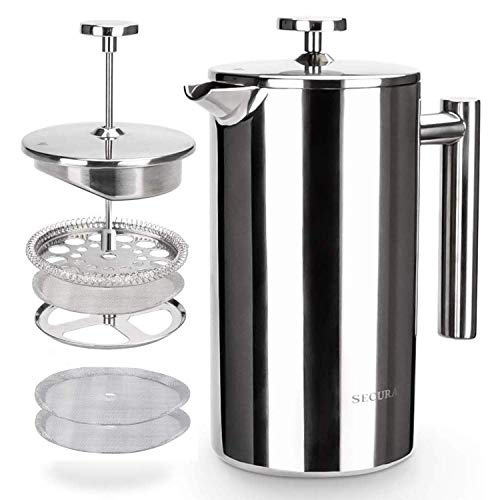
Secura French Press Coffee Maker 34 oz
Badge: Best Overall
Strengths
- 304 grade stainless steel build resists rust and kitchen knocks
- Insulated body holds serving heat longer than a thin glass beaker
- Two extra screens included, so a worn mesh does not end the press
Trade-offs
- Stainless walls hide the brew level while the coffee steeps
- Heavier than a glass press when full and carried one-handed
- Silver finish shows fingerprints and water spots quickly
Key specs
- Capacity: 34 oz (1 litre)
- Material: 304 grade stainless steel
- Construction: insulated
- Extras: 2 extra screens included
This is the press most households should start with, because it removes the two classic French press failures at once: the fragile glass beaker and the single screen that slowly frays until grounds slip through. The insulated stainless body keeps a second cup properly hot while you finish the first, and the spare screens mean routine wear is a swap, not a replacement purchase.
The honest limitation is visibility: you cannot watch the bloom or judge the fill line through steel, so the first few brews need a measuring habit rather than eyeballing.
In daily use, the Secura French Press Coffee Maker 34 oz earns its badge of Best Overall in the unglamorous moments: the rinse after breakfast, the second pour twenty minutes later, the wash at night. Its defining specification, Capacity: 34 oz (1 litre), is the one you will feel every day, while Material: 304 grade stainless steel works quietly in the background. Press brewing punishes inconsistency, so a model that removes friction from the routine does more for the cup than a marginal difference in materials ever could. Owners who standardise their ratio around this pot’s capacity tend to get their most repeatable results from it, because the vessel stops being a variable.
There is also a longevity argument specific to this pick. A press is a mechanical product with exactly one wear assembly, the screen stack, and everything else is structure. The structure here is built to be boring for a decade, and boring is what you want from a tool you use half-asleep. Pair it with fresh screens when the originals tire, keep the threads and rim free of old grounds, and the Secura French Press Coffee Maker 34 oz should still be pouring a familiar cup long after trendier brewers have been replaced twice over.
Best for: buyers who want an all-round first choice that balances the strengths in this category / Not suited for: buyers whose priorities run against the trade-offs listed for this pick above
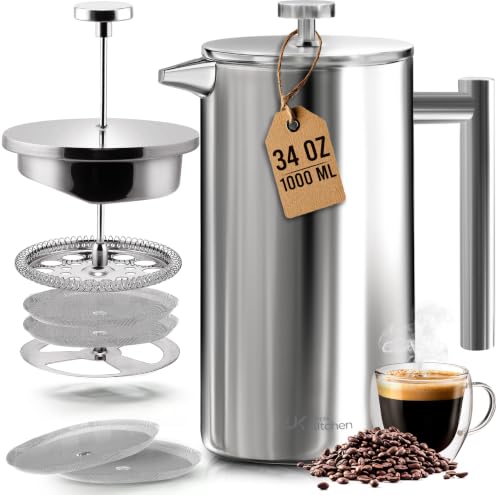
Utopia Kitchen Stainless Steel French Press 34 oz
Badge: Best Filtration
Strengths
- Four-level filtration system traps more fine sediment than a single screen
- Double wall insulation keeps the pot hot through a slow breakfast
- Dishwasher safe, which makes daily use realistic rather than occasional
Trade-offs
- Filtration stack takes a little longer to rinse fully clean
- Thirty-four ounce size is a ceiling for larger groups
- Design is functional rather than decorative on the table
Key specs
- Capacity: 34 oz
- Material: 304 grade stainless steel
- Construction: double wall insulated
- Filtration: 4-level system, 2 extra filters included
- Care: rust-free, dishwasher safe
Sediment is the complaint that pushes many drinkers away from press coffee, and this model answers it directly with a layered filtration stack. If you love the heavy body of immersion brewing but dislike the last gritty mouthful, the extra filtering stages are aimed squarely at you, while the double wall keeps the pot from going lukewarm mid-morning.
More filtration layers mean more parts to separate and rinse after every brew; if you routinely leave the press sitting until evening, cleaning becomes a small chore rather than a quick rinse.
In daily use, the Utopia Kitchen Stainless Steel French Press 34 oz earns its badge of Best Filtration in the unglamorous moments: the rinse after breakfast, the second pour twenty minutes later, the wash at night. Its defining specification, Capacity: 34 oz, is the one you will feel every day, while Material: 304 grade stainless steel works quietly in the background. Press brewing punishes inconsistency, so a model that removes friction from the routine does more for the cup than a marginal difference in materials ever could. Owners who standardise their ratio around this pot’s capacity tend to get their most repeatable results from it, because the vessel stops being a variable.
There is also a longevity argument specific to this pick. A press is a mechanical product with exactly one wear assembly, the screen stack, and everything else is structure. The structure here is built to be boring for a decade, and boring is what you want from a tool you use half-asleep. Pair it with fresh screens when the originals tire, keep the threads and rim free of old grounds, and the Utopia Kitchen Stainless Steel French Press 34 oz should still be pouring a familiar cup long after trendier brewers have been replaced twice over.
Best for: buyers who want a cleaner cup through layered filtration / Not suited for: buyers whose priorities run against the trade-offs listed for this pick above
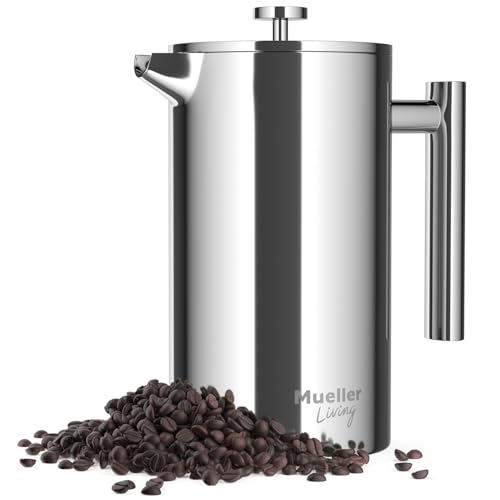
MuellerLiving French Press Coffee Maker 34 oz
Badge: Best for Daily Use
Strengths
- Four filter screens work to keep the cup cleaner and smoother
- Double insulated, heat resistant build suits rushed weekday handling
- Food grade stainless steel inside and out, with no glass to crack
Trade-offs
- Shares the steel visibility trade-off when judging water level
- Thirty-four ounces serves a household, not a crowd
- Plain styling will not be the centrepiece of a styled counter
Key specs
- Capacity: 34 oz
- Material: stainless steel, food grade
- Construction: double insulated, heat resistant
- Filtration: 4 filter screens
- Care: rust-free, dishwasher safe
MuellerLiving pitches this press at the everyday drinker, and the specification supports that reading: layered screens for a cleaner cup, insulation for a slower morning, and a body that shrugs off the bumps a glass beaker would not survive. It is a sensible pick for a shared kitchen where the press gets used, washed, and used again without ceremony.
Like the other steel presses here, it asks you to measure water before pouring rather than watching a line climb, which takes a brew or two to become automatic.
In daily use, the MuellerLiving French Press Coffee Maker 34 oz earns its badge of Best for Daily Use in the unglamorous moments: the rinse after breakfast, the second pour twenty minutes later, the wash at night. Its defining specification, Capacity: 34 oz, is the one you will feel every day, while Material: stainless steel, food grade works quietly in the background. Press brewing punishes inconsistency, so a model that removes friction from the routine does more for the cup than a marginal difference in materials ever could. Owners who standardise their ratio around this pot’s capacity tend to get their most repeatable results from it, because the vessel stops being a variable.
There is also a longevity argument specific to this pick. A press is a mechanical product with exactly one wear assembly, the screen stack, and everything else is structure. The structure here is built to be boring for a decade, and boring is what you want from a tool you use half-asleep. Pair it with fresh screens when the originals tire, keep the threads and rim free of old grounds, and the MuellerLiving French Press Coffee Maker 34 oz should still be pouring a familiar cup long after trendier brewers have been replaced twice over.
Best for: buyers who want a durable press built for everyday brewing / Not suited for: buyers whose priorities run against the trade-offs listed for this pick above

AgcKuzt French Press 34 oz
Badge: Best for Camping and Travel Kitchens
Strengths
- Full stainless steel build travels without the breakage risk of glass
- Double-walled insulation suits outdoor mornings and slow starts
- Two additional filters are included for life away from a shop
Trade-offs
- Four-cup framing means modest batches for bigger groups
- Brand support network is smaller than the long-established names
- Steel body still needs measuring rather than visual filling
Key specs
- Capacity: 34 oz, 4 cups
- Material: full stainless steel, food grade
- Construction: double-walled insulated
- Extras: 2 more filters included
- Care: dishwasher safe
The listing itself points this press at kitchen and camping use, and the all-steel construction is exactly why that claim holds up: it can ride in a camp box, survive a tailgate table, and still work as the house press on Monday. Insulation matters even more outdoors, where a second cup poured twenty minutes later would otherwise be cold.
The limitation is scale and pedigree: four cups is a small batch for a group campsite, and a newer brand means a thinner track record than the established names in this guide.
In daily use, the AgcKuzt French Press 34 oz earns its badge of Best for Camping and Travel Kitchens in the unglamorous moments: the rinse after breakfast, the second pour twenty minutes later, the wash at night. Its defining specification, Capacity: 34 oz, 4 cups, is the one you will feel every day, while Material: full stainless steel, food grade works quietly in the background. Press brewing punishes inconsistency, so a model that removes friction from the routine does more for the cup than a marginal difference in materials ever could. Owners who standardise their ratio around this pot’s capacity tend to get their most repeatable results from it, because the vessel stops being a variable.
There is also a longevity argument specific to this pick. A press is a mechanical product with exactly one wear assembly, the screen stack, and everything else is structure. The structure here is built to be boring for a decade, and boring is what you want from a tool you use half-asleep. Pair it with fresh screens when the originals tire, keep the threads and rim free of old grounds, and the AgcKuzt French Press 34 oz should still be pouring a familiar cup long after trendier brewers have been replaced twice over.
Best for: buyers who want an unbreakable press that travels as well as it brews / Not suited for: buyers whose priorities run against the trade-offs listed for this pick above
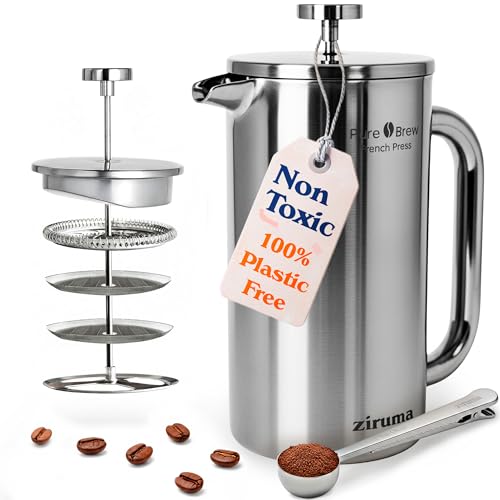
Ziruma Non-Toxic Stainless Steel French Press 34 oz
Badge: Best Materials-First Pick
Strengths
- No plastic or heavy metals in the brew path, per the maker
- Surgical-grade steel with a four-layer filter for a cleaner cup
- Measurement marks help repeat a ratio without a separate jug
Trade-offs
- Materials-first positioning usually sits at a higher tier
- Steel walls still limit how much of the steep you can watch
- Thirty-four ounces is the only size story here
Key specs
- Capacity: 34 oz
- Material: surgical-grade stainless steel
- Filtration: 4-layer filter
- Features: measure marks, double-wall insulated
- Care: dishwasher safe, portable
Some buyers choose a press the way they choose a pan: by asking what touches the drink. This model is built for that buyer, with an all-steel brew path, no plastic in contact with hot coffee, and measurement marks that quietly improve consistency. The four-layer filter keeps the materials story from costing you a gritty cup.
The trade-off is that you are paying attention, and usually a premium tier, for material purity that a more casual drinker may never think about; the coffee itself brews by the same immersion rules as every press here.
In daily use, the Ziruma Non-Toxic Stainless Steel French Press 34 oz earns its badge of Best Materials-First Pick in the unglamorous moments: the rinse after breakfast, the second pour twenty minutes later, the wash at night. Its defining specification, Capacity: 34 oz, is the one you will feel every day, while Material: surgical-grade stainless steel works quietly in the background. Press brewing punishes inconsistency, so a model that removes friction from the routine does more for the cup than a marginal difference in materials ever could. Owners who standardise their ratio around this pot’s capacity tend to get their most repeatable results from it, because the vessel stops being a variable.
There is also a longevity argument specific to this pick. A press is a mechanical product with exactly one wear assembly, the screen stack, and everything else is structure. The structure here is built to be boring for a decade, and boring is what you want from a tool you use half-asleep. Pair it with fresh screens when the originals tire, keep the threads and rim free of old grounds, and the Ziruma Non-Toxic Stainless Steel French Press 34 oz should still be pouring a familiar cup long after trendier brewers have been replaced twice over.
Best for: buyers who want an all-steel brew path with no plastic touching the coffee / Not suited for: buyers whose priorities run against the trade-offs listed for this pick above
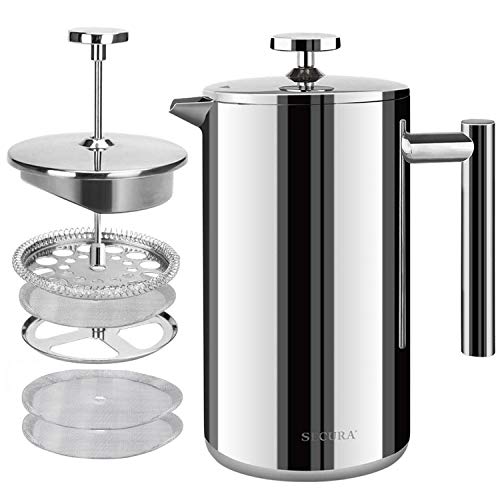
Secura French Press Coffee Maker 50 oz
Badge: Best for Larger Households
Strengths
- Fifty ounce capacity brews for a table, not just a couple
- Same 304 grade stainless steel and insulated build as the smaller Secura
- Two extra screens included for the higher wear of bigger batches
Trade-offs
- A full fifty ounce steel press is genuinely heavy to pour
- Too much press for a solo drinker; coffee sits and over-extracts
- Takes more counter and cupboard room than the standard size
Key specs
- Capacity: 50 oz (1.5 litre)
- Material: 304 grade stainless steel
- Construction: insulated
- Extras: 2 extra screens included
Households that brew for four or more people know the standard press problem: the first pot empties before everyone has a cup, and the second pot makes latecomers wait. This larger Secura solves the arithmetic with half as much again in capacity, in the same insulated stainless format as its smaller sibling, so the last pour is still hot.
Size cuts both ways: a full pot is heavy, and a half pot brewed for one person will sit in contact with the grounds and turn bitter unless you decant it straight away.
In daily use, the Secura French Press Coffee Maker 50 oz earns its badge of Best for Larger Households in the unglamorous moments: the rinse after breakfast, the second pour twenty minutes later, the wash at night. Its defining specification, Capacity: 50 oz (1.5 litre), is the one you will feel every day, while Material: 304 grade stainless steel works quietly in the background. Press brewing punishes inconsistency, so a model that removes friction from the routine does more for the cup than a marginal difference in materials ever could. Owners who standardise their ratio around this pot’s capacity tend to get their most repeatable results from it, because the vessel stops being a variable.
There is also a longevity argument specific to this pick. A press is a mechanical product with exactly one wear assembly, the screen stack, and everything else is structure. The structure here is built to be boring for a decade, and boring is what you want from a tool you use half-asleep. Pair it with fresh screens when the originals tire, keep the threads and rim free of old grounds, and the Secura French Press Coffee Maker 50 oz should still be pouring a familiar cup long after trendier brewers have been replaced twice over.
Best for: buyers who want a press sized for a full table in one brew / Not suited for: buyers whose priorities run against the trade-offs listed for this pick above
Comparison Table
| Pick | Badge | Key attribute | Second attribute | Check |
|---|---|---|---|---|
| Secura French Press Coffee Maker 34 oz | Best Overall | Capacity: 34 oz (1 litre) | Material: 304 grade stainless steel | Check on Amazon |
| Utopia Kitchen Stainless Steel French Press 34 oz | Best Filtration | Capacity: 34 oz | Material: 304 grade stainless steel | Check on Amazon |
| MuellerLiving French Press Coffee Maker 34 oz | Best for Daily Use | Capacity: 34 oz | Material: stainless steel, food grade | Check on Amazon |
| AgcKuzt French Press 34 oz | Best for Camping and Travel Kitchens | Capacity: 34 oz, 4 cups | Material: full stainless steel, food grade | Check on Amazon |
| Ziruma Non-Toxic Stainless Steel French Press 34 oz | Best Materials-First Pick | Capacity: 34 oz | Material: surgical-grade stainless steel | Check on Amazon |
| Secura French Press Coffee Maker 50 oz | Best for Larger Households | Capacity: 50 oz (1.5 litre) | Material: 304 grade stainless steel | Check on Amazon |
Read the table by columns, not by rows: find the attribute that matches your situation, then follow that column to the pick that carries it. The detailed reviews above explain what each attribute costs in trade-offs, which is the half of the story a table cannot tell.
How to Choose for Best coffee press makers
Capacity: do the cup maths before the style maths
A thirty-four ounce press makes roughly four generous mugs, which covers a couple with a second cup each, or a small family at breakfast. A fifty ounce press covers a table of guests without a second brew, but it punishes the solo drinker: a half-filled large press extracts unevenly, and a full one left standing turns bitter on its own grounds. Buy for your ordinary Tuesday, not your largest Sunday, and let a second quick brew handle the rare crowd. Households that regularly split between press mornings and faster methods often keep a smaller machine alongside; the trade-offs are mapped in Best Cold Hot Coffee Makers.
Filtration: the taste decision hiding in the parts list
A single screen is the traditional design and it leaves the traditional silt in the last mouthful. Multi-layer and four-level systems add finer stages that catch more of that sediment, at the cost of a slower plunge and more parts to rinse. If you have abandoned press coffee before because of grit, filtration is your first filter when shopping, ahead of brand and finish. If you enjoy the heavy, almost chewy body of a classic press, a simpler screen keeps that character intact.
Material and insulation: steel versus the glass you may be replacing
Glass shows you the brew and breaks in the sink; steel hides the brew and survives the decade. Double-walled steel also holds serving temperature far longer, which changes the second cup from a compromise into a pleasure. The cost is process visibility, answered by measuring water in a kettle or jug before pouring. Every pick in this guide is steel, so the real choice is between insulation levels, finishes, and the small group of material-first designs that remove plastic from the brew path entirely.
Screens, spares, and the cost of year three
The screen is the wear part of every press. It frays at the edges, traps old oils, and eventually lets grounds slip past. Picks that include spare screens postpone that decline by years and cost nothing extra to store in a drawer. When comparing two similar presses, the one with spares in the box is usually the better long-term buy, and a dishwasher-safe rating decides whether the press gets used daily or saved for weekends.
How to Brew, Clean, and Troubleshoot a Coffee Press
The press rewards a simple, repeatable routine. Work through these steps in order and the same press will pour the same cup every morning.
- Measure. Use a coarse, even grind and a starting ratio near one part coffee to fifteen parts water by weight, then adjust one step at a time.
- Heat. Bring fresh water just off the boil and let it settle for half a minute so it does not scald the grounds.
- Bloom. Add the grounds, pour enough water to wet them fully, and wait thirty seconds while the bed swells and releases gas.
- Fill and steep. Pour the remaining water in a slow circle, rest the lid on top without plunging, and steep for about four minutes.
- Break and skim. Stir the crust gently and skim the foam if you want the cleanest possible cup.
- Plunge slowly. Press the plunger down with steady, light pressure until the screen sits just above the grounds bed. Forcing it stirs sediment back into the coffee.
- Decant at once. Pour every cup immediately, or move the coffee to a carafe. Coffee left on the grounds keeps extracting and turns harsh.
Cleaning is a two-minute habit: knock the grounds into the bin or compost, rinse the screen stack under hot water, and wash with a drop of detergent whenever oils start to smell stale. Separate layered filters weekly so trapped fines do not sour the next brew. The same maintenance mindset keeps drip machines honest too, and the makers of mixed counters will find the overlap discussed in Best Cold Brew Coffee Makers Geek.
Troubleshooting
Problem: the cup tastes bitter and harsh → shorten the steep, coarsen the grind, or decant sooner; bitterness in a press is almost always time and contact, not the beans.
Problem: the cup is full of silt → grind coarser and more evenly, plunge more slowly, and pour gently without tilting the last of the pot; a worn screen that has started to fray should be replaced with a spare.
Problem: the plunger is hard to press → the grind is too fine or the dose is too heavy; forcing it can spray hot coffee, so lift, stir, and re-plunge with less resistance.
Why Steel Won This Category
It is worth pausing on the fact that no glass press made this list, because glass is where the category began. The shift is practical rather than fashionable. Kitchens have become harder on equipment: presses share counters with heavy pans, travel to cabins and campsites, and go through dishwashers that a delicate beaker should never meet. Steel also changed the drinking experience itself by holding heat, which matters in a brewer whose whole method is a slow steep followed by unhurried pouring. Glass still wins on one axis, visibility, and a brewer who loves watching the bloom should weigh that honestly. For everyone else, the modern steel press is simply the more durable tool, and durability is what a daily brewer needs most.
Steel has a second, quieter advantage: consistency across years. A glass beaker that survives is eventually replaced for chips and clouding; a steel body and a fresh screen brew in year five much as they did in week one. That is why the spare-screen detail recurs in these reviews. It looks like a small line in a listing and behaves like a long warranty in the kitchen.
Getting a Cleaner Cup Without Leaving the Press Behind
Many drinkers drift from press to filtered coffee chasing cleanliness, then miss the body they left behind. The middle path is technique plus filtration. Start with the layered-filter picks in this guide, grind coarse and even so there are fewer fines to escape, skim the surface foam after the steep, and pour in one smooth motion that leaves the last cloudy ounce in the pot. Let the poured cup rest for a minute and any remaining sediment settles below drinking level. Readers who split their week between hot press mornings and cold drinks can compare the chilled side of the craft in Best Cold Bew Coffee Makers, where filtration choices matter just as much.
Water deserves a sentence of its own. A press has no paper to hide behind, so stale or heavily chlorinated water shows directly in the cup. Fresh, good-tasting water at the right temperature does more for a press than any accessory, and it costs nothing but attention.
Press Coffee and the Wider Coffee Counter
A press rarely lives alone on a counter, and it is worth being clear about what it does better than its neighbours and where it should politely step aside. Against drip, the press offers body and simplicity: no filters to buy, no carafe geometry to fight, and a cup that tastes like the beans were actually in the water, because they were. Against espresso, it offers calm: no pressure, no puck preparation, no maintenance programme, just a steep and a plunge. Against pour-over, it trades a measure of clarity for forgiveness, which is the right trade at seven in the morning. The households that keep a press for years are the ones that assign it this honest job description, the slow, generous, weekend-and-guest brewer, and stop asking it to be the fastest machine they own.
That division of labour also explains why the steel shift matters beyond durability. A press that holds heat can sit at the centre of a breakfast table doing its one job socially, poured from over conversation, rather than sprinting back and forth to a hot plate. The picks in this guide were chosen with that table in mind as much as the sink and the cupboard. Choose the one whose capacity, filtration, and materials match the breakfasts you actually host, and the press stops being an appliance and becomes part of the furniture of the morning, which is the highest compliment kitchen equipment can earn.
Common Buying Mistakes
- Buying capacity for the biggest gathering of the year and living with a half-empty, over-extracted press every ordinary day.
- Grinding fine because the grinder was left on a drip setting, then blaming the press for silt and a hard plunge.
- Leaving finished coffee sitting on the grounds while the household drifts through breakfast, then judging the brewer for bitterness it did not cause.
- Ignoring the screen for years until it frays, when several picks in this guide include the spare in the box.
- Judging steel presses by looks alone and skipping the filtration design, which is the specification that changes the taste.
Every mistake on that list has the same shape: a decision made on the wrong axis, size instead of fit, headline instead of specification, or hope instead of a routine. The sections above exist to put the decision back on the axis that decides how the product will actually live in your kitchen.
A Short History of the Press, and Why It Still Earns Its Counter Space
The press pot is one of the oldest ideas in modern coffee, and its survival is not nostalgia. Immersion brewing, grounds and water spending real time together, extracts evenly in a way that forgiving home technique can actually achieve, which is more than can be said for methods that demand a perfect pour in a spiral at a set temperature. The press asks for coarse grounds and patience, two things a home kitchen can supply, and it forgives the rest. That forgiveness is why the design has outlived a century of cleverer brewers, and why it remains the recommendation for anyone who wants a reliably good cup without turning breakfast into a ceremony.
What has changed, and what this guide’s all-steel shortlist reflects, is the material culture around the method. The classic glass pot belonged to a slower kitchen with a single careful owner. The modern press belongs to households: shared, hurried, dishwasher-fed, occasionally packed into a car for a weekend away. Steel, insulation, and layered filtration are not marketing layers on an old idea; they are the old idea adapted to the kitchens it now lives in. The brewing itself would be recognised instantly by a drinker from generations ago, which is rather the point.
So the choice in this guide is not really between six pots. It is between six versions of a morning: the cleaner cup, the bigger table, the purer materials, the travelling pot. Pick the morning you actually have, most days, and the press will take care of the coffee. That has always been the bargain the press offers, and on the evidence of these six, it is still keeping its side of it.
Final Recommendation
Start with the Secura 34 oz as the default: it is the balanced press, with an insulated steel body and spare screens, that suits the widest range of kitchens. Choose the Utopia Kitchen or the MuellerLiving if a cleaner cup is your priority, since their layered filtration tackles sediment head-on. The Ziruma is the pick when what touches your coffee matters most, the AgcKuzt earns its place in a camp box as easily as on a counter, and the larger Secura is the answer for households brewing for a table. Whichever you choose, pair it with a coarse grind, a four minute steep, and immediate decanting, and the press will repay you every morning.
Shortlist again, for the reader who scrolled: start with Secura French Press Coffee Maker 34 oz as the default, consider Utopia Kitchen Stainless Steel French Press 34 oz for its particular strength, and look at MuellerLiving French Press Coffee Maker 34 oz if your situation matches its speciality. Each listing is the place to check the latest price on Amazon before you commit.
Related guides
Frequently Asked Questions
Is a French press the same thing as a coffee press?
Yes. Coffee press, French press, and press pot describe the same immersion brewer: grounds steep in hot water inside a pot, then a plunger pushes a filter screen down to separate them. The name changes by region and by brand, the method does not.
Why do all six picks use stainless steel instead of glass?
Because steel answers the failures that end most press ownership: breakage, fast heat loss, and travel damage. Glass offers a view of the brew, and that is a real pleasure, but for daily durability and a hot second cup the insulated steel designs in this guide are the stronger long-term tools.
How do I keep sediment out of my cup?
Choose a layered filtration pick, grind coarse and evenly, plunge slowly, and pour gently, leaving the last cloudy sip in the pot. Sediment is reduced by each of those steps together; no single trick removes it entirely, and a small amount of body is part of the press character.
What size press should a household buy?
Thirty-four ounces covers most homes: about four generous mugs per brew. Move to the fifty ounce pick only if you regularly serve a table at once. A press that is too large for daily use brews uneven half batches and tempts you to leave coffee standing on the grounds.
Can I brew tea in a coffee press?
Loose-leaf tea steeps well in a press, and the plunger separates leaves cleanly, though a dedicated pot avoids coffee oils flavouring delicate tea. For cold drinks, a press can strain a quick fridge steep, but the purpose-built pitchers in Best Cold Brew Coffee Makers Geek Com suit overnight cold brewing better.
How often should the filter screen be replaced?
Inspect it whenever cleaning starts to feel ineffective. Frayed edges, a warped rim, or grounds appearing in every cup are the signals. Several picks include spare screens, which turns replacement into a two-minute swap instead of a parts hunt.


