Disclosure: topratedkitchenware.com is reader-supported. When you buy through links on our site, we may earn an affiliate commission from Amazon and other retailers, at no extra cost to you.
Where to buy
The six machines below are the verified picks in this guide to the best combination multi cup and single serve coffee makers, for readers who need one machine to serve a crowd in sequence and a single cup in seconds. Each name links to its Amazon listing, where you can check the latest price on Amazon, confirm the current configuration, and read the newest owner feedback before you decide.
- Keurig K-Express (Black)
- Keurig K-Express (Warm Stone)
- Elite Gourmet EHC111A
- Keurig K-Mini Mate
- Tastyle Mini Hot and Iced Coffee Maker
- Keurig K-Express (Evergreen)
Read the full guide ↓ for the reasoning behind the order, the honest limitations of every pick, and the checks that matter more than any headline claim.
The need behind the best combination multi cup and single serve coffee makers is a rhythm problem. Most days, a household wants one cup, fast, with no pot brewed and wasted. Some days — weekends, guests, deadlines, school projects — the same household wants cup after cup without the machine becoming the bottleneck. Machines that promise both lives are really promising a water system and a pace that can stretch from one cup to many without changing appliances, and that is exactly how this guide judges the six verified picks below.
One clarification keeps the ranking honest: none of these machines brews a multi-cup carafe at once. Multi-cup service here means sequential brewing from a reservoir — cup after cup, each fresh, each the drinker’s own — which is how the Keurig K-Express models, with their 42 oz reservoirs, earn the top of this list. The fill-per-cup machines behind them, the Tastyle, Elite Gourmet and K-Mini Mate, serve the single-cup end beautifully and the multi-cup end one deliberate cup at a time. The guide weighs both ends openly rather than pretending the two designs are the same.
Read with your heavy day in mind, not your average one. A machine that delights on Tuesday and collapses on Saturday will be remembered for Saturday. Readers whose crowd is an office rather than a family will find the same logic scaled up in the Best Commercial Coffee Makers For Office guide, and readers whose crowd wants different drinks rather than merely more drinks should compare the Best Combo Coffee And Espresso Makers shortlist as well.
Key Takeaways
- Multi-cup in this pool means sequential brewing: the 42 oz K-Express reservoir serves a crowd cup after cup, each one fresh.
- The three K-Express finishes are one machine; choose between them on looks and upkeep, not performance.
- The Tastyle is the most versatile single-cup machine here, with pods, grounds and hot and iced modes.
- The Elite Gourmet and K-Mini Mate are true one-cup machines: perfect for one drinker, a queue for four.
- Judge this category by your heaviest day, because every machine here handles the light day well.
In this guide
Quick Picks
The six verified picks below are ordered by how gracefully each stretches from one cup to many. Badges are consistent across the Quick Picks, the detailed reviews and the comparison table.
| Pick | Badge | Best for | Link |
|---|---|---|---|
| Keurig K-Express (Black) | Best Overall | Households that swing between one weekday cup and a weekend crowd | Check on Amazon |
| Keurig K-Express (Warm Stone) | Best for Style-Led Kitchens | K-Express buyers whose crowd gathers in a design-led kitchen | Check on Amazon |
| Elite Gourmet EHC111A | Best for Grounds Drinkers | Solo drinkers who occasionally make a second cup for a guest | Check on Amazon |
| Keurig K-Mini Mate | Best True Single Cup | Individuals in small spaces whose multi-cup need is rare | Check on Amazon |
| Tastyle Mini Hot and Iced Coffee Maker | Most Versatile | Couples whose crowd is two and whose drinks vary wildly | Check on Amazon |
| Keurig K-Express (Evergreen) | Best Colour Statement | K-Express buyers furnishing a kitchen with personality and a crowd habit | Check on Amazon |
How These Picks Were Chosen
For a multi-cup brief, selection began with the water. Machines were sorted by how they hold and deliver it — reservoir capacity first, then brew size range, then the pace implied by the design — because those three attributes, all confirmed in the verified listings, are what multi-cup service actually consists of in a single-serve world. Format flexibility and footprint were weighed next, and finish last, which is why three identical machines in different colours are reviewed as one capability in three outfits rather than as three capabilities.
The guide is research-led and makes no hands-on claims. Sequential service is evaluated as a system: a reservoir only helps if the brew sizes let each drinker finish in one pass, and a large brew size only helps if the reservoir behind it survives the round. Where a machine’s design caps its crowd service — the fill-per-cup minis — the review says so warmly but plainly, because a mini bought for a crowd is a disappointment that honest labelling prevents.
The 6 Best Combination Multi Cup and Single Serve Coffee Makers

Keurig K-Express (Black)
Badge: Best Overall
The Keurig K-Express in black is the straightforward centre of the K-Cup world: a single-serve pod machine with a 42 oz removable reservoir, three brew sizes and a Strong Brew button for a bolder extraction from the same pod. The reservoir is the detail that shapes daily life with it, because it turns brewing into a rhythm of several cups between refills instead of a fill for every single mug. It is travel mug friendly, so a commuter cup slides under the spout without decanting from a smaller mug first. Because it works with all K-Cup pods, the coffee choice is as wide as the pod aisle itself, from dark roasts to flavoured blends to tea and cocoa pods. Operation is deliberately plain: insert a pod, choose a size, press brew. There is no carafe, no grinder and no milk system, and that simplicity is the point. For a household that wants predictable pod coffee with the fewest possible steps, this is the reference design the rest of this guide is measured against.
The black K-Express is the purest expression of this keyword in the pool. One cup is a pod and a button; many cups are the same pod and button repeated, with the 42 oz reservoir absorbing the repetition so nobody refills, waits for a tank or manages a pot. The three brew sizes keep the sequence honest — each drinker gets their size in one pass — and Strong Brew covers the drinker whose cup must be serious. What it never does is brew a batch, and a household whose crowd wants coffee simultaneously in a jug should read the pot guide in this cluster. For the far more common crowd that drinks in sequence, this is the machine the brief describes.
Strengths
- 42 oz removable reservoir means several cups between refills
- Strong Brew button gives a bolder cup from the same pod
- Three brew sizes cover a small cup through a travel mug
Trade-offs
- Pods only in normal use, so grounds need a separate routine
- No dedicated iced or cold-brew programme
- Black finish shows dust and scale marks readily
Key specifications
- Format: Single-serve K-Cup pod coffee maker
- Brew sizes: 3 brew sizes
- Reservoir: 42 oz, removable
- Feature: Strong Brew button
- Mug fit: Travel mug friendly
- Finish: Black
Best for: Households that swing between one weekday cup and a weekend crowd / Not suited for: Anyone who needs a carafe brewed all at once
Keurig K-Express (Warm Stone)
Badge: Best for Style-Led Kitchens
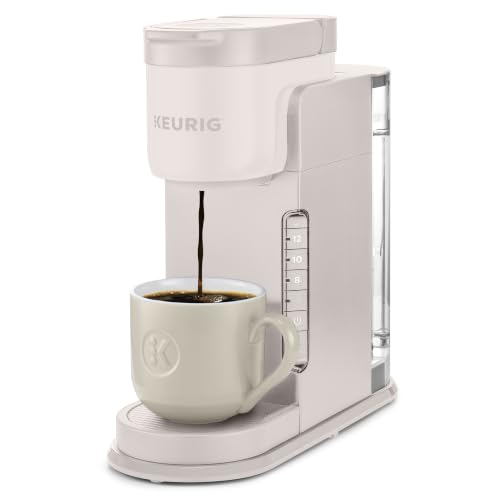
The Warm Stone K-Express is the same machine as the black K-Express — 42 oz removable reservoir, three brew sizes, Strong Brew button, travel mug friendly, compatible with all K-Cup pods — wearing a softer, stone-toned finish. That makes the choice between them a kitchen-design decision rather than a coffee decision, and there is no shame in that: a machine that lives on the counter every day should look like it belongs there. The warm neutral tone sits comfortably beside pale wood, stone worktops and stainless appliances, and it is more forgiving of the light dusting of coffee grounds and water spots that accumulate around any brewer. Everything said about the K-Express routine applies here unchanged: pod in, size chosen, cup brewed, with several cups available before the reservoir needs attention. If your household has already decided the K-Express feature set is right, Warm Stone is simply the version for kitchens where black reads too stark.
Warm Stone serves the multi-cup brief identically to the black K-Express, and its review exists to make the colour decision honestly. Crowd service is messy service: more cups, more drips, more grounds dust around the machine, and the warm neutral finish hides that evidence between cleanings better than gloss black or pale mint. In a kitchen where the machine sits in view of the living space, that forgiveness compounds daily. The capability underneath — reservoir rhythm, three sizes, strong option — is the K-Express standard, and this guide will not pretend the finish changes a single cup. Buy it when the function is settled and the kitchen gets its vote.
Strengths
- Same 42 oz reservoir and three brew sizes as the black version
- Warm Stone finish hides everyday marks better than gloss black
- Strong Brew button for a more intense cup when wanted
Trade-offs
- Functionally identical to the other K-Express colours
- Pods only in normal use, with no grounds basket in the box story
- No dedicated iced or cold-brew programme
Key specifications
- Format: Single-serve K-Cup pod coffee maker
- Brew sizes: 3 brew sizes
- Reservoir: 42 oz, removable
- Feature: Strong Brew button
- Mug fit: Travel mug friendly
- Finish: Warm Stone
Best for: K-Express buyers whose crowd gathers in a design-led kitchen / Not suited for: Anyone expecting more capacity than the black K-Express

Elite Gourmet EHC111A
Badge: Best for Grounds Drinkers
The Elite Gourmet EHC111A takes the opposite route to the pod machines around it: instead of a capsule, it brews through a reusable filter filled with your own ground coffee, and it will handle loose-leaf tea as well. That single design choice changes the running relationship completely, because your coffee choice becomes whatever bag is open in the cupboard rather than whatever pods you remembered to order. At 600W with one-touch operation it is intentionally simple, aimed at a 14 oz travel mug brewed directly and taken away. Auto shut-off removes the worry of leaving a small appliance on in a dorm, office or spare room, and the dishwasher-safe parts make the reusable filter routine realistic rather than a chore that quietly gets abandoned after the first week. Its compact shape fits the corners of a kitchen that larger machines cannot use: beside a student desk, on an office credenza, in a spare room when guests stay over.
The Elite Gourmet defines the single end of this guide’s spectrum, and its multi-cup story must be told honestly: each cup is filled, dosed and brewed individually, so serving four people is four small ceremonies. For one drinker that ceremony is the pleasure of the machine — your grounds, your dose, your mug — and for a guest it is a charming, deliberate second cup. For a family breakfast it is a queue with rinsing in the middle. Its place here is as the reference point that makes the reservoir machines’ virtue visible, and as the right buy for the large group of drinkers whose crowd is almost always one, occasionally two, and never in a hurry.
Strengths
- Reusable filter brews your own grounds, with no pods to stock
- Also handles loose-leaf tea, which pod machines cannot do natively
- Auto shut-off and dishwasher-safe parts suit dorms and offices
Trade-offs
- No reservoir, so every cup starts with a fresh fill
- 600W output means a gentler pace than larger machines
- One mug at a time, with no batch option
Key specifications
- Format: Single-serve coffee maker for grounds
- Capacity: 14 oz brew
- Power: 600W
- Filter: Reusable filter for grounds and loose-leaf tea
- Feature: Auto shut-off
- Care: Dishwasher-safe parts
Best for: Solo drinkers who occasionally make a second cup for a guest / Not suited for: Crowds of three or more drinking in sequence
Keurig K-Mini Mate
Badge: Best True Single Cup
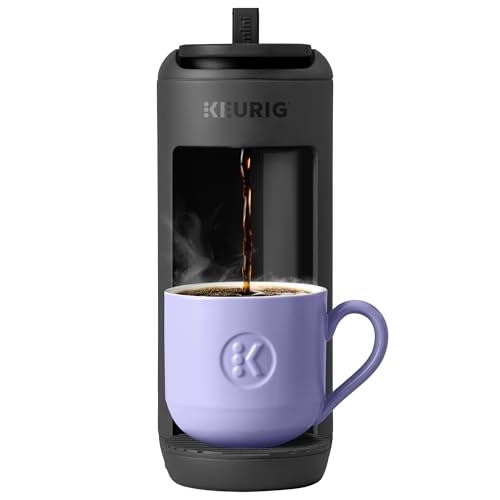
The Keurig K-Mini Mate is the K-Cup idea reduced to its smallest sensible form: a compact, portable single-serve machine that brews up to a 12 oz cup and is aimed squarely at small spaces, dorms and offices. There is no reservoir to manage; you add water for the cup you are about to brew, which keeps the machine tiny and makes it easy to move between a desk, a dorm shelf and a kitchen counter. That fill-per-cup routine is the trade at the heart of the design. For one person making one or two cups a day it is barely a thought, and the machine disappears into spaces where a full-size brewer simply cannot live. For a household queueing for coffee it would be a bottleneck. Judged on its own brief — personal coffee in a small footprint, with the whole K-Cup pod range available — the K-Mini Mate is coherent, honest and easy to recommend to the right owner.
The K-Mini Mate is the honest opposite of the reservoir philosophy: no stored water, no queue management, just one cup brewed from fresh water in the smallest footprint here. Its multi-cup service is real but serial in the slowest sense — fill, brew, fill, brew — which suits the dorm room where a friend occasionally joins and fails the family kitchen where four people leave at the same time. Judged as a personal machine it is superb, and many households solve the multi-cup problem exactly this way: one reservoir machine for the kitchen, one K-Mini Mate exiled to a desk or bedroom where its single cup is the entire brief. As a component of a system, it shines; as the system, it strains.
Strengths
- Compact footprint fits dorms, desks and tiny counters
- Brews up to a 12 oz cup, enough for most mugs
- Simple one-cup-at-a-time routine with familiar K-Cup pods
Trade-offs
- Fill-per-cup design means no reservoir rhythm for groups
- Maximum 12 oz rules out the largest travel mugs in one pass
- Pods only, so grounds drinkers need a different machine
Key specifications
- Format: Single-serve K-Cup pod coffee maker
- Brew size: Up to 12 oz per cup
- Design: Compact and portable
- Intended spaces: Small spaces, dorms and offices
- Finish: Black
Best for: Individuals in small spaces whose multi-cup need is rare / Not suited for: Families and shared kitchens
Tastyle Mini Hot and Iced Coffee Maker
Badge: Most Versatile
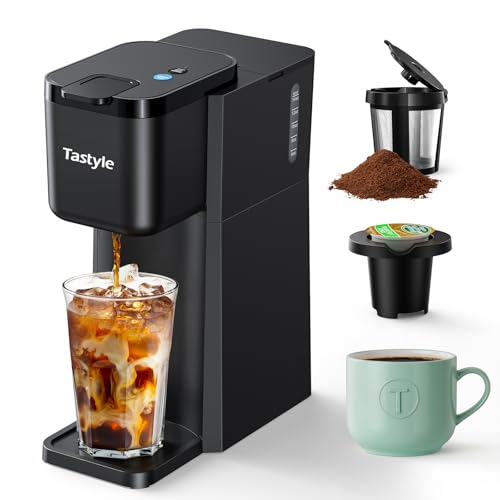
The Tastyle Mini is the most flexible small machine in this pool, because it accepts both K-Cup pods and ground coffee and brews both hot and iced drinks across a 6 to 14 oz range. That combination covers an unusual amount of ground for a mini machine: a pod on a rushed morning, your own grounds when you want a particular bag, a small strong cup or a full travel mug, and an iced coffee in the afternoon without a second appliance. The included recipe book nudges experimentation, and the 120V design is pitched at homes, travel, RVs, offices and dorms — anywhere a full-size brewer is too much machine. The honest limits are size and throughput: this is a one-cup-at-a-time mini, with filling and brewing per cup rather than a reservoir rhythm. For a single drinker or a couple with varied tastes, that trade buys remarkable versatility in a very small footprint.
The Tastyle stretches the single-cup idea further than any mini has a right to: pods and grounds, hot and iced, 6 to 14 oz, so a crowd of two with opposite tastes is served like a café — one pod coffee, one grounds coffee, one of them iced — without a second appliance. What it cannot do is accelerate: the third and fourth cups queue behind the same fill-and-brew cycle. For couples, housemates and small offices of two, that ceiling rarely binds, and the versatility below it is unmatched in this pool. For bigger households it is the ideal second machine, the one that handles the odd drinks while a reservoir model handles the volume.
Strengths
- Genuinely dual-format: K-Cup pods and ground coffee
- Hot and iced modes in one compact machine
- Wide 6 to 14 oz brew range covers espresso-style small cups to travel mugs
Trade-offs
- Mini format means filling and brewing one cup at a time
- No large reservoir for back-to-back group service
- Iced results still depend on using enough ice and strong settings
Key specifications
- Format: Single-serve for K-Cup pods and ground coffee
- Modes: Hot and iced coffee
- Brew sizes: 6 to 14 oz
- Included: Recipe book
- Power: 120V
- Model: K310IC, version 2.0, Classic Black
Best for: Couples whose crowd is two and whose drinks vary wildly / Not suited for: Large households needing reservoir rhythm

Keurig K-Express (Evergreen)
Badge: Best Colour Statement
Evergreen is the boldest colourway of the K-Express, and mechanically it is the same dependable package: a 42 oz removable reservoir, three brew sizes, a Strong Brew button, travel mug clearance and compatibility with all K-Cup pods. A deep green machine makes a deliberate statement on the counter, pairing well with brass fittings, cream cabinetry and the plant-filled kitchens that are currently fashionable, and it hides coffee splashes better than pale finishes do. The brewing story is unchanged and that is a virtue: pods are the fastest route from sleepy to caffeinated, the reservoir stretches across a morning of cups, and the Strong Brew setting answers the most common pod-coffee complaint, a cup that tastes thin, by slowing the extraction for a bolder result. Choose Evergreen when you want the K-Express routine and a machine that looks like a chosen object rather than an appliance that merely happened to you.
Evergreen completes the K-Express trio with the same multi-cup mechanics — 42 oz of ready water, three sizes, a strong option — in the finish that makes the machine a feature of the kitchen rather than an appliance in it. There is a hosting footnote in its favour: a machine that looks deliberate invites guests to use it, and self-service is the reservoir machine’s crowd superpower, since each guest brews their own cup while the host cooks. Deep green also forgives the splash evidence of a busy round. Choose Evergreen when the K-Express has won the functional argument and the room wants a machine with a point of view.
Strengths
- Full K-Express feature set in a distinctive green finish
- 42 oz reservoir supports back-to-back cups for a household
- Strong Brew button adds intensity without changing pods
Trade-offs
- Evergreen is a commitment if your kitchen colours change
- Pods only in normal use, so running costs follow pod prices
- No dedicated iced or cold-brew programme
Key specifications
- Format: Single-serve K-Cup pod coffee maker
- Brew sizes: 3 brew sizes
- Reservoir: 42 oz, removable
- Feature: Strong Brew button
- Mug fit: Travel mug friendly
- Finish: Evergreen
Best for: K-Express buyers furnishing a kitchen with personality and a crowd habit / Not suited for: Minimalists and true carafe devotees
A note on reading the order: the reservoir machines lead because this keyword is won and lost at the crowd end, but the guide’s affection for the minis is genuine and stated in their reviews. A reader whose crowd is hypothetical should invert the ranking without guilt — the Tastyle and the Elite Gourmet are the better daily companions for a life that is mostly one cup. The table that follows exists so both readings can check their facts in the same place.
Comparison Table
Read this table by water system first, because that is the multi-cup question, then by format. The reservoir trio serves crowds; the fill-per-cup trio serves individuals — and the right choice depends entirely on which life is yours.
| Pick | Format | Water capacity | Standout trait | Link |
|---|---|---|---|---|
| Keurig K-Express (Black) | K-Cup pods | 42 oz reservoir | Strong Brew button, three brew sizes | Check on Amazon |
| Keurig K-Express (Warm Stone) | K-Cup pods | 42 oz reservoir | Warm Stone finish, full K-Express feature set | Check on Amazon |
| Elite Gourmet EHC111A | Grounds with reusable filter | Fill per cup, 14 oz brew | Also brews loose-leaf tea | Check on Amazon |
| Keurig K-Mini Mate | K-Cup pods | Fill per cup, up to 12 oz | Compact and portable design | Check on Amazon |
| Tastyle Mini Hot and Iced Coffee Maker | K-Cup pods and grounds | Fill per cup, 6 to 14 oz | Hot and iced modes in a mini body | Check on Amazon |
| Keurig K-Express (Evergreen) | K-Cup pods | 42 oz reservoir | Evergreen finish, full K-Express feature set | Check on Amazon |
How to Choose Between Reservoir Rhythm and Single-Cup Simplicity
Count the crowd honestly, in cups per hour at the peak. A household peak of two cups is a mini’s home ground; a peak of five or six belongs to a reservoir; a peak beyond that starts to belong to the commercial conversation entirely. Peaks, not averages, decide satisfaction, because a machine is loved or cursed at its busiest moment of the week. If your peak is genuinely uncertain — a new house, a growing family — buy the reservoir, because capacity forgives growth while a mini punishes it.
Then weigh what the reservoir asks in return: water that sits must be refreshed, a bigger body must fit the counter, and a machine that is always ready will be used by everyone, including the people who never clean it. The minis ask the opposite discipline — a small ritual per cup — and repay it with freshness and disappearance. Neither discipline is superior; the match between the discipline and the household is the whole decision. Households that hate chores should fear the per-cup ritual; households that hate stale anything should fear the stored water.
Format finishes the decision. Crowds are diverse, and a pod reservoir machine serves diversity at speed, while a dual-format machine like the Tastyle serves diversity at depth for a smaller crowd. Readers whose crowd problem is really a workplace problem will find the next scale up in the Best Commercial Coffee Makers Bunn discussion, where the same reservoir logic is tested against genuinely commercial expectations.
How to Serve a Crowd From a Single-Serve Machine
Set the station before the crowd arrives. Fill the reservoir, lay out pods or grounds where guests can see them, stack mugs that fit the machine, and put milk, sweeteners and a spoon in one obvious place. A visible system is a self-explanatory system, and self-service is the goal: the host who has to operate the machine for every guest has bought a queue, while the host who sets a station has bought a café. On reservoir machines, check the water level twice during a long round rather than discovering the empty tank at the worst moment.
Brew in a sensible order. Large cups and strong settings first, because they take the longest and their drinkers are usually the keenest; small and simple cups last, because they are quick and forgiving. Pour each brew straight to its drinker or into a pre-warmed jug if the round is being carried to another room. Keep a small towel at the station — crowd service is splashy service — and empty the drip tray before it becomes a story.
Problem: the round slows to a crawl → the machine is being refilled or re-dosed between every cup; switch the round to the reservoir machine, or pre-dose grounds cups in a row of mugs ready to brew. Problem: later cups taste weaker → sizes are being stretched to save time; brew each cup at its honest size and let the reservoir do the saving instead. Problem: guests hover uncertainly → the station is not self-explanatory; add the pods, mugs and a tiny note if needed, and make the first cup yourself as a demonstration.
After the crowd, reset while it is easy: empty the drip tray, refresh the reservoir, wipe the splash zone, and restock the format that ran low. Five minutes of reset is what makes the next single weekday cup feel effortless, and it is the maintenance habit that separates households that love these machines from households that merely own them.
Sequential Brewing Versus Batch Brewing: The Honest Trade
Batch brewing makes one coffee for everyone, all at once, and then holds it. Sequential brewing makes everyone’s coffee individually, fresh, at the cost of a small wait per cup. The quality argument favours sequence — the last cup is as fresh as the first — while the ceremony argument favours the batch, with its single pour and its pot on the table. Modern households increasingly live sequential lives even outside coffee, ordering individually and eating at different times, which is why the reservoir single-serve format has grown from a convenience into the default.
The trade sharpens at the extremes. For two people, sequence is painless and batch is wasteful. For ten people in twenty minutes, sequence strains and batch sails. The machines in this guide live in the wide middle, and their reservoirs are sized for it: enough water for a family round, not enough for a village fete. Knowing which side of the middle your heaviest day sits on is the entire purchase decision, stated one last time because it is the one buyers most often fudge.
One Machine or Two: The Satellite Strategy
Many households quietly solve the multi-cup problem by splitting it: a reservoir machine in the kitchen for the crowd, and a mini — a K-Mini Mate or an Elite Gourmet — stationed where one person drinks alone, at a desk, in a studio, in a guest room. The satellite strategy costs counter space in two places but buys peace in both, because the early riser never wakes the house at the kitchen machine and the desk drinker never queues behind the family round. It also lets each station have its own format: pods for the crowd, grounds for the connoisseur’s corner.
The strategy fails when it doubles supplies and cleaning without doubling use — two machines each used twice a week is clutter, not a system. It succeeds when each machine has a named person and a named moment. Readers tempted by it should also weigh the office version of the same idea in the Best Commercial Coffee Makers For Office guide, where satellite machines around a shared break room are standard practice.
Why Three Finishes of One Machine Belong in This Guide
A word about the K-Express trio, because a sceptical reader may wonder why one machine appears three times in a six-pick guide. The verified pool for this keyword contains the K-Express in black, Warm Stone and Evergreen, and the honest response is to review the capability once per finish while saying plainly that the capability is shared. Colour is not a trivial matter in a machine that lives in view for years, and the finishes differ in upkeep — pale shows splashes, dark shows dust, green hides both at the price of presence.
What this guide will not do is manufacture technical differences to justify the three reviews. The reservoir is 42 oz in each, the sizes are three in each, the strong button is the same button. Choose the capability first — it is the right capability for this keyword — and then let the kitchen choose the colour with a clear conscience.
The Mathematics of the Morning Round
Put numbers on the round and the category clarifies itself. A family of four drinking 10 oz cups needs 40 oz of brewed coffee; a K-Express reservoir holds 42 oz of water, which is to say the round fits the tank almost exactly, with the strong drinker’s smaller cup creating the slack. Add a guest and the reservoir empties mid-round — a thirty-second refill at the tap, not a failure, but a rhythm break the host feels. The arithmetic explains why reservoir size is quoted so prominently in this guide: it is not a specification among others, it is the round, expressed in ounces.
The minis run the same mathematics in reverse. Four cups from a fill-per-cup machine are four fills, four doses and four waits, totalling several times the elapsed effort of the reservoir round — effort that is invisible for one cup and decisive for four. Neither machine is better at coffee; they are better at different counts. The buyer’s task is simply to know their count at the peak, and this guide has now given that instruction in several forms because it is the one most often skipped in favour of features that photograph better.
There is a hospitality dividend to sequential service that batch households underestimate: the guest who brews their own second cup feels hosted rather than served, and the host who set the station is free to be at the table instead of at the machine. Coffee rounds in modern homes are social events distributed across an hour, not courses delivered at a moment, and the reservoir machine’s rhythm matches that social shape. The pot matched an older shape, in which everyone sat at once. Neither shape is better company; they are different evenings, and the machine should be bought for the evenings your house actually has.
A Year With a Combination Machine: What Changes
The first month with a combination machine is about discovery: which size becomes the house default, which drinker claims the strong setting, how the weekend round actually flows. Households consistently report the same surprise — the machine’s centre of gravity is not where the purchase discussion put it. The reservoir, debated least, is used most; the versatility, debated most, settles into two or three beloved patterns rather than the dozen imagined in the shop. This is normal, and it is why this guide weighted water and rhythm over novelty from the first section: the daily machine is a rhythm machine, and rhythms are built from the boring specifications.
By the sixth month the machine has become furniture in the best sense — unconsidered, relied upon, maintained by habit rather than decision. The households that reach this state share two practices worth copying: a restock rhythm tied to something else weekly, so pods or grounds never run out unnoticed, and a cleaning moment attached to an existing routine, the Sunday reset or the Friday close-down. Machines that miss those practices drift into the other sixth-month state, the faintly neglected one, where the coffee is fine and the station is tired and nobody can name when it happened.
By the end of the first year, the purchase has usually been judged, and the verdict follows the peak-day rule with embarrassing fidelity. Machines bought for the household’s real heavy day are described as one of the best things in the kitchen; machines bought for the average day are described as fine, with a story about a Saturday attached. The year cannot be re-run, but it can be bought correctly the first time, and the whole of this guide — the reservoir maths, the crowd counting, the honesty about carafes — exists to make the first verdict the good one.
A closing thought on noise, heat and the small physics of a working machine, because crowd service happens in real rooms. A reservoir machine brewing its sixth consecutive cup is warm, faintly steaming and audibly busy, and in an open-plan kitchen that presence is part of the round’s theatre — guests gather where the coffee sounds are. The minis, by contrast, keep their counsel; a single cup appears with almost no ceremony. Neither quality sells a machine on its own, but households that host in the same room where they cook will recognise the difference, and it belongs in an honest account of what serving a crowd from these machines actually feels like.
Common Buying Mistakes
The defining mistake of this category is buying for the average day and discovering the peak. A mini that delights a solo drinker all week becomes the household villain on the one morning five people need coffee, and that morning is the one the machine is remembered by. Shop for the peak your life actually contains.
The second mistake is treating reservoir size as a luxury. In a multi-cup brief it is the product. A machine can have every mode and format and still fail the brief on an empty tank, so read the water line of the spec box before the feature list.
Third, do not let a crowd round run on a neglected machine. Scale slows the brew and cools it, stale water flattens every cup, and a full drip tray announces itself mid-round. The crowd test is also a maintenance test; prepare for both.
Finally, avoid assuming a colour variant is an upgrade. Three picks in this guide are one machine, and paying more attention to the finish than to the water system is how a household ends up with a beautiful machine that cannot serve its Saturday.
Final Recommendation
For most households living this double life, the Keurig K-Express (Black) is the answer: one cup instantly, many cups gracefully, from a reservoir that removes the friction between the two. Its Warm Stone and Evergreen siblings are the same answer in different outfits, and the choice between them is the kitchen’s, not the coffee’s.
Smaller households should take the versatility of the Tastyle Mini Hot and Iced Coffee Maker or the purity of the Elite Gourmet EHC111A, knowing exactly which crowd size they are declining. Buy for the peak, keep the station ready, and the machine will make both of your coffee lives feel like the main one.
Related guides
- Best K Cup Single Serve Coffee Makers
- Best Kcup Single Cup Coffee Makers
- Best Multi Cup And Carafe Coffee Makers
- Best Multiple Serve K Cup Coffee Makers
Frequently Asked Questions
How many cups can a 42 oz reservoir serve?
It depends on the size each drinker chooses: several ordinary cups, or fewer of the largest travel-mug brews. The practical point is rhythm rather than an exact count — a reservoir of this size carries a family round without a refill, which is the moment smaller machines fail.
Is sequential brewing slower than a pot for a family?
For a typical family round it is comparable, and each cup is fresher and individually chosen. A pot wins when many people must be served in the same minute; a reservoir machine wins across the following hour, because the last cup is brewed fresh rather than poured old.
Which pick is best for a household of two?
The Tastyle, if your drinks vary — it covers pods, grounds, hot and iced in a mini body sized for two people’s counter. The K-Express models are the step up when friends and family regularly turn two cups into five.
Can the K-Mini Mate serve guests at all?
Yes, one deliberate cup at a time, which suits a single guest joining you. It is not built for a round, and its review says so; as a personal machine with occasional guest duty it is excellent, and as a desk satellite beside a kitchen reservoir machine it is ideal.
Does a bigger reservoir make coffee taste stale?
Only if the water is left sitting for days. Refreshed on a rhythm, reservoir water is as fresh as fill-per-cup water, and the coffee is brewed on demand either way. The stale risk lives in neglect, not in the reservoir itself.
Why are three finishes of the K-Express in one guide?
Because the verified pool for this keyword includes all three, and the guide reviews the pool honestly: one capability, three finishes, with the upkeep differences between them explained. Choose the capability on the coffee merits and the finish on your kitchen.
Should I keep a kettle or backup for crowd days?
A simple backup is cheap insurance for the biggest hosting days: a kettle and a cafetière, or a pre-warmed jug filled by the thermal method, cover the overflow while the main machine handles the round. Households that host rarely will use the backup twice a year and be glad both times.


