Disclosure: topratedkitchenware.com is reader-supported. When you buy through links on our site, we may earn an affiliate commission from Amazon and other retailers, at no extra cost to you.
Where to buy
The six machines below are the verified picks for this guide to the best commercial pour over coffee makers, with one disclosure stated up front: these are automatic drip machines in the pour-over style — engineered showerheads that saturate the grounds the way a careful hand pour does — not manual pour-over drippers and not plumbed commercial pour-over stations. For offices, small venues, and serious homes that want pour-over quality without a person standing over a kettle, that automatic form is usually the right tool. Each name links to its Amazon listing so you can check the latest price on Amazon.
- KRUPS 12-Cup Programmable Thermal Carafe Coffee Maker
- Cuisinart 10-Cup Thermal Classic Coffeemaker
- SECPOEDR Grind and Brew Coffee Maker with Built-In Grinder
- Gevi 10-Cup Grind & Brew Coffee Maker
- BLACK+DECKER 12-Cup Thermal Programmable Coffee Maker
- Cuisinart PerfecTemp 12-Cup Thermal Drip Coffee Maker
Start with our top pick: Check on Amazon for the current listing. Read the full guide ↓ for the reasoning, the honest limitations, and the checks that matter.
People searching for the best commercial pour over coffee makers are chasing a flavour: the clean, sweet, fully extracted cup that careful pour-over brewing produces. The complication is labour. Manual pour-over is one dripper, one kettle, one attentive person — a beautiful ritual that does not scale to an office kitchen, a small cafe counter, or a family that wants four mugs at once. That is why the automatic pour-over style machine exists: a drip brewer whose showerhead is designed to wet the whole bed of grounds evenly, in stages, imitating what the hand pour does.
This guide covers the verified automatic machines that pursue that goal, and it is honest about the boundary: if you want the manual ritual itself, buy a dripper and a gooseneck kettle, not a machine from this page. If you want pour-over character at pot scale, with programming and thermal carafes, you are in the right place. The picks below were judged on the things that decide pour-over quality — saturation design, brewing temperature, strength control, and grind freshness — rather than on feature counts. Shoppers still forming a shortlist may also want our broader notes on Best Commerical Coffee Makers alongside this more specialised guide.
We will also cover the technique layer honestly: grind size, ratio, and the bloom, because an automatic machine imitating pour-over still depends on the coffee you give it. The machine handles the pour; you still handle the inputs.
Key Takeaways
- These are automatic pour-over style machines: engineered showerheads imitating a hand pour, at pot scale.
- Even saturation is the whole game — it is what separates pour-over character from ordinary drip.
- Hotter, controlled brewing (the Cuisinart PerfecTemp approach) supports the extraction pour-over drinkers chase.
- Grind-and-brew picks add the freshness that pour-over technique assumes.
- If you want the manual ritual itself, buy a dripper and kettle instead — no machine replaces it.
In this guide
Quick Picks
| Pick | Badge | Why it is here | Listing |
|---|---|---|---|
| KRUPS 12-Cup Thermal | Best for Group Serving | Scheduled thermal pots with three strengths for group serving | Check on Amazon |
| Cuisinart Thermal Classic 10-Cup | Best Compact Pick | Compact programmable thermal for smaller pour-over style batches | Check on Amazon |
| SECPOEDR Grind and Brew | Best for Fresh Grounds | Fresh-ground brewing on a timer, the freshness pour-over assumes | Check on Amazon |
| Gevi 10-Cup Grind & Brew | Most Modern | Grind-and-brew with touch controls and reusable filter | Check on Amazon |
| BLACK+DECKER 12-Cup Thermal CM2046S | Best Saturation Design | VORTEX showerhead saturation in a 12-cup thermal format | Check on Amazon |
| Cuisinart PerfecTemp DCC-3400NAS | Best Overall | PerfecTemp hotter brewing for fuller extraction | Check on Amazon |
How These Picks Were Chosen
This guide is research-led. We compared the verified listings available for this guide, read the manufacturer specifications published in those listings, and weighed the features that change daily results for this product type: capacity, carafe format, brewing temperature and saturation design, strength control, programming, and how much cleaning the machine asks for. Every linked pick below comes from that verified pool, with its Amazon listing checked on 2026-11-20, and only those verified products carry links and images in this article.
We want to be plain about the limits of that method. This is not a hands-on laboratory test, and we do not claim it is. We did not brew side-by-side pots under instrumented conditions for this guide. What research can do well is compare verified specifications, spot which features are real and which are decoration, and match machines to the households they actually fit. Where a specification was not present in the verified listing data, we left it out rather than guessing, and where a pick has a genuine weakness we say so in its review.
The badges were assigned after the comparison, not before. Best Overall goes to the machine we would point the widest range of readers to. The other badges name the specific job each machine does best, because in a mature category like drip coffee the second-best machine for everyone is often the best machine for someone. Price played no part in the ranking as a printed number, because prices move; we considered each machine’s tier qualitatively, and every pick’s listing invites you to check the latest price on Amazon before deciding.
The 6 Best Commercial Pour Over Coffee Makers in Automatic Form

KRUPS 12-Cup Programmable Thermal Carafe Coffee Maker
Badge: Best for Group Serving
Strengths
- Three brew strengths make it easy to adjust for different coffees and drinkers
- 24-hour programming covers the set-it-the-night-before routine
- Double-wall thermal carafe is listed as keeping coffee hot for 4 hours without a warming plate
Trade-offs
- No built-in grinder
- No warming plate means the carafe alone carries heat retention, so pre-warming matters
- Buyers who like a visible glass pot will not get one here
Key specs: Capacity: 12 cups; Programming: 24-hour programmable; Strengths: 3 brew strengths; Carafe: Double-wall thermal, keeps coffee hot 4 hours; Warming plate: None (thermal carafe design).
This KRUPS is built for the scheduled household: set it the night before, choose one of three strengths, and wake to a full thermal pot. The double-wall carafe is the centre of the design, listed as keeping coffee hot for four hours, and because there is no warming plate the last cup avoids the scorched, stewed flavour a hot plate creates over a long morning. Strength selection is the feature drinkers actually use day to day, since a bolder setting can rescue a lighter roast and a gentler setting can calm a dark one. The honest limitation is that everything rides on the carafe: if your household stretches a pot across an entire day, even a good thermal carafe will eventually give back lukewarm coffee, and there is no plate to rescue it.
Pour-over flavour at group scale is a scheduling problem as much as a brewing one, and the KRUPS solves the scheduling half: a full thermal pot, at a chosen strength, ready when the group is. The carafe then protects the pot the way a cafe keeps a batch — insulated, not cooked.
Best for: offices and gatherings that want pour-over style pots on a schedule / Not suited for: purists who want hands-on control of every pour

Cuisinart 10-Cup Thermal Classic Coffeemaker
Badge: Best Compact Pick
Strengths
- Straightforward programmable brewing in a manageable 10-cup size
- Thermal carafe avoids hot-plate flavour changes
- Black finish and classic format suit most kitchens without visual fuss
Trade-offs
- Smaller capacity than the 12-cup picks, so big households brew twice
- No built-in grinder
- Fewer headline extras than the PerfecTemp models in this guide
Key specs: Capacity: 10 cups; Carafe: Thermal; Programming: Programmable; Finish: Black; Model: DCC-1170BKNAS.
The Thermal Classic is Cuisinart in its most straightforward form: a programmable 10-cup machine with a thermal carafe and no attempt to be five appliances at once. That restraint is its strength. Ten cups is the right size for a couple or a small family that finishes a pot by mid-morning, and the thermal carafe keeps the coffee tasting like coffee rather than like a warming plate. Programming covers the wake-up routine, and the black finish disappears into most kitchens. The honest limitation is headroom: households that regularly serve six or more drinkers will feel the 10-cup ceiling, and there is no grinder or elaborate strength system to play with. It is the pick for buyers who want a known format done competently.
For a small studio, salon, or home office, the Thermal Classic brings the automatic pour-over style format down to a 10-cup programmable footprint. Smaller pots also turn over faster, which quietly helps flavour: coffee served fresh beats coffee held, however good the carafe.
Best for: small spaces serving a few pour-over style drinkers at a time / Not suited for: venues pouring continuously for a crowd

SECPOEDR Grind and Brew Coffee Maker with Built-In Grinder
Badge: Best for Fresh Grounds
Strengths
- Built-in grinder means whole beans go in and fresh-ground coffee comes out
- Programmable brewing pairs with the grinder for a true night-before setup
- 2-hour keep warm function suits households that drink across the morning
Trade-offs
- Grinder adds noise to early-morning brewing
- More parts to clean than a grounds-only machine
- Keep-warm holding will change flavour over the full two hours, as with any held coffee
Key specs: Capacity: 10 cups; Grinder: Built-in; Programming: Programmable; Keep warm: 2-hour keep warm function; Finish: Stainless steel.
Grind-and-brew machines exist for one reason: coffee tastes better when the beans are ground moments before water hits them, and most people will not run a separate grinder at dawn. This SECPOEDR builds the grinder into a programmable 10-cup machine, so the night-before routine is beans in, timer set, and fresh-ground coffee in the morning without extra counter equipment. The 2-hour keep warm function suits slower mornings. The honest limitations come with the format: grinding is loud, the grinder chamber needs regular cleaning to stop old grounds flavouring new pots, and coffee held warm for the full window will not taste like the first cup. For freshness-first households, those are fair trades.
Pour-over technique assumes fresh grounds, and this SECPOEDR is the honest way to guarantee them at pot scale: beans ground in the machine moments before the showerhead wets them. Program it the night before and the freshness survives the convenience.
Best for: teams and homes that buy whole beans and brew on a schedule / Not suited for: quiet spaces where grinder noise at dawn is a problem

Gevi 10-Cup Grind & Brew Coffee Maker
Badge: Most Modern
Strengths
- Built-in grinder plus touch-screen programmable controls in one all-in-one unit
- Reusable filter cuts paper-filter restocking
- Glass carafe makes the remaining level visible at a glance
Trade-offs
- Glass carafe on a warm plate changes flavour faster than a thermal carafe over long holds
- Grinder adds noise and cleaning steps
- Touch controls are less glove- and wet-hand-friendly than physical dials
Key specs: Capacity: 10 cups; Grinder: Built-in; Controls: Touch screen, programmable brew; Carafe: Glass; Warm plate: 90-minute warm plate; Tank: 1.5L; Filter: Reusable filter included.
The Gevi takes the grind-and-brew idea and gives it a modern control surface: a touch screen, programmable brewing, a built-in grinder, and a 1.5L tank feeding a 10-cup glass carafe. The reusable filter is a small but real running-cost and waste advantage, and the glass carafe lets you see exactly how much is left, which thermal carafes never do. The 90-minute warm plate keeps coffee hot for the standard morning window. The honest limitation is that a warm plate is a flavour compromise over time, and a touch panel is not everyone’s preference with wet hands at dawn. Buyers who want the all-in-one format with contemporary controls will find this the most complete expression of it here.
The Gevi pairs the same fresh-grind logic with a touch-screen interface and a reusable filter, which suits the design-conscious small venue. The glass carafe shows the pot’s level to staff at a glance — a small operational kindness in a serving setting.
Best for: modern small venues and homes wanting grind-and-brew with touch controls / Not suited for: settings that hold pots for hours, where thermal beats glass
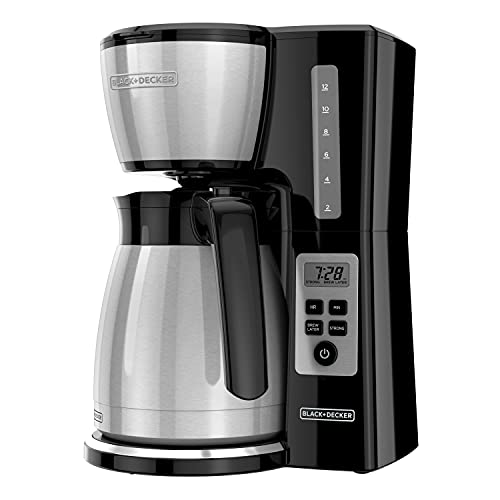
BLACK+DECKER 12-Cup Thermal Programmable Coffee Maker
Badge: Best Saturation Design
Strengths
- VORTEX Technology is designed to saturate the grounds evenly, which is where extraction is won or lost
- Brew strength control lets you adjust the pot to the coffee you bought
- 12-cup thermal format serves a crowd without a warming plate
Trade-offs
- No built-in grinder
- Thermal carafe hides the remaining level
- Showerhead evenness still depends on a level bed of grounds, so sloppy scooping can undo it
Key specs: Capacity: 12 cups; Carafe: Thermal; Programming: Programmable, with brew strength control; Showerhead: VORTEX Technology water dispersion; Finish: Black and steel; Model: CM2046S.
The CM2046S hangs its case on one word in its name: VORTEX, BLACK+DECKER’s name for a showerhead designed to spread water evenly across the grounds instead of drilling a hole through the middle of the bed. Even saturation is the quiet difference between a balanced pot and a sour, under-extracted one, so this is a meaningful feature rather than decoration. Add brew strength control and a 12-cup thermal carafe and you get a family-size machine aimed squarely at better everyday extraction. The honest limitation is that no showerhead fully compensates for uneven scooping or wildly inconsistent grind, and there is no grinder on board. For households that brew full pots daily, the priorities here are the right ones.
If one pick in this guide is built around the pour-over idea itself, it is this BLACK+DECKER: the VORTEX name refers to a showerhead designed to spread water across the grounds evenly, which is precisely the mechanical half of what a hand pour does. Add strength control and a thermal carafe and the concept is complete.
Best for: buyers who prioritise even extraction above all else / Not suited for: buyers who want a built-in grinder

Cuisinart PerfecTemp 12-Cup Thermal Drip Coffee Maker
Badge: Best Overall
Strengths
- PerfecTemp hotter brewing targets the temperature range where extraction tastes sweet rather than sour
- Brew Strength control adjusts the pot without changing your coffee-to-water ratio math
- Double-wall stainless thermal carafe protects flavour across the morning
Trade-offs
- No built-in grinder
- Silver finish shows fingerprints more than matte black
- Hotter brewing rewards fresh coffee but will expose stale beans honestly
Key specs: Capacity: 12 cups; Carafe: Double-wall stainless steel thermal; Brewing: PerfecTemp hotter brewing; Controls: Brew Strength control; Finish: Silver; Model: DCC-3400NAS.
PerfecTemp is Cuisinart’s answer to the most common drip complaint: coffee that tastes thin and sour because the water never got properly hot. This 12-cup model brews hotter by design, pairs that with Brew Strength control, and lands the coffee in a double-wall stainless thermal carafe so the temperature work is not undone by a scorching plate. It is a coherent package aimed at flavour first. The honest limitation is that hotter, more complete extraction is an honest mirror: fresh, well-stored beans taste better, and stale beans taste more obviously stale. There is also no grinder, so freshness of grind is your job or your coffee bag’s. For drinkers who blame their machine for sour pots, this is the most direct fix in the group.
The PerfecTemp earns the top badge here because pour-over quality is extraction quality, and extraction starts with temperature. Hotter brewing by design, strength control to tune the pot, and a double-wall thermal carafe to protect the result: it is the most complete pour-over style package in the verified pool.
Best for: drinkers who find ordinary drip sour and want fuller extraction / Not suited for: buyers who want the cheapest route to a decent pot
Comparison Table
| Pick | Capacity | Carafe / Format | Standout feature | Listing |
|---|---|---|---|---|
| KRUPS 12-Cup Thermal | 12 cups | Double-wall thermal, keeps coffee hot 4 hours | Scheduled thermal pots with three strengths for group serving | Check on Amazon |
| Cuisinart Thermal Classic 10-Cup | 10 cups | Thermal | Compact programmable thermal for smaller pour-over style batches | Check on Amazon |
| SECPOEDR Grind and Brew | 10 cups | Drip coffeemaker | Fresh-ground brewing on a timer, the freshness pour-over assumes | Check on Amazon |
| Gevi 10-Cup Grind & Brew | 10 cups | Glass | Grind-and-brew with touch controls and reusable filter | Check on Amazon |
| BLACK+DECKER 12-Cup Thermal CM2046S | 12 cups | Thermal | VORTEX showerhead saturation in a 12-cup thermal format | Check on Amazon |
| Cuisinart PerfecTemp DCC-3400NAS | 12 cups | Double-wall stainless steel thermal | PerfecTemp hotter brewing for fuller extraction | Check on Amazon |
How to Choose the Right Drip Coffee Maker
Start with honest capacity math. A coffee maker’s cup is a small unit, roughly five ounces, not the mug in your hand. A 10-cup machine makes about 50 ounces, which is four generous mugs; a 12-cup machine makes about 60 ounces, or five mugs. Count the mugs your household actually drinks before noon, add one for the guest or the second round, and buy that size. Oversized machines brew small pots badly unless they carry a dedicated small-batch setting, and undersized machines make you brew twice, which nobody does happily at dawn.
Choose the carafe before the features. Thermal carafes hold coffee with insulation, so the last cup tastes close to the first, but you cannot see how much is left and they reward a hot-water pre-warm. Glass carafes show the level at a glance and sit on warming plates that keep coffee hot at the cost of slowly cooking it. If your household finishes a pot within the hour, glass is fine and cheaper to replace. If a pot stretches across a morning, thermal is the flavour-preserving choice, and it is why thermal models dominate this guide.
Temperature and saturation decide the taste more than the badge count. Coffee extracts best in hot water, and it extracts evenly only when the water is spread across the whole bed of grounds. Machines that advertise hotter brewing or engineered showerheads are addressing the two variables that most often make home drip taste sour or hollow. Strength controls are the third useful lever: they let you adjust a pot to the coffee you bought instead of re-measuring ratios every time a new bag arrives.
Decide how you feel about grinding. A built-in grinder delivers the single biggest freshness upgrade available to a drip drinker, because ground coffee stales in hours while whole beans hold for weeks. The cost is noise, a chamber to clean, and one more mechanism in the machine. Households that buy pre-ground coffee for convenience should skip grind-and-brew entirely and put the money toward a better brewer; households that buy whole beans anyway should seriously consider it.
Programming is worth having if your mornings are predictable. A 24-hour programmable start sounds like a small thing until the first week of waking to a finished pot. It matters less for households where someone is always awake first and happy to press a button. Small-batch settings, brew pause, and removable reservoirs are the other practical features: each removes a specific daily friction rather than adding a line to a feature list.
Finally, think about the sink, not the counter. Every machine here needs descaling, carafe washing, and basket rinsing. Removable reservoirs, dishwasher-friendly carafes where the listing allows, and reusable filters all change the weekly effort. The machine you will keep clean is the machine that will keep making good coffee in year three.
How to Brew, Clean, and Look After a Drip Coffee Maker
Setting up for the first pot. Wash the carafe, lid, and filter basket in warm soapy water before first use, then run one full cycle of plain water through the machine to rinse the internal path. Place the machine so the reservoir is easy to fill and the steam from brewing is not trapped under a cabinet. If your model has a clock and programmable start, set them now, while the manual is open, rather than at midnight before the first workday.
The daily brew, step by step. Fill the reservoir with fresh cold water to the line for the number of cups you actually want. Add the filter and coffee: a reliable starting ratio is one to two tablespoons of ground coffee per six ounces of water, adjusted to taste over the first week. For a thermal carafe, swirl hot water through it for a minute first and empty it; a pre-warmed carafe can be the difference between a hot last cup and a lukewarm one. Start the brew, and resist lifting the carafe mid-cycle unless your machine has a brew-pause feature, because early cups are disproportionately strong and the pot’s balance depends on the full cycle finishing.
Grind and storage basics. Medium grind is the drip standard; too fine over-extracts into bitterness and can overflow the basket, too coarse under-extracts into sourness. Store beans or grounds in an airtight container away from heat and light, and buy in quantities your household finishes while the coffee is still lively. If your machine grinds, empty and brush the grinder chamber regularly, because old grounds clinging to the chamber will flavour every new pot.
Cleaning rhythm. Rinse the carafe and basket daily; coffee oils go rancid and will season the machine in the worst way. Wash removable parts weekly. Descale on the schedule your water hardness demands: mineral scale insulates the heating element, brewing temperature falls, and the coffee quietly turns sour weeks before the machine complains. Use the descaling method the manufacturer specifies, run rinse cycles afterwards, and treat a slowdown in brew time as the early warning it is.
Troubleshooting
Problem: the coffee tastes sour and weak → check the grind first (too coarse), then the ratio (too little coffee), then descale, because a scaled machine brews too cool and under-extracts exactly this way.
Problem: the basket overflows or grounds reach the carafe → the grind is likely too fine, the basket was overfilled, or a collapsed paper filter blocked drainage; reduce the dose slightly and make sure the filter sits flat before brewing.
Problem: the last cups from a thermal carafe are lukewarm → pre-warm the carafe with hot water before brewing, keep the lid fully closed between pours, and brew the size of pot your household finishes within the carafe’s strong window.
Automatic Pour Over Style vs the Manual Ritual: Choosing Honestly
Manual pour-over gives the brewer total control: the bloom, the pour rate, the spiral pattern, the total time. In skilled hands it produces a cup with a clarity automatic machines approach but rarely match, and the ritual itself is the point for many drinkers. Its costs are equally real: one or two cups at a time, several attentive minutes per round, and results that vary with the person pouring. A small venue serving a morning rush, or an office where coffee is infrastructure rather than ceremony, cannot run on that model.
Automatic pour-over style machines trade the last degree of control for scale and repeatability. A good showerhead wets the bed evenly; a good thermostat holds temperature; the pot that results is consistent from Tuesday to Friday and from the first cup to the last. For most group settings that consistency is worth more than the manual method’s higher ceiling. Readers comparing the wider category can cross-check our guide to Best Compact Coffee Makers for tight counters, and Best Cone Coffee Makers for the basket-geometry side of extraction.
The honest summary: buy manual equipment for the ritual and the single perfect cup; buy from this guide for pour-over character served to a group, on a schedule, by whoever arrives first.
Technique Still Matters: Grind, Ratio, and the Bloom
An automatic machine imitates the pour, but it cannot fix the inputs. Grind size remains the biggest lever: medium, even grounds extract cleanly in a drip basket, while dusty, uneven grinds produce the muddy, bitter-sour mix that gives drip a bad name. Grind-and-brew picks and a decent home grinder both exist to serve this point. Ratio is the second lever — start near one to two tablespoons per six ounces of water and adjust by taste over several pots, changing one variable at a time.
The bloom — the initial wetting that lets fresh coffee release gas before the main pour — is where freshness announces itself. Very fresh coffee blooms vigorously; stale coffee barely reacts, and no showerhead design can restore what stale beans have lost. This is why this guide keeps returning to freshness: buy beans in quantities you finish while they are lively, store them airtight and away from heat, and let the machine’s saturation design do the rest. For the neighbouring basket-shape discussion, see Best Cone Style Coffee Makers and Best Conical Drip Coffee Makers.
Reading a Pot Like a Pour-Over Drinker
Pour-over drinkers judge a cup in a sequence, and the sequence transfers to judging these machines. First, aroma as the pot finishes: a good automatic brew smells sweet and distinct, not flat or papery. Second, the first sip at drinking temperature: sweetness should arrive before acidity, and bitterness should be a frame, not the picture. Third, the cup as it cools: well-extracted coffee stays coherent and even gains sweetness as it cools, while under-extracted coffee turns sour and over-extracted coffee turns ashy. Judge each pick in this guide by a cooled cup, not just a hot one, and you will rank them the way this guide did.
Use the same coffee for your first week with any new machine. Changing beans and machine simultaneously makes every judgement meaningless, because you cannot tell which change you are tasting. Brew the house coffee at the standard ratio, at the middle strength setting where one exists, and only then begin adjusting. Pour-over culture’s real gift to machine buyers is not snobbery; it is this discipline of one variable at a time.
Serving Pour-Over Style Coffee to a Group
Group serving has its own technique. Brew the full pot rather than two halves: a full basket extracts more predictably than a half one in most machines, and the thermal carafe exists precisely to hold the surplus well. Serve within the carafe’s strong window and say so — guests pace themselves differently when they know the pot was brewed at nine and is best before eleven. Keep a small notebook by the machine in a workplace for the first month: which coffee, which strength setting, what people said. That notebook is how a shared machine gets dialled in instead of endlessly debated.
For the small venue — the salon, the studio, the waiting room — presentation is part of the product. A thermal carafe on a tray with real cups signals the same care as the drink itself. The machines in this guide were chosen partly for that setting: they look composed on a counter, they start on a schedule, and they do not require the person serving to perform barista theatre in front of a client. Pour-over flavour, in the end, is the headline; pour-over calm is the delivery.
What to Serve Alongside: Beans That Suit the Pour-Over Style
Automatic pour-over style machines flatter certain coffees and expose others, and matching the bag to the method is the last piece of technique this guide owes you. Coffees with bright, distinct character — the kind whose bag notes mention fruit, florals, or a specific farm — are the ones whose clarity the pour-over style exists to reveal; brewed in a saturating machine at proper temperature, they taste like their descriptions, which is a rarer experience than it should be. Heavier, darker roasts brew perfectly well in these machines but show less of the style’s advantage: their character is body and depth, which ordinary drip also delivers. Neither choice is wrong; they are different reasons to own the machine.
Freshness outranks origin. A modest coffee roasted recently and ground fresh — or ground by the grind-and-brew picks moments before brewing — will beat a celebrated coffee that has sat open for a month, in this style of machine, almost every time. Buy in rhythm with your drinking, keep the bag sealed and away from heat, and treat the coffee as a perishable ingredient rather than a pantry staple. The machine’s part of the bargain is heat and saturation; the bean’s part is being worth extracting.
A final serving note for hosts and small venues: brew the coffee slightly ahead and hold it in the thermal carafe rather than brewing to order in front of guests. The pour-over style’s gift is a pot that holds its character, and a host who is present beats a host performing a brew. The machines in this guide were ranked with that social reality in mind as much as with extraction in mind.
Troubleshooting the Pour-Over Style Pot
When a pot from an automatic pour-over style machine disappoints, work the variables in the order a barista would. First, freshness: if the bag has been open for weeks, no adjustment downstream will rescue it, and the correct fix is a fresher bag, not a new setting. Second, ratio: weigh or measure consistently for three pots before concluding anything, because an inconsistent scoop manufactures random results that look like machine moods. Third, grind: one step finer for sour, one step coarser for bitter, three pots per step. Fourth, the machine’s own state: a showerhead filmed with coffee oil cannot wet a bed evenly, and a scaled heater cannot reach the temperature the style depends on, so clean and descale before blaming design. Fifth, and only fifth, the coffee itself: some coffees are simply quiet in drip formats and brilliant in others.
Notice what this sequence assumes: that the machine is capable and the inputs are the variables. That assumption is the working difference between pour-over culture and appliance culture. The drinker who works the sequence learns their machine’s true range within a month; the drinker who returns a capable machine for a random replacement starts the same month over, with the same coffee, the same water, and the same habits, expecting a different pot. The picks in this guide were chosen to reward the first approach — machines whose heat, saturation, and controls give the sequence something to work with.
A Note on Terminology Before You Buy
Retail listings use “pour over” loosely — for manual drippers, for automatic machines with showerheads, and occasionally for anything cone-shaped — so the listing’s own description deserves a careful read before purchase. Establish which of the three you are looking at: a manual dripper is equipment, not a machine; an automatic pour-over style brewer is what this guide ranks; and a machine merely shaped around a cone may or may not have the saturation and temperature design that makes the style meaningful. The picks above were chosen because their verified listings describe the engineering — showerhead design, hotter brewing, strength control, thermal holding — that the term should stand for. Buy the engineering, not the phrase, and the phrase will take care of itself.
What This Guide Deliberately Left Out
A short note on scope, because pour-over searches attract adjacent products that do not belong here. Manual drippers, kettles, and scales are a separate purchase with a separate guide’s logic, and recommending a machine buyer a kettle — or a kettle buyer a machine — serves neither. Espresso is likewise a different discipline with different physics, and nothing in this guide should be read as a comment on it. What remains is the automatic pour-over style category itself, covered as completely as the verified pool allows: six machines, their saturation and temperature engineering, their carafes and controls, and the technique that lets them deliver what their name promises. Boundaries like these are what keep a buying guide honest, and we would rather state them than blur them for a longer list.
Common Buying Mistakes
Buying capacity by the headline number. Shoppers compare 10-cup and 12-cup labels as if they were mug counts. They are not, and the mismatch is why big households end up brewing twice and small households end up with weak small pots. Do the mug math before you shop, and look for a small-batch setting if your household swings between two cups on weekdays and a crowd on weekends.
Paying for a grinder you will not clean. Grind-and-brew machines are wonderful for exactly as long as the grinder chamber stays clean. If you know your household will not brush out a chamber weekly, a grounds-only machine and a bag of good pre-ground coffee will honestly taste better by month two.
Ignoring the carafe question. Buyers compare features and forget the vessel the coffee lives in. A glass carafe on a plate punishes slow drinkers; a thermal carafe frustrates people who want to see the level. This one decision shapes every single morning with the machine, so make it deliberately.
Chasing feature counts instead of extraction basics. Hot water, even saturation, and a sensible ratio make coffee taste good. A long feature list built on a cool, uneven brew makes expensive bad coffee. Weight the basics first, then let features break ties.
Skipping descaling until the machine slows down. By the time a scaled machine brews noticeably slowly, it has been brewing too cool for weeks. Put descaling on a calendar rhythm matched to your water, not on a when-it-breaks rhythm.
Final Recommendation
For pour-over character at group scale, start with the Cuisinart PerfecTemp DCC-3400NAS: its hotter brewing and strength control address extraction directly, and the thermal carafe protects the result. Choose the BLACK+DECKER CM2046S if showerhead saturation is your priority, the SECPOEDR or Gevi grind-and-brew models if freshness of grind is, and the KRUPS 12-Cup Thermal if the pot must simply be ready, at strength, when the group arrives. And keep the honest boundary in view: for the manual ritual itself, a dripper and a gooseneck kettle remain the right purchase.
Ready to decide? Start with the top pick and Check on Amazon to confirm the current configuration before you buy.
Still torn between the top two? Compare the runner-up directly and Check on Amazon for its current listing details.
Frequently Asked Questions
Is an automatic pour-over style machine the same as manual pour-over?
Not identical, and this guide does not pretend otherwise. The machine imitates the key mechanical elements — even saturation of the grounds and hot, controlled brewing — at pot scale and without an attendant. Manual pour-over keeps a higher ceiling of control for one or two cups at a time.
What actually makes coffee taste “pour-over” rather than ordinary drip?
Even extraction. When water wets the whole bed of grounds uniformly at a properly hot temperature, the cup tastes sweet and clear instead of sour in one sip and bitter in the next. Showerhead design, temperature, grind evenness, and freshness all feed that one result.
Which pick is best for a small cafe or salon?
For a handful of pots a day, the KRUPS 12-Cup Thermal or the Cuisinart PerfecTemp both fit: scheduled or on-demand pots, thermal holding, and strength control. For continuous all-day commercial service, buy certified commercial equipment through a commercial channel instead.
Does grind freshness really matter in a machine?
Yes — it is the input pour-over technique assumes. Ground coffee stales in hours. Grind-and-brew machines, or grinding beans just before brewing, protect the flavour that the machine’s saturation design is trying to extract.
Can these machines brew a single mug well?
Pot machines are happiest at half a pot or more. For genuine single cups, a hybrid like a drip-plus-single-serve model or a separate small brewer serves better than a two-cup batch in a 12-cup basket.
How do I keep an automatic machine tasting like pour-over over time?
Descale on schedule so brewing temperature stays where it should, rinse the basket and carafe daily so old oils do not season new pots, and keep the showerhead area clean — a scaled or coffee-fouled showerhead cannot wet the bed evenly.


