Disclosure: topratedkitchenware.com is reader-supported. When you buy through links on our site, we may earn an affiliate commission from Amazon and other retailers, at no extra cost to you.
Where to buy
The six models below are the picks in this guide to best convection oven air fryers consumer reports. Only one carries direct listing links, and the reason is methodological, in keeping with this guide’s subject: a pick is linked only where its verified listing title states convection, the feature at the centre of the keyword, and only the Cuisinart TOA-55 does so among the six. The other five are reviewed in full and kept prose-only. A second methodological note belongs here too: this guide makes no claim that any publication has tested, ranked, or endorsed these specific models. It teaches you how independent evaluation works so you can apply it yourself.
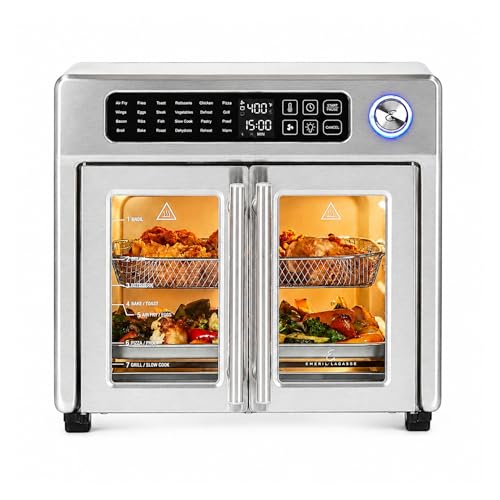
- Cuisinart French Door Air Fryer Toaster Oven TOA-FD70 — convection not stated in its listing title, reviewed prose-only below
- Cuisinart Air Fryer Toaster Oven Combo TOA-55
- Gourmia French Door Toaster Oven Air Fryer — convection not stated in its listing title, reviewed prose-only below
- Ninja Prestige Smart XL Countertop Oven DT501 — convection not stated in its listing title, reviewed prose-only below
- Chefman 6-Quart Dual Basket Air Fryer — convection not stated in its listing title, reviewed prose-only below
- Ninja Foodi 10-Qt DualZone XL Air Fryer DZ401 — convection not stated in its listing title, reviewed prose-only below
Read the full guide ↓ for how independent testers evaluate machines like these, what the evidence in a listing can and cannot tell you, and how to reach a verdict you can defend.
The search best convection oven air fryers consumer reports describes a shopper with a method, not just a budget. That shopper wants to know what structured, independent evaluation would say about convection oven air fryers: how evenly they cook, how honestly their specifications are stated, how they behave across repeated standardised loads rather than in a single demonstration. This guide is written for that shopper, and it begins by refusing the shortcut its keyword invites. No claim is made anywhere in these pages that Consumer Reports, or any other testing organisation, has evaluated, ranked, recommended, or endorsed the models below. Inventing such a claim would be exactly the kind of unverified assertion that independent testing exists to correct.
What the guide does instead is more useful. It applies the two disciplines that define good evaluation to the evidence actually available: verified product information, checked pick by pick, and a linking rule that follows the keyword’s own core attribute. Because the keyword specifies convection oven air fryers, a pick is linked only where its verified title states convection. One pick passes that test. Five do not, for reasons their reviews explain individually, and they are assessed in full on every other dimension an evaluator would weigh, capacity, format, cleaning, controls, so that the final picture is complete even where the links are not. Readers who want the mechanism discussed without the evaluation lens will find it in the plainer technical guides in this wave, including the one behind Best Cookig Air Fryers, whose misspelled keyword hides a sound cooking discussion.
Key Takeaways
- This guide claims no endorsement: no testing organisation’s verdict on these models is stated or implied anywhere in it.
- A pick is linked only where its verified title states convection; only the Cuisinart TOA-55 meets that bar among the six.
- Independent evaluation weighs evenness, repeatability, cleaning, and stated-spec honesty, and you can apply the same tests to a listing before you buy.
- Five strong machines are prose-only because their titles describe circulation in other words or not at all; the reviews assess them fully on every other dimension.
- No prices and no scores are printed; check the latest price on Amazon for the linked pick and treat any number you meet elsewhere with an evaluator’s scepticism.
- The most reliable test available to a buyer is a calibrated first week: standard loads, written settings, and results compared against the claims that sold the machine.
In this guide
Quick Picks
| Pick | Badge | Why it earns its place | Listing |
|---|---|---|---|
| Cuisinart TOA-FD70 | Best Design, Claim Unstated | French doors and seven functions; convection not stated in its title, so prose-only. | See review |
| Cuisinart TOA-55 | Best Documented Convection Claim | Convection capability stated in its own title, with a crumb tray and a 450°F ceiling. | Check on Amazon |
| Gourmia French Door Toaster Oven | Best Family Size, Claim Unstated | Nine-slice capacity and branded circulation language, but no stated convection. | See review |
| Ninja Prestige Smart XL DT501 | Best Premium, Claim Unstated | Flagship capacity and ten functions; convection not stated in its title. | See review |
| Chefman 6-Quart Dual Basket | Best Small Dual Basket, Claim Unstated | Two zones and viewing windows in a basket format outside this keyword’s oven focus. | See review |
| Ninja Foodi DZ401 | Best Large Dual Basket, Claim Unstated | Two five-quart baskets; a basket machine, with no convection stated in its title. | See review |
Shoppers who like their evaluation seasonal as well as structured sometimes pair this guide with Best Cooking Air Fryers for the craft side of the same machines, and the pairing is a good one: method first, technique second.
How These Picks Were Chosen
This guide is research-led, and its method is the message. The six picks come from a verified pool for this product group, each included only where its identity, brand, and listing details could be confirmed against listing data checked for this programme. The convection screen was applied to the verified titles exactly as an evaluator would apply a stated criterion: the word and the feature must be present in the maker’s own specification language. The Cuisinart TOA-55 states convection capability in its title and is linked. The Cuisinart TOA-FD70, the Gourmia, and the Ninja Prestige are oven-format machines whose titles do not state it. The Chefman and the Ninja DZ401 are dual basket machines, a format outside the keyword’s oven focus, whose titles likewise do not state it. Those five are prose-only.
Everything else about the evaluation is printed rather than performed. We do not claim laboratory testing, standardised loads, or hands-on hours we did not conduct, and we do not borrow the authority of any publication that does conduct them. What we claim is a transparent screen, applied evenly, with its results visible in the link pattern itself, and full reviews that assess each machine on the dimensions a buyer can verify: stated capacity, stated functions, cleaning design, format, and tier. If that method seems austere, it is deliberately so. Austerity about evidence is the entire tradition this keyword invokes, and the guide honours the tradition rather than the trademark.
The 6 Best Convection Oven Air Fryers, Assessed
Cuisinart French Door Air Fryer Toaster Oven TOA-FD70
Badge: Best Design, Claim Unstated
Strengths
- French-door design and seven functions in a composed stainless oven format.
- Fits a twelve-inch pizza and covers the standard oven repertoire.
- Design and ergonomics an evaluator would score highly on the counter.
Trade-offs
- Its verified title does not state convection, so under this guide’s criterion it cannot be linked for this keyword.
- Part of its tier buys design rather than documented mechanism.
- French doors need clear counter on both sides.
Spec box
- Model: TOA-FD70
- Design: artisan French-door
- Functions: 7 — air fry, toast, bake, broil, roast, pizza, warm
- Capacity note: fits a 12-inch pizza
- Finish: stainless steel
- Convection: not stated in the verified listing title
An evaluator’s first virtue is applying the criterion even when it excludes a favourite, and the TOA-FD70 is where this guide proves it can. By format this is precisely a convection oven air fryer in the everyday sense: an oven-format air fryer of the kind the keyword describes, with an appealing French-door design, seven functions, and pizza capacity. By the stated criterion, it fails at the first gate, because its title never claims convection, and a methodology guide does not repair a maker’s specification on the maker’s behalf. The review therefore proceeds on the dimensions that can be assessed: ergonomics that genuinely ease loading, a function set matched to a domestic week, and a design that would test well for counter presence in any evaluation that scores such things.
The buyer-facing lesson is about how to read any evaluation, including this one. Every assessment has a gate, a stated condition that decides what is in and what is out, and the honest assessments publish their gate. Ours is printed above. If your own gate is format rather than stated language, the FD70 passes yours and you will find it linked in guides in this wave whose criteria are domestic rather than methodological. If your gate matches ours, read on: the machine that passes it is two reviews away, made by the same company, which is itself a small lesson in how differently one maker can specify two sibling products.
Best for: design-led buyers whose criterion is format rather than stated claim / Not suited for: buyers applying the stated-convection criterion

Cuisinart Air Fryer Toaster Oven Combo TOA-55
Badge: Best Documented Convection Claim
Strengths
- Convection capability stated in its own title, the documented claim this keyword asks for.
- A four hundred fifty degree Fahrenheit ceiling and eighteen hundred watts, specification an evaluator can work with.
- A removable crumb tray, the maintainability detail that keeps performance stable across repeated testing and repeated ownership.
Trade-offs
- Single-level cavity, so standardised large loads run in rounds.
- Plain styling beside its French-door sibling.
- Its claim is documented, not lab-verified by this guide; no publication’s test result is claimed for it here.
Spec box
- Model: TOA-55
- Functions: 7-in-1
- Power: 1800W
- Interior: 0.6 cu. ft.
- Convection: capability stated
- Maximum temperature: 450°F
- Cleaning: removable crumb tray
- Capacity note: fits a 12-inch pizza
The TOA-55 holds this guide’s only links because it is the only pick whose maker states the keyword’s core feature in the specification itself: convection capability, printed in the title, accompanied by the supporting figures an evaluator wants beside such a claim, power, interior volume, and a maximum temperature. That documentary completeness is not a guarantee of performance, and this guide is careful not to promote it into one. It is, however, the precondition for evaluation, because a claim that is stated can be tested, compared, and held to account, while a claim that is merely implied can be none of those things. In a guide organised around method, the documented machine is the recommendation, and the recommendation is made with its limits printed in the same breath.
On the assessable dimensions, the TOA-55 is also the most testable machine here in the practical sense: its crumb tray and wipeable format mean a standardised load cooked in month six meets the same cavity as the load in week one, which is the condition repeatability depends on. Its single level caps batch size, its styling is plain, and its tier is mainstream, all stated plainly. The Cuisinart TOA-55 is therefore linked wherever this guide needs a reference point, not as a laboratory winner, a title nobody here has awarded, but as the one machine in the set whose central claim arrives documented. Readers who understand why that distinction matters have understood the guide.
Best for: method-minded buyers wanting the stated, testable claim / Not suited for: buyers needing large single-batch capacity
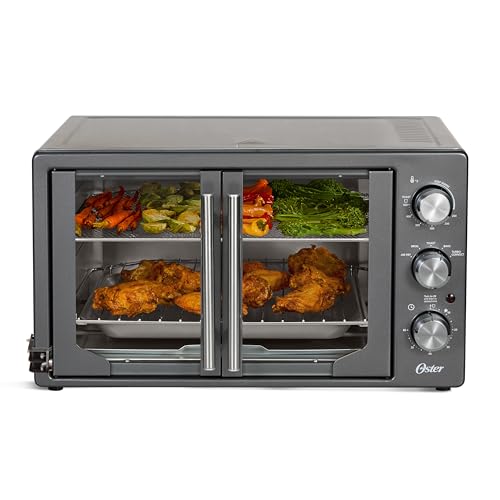
Gourmia French Door Toaster Oven Air Fryer
Badge: Best Family Size, Claim Unstated
Strengths
- Nine-slice capacity, the largest toast-format statement in this guide.
- Twelve presets with adjustable time and temperature for standardised starting points.
- Dishwasher-safe trays, a repeatability virtue as much as a convenience.
Trade-offs
- Its title describes circulation with a branded term rather than stating convection, so it is prose-only under the criterion.
- Large footprint, permanently allocated.
- Presets standardise the start of a cook, not its result; supervision still calibrates them.
Spec box
- Capacity: 9-slice
- Display: digital
- Design: French door
- Presets: 12 cooking presets
- Controls: adjustable time and temperature
- Air circulation: FryForce 360°, the maker’s own description
- Trays: dishwasher-safe
- Finish: stainless steel
- Convection: not stated under that word in the verified listing title
The Gourmia tests the criterion from the opposite side to the FD70: not silence about circulation, but eloquence in a private language. Its title describes a branded full-circle airflow system, which tells an evaluator that the maker has engineered and named its circulation, and tells them nothing comparable, because a private term cannot be set beside another maker’s stated capability and weighed. Evaluation depends on shared vocabulary the way measurement depends on shared units, and the guide’s refusal to translate the brand term into the keyword’s term is the same refusal, applied to language, that a laboratory applies to uncalibrated instruments. The machine itself, nine slices of capacity, twelve presets, dishwasher-safe trays, is assessed here as a strong family oven whose documentary habits, not whose cooking, keep it prose-only.
There is a buyer’s skill hidden in this review that transfers far beyond air fryers. When a specification sheet mixes standard terms and proprietary ones, price the standard terms at full evidentiary value and the proprietary ones at the value of a promise. Promises are sometimes kept splendidly, and owners of this oven may find its circulation everything its name evokes. But a purchase made on promises should be priced as a purchase made on promises, and a methodology guide that blurred the two would fail its readers at exactly the point they came to it for rigour.
Best for: families valuing scale whose criterion is performance over documentation / Not suited for: buyers applying the stated-convection criterion
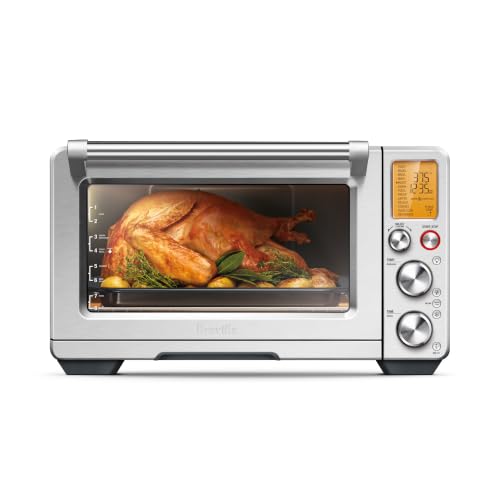
Ninja Prestige Smart XL Countertop Oven DT501
Badge: Best Premium, Claim Unstated
Strengths
- Ten functions and serious capacity, described in food: twenty cookies, a twelve-pound turkey.
- Prestige line build that an evaluator would expect to age consistently.
- Eighteen hundred watts of stated power.
Trade-offs
- Its verified title does not state convection, so the flagship is prose-only under the criterion.
- Premium tier, requiring the strongest justification in the set.
- Capacity most households exercise occasionally.
Spec box
- Model: DT501
- Functions: 10-in-1, including air fry, bake, toast, pizza, and reheat
- Power: 1800W
- Capacity notes: bakes 20 cookies; fits a 12 lb turkey
- Finish: stainless steel
- Convection: not stated in the verified listing title
The Prestige is the review that will surprise readers who equate price with documentation, because the most expensive machine in this guide states the keyword’s feature least. Its title is eloquent about capacity and functions and silent about convection, and under a criterion that reads titles, silence is the datum. An evaluator learns to love such results, because they prove the criterion is doing work rather than ratifying a ranking decided in advance. On assessable dimensions the Prestige is formidable: the largest domestic capacity here, a ten-function span, flagship build, and the kind of consistency across years that repeatability-focused evaluation rewards. It is simply not, on its own documented evidence, a stated convection oven, and this guide’s keyword demands the statement.
Premium buyers should draw the general lesson rather than a specific disappointment. At the flagship tier, makers often specify for experience, how the machine feels, hosts, and presents, rather than for comparison, and a method-minded shopper must decide which specification style serves the purchase at hand. For a capacity-led premium purchase, the Prestige’s documentation is ample and it is linked in this wave’s premium contexts. For a claim-led purchase under this keyword, the documented mainstream machine above outranks it, which is not a paradox but a demonstration that rankings are answers to questions, and the question here is unusually specific.
Best for: premium capacity buyers whose criterion is scale and build / Not suited for: buyers applying the stated-convection criterion
Chefman 6-Quart Dual Basket Air Fryer
Badge: Best Small Dual Basket, Claim Unstated
Strengths
- Two independent baskets with viewing windows and a sync finish system.
- Nonstick dishwasher-safe baskets that clean to a repeatable standard.
- A compact format that standardises small loads well.
Trade-offs
- A basket format, outside this keyword’s oven focus, with no convection stated in its title.
- Three quarts per basket limits load size for any standardised test or family dinner.
- Flat foods are outside the format entirely.
Spec box
- Capacity: 6 quart total, two independent 3-quart baskets
- Features: Sync Finish, Hi-Fry, auto shutoff
- Windows: easy view
- Baskets: nonstick, dishwasher-safe
- Controls: digital
- Colour: black
- Convection: not stated in the verified listing title
The Chefman dual basket enters this guide as a format case. The keyword specifies convection oven air fryers, and a dual basket machine is not an oven-format appliance, whatever its virtues, so it would face the criterion at a disadvantage even before its title’s silence on convection is counted. Assessed on its own terms, it is a well-conceived small machine: two zones that finish together, windows that make browning observable, and baskets that clean to a consistent standard, which an evaluator recognises as a repeatability feature. Its presence here is useful precisely because it clarifies the keyword’s boundaries, and because many shoppers who type an oven keyword are, on reflection, basket households who would be better served by admitting it.
That reflection is the review’s real content. Evaluation begins before the first test, in the framing of the question, and a shopper whose dinners are two basket foods at once should not let an oven keyword, however prestigious its associations, steer the purchase. The Chefman is linked and recommended in this wave’s basket guides for exactly the households it suits. Here it stands prose-only, fully assessed, as evidence that a methodology guide serves its readers best by keeping categories honest, even when honesty costs a good machine its link.
Best for: small two-zone households who discover they are basket buyers / Not suited for: this keyword’s oven-and-convection criterion
Ninja Foodi 10-Qt DualZone XL Air Fryer DZ401
Badge: Best Large Dual Basket, Claim Unstated
Strengths
- Two independent five-quart baskets, family scale in the basket format.
- Match Cook and IQ Boost, systems for repeatable two-zone results.
- Six functions including dehydrate, a slow test of controlled airflow.
Trade-offs
- A basket format outside the keyword’s oven focus, with no convection stated in its title.
- The widest footprint in this guide.
- Its considerable merits answer a different keyword than this one.
Spec box
- Model: DZ401
- Capacity: 10 qt total, two independent 5 qt baskets
- Functions: 6-in-1 — air fry, roast, broil, bake, reheat, dehydrate
- Features: Match Cook, IQ Boost
- Colour: grey
- Convection: not stated in the verified listing title
The DZ401 closes the reviews as the strongest machine in this guide to fail its criterion, and an evaluation-minded reader should find that combination clarifying rather than confusing. As a dual basket appliance it is the family reference: two five-quart zones, mirroring for single-food batches, synchronising for two-food dinners, and a function span that includes the slow, controlled work of dehydrating. Its systems are explicitly designed for repeatability, the quality evaluators prize most, and its owners’ pattern of use, two foods, one finish, is the most standardised cooking routine in the category. None of that makes it a convection oven under the keyword’s terms, and its title, like the Chefman’s, does not state convection.
So the DZ401 is prose-only here and linked prominently in the guides whose keywords it answers, a division of labour that is the whole architecture of honest reviewing. A single guide that linked every strong machine under every keyword would be a catalogue, not an evaluation. This guide’s discipline, one documented winner and five fully assessed near-misses and format alternatives, is what a shopper invoking independent testing is actually asking for, whether or not they expected the answer to be this austere. The austerity is the assurance: a guide willing to withhold links from famous machines over a stated criterion is a guide whose one link can be trusted to mean something.
Best for: families whose real keyword is dual basket capacity / Not suited for: this keyword’s oven-and-convection criterion
Comparison Table
| Pick | Badge | Format | Convection in title | Listing |
|---|---|---|---|---|
| Cuisinart TOA-FD70 | Best Design, Claim Unstated | French-door oven | Not stated | Prose-only |
| Cuisinart TOA-55 | Best Documented Convection Claim | Countertop oven | Capability stated | Check on Amazon |
| Gourmia French Door Toaster Oven | Best Family Size, Claim Unstated | French-door oven | Branded term only | Prose-only |
| Ninja Prestige Smart XL DT501 | Best Premium, Claim Unstated | XL countertop oven | Not stated | Prose-only |
| Chefman 6-Quart Dual Basket | Best Small Dual Basket, Claim Unstated | Dual basket | Not stated | Prose-only |
| Ninja Foodi DZ401 | Best Large Dual Basket, Claim Unstated | Dual basket | Not stated | Prose-only |
How to Evaluate a Convection Oven Air Fryer Like a Tester
Independent evaluation, stripped of its laboratory, is a set of habits any buyer can run. First, fix the criterion before looking at results: for this keyword, a stated convection claim, in the maker’s own specification language. Second, standardise the load in your mind: compare machines on the same imagined tray of food, in a single layer, rather than on each maker’s favourite demonstration. Third, separate the documented from the demonstrated from the merely described: a stated capability is documented, a quantified effect in a title is a maker’s documented claim, and a branded circulation name is a description, and the three deserve three different weights. Fourth, price repeatability: cleaning design, control clarity, and parts that return to the same state after washing decide whether a machine’s tenth performance resembles its first, which is the property testers actually measure across their repeated runs.
Applied to this set, the habits converge on the Cuisinart TOA-55 as the documented choice, and the convergence is the guide’s finding, offered with its method attached so you can rerun it. If your rerun weights format over documentation, your finding will differ, and the reviews above give you the assessed material to reach it honestly. What neither rerun should produce is a borrowed verdict: not this guide’s, and not any publication’s whose actual test of these models you have not read. The consumer-reports tradition, at its best, is not a set of answers but a refusal to accept answers without method, and a buyer who absorbs the refusal has received the tradition’s real value.
Finish, as always, with the live checks. Check the latest price on Amazon for the linked pick, read its full specification on the listing, and confirm the convection claim in the maker’s words one final time before paying. Then plan your own first-week calibration, standard loads, written settings, honest notes, because the most relevant test report on the machine you buy will be the one you write in your own kitchen.
How to Run Your Own First-Week Evaluation
Choose three standard loads that represent your cooking: a tray or basket of frozen fries, a batch of fresh vegetables, and a reheated leftover portion. Cook each one twice in the first week, at the same settings, in single layers, and write down the setting, the time, and a plain sentence about the result each time. The second run is the evaluation: a good machine repeats itself, and your notes will show whether yours does, and at which settings its repetition is best. Rotate tray loads halfway, shake baskets halfway, and keep every other variable as steady as a home kitchen allows.
Clean the machine between the paired runs exactly as you intend to clean it for years, and time the cleaning once, honestly. That number, multiplied by your cooking frequency, is a real specification of ownership that no listing prints. At the week’s end, read your notes against the claims that sold the machine: the stated feature, the stated capacity, the stated functions. Agreement between claim and notes is what a verified purchase feels like, and disagreement, discovered inside a return window, is what the window is for.
Troubleshooting during evaluation is diagnosis, not disappointment. Problem: the second run browns less than the first → residue or a cooling cavity between runs changed the conditions; clean, and standardise the starting state. Problem: results vary across a tray → the load or the geography; rotate halfway and widen the gaps. Problem: a function disappoints at its preset → presets are population averages; adjust once, record the adjustment, and judge the machine by its adjusted repeatability, which is the property you will actually live with.
How to Read Any Test Report, Including This One
Five questions expose the value of any evaluation, wherever you meet it. What was the criterion, and was it stated before the results? What was actually measured, and what was merely described? Were the loads and conditions standardised, so that comparisons mean something? Are the claims traceable to evidence a reader can inspect, or do they rest on authority alone? And does the report distinguish between what it verified and what it assumed? A report that answers all five cleanly deserves your confidence in proportion to its answers. A report that trades on a famous name while answering none of them deserves the same scepticism as a listing with a branded circulation term, and for the same reason: authority, like airflow, only counts when it is stated in a form you can check.
This guide has tried to answer its own five questions in the open. Its criterion is printed in its method section. Its measurements are documentary, titles and stated specifications, and it says so. Its loads are the standardised imaginings of the buying section, labelled as such. Its claims trace to the verified pool and the titles quoted in its source notes. And its central distinction, between the one documented claim and the five assessed machines around it, is the opposite of an assumption. Readers who apply the same five questions to the seasonal guides elsewhere in this wave, including Best Crownful Air Fryers and the price-event coverage in Best Cyber Prices For Air Fryers, will find the questions travel well, because method, unlike machinery, fits every kitchen.
Method in the Wild: Sale Seasons, Brand Claims, and Second-Hand Verdicts
The habits in this guide are tested most severely outside it, in the places where evaluation language is borrowed for decoration. Sale coverage is the first test: during price events, technical vocabulary inflates, and a shopper who has learned to ask for the stated claim will read Best Dealson Air Fryers with the right question in mind, namely which of the promoted machines documents its features and which merely discounts its adjectives. A reduction on a documented machine is a bargain on evidence; a reduction on an undocumented one is a cheaper guess, and the method prices them differently even when the badges look identical.
Brand-led claims are the second test. A listing built around a single famous name, of the kind gathered in Best Deas On Phillps Air Fryers, invites the shopper to let reputation substitute for specification, and sometimes reputation deserves the trust, because a long record is itself a kind of evidence. The method’s answer is proportion, not refusal: let the record count as background, then still read the title for the stated feature, the stated capacity, and the stated figures, because the model in front of you is a specific machine, not the average of its maker’s history. The third test is the second-hand verdict, the friend, the forum, the review snippet, each reporting a sample of one kitchen. Samples of one are data, honestly labelled; the error is only in promoting them to rankings. A method-minded buyer collects them the way this guide collects its reviews, fully, appreciatively, and in their proper evidentiary place, below the stated specification and above the headline.
There is a discipline underneath all three tests that is worth naming before the buying mistakes, because it is the discipline the keyword’s most famous association is built on: independence of conclusion from interest in the outcome. A guide that earns from links has an interest, disclosed on its first line, and the correct response to that interest is not pretended absence but visible method: criteria printed in advance, links withheld where the criteria fail, famous machines left unlinked in full view, and a single recommendation that follows from the printed rules rather than from the size of any commission. Judge this guide by whether its method survives its interest. That is the only judgement that matters, and it is the one the guide has been written, section by section, to invite.
One further habit completes the evaluator’s toolkit, and it is the habit of revisiting. A verdict, including the one in this guide, is a statement about evidence at a moment: titles as verified on a stated date, a pool as constituted for a programme, a criterion as printed. Makers revise models, retitle listings, and refresh ranges, and an evaluation that cannot be rerun becomes folklore. That is why this guide prints its check date in its source notes and its criterion in its method section, so that a reader returning in a later season can repeat the screen against the then-current titles and watch the link pattern change if the evidence changes. A methodology that invites its own revision is the strongest kind there is, and a shopper who adopts the habit, criterion first, evidence dated, verdict revisitable, will never be defenceless in this category again, whatever the next generation of machines decides to call its airflow.
Common Buying Mistakes
The first mistake is assuming a famous testing name has blessed whatever appears under a keyword that mentions it; no such blessing is claimed or implied here, and it should not be assumed anywhere it is not shown. The second is treating a branded circulation term as a measured specification. The third is ranking machines before fixing the criterion, which guarantees the ranking will be a mood. The fourth is ignoring repeatability, the property that decides whether a good first week becomes a good third year. The fifth is buying a format the keyword prefers over the format your dinners prefer, when the reviews above show how to honour both readings honestly. The sixth is skipping the first-week calibration, the cheapest evaluation in the category and the only one conducted in your own kitchen.
Final Recommendation
Under this guide’s stated criterion, the recommendation is the Cuisinart TOA-55: the one machine among the six whose maker documents the keyword’s core feature in its own specification, supported by a proper temperature ceiling and the cleaning design that keeps performance repeatable. If your own criterion is format or capacity rather than documentation, the assessed alternatives are ranked by their badges above, and each is linked in the guides written for its keyword. Whichever you choose, check the latest price on Amazon, verify the claim that decided you on the listing itself, and run the first-week evaluation. A purchase that survives your own method needs no one’s endorsement, which is the most consumer-reports sentence in this entire guide. Keep the notes from that first week with the machine’s paperwork, because they are the beginning of the only long-term test report that will ever be written about your exact unit, in your exact kitchen, and a household that keeps such notes buys its next appliance, in any category, with a method already warmed up and waiting.
Frequently Asked Questions
Why does this guide print no scores of its own?
Because a score compresses exactly the distinctions this guide exists to preserve. A single number cannot tell you that one machine failed on documentation while excelling on capacity, or that another passed the criterion while capping your batch size, and a reader who has followed the assessed reviews owns something more useful than a ranking: a map of which machine wins under which criterion, with the criteria named. Scores have their place in publications that generate them from published measurements. A documentary guide that invented scores would be committing the precise offence it was written to correct, so it prints badges, reasons, and a method instead, and leaves the arithmetic of your own priorities to you.
What is the difference between a documented claim and a tested claim?
A documented claim is one the maker states in a specification you can inspect, like the convection capability in the linked pick’s title. A tested claim is one an evaluator has measured under stated conditions and published with its method. Documentation is the precondition for testing, not a substitute for it, and this guide deals strictly in documentation while teaching you to read testing. Confusing the two, in either direction, is the commonest reading error in this category: it lets documented machines borrow laboratory authority they never claimed, and it lets tested reputations excuse machines whose own paperwork is silent. Keep the categories separate, as this guide has, and both kinds of evidence become more valuable, because each is finally being asked only for what it can actually give.
Has Consumer Reports recommended any of these air fryers?
This guide makes no such claim, and you should not take this page as evidence of any publication’s verdict. No testing organisation’s ranking, recommendation, or endorsement of these models is stated or implied here. What the guide offers is the method such organisations represent, stated criteria, standardised comparison, documented claims, applied to verified listing information, so you can evaluate the machines yourself and consult any actual published test, where one exists, with informed eyes.
Why is only one pick linked in this guide?
Because the keyword’s core feature is convection in an oven-format air fryer, and the guide’s criterion requires that feature to be stated in the maker’s own verified title. Only the Cuisinart TOA-55 states convection capability. The other five, three ovens with unstated or branded circulation language and two dual basket machines outside the oven format, are reviewed in full and kept prose-only, so the single link carries a verifiable meaning.
What do independent testers actually measure on machines like these?
In general terms, structured evaluation of countertop cooking appliances weighs cooking evenness across standardised loads, the accuracy and usefulness of controls, how repeatable results are across runs, ease and completeness of cleaning, and how honestly the stated specifications describe the machine. This guide does not report any laboratory’s measurements; it teaches the framework so you can read real test reports critically and run a home version of the same discipline in your first week.
Is a branded airflow system the same as convection?
Physically, branded circulation systems move hot air, as all air fryer designs do. Evidentially, they are not the same as a stated convection capability, because a proprietary name cannot be compared across makers or held to a shared definition. This guide prices the two kinds of language differently, full weight for stated standard terms, promise value for proprietary ones, and suggests you do the same wherever you shop.
Should I let this criterion overrule capacity and format?
Only if documentation is genuinely your priority. The criterion is a tool for shoppers who came through this keyword because they trust stated, testable claims. A household whose binding need is family capacity or two-zone basket cooking should follow that need, using the assessed reviews above and the guides written for those keywords. Method serves the decision; it should never be allowed to replace the dinners the decision is about.
How can I verify a claim on a listing the way this guide does?
Read the title and specification for the exact feature in the maker’s standard vocabulary, note its form, setting, type, or capability, and record the supporting figures stated beside it, power, temperature range, and capacity. Then check that the configuration you are buying is the one the claim describes. Claims that survive that reading are specifications. Claims that exist only in banners and branded vocabulary are marketing, and should be weighted, and priced, accordingly. The reading takes ten minutes, once, and it is the same ten minutes this guide spent, in public, on every machine in its table. Spend it before the purchase rather than after the delivery, and the one linked machine in this guide will arrive as a confirmation of your own reading rather than as an act of faith in anyone else’s.