Cookware sets are among the most frequently promoted kitchen items, but a discount only helps if the set itself is worth owning. The best approach is to pick a quality line first, then watch the listing for the moment the price suits you.
The six sets below are popular lines that shoppers often track for price changes, from stainless to nonstick. We have not used these products ourselves, we do not know what any listing costs today, and the details here come from general product knowledge, so confirm prices, piece counts and materials on the current listing before buying.
As an Amazon Associate we earn from qualifying purchases. Links below are affiliate links, and they do not change the product information we give.
What to Look For
| Feature | Why it matters |
|---|---|
| Brand track record | Established lines hold up better than unknown names with deep markdowns |
| Piece list | Check what is actually included, since lids and tools inflate counts |
| Material | Stainless, hard-anodized and ceramic suit different cooks |
| Warranty | A maker warranty adds comfort when buying a set |
| Price history | A tracker shows whether a listed discount is truly a good one |
In this guide
Specs at a Glance
| Set | Material | Type | Notes |
|---|---|---|---|
| Cuisinart Chef’s Classic Stainless | Stainless steel | Large set | Aluminum-encapsulated base |
| Calphalon Classic Nonstick | Hard-anodized, nonstick | Multi-piece set | Popular mainstream line |
| T-fal Ultimate Hard Anodized | Hard-anodized, nonstick | Multi-piece set | Vented glass lids |
| Farberware Millennium | Stainless steel | Multi-piece set | Long-running line |
| Rachael Ray Cucina | Hard-anodized, nonstick | Multi-piece set | Rubberized handles |
| Oster Sangerfield | Aluminum, nonstick | Multi-piece set | Value-oriented nonstick |
The 6 Best Cookware Sets on Sale

Top pickBest for durable everyday cooking
1. Cuisinart Chef’s Classic Stainless Steel Cookware Set
A stainless steel set with an aluminum-encapsulated base, glass lids and cool-grip handles. It is a mainstream line that appears often in promotions, so it makes sense to track the listing.
Suits: durable everyday cooking. Strengths: a broad piece list and easy care. Weaknesses: aluminum only in the base. Skip it if you want nonstick.

Best for easy everyday cooking
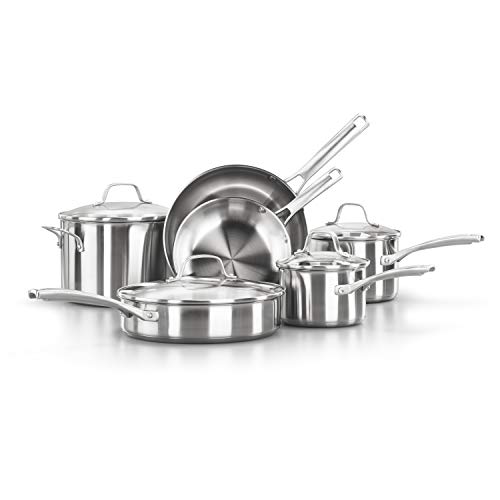
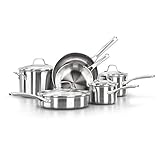
2. Calphalon Classic Hard-Anodized Nonstick Cookware Set
A hard-anodized nonstick line with fry pans, saucepans, a sauté pan and a stockpot, topped with glass lids. It is a very familiar set that many shoppers watch for price changes.
Suits: easy everyday cooking. Strengths: a trusted brand and a wide range. Weaknesses: nonstick wears with time. Skip it if you sear at high heat.

Best for busy weeknights
3. T-fal Ultimate Hard Anodized Nonstick Cookware Set
A hard-anodized set with a nonstick interior, vented glass lids and riveted handles. Some pans carry a heat indicator. It is a sturdy, popular nonstick choice.
Suits: busy weeknights. Strengths: easy release and simple cleanup. Weaknesses: metal tools can scratch. Skip it if you prefer stainless.


Best for traditional stainless cooking
4. Farberware Millennium Stainless Steel Cookware Set
A classic stainless set with an aluminum-encapsulated base and a plain, durable look. It has been sold for many years and is often a go-to for budget-minded shoppers.
Suits: traditional stainless cooking. Strengths: a flat, heavy base and easy care. Weaknesses: not fully clad. Skip it if you want premium heating.

Best for cooks who like soft grips
5. Rachael Ray Cucina Hard-Anodized Nonstick Cookware Set
A hard-anodized nonstick set with soft rubberized handles and a friendly look. It is a casual everyday collection that suits relaxed home cooking, and the bright finish makes it a popular gift. Check the listing for the exact piece list.
Suits: cooks who like soft grips. Strengths: comfortable handles and easy cleanup. Weaknesses: nonstick care applies. Skip it if you want stainless looks.
View Rachael Ray Cucina Set on Amazon

Best for casual cooking on a budget
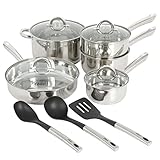
6. Oster Sangerfield Nonstick Cookware Set
A value-oriented aluminum nonstick set with a simple design and glass lids. It suits cooks who want a basic collection without a premium name.
Suits: casual cooking on a budget. Strengths: a straightforward piece list. Weaknesses: basic build. Skip it if you plan to keep it for decades.
Care and Setup
- Wash each piece before first use.
- Use soft tools on nonstick surfaces.
- Keep the receipt or order record for the warranty.
- Hand wash when the maker recommends it.
Mistakes to Avoid
- Buying a set only because a price drop looks big.
- Ignoring the piece list and counting lids as pans.
- Choosing nonstick for tasks that need a hard sear.
- Forgetting to check stove compatibility.
Deciding What You Need Before Hunting Discounts
A sale only helps if the set matches your cooking. Before looking at any discount, write down what you cook most. If you sear steaks and roast vegetables, stainless or cast iron will suit you. If you make eggs and pancakes every morning, nonstick earns its place. If you cook on induction, you need magnetic cookware. Knowing this prevents you from being drawn by a low price on the wrong material.
Then count what you need. A household of one or two may be happy with a smaller set, while a family may need larger pots and extra skillets. Check your current cookware too. If you already own a good stockpot, you may not need another one, and a set that duplicates it is not a bargain. Look at storage as well. A large set with many nesting pieces may not fit in a small cabinet.
Set a simple target in advance: the material, the approximate piece list and the features you require, such as oven-safe lids or a particular handle style. With that target, a sale becomes a chance to buy something you already decided on, rather than a reason to buy something new. If a deal pushes you toward a set that differs from your plan, pause and ask whether you are buying the discount or the cookware. A good set that you use daily is better than a bargain that sits in a box.
Reading a Piece Count and What Is Really Included
Piece counts can be misleading. Many listings count each lid as a separate piece, and some include utensils, trivets or small accessories in the total. A set advertised with a high number might contain only a handful of pans. To compare fairly, list the actual pots and pans and note their sizes. For example, you might find two skillets, two saucepans, a stockpot and a sauté pan, plus lids.
Look at the sizes. A skillet that is too small for a family meal, or a stockpot that is too small for pasta, limits the set’s usefulness. Check whether the set includes the sizes you reach for most. Also check whether the pieces are the same material and base construction, since a few sets pair a quality skillet with thin accessories.
Consider what is missing. Many sets omit a large skillet or a roasting pan. If that is something you need, factor in the cost of buying it separately. Check lids as well: tempered glass lids let you watch food, and metal lids may withstand higher oven temperatures. Look at the handles and the maker’s guidance on oven temperatures and dishwasher use. A set with fewer, better pieces often outperforms a larger one padded with filler, and it is easier to store. Match the pieces to your meals, not to the number on the box.
Judging Whether a Discount Is Real
A percentage off a list price tells you little if the list price was never what shoppers paid. A reliable way to judge a deal is to watch the same listing over a few weeks and note the normal range. Price tracking tools and browser extensions can show history, and comparing the same set across retailers helps. If a price is only slightly lower than usual, waiting may not cost you much. If it is clearly at the low end of the range, that is more meaningful.
Be wary of model changes. Retailers sometimes discount a set because a new version replaced it, and the older one may have a different base, handle or coating. That can be fine, but check that the listing describes the model you want. Also watch for listings that bundle extras to make a set look generous, or that use slightly different model numbers to prevent price comparison.
Check seller details. Buy from a seller whose return policy you understand, and confirm that the warranty applies when you buy from that seller. Look at shipping costs and delivery time too, because a heavy set can add cost. Finally, note the return window and condition requirements before you open the box. A deep discount from a seller with a restrictive return policy is riskier than a smaller discount from a seller with an easy return process.
Warranty, Return Policy and Brand Support
Cookware is used daily and heated repeatedly, so the support behind it matters. Look for a warranty on the listing or the maker’s site, and read what it covers. Some warranties apply to defects in materials and workmanship, but exclude normal wear, misuse, dishwasher damage or commercial use. Others require registration or proof of purchase. Keep your receipt or order record in a safe place, and note the date.
Check how to make a claim. A brand with clear contact information and a straightforward process is easier to deal with. Find out whether replacement pieces are available separately, since you may want to replace a lid or a single pan without buying a new set. Established lines are more likely to have spare parts and consistent availability.
Understand the return policy as well. Look at the window, who pays for return shipping and whether opened or used cookware can be returned. Inspect the set as soon as it arrives: check for dents, warped bases, scratches in the coating and missing pieces. Do a quick flatness check and wash it as directed. If something is wrong, contact the seller promptly. A deal is only a deal if you can resolve problems easily. If a seller or a brand is unclear about its policies, treat that as a reason to look elsewhere, even if the price is attractive.
Timing, Patience and Avoiding Impulse Buys
Sales events create urgency, and urgency leads to mistakes. Countdown timers, limited stock banners and bundled offers are designed to prompt quick decisions. A calmer approach is to keep a short list of sets you would be happy with, check their listings from time to time and buy when one meets your price and requirements. If you miss a sale, another will usually come, though you cannot count on a specific date.
A few practical habits help:
- Decide on a maximum you are willing to pay before you start browsing.
- Compare at least two or three sets with the same material and similar piece lists.
- Read the care instructions on the listing, since a set that needs hand washing may not suit a busy household.
- Check the oven and stove compatibility against your own kitchen.
- Sleep on big purchases rather than buying within minutes of seeing a deal.
Consider timing around your own needs, too. If your pans are damaged or unsafe, waiting for a perfect sale may not be sensible. If you are building a first kitchen, buying a modest set now and adding pieces later can be more practical. Gift timing, moving dates and new stoves are all reasons to buy when you need to. Treat the discount as a bonus, not the purpose of the purchase.
A Plain Glossary of Cookware Terms
Product pages for cookware use shorthand that can hide what you are really getting. These definitions help you read between the lines.
- Hard-anodized: aluminum that has been treated to make the surface harder and more resistant to wear.
- Clad: layers of different metals bonded together, often with an aluminum or copper core, to spread heat.
- Nonstick coating: a slick surface that helps food release. It usually needs gentle utensils and careful cleaning.
- Induction compatible: the base contains magnetic material so it works on induction cooktops.
- Oven safe: the maker lists a maximum oven temperature for the pan and its lid, which can differ.
- Riveted handle: a handle fixed with metal fasteners, which many cooks find sturdy.
Always confirm the details for your specific set on the product page and in the care booklet. Two sets that look the same can differ in oven limits, lid material and whether they suit your cooktop.
Which Set Matches Which Cook
Instead of chasing a deal on whatever is available, match the set to how you actually cook. The table pairs common habits with features worth seeking.
| How you cook | Features to seek |
|---|---|
| Quick weeknight meals | Nonstick pans that clean easily and feel light |
| Searing and sauces | Stainless steel with a solid base |
| Cooking for a crowd | A large stockpot and a deep saute pan |
| Small household | Fewer pieces, smaller sizes, easy storage |
| Induction cooktop | A clearly stated induction compatible base |
Many people end up using three or four pieces from a large set and ignoring the rest. Be honest about which pieces you reach for most, and weigh the set against that habit.
Mistakes That Waste a Good Offer
Even a smart purchase can go wrong through small oversights. Watch for these.
- Buying for piece count alone, when lids and utensils inflate the number.
- Ignoring your cooktop type until the box arrives.
- Skipping the care booklet, then using heat or tools the maker advises against.
- Choosing a set so large that it will not fit your cabinets.
- Throwing away packaging before you are sure the set suits you.
Keep the packaging and paperwork until you have cooked a few normal meals, in case a return is needed. Read the use and care notes soon after delivery, and follow them for temperature limits, cleaning methods and utensil choices, since these directly affect how long the pieces stay in good shape.
Judging Whether a Promotion Fits Your Kitchen
A markdown on the product page is only useful if the set itself fits your life. Before you act on any promotion, compare the set against a short list of needs rather than the headline reduction.
Check the pan sizes first. Many sets include a tiny pan and a very large pot, while the sizes you reach for daily sit in the middle. Look at the lids, which may be glass or metal, and whether each lid fits more than one pan. Confirm the cooktop type, because gas, electric coil, glass top and induction surfaces each have their own requirements.
Think about handle comfort and weight too. A pan that feels heavy in a store photo description may be tiring when full. Read what the maker says about oven limits, utensil choices and cleaning, then picture yourself following those rules every week. If any of them clash with your habits, such as a dishwasher routine for a set that calls for hand washing, the promotion may not be worth acting on.
Mixing a Set with Single Pieces
A full set is not the only path. Some cooks prefer a small core set plus a few single pieces chosen for particular jobs. The table shows how that approach can compare with a large set.
| Approach | Good for | Watch out for |
|---|---|---|
| Large set | Furnishing a first kitchen in one go | Duplicate sizes and unused filler pieces |
| Small core set | Everyday cooking with less storage | Gaps for big batch cooking |
| Core set plus singles | Tailoring tools to your habits | Mismatched handles and lids |
Whichever path you take, keep a list of the pieces you already own so you do not buy duplicates. Hold off on specialty pans until you know you will use them often, and rely on the maker’s care booklet to protect what you purchase.
Head-to-Head: How the Six Sale-Tracked Sets Differ Beyond the Discount
A discount changes what a set costs, not what it is, so this comparison ignores price movement entirely and looks at what each set does in the kitchen. The Cuisinart Chef’s Classic Stainless and the Farberware Millennium represent stainless steel with encapsulated bases. The Calphalon Classic, the T-fal Ultimate Hard Anodized, the Rachael Ray Cucina and the Oster Sangerfield represent nonstick at different levels of build. A shopper who sorts out which material and which build level they want first will find that the right sale, when it appears, becomes obvious.
The Cuisinart Chef’s Classic Stainless is the durability pick of the six. Its aluminum-encapsulated base spreads heat across the bottom, the piece list is broad, and the stainless body tolerates high heat, metal utensils and years of ordinary abuse. Its limitation is the one shared by all base-only designs: the walls are plain stainless, so a sauce gets most of its heat from below and benefits from an occasional stir. For a cook who browns, deglazes and finishes in the oven, it is the most capable set here, and the one least likely to need replacing.
The Farberware Millennium covers similar ground in a plainer package. It has the flat, heavy base and easy care that made the line a budget staple for years, and it suits traditional stainless cooking without fuss. Against the Cuisinart it gives up some refinement and breadth, but the cooking experience, preheat, sear, simmer, wash, is much the same. Shoppers choosing between them are really choosing how much finish and piece variety matters, because the underlying bargain, stainless longevity at a modest tier, is common to both.
The Calphalon Classic is the nonstick set for cooks who want a known quantity: a hard-anodized body, the standard spread of fry pans, saucepans and a stockpot, and handling that feels familiar from the first use. The T-fal Ultimate Hard Anodized is its closest rival, adding vented lids and, on some pans, a heat indicator that helps beginners judge preheating. Both wear at the same rate as all nonstick, which is to say gradually and from the centre outward, and both are happiest at moderate heat with soft tools.
The Rachael Ray Cucina is the comfort pick, with rubberized handles that stay pleasant to grip and a friendly look that makes it a common gift purchase. Its cooking is standard hard-anodized nonstick, which is to say perfectly good for the eggs, grains and weeknight sautés most households actually make. The Oster Sangerfield is the simplest set of the six, a value-oriented aluminum nonstick collection with glass lids and no pretensions. It suits a first apartment, a holiday home or a stopgap while a worn set is replaced, and it should be judged as exactly that.
Seen together, the six form a ladder. At the top for longevity sit the two stainless sets. In the middle, the Calphalon and T-fal offer the most substantial nonstick builds. The Cucina trades a little substance for comfort and looks, and the Oster covers the basics at the simplest level. A sale can move any of them into a lower price tier temporarily, but it cannot move a set up the ladder of build. Decide which rung you need, then let the discount decide when, not what, you buy.
How to Judge Whether a Sale Price Is Genuinely Good
The first discipline of sale shopping is to separate the set’s worth from the theatre around it. Listings use struck-through prices, percentage claims and countdown timers because they work on hurried shoppers. A calmer method is to note the price of the set you actually want, on a day when you feel no urgency, and check it again over the following weeks. Prices on popular cookware lines move in cycles, and a shopper who has seen the ordinary level can recognise a genuine drop instantly, while a shopper seeing the set for the first time has no way to tell a real reduction from a permanent markdown dressed up as an event.
Piece count is the second place value hides. Two sets with the same headline count can contain very different amounts of cookware, because lids, steamer inserts and utensils are often counted as pieces. Compare the pans themselves: how many fry pans, saucepans and pots, and in what sizes. A smaller set of pans you will use daily is worth more than a larger count padded with tools you already own. This matters most with frequently promoted sets, where the bundle composition sometimes changes between listings while the headline count stays the same, so read the current piece list every time.
The third check is the version. Established lines like the Calphalon Classic and T-fal Ultimate are sold in several configurations, and a strikingly low price sometimes belongs to a configuration with fewer or smaller pieces rather than to the set you researched. Match the model name and the piece list, not just the brand. The same care applies to materials: a stainless-looking finish on a promotional variant may not be the same construction as the standard line. None of this requires suspicion, only the habit of reading the listing in front of you instead of the one you remember.
Finally, weigh the total cost of ownership rather than the ticket alone. A stainless set bought once can outlast several nonstick replacements, so its higher ordinary price may be the cheaper path over a decade. A nonstick set bought well can be the right choice for a household that values easy cooking now and accepts renewal later. A genuine bargain is a good set, suited to your cooking, at a price below its own usual level. Anything else is just a number in red, and the kitchen will not notice it once the cooking starts.
Timing, Tracking and Staying Patient
Cookware is promoted so regularly that patience is a real strategy. The big retail events bring wide reductions, but popular lines also dip between events, and a shopper tracking two or three candidate sets will usually see an acceptable price within a few weeks. Set a simple rule before you start: the set you want, the configuration you want, and the level at which you will buy without further deliberation. Rules made in advance protect against both errors, paying full price in a hurry and buying the wrong set because its discount was the loudest.
While you wait, use the time to verify the unglamorous details that a rushed purchase skips. Measure the cupboard or drawer the set must live in. Confirm the stove type and, for induction, the magnetic base. Read the care guidance for the material, because a set that needs hand washing is a poor bargain for a household that runs everything through the dishwasher. Check the warranty terms the maker publishes, since a clear warranty is part of what an established line offers over an unknown one, and keep your order record somewhere findable after the box is recycled.
Patience also protects against the duplicate purchase. Households shopping sales over several weeks sometimes buy a discounted skillet, then a discounted set that contains the same skillet. Decide early whether you are building a set or a collection of individual pieces, and stick to the plan. If a single pan is the real need, a sale on that pan is the bargain; a set discount, however deep, is money spent on pieces that will sit in a cupboard. The sets in this guide are for cooks who genuinely need the spread of pieces, and for them a complete set on a good week is the efficient buy.
When the price does reach your level, buy without second-guessing and stop tracking. Prices will move again, sometimes lower, and that movement is not a verdict on your decision. The value of a cookware set is realised at the stove, meal after meal, not in the history graph of its listing. A Cuisinart or Farberware set searing properly, or a Calphalon or T-fal set turning out easy breakfasts, repays its price in the ordinary currency of dinners that worked. That is the outcome the tracking was for, and it is worth more than the last small dip you might have caught.
Cooking With the Set Once the Bargain Is Home
A new set, however good the deal, cooks best once its owner learns its particular habits. Stainless sets like the Cuisinart Chef’s Classic and the Farberware Millennium want a patient preheat: warm the empty pan at a medium setting, test with a flick of water, and when the droplets bead and roll, add oil and then food. Food that goes into a correctly heated stainless pan releases as it browns; food that goes in cold or into an overheated pan sticks and scorches. The first week with stainless is mostly learning this timing, and after that the pans feel almost as forgiving as nonstick for most jobs.
Nonstick sets ask for the opposite discipline: less heat, applied gently. The Calphalon, T-fal, Rachael Ray and Oster sets all cook eggs, pancakes, fish and reheats beautifully at low to medium settings, and none of them needs or rewards a fierce preheat. Use the highest settings only under a pot of water. Add a little fat even though the coating is slick, because fat carries flavour and protects the surface. With soft tools and moderate heat, a nonstick set bought on sale will last about as long as the same set bought at full price, which is the real test of whether the bargain was good.
Use the whole set, not just the favourite skillet. New owners commonly cook everything in one fry pan while saucepans sit untouched, then wonder why meals feel limited. The saucepan with a lid makes better rice and grains; the stockpot makes soup and pasta properly instead of in cramped batches; the sauté pan handles braises that a skillet spills. Rotating pieces also spreads wear evenly, which matters for nonstick, where one overused pan can age years ahead of its siblings. A set is a small system, and cooking across the system is how its value shows up.
Treat the first month as calibration. Note which burner suits which pan, how your stove’s medium setting compares with recipe language, and which pieces earn their cupboard space. If a piece truly never gets used, that is information for the next purchase, not a failure of this one. And keep the receipt or order confirmation with the warranty details, because the one administrative task that turns a good sale into a protected purchase is being able to prove it. After that, the set stops being a bargain you found and becomes simply your cookware, which is the point.
Care That Protects the Value You Bought
The economics of a sale only work if the set lasts as long as it should, and care is where that is decided. Stainless is the forgiving material: wash it warm, dry it to prevent water spots, and use a gentle powdered cleanser when browning leaves a film or heat leaves a tint. The Cuisinart and Farberware sets tolerate this routine indefinitely. What shortens even stainless life is neglect at the joints: food and moisture left around rivets and lid rims, and pans stored wet in a stack. A minute of drying before storage is the cheapest maintenance there is.
Nonstick care is a short list of habits repeated consistently. Let the pan cool before washing so the coating is not shocked by cold water. Wash with a soft sponge rather than an abrasive pad, even when a listing calls a set dishwasher safe, because detergents and rattling age coatings faster than hand washing does. Store pieces separated by cloths or pan protectors. Keep cooking sprays off the surface if the maker advises it, since their residues can build into a sticky film that cooks blame on the coating. None of this is burdensome, but all of it has to be routine rather than occasional.
Handles and lids deserve a share of the attention. Rubberized handles like the Cucina’s should be kept out of prolonged high oven heat unless the listing clearly allows it, and all handles should be checked occasionally for tightness. Glass lids wash easily but chip at the rim if they are stored clattering in a drawer; a rack or a towel-lined slot keeps them intact. Vented lids, like those on the T-fal set, should be rinsed so the vent stays clear. These are small things, but a set feels old when its lids and handles fail long before its pans do.
Finally, judge wear honestly so the next purchase is timed well. Nonstick that sticks in the centre despite gentle heat has reached the end of its slick life, however good the original deal was, and replacing the single hard-working piece keeps the rest of the set in service. Stainless that has warped enough to rock on a glass top should be retired from that stove, though it may still serve in the oven. A sale bought well and cared for properly can carry a kitchen for years; the discount was the beginning of the value, and the care is what delivers the rest of it.
Making the Final Call on a Sale Set
If longevity is the priority, the stainless pair leads this guide. The Cuisinart Chef’s Classic Stainless brings the broader piece list and the more refined build; the Farberware Millennium brings the same basic durability in a plainer form. Either, bought at a genuine dip in its usual price, is the kind of purchase a kitchen makes once and forgets about, which is the highest compliment cookware can earn. Cooks who sear, deglaze and use the oven will get the most from this direction.
If easy cooking and easy cleaning lead, the nonstick four divide by build and feel. The Calphalon Classic is the safe mainstream choice, the T-fal Ultimate Hard Anodized the sturdiest with its vented lids and indicators, the Rachael Ray Cucina the comfort and gift pick, and the Oster Sangerfield the simple cover-the-basics option for a spare kitchen or a short horizon. All four reward moderate heat and soft tools, and all four are at their best value when a sale brings their price in line with the years of service you realistically expect from a coating.
Whatever you choose, let the decision order stay fixed: material first, piece list second, version third, price last. That order is the whole secret of cookware sale shopping, because it guarantees the discount decorates a sound decision instead of replacing one. Check the current listing for the exact configuration, confirm the stove match, and keep the order record. Then cook with the set for years and let the bargain prove itself at the stove, which is the only place it ever really mattered.
Three Sale Shoppers, Three Different Right Answers
The first shopper is furnishing a kitchen for the long term and has settled, after reading and thinking, on stainless steel. For this shopper the sale question is purely one of timing between the Cuisinart Chef’s Classic Stainless and the Farberware Millennium, two sets whose cooking is similar and whose difference is breadth and finish. The right method is to watch both, buy whichever reaches a genuine dip first, and feel no regret about the other, because the daily experience will be nearly identical. Long-term shoppers win at sales not by finding the deepest cut but by removing emotion from a decision that was already made well.
The second shopper cooks daily for a family, values easy cleaning over almost everything, and replaces nonstick every few years as a matter of routine. For this shopper the Calphalon Classic and the T-fal Ultimate Hard Anodized are the candidates, and a sale is genuinely valuable because the purchase repeats: money saved on a consumable cycle is money saved again and again. This shopper should also watch for the set’s configuration changes, since the family needs the larger saucepan and the stockpot, not a bundle padded with tools. A sale on the right configuration, whenever it appears, beats a deeper sale on the wrong one by exactly the cost of the missing pot.
The third shopper is buying for a second kitchen, a rental, a gift or a stopgap, where the horizon is short and the cooking is light. Here the Rachael Ray Cucina, as a comfortable and presentable gift, and the Oster Sangerfield, as simple cover for a spare kitchen, come into their own, and a sale on either is a rational buy rather than a compromise. The mistake for this shopper would be over-buying: a heavyweight stainless set for a holiday kitchen is money stored in a cupboard. Matching the set to the horizon is as much a part of sale craft as watching the price, and it is the part most often skipped in the excitement of a discount.
What unites the three is that each decided what they needed before the sale decided anything. That order of operations is the whole content of smart sale shopping, and it is why this guide spends more words on materials, piece lists and versions than on prices. Prices are weather; needs are climate. A shopper who knows their material, their pieces and their configuration can treat every promotion calmly, buying when the weather suits and ignoring it when it does not. A shopper without those decisions is at the mercy of every red banner, and will own, in time, a cupboard of bargains that do not quite cook the way the household eats.
One last habit separates satisfied sale buyers from frustrated ones: after buying, stop watching. The set you bought at a good price will be cheaper again one day, and dearer on other days, and neither fact changes a single meal it cooks. The value was locked in when the right set met an acceptable price, and it is paid out at the stove over the following years. Cook with it, care for it as this guide describes, and let the listing’s future movements belong to other shoppers. The bargain is finished; the cooking, which was the point all along, is just beginning.
A Note on Returns, Records and Warranty Claims
A sale purchase deserves the same paperwork discipline as a full-price one, and it takes two minutes. Save the order confirmation where you can find it, note the set’s exact model and configuration name, and photograph the piece list in the box before the packaging is recycled, because configurations change and your record is the only proof of what you bought. If a piece arrives damaged or a handle works loose early, that record turns a frustrating claim into a short one. Makers of established lines deal with documented claims every day; what slows a claim down is never the discount the set was bought at, only missing information. Treat the bargain as the serious purchase it is, keep its papers, and the warranty that helped justify choosing an established line will be there in full if you ever need it.
One further small discipline completes the sale buyer’s toolkit: decide, before the set arrives, where it will live and which old pieces it replaces, and deal with the replaced pieces at once, by passing them on, donating them or storing them deliberately elsewhere. A new set that lands in an already full cupboard gets damaged by the crowding and resented for the clutter, through no fault of its own. Clear its space, let it start its life organised, and the bargain will feel like the upgrade it was meant to be from the very first meal it cooks in your kitchen.
Cookware Sets on Sale FAQ
When do cookware sets go on sale?
Promotions vary and cannot be predicted. Tracking a listing’s price history over a few weeks shows its usual range.
Is a bigger set a better deal?
Not always. A smaller set of better pieces can serve you longer than a huge set with filler.
Should I buy during a big shopping event?
Only if the set is already on your list. Compare the current price to its typical range first.
What should I check before buying a discounted set?
Confirm the exact model, the piece list, the material and the return policy. A low price on the wrong set is not a bargain.
Is a larger set always better value?
No. A big set can include filler pieces or lids counted as separate items. Compare the actual pots and pans and their sizes.
How do I tell if a listed discount is genuine?
Watch the listing's price over several weeks or use a price history tool. If the sale price is near the low end of its usual range, the discount is more meaningful.
Should I buy an older model because it is marked down?
It can be fine, but check how it differs from the current model, including the base, coating and handles. Confirm warranty coverage too.
What should I check when the set arrives?
Count the pieces, look for dents or warping, check that the bases sit flat and wash the cookware as directed. Contact the seller quickly if anything is wrong.
Does a sale price affect the warranty?
Usually not, but terms can depend on the seller and the region. Read the warranty terms and keep your proof of purchase.
Is it better to wait for a big shopping event?
Only if you are not in urgent need and you know the usual price range. Otherwise, buy when a set meets your requirements at a price you are comfortable with.
Can I mix a discounted set with pieces I already own?
Yes. Many cooks combine a set with extra skillets or a Dutch oven. Check that the materials and stove compatibility suit your kitchen.
The Short Version
For stainless, the Cuisinart Chef’s Classic or the Farberware Millennium. For nonstick, the Calphalon Classic or the T-fal Ultimate. For soft grips, the Rachael Ray Cucina. For a basic budget set, the Oster Sangerfield.
Related Guides
- 6 Best Cookware Sets: What Is Really in the Box (2026)
- 6 Best Cookware for Induction Cooktops: Pans That Work (2026)
- 6 Best Small Stainless Steel Cookware Sets: 5 to 8 Pieces (2026)
- 6 Best Calphalon Cookware Sets: Nonstick and Stainless (2026)
- 6 Best Camp Kitchen Sets: Cookware Kits for Camping (2026)