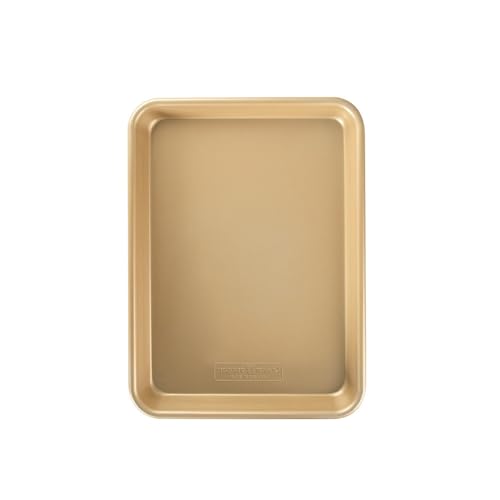
A pie leaves the oven in a fragile state. The filling is still setting, the crust is saturated with steam, and the dish itself holds enough heat to keep cooking the bottom long after the timer stops. Where you set that pie down for the next hour decides whether the base stays crisp or turns soft and gummy. A cooling rack is not a passive landing pad in that moment. It is the tool that lets hot air escape from underneath the dish, lets steam move away instead of condensing back into the crust, and supports a heavy, sloshing pie without flexing at the exact moment you can least afford a wobble. This site may earn an affiliate commission when you buy through links on this page, and that support is part of what keeps detailed comparisons like this one free to read.
Most cooling racks are designed with cookies in mind, and cookies forgive almost anything. A pie does not. A deep-dish fruit pie in a ceramic dish can weigh several pounds, it arrives at the rack still bubbling at the edges, and its dish has a narrow foot ring that concentrates all of that weight onto a small circle of wire. A flimsy rack with widely spaced bars can bow under the load, let the dish rock, or allow a soft, still-warm crust edge to sag between the wires if the pie is cooled out of its dish. A rack that is too small leaves a 10 inch dish overhanging on two sides, which is an invitation to tip the whole thing when you brush past the counter. The six racks below were chosen specifically for pie duty: close grids or heavy wire, honest load-bearing stiffness, foot height that actually lifts the dish clear of the counter, and sizes that suit standard 9 and 10 inch pie dishes with room to spare.
This guide explains what separates a pie-worthy rack from a cookie rack, walks through six real models from Checkered Chef, Hiware, Ultra Cuisine, Fox Run, Nordic Ware, and USA Pan, and then covers the cooling technique itself, because the best rack in the world cannot save a pie that is left to steam in a closed kitchen or sliced before the filling has set. Every pick here is a real, widely sold product. Prices change constantly, so each pick ends with a pointer to check the current listing rather than a number that would be stale within the month.
Why pies punish the wrong rack
Understanding why pies are hard on racks makes the buying criteria obvious. First, there is the weight. A double-crust apple pie in a stoneware dish is one of the heaviest things a home baker routinely moves around a kitchen, and unlike a roasting pan it cannot be grabbed by two sturdy handles. The dish is hot, the filling is liquid at the center, and the transfer from oven to rack happens with oven mitts that reduce your grip and your feel. The rack has to receive that load without bouncing, sliding, or dipping in the middle. A rack that flexes even slightly can slosh hot filling over the rim or crack a crust that is still setting its structure.
Second, there is the steam problem, which is the entire reason the rack exists. A pie crust is a sponge for moisture in the minutes after baking. The bottom crust sits against a hot dish, and the space between dish and counter becomes a small steam chamber if the dish is set flat. Moisture that should escape downward and outward instead condenses on the base of the dish and soaks back up. Raising the dish on a rack opens that space to the room air, and the difference between a rack that lifts a dish a full inch and a low-profile rack that lifts it a quarter inch is the difference between air that circulates and air that barely moves. Foot height is not a cosmetic detail on a pie rack. It is the mechanism.
Third, there is the matter of the dish foot. Pie dishes do not have flat bottoms. Most have a small raised ring, sometimes barely wider than a dinner plate’s foot, and that ring is the only contact patch. On a rack with parallel bars spaced an inch apart, the ring can land across two bars or, worse, settle between them and let the dish tilt a degree or two. A degree of tilt does not sound like much until the filling is still liquid enough to pool to one side and the lattice on top sets lopsided. A close crosshatch grid spreads that contact across many wires at once, which is why grid-style racks dominate this list and why the spacing of the mesh matters more for pies than for almost any other baked good.
In this guide
What to look for in a cooling rack for pies
Grid density and support under the dish
The single most important specification is how closely the wires are spaced. Look for a true grid or crosshatch pattern, or parallel wires spaced well under an inch apart, so the foot ring of a pie dish is always supported at several points and a warm crust edge never meets a gap. Close grids have a second benefit if you ever cool a pie out of its dish, or rest a galette or a hand pie directly on the rack: nothing sags through. Wide-spaced bar racks are fine for sheet pans and roasts, but they are the wrong tool here. When a product lists its grid pattern, prefer the ones that describe a tight mesh, and be skeptical of racks photographed only with cookies, which hide wide spacing under a forgiving load.
Wire gauge, stiffness, and honest load capacity
Thick wire and a reinforced rim frame keep a rack flat under a heavy ceramic dish. You can judge a lot from how a rack is built: a rolled or framed edge, welded cross wires, and a rim that does not twist when you pick the rack up by one corner all point to a rack that will not oil-can under a pie. Thin, lightweight racks have their place for cooling muffins, but a rack that bows in the middle drops the dish closer to the counter and defeats the airflow you bought it for. If you bake in stoneware or cast iron, treat stiffness as a requirement, not a luxury, and consider the rack’s footprint too, because a larger frame distributes the load across more wire.
Foot height and airflow clearance
Feet or a raised frame should lift the cooking surface roughly an inch off the counter. That clearance lets steam escape sideways instead of pooling, keeps the hot dish from scorching or heat-shocking a stone or laminate countertop, and gives the bottom of the dish moving air on all sides so the crust dries as it cools. Very low racks are easier to store, and folding racks are clever, but for pies the trade is rarely worth it. Check whether the feet are positioned near the corners, where they keep the rack stable under an off-center load, and whether they are tall enough that a slightly domed rack surface still clears the counter at the center.
Size relative to 9 and 10 inch pie dishes
A rack should extend at least an inch beyond the dish on every side, which means a half-sheet-sized rack around 17 by 12 inches is the natural home for a 10 inch pie dish, while a 10 by 15 inch rack suits a 9 inch dish comfortably. Round racks look purpose-built for pies and center the dish naturally, but rectangular racks are more versatile and store flat against a sheet pan. Think about your whole baking session, not just one pie: holiday baking often means two pies cooling at once, plus a rack for the crust you are par-baking next. Two medium racks are usually more useful than one enormous one, and several of the picks below are sold in pairs for exactly that reason.
Material, coating, and oven safety
Stainless steel racks tolerate high oven temperatures, which matters more than you might expect: a rack that is oven safe can double as a trivet inside a sheet pan, a roasting rack, or a way to keep a pie warm at low heat. Nonstick-coated racks release sticky fruit drips more easily and clean up faster, but coatings have temperature ceilings and can chip over years of use, and a chipped coating under a pie dish is mostly a cosmetic issue while a chipped coating under food is not. Chrome-plated steel sits between the two and should be kept out of very high heat. For pure cooling duty all three work; for bakers who want one rack to do everything, uncoated stainless is the most forgiving choice. Whichever you choose, confirm the stated oven limit before you ever slide it into a hot oven, because cooling racks and baking racks are not always rated the same.
Cleaning and storage realities
Pie filling that bubbles over is mostly sugar, and baked-on sugar is the enemy of wire grids. A close grid has more intersections where syrup can carbonize, so dishwasher safety and a surface that releases residue after a soak matter. Stainless and nonstick racks generally go in the dishwasher; chrome racks often ask for hand washing to protect the plating. Storage is the other quiet factor: racks that nest inside a standard half sheet pan disappear into a cabinet, while oversized or round racks need a dedicated slot. If your kitchen is small, measure your cabinet before falling in love with the largest rack on the list.
Stability on the counter
A rack that skates is a hazard with a hot pie aboard. Feet should grip rather than glide: wide, flat foot pads or a frame that sits in full contact with the counter beats narrow wire feet on a slick stone surface. Test the idea mentally before you buy by picturing the landing. You are coming in from the oven at an angle, mitts thick, dish heavy, and you set it down with a little sideways momentum. A stable rack absorbs that without traveling. Some bakers put a damp towel or a silicone mat under the rack for insurance on polished counters, which works well, but a rack whose feet are sensibly designed rarely needs the help. Weight helps too: a heavier rack is less likely to shift when a dish lands off-center, which is one more reason the sturdier picks on this list feel calm in use.
One rack or a system
Think about whether you are buying a single rack or the start of a small system. Bakers who produce pies in batches, for holidays, markets, or big family dinners, benefit from racks that stack or from owning two identical racks that can work side by side and store nested. Identical pairs are easier to store than a mismatched collection, and a two-pack like the Hiware set below builds that in from the start. If your baking is occasional and single-pie, one good rack is genuinely enough, and the money saved is better spent on a second pie dish. Match the purchase to the baking you actually do, not the baking you imagine doing once a year.
Matching the rack to your pie dish
Different dishes ask slightly different things of a rack, and it is worth a moment on the pairings. Glass pie dishes, the classic transparent kind, benefit most from a rack’s gentle contact: their bottoms are smooth, their foot rings are modest, and they are the dishes most at risk from thermal shock on a cold counter, so any rack on this list serves them well, with the tight grids giving the most even support. Ceramic and stoneware dishes are the heavyweights. They hold heat the longest, which means they keep steaming the crust the longest, and they reward both foot height and frame stiffness; the Hiware and USA Pan racks were chosen with exactly these dishes in mind. Metal pie pans are light and cool quickly, and their rolled rims can rest across almost any wire pattern, though a very flexible rack under a thin pan full of liquid filling can still allow a worrying wobble. Cast iron skillets and pie irons are the extreme case: immensely heavy, with small feet or none, and they demand the stiffest rack you own and a landing spot that will not be bumped.
Deep-dish and slab pies stretch the sizing advice. A deep-dish pie in a 10 inch stoneware dish with a wide, flared rim can measure closer to 12 inches across the top, and it deserves a rack with margin to spare, which is where the large Nordic Ware earns its place. Slab pies baked in quarter sheet pans invert the problem: the pan is rectangular and broad, it lands across a rack easily, but it is flexible when full, so the rack beneath should be flat and broad rather than small and round. Quiches and custard tarts in fluted metal tins with loose bottoms are the delicate case: the tin must stay level and undisturbed while the filling sets, and a close grid that supports the tin’s base evenly is kinder than bars that might press on the loose bottom unevenly. None of this requires a different rack for every dish, but it explains why the strongest all-rounders here pair a close grid with a stiff frame: that combination is the one that never argues with any dish you set on it.
The six best cooling racks for pies

Checkered Chef Cooling Rack: the close-grid all-rounder
The Checkered Chef rack built its reputation on one decision that happens to be exactly right for pies: a tight crosshatch grid instead of widely spaced parallel bars. The mesh supports a pie dish at dozens of contact points, so the foot ring never hunts for a bar to rest on, and the dish sits dead level while the filling settles. The rack is sized to fit inside a standard half sheet pan, which gives a 10 inch pie dish comfortable margins on the long sides and turns the pan-plus-rack combination into a drip-catching station for fruit pies that bubble over. That last point is underrated: a rack nested in a sheet pan means the sugary overflow lands on metal you can soak, not on your counter.
Under load, the frame stays flat. The rim is sturdy enough that the rack does not twist when you lift it by a corner with a dish aboard, and the grid does not have the springy trampoline feel of cheaper mesh racks. The feet lift the surface high enough for real airflow, and because the grid is continuous, the dish cannot rock even if you set it down slightly off center in a hurry. For bakers who cool pies out of the dish, the tight mesh is equally valuable, since a still-tender bottom crust rests on wire every fraction of an inch instead of spanning open gaps.
Day to day, it is also a forgiving rack to live with. The stainless surface does not hold odors, the corners are finished smoothly enough that it does not snag towels or mitts, and the whole thing rinses off quickly when the pie behaved itself. Bakers who freeze pies will find another use for it: set the wrapped pie on the rack inside the freezer for the first hour and the bottom chills as fast as the top, instead of sitting on a shelf absorbing the cold unevenly. It is a small thing, but racks earn their keep in these unglamorous moments, and this one keeps showing up as the right size and the right surface for whatever the day’s baking happens to be.
Strengths:
- Tight crosshatch grid gives a pie dish level, multi-point support with no sagging anywhere.
- Sized to nest in a half sheet pan, which catches fruit drips and makes storage effortless.
- Stainless steel construction is oven safe to high temperatures, so it doubles as a baking and roasting rack.
- Feet provide genuine clearance for steam to escape from beneath the dish.
Trade-offs:
- The dense grid has many welded intersections where baked-on syrup can lodge, so it rewards a soak before scrubbing.
- It is a single flat size, so very large or oversized rustic pie dishes may want the bigger racks further down this list.
- No nonstick coating, which means sticky spills need a little more patience than on coated rivals.
Who it suits: This is the default recommendation for most pie bakers: anyone using standard 9 or 10 inch dishes, anyone who bakes fruit pies that drip, and anyone who wants one rack that cools, roasts, and stores inside the pan they already own. If you bake pies weekly and want to stop thinking about your rack entirely, start here and check price on Amazon.
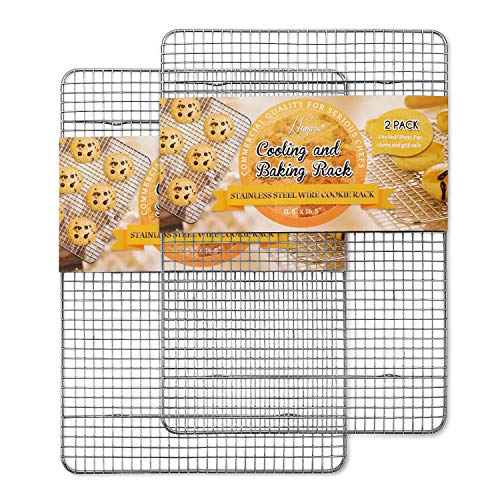
Hiware Cooling Rack: heavy-gauge stainless in a two-pack
Hiware’s rack takes the opposite approach to the same problem. Instead of a mesh, it uses thick parallel stainless wires set close together, welded to a substantial frame, and the result is a rack with a noticeably rigid, almost cast feel in the hand. The wires are spaced tightly enough that a pie dish foot ring always spans several of them, and the gauge of the wire means there is no perceptible flex when a heavy stoneware dish lands. Hiware sells this rack in a two-pack sized for half sheet pans, and for pie bakers that pairing is genuinely useful: Thanksgiving rarely involves a single pie.
The raised feet are tall and positioned at the corners, and the whole rack has the slightly overbuilt character of bakeware meant to be used hard. Because the wires run in one direction, sliding a dish onto the rack from the oven is smooth, and the open structure rinses clean faster than a crosshatch grid. The stainless is the high-grade, rust-resistant kind, and the rack is rated for serious oven heat, so it can go from cooling duty to crisping duty under a pie you want to re-crisp before serving. Two racks also stack the workflow nicely: one receives the finished pie while the other holds the next crust, and neither session requires washing anything mid-bake.
There is a confidence to landing a heavy dish on this rack that thinner racks never quite give. The wires do not ping or settle, the frame does not creak, and the dish stays where you put it while you close the oven door with your elbow. That steadiness matters most with the pies that worry you: the deep-dish stoneware monster, the lattice-top pie whose filling is still visibly moving, the custard that must not slosh. A rack cannot make a pie set faster, but it can remove itself from your list of concerns, and the Hiware pair does that at a standard few single racks match.
Strengths:
- Thick-gauge stainless wires and a rigid frame handle heavy ceramic and stoneware dishes without flex.
- Sold as a two-pack, which matches real pie sessions where two dishes cool at once.
- Open wire design rinses and dries faster than dense mesh, with fewer spots for syrup to hide.
- Oven safe to high heat and dishwasher safe, so it is easy to live with daily.
Trade-offs:
- Parallel wires, however close, are slightly less forgiving than a full grid if a small dish lands at an awkward angle.
- The pair takes more storage room than a single rack, though both nest in one sheet pan.
- The utilitarian finish shows water spots more readily than coated racks if you air-dry it.
Who it suits: Bakers who use heavy dishes, bake in pairs, or simply want the stiffest-feeling rack in the drawer will get the most from the Hiware. It is also the pick for anyone who has bent a cheap rack before and intends never to do it again, so it is worth a look at the current listing to check price on Amazon.

Ultra Cuisine Cooling Rack: professional-grade stainless in a true half-sheet size
Ultra Cuisine built this rack around a single material decision: premium stainless steel throughout, with no coating to protect and no plating to wear through. For pie cooling, that specification answers the two failures that end most racks’ lives. The wire frame is stiff enough that the rack does not drum or bow under a stoneware load, the surface tolerates the heat of an oven when a bottom crust needs a few minutes of re-crisping, and the whole rack can go into the dishwasher after a blueberry pie has done its worst. At 11.5 by 16.5 inches it is honestly sized for a half sheet pan, which keeps the drip-catching trick available, and it is the rack that frequently gets recommended when a baker asks for one good rack rather than a collection.
What stands out is the combination of stiffness and durability at this size. Many racks in this tier achieve one or the other: a close wire pattern in thin wire that flexes, or stout bars in a frame that rusts at the first scratch. A solid stainless build manages both, which is why it handles a deep-dish pie with the same composure it shows under a tray of scones, and why the same rack doubles for roasting and grilling duty when it is not cooling pies. Owners who bake for bake sales and holidays tend to end up owning two, because the first one is always occupied.
It is worth saying plainly that nothing about this rack is decorative. The finish is plain stainless steel, and the design has not changed because it does not need to. That plainness is a virtue in a tool that lives in a drawer and works in steam and syrup. If you are outfitting a first serious baking kitchen, this is the kind of purchase that quietly upgrades every bake that follows it, because the last stage of baking, the cooling, finally gets the same quality of equipment as the mixing and the baking stages got.
Strengths:
- Premium stainless steel construction tolerates high oven heat and dishwasher cleaning without special care.
- Stiff, durable wire frame supports a heavy pie dish without flexing or rocking.
- True 11.5 by 16.5 inch sizing fits inside a half sheet pan for drip control and flat storage.
- Uncoated surface has no finish to chip, so the rack doubles for roasting and grilling work.
Trade-offs:
- The wire intersections collect baked sugar, so sticky sessions need a soak before the dishwasher does its best work.
- The single standard size may feel small under oversized 10 inch deep-dish stoneware with wide rims.
- No coating means no easy-release surface for bakers who also cool sticky buns and caramel-topped bakes directly on the wires.
Who it suits: The Ultra Cuisine is for the baker who wants one dependable stainless rack that does pie duty properly and shrugs off oven and dishwasher alike: home bakers with standard dishes, bake-sale regulars, and anyone replacing a flimsy rack for good. If that sounds like your kitchen, the sensible move is to settle the search and check price on Amazon.
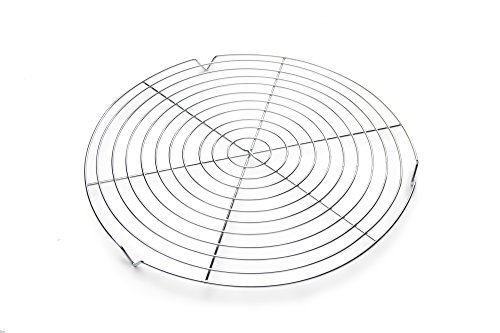
Fox Run Cooling Rack: the round rack shaped like the pie itself
Fox Run has been making simple, sensible bakeware for generations, and its round cooling rack is the most pie-specific shape on this list. A round rack centers a round dish by instinct. There are no corners to misjudge with mitts on, the dish overhangs evenly on every side, and the whole arrangement looks and feels stable in a way that a small dish lost on a big rectangular rack sometimes does not. The chrome-plated steel construction keeps the price gentle, and the concentric-and-spoke wire pattern supports the foot ring of a standard pie dish at multiple points around its circle.
The round format has practical virtues beyond looks. It fits neatly on a small counter or a stovetop burner grate area where a half-sheet rack would crowd everything else, and it stores upright in a cabinet slot beside the pie dishes it serves. The raised feet give a dish the clearance it needs, and for a single-pie household the footprint is exactly proportioned: a 9 inch dish sits with a modest margin, and the rack disappears into a drawer or a narrow gap when the pie is done. Fox Run also makes rectangular racks, but the round one is the charmer here, and for bakers whose pie dish collection tops out at the standard size it may be all the rack they ever need.
There is also something to be said for a tool that does one job in a kitchen full of multitaskers. The round rack will never be borrowed to drain fried food or pressed into service under a roast, which means it is always where you left it when the pie comes out, clean and ready. Small kitchens run on that kind of reliability. Apartment bakers, in particular, tend to appreciate equipment that stores in the same footprint as the dishes it serves, and a round rack slides into the pie-dish stack’s cabinet as if it were part of the set.
Strengths:
- Round shape centers a pie dish naturally and evenly, which feels secure when you are wearing mitts.
- Compact footprint suits small kitchens and crowded holiday counters.
- Wire pattern supports the dish foot ring at points all around the circle.
- Simple chrome-plated build keeps it light, inexpensive to replace, and easy to store.
Trade-offs:
- Chrome plating prefers hand washing and drying, and it is not the choice for high-heat oven work.
- The round size is tailored to standard dishes; a 10 inch deep-dish pie with a wide rim will overhang more than is ideal.
- One dish at a time is the realistic capacity, so high-volume bakers will want a second rack alongside it.
Who it suits: Choose the Fox Run if your pie baking is a one-pie-at-a-time pleasure, your kitchen is short on counter space, or you simply like tools shaped for their job. It is a small, honest rack that treats a 9 inch pie exactly right, and you can confirm the current listing details when you check price on Amazon.


Nordic Ware Cooling Rack: the big, nonstick half-sheet workhorse
Nordic Ware’s cooling rack is built to pair with the company’s famous half sheet pans, and that heritage shows in its proportions: it is one of the largest racks here, with room for a 10 inch pie dish and the confidence that comes from a frame that extends well past the dish on every side. The rack uses a nonstick-coated grid that fruit bakers will appreciate the first time a cherry pie erupts, because the sugary overflow releases with a fraction of the scrubbing that bare wire demands. The grid is fine enough to support a dish evenly, and the frame is rigid in the way bakers expect from this brand.
Size is this rack’s argument. A large rack is not only about the dish it holds today; it is about the whole cooling landscape of a serious baking day, when a pie, a par-baked crust, and a tray of something else are all looking for air at the same time. The Nordic Ware gives a big dish a stable, uncrowded platform and leaves working room around it. The nonstick surface also makes it the friendliest rack here for cooling a pie that has been turned out of its dish, since a tender crust releases instead of bonding to the wires. Just respect the coating: keep it within its stated temperature range, which is lower than bare stainless, and treat it as a cooling specialist rather than an all-purpose oven rack.
Bakers who work in stoneware will feel the difference in the landing. A wide, flared deep-dish rim that would perch on the edge of a smaller rack sits fully supported here, and the frame’s rigidity keeps the whole arrangement composed while the filling settles. The rack also earns its size after the pie is done, because a big cooling surface is where slab pies, galettes, and a whole afternoon’s worth of hand pies end up. If your baking tends toward abundance, the extra inches stop being a luxury and start being the point.
Strengths:
- Generous half-sheet footprint gives large and deep-dish pies a stable platform with margin on all sides.
- Nonstick grid releases baked-on fruit syrup with minimal soaking and scrubbing.
- Fine grid supports the dish evenly and is gentle under a crust cooled out of its dish.
- Pairs perfectly with standard half sheet pans for the drip-catching setup.
Trade-offs:
- The nonstick coating has a lower oven temperature ceiling than uncoated stainless racks.
- Coating can wear over years of heavy use, especially with metal utensils and abrasive pads.
- Its size is a storage commitment in a small kitchen, even though it nests in its pan.
Who it suits: This is the rack for high-volume and deep-dish bakers: the holiday producer with two pies in rotation, the stoneware devotee, and anyone whose pies reliably bubble over and who is tired of chiseling syrup off bare wire. If your baking days are big ones, look at the listing before the next holiday arrives and check price on Amazon.
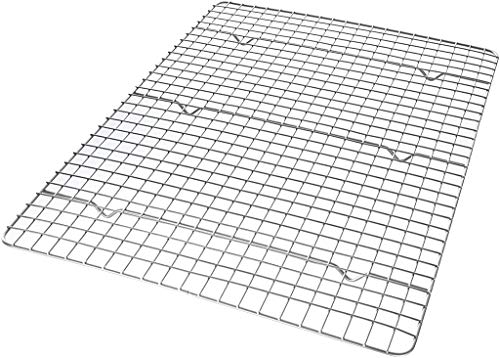
USA Pan Cooling Rack: commercial-weight wire with a superb nonstick finish
USA Pan makes bakeware to commercial patterns, and its cooling rack carries that DNA: heavy-gauge steel wire in a tight grid, a reinforced frame, and the company’s well-known silicone-based nonstick coating that shrugs off sticky residue. In the hand it feels like the racks used in bakery kitchens, flat and unbothered by weight, and under a pie dish it behaves the same way. The grid is close enough that a dish foot ring is supported everywhere it lands, the surface is level, and the whole rack stays put instead of skating on the counter when a heavy dish arrives.
The coating is the headline for pie bakers who also cool sticky work. Fruit syrup, caramel drips, and the occasional leaked custard wipe or rinse away with far less effort than on bare metal, and the coating is formulated to handle the job without flaking into food. The rack is sized for a half sheet pan, so the drip-catching combination works, and the frame’s stiffness means you can carry the rack with the dish on it from counter to table with more confidence than most racks inspire. Its stated temperature limit is generous for a coated rack, though like all coatings it deserves respect at the top of its range. For bakers who want the grid support of the mesh-style racks plus genuinely easy cleanup, this is the most complete package on the list.
Longevity is the quiet part of the value here. Cheap racks fail in predictable ways: a weld lets go, a foot bends, the surface rusts at a scratch. A commercial-pattern rack like this one is built to be washed daily and used hard without those small failures accumulating, and the coating’s durability is part of that design rather than an afterthought. For a baker who measures equipment in years of holidays rather than seasons, that steadiness is the real specification, and it is why this rack closes the list as the premium standard.
Strengths:
- Commercial-weight wire grid supports heavy pie dishes with no flex or rocking.
- Premium nonstick coating releases fruit syrup and custard drips with minimal effort.
- Reinforced frame is stiff enough to carry the rack with a dish aboard.
- Half-sheet sizing nests in a standard pan for drip control and tidy storage.
Trade-offs:
- It sits at the premium end of this list, reflecting the build and the coating.
- Like any coated rack, it should be kept within its stated oven temperature and away from sharp metal tools.
- The dense grid still benefits from a brief soak after the stickiest bakes, even if cleanup is easier than most.
Who it suits: Pick the USA Pan if you want the buy-it-once option: the frequent baker, the sticky-pie specialist, and anyone who values cleanup as much as support. It is the rack most likely to still be performing like new after years of holidays, so it earns a moment of your time to compare it against the others here and check price on Amazon.
How the six racks compare
| Rack | Surface pattern | Material | Best pie scenario | Standout quality |
|---|---|---|---|---|
| Checkered Chef | Tight crosshatch grid | Stainless steel | Everyday 9 and 10 inch pies | Level support and sheet-pan nesting |
| Hiware | Close parallel wires | Stainless steel | Heavy stoneware, two-pie days | Rigidity and the two-pack format |
| Ultra Cuisine | Close wire grid | Stainless steel | One-rack households | Professional-grade build, oven and dishwasher safe |
| Fox Run | Round wire pattern | Chrome-plated steel | Single standard pies, small kitchens | Shape that centers the dish |
| Nordic Ware | Fine grid | Nonstick-coated steel | Deep-dish and high-volume baking | Size and easy syrup release |
| USA Pan | Tight grid | Nonstick-coated steel | Frequent, sticky, serious baking | Commercial build and cleanup |
Read the table as a map of priorities rather than a ranking. If support under the dish is your whole concern, the close-grid stainless racks from Checkered Chef and Ultra Cuisine are the purest expression of it. If your dishes are heavy and your sessions come in pairs, the Hiware’s stiffness and two-pack format answer directly. If your kitchen is small and your pies are standard, the Fox Run’s round footprint is the elegant fit. And if your pies are big, deep, and prone to glorious sticky overflow, the coated grids from Nordic Ware and USA Pan trade a little oven versatility for a great deal of cleanup mercy.
One pattern is worth noticing across all six: none of them is a wide-barred, lightweight rack of the kind sold in multipacks for cookies. That absence is deliberate. Pie cooling rewards density, stiffness, and clearance, and every pick here was chosen because it delivers all three in its own way, whether through mesh, heavy wire, or a reinforced coated grid. If you remember nothing else from the table, remember that: the right rack for a pie is the one that treats the pie like the heavy, steaming, still-setting thing it is, not like a tray of biscuits that would forgive anything.
Cooling technique: getting a crisp bottom every time
The rack does half the work; the other half is what you do around it. Move the pie to the rack the moment it comes out of the oven, because every minute it sits on a hot sheet pan or a flat counter is a minute of steam soaking the base. Set the rack somewhere with moving air but out of a direct draft, and resist the urge to cover the pie with a towel, which traps the very moisture you are trying to release. Fruit pies need patience measured in hours, not minutes: the filling sets as it cools, and a pie sliced warm will run no matter how good the rack is. Custard and cream pies should cool on the rack until the dish no longer feels warm to the touch, then move to the refrigerator, because the rack’s job is to shed the oven’s heat quickly and evenly, not to hold the pie at room temperature all afternoon.
A few small habits multiply the rack’s effect. If your pie baked on a sheet pan to catch drips, lift the dish off the pan and onto the rack rather than cooling it on the pan, since the pan is a heat reservoir that keeps the bottom cooking and steaming. For pies baked in glass dishes, the rack also protects the dish: setting a screaming-hot glass dish directly on a cold stone counter can shock it, while the rack’s wires make gentle, minimal contact. And if you plan to serve from the dish, cool the pie fully on the rack before moving it to a trivet or table, because a dish that is still radiating heat will keep softening the crust from below even at the table. Finally, if the bottom crust is your obsession, a few minutes of the cooling period can happen with the pie still in a warm, switched-off oven with the door ajar only if the recipe directs it; otherwise, the open air of the rack is the right environment, and time is the ingredient that finishes the job.
Care and longevity: keeping a rack flat, clean, and rust-free
A cooling rack asks for very little, but the little it asks for matters. Baked-on fruit syrup is the main enemy, and the countermeasure is time in water rather than force: a twenty-minute soak in hot, soapy water softens carbonized sugar so a brush can lift it, while steel wool on a coated rack will strip the finish you paid for. Stainless racks forgive almost any cleaning method, which is part of their appeal. Chrome racks should be dried promptly after washing, since water left standing on plating is what eventually invites rust at the welds. Coated racks prefer soft sponges and should never meet a knife edge used to pry off a stuck drip.
Storage shapes a rack’s lifespan too. A rack stored flat inside its sheet pan stays flat; a rack jammed vertically into an overstuffed cabinet gets its feet bent and its frame torqued, and a bent foot is what turns a level rack into a rocking one. If a foot does bend, gentle pressure back into line usually restores it on wire racks, which is another point in favor of simple constructions. Check your rack once in a while the way you would check a pan: set it on a flat counter, press each corner, and look for rock. A rack that rocks under an empty counter will rock more under a hot pie, and replacing it before the holiday rush is cheaper than replacing the pie. Treated decently, any of the six racks above should serve for years, and the stainless ones should serve for decades.
Common cooling mistakes that undo a good rack
The first mistake is cooling the pie on the sheet pan it baked on. The pan comes out of the oven holding serious heat, and it keeps the bottom of the dish hot and steaming long after the top has begun to cool, which is precisely backwards. Lift the dish onto the rack and let the pan cool somewhere else. The second mistake is impatience with the transfer itself: sliding a pie dish across a counter or carrying it at a tilt to a distant rack invites sloshing and cracked crusts, so stage the rack beside the oven before the pie comes out, close enough that the move is a short, level lift. The third mistake is covering the pie too soon, whether with foil, a towel, or a cake dome, because anything that caps the pie traps steam against the top crust as well as the bottom. The fourth is refrigerating a warm custard pie before it has shed its oven heat on the rack, which fogs the surface and can weep moisture into the crust; an hour of open cooling first makes the chilled result noticeably better. The fifth is slicing to check. A cut made before the filling sets does not heal, and the first slice of an unset fruit pie releases juice that softens the neighboring crust as it sits. Every one of these mistakes is free to avoid, and together they are worth as much crispness as the rack itself.
Frequently asked questions
Can I cool a pie directly on the rack without its dish?
Sometimes, and the grid is what decides. A fully baked, sturdy double-crust pie can be turned out onto a tight-grid rack once it has firmed up slightly in its dish, and cooling it bare gives the bottom crust maximum airflow. But a warm pie is fragile, custard and cream pies should never leave their dishes, and a soft single crust can sag between widely spaced wires. If you want the option, choose one of the tight-grid racks above, let the pie set in its dish for the first stretch of cooling, and only turn it out if the crust feels firm and the filling has stopped sloshing.
What size rack do I need for a 10 inch pie dish?
Look for at least an inch of rack beyond the dish on every side, which in practice means a half-sheet-sized rack for a 10 inch dish, especially a deep-dish model with a wide rim. The margin is not wasted space: it is what keeps the dish stable when you set it down with mitts, and it keeps the whole arrangement from tipping if you bump the counter. For a 9 inch dish, a 10 by 15 inch rack or a round rack of similar diameter is comfortable. When in doubt, size up, because an oversized rack is merely roomy while an undersized one is a hazard.
Why did my bottom crust still turn soggy on a rack?
The usual culprits are time and filling, not the rack. A very juicy fruit filling will weep as it sets, and some of that juice reaches the bottom no matter what the pie sits on; thickening the filling properly and baking the pie until the juices bubble thickly in the center are the real fixes. Cooling also has to be complete: a pie cut or covered while still warm traps steam against the crust. Underbaking is the other frequent cause, since a pale bottom crust never developed the structure to resist moisture. The rack removes the counter’s steam chamber from the equation, but it cannot compensate for a pie that needed ten more minutes in the oven.
Is a nonstick rack or a stainless rack better for pies?
For pure cooling, both work well, and the choice turns on your habits. Stainless racks tolerate any oven temperature, shrug off metal tools, and can double as roasting and re-crisping racks, which suits bakers who want one tool for everything. Nonstick racks release baked-on fruit syrup with far less effort and are gentler under a crust cooled out of its dish, which suits bakers whose pies bubble over and who dread the cleanup. If your rack will live a double life in the oven, choose stainless; if its life is cooling and easy washing, a quality coated rack is a pleasure.
How long should a pie cool on the rack before slicing?
Longer than feels reasonable. Fruit pies generally need several hours at room temperature for the filling to set to a clean slice, and many bakers find an overnight rest gives the best texture of all. Custard pies should cool until the dish feels neutral, then chill in the refrigerator before serving. The rack matters most in the first hour, when the temperature difference between pie and room is greatest and the steam is moving fastest; after that, the pie is mostly setting rather than cooling. Slicing early is the one mistake no rack can undo, so let the pie finish its work.
glass vs metal baking dishes follow the recipe s assumptions
how to bake a pie with a flaky crust
Every great pie spends its most vulnerable hour sitting on wire, and the bakers who take that hour seriously are the ones whose bottom crusts shatter instead of sag. Choose the rack that matches your dishes and your habits, give the pie air and time, and the slice you serve will be crisp from the first bite to the last.