Disclosure: topratedkitchenware.com is reader-supported. When you buy through links on our site, we may earn an affiliate commission from Amazon and other retailers, at no extra cost to you.
Where to buy
The six sets below are the verified picks for this guide to the best cost effective cookware sets. Each name links to its Amazon listing, where you can check the latest price on Amazon — because cost-effectiveness is a calculation you should run on today’s number, not on a figure printed in an article — confirm the current configuration, and read the newest owner feedback before you decide.
- Cuisinart Chef’s Classic 7-Piece Stainless Steel Set (77-7P1) — Check on Amazon
- CAROTE 30-Piece Tri-Ply Stainless Steel Set
- Fruikit 21-Piece Stainless Steel Set
- CAROTE 15-Piece Tri-Ply Set with Detachable Handle
- Cuisinart PureClad 12-Piece Triple-Ply Set (PCT-12)
- EWFEN 11-Piece 3-Ply Stainless Steel Set
Read the full guide ↓ for the ranking logic, the honest limitations of every pick, and the buying checks that matter more than any headline claim.
Finding the best cost effective cookware sets is not the same as finding the cheapest ones, and the difference is arithmetic. A set’s real cost is its price divided by the years it serves and the vessels you actually use — which means a durable stainless set that cooks daily for a decade can cost a household less per year than a bargain set replaced twice, and a sprawling set whose extra pieces never leave the cabinet is expensive at any price. This guide ranks six verified stainless steel sets by that honest arithmetic: construction that lasts, vessel counts that match real cooking, and none of the quiet costs — warping, coating wear, duplicate pieces — that turn a deal into a subscription.
You will notice this article prints no prices. That is deliberate, and it is not coyness: prices on these listings move with sales, configurations, and seasons, so a number printed here would be wrong precisely when you relied on it. Instead, each review positions its pick qualitatively — the value tier it occupies, the cost-per-year logic behind its badge — and every pick links to its live listing so you can check the latest price on Amazon and run the division yourself. The buying-guide layer gives you the full method: how to compute cost per used vessel, how to spot piece-count inflation, and which construction details predict a long service life. Readers who arrived via a warehouse-club comparison may also want Best Costco Cookware Sets, which applies a bulk-buying version of the same maths.
All six picks are stainless steel, and that is the value thesis in one line: stainless is the material with no built-in replacement date. It has no coating to wear through, it tolerates the heat and utensils that shorten other pans’ lives, and a tired-looking piece can usually be restored with a cleanser rather than replaced. The sets differ in how they spend your money — one buys clad construction, one buys fleet completeness, one buys storage efficiency — and the reviews are explicit about which expenditure earns its keep for which household.
Key Takeaways
- Cost-effective means lowest cost per year of real use, not lowest sticker: durability and vessel usefulness dominate the arithmetic.
- All six picks are stainless steel because it has no coating to wear out — the single biggest driver of long service life.
- The Cuisinart Chef’s Classic 7-Piece is the value first choice: a compact, induction-ready core set with nothing to replace and nothing unused.
- Count cost per used vessel: divide by the pans you will actually cook in weekly, not by the headline piece count.
- Tri-ply picks (CAROTE, PureClad, EWFEN families) cost more in construction and return it in even heating and longevity.
- This guide prints no prices on purpose — check the latest price on Amazon and run the cost-per-year division at decision time.
In this guide
Quick Picks
Six verified stainless sets ranked by cost per year of honest service. Badges name the specific way each set earns its money back.
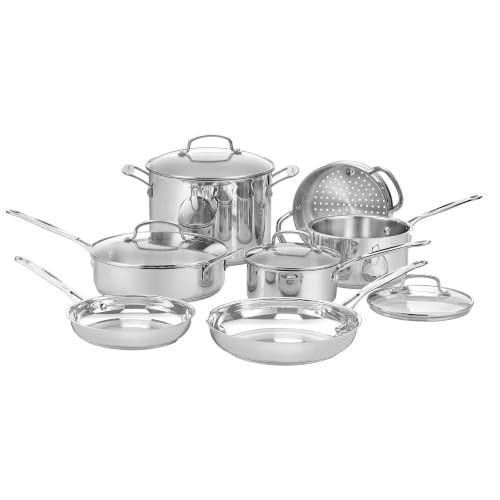
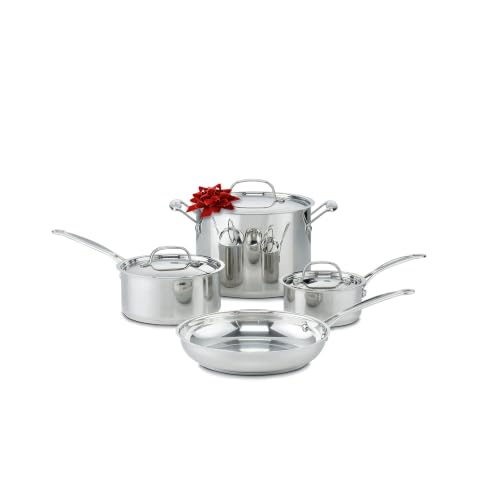
- Cuisinart Chef’s Classic 7-Piece Stainless Steel Set (77-7P1) — Best Overall Value: Seven induction-ready stainless pieces with zero filler — the lowest cost per used vessel in this guide for small-to-mid households, in a material with no replacement date. Check on Amazon
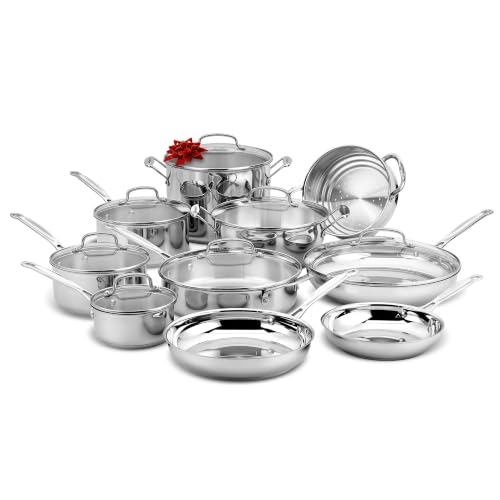
- CAROTE 30-Piece Tri-Ply Stainless Steel Set — Best Value for Large Households: Thirty tri-ply pieces that end vessel shopping in one purchase — cost effective precisely when the household cooks in parallel every day. Check on Amazon
- Fruikit 21-Piece Stainless Steel Set — Best Big-Set Value Alternative: Twenty-one pieces with a 3-ply frying pan at the centre — big-set coverage that spends its construction budget on the vessel you use most. Check on Amazon
- CAROTE 15-Piece Tri-Ply Set with Detachable Handle — Best Value for Small Spaces: Fifteen tri-ply pieces whose detachable handles collapse storage — the set whose hidden saving is the cabinet you do not have to rent or replace. Check on Amazon
- Cuisinart PureClad 12-Piece Triple-Ply Set (PCT-12) — Best Long-Term Buy: Cuisinart’s PureClad triple-ply twelve-piece set — the premium spend whose cost per year falls every year you keep it, aimed at cooks who will use what clad construction adds. Check on Amazon
- EWFEN 11-Piece 3-Ply Stainless Steel Set — Best Balanced Value: Eleven pieces of 3-ply stainless with every compatibility stated in the title — the middle path where construction, count, and commitment are all in proportion. Check on Amazon
How These Picks Were Chosen
The method was to rank by total cost of ownership rather than by shelf appeal. Each candidate set was scored on four value inputs: construction durability (does the build predict a decade of service — clad or well-bonded stainless scores high; thin single-layer steel and coatings score low); vessel usefulness (the set’s composition counted in vessels a household actually uses weekly, with lids excluded from the value count); replacement risk (any feature with a known service life — a coating, a mechanism, a handle joint — was noted as a future cost); and versatility (stated induction, oven, and dishwasher compatibility, which widens the set’s useful life across stoves and kitchens). Verified listing data supplied the construction and compatibility facts; recurring owner-feedback themes supplied the durability signals.
Two common value traps were screened out deliberately. The first is the ultra-cheap thin set: its cost per year is poor because warping and hot spots end its useful life early, however attractive the sticker. The second is the inflated fleet bought for its count: pieces that never cook are pure cost. The six survivors each defend their price differently — the compact Cuisinart by having nothing wasted, the fleets by ending vessel shopping entirely, the clad sets by performance that does not decay — and the reviews make each defence explicitly so you can judge which one matches your household’s arithmetic.
Prices were excluded from scoring because they are unstable, and because a ranking that flips with every sale event is not a ranking. Instead, each pick is positioned in a qualitative tier — the guide’s language for where it sits in its class — and the links let you check the latest price on Amazon when you are ready to divide it by the years and vessels the review describes. The companion construction treatment at Best Deal On Stainless Steel Cookware Sets shows how the same sets score when base build, not value, leads.
The 6 Best Cost Effective Cookware Sets by Cost Per Year

Cuisinart Chef’s Classic 7-Piece Stainless Steel Set (77-7P1)
Badge: Best Overall Value
Strengths
- Every piece is a weekly vessel for its audience: nothing bought and never cooked in
- Induction compatibility and PFAS-free positioning stated in the verified title
- Bare stainless: no coating countdown, fully restorable with cleansers
Trade-offs
- No stockpot depth for batch cooking — big households will outgrow it
- Value case depends on your household size; fleets beat it at family scale
- Stainless technique applies: a week of preheat habit is part of the price
Key specs from the verified listing
- 7-piece set (model 77-7P1)
- Stainless steel construction
- Listing title describes the set as non toxic and PFAS free
- Cool-grip handles
- Oven safe
- Listing title describes it as induction cookware
This is what cost-effective looks like when the household is small to mid-sized: seven pieces, all of them weekly vessels, in bare stainless steel with cool-grip handles. The value maths is unbeatable in its lane — the denominator (used vessels) equals the numerator’s whole count, and the service life is measured in decades because there is no coating to retire the set. The verified title removes the usual screening errands by stating induction compatibility and PFAS-free positioning outright.
Its value case collapses only when the household outgrows it: batch cooks and large families will buy supplementary vessels, and each supplement erodes the compact set’s arithmetic (though the core still earns its place). For one-to-four-person kitchens, though, no pick here delivers more cooking per unit of money over time. Buy it, learn the preheat week, and the set effectively leaves your household budget forever — the definition of cost effective.
Best for: one-to-four-person households wanting maximum service per purchase / Not suited for: large households and batch cooks, whose arithmetic favours the fleets
Check on Amazon to confirm the current configuration, what is in the box, and the latest price on Amazon before you decide.

CAROTE 30-Piece Tri-Ply Stainless Steel Set
Badge: Best Value for Large Households
Strengths
- Tri-ply construction across the fleet protects the long service life the value case needs
- One purchase furnishes every station: no drip of supplementary single-piece buys
- All-stovetop and induction compatible per the title, so the set survives a stove change
Trade-offs
- Value inverts if pieces go unused: the count leans on lids and depth you must genuinely need
- Storage is a real cost — a fleet rents serious cabinet space for its whole life
- Highest single outlay in this guide, however well the per-year maths works
Key specs from the verified listing
- 30-piece set
- Tri-ply stainless steel construction
- Listing title describes the set as non toxic
- Induction compatible and all-stovetop compatible
- Oven and dishwasher safe
Fleet economics are household economics. For a family that runs three burners nightly, the alternative to this set is not a cheaper set — it is a mid-size set plus years of supplementary purchases, each at single-piece prices, each with its own delivery and decision cost. Thirty pieces of tri-ply stainless, all-stovetop compatible and induction ready per the title, collapse that drip into one decision with a decade-long horizon. Divided by years and by genuinely used vessels, the figure is hard to beat at this scale of cooking.
The same maths executes small households without mercy: pieces that never cook are pure cost, and this set’s storage appetite is a standing charge. So the review’s advice is arithmetic, not enthusiasm — count the vessels your last two weeks of cooking would have used, honestly, and if the number approaches this fleet’s vessel count, buy it with confidence. If it approaches half, the EWFEN or the seven-piece Cuisinart is your cost-effective answer and this is an expensive way to store air.
Best for: large households furnishing a kitchen in one purchase / Not suited for: small households, for whom the unused half is pure cost
Check on Amazon to confirm the current configuration, what is in the box, and the latest price on Amazon before you decide.

Fruikit 21-Piece Stainless Steel Set
Badge: Best Big-Set Value Alternative
Strengths
- The 3-ply build is specified for the frying pan, the highest-use vessel in most kitchens
- Twenty-one pieces cover a full repertoire at a smaller footprint than the thirty-piece fleet
- Induction compatible and oven and dishwasher safe per the verified title
Trade-offs
- The title specifies 3-ply for the frying pan only — check the listing for other vessels’ builds
- Twenty-one still leans partly on lids; count vessels before valuing
- Less long-term owner history than the Cuisinart lines when judging durability claims
Key specs from the verified listing
- 21-piece set
- Stainless steel, with a 3-ply stainless steel frying pan
- Induction compatible
- Oven and dishwasher safe
Fruikit’s set makes the value shopper’s favourite move: it concentrates its construction claim where usage concentrates. The verified title specifies a 3-ply stainless steel frying pan — the vessel that sears, sautes, and fries daily — inside a twenty-one-piece stainless fleet that covers the rest of the repertoire. If the skillet is where a set earns its keep, spending the clad budget there rather than uniformly is rational engineering, and the fleet size stops short of the thirty-piece storage commitment.
The diligence item is asymmetry: because the title singles out the frying pan, verify the saucepans’ construction on the live listing if clad performance there matters to your cooking — and count vessels, as with every fleet. For a three-to-five-person household whose cooking is skillet-led, the allocation here is genuinely smart money: full coverage, hero-pan construction, and a footprint your cabinets can survive.
Best for: skillet-led cooks in three-to-five-person households / Not suited for: buyers who want confirmed uniform clad construction in every vessel
Check on Amazon to confirm the current configuration, what is in the box, and the latest price on Amazon before you decide.

CAROTE 15-Piece Tri-Ply Set with Detachable Handle
Badge: Best Value for Small Spaces
Strengths
- Detachable handles let fifteen tri-ply pieces nest, cutting storage cost dramatically
- Tri-ply stainless protects the decade-long service life the value maths assumes
- Induction compatible and dishwasher and oven safe per the verified title
Trade-offs
- The detachable mechanism is the one moving part in the guide — a long-term wear item to treat with care
- Handle-swapping workflow can slow multi-pan cooking, a time cost for busy cooks
- Fifteen pieces still need the vessel-count check against your repertoire
Key specs from the verified listing
- 15-piece set
- Tri-ply stainless steel construction
- Detachable handle system
- Listing title describes the set as non-toxic
- Induction compatible
- Dishwasher and oven safe
Storage rarely appears in value calculations, and in small kitchens it should: the cost of a set includes the cabinet it monopolises and, in the extreme, the kitchen you feel you need to move to. This CAROTE set attacks that line item directly — fifteen pieces of tri-ply stainless with detachable handles that nest into a fraction of fixed-handle volume. The construction keeps the service-life side of the ratio intact: this is a storage innovation on a durable base, not a flimsy compact set that will need replacing.
The honest offset is the mechanism. A detachable handle is the only moving part among these six picks, and moving parts are where long-term value goes to be negotiated — treat the lock well, check it before lifting, and the design should serve; abuse it and you have introduced the replacement risk the other picks avoid. For apartments, RVs, and one-cabinet kitchens, the trade is usually worth it: the space saved is worth money every single month the set serves.
Best for: small kitchens, RVs, and anyone whose storage is the scarce resource / Not suited for: cooks who run several pans simultaneously and dislike mechanisms
Check on Amazon to confirm the current configuration, what is in the box, and the latest price on Amazon before you decide.

Cuisinart PureClad 12-Piece Triple-Ply Set (PCT-12)
Badge: Best Long-Term Buy
Strengths
- Triple-ply clad construction delivers performance that does not decay — no year-three cliff
- Twelve honest pieces: a complete repertoire without lid-count padding
- Premium build quality is the service-life insurance the value ratio rewards
Trade-offs
- Highest commitment in this guide: cost effective only across a long horizon
- The verified title does not state induction compatibility — verify before buying for induction
- Over-specified for boiling-and-frying repertoires, where its premium buys unused capability
Key specs from the verified listing
- 12-piece set (model PCT-12)
- PureClad triple-ply stainless steel construction
Premium and cost effective are compatible when the horizon is long and the usage is real. The PureClad’s triple-ply construction performs in year ten as in year one — there is no coating to tire and no thin base to warp — so its cost per year declines relentlessly across a decade of daily cooking. Twelve pieces is the honest count of a serious repertoire. For the sauce-led, grain-cooking, sear-serious household, this is the set whose apparently high price becomes the lowest figure in this guide when the division is done properly.
The conditions matter, and the review states them plainly: if your repertoire is boiling, steaming, and frying, the clad premium buys capability you will never invoice, and the bonded or compact picks deliver the same service for less commitment. And induction households must verify compatibility on the listing, since the title provided does not state it. Value is a fit between a set and a life; for the right life, this flagship is the bargain.
Best for: serious cooks buying once for a decade or more / Not suited for: simple repertoires and induction households until compatibility is verified
Check on Amazon to confirm the current configuration, what is in the box, and the latest price on Amazon before you decide.

EWFEN 11-Piece 3-Ply Stainless Steel Set
Badge: Best Balanced Value
Strengths
- 3-ply stainless construction at a mid-size count: the value sweet spot for many households
- Induction, oven, and dishwasher compatibility all stated outright in the title
- Lids included and piece count honest — eleven covers daily parallel cooking for its size
Trade-offs
- Brand track record is thinner than Cuisinart’s for long-horizon durability judgements
- No standout feature: its case is proportion, which some buyers undervalue
- Serious batch cooks will still outgrow eleven pieces
Key specs from the verified listing
- 11-piece set with lids
- 3-ply stainless steel construction
- Listing title describes the set as non-toxic
- Induction compatible
- Oven and dishwasher safe
EWFEN’s set is the guide’s exercise in proportion: 3-ply stainless construction, eleven pieces, and a title that states induction, oven, and dishwasher compatibility without making you dig. Nothing is over-bought — no fleet sprawl, no flagship premium — and nothing essential is under-bought either, which is exactly the shape cost-effective purchases usually have. For a two-to-four-person household cooking most nights, the used-vessel count will be high and the service life long, and those two denominators are the whole game.
The caveats are about confidence rather than configuration: the brand’s long-term owner record is thinner than the Cuisinart lines’, so the listing check carries more weight here — confirm the piece list and construction details on the live page. If they match the title, this is the quiet pick that value shoppers tend to find last and keep longest: no drama, no waste, and arithmetic that works from the first year.
Best for: two-to-four-person households wanting balanced construction and count / Not suited for: buyers who weight brand track record above configuration
Check on Amazon to confirm the current configuration, what is in the box, and the latest price on Amazon before you decide.
Comparison Table
The value-relevant facts only: construction (which predicts lifespan), set size (which you should recount in vessels), and the specific way each pick earns its money back. Prices are intentionally absent — they belong on the live listing, checked at decision time.
| Pick | Construction (from verified title) | Set size | Standout trait | Link |
|---|---|---|---|---|
| Cuisinart Chef’s Classic 7-Piece Stainless Steel Set (77-7P1) | Stainless steel | 7-piece | Lowest cost per used vessel for its audience | Check on Amazon |
| CAROTE 30-Piece Tri-Ply Stainless Steel Set | Tri-ply stainless steel | 30-piece | Fleet economics: one purchase, decade horizon | Check on Amazon |
| Fruikit 21-Piece Stainless Steel Set | Stainless steel (3-ply frying pan) | 21-piece | Construction budget spent on the hero pan | Check on Amazon |
| CAROTE 15-Piece Tri-Ply Set with Detachable Handle | Tri-ply stainless steel, detachable handle | 15-piece | Storage savings as a real value line item | Check on Amazon |
| Cuisinart PureClad 12-Piece Triple-Ply Set (PCT-12) | Triple-ply stainless steel | 12-piece | Premium spend, lowest long-horizon cost per year | Check on Amazon |
| EWFEN 11-Piece 3-Ply Stainless Steel Set | 3-ply stainless steel | 11-piece | Proportion: nothing over-bought, nothing missing | Check on Amazon |
How to Choose a Cookware Set That Is Genuinely Cost Effective
Run the only two divisions that matter
Cost per year: take the live price, and divide by a realistic service life. For a well-built stainless set, a decade is a conservative planning figure — many serve far longer — while a coated set’s honest figure is the coating’s life, which is much shorter and ends in a replacement purchase. Cost per used vessel: list the vessels you cook in weekly, count how many the set provides, and divide the price by that number — not by the headline piece count, which includes lids. A set whose cost per used vessel is low and whose cost per year is low is genuinely cost effective; a set that wins only one division is a compromise you should choose knowingly. Run both divisions on the live listings linked throughout this guide — the numbers take two minutes and they do not care about badges, including ours.
Worked qualitatively, the divisions explain this guide’s ranking shape. The compact Chef’s Classic wins on cost per used vessel for small households because every piece cooks weekly. The fleets win on cost per year for big households because one purchase ends a decade of vessel shopping. The clad sets win on cost per year for serious cooks because their performance does not decay — there is no year three cliff where the surface tires. Your household’s pattern decides which division dominates, which is why the reviews state each pick’s value logic instead of pretending one winner fits all budgets and kitchens. The utensil half of the budget follows the same logic — buy once, in honest materials — and the timing of both halves is covered at Best Deals Cookware Sets.
Construction details that predict a long, cheap life
Three build features predict service life better than any brand claim. First, base integrity: tri-ply clad construction or a well-bonded base resists the warping that ends cheap pans’ careers, especially on glass and induction hobs where flatness is function. Second, handle attachment and design: handles are the most-stressed joint in the set, and sturdy, simply designed grips — the cool-grip and stay-cool families in these listings — age better than ornate ones. Third, surface simplicity: bare stainless can be scoured, deglazed, and restored indefinitely, while every coating is a countdown. When two sets compete on price, the one with the better showing on these three features is almost always the cheaper set by year five, whatever the stickers said.
The hidden costs that turn deals into subscriptions
Replacement is the obvious hidden cost, but not the only one. Energy waste is real: a warped pan on an electric hob heats the room as much as the food. Time is real: fighting hot spots and sticking costs minutes at every meal, and minutes are the currency home cooking is actually short of. Storage is real: unused fleet pieces rent your cabinets for a decade. And the mismatch cost is the largest of all — a set bought for the wrong stove or the wrong household size gets replaced wholesale, which doubles its effective price at a stroke. The screening questions in this guide — stove first, vessels second, construction third — are ordered to kill the mismatch cost before the subtler ones matter. If a seasonal sale is driving your timing, Best Cyber Monday Deals On Cookware Sets covers how to evaluate event pricing without abandoning this arithmetic.
How to Make a Good Set Last Like a Great One
Habits that add years to any stainless set
Longevity is partly bought and partly behaved. The behaviours are simple: preheat gradually rather than blasting a cold pan on maximum (thermal shock is the warping mechanism), add salt only to boiling water (undissolved salt pits stainless), deglaze warm pans so residue never carbonises into armour, and hand wash the daily pieces even when the title permits the dishwasher — the sets here largely do, but detergent and rack-rattling age finishes and handles faster than a sponge does. Follow those four habits and the service-life figures used in this guide’s cost-per-year maths become conservative.
- Bring pans up to heat over medium settings; reserve maximum heat for boiling water.
- Add salt after the water boils, never to cold water in a stainless vessel.
- Deglaze while the pan is warm so fond lifts with water instead of hardening.
- Wash daily pieces by hand; reserve the dishwasher for busy-day exceptions.
- Restore tired-looking pieces with a baking-soda paste or stainless cleanser instead of replacing them.
When a piece does tire: repair, demote, or replace
Stainless sets rarely die all at once; individual pieces tire. A warped skillet can be demoted to oven duty, where flatness matters less, while its replacement joins the set — one advantage of standard stainless is that single pieces are easy to add without aesthetic penalty. A stained saucepan is a cleaning problem, not a purchasing one: a boil with baking-soda water, then a cleanser pass, restores most. Handles that loosen on screwed designs can often be tightened. The replace decision should be reserved for genuine structural failure — a separated base or a cracked vessel — which in this material class is rare enough that its rarity is the value argument.
Troubleshooting: three value-killing problems
Problem: the base rocks on a glass hob → the pan has warped, usually from thermal shock. Prevention beats cure (gradual preheating), but a mildly warped pan can finish its career on gas or in the oven while you replace it for the glass hob.
Problem: everything sticks, so you cook less and order in more → a technique cost masquerading as an equipment cost. The preheat-and-oil routine in this guide’s other stainless coverage fixes it within a week; the most expensive pan is the one that makes you avoid cooking.
Problem: the set looks tired and you are browsing replacements → try restoration first. Heat tint, mineral film, and light staining all yield to cleansers and vinegar; stainless’s restorability is precisely why its cost per year beats materials that must be replaced when they look worn. The coating question behind that advantage is one reason the brand screen at Best Cuisinart Induction Cookware Sets leads with bare stainless lines.
Cheap, Cost Effective, and Premium: Three Different Words
Cheap describes a sticker. Cost effective describes a ratio — service delivered per unit of money over time. Premium describes a tier of construction and finish, which may or may not be cost effective depending on whether the buyer uses what the tier adds. Confusing the three is the category’s most expensive reading error. A cheap set replaced twice costs more than a mid-tier set bought once; a premium clad set is cost effective for a sauce cook who uses its sidewalls daily and a poor buy for a household that boils pasta and fries eggs, where its advantages never come into play. This guide’s badges are deliberately written in ratio language — best value core set, best long-term buy — because the ratio is the honest unit.
The practical consequence is that your neighbour’s cost-effective set may not be yours. Households differ in the two variables that dominate the ratio: how many vessels they use weekly, and how many years they keep a set. A household that moves frequently and cooks simply should weight the compact, lower-commitment picks; a settled household cooking daily should weight construction and let the years do the dividing. Neither is being careless with money — they are running the same arithmetic on different lives, which is what this guide’s per-pick value logic is designed to support.
Where the Money Goes in a Stainless Set — and What to Pay For
A stainless set’s price buys four things in varying proportions: metal (gauge and cladding), finishing (polishing, handle work, lid fit), composition (how many genuinely useful vessels), and brand assurance (quality control and support). The value shopper’s skill is funding the first three and discounting the fourth — not to zero, because quality control is real, but below the level where a logo substitutes for construction. In this guide’s field, the tri-ply sets spend on metal, the Cuisinart lines spend on finishing and assurance, and the fleets spend on composition. Each is a legitimate allocation; the reviews name which one each pick chose.
What not to pay for: piece-count theatre (lids priced as cookware), novelty mechanisms you did not ask for, and coatings in a category whose whole value thesis is their absence. What to pay for without regret: base integrity, because warping is the commonest stainless death; handle quality, because it is the daily interface; and the one vessel size your cooking has been missing, because a set that completes your repertoire ends the drip of single-piece purchases that quietly outspends any box. Judge each listing with that ledger open, and the cost-effective choice usually identifies itself.
Two Households, Two Right Answers: The Arithmetic in Practice
Consider the first household: two adults, one small kitchen, cooking five nights a week — pasta, stir-fries, eggs, a soup on Sundays. Their used-vessel list is short and stable: a saucepan, a skillet, a stockpot for the soup, a second small pan twice a week. For them, the seven-piece Chef’s Classic produces the best arithmetic in this guide, because nearly every vessel they own cooks weekly and the set’s service life runs in decades. A fleet would halve their cost-per-used-vessel performance by adding pieces that cook monthly; a premium clad set would add capability their repertoire never invoices. Their cost-effective answer is small, and it is not a compromise — it is the ratio, correctly computed for their life.
Consider the second household: five people, two enthusiastic cooks, a kitchen that runs three burners most nights and four on weekends. Their used-vessel list is long, and it changes shape nightly. For them, the same seven-piece set would be the expensive choice: its gaps would be filled by single-piece purchases at single-piece prices, by borrowed pans, and by the friction of cooks waiting on vessels. The CAROTE thirty-piece fleet or the seventeen-piece Chef’s Classic — absurd over-buying for the first household — produces the better division here, because the denominator (vessels used weekly) is large and the horizon is the same stainless decade. Same guide, same arithmetic, opposite answers: that is what a ratio-based method is for.
The lesson generalises beyond these two sketches. Cost effectiveness is not a property of a set; it is a property of a set inside a household. Before you buy, spend ten minutes reconstructing your last two weeks of cooking — which vessels, how often, in parallel with what — and let that census, not a badge or a banner, choose the size. Then choose construction by the years you honestly expect to keep the set, and only then look at prices, live ones, through the links in this guide. Households that run the census buy once. Households that skip it buy twice, and the second purchase is the one that was never cost effective at all.
Common Buying Mistakes
Value shopping fails in characteristic ways — mostly by optimising the visible number (the sticker, the piece count) instead of the ratio that actually governs cost.
- Dividing by pieces instead of used vessels. Lids do not cook dinner. Your cost-per-vessel figure should count only the pans you will actually put on burners weekly.
- Ignoring the replacement cycle. A set with a coating or a thin base has a second purchase hiding inside the first. Stainless’s whole value case is that the second purchase does not exist.
- Buying a fleet for a two-person kitchen. Unused vessels are pure cost plus storage rent. Match the count to the household, not to the occasion you host twice a year.
- Buying premium construction your cooking never uses. Clad sidewalls earn their money in sauces and grains. If your repertoire is boiling and frying, a bonded-base set is the cost-effective equivalent.
- Trusting a printed price — including an old sale price. Prices move. Run the divisions on the live listing at decision time; that is what the links in this guide are for.
- Forgetting the stove in the value maths. A set that is not confirmed for your induction hob, or that warps on your glass top, has an infinite cost per year: it does not work at all.
Every one of these mistakes is a failure of division, not of shopping effort. Two minutes with the right denominators outperforms hours of browsing.
One last denominator deserves a mention, because households forget it until the delivery arrives: your own time. A set that fights you — sticking, scorching, warping, shedding its surface — taxes every meal it touches, and a set that simply works returns those minutes daily. Cost effectiveness that ignores the cook’s time is only counting the money, and money was never the scarcest thing in the kitchen.
Final Recommendation
For most households, the first choice is the Cuisinart Chef’s Classic 7-Piece Set (77-7P1): the lowest-commitment way to own the material that never needs replacing. Every vessel cooks weekly in a small-to-mid household, the title states induction compatibility and PFAS-free positioning, and the cool-grip handles remove the daily annoyance that makes people abandon sets. Its cost per used vessel and cost per year are both at the front of this field for its audience.
Choose the EWFEN 11-Piece if you want clad-style construction in the mid-size at the balanced end of the range, the PureClad if your cooking will genuinely use premium clad performance for a decade, and the CAROTE or Fruikit fleets if one purchase must furnish a whole kitchen. The arithmetic is the guide; the badges are just where it points first.
Start with the Cuisinart Chef’s Classic 7-Piece Stainless Steel Set (77-7P1) if you want the first choice above, or the EWFEN 11-Piece 3-Ply Stainless Steel Set if the alternative profile fits your kitchen better — and check the latest price on Amazon for either before you commit.
Frequently Asked Questions
What makes a cookware set cost effective rather than just cheap?
The ratio of service to money over time: a realistic service life in years, and the number of vessels you actually use weekly. A durable stainless set used daily for a decade beats a bargain set replaced twice on both divisions, even if its sticker was higher. This guide ranks by that ratio and explains each pick’s value logic in its review.
Why are all the picks stainless steel?
Because service life dominates cost effectiveness, and stainless has no coating to wear out, tolerates any heat and utensil, and can be restored with cleansers instead of replaced. Coated sets can be cheap to buy; they are rarely cheap to own for long.
How do I calculate cost per used vessel?
List the vessels you cook in weekly, count how many of them a set provides, and divide the live price by that count — ignoring lids and any pieces you know you will not use. Then divide the price by a realistic service life for cost per year. A set that wins both divisions for your household is your cost-effective pick.
Is a bigger set ever the cost-effective choice?
Yes — when the household genuinely uses the depth: large families cooking in parallel, or anyone furnishing an empty kitchen in one purchase. The CAROTE 30-Piece and Fruikit 21-Piece picks exist for exactly that case. Bigness is waste only when the vessels do not cook.
Why does this guide not print prices?
Because listing prices change with sales and configurations, and a printed figure would mislead you at the moment you relied on it. Each review positions its pick’s value tier qualitatively, and every pick links to its live listing so you can check the latest price on Amazon and run the cost-per-year maths on the real number.
When should I replace a stainless set?
Rarely, and usually piece by piece rather than wholesale: a structurally failed vessel (separated base, cracked body) is a replacement; staining, heat tint, and mineral film are cleaning jobs. That restorability is the core of stainless’s cost-effectiveness — most ‘tired’ stainless sets are one cleanser session away from looking new.