A digital kitchen scale weighs ingredients in grams and ounces, which makes baking and portioning easier to repeat. The tare button zeroes out the bowl, so you can add ingredients one after another in the same container.
The six scales below range from 11 to 22 pound capacity and include a dual-platform model. Capacity, increments and power come from each product’s listing page. We have not used these scales ourselves. Accuracy figures are the makers’ own.
As an Amazon Associate we earn from qualifying purchases. Links below are affiliate links, and they do not change the product information we give.
What to Look For
| Feature | Why it matters |
|---|---|
| Capacity | 11 lb suits most recipes; larger bowls may need more |
| Increments | 1 g steps suit baking; finer steps help with small amounts |
| Units | Grams, ounces, pounds and milliliters on the same scale |
| Power | AAA batteries or a USB rechargeable cell |
In this guide
Specs at a Glance
| Scale | Capacity | Increment | Notes |
|---|---|---|---|
| Etekcity 11lb | 11 lb (5 kg) | 1 g | 304 stainless steel; backlit LCD; 5 units; 2 AAA included |
| Amazon Basics | 11 lb | 1 g | Stainless platform; wide LCD; tare; 2 AAA included |
| Etekcity 22lb | 22 lb (10 kg) | 1 g in the bullets | IPX6 waterproof design; USB-C rechargeable; hold function |
| OXO Good Grips | 11 lb | 1/8 oz and 1 g | Pull-out display; zero function; capacity meter |
| KitchenAid KQ909 | 11 lb plus 16 oz platform | 1 g and 0.01 g | Two platforms; two-line backlit LCD; 3 AAA included |
| Escali Telero | 13.2 lb listed | Listed as high precision | Large platform; display hold; sealed control panel |
The 6 Best Digital Kitchen Scales

Top pickBest for everyday baking and prep
1. Etekcity Food Kitchen Scale, 11lb
A slim 304 stainless steel scale with a backlit LCD, 1 gram increments up to 11 pounds (5 kg), five units (oz, lb:oz, fl oz, g and mL), a tare function and 2 AAA batteries included.
Suits: everyday baking and prep. Strengths: a compact steel body. Weaknesses: 11 lb cap. Skip it if you weigh heavy bowls.

View Etekcity Food Kitchen Scale, Digital Grams and Ounces, 11lb on Amazon

Best for a straightforward scale
2. Amazon Basics Digital Kitchen Scale
A flat scale with a stainless steel platform and wide LCD, weighing up to 11 pounds in pounds, ounces, grams, fluid ounces and milliliters, with a tare button and 2 AAA batteries included.
Suits: a straightforward scale. Strengths: a wide display and five units. Weaknesses: a plain feature set. Skip it if you want waterproofing or rechargeable power.

Best for large bowls and wet prep
3. Etekcity 22lb Food Kitchen Scale
A higher-capacity scale (22 lb or 10 kg) with an IPX6 waterproof design, a USB-C rechargeable battery, a backlit display, auto shut-off, tare and hold functions and five units. The specification field lists 2.86 g while the bullets describe 1 g increments.
Suits: large bowls and wet prep. Strengths: 22 lb capacity and rechargeable power. Weaknesses: conflicting increment figures. Skip it if you want battery swaps.
View Etekcity 22lb Food Kitchen Scale, USB Rechargeable, IPX6 Waterproof on Amazon
Best for big bowls and plates
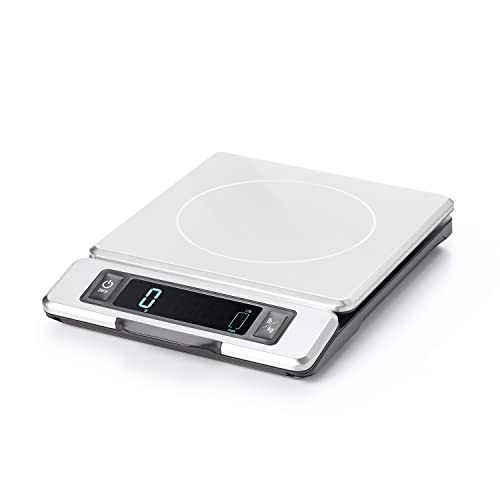
4. OXO Good Grips 11-Pound Digital Kitchen Food Scale
An 11 pound scale reading in 1/8 ounce and 1 gram steps, with a display that pulls away from the base so a large plate or bowl does not shade it, a zero function, an optional backlight and a meter showing remaining capacity.
Suits: big bowls and plates. Strengths: a pull-out display. Weaknesses: 11 lb cap. Skip it if you want a flat, simple unit.

View OXO Good Grips 11-Pound Digital Kitchen Food Scale on Amazon

Best for small spice or yeast amounts as well as bulk
5. KitchenAid KQ909 Dual Platform Scale
Two platforms in one scale: an 11 pound platform with 1 gram steps and a 16 ounce precision platform with 0.01 gram steps, a two-line backlit LCD showing both, a tare feature and three AAA batteries included.
Suits: small spice or yeast amounts as well as bulk. Strengths: a second fine platform. Weaknesses: two surfaces to manage. Skip it if you only weigh larger amounts.


Best for large glass mixing bowls
6. Escali Telero Digital Food Scale
A glass-surface scale with a 13.2 pound (6,000 gram) capacity, a large LCD, a large platform, instant-on, display hold, auto shut-off and units of g, lb, oz, lb:oz and ml. The control panel is sealed. The title says 11 lb while the specifications say 13.2 lb.
Suits: large glass mixing bowls. Strengths: a big platform and display hold. Weaknesses: conflicting capacity figures. Skip it if you want a steel surface.

Care and Setup
- Place the scale on a flat, hard surface.
- Turn it on, wait for zero, then add the bowl and tare.
- Wipe the platform with a damp cloth.
- Replace weak batteries or recharge before baking.
Mistakes to Avoid
- Weighing past the maximum capacity.
- Forgetting to tare after adding the container.
- Using the scale on a soft or uneven surface.
- Submerging a scale that is not listed as waterproof.
Capacity and Increment: Choosing the Right Range
Two numbers define what a scale can do: the maximum weight it can handle and the smallest step it displays. The maximum determines whether your bowl, container and ingredients will exceed the limit. Remember that the container counts toward the total, even if you tare it. A heavy ceramic mixing bowl can use up a good share of the capacity before you add a single ingredient.
The increment, sometimes called resolution, shows how fine the display is. A scale that moves in 1 gram steps is fine for flour, sugar, butter and portions of meat or vegetables. For small amounts such as yeast, salt, spices or coffee, finer steps are helpful, because a single gram is a big error on a few grams of yeast. Some scales offer finer resolution on a separate small platform or a limited range, as in the dual-platform model in this guide.
Increment and accuracy are not the same thing. A scale can display tiny steps without being accurate to that level. Makers often state accuracy separately or not at all, and those figures are theirs, so treat them as claims. If precision matters, look for a scale that lists both, and test it with an object of known weight.
For most home cooks, a capacity around 11 pounds with 1 gram steps covers daily use. Choose a larger capacity if you weigh big batches of dough, bulk meat or heavy containers.
Platform Size, Display and Day-to-Day Usability
How a scale feels in use depends on layout. A small platform works for a bowl, but a wide dish or large cutting board can overhang and make weighing awkward. If you use large bowls, look for a bigger platform or a display that does not get hidden. Some scales have a display that pulls away from the base, which avoids being covered by a large plate.
Display clarity matters in practice. A backlit screen is easy to read in dim light, and large digits help if you do not wear glasses in the kitchen. Check the viewing angle, because a display set low and flat can be hard to see from a stand.
Think about the surface. Glass, stainless steel and plastic platforms each wipe clean differently. Smooth surfaces are easy to clean but can show fingerprints. Raised edges stop spills from running onto the controls.
Controls should be easy to use with messy hands. Buttons that respond reliably and are not buried under a seam or lip are a plus. Check how long it takes the scale to turn on, how it handles auto shut-off and whether a hold function is available for items that must be removed to read the display.
Finally, consider storage: a flat scale slides into a drawer or stands upright, which matters in a small kitchen.
Units, Conversions and Recipe Habits
Most scales offer grams, ounces and pounds, and some add fluid ounces and milliliters. These liquid units are usually conversions based on water, so they are not exact for thicker liquids such as honey or oil. If a recipe demands precise liquid volume, a measuring jug may still be better.
Many bakers prefer grams because the numbers are bigger and finer, which reduces rounding errors. If your recipes use ounces, switch to the unit your recipes use to avoid arithmetic mistakes. Check that the scale remembers the unit you choose, or whether it resets each time it is switched on.
Habits that help:
- Place the empty container, then tare, and add ingredient one.
- Tare again between ingredients so each reading shows only what you just added.
- Pour slowly toward the target, because it is easier to add than to remove.
- Write down your own favorite weights for items you use often, such as a cup of flour in your method.
Weighing in the bowl also reduces washing up. If you convert recipes from cups, remember that different sources use different gram values for a cup of the same ingredient. Choose recipes written in weight for the most consistent results.
Power, Accuracy Checks and Simple Calibration Tests
Scales run on replaceable batteries or on a rechargeable cell. Replaceable batteries are easy to swap, but weak ones can cause erratic readings or a dim display. Rechargeable scales avoid that, yet they need a charging cable and a plan for when the charge runs out. Either way, replace or recharge at the first sign of flickering.
You can check accuracy at home. Weigh an object of known weight, such as a sealed item with the weight printed on the package, and see whether the reading matches. Repeat with the object in different spots on the platform to check for corner errors. Weigh the same item several times to see if the reading stays steady. Check whether the scale returns to zero when empty.
Several things throw off readings. Soft surfaces such as a folded towel can cause drift, so place the scale on a hard, level counter. Drafts, vibration from a mixer and sticky or damp platform edges all matter. A scale kept near a hot stove or in a cold garage may behave differently.
Some scales have a calibration function, but it requires a reference weight and the maker’s instructions. If your scale gives inconsistent results even on a good surface, it may need new batteries or replacement.
Cleaning, Storage and When to Replace a Scale
Wipe the platform with a damp cloth and mild soap, drying it afterward. Unless the listing states waterproofing, keep water away from the controls and seams, and never submerge the scale. Flour, sugar and sticky ingredients can work their way beneath the platform, so wipe up spills quickly.
Store the scale flat and do not stack heavy items on top, because pressure can strain the sensors. Remove batteries if you will not use it for a long period, to avoid leaks. Keep it away from steam and direct heat.
Signs that a scale needs replacing include:
- Readings that drift or jump without a change in weight.
- A display that fails to zero or shows errors when empty.
- Buttons that stick or do not respond.
- Different readings for the same item in different spots on the platform.
- Corrosion or moisture inside the battery compartment.
Before replacing, try fresh batteries and a clean, hard surface. If it still misbehaves, it is time for a new one. When choosing a replacement, consider what annoyed you about the old one: platform size, display visibility, small-amount precision or battery life. A scale you enjoy using will get used more, and that matters more for results than a long feature list.
Capacity and Readability: Reading the Numbers on a Scale
Two figures describe what a kitchen scale can do: its maximum capacity and its smallest increment. Capacity tells you the heaviest load it can read, which matters if you weigh a large mixing bowl full of dough or a whole roast. The increment, also called resolution, tells you the smallest change the display can show, such as one gram or a tenth of a gram. A scale with a fine increment suits coffee, spices and baking additions, while a scale with a higher capacity suits bulk ingredients and meal prep.
| Use | Look for | Why |
|---|---|---|
| Coffee and spices | Fine increment | Small changes show on the display |
| Everyday baking | Moderate capacity and clear display | Handles bowls and flour easily |
| Meal prep and bulk cooking | Higher capacity | Heavy containers do not overload the scale |
| Shared family use | Large platform and easy buttons | Simple for everyone |
Remember that the weight of the bowl counts toward the capacity, so a scale with a modest limit can run out of room quickly when you place a heavy container on it. Check also how readable the display is when a large bowl sits on the platform, because a bowl wider than the platform can hide the numbers.
Units, Tare and Other Everyday Functions
Most digital scales switch between grams, ounces, pounds and sometimes milliliters. Unit switching is useful when you follow recipes from different countries. The tare button zeroes the display after a container is on the platform, so you can weigh only the ingredient. Good scales let you tare repeatedly, which is handy for adding several ingredients to the same bowl one after another.
- Auto shutoff saves battery but should not turn off in the middle of a measurement.
- A hold function can keep a reading on screen when you lift a large item.
- Backlit displays help in dim kitchens.
- Removable platforms are easier to clean.
Check how the scale is powered. Some use replaceable batteries, others a rechargeable cell. Look at whether the batteries are easy to reach and whether a low battery indicator is provided.
Keeping Readings Accurate
Place the scale on a hard, flat, steady surface, since a soft mat or uneven counter can cause drift. Keep it away from drafts and from heavy vibration, such as a running mixer. Press tare before adding food, and apply the load gently. Check accuracy occasionally with an object of known weight, and follow the maker’s calibration steps if the model offers them.
Cleaning and Storage
Wipe the platform with a damp cloth and mild cleaner, never immersing the body in water unless the maker says it is waterproof. Store the scale flat and do not stack heavy items on it, since pressure can affect the sensors.
More on Mistakes to Avoid
Overloading the scale, weighing on a sloped surface and forgetting to zero the display are the main causes of inaccurate numbers. Watch for a low battery too, because weak power can cause odd readings.
How to Read a Scale Listing
Scale listings often highlight a long set of features, but only some are worth your attention. Check the platform size and material. Stainless steel surfaces wipe clean easily, and glass is smooth but can show fingerprints. A larger platform handles big bowls and plates, while a small one saves counter space. Note the thickness, because a slim scale slides into a drawer, though a thicker body often holds batteries and sensors that feel sturdier.
Look at whether the display is on the top or the front. Front displays are visible even when a large bowl rests on the platform. Check the button feel, since touch buttons can be tricky with wet or floury fingers, while physical buttons can be easier. Read what the maker says about overload protection and error messages. Finally, find out whether a bowl, a cover or a case is included, and whether the warranty terms are shown.
If you plan to use the scale for portion control, confirm that it can display the units you rely on. If you weigh for baking, look for a scale that responds quickly when you add flour or sugar, because slow updates can cause overshoot. Reading the manual before buying, if available online, shows how easy it is to switch units or calibrate.
Digital Kitchen Scale FAQ
Why weigh instead of measuring by volume?
Weight is more repeatable, since a cup of flour can vary with how it is scooped.
What does tare do?
It sets the display to zero with a container on the platform, so only the added ingredient is counted.
Does the container count toward the capacity limit?
Yes. Tare removes the container from the display, but the scale still carries its weight. A heavy bowl can use up much of the capacity.
How can I check if my scale is accurate?
Weigh an object of known weight, such as a sealed package with the weight printed on it. Try different spots on the platform and see if the reading is consistent.
Why does my scale reading keep changing?
Low batteries, a soft or uneven surface, drafts or vibration are common causes. Try fresh batteries and a hard, flat counter.
Is milliliter mode accurate for all liquids?
It is usually a conversion based on water. Thicker liquids such as honey or oil weigh differently, so the reading is only approximate for them.
Why do bakers prefer grams?
Grams are finer than ounces, so small amounts are easier to measure precisely. Recipes written in weight also give more consistent results than volume.
Can I wash my scale under the tap?
Only if the listing says it is waterproof. Otherwise, wipe it with a damp cloth and keep water away from the buttons and seams.
How long should I wait after turning on before weighing?
Let it settle to zero first, as most manuals advise. Then place your container and tare before adding ingredients.
Choosing digital kitchen scales With Your Real Routine in Mind
Most buying guides list features, but the digital kitchen scale that suits you best is the one that matches how your home actually runs week to week. Start by picturing the busiest moment this purchase has to handle, not the calmest one. If that busy moment involves guests, children, pets, a tight schedule or a small workspace, let it set your priorities, because a digital kitchen scale that copes well on an ordinary Tuesday but fails on a hectic Saturday will annoy you far more often than the reverse. Write down the two or three jobs you expect it to do most often, and rank the features in this guide against those jobs rather than against a generic ideal.
Next, think about who else will use it. A digital kitchen scale chosen for one careful adult may be handled very differently by a partner, a teenager, a grandparent or a houseguest who has never seen it before. Controls, weight, grip, storage and cleaning all feel different in unfamiliar hands. If several people will share it, favour the option that is easiest to understand at a glance and hardest to misuse by accident. That single decision prevents a surprising share of returns, because shared household items fail socially long before they fail mechanically: people avoid what confuses them, and the purchase ends up unused in a corner.
Space deserves the same honest treatment. Measure where the digital kitchen scale will live, where it will be used, and the route between the two, including doorways, cupboard openings and the swing or clearance it needs while working. Photograph the spot on your phone and keep the measurements with the photo, so you can check them against a listing in seconds. Allow a little breathing room around the stated size rather than planning a fit with no margin at all, because packaging dimensions, assembled dimensions and usable dimensions are three different things, and listings do not always make clear which one a headline figure describes.
Finally, decide in advance what would make you send it back. Naming your deal-breakers before you order — a size that cannot fit, a care routine you will not follow, a material you dislike the feel of, a control layout you find fiddly — turns a vague hope into a testable checklist. When the digital kitchen scale arrives, work through that checklist in the first day or two, while returning it is still simple. Shoppers who test deliberately in week one are far happier in month six than shoppers who drift into ownership and only notice the mismatch once the return window has closed.
Setting Up and First-Use Checks
Unbox the digital kitchen scale somewhere you can spread the parts out, and keep the packaging until you are sure it is staying. Photograph how it was packed; if you ever need to return or store it, those photos are worth more than the instruction leaflet. Check every part against the contents list before you throw anything away, because small fittings, covers and accessories are easily lost inside folded cardboard and protective wrapping, and discovering a missing piece halfway through setup turns a simple job into a frustrating one.
Read the maker’s instructions once through before you begin, even if the digital kitchen scale looks self-explanatory. The order of steps sometimes matters: a part that seems obviously first may need to go on last, and a warning about orientation, tightening or first-use preparation is easy to miss once you are halfway in. Keep the instructions somewhere findable afterwards — a drawer, a folder or a photo on your phone — because the care guidance you need in eight months is usually in the same booklet you were tempted to bin on day one.
Do a gentle first test before relying on the digital kitchen scale for anything important. Run it through its easiest, most forgiving job and watch how it behaves: how it feels in the hand or in place, whether anything shifts, rattles, sticks or resists, and whether the result matches what the listing led you to expect. Small oddities at this stage are information, not necessarily faults, but they tell you what to watch. If something is plainly wrong — damage, a missing function, a part that does not fit — stop and contact the seller while the problem is fresh and documented.
Take a baseline photo once everything is set up and working. It sounds unnecessary, but a clear picture of the digital kitchen scale new, correctly assembled and correctly positioned becomes your reference for every later question: how it originally sat, how a part was oriented, how much wear is normal after a year. Households that keep that one photo solve most later puzzles in minutes instead of guessing, and it also helps if you ever need to explain a warranty question to a seller.
Care Habits That Keep digital kitchen scales Working Well
Little and often beats rare and heroic with almost every household purchase, and digital kitchen scales are no exception. A quick wipe, shake, rinse or check at the moment something spills, splashes or builds up takes seconds, while the same job left for a month can become a project. Build the tiny version of the care task into the moment of use itself — deal with the mark while you are already there, return the digital kitchen scale to its place while your hands are on it — and the deep-clean version becomes something you need far less often.
Use the gentlest cleaning method that works, and escalate only if it does not. Harsh scrubbing, strong chemicals and very hot water can damage finishes, seals, coatings and fabrics that mild methods would have preserved, and the damage is often invisible until it has accumulated. Test any new cleaning product on a hidden patch first, follow the maker’s care label where one exists, and let things dry fully before storing them, because trapped moisture causes more quiet harm — smells, mildew, corrosion, warped parts — than almost any other single factor in home care.
Storage matters as much as cleaning. Keep the digital kitchen scale where it will stay dry, out of harsh direct sunlight if its materials are prone to fading or perishing, and not crushed under heavier items. If it has parts that can be lost — caps, attachments, fittings, covers — store them together in one labelled place rather than scattering them across drawers. A surprising number of perfectly good household items are retired not because they broke, but because one small essential piece went missing and the owner replaced the whole thing instead of the part.
Once or twice a year, give the digital kitchen scale a proper inspection rather than waiting for a failure. Look for the early signs appropriate to its kind: looseness, fraying, cracks, stiffness, dullness, discolouration, worn edges or parts that no longer sit as they did. Catching wear at this stage usually means a cheap fix, a tightening, a wash or a replacement part; missing it can mean a ruined meal, a damaged surface or a safety problem later. Put the inspection on the back of an existing habit — a seasonal clear-out, a holiday clean — so it actually happens.
Mistakes That Lead to Returns and Regrets
The commonest mistake with digital kitchen scales is buying for an imagined life rather than the real one: the keen baker, tidy household or enthusiastic hobbyist we plan to become, rather than the person who actually walks through the door tired on a weekday. There is nothing wrong with aspirational purchases, but they should be the exception. For an item you will use weekly, buy for your current habits and let it earn an upgrade later if your routine genuinely changes.
A second mistake is treating the headline claim as the whole story. Makers describe their digital kitchen scale in its best light, and a single impressive figure — capacity, coverage, speed, strength — can hide ordinary performance everywhere else. Read the full listing, including the parts written in smaller type, and weigh the whole picture: materials, care demands, what is included and what is sold separately, and any limitation the maker states plainly. The honest details are usually there; they are just rarely in the headline.
Third, shoppers often ignore the running costs and consumables. Some digital kitchen scales need refills, replacement parts, special cleaning products, batteries, filters or accessories that the first purchase quietly commits you to. None of that makes a product bad, but it changes what owning it involves, and it is better discovered before ordering than after. Check what wears out, what needs replacing, and whether those things are easy to find, before you commit.
Finally, many regrets come from skipping the boring checks: measurements, compatibility with what you already own, care requirements, and the returns terms themselves. Ten minutes with a tape measure and the listing open side by side prevents most of them. If a detail you need is missing from the listing, ask the seller before buying rather than hoping; a clear answer in writing is also useful if the delivered digital kitchen scale does not match what was described.
Weighing in Real Kitchens: Where a Scale Earns Its Place
Baking that finally repeats
Baking is where a scale changes from gadget to instrument. Flour scooped in a cup varies with how the bag was stored and how heavy-handed the scoop was; flour weighed is the same every time. The first time a recipe that ‘sometimes works’ works three times running, most bakers are converted. Weigh directly into the mixing bowl using tare between ingredients and a whole cake’s dry goods take a minute, with one bowl to wash instead of a counter of measuring cups.
Portioning and meal preparation
For portioning — dividing dough into equal rolls, burgers into even patties, batter between two tins — a scale replaces guesswork with fairness, and even portions cook evenly, which is the real prize. Meal-prep households weighing ingredients for several days of lunches find the scale faster than cups once the habit forms, because one bowl on the platform replaces a parade of measures. Keep the scale where you prep, not in a drawer: a tool that takes ten seconds to fetch gets used; one that takes a minute gets skipped.
Coffee and precise drinks
Coffee drinkers were weighing long before it was fashionable, because the ratio of coffee to water decides the cup more than any other variable. A scale with a responsive display and a platform that fits your brewing vessel turns a vague routine into a repeatable one, and lets you recreate the morning a guest compliments. If coffee is your main use, platform size and how the display reads when a large vessel covers the base — the problem the pull-out display in this guide exists to solve — matter more than raw capacity.
Recipes from other countries
Cookbooks and creators from metric countries write in grams as naturally as breathing, and a scale dissolves the conversion problem entirely: set the unit, weigh, cook. The same applies to older family recipes in ounces. Households that cook internationally stop maintaining conversion charts taped inside cupboard doors. This is also where a scale quietly improves nutrition tracking and pet feeding, parcel weighing and craft work — once a household owns an accurate scale, uses for it keep appearing.
Children cooking and learning
A scale is a kind first instrument for young cooks: no filling to a line at eye level, no spilling from a brimming cup, just a number to reach, with tare as a small piece of everyday magic. Weighing teaches estimation too — children quickly learn what a handful of flour weighs by checking. Choose a wipeable platform and expect the scale to be borrowed for school projects, slime recipes and the weighing of every object in the house, in roughly that order.
Scale Problems and Fixes
Readings that drift or jump
Unstable numbers usually mean an unstable situation: a wobbly worktop, a draught from a window or fan, a platform not seated properly, or batteries running low. Move the scale to the firmest, flattest surface you have, shield it from moving air, and change or charge the batteries before suspecting the electronics. Let the reading settle for a breath before recording it, especially with larger loads, and keep the bowl centred so the load sits over the sensor as designed.
The bowl hides the display
The classic scale frustration: your biggest, most useful bowl covers the readout completely. Solutions in ascending order of effort: use a smaller or narrower vessel, raise the bowl on an upturned ramekin or trivet so you can see beneath it, weigh ingredients into a jug and transfer, or choose a scale designed around the problem, like the pull-out display model in this guide. Anyone who regularly weighs into a stand-mixer bowl should treat display visibility as a headline feature, not a detail.
Flour everywhere and sticky platforms
Weighing is cleaner than cup-measuring but not spotless: flour puffs, honey creeps, and grated cheese sheds. A quick wipe between ingredients keeps flavours separate and the platform honest, since a lump of dough stuck to the underside becomes part of every later measurement. For very sticky ingredients, weigh them in their container or on a small sheet of baking paper, taring the paper first. At the end of a baking session, brush the platform before wiping, so dry debris does not turn into paste.
It will not switch units or tare
Most odd behaviour is a low battery or a button that needs a firmer, longer press than expected, so start there and with the manual’s reset advice. Tare only works within the scale’s remaining capacity: a heavy bowl plus a heavy ingredient can exceed the limit even though each alone is fine, which is the practical difference between the capacity figures in this guide. If a scale has survived a soaking or a drop and behaves erratically afterwards, replacement is wiser than trusting it with recipes.
Doubting the accuracy
Test with something of known weight: a fresh bag of sugar or flour as a rough check, or proper calibration weights if you bake seriously. Weigh the same item three times, removing and replacing it; consistent readings slightly off a nominal bag weight usually reflect the bag, not the scale. True inconsistency — different numbers each time on a firm surface with good batteries — is the real warning sign. A scale you do not trust is worse than none, because it lends false confidence to every measurement.
More Kitchen Scale Questions Answered
What capacity and precision do I need?
Match them to your cooking. Everyday baking and cooking sit comfortably within the capacities in this guide, while bread bakers weighing big batches of dough in the bowl should count bowl plus dough together. Precision matters most at the small end — yeast, salt, spices, coffee — where a gram either way is a real proportion of the amount. If you regularly weigh both tiny and huge quantities, that is the honest case for a two-platform model rather than a compromise.
Rechargeable or replaceable batteries?
Rechargeable scales remove the dead-battery-mid-recipe moment if you keep them charged, and suit households that weigh daily. Battery models can sit in a drawer for months and still work the moment they are needed, which suits occasional bakers — provided spare batteries live in the same drawer. Either is fine; what fails people is a scale whose power runs out during a recipe with no backup in the house. Choose the system your household will actually maintain.
Can I weigh liquids on a kitchen scale?
Yes, and for water-based liquids it is simpler than a measuring jug: a gram of water is a millilitre, and the scale does not care about meniscus or eye level. Milk and most thin liquids are close enough for cooking. Oils and syrups differ more from water, so for precision work with those, volume measures still have a place. Many scales offer a dedicated liquid unit that assumes water’s density — useful, as long as you remember the assumption behind it.
Where should a scale live?
Flat, dry and reachable. A scale stored under heavy tins arrives at the counter pre-stressed and possibly damaged; one stored on its side in a crowded drawer gets its platform knocked. Many bakers keep theirs in a shallow drawer alone, in a cookbook stand position on the counter, or on top of the microwave. Wipe it before storing if the session was messy, because dried batter under the platform is tomorrow’s inaccurate reading and next month’s smell.
Is a scale worth it if I cook by eye?
For the dishes you make from memory, probably not — and those dishes will not change. The scale earns its place at the edges: the new recipe, the borrowed cookbook, the bake that must work for guests, the portioning that must be even. Most cooks who buy one expecting a baking tool find themselves weighing pasta water portions, coffee, parcels and pet food within a month. It is one of the few kitchen tools whose usefulness grows the longer it is in the house.
A Final Rehearsal Before You Buy
Before you finally commit to one of the digital kitchen scales above, run a short rehearsal of ownership in your head, covering taring, weighing and keeping readings honest. Picture the first day: where it goes, what you do first, and what could plausibly go wrong while everything is still new and unfamiliar. Then picture an ordinary day three months later, when the novelty has gone and only the routine remains. Most buying mistakes are visible in one of those two pictures if you look honestly — a size that only works on the tidy first day, or a care step that only a keen first-week owner would ever keep doing.
It also helps to decide what good enough looks like for the food it will weigh. Perfection is rarely on offer at any budget: one option will be easier to live with, another simpler to clean, another kinder to a tight space or a shared household. Ranking those qualities in your own order, before you compare models, stops the loudest single feature from winning by default. The best choice in this guide is the one whose compromises fall on the things you care about least, and that is a judgement only your household can make, because only your household knows which inconveniences it shrugs at and which ones it resents daily.
When the digital kitchen scale arrives, give it a fair but deliberate trial rather than a vague first impression. Use it for its main job at least twice in the first few days, follow the maker’s instructions properly rather than improvising, and note anything that surprises you while the surprise is fresh. Small surprises are often just unfamiliarity, and they fade within a week; the ones worth acting on are the ones that repeat — the step that is always awkward, the part that never quite sits right, the result that keeps falling short of what the listing led you to expect.
Finally, keep the paperwork and your own notes together: the order confirmation, the care instructions, and a line or two about what you chose and why. That small file answers future questions instantly — when you need a matching item, a replacement part, a gift for someone whose home resembles yours, or a warranty conversation with a seller. It also closes the loop on the purchase: instead of a thing that merely arrived, the digital kitchen scale becomes a considered part of how your home works, chosen against your real routine and kept that way by the habits this guide describes.
The Short Version
For a compact steel scale, the Etekcity 11lb. For a plain one, the Amazon Basics. For 22 lb and rechargeable power, the Etekcity 22lb. For a pull-out display, the OXO. For two platforms, the KitchenAid. For a large glass platform, the Escali Telero.