Only one rule decides what enters this guide, and it is a hard one: the product’s main job, as printed on its own maker’s label, must be cleaning the inside of the dishwasher itself — the limescale, the hidden grease, the odor and the buildup in the pump, the tub, the pipes and the spray arms. A detergent that cleans the dishes is not a machine cleaner, however similar the box looks, and a rinse aid that helps dishes dry is not a machine cleaner either, because it does not clean the machine. Hand dish soap is not a machine cleaner at all, and vinegar and baking soda from the pantry are not products with a maker, so they have no place here. The six picks below are all machine cleaners by that definition, and each one was verified against its own maker’s product page for the exact product named.
The difference between a machine cleaner and a detergent is the difference between washing the dishes and washing the machine that washes the dishes, and a household that confuses the two will buy the wrong product twice. Detergent goes into every wash and cleans the plates, the glasses and the cutlery; a machine cleaner goes in on its own schedule and cleans the parts of the machine the detergent never reaches — the pump that moves the water, the pipes that carry it, the spray arms that throw it, and the tub that holds it. A machine that has never been cleaned will smell, leave a film on clean glasses, and run louder than it should, and no detergent can fix those problems. This guide keeps that line in view on every page, and every pick below is a machine cleaner by the label’s own words.
Top Rated Kitchenware earns an affiliate commission on a sale made through a link in this guide, and the buyer pays nothing extra for it. Each pick was verified from the maker’s own listing for the exact product named — the uses, the forms and the schedules the maker prints — not from a retail listing’s paraphrase. None of the cleaners in this guide was bought, borrowed or handled by the site’s team, and nothing here claims first-hand use.
What separates the six picks is the problem inside the machine, because no pick stands in for another. Four things tell them apart, and no two picks turn on the same one: what the machine suffers from — limescale from hard water, hidden grease, odor, or rust and buildup; the form and the way it runs — a tablet that runs with a normal load, a liquid bottle that runs upside down in an empty machine, or a single-use powder pouch; the certifications and safety marks — EPA Safer Choice, septic safe, phosphate-free and bleach-free; and the schedule and the quantity — monthly with six tablets, monthly with twelve, quarterly with one bottle, or a bulk pack of twenty-four.
A reader who has not settled on a detergent yet can weigh the whole field in the site’s guide to detergent for dishwashers, which ranks powders and tablets by how well they clean the dishes and how safe they are for the dishes — a different product for a different job, because the detergent cleans the load and the cleaner cleans the machine, and a household needs both rather than choosing one over the other; readers whose kitchens need a smaller machine may also want the site’s roundup of portable dishwashers, which chooses a portable machine by size and installation, while this guide chooses the cleaner to maintain that machine: a small machine that runs often builds up residue and odor faster, so the buyer of a portable machine is the reader who needs this guide most. Both of those guides pick a different product. This one picks what keeps the machine itself clean.
One form note before the guide begins: the six picks come in three forms — tablets, a liquid bottle and single-use powder pouches — and the form decides how the cleaner runs, which the buyer must know before ordering. A tablet that runs with a normal load can be dropped in with the dishes; a liquid bottle must run upside down in an empty machine with no dishes at all; a powder pouch is used once and thrown away. A buyer who orders a liquid bottle expecting to run it with a full load will waste the bottle and clean nothing, and a buyer who orders tablets expecting an empty-machine cycle will run a cycle the maker never intended.
In this guide
Quick picks: best dishwasher cleaner
| # | Product | Where to buy |
|---|---|---|
| 1 | Affresh Dishwasher Cleaner, 6 Tablets | Check on Amazon |
| 2 | Finish Dual Action Dishwasher Cleaner, 8.45 oz liquid | Check on Amazon |
| 3 | Finish Dishwasher Cleaner Tablets, 12 ct, Lemon | Check on Amazon |
| 4 | Lemi Shine Natural Dishwasher Cleaner, 8 ct | Check on Amazon |
| 5 | Glisten Dishwasher Cleaner, 12 oz Lemon | Check on Amazon |
| 6 | ACTIVE Dishwasher Cleaner and Deodorizer Tablets, 24-pack | Check on Amazon |
A Machine Cleaner Is Not a Detergent
The six picks below are all machine cleaners, and the reason is not a preference for one brand over another. It is that the maker’s own label states the job in plain words — clean the machine — and every pick is held to that label. The distinction unfolds in four short sections: what a machine cleaner actually cleans, why the form decides how it runs, what the certifications on the label mean, and why the schedule matters more than the price.
What a machine cleaner actually cleans
A machine cleaner cleans the parts of the dishwasher that the dishes never touch and the detergent never reaches, and the maker’s label names those parts: the pump that moves the water, the tub that holds it, the pipes that carry it, and the spray arms that throw it against the dishes. Limescale from hard water coats the heating element and the spray arms until the arms throw less water and the element heats less evenly; hidden grease builds up in the pump and the pipes until the machine drains slowly and smells; odor settles into the tub and the seals until every load comes out smelling of the machine rather than of clean dishes; rust and mineral buildup stain the tub and the racks. A detergent cannot reach those parts, because it dissolves in the wash water and cleans the load, while a machine cleaner is dosed to clean the machine itself — either by running with a load and cleaning as it washes, or by running the machine empty so the cleaner can work on the parts alone. The parts each cleaner addresses are printed in the pick itself.
Why the form decides how the cleaner runs
The form of a cleaner is not a matter of packaging. It decides whether the machine runs full or empty, and a buyer who gets the form wrong wastes the cleaner. A tablet that runs with a normal load — the Affresh tablets and the Finish tablets in this guide — is dropped into the machine with the dishes, and it cleans the machine while the dishes wash, so the household loses no cycle to maintenance. A liquid bottle — the Finish liquid and the Glisten liquid in this guide — must run upside down in an empty machine, because the bottle releases the liquid slowly through the cycle and the machine must be empty for the liquid to reach the parts it is meant to clean; a bottle run with a full load cleans the dishes and not the machine, and the bottle is wasted. A single-use powder pouch — the Lemi Shine pouches in this guide — is torn open and poured in for one cycle, and it is gone after that cycle. The form also decides the schedule: tablets run monthly, the liquid bottle runs every three months, and the powder pouch runs when the household remembers to use it.
What the certifications on the label mean
Two marks on a machine cleaner label carry real meaning, and the guide prints them where they apply. EPA Safer Choice is the United States Environmental Protection Agency’s mark for a product whose ingredients meet the agency’s safer-chemistry criteria, and in this guide it appears on the Affresh tablets and the Lemi Shine pouches — a useful signal for a household that wants a cleaner with a gentler ingredient list, though it does not make the cleaner weaker, because the citric acid in the Lemi Shine pouches and the formulation in the Affresh tablets both carry the mark while still removing limescale and odor. Septic safe means the product is safe for a household septic system, and in this guide it appears on the Affresh tablets, the ACTIVE tablets and the Clean Elements backup — a household on a septic tank should weigh that mark above the rest, because a cleaner that harms the septic system costs far more than a bottle of cleaner. Phosphate-free and bleach-free, which appear on the Clean Elements backup, mean the product contains neither phosphate nor bleach, which matters for a household that wants to keep both out of its wastewater. The marks say what a cleaner leaves behind, not how hard it cleans.
Why the schedule matters more than the price
A machine cleaner that sits in the cupboard does not clean the machine, and the schedule is the part of the purchase that decides whether the cleaner gets used. The Affresh tablets run monthly, six tablets for six months, so the household buys once and the schedule is printed on the box; the Finish tablets run monthly as well, twelve tablets for twelve months, so the household buys once a year and never thinks about it again; the Finish liquid runs every three months, one bottle per quarter, so the household buys four bottles a year and marks the calendar; the ACTIVE tablets come in a bulk pack of twenty-four, so the household buys once and has two years of monthly cleaning on the shelf. Value follows use: the cleaner the household actually runs on schedule is the cheapest cleaner in the guide, and the one that sits unopened while the machine grows louder and smellier is the dearest.
What to Look for in a Dishwasher Cleaner
Five checks follow, ranked by how well each one stops the most common mistake in this category — buying a detergent when the machine needs a cleaner, or buying a cleaner in the wrong form for the household’s habits. The first check answers the question by itself; the other four choose which of the six genuine cleaners fits a particular machine.
Start with the problem inside the machine, not the brand
Before anything else, name the problem the machine actually has, and confirm that the cleaner names that problem on its own label. A machine that leaves a white film on glasses has a limescale problem, and the cleaner should name limescale — the Lemi Shine pouches and the ACTIVE tablets lead on it. A machine that smells has an odor problem, and the cleaner should name odor — the Affresh tablets and the Glisten liquid are the picks that lead on odor. A machine that drains slowly has a hidden grease problem, and the cleaner should name grease — the Finish tablets lead on it. A machine with rust and mineral buildup needs the Glisten liquid, which names rust on its label. A buyer who chooses by brand rather than by problem will own a cleaner that does not address the machine’s actual fault, and the machine will keep smelling or filming while the cleaner sits in the cupboard.
Match the form to the cycle the household will actually run
The form decides the cycle, and the cycle decides whether the cleaner gets used. A tablet that runs with a normal load suits a household that will never run an empty cycle for maintenance, because the tablet cleans the machine while the dishes wash and costs the household no extra cycle. A liquid bottle that runs upside down in an empty machine suits a household that will mark the calendar every three months and run the machine empty on purpose. A single-use powder pouch suits a household that wants a one-off deep clean and will remember to buy more pouches, because the pouch is gone after one cycle. The honest way to choose is to ask whether the household will run an empty cycle on a schedule: if the answer is no, buy the tablets; if the answer is yes, buy the liquid bottle and mark the calendar.
Read the label for the machine, not the dishes
The label on a machine cleaner names the machine, and the label on a detergent names the dishes, and a buyer who reads the wrong label will buy the wrong product. The Affresh label says dishwasher cleaner and names the pump, the tub, the pipes and the spray arms; the Finish liquid label names grease and limescale in the machine; the Lemi Shine label names citric acid for limescale. The detergent labels in the same aisle say detergent, name the dishes, and promise spotless plates — and a buyer who picks up a detergent pouch thinking it is a machine cleaner has bought a product for a different job. The washing machine cleaner from the same brand is the sharpest trap in this guide: Affresh, Glisten and ACTIVE all sell a washing machine cleaner beside the dishwasher cleaner, in a similar box with a similar name, and the guide names that trap in every pick where it applies. Match the listing to the word dishwasher cleaner on the label, and treat a listing that does not show the label as a listing to avoid.
Count the schedule, not the size of the pack
A pack with more tablets is not a better buy than a pack whose schedule the household will keep, and the guide weighs the schedule above the pack size. Six Affresh tablets cover six months of monthly cleaning and twelve Finish tablets cover twelve, so both packs are a year of maintenance bought once; a single Finish liquid bottle covers one quarter, so the household buys four a year; twenty-four ACTIVE tablets cover two years, so the household buys once and has the schedule on the shelf for two years. The bulk pack looks cheaper by the tablet, and it is, but only if the household actually uses a tablet every month — a pack of twenty-four that sits in the cupboard for two years while the machine is cleaned twice has cost more per cleaning than a pack of six used on schedule. Buy the schedule the household will keep, and let the pack size follow.
Check the septic and safety marks before the scent
The scent of a cleaner is the least important thing about it, and the safety marks are the most important, because the cleaner goes into the machine and then into the wastewater. A household on a septic tank should check the septic safe mark first — Affresh, ACTIVE and the Clean Elements backup carry it — because a cleaner that harms the septic system costs far more than a bottle of cleaner. A household that wants a gentler ingredient list should check the EPA Safer Choice mark, which Affresh and Lemi Shine carry. A household that wants neither phosphate nor bleach in its wastewater should check for both words on the label — the Clean Elements backup carries both. The lemon scent on the Finish tablets, the Lemi Shine pouches and the Glisten liquid is pleasant, and the guide names it where it applies, but a buyer should never choose a cleaner by its scent: the scent fades after one cycle, and the marks stay on the label for the life of the product.
The Six Picks: Dishwasher Cleaners, Verified From the Makers’ Documents
The six picks run from the cleaner the most makers recommend to the bulk pack that covers two years, and each one was checked on the product page its own maker publishes for the exact product named. Every pick names its form, its way of running, its schedule and its Amazon United States channel position; every pick is a current machine cleaner on sale through ordinary retail in the United States. The variant notes belong inside each pick, not in an appendix: the maker sells the same cleaner in several pack sizes and beside a washing machine cleaner with a similar name, and the wrong pack or the wrong machine on an order can deliver a cleaner for a different job.

Affresh Dishwasher Cleaner, 6 Tablets — The Cleaner the Most Makers Recommend
The Affresh tablets are the most recommended cleaner in this guide, because Whirlpool, KitchenAid, Maytag, JennAir and Amana all name Affresh as the cleaner they recommend first for their machines, and the recommendation is printed on the Affresh product page itself. The tablets clean limescale and the residue that causes odor in the pump, the tub, the pipes and the spray arms, and they carry the EPA Safer Choice mark and the septic safe mark, so a household on a septic tank and a household that wants a gentler ingredient list can both use them. The tablets run with a normal load or in an empty machine, which means maintenance costs the household no cycle, and the schedule is monthly — six tablets for six months, bought once and used on the calendar printed on the box.
The maker recommendation is the feature that earns the Affresh tablets their place first in the guide, because it is the only pick whose maker is the parent company of five dishwasher brands. Whirlpool Corporation owns Affresh and also owns Whirlpool, KitchenAid, Maytag, JennAir and Amana, so the recommendation is not a paid placement but a maker telling owners of its own machines which cleaner to use — and the recommendation carries weight precisely because the maker that built the machine also made the cleaner for it. The tablets’ ability to run with a normal load is the second feature that matters, because it removes the most common reason a household skips maintenance: the cleaner works while the dishes wash. The 6-tablet pack is the version the guide matches, with the 12-tablet pack as a quantity variant of the same product under the same code W10549851.
Strengths: The recommendation from five dishwasher brands is the strongest endorsement in the guide, because the maker that built the machines also made the cleaner and names it first for its own products. The tablets run with a normal load or in an empty machine, so the household never loses a cycle to maintenance, and the monthly schedule is printed on the box — six tablets for six months, bought once. The EPA Safer Choice mark and the septic safe mark cover both the household that wants a gentler ingredient list and the household on a septic tank. The tablets address limescale and odor-causing residue together, in the pump, the tub, the pipes and the spray arms, so one product covers the two most common machine problems.
Trade-offs: The 6-tablet pack covers only six months, and a household that wants a year of maintenance in one purchase should look at the 12-tablet Finish tablets or the 24-tablet ACTIVE pack instead. The Affresh washing machine cleaner is a different product in a similar box, and a buyer who orders by the brand name alone can receive the cleaner for the wrong machine — the listing must name dishwasher cleaner and the code W10549851. The 12-tablet pack is a quantity variant of the same product, and a buyer who orders it by mistake has not bought the wrong cleaner, but has bought twice the quantity and should check the code before ordering.
Who it suits: the household that owns a Whirlpool, KitchenAid, Maytag, JennAir or Amana machine, wants the cleaner the maker itself recommends first, and will drop a tablet in with a normal load once a month. Order the six Affresh tablets under the code W10549851 — check price on Amazon.
Check price on Amazon: Affresh Dishwasher Cleaner, 6 Tablets

Finish Dual Action Dishwasher Cleaner, 8.45 oz Liquid — The Bottle That Runs the Machine Empty
The Finish liquid is the bottle that runs the machine empty, and it is the most deliberate cleaner in the guide for exactly that reason. The 8.45 ounce bottle fights grease and limescale inside the machine, and it runs upside down in an empty machine with no dishes at all, releasing the liquid slowly through the cycle so it can reach the pump, the tub, the pipes and the spray arms without a load in the way. The schedule is every three months — one bottle per quarter, four bottles a year — and the guide matches the single 8.45 ounce bottle, with the Twin Pack of two 250 millilitre bottles as a quantity variant of the same product.
The empty-machine cycle is the feature that earns the Finish liquid its place, because it is the only form in the guide that cleans the machine with nothing else in it. A tablet that runs with a load shares the cycle with the dishes, and the cleaner must compete with the detergent for the water; a liquid bottle in an empty machine has the whole cycle to itself, and the liquid can work on the grease and limescale in the parts the dishes normally shield. The trade is time: the household must run a cycle with no dishes in it, and one that will not do that should buy the tablets instead. The bottle’s dual action — grease and limescale in one product — is the second feature that matters, because a machine with both problems needs only one bottle rather than two products, and the quarterly schedule is easy to mark on a calendar.
Strengths: The empty-machine cycle gives the liquid the whole cycle to itself, so it can reach the grease and limescale in the pump, the tub, the pipes and the spray arms without a load in the way. The dual action covers grease and limescale in one bottle, so a machine with both problems needs only one product. The quarterly schedule is easy to keep — one bottle every three months, four bottles a year, marked on a calendar. The Finish channel on Amazon United States is one of the strongest in the guide, and the 8.45 ounce bottle is one of the most widely sold machine cleaners in the country.
Trade-offs: The bottle must run in an empty machine, and a household that will not run an empty cycle will waste the bottle — the liquid needs the empty machine to reach the parts it is meant to clean, and a bottle run with a full load cleans the dishes and not the machine. The Finish tablets are a different product from the same maker, and a buyer who orders tablets expecting a liquid bottle, or a bottle expecting tablets, has bought the wrong form. The Twin Pack is a quantity variant, and a buyer who orders it has bought two bottles rather than one, which suits a household that wants a year of quarterly cleaning on the shelf.
Who it suits: the household that will run an empty cycle every three months on purpose, wants grease and limescale cleaned in one bottle, and marks the calendar for maintenance. Take the single 8.45 ounce bottle of Finish liquid, run upside down in an empty machine — check price on Amazon.
Check price on Amazon: Finish Dual Action Dishwasher Cleaner, 8.45 oz liquid

Finish Dishwasher Cleaner Tablets, 12 ct, Lemon — Twelve Months of Cleaning in One Pack
The Finish tablets are the pack that covers a whole year in one purchase, because twelve tablets run monthly for twelve months, and the household that buys them once never thinks about machine cleaning again until the next year. The tablets clean hidden grease through the normal cycle, running with a full load of dishes, so no cycle is lost to maintenance, and the lemon scent leaves the machine smelling fresh after the cycle. The guide matches the 12-count lemon tablets, with the 4-count pack as a quantity variant of the same product, and the tablets are a different product from the Finish liquid bottle — two products from the same maker, in two forms, for two ways of running the machine.
The year-long pack is the feature that earns the Finish tablets their place, because it removes the most common reason a household skips maintenance: forgetting to buy more. A pack of twelve bought once sits on the shelf for a year, and the household drops a tablet in once a month without ordering again, while a pack of six needs a second purchase halfway through the year and a single bottle needs four purchases a year. The hidden grease claim is the second feature that matters, because grease in the pump and the pipes is the problem a household cannot see — the machine drains slowly and smells until the cleaner removes it. The tablets run with a normal load, so the household that will not run an empty cycle can still clean the machine, and the lemon scent is the most pleasant in the guide, though the guide does not rank cleaners by scent.
Strengths: Twelve tablets cover twelve months of monthly cleaning in a single purchase, so the household buys once a year and never reorders until the next year. The tablets run with a normal load, so the household gives up no cycle and never has to run the machine empty. The hidden grease claim addresses the problem a household cannot see — the grease in the pump and the pipes that makes the machine drain slowly and smell. The lemon scent leaves the machine smelling fresh after the cycle, and the Finish channel on Amazon United States is one of the strongest in the guide.
Trade-offs: The Finish liquid is a different product from the same maker, and a buyer who orders the liquid expecting tablets, or tablets expecting liquid, has bought the wrong form — the tablets run with a load and the liquid runs in an empty machine. The 4-count pack is a quantity variant, and a buyer who orders it has bought four months rather than twelve, so the code and the count must be checked before ordering. The Finish in-Wash Dishwasher Cleaner in a 3-count pack is a different line from the same maker, and it must not be substituted silently, because it is a different product with a different dose. The tablets address hidden grease first, and a household whose main problem is limescale should weigh the Lemi Shine pouches or the ACTIVE tablets instead.
Who it suits: the household that wants a year of monthly cleaning bought once, runs the cleaner with a normal load, and will not run an empty cycle for maintenance. Order the 12-count lemon pack of Finish tablets for twelve months — check price on Amazon.
Check price on Amazon: Finish Dishwasher Cleaner Tablets, 12 ct, Lemon

Lemi Shine Natural Dishwasher Cleaner, 8 ct — Citric Acid for Hard Water and Limescale
The Lemi Shine pouches are the pick for hard water, because their active ingredient is citric acid, and citric acid dissolves limescale the way no other ingredient in this guide does. Each pouch is a single-use powder pouch, torn open and poured in for one cycle, and the eight pouches in the pack give the household eight deep cleans for a machine filmed with limescale. The product carries the EPA Safer Choice mark and a natural lemon scent, and the maker’s documents name limescale and hard water as the problems it addresses first — the white film on glasses, the chalky coating on the heating element, the spray arms that throw less water because their holes are narrowed by mineral buildup.
The citric acid is the feature that earns the Lemi Shine pouches their place, because it is the only active ingredient in the guide that is named for limescale on the label itself. A household with hard water will see the film return within weeks of any other cleaner, because the other cleaners address grease and odor first and limescale second; the citric acid in the Lemi Shine pouches attacks the mineral itself, and the film lifts off the glasses and the heating element in a single cycle. The single-use pouch is the second feature that matters, because it doses the citric acid exactly — one pouch per cycle, no measuring, no guessing — and the pouch is gone after the cycle. The EPA Safer Choice mark is the third feature, because it means the ingredients meet the agency’s safer-chemistry criteria, and a household that wants a gentler ingredient list can use the pouches without giving up cleaning power.
Strengths: The citric acid dissolves limescale from hard water, which is the one problem no other pick in the guide addresses first, and the film on glasses and the coating on the heating element lift off in a single cycle. The single-use pouch doses the citric acid exactly, with no measuring and no guessing, and the pouch is gone after the cycle. The EPA Safer Choice mark means the ingredients meet the agency’s safer-chemistry criteria, and the natural lemon scent leaves the machine smelling fresh. The eight pouches give the household eight deep cleans for a machine filmed with limescale, which is enough to break a long-standing buildup over several cycles.
Trade-offs: The pouches are single-use, so the household must remember to buy more, and a household that wants a year of cleaning bought once should look at the twelve Finish tablets or the twenty-four ACTIVE tablets instead. The Lemi Shine Detergent Booster is a different product — a powder additive for the detergent, not a machine cleaner — and a buyer who orders it by the brand name alone has bought a product for a different job. The Lemi Shine Appliance Cleaner and Deodorizer in nine pouches is a multi-appliance product for dishwashers, washing machines and garbage disposals, and it is a backup in this guide rather than a main pick, because it is not a cleaner made for the dishwasher alone. The pouches lead on limescale, and a household whose main problem is hidden grease should weigh the Finish tablets instead.
Who it suits: the household with hard water, white film on its glasses and a chalky heating element, that wants citric acid to dissolve the limescale in a single cycle. Order the 8-count pouch pack of Lemi Shine for the hard-water machine — check price on Amazon.
Check price on Amazon: Lemi Shine Natural Dishwasher Cleaner, 8 ct
Glisten Dishwasher Cleaner, 12 oz Lemon — The Liquid That Names Rust on Its Label
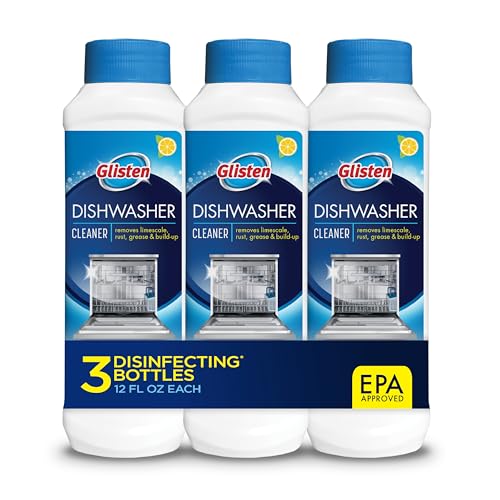
The Glisten liquid is the pick that names rust on its label, and it is the only pick in the guide that does. The 12 ounce bottle from Summit Brands cleans limescale, rust, mineral buildup and grease, and it deodorizes with a lemon scent, running as a liquid in an empty machine like the Finish liquid bottle. The maker’s documents name the problems in the same order the household meets them: the limescale that films the glasses, the rust that stains the tub, the buildup that narrows the spray arms, and the grease that makes the machine drain slowly and smell. The guide matches the single 12 ounce lemon bottle, with the 3-pack as a quantity variant of the same product.
The rust claim is the feature that earns the Glisten liquid its place, because no other pick in the guide names rust at all. A machine with rust stains on the tub or the racks has a problem that a grease cleaner or a limescale cleaner alone will not solve, and the Glisten liquid is formulated for the mineral and rust side of the problem rather than the grease side. The liquid form is the second feature that matters, because it runs in an empty machine and reaches the parts the dishes normally shield, and the lemon deodorizer is the third, because a machine that has smelled for months needs the odor removed as well as the stain. The Summit Brands name is less familiar than Finish or Affresh, and the guide says so plainly: the pick earns its place on the label’s own claims, not on the brand’s fame.
Strengths: The rust claim is unique in the guide, because no other pick names rust on its label, and a machine with rust stains on the tub or the racks needs exactly this cleaner. The liquid form runs in an empty machine and reaches the limescale, the buildup and the grease in the parts the dishes normally shield. The lemon deodorizer removes the odor as well as the stain, so a machine that has smelled for months comes out smelling fresh. The 12 ounce bottle is a single purchase for a single deep clean, and the 3-pack covers three quarterly cleans for a household that wants a year of maintenance on the shelf.
Trade-offs: The liquid must run in an empty machine, and a household that will not run an empty cycle will waste the bottle — the liquid needs the empty machine to reach the parts it is meant to clean. The Glisten Washer Magic is a washing machine cleaner from the same maker in a similar bottle, and a buyer who orders by the brand name alone can receive the cleaner for the wrong machine. The Glisten Dishwasher Magic and Washer Magic Value Pack is a combo of two bottles for two different machines, and it must not be taken as the main pick, because it is two products rather than one. The Summit Brands name is less familiar than Finish or Affresh, and a buyer who chooses by brand fame alone will pass over this pick — though the label’s own claims are what earn it a place here.
Who it suits: the household whose machine shows rust stains on the tub or the racks, films its glasses with limescale, and smells after months without a deep clean. Take the single 12 ounce lemon bottle of Glisten liquid, run in an empty machine — check price on Amazon.
Check price on Amazon: Glisten Dishwasher Cleaner, 12 oz Lemon
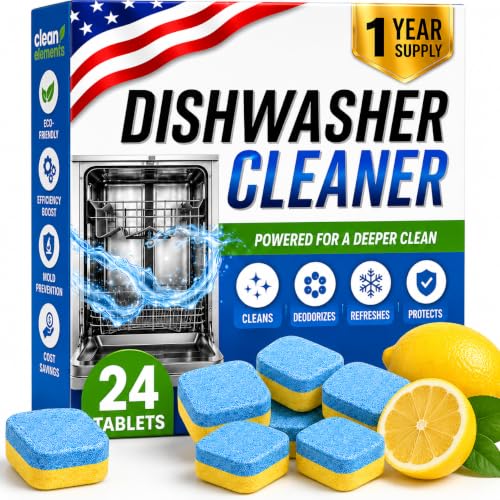
ACTIVE Dishwasher Cleaner and Deodorizer Tablets, 24-Pack — Two Years of Monthly Cleaning in One Pack
The ACTIVE tablets are the bulk pack of this guide, because twenty-four tablets run monthly for twenty-four months, and the household that buys them once has two years of machine cleaning on the shelf. The tablets use citric acid to remove limescale, and they deodorize and deep-clean the inside of the machine, and they carry the septic safe mark, so a household on a septic tank can use them without worry. The guide matches the 24-pack, with smaller packs as quantity variants of the same product, and the tablets run with a normal load, so the household keeps every cycle for the dishes.
The bulk pack is the feature that earns the ACTIVE tablets their place, because it removes the reordering problem entirely for two years. A household that buys six tablets must reorder twice a year, and a household that buys a liquid bottle must reorder four times a year; a household that buys twenty-four tablets orders once and has the schedule on the shelf until the pack runs out. The citric acid is the second feature that matters, because it gives the tablets a limescale claim beside the deodorizing claim, so one product covers film and smell together. The septic safe mark is the third feature, because it means the household on a septic tank can use the tablets without harming the system, and the bulk price per tablet is the lowest in the guide — though the guide does not rank cleaners by price, and a buyer should weigh the schedule above the pack size.
Strengths: Twenty-four tablets cover two years of monthly cleaning in a single purchase, so the household orders once and has the schedule on the shelf until the pack runs out. The citric acid removes limescale while the tablets deodorize and deep-clean, so one product covers the film on the glasses and the smell in the tub together. The septic safe mark means the household on a septic tank can use the tablets without harming the system. The tablets run with a normal load, so maintenance takes no cycle from the household, and the bulk price per tablet is the lowest in the guide.
Trade-offs: The bulk pack suits only a household that will actually use a tablet every month, because twenty-four tablets that sit in the cupboard for two years while the machine is cleaned twice have cost more per cleaning than a pack of six used on schedule. ACTIVE also sells washing machine tablets, and the buyer must verify the words dishwasher cleaner on the exact listing before ordering, because the two products share a brand and a form. The smaller packs are quantity variants of the same product, and a buyer who orders one has bought fewer months rather than a different cleaner, so the count must be checked before ordering. The tablets lead on limescale and odor together, and a household whose main problem is hidden grease should weigh the Finish tablets instead.
Who it suits: the household that wants two years of monthly cleaning bought once, runs the cleaner with a normal load, and is on a septic tank or wants the lowest cost per tablet in the guide. Order the 24-pack of ACTIVE tablets with dishwasher cleaner on the label — check price on Amazon.
Check price on Amazon: ACTIVE Dishwasher Cleaner and Deodorizer Tablets, 24-pack
The Six Side by Side
| Cleaner | Form | How it runs | Main problem | Schedule |
|---|---|---|---|---|
| Affresh, 6 Tablets | Tablets | With a normal load or empty | Limescale and odor-causing residue | Monthly, 6 tablets for 6 months |
| Finish Dual Action Liquid, 8.45 oz | Liquid bottle | Upside down in an empty machine | Grease and limescale | Every 3 months, 1 bottle per quarter |
| Finish Tablets, 12 ct, Lemon | Tablets | With a normal load | Hidden grease | Monthly, 12 tablets for 12 months |
| Lemi Shine, 8 ct | Single-use powder pouches | One pouch per cycle | Limescale and hard water | As needed for deep cleans |
| Glisten, 12 oz Lemon | Liquid bottle | In an empty machine | Rust, limescale, buildup, grease, odor | As needed for deep cleans |
| ACTIVE, 24-pack | Tablets | With a normal load | Limescale and odor | Monthly, 24 tablets for 24 months |
Matching the Pick to Your Machine
Three questions settle the choice among the six picks. The first is the problem inside the machine: a white film on glasses points to the Lemi Shine pouches or the ACTIVE tablets, a smell points to the Affresh tablets or the Glisten liquid, slow draining points to the Finish tablets, and rust stains point to the Glisten liquid alone. The second is the cycle the household will actually run: a household that will never run an empty cycle should choose among the three tablet picks — Affresh, Finish tablets and ACTIVE — while a household that will mark the calendar and run the machine empty should choose the Finish liquid or the Glisten liquid. The third is the schedule the household will keep: six months bought once points to Affresh, twelve to Finish tablets, two years to ACTIVE, and a quarterly bottle to Finish liquid. No pick here bends the entry rule, and no pick is a detergent in a cleaner’s box.
Frequently Asked Questions
Is a dishwasher cleaner the same as dishwasher detergent?
No. Detergent and cleaner are different products for different jobs, and that difference is the whole subject of this guide. Detergent goes into every wash and cleans the dishes — the plates, the glasses and the cutlery. A machine cleaner goes in on its own schedule and cleans the machine itself — the pump, the tub, the pipes and the spray arms. A household that uses detergent alone will have clean dishes in a machine that smells, films the glasses and drains slowly, because the detergent never reaches the parts the cleaner is made for. The household needs both, for two different jobs, and should never choose one over the other.
Should I run the cleaner with dishes in the machine or empty?
It depends on the form, and the guide names the form in every pick. The Affresh tablets, the Finish tablets and the ACTIVE tablets run with a normal load, so the household drops a tablet in with the dishes and loses no cycle to maintenance. The Finish liquid and the Glisten liquid must run upside down in an empty machine, because the liquid needs the empty machine to reach the parts it is meant to clean — a bottle run with a full load spends itself on the dishes and leaves the machine uncleaned. The Lemi Shine pouches are used once per cycle and are gone after that cycle. Read the form, read the way it runs, and never run a liquid bottle with a full load.
How often should I clean my dishwasher?
The makers in this guide agree on monthly for tablets and quarterly for liquid bottles, and the guide follows the makers. The Affresh tablets run monthly, six tablets for six months; the Finish tablets run monthly, twelve tablets for twelve months; the ACTIVE tablets run monthly, twenty-four tablets for twenty-four months; the Finish liquid runs every three months, one bottle per quarter. A household with hard water should clean more often, because limescale returns within weeks, and a household that runs the machine daily should keep the monthly schedule without skipping it. The cheapest cleaner in the guide is the one the household actually uses on schedule, and the most expensive is the one that sits in the cupboard while the machine grows louder and smellier.
Can I use vinegar instead of a dishwasher cleaner?
Vinegar can loosen some limescale, and the guide does not pretend otherwise, but it is not a machine cleaner, and it has no place in this guide. A machine cleaner is a product with a maker, a label, a dose and a schedule, and the maker publishes the exact product, the exact form and the exact way it runs. Vinegar from the pantry has no maker, no dose and no schedule, and it cannot clean hidden grease in the pump or deodorize the tub the way a formulated cleaner can. A household that wants a clean machine should buy a cleaner made for the machine, and should use vinegar for the salad rather than the dishwasher.
Will a dishwasher cleaner work in a portable dishwasher?
Yes, and the portable machine is the machine that needs it most. A portable dishwasher is smaller than a full-size machine and runs just as often, so residue and odor build up faster in a smaller tub with smaller pipes, and the cleaner picks in this guide do not depend on the machine type — they work in every machine, portable or built-in. The tablet picks suit a portable machine best, because they run with a normal load and cost the household no cycle, while the liquid bottles suit a household that will run the small machine empty on purpose. A buyer of a portable dishwasher should buy the cleaner with the machine, and should start the monthly schedule from the first wash rather than waiting for the smell to arrive.
The Bottom Line
Buy the cleaner that matches the problem inside your machine, run it the way its maker says, and the machine that washes your dishes will finally get washed itself.