Disclosure: topratedkitchenware.com is reader-supported. When you buy through links on our site, we may earn an affiliate commission from Amazon and other retailers, at no extra cost to you.
Where to buy
If you are shopping for the best extra large convection ovens, start with the three below whose verified listings actually prove an extra large cavity, then read the full guide before you decide. Three further ovens are reviewed in full as prose-only references: they are good machines, but their verified titles do not prove the extra large capacity this guide is about, so they carry no purchase link and no photo here. Every linked model goes to its Amazon listing, where you can check the latest price on Amazon before ordering.
- VEVOR Commercial Convection Oven, 47L / 43Qt Half-Size, 1600W, 4-Tier — Best Overall Extra Large
- Ninja French Door Premier Air Fry Oven FO101, 20.3 Qt — Prose-Only Reference: Compact French Door (no link; capacity below this guide’s extra large group)
- Breville BOV900BSS Smart Oven Air Fryer Pro — Prose-Only Reference: Premium Smart Oven (no link; no capacity figure stated in the verified title)
- KoolMore 23 in. Commercial Countertop Convection Oven for Half-Size Pans, KM-CTCO-15 — Best Commercial Half-Pan Oven
- Cuisinart Air Fryer Toaster Oven Combo TOA-55, 0.6 cu. ft. — Prose-Only Reference: Standard-Size Oven (no link; capacity below this guide’s extra large group)
- Oster Extra-Large French Door Air Fryer Countertop Oven — Best Extra Large French Door
Read the full guide ↓
Shoppers hunting for the best extra large convection ovens usually have one problem in common: a standard countertop oven keeps forcing them to cook in relays. A whole tray of vegetables waits while the chicken finishes. Cookies go in two batches and the second batch always browns differently. A holiday side dish has to be timed around whatever the main oven is already doing. An extra large convection oven solves that bottleneck by giving you a second, fan-driven cavity big enough for half-size sheet pans, multiple racks of baked goods, or a family-size roast, without heating the full-size range for a single tray. The catch is that “extra large” is one of the loosest phrases in small-appliance marketing. Brands apply it to cavities that differ by more than two to one in usable volume, so this guide judges size only by what a verified listing title actually states: a capacity figure in liters or quarts, an explicit extra large or extra wide claim, or a half-size pan format with multiple racks. Models that could not prove size on that evidence are still reviewed honestly below, but as prose-only references rather than linked recommendations.
The six ovens in this pool split into two camps. The commercial camp, the VEVOR 47L and the KoolMore KM-CTCO-15, is built around half-size pans, four rack positions, and hard-wearing construction for bakeries, cafes, and serious home batch cooking. The household camp, led by the Oster Extra-Large French Door model, wraps a genuinely large cavity in friendlier controls, French doors, and air fry presets aimed at family dinners. Between them sit three well-known ovens, the Ninja FO101, the Breville Smart Oven Air Fryer Pro, and the Cuisinart TOA-55, that are capable convection ovens but state capacities of 20.3 quarts and 0.6 cubic feet, or no capacity at all, which puts them outside the extra large class defined here. If you genuinely need the biggest cavity, start with the linked three; if your cooking is more modest, the prose-only references may still be the smarter buy.
Key Takeaways
- Extra large, as used here, means a verified capacity of roughly 25 quarts or more, an explicit extra large claim in the title, or a half-size pan commercial format. Only three of the six pooled ovens meet that bar.
- The VEVOR 47L / 43Qt half-size oven is the capacity leader here: four tiers, 1600W, and trays and racks included.
- The KoolMore KM-CTCO-15 is the pick for buyers who already own half-size sheet pans and want a 23-inch commercial oven with four racks and an ETL listing.
- The Oster is the most household-friendly extra large option, with French doors, room for 15 x 12 inch pans, six cooking presets, and an auto-shutoff timer.
- The Ninja FO101 (20.3 Qt), Cuisinart TOA-55 (0.6 cu. ft.), and Breville BOV900 (no capacity in its verified title) are reviewed in full as prose-only references. They are strong ovens that simply do not prove extra large size on the evidence available.
- Measure your counter depth and cabinet clearance before ordering any oven in this class; extra large cavities come with extra large footprints.
In this guide
Quick Picks
| Pick | Badge | What the verified title proves | Link |
|---|---|---|---|
| VEVOR Commercial Convection Oven, 47L / 43Qt Half-Size | Best Overall Extra Large | 47L / 43Qt capacity, 1600W, 4 tiers, front glass door, tray and wire racks included, 120V | Check on Amazon |
| Ninja French Door Premier Air Fry Oven FO101 | Prose-Only Reference: Compact French Door | 10-in-1, 20.3 Qt, cyclonic air up to 450F, PFAS-free surface | Prose-only reference — no link |
| Breville BOV900BSS Smart Oven Air Fryer Pro | Prose-Only Reference: Premium Smart Oven | 13 functions, brushed stainless steel, convection setting; no capacity stated in title | Prose-only reference — no link |
| KoolMore KM-CTCO-15 Commercial Countertop Convection Oven | Best Commercial Half-Pan Oven | 23 in., half-size pans, 4 racks, 1600W, stainless steel, ETL listed | Check on Amazon |
| Cuisinart Air Fryer Toaster Oven Combo TOA-55 | Prose-Only Reference: Standard-Size Oven | 7-in-1, 1800W, 0.6 cu. ft., fits a 12-inch pizza, removable crumb tray | Prose-only reference — no link |
| Oster Extra-Large French Door Air Fryer Countertop Oven | Best Extra Large French Door | Explicit extra-large design, French doors, fits 15 x 12 inch pans, 6 cooking presets, auto-shutoff timer | Check on Amazon |
Two patterns in that table are worth a second look. First, wattage alone tells you almost nothing about size: the smallest cavity in this pool carries the joint-highest power figure, because wattage describes heating muscle, not interior volume. Second, the two commercial ovens prove their size with pan format and rack count rather than a headline quart figure, which is why the buying guide below explains how to compare liters, quarts, cubic feet, and pan formats on equal footing. Our companion shortlist of Best Extra Large Convection Ovens Countertop applies the same evidence rules with the counter as the starting constraint.
How These Picks Were Chosen
This guide was built from verified listing data rather than hands-on testing, and it is worth being plain about what that means. Every product name, capacity figure, wattage, and feature mentioned in the reviews comes from the manufacturer’s Amazon listing title as returned and confirmed through the Creators API on the check date recorded in the sources file that accompanies this article. Where a title states a fact, such as the VEVOR’s 47-liter capacity or the KoolMore’s ETL listing, the review uses it. Where a title is silent, such as the Breville’s interior volume, the review says so instead of filling the gap with a number from memory. That discipline is exactly why three respected ovens appear here without purchase links: a buying guide that links first and verifies later is not a guide worth trusting.
The selection started from a pooled shortlist of countertop convection ovens and then applied the keyword’s core test, size, strictly. An oven earned a linked place only if its verified title proved extra large status in one of three ways: a stated capacity at the top of the countertop class, an explicit extra large claim from the manufacturer, or a commercial half-size pan format with four racks. Everything else was kept as a prose-only reference, because readers comparing big ovens benefit from knowing why a popular model did not qualify, and because several of those models are the right answer for smaller households. Within the linked group, badges were assigned by role: the largest all-round cavity, the commercial pan-format specialist, and the most family-friendly large oven. Features were weighed in the order batch cooks care about them: usable capacity first, then rack flexibility, door design, presets, and cleanup. Price was deliberately excluded from the ranking because prices move constantly; each review instead positions its oven qualitatively, as a commercial-tier, premium-tier, or mainstream-tier design, and leaves the live figure for you to check on Amazon when you buy.
The 6 Best Extra Large Convection Ovens
A quick note on how to read the six reviews that follow. Linked picks carry a photo, a specification box drawn only from verified title data, and a purchase link. Prose-only references carry the same honest strengths, trade-offs, and verdict, but no photo and no link. All six are genuine convection ovens with fan-driven air; they differ in size class, door design, and the cooking they are built to do every day.
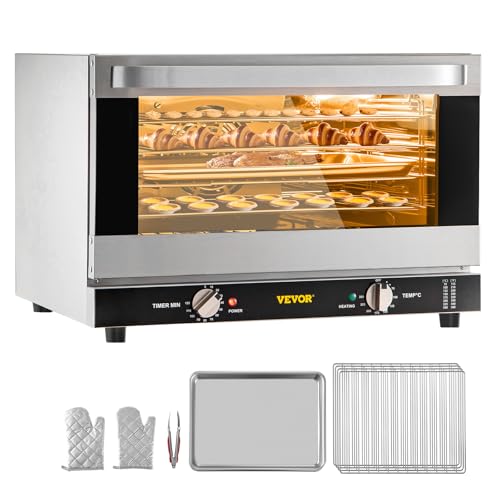
VEVOR Commercial Convection Oven, 47L / 43Qt Half-Size
Badge: Best Overall Extra Large
Strengths
- The largest verified capacity in this guide: 47 liters, stated as 43 quarts, in a half-size commercial format.
- Four tiers mean four levels of trays or racks, so batch baking runs in parallel instead of in relays.
- Trays and wire racks are included in the box, along with clip gloves for handling hot pans.
Trade-offs
- Commercial styling and a front glass door prioritize function over kitchen-counter looks.
- A 47-liter countertop cabinet is a serious footprint commitment; measure before ordering.
- The feature set is baking-focused rather than preset-driven, so air fry style convenience cooking takes more manual input.
Mini spec box (from the verified listing title)
- Capacity: 47L / 43Qt, half-size format
- Power: 1600W
- Racks: 4-tier interior
- Door: front glass door
- Included: trays, wire racks, clip gloves
- Electrical: 120V
The VEVOR 47L is the oven this guide exists to find. Its verified title leads with the two numbers that matter most, 47 liters and 43 quarts, and everything else in the listing supports the same story: a half-size commercial cavity with four tiers, a front glass door you can monitor a bake through, and the trays and wire racks included rather than sold as extras. For a home baker who produces for markets, church events, school fundraisers, or simply a large family, that four-tier layout changes the rhythm of a cooking day. Four trays of cookies brown at once. Two racks of roasted vegetables can share the cavity with a tray of rolls on a third level. The convection fan earns its keep precisely in this loaded configuration, because moving air is what keeps the middle racks cooking at a pace close to the outer ones, where a still-air oven would leave the center pale and slow.
Performance expectations should be set by its commercial brief. At 1600W on a standard 120V supply, this is a straightforward electric baking oven: set temperature and time, load the racks, rotate trays partway through if a batch is uneven, and let the fan do the evening-out work. It does not wrap that process in touchscreen presets, and for high-volume baking that simplicity is a virtue, because there is very little to fail or mis-set. The honest limitation is the flip side of the same coin. If your idea of a countertop oven is mostly reheating pizza and toasting breakfast, a 47-liter commercial cabinet is more oven than you need, and its baking-first control style will feel plain next to a household air fryer oven. Buy it for throughput, and it delivers exactly that.
Best for: high-volume home bakers, small bakeries and cafes, and anyone who regularly cooks on half-size pans across several racks at once / Not suited for: small kitchens, toast-and-reheat households, or buyers who want one-touch air fry presets
Ninja French Door Premier Air Fry Oven FO101
Badge: Prose-Only Reference: Compact French Door
Strengths
- French door design opens the full width of the cavity with a single pull, which is genuinely convenient with a hot tray in hand.
- A true 10-in-1 function list in the verified title: air fry, sear crisp, bake, broil, toast, and dehydrate among them.
- Cyclonic air rated up to 450F and a PFAS-free interior surface, both stated in the listing title.
Trade-offs
- At 20.3 quarts, the verified capacity sits below this guide’s extra large group, which is why this pick is prose-only here.
- French doors need clear counter in front of the oven and care around hot door edges.
- The wide, shorter cavity suits trays and pizzas better than tall roasts or stacked multi-rack baking.
Mini spec box (from the verified listing title)
- Capacity: 20.3 Qt
- Functions: 10-in-1, including air fry, sear crisp, bake, broil, toast, dehydrate
- Maximum temperature: 450F cyclonic air
- Surface: PFAS-free
- Finish: stainless, model FO101
The Ninja FO101 is the oven many readers will cross-shop against this guide’s linked picks, so it deserves a straight answer about why it appears without a link. The verified title states 20.3 quarts. That is a respectable mid-size cavity, and Ninja uses the space cleverly, with French doors that open wide and a function set built around fast, high-heat cooking: cyclonic air up to 450F, a sear crisp mode for finishing, air frying, broiling, toasting, and dehydrating in one 10-in-1 package. For a household of two to four that cooks sheet-pan dinners, crisps snacks, and wants one appliance to replace a toaster and a basket air fryer, this is a thoughtfully designed machine, and the PFAS-free surface stated in the title will matter to buyers who screen for it.
What it is not, on the evidence of its own listing, is an extra large oven. Twenty quarts is roughly half the VEVOR’s verified volume, and the difference shows up the moment you cook for a crowd: one tray at a time instead of four tiers. The honest limitation is purely about fit for this keyword. If your batches are modest and your counter is tight, the FO101’s size is a feature, not a flaw. If you arrived here because a standard oven keeps bottlenecking your cooking, the linked picks are the ones built to remove that bottleneck.
Best for: smaller households that want French door convenience and strong air fry performance in a mid-size footprint / Not suited for: batch bakers or large families who need verified extra large capacity
Breville BOV900BSS Smart Oven Air Fryer Pro
Badge: Prose-Only Reference: Premium Smart Oven
Strengths
- The deepest function list in this pool: 13 functions in the verified title, spanning roast, bake, dehydrate, and air fry work.
- The title states its convection setting reduces cooking time by up to 30 percent, the clearest convection claim in the group.
- Brushed stainless steel construction from Breville’s premium countertop oven line.
Trade-offs
- The verified title states no capacity figure at all, so its size cannot be confirmed against this guide’s extra large standard; that is why this pick is prose-only here.
- It sits in the premium tier of this class qualitatively, so it is not the value route into big-oven cooking.
- Thirteen functions mean a learning curve before the controls feel automatic.
Mini spec box (from the verified listing title)
- Model: BOV900BSS Smart Oven Air Fryer Pro
- Functions: 13, including roast, bake, dehydrate, air fry
- Convection: setting stated to reduce cook time by up to 30 percent
- Finish: brushed stainless steel
- Capacity: not stated in the verified title
The Breville Smart Oven Air Fryer Pro is, by reputation and by its function list, one of the most capable countertop ovens in this pool, and this review will not pretend otherwise. Thirteen functions, a convection system the manufacturer credits with cutting cook times by up to 30 percent, and Breville’s brushed stainless build make it the premium smart oven of the group. Readers who cook a wide repertoire in a countertop oven, roasting one night, dehydrating the next, proofing, reheating, and air frying in between, will find more cooking intelligence here than in either commercial pick.
The reason it carries no link in a guide to extra large ovens is narrow and specific: its verified listing title does not state a capacity. Not in quarts, not in liters, not in cubic feet, and not through an extra large claim. This guide’s rule, applied to every pick equally, is that size must be proven from verified title data before an oven is linked as an extra large recommendation. The Breville may well be a large oven in the metal; plenty of owners treat it as one. But a guide that relaxes its evidence rule for a famous name would have no rule at all, so the BOV900 is reviewed here in full as a premium reference point. If precise temperature control and function depth matter more to you than a verified maximum cavity, it remains a machine worth your own further research, starting with the manufacturer’s stated dimensions. If verified capacity is your first criterion, the linked VEVOR, KoolMore, and Oster picks are the ones that prove it.
Best for: experienced cooks who value function depth and premium controls, and who will verify dimensions against their own space / Not suited for: buyers who need capacity proven up front, or anyone shopping the value tier

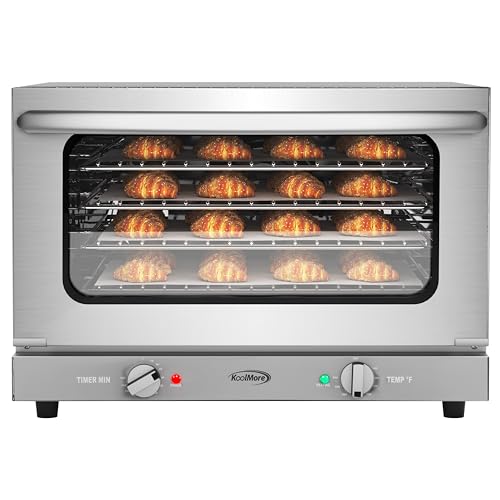
KoolMore 23 in. Commercial Countertop Convection Oven, KM-CTCO-15
Badge: Best Commercial Half-Pan Oven
Strengths
- Built around the half-size pan standard, with four racks, so it slots straight into a bakery or cafe workflow.
- ETL listed for safety and sanitation, a credential stated in the verified title that matters for commercial use.
- Stainless steel construction and 1600W of power in a 23-inch countertop format.
Trade-offs
- A commercial brief means a plainer control experience than household preset-driven ovens.
- Half-size pan sizing is an advantage only if your pans and batches match the format.
- Like the VEVOR, it asks for a generous, permanent slice of counter.
Mini spec box (from the verified listing title)
- Model: KM-CTCO-15
- Width class: 23 in. commercial countertop
- Pan format: half-size pans
- Racks: 4
- Power: 1600W
- Construction: stainless steel; ETL listed for safety and sanitation
The KoolMore KM-CTCO-15 proves its extra large status a different way from the VEVOR: not with a headline quart figure, but with format. A 23-inch commercial countertop oven built for half-size pans, with four racks and 1600W of power, belongs to the same working class as the 47-liter VEVOR, and for buyers already invested in half-size sheet pans it may be the more natural fit. Half-size pans are the lingua franca of small commercial kitchens: they stack, they swap, they move between ovens without drama, and a four-rack cavity that accepts them natively turns batch planning into simple arithmetic. The ETL listing for safety and sanitation, stated right in the verified title, is the detail that separates this from a merely big home oven. For a food business, that listing is often the difference between an oven an inspector accepts and one that has to leave the kitchen.
At home, the same oven suits a narrower but real audience: the serious batch baker, the meal-prep cook who roasts on multiple racks every Sunday, the household that caters its own events. Stainless construction wipes down well and shrugs off the flour dust and splatter of production baking. The honest limitation is temperament. Commercial ovens assume an operator who thinks in temperatures and times rather than presets, and who values durability and pan compatibility over guided cooking programs. If that description fits you, the KoolMore is arguably the most professionally honest oven in this guide. If you want the oven to suggest settings and count down family dinners with preset logic, the Oster below speaks your language better.
Best for: small food businesses, caterers, and serious home batch bakers standardized on half-size pans / Not suited for: preset-driven family cooking or counters that cannot spare a 23-inch commercial footprint
Cuisinart Air Fryer Toaster Oven Combo TOA-55
Badge: Prose-Only Reference: Standard-Size Oven
Strengths
- A balanced 7-in-1 function set with convection capability and a maximum temperature of 450F, all stated in the verified title.
- 1800W of power, the joint-highest figure in this pool, in a standard countertop footprint.
- Practical details done right: a removable crumb tray and room for a 12-inch pizza.
Trade-offs
- At 0.6 cu. ft., the verified capacity is a standard size, well below this guide’s extra large group; that is why this pick is prose-only here.
- One cooking level at a time for most jobs, so big batches still run in relays.
- Air fryer toaster oven combos trade some pure baking volume for everyday versatility.
Mini spec box (from the verified listing title)
- Model: TOA-55
- Capacity: 0.6 cu. ft.
- Functions: 7-in-1 combo with convection capability
- Power: 1800W
- Maximum temperature: 450F
- Details: fits a 12-inch pizza; removable crumb tray; stainless steel
The Cuisinart TOA-55 is the everyperson oven of this pool, and in a general guide to countertop convection ovens it would be an easy linked recommendation. It combines seven functions, strong 1800W power, convection capability, a 450F ceiling, and the two everyday details owners actually mention, a crumb tray that removes for cleaning and an interior that takes a 12-inch pizza. For a couple or a small family replacing a toaster and gaining air fry and convection baking in one footprint, it covers the brief neatly.
Its verified capacity, though, is 0.6 cubic feet, and that number is the whole story for this keyword. Six-tenths of a cubic foot is a standard countertop oven size, roughly two-fifths of the VEVOR’s verified volume, with a single working level for most cooking. Nobody batch-bakes four trays at once in it, and nobody should buy it expecting to. The honest limitation is therefore identical in kind to the Ninja’s: not quality, but class. This guide keeps the TOA-55 in the article, reviewed in full and without a link, because many readers who start out searching for extra large actually discover, once they count their real batches, that a standard oven like this is the right size. If that is you, the Cuisinart deserves a place on your own shortlist. If your batches are genuinely big, stay with the linked picks.
Best for: couples and small families who want one versatile standard-size oven for daily cooking / Not suited for: multi-rack batch baking or anyone whose current oven already feels too small

Oster Extra-Large French Door Air Fryer Countertop Oven
Badge: Best Extra Large French Door
Strengths
- The only household oven here whose verified title claims extra-large status outright, with French doors to match.
- Fits 15 x 12 inch pans, a pan size stated in the title that covers most family casseroles and sheet-pan dinners.
- Six cooking presets and an auto-shutoff timer make the big cavity approachable for everyday family use.
Trade-offs
- The verified title states no quart or liter capacity, so its size claim rests on the manufacturer’s extra-large designation and pan fit rather than a volume figure.
- French doors need frontal clearance and a habit of care with hot door panels.
- Six presets is a simpler control set than the function lists of the premium household ovens in this pool.
Mini spec box (from the verified listing title)
- Design: extra-large French door air fryer countertop oven
- Pan fit: 15 x 12 inch pans
- Presets: 6 cooking presets
- Safety: auto-shutoff timer
- Door style: French doors
The Oster makes its case in the first three words of its name: Extra-Large French Door. Where the commercial picks prove size with pan formats and rack counts, the Oster proves it the household way, with an explicit extra-large designation and a stated pan fit of 15 x 12 inches. That pan size is well chosen. It swallows the casseroles, sheet-pan dinners, and frozen pizzas that make up most family oven cooking, and the French doors that reveal it open with one hand, which matters when the other hand is holding a hot, heavy dish. Six cooking presets and an auto-shutoff timer complete a package aimed squarely at busy households rather than production bakers.
In daily use, expect the Oster to behave like a second, faster main oven for family food: roast a tray of chicken pieces with room to spare, bake a big casserole without heating the range, air fry party quantities of snacks in fewer relays than a standard oven allows. The honest limitation is precision of information. Because the verified title gives no volume figure, this guide cannot rank the Oster’s cavity against the VEVOR’s 43 quarts with false exactness, and buyers who think in quarts should treat its extra-large claim as manufacturer-stated rather than independently measured here. What the Oster gives up in commercial throughput, it returns in approachability, and for a household that wants big without going commercial, it is the natural first stop. Readers weighing full-size gas alternatives for a remodel will find a different set of trade-offs in Best Gas Stoves With Convection Ovens, but for a plug-in countertop solution, this is the family pick.
Best for: families who want a genuinely large, friendly second oven for sheet-pan dinners, casseroles, and party batches / Not suited for: commercial pan workflows or buyers who need a stated quart capacity before they commit
Comparison Table
| Oven | Size evidence in verified title | Power | Door / format | Standout point | Link |
|---|---|---|---|---|---|
| VEVOR 47L Half-Size | 47L / 43Qt stated | 1600W | Front glass door, 4-tier commercial | Largest verified capacity; trays and racks included | Check on Amazon |
| Ninja FO101 | 20.3 Qt stated (below extra large group) | Not stated in title | French door, household | 10-in-1 functions, PFAS-free surface | Prose-only |
| Breville BOV900 | No capacity stated in title | Not stated in title | Household smart oven | 13 functions; convection time claim | Prose-only |
| KoolMore KM-CTCO-15 | Half-size pan format, 4 racks, 23 in. | 1600W | Commercial countertop | ETL listed for safety and sanitation | Check on Amazon |
| Cuisinart TOA-55 | 0.6 cu. ft. stated (standard size) | 1800W | Household combo | Fits a 12-inch pizza; removable crumb tray | Prose-only |
| Oster Extra-Large | Extra-large claimed; fits 15 x 12 in. pans | Not stated in title | French door, household | 6 presets, auto-shutoff timer | Check on Amazon |
How to Choose an Extra Large Convection Oven
Choosing in this class starts with a single discipline: compare capacities in the same unit, from stated figures, and ignore adjectives until the numbers are on the table. Manufacturers mix liters, quarts, and cubic feet freely. The conversions are simple: a quart is roughly 0.95 liters, and a cubic foot is roughly 28 quarts. Run them on this guide’s pool and the field separates instantly. The VEVOR states 47 liters and 43 quarts, two figures that agree with each other. The Cuisinart’s 0.6 cubic feet converts to roughly 17 quarts, less than half the VEVOR. The Ninja states 20.3 quarts directly. The KoolMore and the Oster state no volume at all, proving size instead through pan format and pan fit, which is legitimate evidence of a different kind: a cavity that accepts half-size pans on four racks, or a 15 x 12 inch family pan, is a large working cavity whatever its quart count. What you should not do is compare one brand’s quart figure against another brand’s adjective. When a title says only “large” with no number, no pan size, and no rack count behind it, treat the claim as unproven, exactly as this guide treated the Breville’s silent title.
Next, decide which kind of large you actually need, because the two camps solve different problems. Commercial-format ovens, the VEVOR and the KoolMore, maximize parallel capacity: multiple racks, standard pans, simple controls, durable cabinets. They suit repetitive, voluminous cooking, trays of baked goods and racks of vegetables rotating through a market-day bake. Household-format ovens, the Oster in the linked group, maximize convenience per cook: presets, friendly doors, timers that shut the oven off, and interiors shaped around family dishes rather than bakery pans. A cafe would find the Oster’s single-level cooking limiting; a family would find the VEVOR’s four tiers mostly empty. Match the oven to the batch you cook most weeks, not the biggest batch you cook once a year, because holiday overflow can be solved by the main range, while the weekly workhorse has to earn its counter space every day.
Power and electrical fit come third. The stated figures in this pool run from 1600W for both commercial ovens to 1800W for the Cuisinart, and the VEVOR’s title confirms a standard 120V supply. Any oven in this class deserves a circuit that is not already sharing its load with a kettle and a microwave running at the same moment; big ovens draw big current for long stretches, especially during preheat. Check the listing for your model’s exact supply requirement and plan the outlet before the oven arrives. Fourth, measure like you mean it: width, depth, and height, plus clearance above and behind for heat to escape, room in front for a door to open, and enough depth that a tray can slide out toward you safely. Under-cabinet placement deserves special care, because escaping heat from an extra large oven can discolor or damage a low cabinet underside; many owners give ovens in this class an open stretch of counter instead.
Finally, weigh the qualitative tiers honestly. The premium tier, represented here by the Breville as a prose-only reference, buys control sophistication and finish. The commercial tier buys throughput and durability credentials such as an ETL listing. The mainstream household tier, the Oster, buys approachability. None guarantees a better dinner; they allocate your money differently. The cheapest mistake in this category is paying a premium-tier figure for a standard-size cavity because the marketing sounded large, which is why this guide insists on stated numbers. Readers replanning a kitchen around a built-in rather than a countertop unit will find the relevant comparisons in Best Gas Convection Wall Ovens.
How to Use an Extra Large Convection Oven Well
Setup begins before the first cook. Place the oven on a level, heat-safe surface with the clearance the manufacturer specifies, wash the racks, trays, and crumb tray in warm soapy water, and run the empty oven hot for a short burn-in cycle to clear manufacturing residues, with the kitchen ventilated. Confirm which rack positions your model offers; in a four-tier commercial cavity the middle positions are where most baking will live, while in a household oven the center rack is the default for even results. Keep the manual’s temperature guidance nearby for the first few weeks, because convection changes the arithmetic you are used to.
That arithmetic is the core skill. A convection fan circulates hot air so food cooks faster and browns more evenly than in still air, and the standard adjustment is to reduce a recipe’s stated temperature modestly, or keep the temperature and shorten the time, checking early either way. In an extra large cavity the effect is amplified in a good way: loaded racks that would smother a still-air oven keep cooking because the fan keeps air moving between trays. Three habits make the most of it. First, leave gaps between pans so air can circulate; a crowded rack defeats the fan you paid for. Second, rotate and swap trays partway through large bakes, top to bottom and front to back, because even good fans leave mild gradients. Third, check color through the glass door or with a brief opening rather than repeatedly dumping heat; every long opening costs temperature the cavity must rebuild.
Cleaning and maintenance are simpler than the size suggests. Let the oven cool, empty the crumb tray after crumb-heavy sessions, and wipe the interior while it is still faintly warm with a damp cloth and mild detergent; baked-on splatter softens if a heat-safe dish of water is warmed in the cavity first. Wash racks and trays separately, dry everything before it goes back, and keep the door seal and fan intake free of grease film, because a greasy fan moves less air and quietly erases the convection advantage. Never use oven-cleaner chemicals meant for self-cleaning ranges unless your countertop model’s manufacturer explicitly allows them.
Troubleshooting follows the same logic. Problem: baked goods brown on the outer racks but stay pale in the center → reduce the load per rack, leave wider gaps between pans, and swap tray positions halfway. Problem: the oven trips a breaker during preheat → move it to a less loaded circuit and avoid running other high-draw appliances on that circuit at the same time. Problem: toast and reheated foods dry out → lower the temperature slightly and shorten the time, because convection efficiency that helps a roast will punish small, thin foods at still-air settings. Problem: smoke during high-heat cooking → check the crumb tray and interior floor for old grease, clean both, and trim excess fat from the next batch.
Extra Large Ovens for Batch Baking and Weekly Meal Prep
The strongest case for an extra large convection oven is not a holiday; it is a Tuesday. Households that meal-prep discover quickly that the limiting factor is rarely the recipe and almost always the cavity. A week of lunches means trays of chicken, trays of vegetables, and a grain dish, all wanting the oven in the same two hours. In a standard oven those trays queue. In a four-tier commercial cavity like the VEVOR’s, or a four-rack KoolMore, they run together, and the fan keeps the middle of the stack honest. The practical technique is to stagger by density rather than by course: dense root vegetables start first, proteins join next, and delicate items ride the final stretch. Because everything shares one preheat and one cooking window, the time savings compound across the week.
Batch bakers get a parallel benefit. Cookies, scones, and rolls reward the even air of a loaded convection cavity, provided the trays are spaced and swapped as described in the how-to section. The commercial picks exist precisely for this work, and their half-size pan format means a home baker can adopt the same stackable pans bakeries use instead of collecting mismatched home trays. If your ambitions run toward a stacked commercial setup rather than a countertop one, the landscape changes completely, and Best Gas Convection Ovens Double Deck covers that different class of equipment. For countertop batch work, the formula is simple: verified capacity, standard pans, disciplined rotation.
Counter Space, Clearance, and Living With a Big Oven
An extra large oven is a piece of kitchen furniture, and treating it that way prevents the commonest disappointment in this category, which is not cooking performance but geography. Before ordering, tape the oven’s footprint onto your counter with painter’s tape, using the dimensions from the manufacturer’s listing, and live with the tape for a day. Notice what it displaces, whether the cabinet above sits at a height the manufacturer accepts, and the path from oven to landing space, because a 15 x 12 inch pan of roasted anything needs a heat-safe surface within one step the second it leaves the cavity. French door models like the Oster and the prose-only Ninja help here, since their doors do not drop down into your shin space, but they ask for clear counter in front of the doors’ arc instead.
Heat management deserves the same forethought. Big cavities vent big heat, and in summer a long batch bake in a 47-liter oven will warm the kitchen noticeably, which some cooks treat as a reason to shift batch work to mornings. The oven’s exterior gets hot enough to demand respect: keep paper, plastics, and small appliances out of the clearance zone, and teach the household that the top of a running countertop oven is not a shelf. None of this is a reason to avoid the class; it is simply the honest cost of capacity. Shoppers comparing against built-in capacity should also read Best Gas True Convection Ovens with care, since true convection in a wall oven is a different technology promise from fan convection on a counter, and the two should never be conflated at purchase time.
Common Buying Mistakes
The first mistake is buying the adjective. “Large” and even “extra large” appear on ovens whose stated capacities differ by more than double, and the only defense is the habit this guide models: find the number, convert the unit, compare like with like. The second mistake is the mirror image, dismissing an oven that proves size by format rather than volume. A half-size pan, four-rack commercial oven is a large working cavity by any functional measure, and skipping it because the title leads with pan size instead of quarts means missing the most capable tools in the class. The third mistake is ignoring the pans you already own. Measure your most-used trays and casserole dishes against the stated pan fit before ordering; an oven that cannot accept your favorite roasting pan will annoy you weekly, while one that swallows it becomes invisible infrastructure.
The fourth mistake is electrical optimism: assuming any outlet will do, then discovering the oven shares a circuit with half the kitchen and trips protection during Sunday preheat. The fifth is clearance denial, wedging a big oven under low cabinets and then blaming the oven for heat marks. The sixth is paying for the wrong camp, buying commercial throughput for a household that cooks one tray at a time, or household presets for a bakery workflow that needs racks and standard pans. Each mistake is cheap to avoid at the reading stage and expensive to reverse after delivery, which is why the sizing and camp questions in the buying guide are worth answering with your own tape measure before any checkout page opens.
Final Recommendation
Start with the VEVOR Commercial Convection Oven, 47L / 43Qt if capacity is the reason you are here. It posts the largest verified numbers in this guide, loads four tiers of trays and racks that are included in the box, and asks only that you cook like a baker rather than a preset user. Choose the KoolMore KM-CTCO-15 instead if your kitchen already runs on half-size pans or if an ETL listing matters for a small food business; its commercial format is the most professionally credible in the pool. Choose the Oster Extra-Large French Door if the oven must serve family dinners first and batch work second; it is the only linked pick that wraps a manufacturer-stated extra large cavity in French doors, six presets, and an auto-shutoff timer.
And keep the prose-only three in perspective. The Ninja FO101, the Breville Smart Oven Air Fryer Pro, and the Cuisinart TOA-55 are not failed ovens; they are successful standard and mid-size ovens that did not prove extra large capacity from their verified titles. If your real batches are modest, one of them may be your best oven. If your batches are the bottleneck of your cooking week, the linked three are where the bottleneck ends.
Frequently Asked Questions
What capacity actually counts as extra large in a countertop convection oven?
There is no regulated threshold, which is exactly why this guide set its own evidence rule: a stated capacity around the mid-20s in quarts or higher, an explicit extra large claim from the manufacturer, or a commercial half-size pan format with multiple racks. On that rule the VEVOR at 43 quarts qualifies easily, the KoolMore qualifies by format, and the Oster by its stated designation and pan fit, while figures of 20.3 quarts and 0.6 cubic feet fall into the standard and mid-size classes.
How do I compare liters, quarts, and cubic feet between listings?
Convert everything to one unit before comparing. A quart is roughly 0.95 liters, so a 47-liter oven is about a 43 to 44 quart oven, matching the VEVOR’s dual statement. A cubic foot is roughly 28 quarts, so a 0.6 cubic foot oven is about 17 quarts. Once every figure is in quarts, marketing adjectives lose their power and the real size order of a shortlist becomes obvious.
Is a commercial countertop convection oven a good idea in a home kitchen?
It is, if your cooking resembles the work commercial ovens are built for: repeated batches, standard pans, and multiple racks in use at once. The VEVOR and KoolMore trade preset convenience for capacity, durability, and pan compatibility, and the KoolMore adds an ETL listing. If your cooking is one family dish at a time, a household model like the Oster will feel friendlier.
Why are three well-known ovens in this guide not linked?
Because their verified listing titles do not prove extra large capacity. The Ninja FO101 states 20.3 quarts, the Cuisinart TOA-55 states 0.6 cubic feet, and the Breville BOV900 title states no capacity figure at all. Rather than link them under a size claim the evidence does not support, this guide reviews each in full as a prose-only reference, with its genuine strengths stated plainly, so you can judge whether its actual size class fits your cooking.
Do French doors matter on an extra large oven?
They matter ergonomically. French doors, as on the Oster, open the full cavity width with one hand and do not create the hot drop-down shelf a conventional door becomes, which is welcome when both hands are managing a wide, heavy pan. The costs are frontal clearance for the doors’ swing and a little more care around hot door edges. Drop-down and front glass door designs, like the VEVOR’s, remain better for commercial settings where monitoring a bake through glass and simple mechanics are the priorities.
What should I check before an extra large oven arrives?
Four things: the taped footprint on your counter, including door swing and landing space for hot pans; the clearance above and behind the unit for heat to escape, especially under cabinets; the electrical circuit the oven will use, since big ovens draw heavily during preheat; and the fit of your most-used pans against the oven’s stated pan size. An hour with a tape measure prevents nearly every disappointment reported in this category.
Can an extra large countertop oven replace my main oven?
For many households it can handle the majority of oven work, roasts, bakes, casseroles, and reheating, often faster than a full-size range thanks to convection air and a smaller cavity to heat. Most owners keep the main oven for the largest holiday items and run the countertop oven as the daily workhorse.