Disclosure: topratedkitchenware.com is reader-supported. When you buy through links on our site, we may earn an affiliate commission from Amazon and other retailers, at no extra cost to you.
Where to buy
The six machines below are the verified picks in this guide to the best fast brewing coffee makers. Each name links to its Amazon listing, where you can check the latest price on Amazon, confirm the current colour and configuration, and read the newest owner feedback before you decide.
- Keurig K-Express Single Serve Coffee Maker, Mint
- Hamilton Beach FlexBrew Advanced 4-in-1 Single Serve Coffee Maker
- Ninja Single Serve Coffee Maker, PB051
- Keurig K-Elite Single Serve Coffee Maker, Brushed Silver
- Keurig K-Express Single Serve Coffee Maker, Black
- Keurig K-Express Single Serve Coffee Maker, Warm Stone
Read the full guide ↓ for how brewing speed actually works — where the time in a brew cycle goes, which designs spend it well, and why the fastest-brewing machine is usually the best-maintained one.
Ranking the best fast brewing coffee makers requires a discipline most speed claims skip: this guide prints no brew times, because the verified data behind these picks does not include comparable measured cycle times, and a ranking built on invented seconds would be fiction with a stopwatch. What can be ranked honestly is brewing architecture. All six machines here brew single cups rather than pots, which is itself the largest speed decision in coffee — a cycle that heats and delivers one cup’s water instead of a carafe’s finishes sooner and wastes nothing on coffee nobody drinks. Within that architecture, the differences that matter are readiness of water, directness of the brew path, and how much cup the cycle can complete in one pass. That is the ranking below: not who claims the smallest number, but whose design removes the most waiting.
One pick states the brief in its own listing: the Hamilton Beach FlexBrew is designed and described as a fast brewing machine, across both hot and iced drinks and both of its formats. The Ninja answers with range — a cycle that can complete a 24 oz cup in one pass is, in throughput terms, faster than a quicker small cycle run twice. The K-Express platform, in its three finishes here, answers with a standing reservoir: water already in the machine, ready to brew, across days of mornings. And the K-Elite carries the same pod architecture in the platform’s premium finish. Readers comparing this brewing-cycle lens with the whole-morning lens will find the sibling treatment at Best Fast Coffee Makers; this guide stays inside the cycle itself.
Key Takeaways
- Single-serve architecture is the biggest brewing-speed decision: one cup’s water heats and brews faster than a pot’s, with nothing wasted.
- Throughput beats cycle bragging: a machine that finishes your actual cup size in one pass, like the Ninja up to 24 oz, is faster in real life than a small cycle repeated.
- A standing reservoir is a brewing-speed feature, because water already in the machine removes the fill-and-heat preamble from every cycle.
- The FlexBrew is the one pick whose verified brief names fast brewing directly, across pods and grounds, hot and iced.
- Scale is the silent brake: mineral build-up restricts flow and heating in every design, so descaling is literally speed maintenance.
- Fast brewing cannot rescue a wrong dose: a stretched, weak large cup brewed quickly is still a weak cup, just sooner.
In this guide
Quick Picks
| Pick | Badge | Format | Its brewing-speed argument | Check |
|---|---|---|---|---|
| Keurig K-Express, Mint | Best Fast Brewing in Colour | K-Cup pods, 3 brew sizes, 42 oz reservoir | Reservoir-ready water and a three-size direct cycle, in the Mint finish | Check on Amazon |
| Hamilton Beach FlexBrew Advanced 4-in-1 | Fastest Brewing Brief | Pod packs and grounds, hot and iced, 45 oz reservoir | Fast brewing is its stated design trait, across four brewing jobs | Check on Amazon |
| Ninja Single Serve PB051 | Best Overall Fast Brewing | K-Cup pods and grounds, 4 styles, 56 oz reservoir | One-pass throughput to 24 oz plus the largest ready reservoir | Check on Amazon |
| Keurig K-Elite, Brushed Silver | Best Premium Fast Brewing | K-Cup pods, single serve | The pod platform’s direct cycle in its premium brushed silver form | Check on Amazon |
| Keurig K-Express, Black | Best No-Nonsense Fast Brewing | K-Cup pods, 3 brew sizes, 42 oz reservoir | The reservoir platform in its classic finish — ready water, direct cycle | Check on Amazon |
| Keurig K-Express, Warm Stone | Best-Looking Fast Brewing | K-Cup pods, 3 brew sizes, 42 oz reservoir | Identical brewing architecture in the warm neutral finish | Check on Amazon |
How These Picks Were Chosen
This is a research-led guide. The six machines come from a verified product pool, and every format, capacity, and feature in the reviews is taken from the manufacturer’s own listing information for that exact model. No measured brew times are quoted for any pick, because the verified data does not provide them on a comparable basis; the guide ranks architecture and stated design briefs instead, and says so wherever a claim rests on a maker’s description rather than a measurement. Where a listing is brief — the K-Elite’s verified data centres on format and brushed silver finish — the review works within that ground.
Selection scored four brewing-speed factors. First, cycle scope: single-serve machines brew a cup’s worth of water per cycle, the structural basis of fast brewing. Second, one-pass completion: whether the machine finishes the cup sizes people actually drink — up to travel tumblers — without a second cycle. Third, water readiness: reservoir size and removability, since a fed machine starts its cycle immediately. Fourth, stated design intent: where a maker has engineered and described a machine around fast brewing, as Hamilton Beach has with the FlexBrew, that intent counts — labelled as intent. Finish variations of one platform were kept transparent: the three K-Express listings share one brewing architecture and are ranked as such, with the colour discussion confined to the colour.
The 6 Best Fast Brewing Coffee Makers

Keurig K-Express Single Serve Coffee Maker, Mint
Badge: Best Fast Brewing in Colour
Strengths
- The K-Express brewing architecture — 42 oz of water standing ready, three direct brew sizes — in the Mint finish.
- Strong Brew button lets a fast cycle stay a strong one, instead of trading strength for pace.
- Travel mug friendly, so the fast cycle can fill the vessel that actually leaves the house.
Trade-offs
- Brewing is identical to the Black and Warm Stone versions; only the finish differs, and this review claims nothing more.
- Pod format means the cycle’s speed depends on a stocked pod supply.
- Light finish shows the splash zone’s history sooner — a cleaning prompt, not a brewing flaw.
Mini spec box: Format: single serve K-Cup pod, works with all K-Cup pods · Brew sizes: 3 · Reservoir: 42 oz, removable · Controls: Strong Brew button · Fit: travel mug friendly · Colour: Mint.
The Mint K-Express leads this guide’s order for a deliberate reason: it demonstrates that the fast brewing brief and the design brief are the same purchase for many households. The brewing underneath is the platform standard — reservoir water ready to move, a short single-cup cycle at three sensible sizes, a Strong Brew option that protects the cup’s character at speed. Nothing in the cycle is slowed by the colour, and nothing in the colour is slowed by the cycle. Buyers who assumed they had to choose between a fast machine and a beautiful one are the exact audience for this listing.
As with every K-Express review in this programme, the honest sentence comes first: the brewing equals its siblings’. What the Mint adds is a kitchen that looks intentional at the moment the fast cup is brewing. If that combination — pace plus presence — is your brief, this is your pick, and the remaining reviews should be read as alternatives for different priorities: throughput, stated fast-brew engineering, or premium metal.
Best for: households wanting reservoir-fed fast brewing in a bright statement finish / Not suited for: buyers who want any brewing difference from the other K-Express finishes

Hamilton Beach FlexBrew Advanced 4-in-1 Single Serve Coffee Maker
Badge: Fastest Brewing Brief
Strengths
- Fast brewing is a stated design trait of this machine — the only pick whose verified brief names the brief of this guide.
- The speed applies across its whole repertoire: pod packs and grounds, hot and iced coffee.
- A removable 45 oz reservoir keeps the fast cycles fed through a morning of varied orders.
Trade-offs
- “Fast brewing” here is the maker’s design description, not a measured time this guide can verify or compare numerically.
- Four-in-one flexibility means more modes to learn before the speed feels automatic.
- Single-serve pacing: fast per cup is still one cup per cycle.
Mini spec box: Format: single serve, pod packs and grounds, 4-in-1 · Drinks: hot and iced coffee · Reservoir: 45 oz, removable · Brewing: fast brewing design · Colour: Black.
The FlexBrew earns its badge on the maker’s own words, quoted as words. Hamilton Beach describes this machine as a fast brewing design, and unusually, the claim spans the machine’s entire repertoire rather than one showcase mode: pods brewed fast, grounds brewed fast, iced coffee included. For a buyer whose household varies — the exact household a 4-in-1 exists for — that breadth matters more than any single-mode sprint, because the slowest cup in a varied household is the one brewed by the mode the maker neglected.
The FlexBrew name itself has become a small category, and readers tracing the design’s family will find its dedicated shortlist under Best Flex Brew Coffee Makers. Within this guide, its position is clear: it is the pick for the buyer who wants the fast brewing intention stated by the maker, applied to every format they use, behind a reservoir sized to keep the promise through a busy morning. Treat the claim as a design brief rather than a stopwatch result — as this guide does — and it is a strong, honest reason to choose this machine.
Best for: mixed-format households wanting a stated fast brewing design across pods, grounds, hot, and iced / Not suited for: buyers who want a measured cycle time before deciding

Ninja Single Serve Coffee Maker, PB051
Badge: Best Overall Fast Brewing
Strengths
- One-pass throughput: cup sizes to 24 oz completed in a single cycle, where smaller machines need two.
- The largest ready reservoir here at 56 oz removable, so cycles start immediately, back to back.
- Four brew styles and dual format — pods and grounds — mean the fast cycle rarely has to be preceded by a workaround.
Trade-offs
- A larger cup is a larger cycle: the 24 oz brew that saves a second pass still takes its own time to deliver its volume.
- The most settings to navigate of any pick, a small decision cost before each fast cup.
- Overkill, in size and range, for a one-small-cup household.
Mini spec box: Format: single serve combo, K-Cup pods and grounds · Brew styles: 4 · Cup sizes: up to 24 oz · Reservoir: 56 oz, removable · Model: PB051 · Colour: Black.
The Ninja’s fast brewing case is arithmetic. Real households do not drink in the small uniform cups of advertising; they drink in mugs and travel tumblers, and a machine whose ceiling sits below the vessel forces the slowest pattern in single-serve coffee — the double cycle, with its second fill of attention, its second wait, and its often-weaker combined result. By completing cups up to 24 oz in one pass, across four styles and both formats, the Ninja deletes that pattern. Add the guide’s largest standing reservoir, and its cycles also start without preamble. Throughput — finished, correct cups per morning — is the speed metric households actually live by, and by that metric this is the fastest-brewing machine in the guide.
Its trade-off is the honest physics of volume: a big cup takes longer to brew than a small one, in this machine as in any other. The Ninja does not repeal that; it simply refuses to make you pay it twice. Households whose cups are uniformly small will feel less of its advantage and may prefer the K-Express’s simpler three-size directness. Households with tumblers, varied drinkers, and grounds-and-pods range will feel the advantage every single morning.
Best for: households whose real cup sizes and formats vary, wanting one-pass fast brewing / Not suited for: small-cup minimalists

Keurig K-Elite Single Serve Coffee Maker, Brushed Silver
Badge: Best Premium Fast Brewing
Strengths
- The direct single-cup pod cycle of the established Keurig platform, in its premium brushed silver presentation.
- The depth of the K-Cup range behind it means the fast cycle is never delayed by an empty or unsuitable coffee supply.
- Single-serve architecture keeps its brewing scope to one cup’s water per cycle, the structural basis of fast brewing.
Trade-offs
- Verified listing data is brief — format and finish — so no comparative speed figure can be claimed for it here.
- Pod format only on the verified data.
- Buyers ranking purely on architecture may find the reservoir-stated picks easier to compare.
Mini spec box: Format: single serve K-Cup pod · Finish: Brushed Silver. (Verified listing data is brief; no further specifications are invented here.)
The K-Elite’s place in a fast brewing guide is architectural and aesthetic at once. Architecturally, it brews the way this whole category brews fast: one cup’s water, one direct cycle, from the deepest pod ecosystem in the business — a supply depth that is itself a speed trait, since no cycle outruns an empty cupboard. Aesthetically, it performs that cycle inside the platform’s brushed silver form, for kitchens where the fast machine must also be the formal one.
This guide will not assign it a rank in seconds it cannot verify, and readers should distrust any guide that does. What can be said is that nothing in its verified proposition suggests a slower architecture than its platform siblings, and its finish is the most durable-looking in the guide. Buy it when the fast brewing brief arrives wearing a premium kitchen; confirm its current configuration on the live listing, as its verified data here is intentionally unembellished.
Best for: premium kitchens wanting the pod platform’s direct fast cycle in brushed silver / Not suited for: spec-first comparers or grounds brewers

Keurig K-Express Single Serve Coffee Maker, Black
Badge: Best No-Nonsense Fast Brewing
Strengths
- The platform’s fast brewing architecture in its most deployable form: 42 oz ready reservoir, three direct sizes, Strong Brew.
- Travel mug friendly, so the single cycle fills the commuting vessel without decanting delays.
- Black finish hides the splash zone best — the fast station stays looking fast.
Trade-offs
- Identical brewing to the Mint and Warm Stone listings; finish is the only variable.
- Three sizes cap below the Ninja’s 24 oz ceiling, so the largest tumblers may need the two-cycle workaround.
- Pod supply dependence, as across the platform.
Mini spec box: Format: single serve K-Cup pod, works with all K-Cup pods · Brew sizes: 3 · Reservoir: 42 oz, removable · Controls: Strong Brew button · Fit: travel mug friendly · Colour: Black.
The Black K-Express is the fast brewing brief with the decoration removed, and for many households that is the correct form of it. Water stands ready in a 42 oz tank. The cycle offers three sizes and a strength button, nothing more to deliberate over. The cup it fills can be the mug that leaves the house. In throughput terms it concedes only the very large vessel to the Ninja, and in readiness terms it concedes nothing to anything in this guide. It is the machine for the buyer who read the Mint review, agreed with every brewing word, and wanted it in the finish that asks the least of the kitchen and the cleaner.
That buyer should also hear the platform’s one maintenance truth plainly, because it decides whether this machine is still fast in year two: keep the tank washed and the water path descaled, and the direct cycle stays direct. Scale is the only common force that slows this architecture down, and it is entirely within the owner’s control — a point the how-to section below turns into a routine.
Best for: pod households wanting the platform’s fast brewing in its classic, lowest-upkeep finish / Not suited for: 24 oz tumbler households or colour seekers
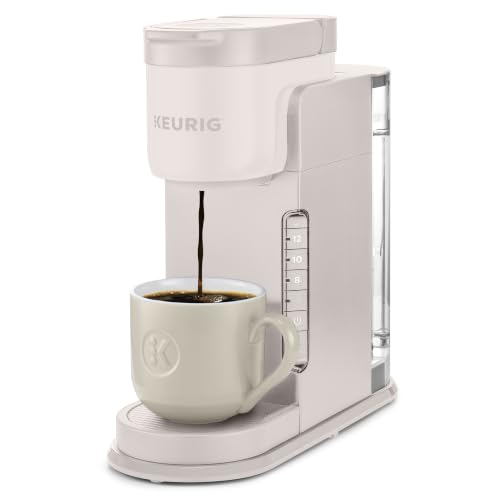
Keurig K-Express Single Serve Coffee Maker, Warm Stone
Badge: Best-Looking Fast Brewing
Strengths
- The complete K-Express fast brewing architecture — ready reservoir, three sizes, Strong Brew — in Warm Stone.
- The finish suits stone, timber, and warm-white kitchens where the fast machine must also belong visually.
- Full K-Cup compatibility keeps the cycle’s supply unrestricted.
Trade-offs
- No brewing difference from the other finishes; this review exists for the room, and says so.
- Mid-tone finishes show splashes more readily than black.
- Same three-size ceiling and pod pattern as the platform.
Mini spec box: Format: single serve K-Cup pod, works with all K-Cup pods · Brew sizes: 3 · Reservoir: 42 oz, removable · Controls: Strong Brew button · Fit: travel mug friendly · Colour: Warm Stone.
The Warm Stone K-Express closes the platform trio in this guide, and its review can be the shortest honest one: the brewing is the platform’s, the reservoir is the platform’s, the sizes and Strong Brew are the platform’s, and the colour is a warm neutral chosen for kitchens built from pale stone and light wood. In those kitchens, black reads as a hole and bright colours read as noise; Warm Stone reads as belonging, and a machine that belongs gets kept on the counter, plugged in, tank filled — which is to say, kept fast. There is a genuine, if indirect, brewing argument for the right finish: the machine that lives ready is the machine that brews fast.
Choose among the three finishes with the room in front of you and no guilt in any direction. The coffee will not know the difference. You will, every morning, and in a category purchased for daily use, your experience of the machine is part of the machine.
Best for: warm-toned kitchens wanting the platform’s fast brewing in a finish that belongs / Not suited for: buyers expecting a functional difference between finishes
Comparison Table
| Pick | Architecture | Ready water | One-pass ceiling | Speed trait | Check |
|---|---|---|---|---|---|
| Keurig K-Express, Mint | Single-serve pod | 42 oz reservoir | 3 brew sizes | Ready water, Strong Brew | Check on Amazon |
| Hamilton Beach FlexBrew 4-in-1 | Single-serve, dual format | 45 oz reservoir | Hot and iced range | Maker-stated fast brewing design | Check on Amazon |
| Ninja PB051 | Single-serve, dual format | 56 oz reservoir | Up to 24 oz, 4 styles | One-pass throughput | Check on Amazon |
| Keurig K-Elite | Single-serve pod | See listing | Single serve | Direct pod cycle, premium finish | Check on Amazon |
| Keurig K-Express, Black | Single-serve pod | 42 oz reservoir | 3 brew sizes | Ready water, Strong Brew | Check on Amazon |
| Keurig K-Express, Warm Stone | Single-serve pod | 42 oz reservoir | 3 brew sizes | Ready water, Strong Brew | Check on Amazon |
How to Choose a Fast Brewing Coffee Maker
Start with your vessel, because it decides more than any other factor. Measure the cup or tumbler you actually drink from, in ounces, and compare it honestly against each machine’s one-pass range. If your vessel exceeds a machine’s ceiling, that machine’s cycle speed is irrelevant — you will run it twice, and two medium cycles lose to one large one every time. This single check is why the Ninja leads this guide for tumbler households and why the K-Express trio, with their three sensible sizes, leads it for standard-mug households. Speed is per finished cup, not per cycle, and the finished cup is the only unit your morning recognises.
Next, weigh readiness. A reservoir machine’s cycle begins the moment you ask; the water is present, at the machine, in quantity. Size the reservoir to your pattern — 42 oz for most couples, 45 and 56 oz for heavier or more varied use — and prefer removable tanks, because the reservoir you can wash is the reservoir whose water you will trust at speed. Then consider format friction: pods remove measuring from the cycle’s surroundings, grounds remove the pod step, and dual-format machines remove the risk that the house’s current stock slows you down. Finally, discount any speed claim you cannot trace to architecture or to a maker’s stated design brief. A number without a method is advertising, and this category’s honest differences — scope, ceiling, readiness — are all visible without one.
How Brewing Speed Works, and How to Keep It
A brew cycle spends its time in three places: heating water, moving water, and passing that water through coffee. Single-serve machines are fast chiefly because all three quantities are small — one cup’s water to heat, a short path to move it through, a single serving of coffee to extract. Batch machines invert the maths, heating and delivering many cups’ worth even when only one will be drunk, which is why the honest fast-brewing shortlist is a single-serve shortlist, and why households that truly need volume at speed should compare batch throughput separately, the question framed by Best Five Cup Coffee Makers and its neighbours rather than by this guide.
Keeping a machine fast is a short routine. Descale on the manufacturer’s schedule — mineral scale narrows the water path and insulates heating surfaces, taxing both the moving and the heating thirds of every cycle, and it is the overwhelming reason owners report a machine “getting slower.” Keep the reservoir water reasonably fresh and the tank washed, so readiness never becomes reluctance. Remove spent pods and grounds promptly; a fouled brew path extracts worse and can restrict flow. Troubleshooting, in pattern. Problem: the stream has thinned and the cycle lengthened over months → descale first; it is the cause in the great majority of cases. Problem: the cup is fast but weak at the largest size → the dose has been outgrown, not the machine; use a strength or style setting, or accept two cycles for the biggest vessels. Problem: the first cup is fast and the second is not → the reservoir ran dry between them; readiness is a stocking habit, and the fix is an evening refill.
Fast Brewing Versus Batch Brewing, in Throughput Terms
The fairest comparison between this guide’s single-serve machines and a drip pot is not cycle against cycle but morning against morning. For one or two cups, single-serve wins outright: the pot’s larger heating and delivery load is spent mostly on coffee that waits, cools, or is poured away. Somewhere around a household drinking several same-sized cups at the same time, the pot’s single large cycle overtakes the sequence of single cycles, and beyond that point batch brewing is the genuinely faster system per cup served. Neither result is a verdict on the machines; it is a description of two architectures crossing at a household size.
Knowing your side of the crossing is the whole decision. Under it, buy the single-serve architecture ranked here and enjoy cycles that match demand exactly. Over it, buy a good drip machine and let this guide’s picks serve as the household’s second, off-peak brewer — a role at which the reservoir models excel, since their readiness costs nothing while they wait. The mistake is forcing one architecture to impersonate the other: a single-serve machine queueing for six at brunch, or a pot brewed for one at midnight, are the same error in opposite directions. Readers whose kitchens run on the unadorned batch side of that line will find its purest expression under Best Filter Coffee Makers.
Reading Speed Claims Like an Editor
Because this category sells velocity, it attracts the loosest language in coffee, and a short critical apparatus is worth more than another ranking. Sort every speed sentence into three kinds. Architecture sentences — single-serve format, reservoir size, cup-size ceiling — are checkable facts, and they built this guide. Design-intent sentences — a maker’s statement that a machine is built for fast brewing, as with the FlexBrew — are genuine information about engineering priorities, to be weighed as intent rather than measurement. Atmosphere sentences — words like “lightning” and “instant” attached to no mechanism at all — commit the maker to nothing and should be priced accordingly, at zero.
Apply the sort and this guide’s order explains itself. The Ninja leads on architecture: ceiling and reservoir, both countable. The FlexBrew holds the strongest design-intent claim, stated by its maker across its whole repertoire. The K-Express trio stands on the reservoir architecture it shares. And the K-Elite is presented with its verified ground labelled, so its premium can be judged without counterfeit numbers. A buyer who keeps those three piles separate will never be sold a stopwatch that does not exist — and will notice, as this guide hopes, how much honest speed remains once the imaginary kind is discarded. The category’s wider feature landscape, for readers who want to compare beyond pace, is inventoried under Best Features On Single Cup Coffee Makers.
Fast Brewing for Iced Coffee and Other Special Cases
Iced coffee exposes a pleasant paradox in fast brewing: the drink is served cold, but it is made with a hot, fast cycle, and the quality of the result depends on the ratio between the two. The FlexBrew brews iced coffee as one of its four jobs, and the technique that honours its design is the same one this programme recommends everywhere: a full glass of ice, a smaller and stronger hot brew delivered directly over it, and additions stirred in after the chill. Brewed that way, the fast cycle is an advantage — the coffee spends the least possible time hot and exposed before the ice takes it down — and the drink tastes deliberate rather than diluted. Brewed large and weak over a few cubes, the same machine produces the watery result that gives home iced coffee its unfair reputation.
Other special cases follow the same pattern of the cycle serving the drink rather than defining it. A travel tumbler is a fast brewing problem of ceiling, solved by the Ninja’s one-pass range. A second cup for a partner is a problem of readiness, solved by every reservoir in this guide. A cup in a rented or borrowed kitchen is a problem of supply, solved by dual-format machines that accept whatever coffee the house contains. Naming the special case your household actually lives is worth more than any general speed ranking, including this one — the rankings exist to be consulted after the case is named, not instead of naming it.
The Reservoir, Considered as a Speed Part
It is worth pausing on the component this guide keeps crediting, because reservoirs are usually filed under convenience when they belong under performance. A reservoir converts brewing from a two-stage process — fetch and heat water, then brew — into a one-stage process that begins at the coffee. It also stabilises the cycle’s conditions: the machine draws from a known supply at a known state, rather than from whatever the morning’s measuring produced. And its size sets the household’s refill rhythm, which is why this guide treats the step from 42 to 45 to 56 oz as a genuine fast brewing variable rather than a capacity footnote: every refill avoided is a preamble deleted from a future morning.
The reservoir’s costs are the ones this guide has noted throughout: it must be washed, its water should turn over rather than age, and a removable design — every reservoir pick here is removable — is what makes both duties easy enough to actually happen. A fast brewing machine with a neglected fixed tank is a contradiction that develops slowly and then all at once. Choose the removable tank, keep it clean, and the reservoir remains what it was designed to be: the part of the machine that makes every other part feel fast.
Fast Brewing in a Shared or Working Kitchen
Offices, workshops, and shared houses judge fast brewing by a harsher standard than homes do: the queue. In a shared kitchen, a machine’s speed is experienced by the person waiting behind the person brewing, and the traits that matter shift accordingly. Reservoir size becomes a courtesy feature — the 56 oz Ninja or the 45 oz FlexBrew can serve a morning’s worth of colleagues without anyone performing a refill in front of an audience. Format tolerance becomes peace-keeping, because a shared machine that accepts both pods and grounds ends the supply disputes that make communal coffee political. And cycle directness becomes the whole product: in a queue, nobody wants to watch a colleague navigate a menu.
The shared setting also raises the maintenance stakes, because no single owner feels responsible for the descale that keeps the machine fast. The practical fix is social rather than technical: name an owner, put the routine on the calendar, and keep supplies stocked at a level above the day’s demand. A fast brewing machine in a shared kitchen is a small commons, and like all commons it runs on one person’s quiet diligence — a truth worth knowing before the machine, rather than after the first slow, scaled, resented month.
Common Buying Mistakes
The first fast brewing mistake is comparing cycle claims instead of finished cups, and buying a small-ceiling machine for a large-tumbler life. The second is ignoring the reservoir, then performing a fill ritual before every “fast” cup. The third is stretching one dose across the largest size and concluding the machine brews weakly, when it brews exactly as dosed. The fourth is letting scale accumulate and shopping for a faster replacement instead of descaling the machine you own. The fifth is demanding batch service from a single-serve architecture at gatherings, then blaming the category. The sixth is paying for a speed atmosphere — adjectives without architecture — when the honest traits in this guide, ceiling, reservoir, and stated design, were available to compare all along.
Final Recommendation
For fast brewing as households actually experience it, take the Ninja Single Serve PB051: one-pass cups to 24 oz, both formats, four styles, and the largest ready reservoir make it the throughput leader of this guide. Choose the Hamilton Beach FlexBrew Advanced 4-in-1 when you want the maker’s own fast brewing brief applied across pods, grounds, hot, and iced. Take the K-Express platform for the purest reservoir-fed direct cycle, in Black for neutrality, Mint for brightness, or Warm Stone for warm rooms — the brewing is one architecture in three finishes. And choose the K-Elite when the fast cycle must arrive in brushed silver. However you choose, protect the purchase with the descaling habit: in fast brewing, maintenance is not upkeep, it is the speed itself, renewed on a schedule, in a category where the difference between a fast machine and a slow one is very often nothing more than the difference between an owner who descaled and an owner who meant to.
Frequently Asked Questions
What makes a coffee maker brew fast?
Architecture, mainly: heating and delivering one cup’s water instead of a pot’s, keeping water ready in a reservoir so the cycle starts immediately, and completing your real cup size in one pass. Design intent matters too — some machines, like the FlexBrew, are described by their maker as fast brewing designs across their whole range.
Why does this guide not list brew times in seconds?
Because the verified product data behind these picks does not include comparable measured cycle times, and printing invented figures would mislead exactly the buyers this guide serves. The ranking rests on checkable architecture — format, reservoir, cup ceiling — and on makers’ stated design briefs, labelled as such.
Is a bigger cup size range really a speed feature?
Yes, in the only unit that matters: finished cups. A machine that completes a 24 oz tumbler in one cycle, like the Ninja, is faster for that drinker than a machine with a quicker small cycle that must run twice and be combined.
Why has my coffee maker slowed down?
Almost always mineral scale, which restricts water flow and dulls heating gradually. Descale following the manufacturer’s directions and reassess; in most cases the original pace returns, because the architecture that made the machine fast has not changed — only its plumbing has narrowed.
Are pods or grounds faster to brew with?
The cycle itself is comparable; the surroundings differ. Pods remove measuring and rinsing, grounds remove the pod step and its supply chain. Dual-format machines like the Ninja and FlexBrew remove the question, which is its own kind of speed for households whose stock varies.
Can a fast brewing machine serve several people at breakfast?
Sequentially, yes, and reservoir models handle the relay well. Simultaneously, no single-serve machine can match a batch pot once several same-time cups are needed. Match the architecture to the household’s pattern rather than asking one design to win both contests.
Do fast brewing machines need different coffee than slow ones?
No different coffee, but less forgiving coffee. A quick, direct cycle extracts what is in front of it, so stale pods, tired grounds, or a dose stretched across an oversized cup show up in the glass without anywhere to hide. Fresh supplies, an honest dose for the size selected, and a strength or style setting used when the cup is large will keep a fast cycle tasting deliberate. Owners sometimes blame pace for thin coffee that was actually a supply problem travelling at speed; fix the input before questioning the architecture.
What is the fastest way to serve coffee to overnight guests?
Stage the machine the night before — reservoir full, a visible choice of pods or grounds, cups set out — and brew to order in the morning, one cup per guest, at each guest’s size and strength. A reservoir pick from this guide turns that into a relaxed sequence rather than a project, and guests experience the speed as hospitality rather than haste, which is the best form fast brewing takes in any kitchen, shared or private, at any hour of the morning, on any day of the week, for any guest at the table, expected or otherwise, in any season.
Should I time my machine’s cycle to compare it with a new one?
You can, and the exercise is more useful than it sounds — provided you time the whole routine, from arriving at the counter to holding the finished cup, rather than the brew cycle alone. Most households that perform this small audit discover their delay lives in filling, deciding, and second cycles, not in the brew itself, and that discovery redirects the purchase toward readiness and ceiling, which are the traits this guide ranks. Time the morning, not the marketing.
Which fast brewing pick suits a two-person household best?
For two people with standard mugs, the K-Express platform is the natural fit: its 42 oz reservoir covers the relay without daily refills, and its three sizes and Strong Brew button cover the realistic range of two drinkers’ cups. Step up to the Ninja when either person’s vessel is a large tumbler or their formats differ, and to the FlexBrew when iced coffee joins the household’s regular orders.
Does cold or room-temperature starting water change brewing speed?
Any brewer must bring its water to brewing temperature, so the state of the water it starts from is part of the cycle’s work. A reservoir machine manages that work on its own schedule and stock; a fill-per-cup routine hands the machine whatever the tap provided. The practical lesson is not to game the water but to keep the machine descaled, since scale insulates heating surfaces and taxes every cycle regardless of starting temperature.
Is fast brewing harder on a machine?
Fast brewing as designed here is ordinary brewing at single-cup scope, not a stressed mode. What ages any of these machines is the accumulation of scale and coffee residue, plus thermal cycling over years — all governed by the maintenance rhythm in this guide rather than by how quickly the machine brews. A fast machine kept clean will outlast a slow machine neglected, comfortably.
Does the Strong Brew setting slow the cycle down?
Strength settings work by adjusting the brew’s contact pattern rather than by adding a second cycle, and they exist so a fast cup does not have to be a weak one. Use the Strong Brew button on the K-Express models, or a style setting on the Ninja, whenever a large or hurried cup tastes thin.


