Disclosure: topratedkitchenware.com is reader-supported. When you buy through links on our site, we may earn an affiliate commission from Amazon and other retailers, at no extra cost to you.
Where to buy
If you are shopping for the best food dehydrators for jerky, the six machines below are the shortlist this guide is built around, and each is linked so you can check its current Amazon listing and full manufacturer detail before you order. Jerky makes specific demands that general dehydrating does not — a temperature range that reaches the jerky zone, trays that survive fatty batches and scrubbing, airflow that dries meat evenly in a single layer, and a timer that outlasts the longest batch — so this guide scores every pick against those demands first and treats fruit, herbs and treats as the bonus they are. Two listings here do not state their maximum temperature, and one machine’s range stops short of the jerky zone; all three facts are flagged in their reviews rather than smoothed over, because jerky is preserved meat and honesty about temperature is a safety matter, not a style choice.
- Best Overall: Magic Mill Pro Food Dehydrator — Check on Amazon
- HOPERAN 16 Tray Food Dehydrator — Check on Amazon
- PSIIDAN Food Dehydrator, 8 Trays — Check on Amazon
- Magic Mill Food Dehydrator, 5 Stackable Trays — Check on Amazon
- Elite Gourmet 5-Tray Food Dehydrator — Check on Amazon
- FOHERE Food Dehydrator — Check on Amazon
Read the full guide ↓
The best food dehydrators for jerky are decided by three numbers and one design. The numbers are the top of the temperature range — home jerky guidance commonly centres on drying that reaches about 165 degrees Fahrenheit for beef, frequently with a pre-heating or finishing step for the meat itself — the drying area, because jerky lies in a single layer and batch size is square feet wearing a disguise, and the timer length, because a thick batch runs for many hours and should never depend on someone remembering to restart a machine. The design is airflow: rear-fan horizontal systems push air across every tray and finish batches together, while stackable systems trade a little of that evenness for flexibility. Every pick below is read against that framework, and the ranking follows it without exception.
The field divides into clear roles. The Magic Mill Pro is the complete jerky specification — wide temperature range, rear fan, seven full-size stainless trays, and working details like keep-warm and auto shutoff. The HOPERAN is the bulk answer, with sixteen trays and two fans for households that process a season at a time. The PSIIDAN concentrates eight trays and the joint-strongest conventional motor into a single box. The stackable Magic Mill is the flexible format. The Elite Gourmet is the classic simple tray machine, included with a note that its listing does not state a temperature range, so jerky buyers must verify it. And the FOHERE is the light-duty end of the category, included with its 158°F ceiling stated plainly. Readers comparing the wider dehydrator market beyond jerky should also scan Best Food Dehydrators For Sale, where the same machines are weighed for general use.
This guide is research-led. Every specification is taken from the manufacturer’s listing and reported as the maker’s own claim; nothing is described as hands-on tested. The jerky method in the how-to section follows widely published food-safety practice for home meat drying, and new makers should treat it as required reading: a dehydrator is a simple machine, and nearly all home jerky failures are procedural rather than mechanical.
Key Takeaways
- Temperature reach is the jerky gatekeeper: look for a listed range reaching about 165°F for beef jerky. The Magic Mill Pro and PSIIDAN clear it on their listings; the FOHERE stops at 158°F and is flagged; the HOPERAN and Elite Gourmet listings do not state a range and must be verified.
- The Magic Mill Pro is the most complete jerky machine here: 95–176°F, a 600W rear fan, 7 full-size stainless trays, keep-warm and auto shutoff, ETL listed.
- Batch size is drying area in a single layer: the HOPERAN’s 16 trays serve bulk processors, the PSIIDAN’s 8 full-size trays serve large households, and 5-tray machines serve weekly-scale makers.
- Stainless trays dominate this shortlist because jerky is fatty: they scrub clean after meat batches in a way plastic resents.
- Technique decides safety more than hardware does — lean meat, uniform slices, refrigerated marinating, tested temperatures and the bend test, every batch.
In this guide
Quick Picks
| Pick | Badge | Standout feature from its listing | Link |
|---|---|---|---|
| Magic Mill Pro Food Dehydrator | Best Overall | 7 full-size stainless trays, 600W rear fan, 95–176°F, keep warm, auto shutoff, ETL listed | Check on Amazon |
| HOPERAN 16 Tray Food Dehydrator | Best for Bulk Batches | 16 trays, 2 fans, 800W, quiet under 48 dB, mesh screens and fruit roll tray included | Check on Amazon |
| PSIIDAN Food Dehydrator, 8 Trays | Best Large Box | 8 full-size stainless trays, 650W, 95–167°F, 48-hour digital timer | Check on Amazon |
| Magic Mill Food Dehydrator, 5 Stackable Trays | Best Flexible Format | 5 stackable stainless trays, digital controls up to 167°F, 48-hour timer | Check on Amazon |
| Elite Gourmet 5-Tray Food Dehydrator | Best Simple Classic | 5 BPA-free 11.4-inch trays, adjustable temperature; listing does not state the range — verify before jerky use | Check on Amazon |
| FOHERE Food Dehydrator | Best Light-Duty | 5 BPA-free stackable trays, 400W, 95–158°F — below the usual jerky zone; see its review | Check on Amazon |
How These Picks Were Chosen
We scored the dehydrators in our verified pool on a jerky-specific rubric, in this order: listed temperature reach against the jerky zone; tray material and cleanability after fatty meat; airflow design and its evenness across a full load; capacity expressed as trays and, where the maker states it, area; timer length against long batches; and the working details — shutoff behaviour, included screens, noise — that decide how a machine behaves across a season of use. Specifications come from manufacturer listings and are reported as the makers’ claims.
Three editorial judgements in this guide deserve daylight. First, where a listing does not state a maximum temperature — the HOPERAN and the Elite Gourmet — we say so in the review and the comparison table rather than assuming the number a jerky buyer needs; both machines are listed by their makers for jerky use, so they stay in the guide, but verification on the live listing is part of their purchase. Second, the FOHERE stays in the guide with its 158°F ceiling flagged in every place it appears, because a shortlist that silently deletes its boundary teaches buyers nothing about where the boundary is. Third, we ranked the Magic Mill Pro first despite the HOPERAN’s larger tray count, because jerky quality is set by the combination of verified temperature reach and even airflow across a load a household will actually run — and on verified specifications, the Pro is the most completely documented jerky machine in the pool. Readers whose drying life is mostly low-temperature projects, such as Best Food Dehydrators For Making Vegan Bread, should invert parts of this rubric: there, the low end of the dial matters more than the top.
The 6 Best Food Dehydrators for Jerky

Magic Mill Pro Food Dehydrator
Badge: Best Overall
Strengths
- A verified 95–176°F range gives jerky makers the full zone plus headroom, on the record, in the listing.
- The 600W rear-fan even-drying system across 7 full-size stainless trays is the airflow arrangement jerky rewards most.
- Keep-warm, auto shutoff and an ETL listing are the working details of a machine meant for long, unattended meat batches.
Trade-offs
- A serious box to store; casual households will find it more machine than their drying life needs.
- Fixed box format — capacity does not shrink for a two-tray batch.
- Its strengths are jerky-and-volume strengths; herb-only households are buying capability they will not touch.
Mini spec box
- Trays: 7 full-size stainless steel trays
- Temperature: 95°–176°F control
- Power: 600W rear fan
- Timer: 48 hours
- Functions: Keep warm, auto shutoff
- Certification: ETL listed (manufacturer listing)
Every element of the jerky rubric is answered here, in writing, by the manufacturer. The temperature range runs from a gentle 95°F to 176°F, which means the jerky zone is not approached at the machine’s limit but sits comfortably inside its capability — headroom matters because a dehydrator holding its maximum for ten hours is working harder than one cruising below it. The rear fan drives air across seven full-size stainless trays, the arrangement that finishes a loaded batch most evenly, and stainless is the tray material that shrugs off the scrubbing a fatty beef batch demands afterwards.
The supporting details read like they were specified by someone who dries meat. Keep-warm holds a finished batch safely when the maker is asleep or out; auto shutoff closes a run cleanly; the 48-hour timer covers the thickest cuts without a restart ritual; and the ETL listing is the quiet line that separates documented appliances from anonymous ones. The honest costs are commitment and size: this is equipment for a household that dries in earnest, and it will dominate a small kitchen’s storage. For the jerky maker who wants one machine, fully specified, with nothing important left to assumption, the Pro is the guide’s clear answer.
Best for: committed jerky makers who want the most completely specified machine in the guide / Not suited for: occasional dryers or minimal kitchens

HOPERAN 16 Tray Food Dehydrator
Badge: Best for Bulk Batches
Strengths
- Sixteen trays is the largest format in this guide by a wide margin — a season’s processing in very few runs.
- Two fans and 800W are specified for moving air through that full stack, with noise stated under 48 dB.
- Included mesh screens and a fruit roll tray extend it beyond jerky to small pieces and leathers.
Trade-offs
- The listing does not state its temperature range — jerky buyers must verify the maximum on the live listing before relying on it for meat.
- Sixteen trays is a storage and cleaning commitment proportional to its capacity.
- Its scale is wasted on weekly small-batch households.
Mini spec box
- Trays: 16, stainless steel
- Power: 800W, 2 fans
- Controls: Digital temperature and timer control (range not stated in listing)
- Noise: Quiet, under 48 dB (manufacturer listing)
- Included: 2 mesh screens, 1 fruit roll tray
- Stated uses: Jerky, fruit, herbs, dog treats (manufacturer listing)
The HOPERAN exists for the household whose jerky arrives by the season rather than the week: the hunter with a successful autumn, the family that buys a side of beef, the gardener-processor whose preserving calendar peaks twice a year and idles between. Sixteen trays convert that glut into a small number of very large runs, and the specification takes the obvious objection seriously — moving air evenly through sixteen trays is a real engineering ask, answered here with two fans and 800W, the strongest power figure in this guide, while keeping stated noise under 48 dB so a long run can live in the house rather than exile itself to the garage.
The included extras — mesh screens for small items, a fruit roll tray — acknowledge that a bulk machine’s owner processes everything, not just jerky. The one verification this guide insists on is temperature: the listing describes digital temperature control without stating the range, and jerky buyers should confirm the maximum on the live listing before counting on it for meat, exactly as its review in this guide flags. With that confirmed, the HOPERAN is the bulk pick without rival here; without the need for bulk, it is a great deal of machine to store, wash and walk around.
Best for: hunters and bulk processors who dry a season at a time / Not suited for: small-batch households or buyers unwilling to verify the temperature range

PSIIDAN Food Dehydrator, 8 Stainless Steel Trays
Badge: Best Large Box
Strengths
- Eight full-size stainless trays with a verified 95–167°F range is a large, fully documented jerky capacity.
- 650W is strong power for full loads, aimed at faster drying when the machine is at its fullest.
- A 48-hour digital timer covers the longest batches without supervision rituals.
Trade-offs
- Total drying area in square feet is not stated; verify tray dimensions on the listing if area arithmetic drives your choice.
- A newer name beside the established brands here; judge on specification and listing completeness.
- Large-box storage applies, as with the Pro.
Mini spec box
- Trays: 8 full-size stainless steel trays
- Temperature: 95°–167°F control
- Power: 650W
- Timer: 48-hour digital timer
- Stated uses: Beef jerky, fruits, vegetables, dog treats (manufacturer listing)
The PSIIDAN is the straightforward large-box case: eight full-size stainless trays, a temperature range that clears the jerky zone with its 167°F top, 650W behind the load, and a digital timer that runs the full two days a thick batch can claim. Where the HOPERAN asks for a verification, the PSIIDAN’s jerky-critical numbers are on the record, which makes it the capacity pick for buyers who want scale without homework. Its stated uses lead with beef jerky, and the specification supports the billing.
Its cautions are the ones this guide applies to any newer name: the brand has less history behind it than Cosori or Magic Mill, and the listing omits a square-foot area figure, so the careful buyer confirms tray dimensions before comparing its true capacity against stated-area rivals. Neither caution touches the machine’s documented jerky fitness. For a large household — or a small one that hosts, gifts and trades its jerky widely — the PSIIDAN offers the most verified trays-per-box in this guide after the Pro’s all-round case is weighed.
Best for: large households wanting maximum verified capacity in one box / Not suited for: buyers who rank brand history above specification
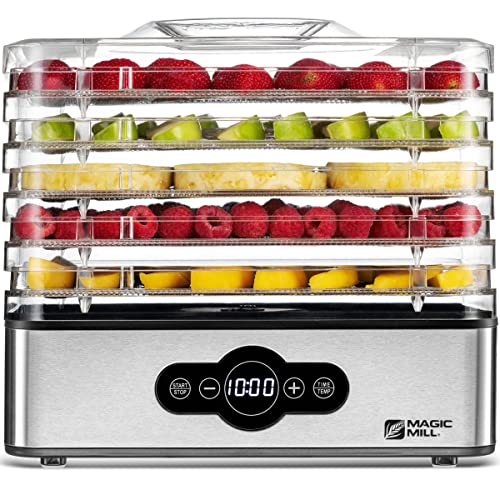
Magic Mill Food Dehydrator, 5 Stackable Stainless Steel Trays
Badge: Best Flexible Format
Strengths
- Stackable stainless trays flex the machine to the batch — five trays for jerky day, fewer for a herb run.
- Digital temperature control up to 167°F clears the jerky zone, with a 48-hour digital timer.
- Stainless in a stackable format cleans after meat the way plastic stacks cannot match.
Trade-offs
- Stack airflow finishes trays unevenly compared with rear-fan boxes; a mid-batch rotation is the working compensation.
- Five trays is mid-capacity in a guide that tops out at sixteen.
- Flexibility is its virtue; pure jerky throughput belongs to the box machines above.
Mini spec box
- Trays: 5 stackable stainless steel trays
- Temperature: Adjustable, up to 167°F
- Timer: 48-hour digital adjustable timer
- Stated uses: Jerky, fruit, dog treats and more (manufacturer listing)
Not every jerky household dries on a schedule, and the stackable Magic Mill is built for the irregular ones. Its five stainless trays stack to the size of the job: a full stack when a cut of beef has been marinated, two trays when the garden offers a handful of peppers, storage at whatever height the cupboard prefers. The digital controls are fully modern — temperature adjustable to a jerky-clearing 167°F, a 48-hour timer — so the format’s flexibility costs nothing in the specifications that matter for meat.
The physics tax is airflow path: in a stack, the trays nearest the heat finish first, and the experienced stack owner’s habit — rotating trays once or twice across a long batch — is the price of the format’s freedom. Jerky tolerates that habit well, since batches benefit from a mid-run inspection anyway. Households whose drying is genuinely various, and whose storage is genuinely tight, will find this the most livable machine in the guide; households running weekly uniform batches should take the rear-fan Pro and skip the rotations.
Best for: irregular, varied drying in space-conscious households / Not suited for: makers who want a fully unattended, uniform finish
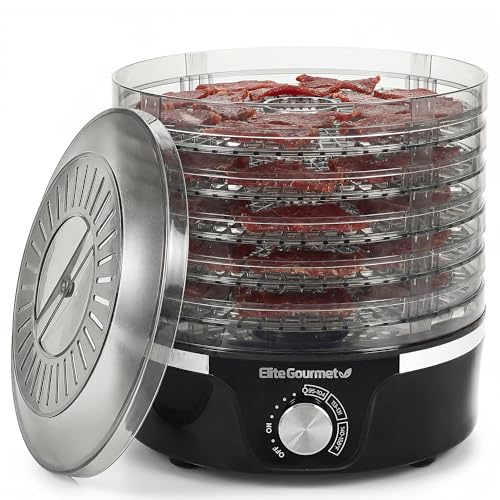
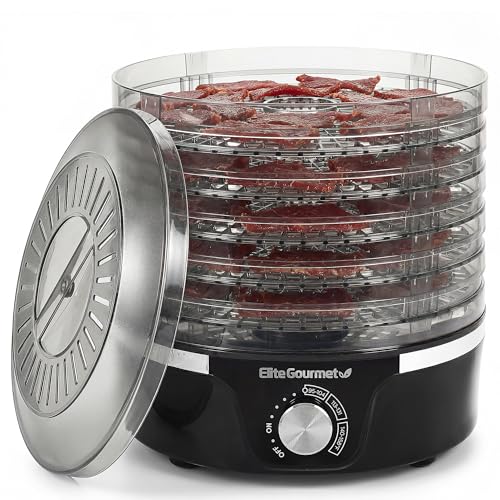
Elite Gourmet 5-Tray Food Dehydrator (EFD319)
Badge: Best Simple Classic
Strengths
- The classic tray format in its simplest form: 5 BPA-free 11.4-inch trays and an adjustable temperature dial.
- Listed by its maker for jerky, fruit, herbs and vegetables — the standard home repertoire.
- Simplicity is a feature for beginners and for households that dry occasionally.
Trade-offs
- The listing does not state the temperature range — jerky buyers must confirm the maximum before relying on it for meat; this guide will not guess it.
- BPA-free plastic trays rather than stainless, with the scrubbing limits that implies after fatty batches.
- A basic feature set beside the digital, timer-led machines around it.
Mini spec box
- Trays: 5, BPA-free, 11.4-inch
- Temperature: Adjustable (range not stated in listing)
- Model: EFD319
- Finish: Black
- Stated uses: Jerky, fruit, herbs and vegetables (manufacturer listing)
The Elite Gourmet represents the dehydrator most households picture first: a stack of round trays, a temperature dial, a familiar brand, and a stated repertoire that leads with jerky. For fruit, herbs and vegetables it asks nothing of its owner but loading and patience, and its simplicity is honestly matched to occasional use. Its inclusion in a jerky guide, however, comes with this guide’s clearest verification note. The listing provided for this machine states adjustable temperature without stating the range, and jerky — preserved meat, made to be stored and eaten over weeks — is exactly the application where “probably hot enough” is not good enough.
So the professional advice is procedural: if this simple classic appeals, open the live listing and confirm the maximum temperature before buying it for meat; if the number clears the jerky zone, it is a legitimate light-duty jerky machine, and if it does not, it is a produce dehydrator and should be bought as one. We link it because its maker lists it for jerky and many owners will verify happily — but verification is part of this pick’s price, and pretending otherwise would fail the reader this guide exists for. Households that prefer their jerky specifications documented in advance should take the Magic Mill Pro or the PSIIDAN and skip the homework.
Best for: beginners and occasional dryers willing to verify one number / Not suited for: jerky-first buyers who want every specification documented upfront

FOHERE Food Dehydrator
Badge: Best Light-Duty
Strengths
- Five BPA-free stackable 11.42-inch trays with a 48-hour timer cover general drying in the lightest format here.
- A 95–158°F range suits fruit, herbs, vegetables and treats — the majority of many households’ drying.
- Simple 400W operation is the gentlest learning curve in the guide.
Trade-offs
- 158°F maximum is below the commonly cited jerky zone of about 165°F — the defining limitation of this pick for meat.
- Plastic trays rather than the stainless fitted to the guide’s jerky leaders.
- Light-duty power and build suit occasional use, not seasonal processing.
Mini spec box
- Trays: 5 BPA-free stackable trays, 11.42-inch
- Temperature: 95–158°F control
- Power: 400W
- Timer: 48 hours
- Stated uses: Food and jerky, fruit, herbs, meat, dog treats (manufacturer listing)
The FOHERE closes this guide the way it closed its sibling guide: as the honest boundary of the category. Taken as a general dehydrator, it is coherent and likeable — light, simple, stackable, with a full timer and a range that covers the produce-led drying most households actually do, from apple slices to garden herbs to dog treats. Its maker’s listing includes jerky among its uses, and this guide includes the machine for completeness, with the flag it owes every reader.
The flag is a number: 158°F. Home jerky practice commonly works to a zone reaching about 165°F for beef, often with the meat itself heated before or after drying under tested procedures. A machine whose dial stops below that zone leaves its owner to build the safety margin entirely from those additional steps, or to accept a process this guide cannot recommend for stored meat. Jerky-first buyers should therefore read the FOHERE as a fine produce dehydrator that can participate in a carefully managed jerky process, and should buy one of the five machines above it — several at comparable simplicity — if jerky is the headline purpose. Boundaries stated plainly are how shortlists stay trustworthy.
Best for: produce-led households that dry meat rarely and carefully / Not suited for: jerky-first buyers, full stop
Comparison Table
| Pick | Trays and material | Temperature (listing) | Power | Jerky verdict | Link |
|---|---|---|---|---|---|
| Magic Mill Pro | 7 full-size stainless | 95–176°F | 600W rear fan | Fully verified jerky specification | Check on Amazon |
| HOPERAN | 16 stainless | Not stated — verify | 800W, 2 fans | Bulk capacity; confirm maximum temperature | Check on Amazon |
| PSIIDAN | 8 full-size stainless | 95–167°F | 650W | Verified range, largest documented box | Check on Amazon |
| Magic Mill Stackable | 5 stainless, stackable | Up to 167°F | Not stated in listing excerpt | Verified range; rotate trays for evenness | Check on Amazon |
| Elite Gourmet EFD319 | 5 BPA-free | Adjustable, range not stated — verify | Not stated in listing excerpt | Maker lists it for jerky; confirm the maximum | Check on Amazon |
| FOHERE | 5 BPA-free, stackable | 95–158°F | 400W | Below the usual jerky zone — flagged | Check on Amazon |
How to Choose a Dehydrator for Jerky
Work the rubric in order and let it eliminate. First, temperature: demand a listed maximum that reaches the jerky zone, about 165°F for beef, and treat an unstated range as a question to answer on the live listing — never as a number to assume — while treating a stated maximum below the zone as a disqualification for jerky-first use. Second, trays: stainless if jerky is a habit, because the cleaning after fatty batches is where plastic trays age fastest and where hygiene is actually decided. Third, capacity in single-layer terms: count your realistic batch — the marinade bowl you actually make — and buy the tray area that loads it once. Fourth, airflow: rear-fan horizontal for unattended evenness, stackable for flexibility with a rotation habit. Fifth, the working details: a 48-hour timer, an auto shutoff or keep-warm if your life runs batches overnight, and noise low enough that a ten-hour run can share the house.
Then sanity-check the choice against the household’s whole drying year. Jerky may headline the purchase, but the machine will also meet the garden, the fruit glut and the dog, and the low end of its range — 95°F on the verified picks here — is what those meetings are made of. Households with low-temperature ambitions, from herbs to projects like Best Food Dehydrators For Soaked Nuts, should confirm the dial’s floor as carefully as jerky buyers confirm its ceiling. Finally, buy the size your second season needs, not just your first batch: jerky households almost always expand — more cuts, more marinades, more recipients — and the price of capacity is lowest on the day the first machine is chosen. The fuller shopping picture, including how these machines sit in the general market, is covered at Best Food Dehydrators To Buy.
How to Make Jerky: The Complete Home Method
Select lean meat and keep it cold from shop to slicing. Fat is jerky’s enemy twice over — it dries poorly and it shortens storage life — so trim visibly and choose lean cuts without apology. Partially freeze the meat until it is firm but not rock-hard, then slice uniformly, about a quarter-inch thick: with the grain for a chewy, traditional tear, across it for tenderness. Uniformity is the whole game at this stage, because a batch of mixed thicknesses cannot finish together, and jerky that finishes in instalments teaches its maker to distrust every piece.
Marinate in the refrigerator for the hours your tested recipe specifies — never at room temperature — and consider a curing salt at the recipe’s measure for flavour and margin. Drain the strips and pat them dry before loading; surface moisture is drying time and steam, not flavour. Many published home-jerky procedures include heating the meat to a safe internal temperature before drying, or a brief finish-heating afterwards, alongside drying in the machine’s jerky range; follow a tested recipe’s specified temperatures rather than improvising, because preserved meat is the one home food project where the procedure is the safety system. Load the strips in a single layer with air gaps between them — airflow is an ingredient — and set the machine to the recipe’s temperature.
Dry until the bend test passes on the thickest piece: the strip bends and its fibres crack, but it does not snap cleanly, and a cut face shows no moisture or raw-looking centre. Cool the batch fully, then condition it — sealed in a container for several days, checked daily — so residual moisture equalizes and any under-dried piece announces itself while it can still return to the machine. Store finished jerky airtight, cool and labelled with its date; refrigerate for longer keeping, and let smell and texture arbitrate any doubt, in favour of caution.
Troubleshooting, in the pattern that covers most home batches. Problem: edges are crisp while centres stay soft → the slices were uneven or the heat hardened the surface early; slice uniformly, dry steadily rather than fiercely, and always test the thickest piece. Problem: the batch dried unevenly across trays → the load was crowded or, in a stackable machine, unrotated; leave air gaps and rotate trays partway through long runs. Problem: jerky moulds or sours in storage → it was stored warm, sealed before cooling, or made from fatty meat; trim harder, cool completely, condition honestly, and store cold. Problem: flavour is flat despite a strong marinade → the strips went in dripping and steamed, or the meat was sliced too thick for the marinade’s time; pat dry before loading and keep thickness honest.
Storing, Gifting and Using What You Dry
Home jerky leaves the dehydrator with a reputation to protect, and storage is where that reputation is kept. Short-term, an airtight container in a cool cupboard serves a batch being eaten within its first weeks; longer keeping belongs in the refrigerator, and the longest in the freezer, where dried meat holds its quality far beyond the cupboard’s horizon. Vacuum sealing, if the household owns the equipment, is the jerky maker’s best friend — it removes the air that stale flavours ride on and makes gifted batches travel like they mean it. Whatever the method, label everything: cut, marinade, date. The batch you cannot identify is the batch you will eventually throw away, and a season’s log turns storage from archaeology into inventory.
Gifting deserves a sentence of its own, because home jerky is given away constantly and should be given responsibly: tell the recipient what it is, when it was made, and how to store it, and never gift a batch you had doubts about at the bend test. Within the household, jerky’s uses extend past the snack bowl — chopped into trail mixes, crumbled over salads and soups, packed for work, travel and the outdoor days it was invented for. A dehydrator bought for jerky tends, quietly, to reorganize a household’s whole relationship with preserved food; the machines in this guide are ranked for the jerky, and ready for everything that follows it.
Other Proteins: Turkey, Venison, Salmon and Ground Meat
Beef is the default, but a jerky machine earns its keep across the protein shelf, and each alternative adjusts the method in ways worth knowing before the first batch. Turkey and chicken jerky are lean, mild and popular — and they are the proteins where temperature discipline matters most, because poultry carries the strictest safety expectations in home preserving. Follow a tested poultry-specific recipe, use the machines whose ranges give you documented headroom, and treat the heat-the-meat step as non-negotiable rather than optional. This is the application where the verified-temperature picks in this guide most clearly separate themselves from the flagged ones.
Venison and other game are the traditional jerky meats in many regions, leaner than beef and often free of the fat-trimming step’s waste — but game brings its own discipline: the meat’s history before it reaches your kitchen is longer and less controlled than a shop-bought cut’s, so cold handling, prompt processing and tested temperatures carry even more weight. Hunters are also the HOPERAN’s natural constituency, since a successful season produces exactly the bulk that sixteen trays exist to absorb. Salmon jerky sits at the delicate end: richer and more fragile, dried at gentler temperatures for a shorter window, and best made in small batches on a machine whose low end is as trustworthy as its high end — one more reason this guide reads temperature ranges in both directions.
Ground-meat jerky, mentioned in the questions below, deserves its place in this survey as the great democratizer: it turns economical mince into a seasoned, portable product, forms uniformly by construction — which solves the thickness problem at a stroke — and dries predictably on mesh screens. Its handling rules are stricter, not looser, because grinding distributes surface bacteria through the batch; a ground-meat-specific tested recipe is the price of admission. Across all four alternatives, the pattern of this guide holds: the machine provides heat, airflow and time, and the maker’s procedure provides the safety. Choose documented equipment, follow documented recipes, and the dehydrator’s repertoire turns out to be as wide as the household’s appetite for learning it.
A Season With a Jerky Machine: How Ownership Settles In
The first month with any pick here is calibration: one cut, one marinade, notes taken, a batch log started. By the third month, most households have a house recipe and a rhythm — slicing on one day, drying on the next, conditioning while the following week’s meals are planned — and the machine has stopped being a purchase and become a utility. What changes across that settling-in is the owner’s sense of which specification matters, and it is remarkably consistent: nobody wishes they had bought a smaller timer, several wish they had bought more tray area, and everyone learns that cleaning design, barely noticed in the shop, is the feature that decides whether batch twelve happens at all. That is why this guide weights stainless trays and accessible interiors as heavily as headline temperatures.
The households that get the most from these machines share one further habit: they dry in rhythm with their food life rather than against it. Jerky follows the meat offer and the hunting season; fruit follows the glut; herbs follow the garden’s cutting days; dog treats follow the trimmings. A machine sized for the peaks and flexible enough for the trickles — the quality the stackable and large-box picks express in different ways — becomes the preserving centre of the kitchen. Bought with that year in view, rather than for a single inaugural batch, any of the verified picks here will justify itself many times over.
Common Buying Mistakes
- Assuming the temperature instead of reading it. Two listings in this very guide do not state a range. For meat, verify — on the listing, before purchase, every time.
- Buying under the jerky zone. A stated maximum in the 150s is a produce machine’s number. One pick here carries it, flagged; do not un-flag it in your head because the size or style appeals.
- Crowding the trays. Overlapping strips dry unevenly and slowly, and uneven jerky is a safety problem wearing a quality problem’s clothes.
- Slicing by eye. Mixed thicknesses finish at mixed times. Partially freeze, slice uniformly, and let the whole batch pass the bend test together.
- Marinating on the counter. The wet phase belongs in the refrigerator, always. Most home jerky risk is created before the dehydrator is even switched on.
- Storing warm and unlabelled. Cool fully, condition, seal, label, refrigerate for keeping. Storage is the second half of the recipe.
Final Recommendation
For most jerky makers, start with the Magic Mill Pro: its verified 95–176°F range, rear-fan airflow across seven full-size stainless trays, keep-warm and auto shutoff make it the most completely documented jerky machine in this guide. Choose the PSIIDAN for the largest verified box, the HOPERAN for true bulk once its temperature range is confirmed, the stackable Magic Mill for flexible, space-conscious drying, and the Elite Gourmet or FOHERE only with their flags in mind — verification in the first case, a temperature ceiling in the second. Buy the machine whose numbers are written down, and make jerky whose process is written down too; the two habits are the same habit.
Frequently Asked Questions
What temperature is best for dehydrating beef jerky?
Home jerky guidance commonly centres on a drying range reaching about 165°F for beef, often paired with heating the meat itself — before drying or as a finishing step under a tested recipe — so it reaches a safe internal temperature. Machines here that document that reach include the Magic Mill Pro at up to 176°F and the PSIIDAN and stackable Magic Mill at up to 167°F. Where a listing does not state a maximum, verify it before buying for meat.
How long does a batch of jerky take?
Several hours at minimum, and considerably longer for thick slices — long enough that a 48-hour timer, standard across this guide’s picks, is a genuine requirement rather than a luxury. Time is a guide, not a verdict: the batch is done when the thickest piece passes the bend test, cracking as it bends without snapping, and showing no moisture when cut.
Do I need stainless steel trays for jerky?
Need is a strong word, but stainless is the jerky maker’s material: it tolerates the scrubbing that fatty meat residue demands, does not hold odours the way plastic can, and ages gracefully across seasons of hot, greasy batches. The stainless machines dominate this guide’s top ranks for exactly that reason; BPA-free plastic trays serve lighter, produce-led drying well.
Why does this guide flag two machines on temperature?
Because jerky is stored meat, and temperature is its safety-critical specification. The FOHERE’s stated maximum of 158°F sits below the commonly cited jerky zone, and the HOPERAN and Elite Gourmet listings do not state a range at all. A trustworthy shortlist prints those facts beside the picks rather than letting buyers discover them after purchase — and in the unstated cases, directs buyers to verify on the live listing, where the number belongs.
Can I make jerky from ground meat?
Yes — ground-meat jerky is a well-established home method, formed into strips or sticks with a jerky gun or by rolling and cutting, and dried by the same principles: lean meat, cold handling, tested temperatures, uniform thickness and the bend test adapted to the formed shape. It is often the most economical route and a good use of the mesh screens included with machines like the HOPERAN. Follow a recipe written for ground meat specifically, since its handling differs from whole-muscle jerky.
How should I store homemade jerky, and for how long?
Cool it fully, condition it sealed for several days while checking for moisture, then store it airtight and labelled. A cool cupboard suits batches being eaten soon; refrigeration extends keeping substantially, and freezing extends it further. Home jerky is a preserved food with a real shelf life, not an indefinite one — when a batch’s smell, texture or history is in doubt, the correct decision is to discard it.
Is jerky from a home dehydrator safe to give to children and guests?
Home jerky made by a tested procedure — lean meat kept cold, marinated refrigerated, heated and dried at documented temperatures, conditioned and stored correctly — is the same food households have made for generations, and sharing it is part of its culture. The conditions are the recipe: batches that skipped steps, ran on unverified temperatures or were stored carelessly should stay home, and any batch you doubt should not be served to anyone. When in doubt, make a fresh batch by the book; jerky rewards the maker who treats generosity and rigour as the same virtue.
What else can a jerky dehydrator do well?
Everything the wide temperature ranges imply: fruit slices and leathers, garden vegetables, herbs at the gentle low end around 95°F, and meat- or vegetable-based dog treats. The same machine that anchors jerky season usually becomes the household’s preserving centre — clean trays thoroughly between meat and produce work, and one appliance covers the year.