A German knife set bundles a chef knife, paring knife and bread knife with a few extras and a storage block, so a home kitchen is equipped in one purchase. The brands below are known for tough, balanced blades, but sets differ in piece count and in whether the blades are forged or stamped. Many include steak knives, shears and a honing steel. Decide first how many knives you will really use, then pick a set that covers those with a block you can fit on the counter.
The six picks below range from compact starter blocks to large sets with steak knives, so you can match one to your household. We have not used these sets ourselves, so confirm piece counts, steel and block style on the current listing before you buy. Material and edge claims are the makers’ own.
As an Amazon Associate we earn from qualifying purchases. Links below are affiliate links, and they do not change the product information we give.
What to Look For
| Feature | Why it matters |
|---|---|
| Piece count | More pieces mean more knives, but many cooks use only three or four |
| Forged or stamped | Forged feels heavier and balanced, while stamped is lighter |
| Block | A wooden block protects edges and saves drawer space |
| Included tools | Check for shears and a honing steel in the list |
| Care | German knives like hand washing and regular honing |
In this guide
Specs at a Glance
| Set | Build | Notes | Best for |
|---|---|---|---|
| Wusthof Classic 7 Piece Set | Forged | Compact set | Serious cooks |
| Zwilling Pro 7 Piece Set | Forged | Curved bolster | Pinch-grip fans |
| Henckels Statement 15 Piece Set | Stamped | Large set | Steak knives included |
| Zwilling Four Star 8 Piece Set | Forged | Mid-size set | Molded handles |
| Wusthof Gourmet 12 Piece Set | Stamped | Mid to large set | Lighter feel |
| Henckels Classic 14 Piece Set | Stamped | Large set | Classic look |
The 6 Best German Knife Sets

Top pickBest for starter kitchens
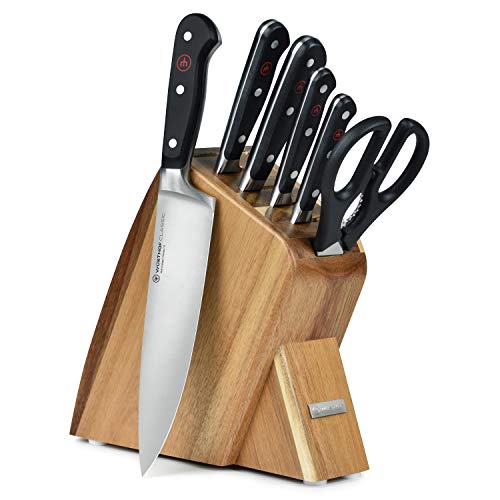
1. Wusthof Classic 7 Piece Knife Block Set
A compact forged block set built around the essentials. It suits people who want fewer, better knives. It is a sensible first purchase that you can add to later. It is built for cooks who prize a single great chef knife.
Suits: starter kitchens. Strengths: quality over count. Weaknesses: fewer knives than big sets. Skip it if you want steak knives.

Best for pinch-grip cooks
2. Zwilling Pro 7 Piece Knife Block Set
A forged block set with the curved-bolster design of the Pro line. It suits cooks who like to pinch-grip. The block is solid and the handles suit larger hands. Handles are comfortable in most hands.
Suits: pinch-grip cooks. Strengths: comfort. Weaknesses: the block takes counter space. Skip it if you prefer a traditional look.
View Zwilling Pro 7 Piece Set on Amazon
Best for families
3. Henckels International Statement 15 Piece Knife Block Set
A large stamped set that includes steak knives, shears and a block. It suits families who want one big purchase. Expect plenty of utility knives for sandwiches and fruit. Check the listing for the full contents.
Suits: families. Strengths: a long list of pieces. Weaknesses: stamped, so lighter feel. Skip it if you want forged blades.
View Henckels Statement 15 Piece Set on Amazon

Best for mid-size kitchens
4. Zwilling Four Star 8 Piece Knife Block Set
A mid-size forged set with seamless molded handles, built around the knives most cooks reach for. It is a tidy middle ground between a starter block and a giant set. Cleaning is easy because the handles lack rivets.
Suits: mid-size kitchens. Strengths: easy cleaning. Weaknesses: fewer extras. Skip it if you want a very large set.

Best for everyday home use
5. Wusthof Gourmet 12 Piece Knife Block Set
A stamped block set with a generous list of pieces, from the same Solingen house. Stamped blades are a little lighter, which many home cooks enjoy. Pieces and the block differ by listing.
Suits: everyday home use. Strengths: breadth. Weaknesses: lighter, less balanced blades. Skip it if you want forged knives.
View Wusthof Gourmet 12 Piece Set on Amazon
Best for big households
6. Henckels International Classic 14 Piece Knife Block Set
A large block set in a classic style, with plenty of blades for a family kitchen. Make sure there is room in your kitchen for a block this size. Check the contents list carefully.
Suits: big households. Strengths: a lot of knives. Weaknesses: block size. Skip it if you have little counter space.
View Henckels Classic 14 Piece Set on Amazon
Care and Setup
- Hand wash every knife and dry it at once.
- Hone the chef knife before each use.
- Return knives to the block with the edge facing up if the slots allow.
- Replace a worn steel rather than skipping honing.
Mistakes to Avoid
- Judging a set by the number of pieces.
- Ignoring counter space for the block.
- Buying a stamped set and expecting forged balance.
- Letting steak knives languish in the dishwasher.
What German-Style Blades Have in Common
German-style kitchen knives share a design philosophy that favors durability and all-purpose use. Blades tend to be a little thicker and heavier than many Japanese-style knives, with a pronounced curve along the belly of the chef knife. That curve suits a rocking motion, where the tip stays near the board while the heel rises and falls. The steel is generally selected to resist chipping and to hold up to daily use, and the edges are usually sharpened at a somewhat wider angle, which makes them sturdy rather than razor-thin.
Many German knives have a full bolster, a thick collar between the blade and the handle that adds weight, protects the hand and provides balance. Handles are typically contoured and riveted. The result is a knife that feels substantial in the hand and tolerates ordinary mistakes, such as cutting through firm vegetables or a bit of poultry cartilage.
This style suits people who like a sturdy knife that can handle many tasks. If you prefer a very light, thin blade for delicate slicing, another style may feel more natural. Remember that makers vary, and the details such as hardness, grind and shape differ from line to line, so use these points as a general guide only.
- Typical traits: sturdy blade, curved belly, bolster, riveted handle.
- Good for: rocking chops, general prep, everyday cooking.
- Less ideal for: ultra-thin slicing and fine, precise work.
Choose according to how you cut and what feels comfortable in your hand.
Forged and Stamped in Everyday Use
Forged and stamped refer to how the blade is made. Forged blades are shaped from a single piece of heated steel, then hammered and ground. They usually have a bolster, more weight and a feeling of balance. Stamped blades are cut from a sheet of steel and then ground and heat treated. They are lighter, often thinner and typically cost less. Many modern stamped knives are well made and perfectly suited to home use.
In practice, the differences show up in feel more than in daily results. Some cooks love the heft of a forged knife, which helps with dense vegetables and makes long prep sessions feel stable. Others find it tiring and prefer the lighter, more agile feel of a stamped blade. A bolster can also make it harder to sharpen the full length of the edge, though a skilled sharpener can handle it.
Look at the set listing to see what is forged and what is stamped, since some sets mix methods across pieces. Also check handle construction. Riveted handles are common and strong, while molded handles are seamless and easier to clean.
- Forged: heavier, bolstered, more balanced for chopping.
- Stamped: lighter, often more affordable, nimble.
If you can, hold a knife before buying. If not, read the weight and balance descriptions and check the return policy.
Choosing Pieces and Sizes Wisely
It is easy to be swayed by large piece counts, but many pieces are rarely used. The knives that carry most of the work are an eight-inch chef knife, a paring knife and a serrated bread knife. A utility knife and a slicer add flexibility, and steak knives matter if you often serve steak. Shears and a honing steel are practical extras.
Look at each knife’s length and shape in the listing. Chef knives vary in size, and a longer blade may feel unwieldy for smaller hands. A paring knife should be nimble for peeling and trimming. A bread knife needs enough length to cut through a loaf in a few strokes. Some sets include specialty knives, such as boning or santoku styles, that you may or may not use.
Consider your cooking habits:
- Cook daily: prioritize a quality chef knife and a good paring knife.
- Bake bread often: ensure the serrated knife is long enough.
- Entertain: steak knives and a slicer may be worthwhile.
- Small kitchen: a compact set with fewer slots fits better.
Sometimes buying a smaller set and adding single knives later is a better path than buying a large set with filler. Compare the cost of the set to buying the key knives individually, and think about whether you want the convenience of matching handles and a single block.
Blocks, Storage and Counter Space
The block is part of the purchase, and it affects both safety and convenience. A solid wood block keeps edges protected and lets you grab a knife quickly, but it takes counter space. Check the footprint and height before buying, particularly if you have low cabinets. Large blocks hold many knives but can feel crowded in a small kitchen.
Slot design matters. Some blocks have fixed slots sized for specific knives, while others use flexible inserts that accommodate different blades. Slots that are too tight can nick the edge as you insert and remove knives. Storing knives with the edge facing up may dull them faster in some blocks, while horizontal storage reduces contact; follow the maker’s guidance.
Keep the block dry. Wet blades stored in a block can trap moisture and promote odors or mold. Dry knives before putting them away, and allow the block to air out if it becomes damp. If you do not want a block, magnetic strips, in-drawer trays and knife rolls are alternatives.
- Measure the counter space and the height under cabinets.
- Look for easy-to-clean slots.
- Consider a drawer tray if counter space is tight.
Whatever storage you choose, keep blades away from other metal utensils that can dull or chip them.
Honing, Sharpening and Getting Years of Use
German knives are known for durability, but they still need maintenance. Honing is the quick, regular step that realigns the edge. A few light strokes on a honing steel before use help the knife stay keen. It does not remove much metal, so the knife will still need sharpening eventually. Sharpening, using whetstones, a pull-through system or a professional service, restores the edge when honing no longer helps. A typical home cook may need to sharpen occasionally rather than constantly.
Washing and drying are equally important. Wash knives by hand with mild soap, dry them right away and avoid the dishwasher. High heat, harsh detergent and banging against other items can dull blades, loosen handles and damage finishes. Use wood or plastic cutting boards instead of glass, stone or ceramic.
Signs it is time to replace a knife or set:
- Chips or cracks that cannot be ground out.
- A blade that has been worn so narrow it no longer feels balanced.
- Handles that are loose, cracked or separating from the tang.
- Persistent rust or pitting.
- A bent blade that cannot be straightened.
Often only one or two knives wear out, so replace those individually. If you rely on the chef knife for most tasks, consider investing in a better one over time, and keep the rest of the set for secondary jobs. With basic care, a good set can last for many years.
Counter Check Before You Choose a Set
A knife set lives on your counter or in a drawer for years, so a short checklist saves regret. Work through it with your own kitchen in mind.
- Decide whether you cook daily or a few times a week, since that changes how many blades you will actually reach for.
- Look at your hand size and grip style, then compare handle shapes in the product photos.
- Measure the free counter width and the gap under wall cabinets before choosing a block.
- Confirm whether the set includes a honing steel or kitchen shears, so you do not buy duplicates.
- Read the maker’s care sheet to see what it says about washing.
Two Block Philosophies Compared
| Feature | Compact 7 piece sets | Large 12 to 15 piece sets |
|---|---|---|
| Core knives | Chef, paring, bread, a few extras | Same core plus steak knives and utility blades |
| Counter space | Smaller block | Wider or taller block |
| Best for | One or two cooks | Shared kitchens and hosts |
| Trade-off | Fewer specialty blades | Some pieces may sit unused |
Use this as a first frame, then check the actual piece list on the listing for the model you like.
How to Read the Piece List
Listings often count items generously. A honing steel, a pair of shears and the block itself may each appear in the total. Read the line by line contents and note blade lengths, which are normally given in inches. Match the chef knife length to your board size: a long blade wants room to move. Compare the paring and utility sizes, then look at whether steak knives are straight or toothed. If a photo shows more pieces than the text lists, trust the text and ask the seller before buying.
Which Set Fits Which Kitchen
- Small apartment: pick a compact block, or one with an in-drawer option if the maker offers it.
- Weekend host: a larger set with steak knives saves a separate purchase.
- New cook building skills: a lean set lets you master a few knives first.
- Gift for a first home: aim for a set that already includes the core three blades and a block.
Small Glossary
- Tang: the part of the steel that runs into the handle.
- Spine: the thick, unsharpened top edge of the blade.
- Heel: the rear section of the edge, used for tougher cuts.
- Honing steel: a rod used to realign an edge between sharpenings.
- Scalloped edge: an edge with small teeth, common on bread knives.
Maker’s Manual or a Sharpening Professional
For daily use, the maker’s care sheet is your guide on washing, drying and storage. When an edge is chipped, badly dull or rolled, a professional sharpening service is a sensible call instead of improvising with a rough tool. Ask the maker about warranty terms if a handle loosens or a rivet lifts, since the details vary between product lines.
Setting Up Your New Block
Wash each knife by hand when it arrives to remove factory residue, then dry it fully before sliding it into the block. Place the block away from the sink edge, with the slots angled so the spine does not rub on the wood. Give the cutting boards some thought as well: softer boards are usually kinder to edges than hard glass or stone.
A Note on Handle Fit
Handle comfort is personal, and a set that looks good can still feel awkward. If you can, hold similar knives in a shop before ordering online. Pay attention to the weight at the balance point and whether your knuckles clear the board. Differences between the Classic, Pro and Gourmet lines are mostly about shape and detailing, so read each maker’s line description and choose the feel that suits your hand.
Storage Alternatives Worth Weighing
Not every kitchen has room for a bulky block. Some sets arrive with a slim holder, and others can be paired with a wall strip or a drawer tray sold separately. Think about the people in your home: a block at counter height is easy to reach, which matters if children are around, so follow the maker’s guidance on safe storage and keep edges out of casual reach.
German Knife Set FAQ
Is a set cheaper than buying single knives?
Often, but you may pay for pieces you never use. Compare against three or four singles.
Which knives do I really need?
A chef knife, paring knife and bread knife cover most tasks.
Are forged sets worth it?
Forged knives feel balanced and heavy, but stamped ones suit lighter prep.
How do I choose a block size?
Count the knives you will use and check your counter space.
What makes a knife German-style?
German-style knives usually have sturdy blades with a curved belly, a bolster and a riveted handle. They are designed for durability and general-purpose use.
Are forged knives always better than stamped ones?
No. Forged knives tend to be heavier and bolstered, while stamped knives are lighter and often cost less. The better choice depends on feel and how you cook.
How many knives do I really need?
A chef knife, a paring knife and a bread knife cover most tasks. Other pieces are useful only if you cook in ways that call for them.
How often should I sharpen German knives?
It depends on use. Hone regularly, and sharpen when honing no longer restores a clean cut, perhaps once or twice a year for many home cooks.
Can I put German knives in the dishwasher?
It is best not to. Heat, detergent and movement can dull edges and damage handles, so wash by hand and dry promptly.
Is a knife block necessary?
No. Magnetic strips, drawer trays and knife rolls also protect blades. Choose what fits your space and habits.
Should I buy a set or single knives?
Sets are convenient and often match, but singles let you buy only what you use. Compare piece lists with your cooking habits.
What is a bolster and does it matter?
A bolster is the thick collar between the blade and handle. It adds balance and hand protection, but it can make sharpening the heel more awkward.
Auditing What You Already Own Before Buying a Set
Most kitchens already own a scattered knife collection: a chef knife from a wedding list, a bread knife of unknown age, two paring knives, and something in a drawer that nobody claims. Before buying a set, lay them all out and be honest about which ones you reach for and which ones merely exist. A set should replace the reaching-for knives with better versions and fill real gaps, not duplicate a drawer of also-rans in matching handles. If your current chef knife is good, a set may be the wrong purchase entirely; a bread knife and a utility knife bought singly could serve you better.
Check the condition of what you have. Dull is fixable; chipped, bent or loose-handled is a retirement decision. Note the storage you actually use, because a block set assumes counter space and a block habit. If your knives live in a drawer now, picture the block on your counter for a week before ordering: beside the hob, under the cupboards, clear of the kettle’s steam. The sets in this list range from a compact seven piece to a fifteen piece with steak knives, and the right size is the one whose block fits your counter and whose pieces fit your cooking.
Finally, count eaters as well as cooks. Steak knives matter in a household that serves steak or chops weekly and are dead weight in one that does not. Shears matter to cooks who spatchcock poultry or open packaging at the counter. A honing steel matters to everyone with German blades, so check whether the set includes one and whether it suits the knives. Reading a piece list against your real week, rather than against an ideal kitchen, is the whole skill of buying a set well.
The First Month With a New Set
A new set changes habits if you let it. In the first week, cook the meals that use each main knife: the chef knife for a full prep session, the bread knife for a crusty loaf, the utility knife for sandwiches and fruit, the paring knife for small work over a bowl. Notice which handles suit which hands in the house, and agree where each knife lives in the block. Put the most-used knives in the slots that are easiest to reach, following any guidance the block maker gives about edge direction.
Build the care routine while the knives are still a pleasure rather than a chore. Hand wash, dry, and return each knife straight after use. Hone the chef knife before big sessions. Keep the block away from the hob’s steam and the sink’s splashes, because a block in a damp spot ages handles and harbours grime in its slots. Once a month, turn the block and clean the slots as the maker allows, and check each edge against a tomato. Small, regular attention is why one set looks new at five years and another looks tired at one.
Resist expanding the set immediately. Live with the pieces for a season and note what you genuinely miss: perhaps a longer bread knife, perhaps a small serrated knife for tomatoes, perhaps nothing at all. German sets are designed to be added to within the same line, so a missing piece can usually join later and match. The discipline of waiting turns a set from a single purchase into a small, considered collection.
Reading the Six Sets by Household
The two compact forged sets are the quality-first choices. The Wusthof Classic seven piece is built around essentials for serious cooks who would rather own fewer, better knives. The Zwilling Pro seven piece brings the curved-bolster design for pinch-grip cooks and handles that suit larger hands. Both ask for counter space and a honing habit, and both can be extended within their lines. If your household cooks daily and argues about whose turn it is to prep, start here.
The Zwilling Four Star eight piece sits in the middle: forged blades, seamless molded handles that clean easily, and a piece count aimed at the knives most cooks actually use. It suits a household that wants forged quality without a giant block. The Wusthof Gourmet twelve piece takes the stamped route to breadth, lighter blades in a generous list, from the same Solingen house as the Classic line. It suits cooks who prefer a lighter feel and want utility pieces covered in one purchase.
The two large Henckels International sets serve families who want everything in the box. The Statement fifteen piece adds steak knives and shears to a stamped line-up, a one-purchase kitchen for a busy household. The Classic fourteen piece offers a traditional look at a similar scale. With both, read the exact contents on the listing, because piece counts include the block and the steel in some listings and the small pieces vary. A large set is good value when the household will use the pieces; it is an expensive block when half the slots hold knives nobody touches.
Blocks, Counters and Honest Storage
A knife block is furniture. Measure its footprint and its height under your wall cupboards, including the clearance needed to draw a long chef knife upward out of its slot. That last check is the one people forget: a block that fits under a cupboard may not let the longest knife leave it. Place the block where the knives can be reached with dry hands, away from the sink’s splash zone and the hob’s steam, and where a knife being returned does not pass over a chopping board in use.
If a block does not suit your kitchen, a set can still live well. A magnetic strip on a wall keeps blades visible and ventilated, provided it is mounted where passing sleeves cannot catch a handle. An in-drawer tray keeps a clear counter and suits homes with small children, provided the tray separates the edges. What matters is that each blade is isolated, dry and reachable. A set stored badly dulls faster than a set stored well, whatever the steel, so treat storage as part of the purchase rather than an afterthought.
Whichever storage you choose, keep the system legible to everyone in the house. Knives returned to the wrong slot or tossed in a drawer undo the whole idea of a set. A brief household agreement, chef knife here, bread knife there, steel in its place, takes a minute and protects both edges and fingers for years. Guests helping in the kitchen will follow the visible system, which is another reason the system should be visible.
Teaching the Household: Shared Knives, Shared Rules
A family set is a shared tool library, and shared tools need shared rules. Agree that knives are hand washed and dried by whoever used them, that the chef knife is never used to pry, scrape or open packaging, and that a dull knife gets reported rather than forced. Show younger cooks the pinch grip and the claw with a cucumber before they graduate to onions, and give them the utility or paring knife first, sized to their hands and the job.
Steak knives deserve their own word, since the larger sets include them. They live a harder life than kitchen knives: ceramic plates, table use, and the temptation of the dishwasher. Hand wash them when you can, keep them in their block slots rather than a cutlery drawer where edges knock, and hone the plain-edged ones lightly if the maker allows. Serrated steak knives, like serrated bread knives, are maintained gently and replaced when they tear rather than cut.
None of these rules needs a meeting. They need modelling: the set’s owner washing, drying, honing and storing the knives properly, every time, until it is simply how the kitchen works. A German set looked after this way is a decade-long purchase. The same set left wet in a sink is a disappointment with a famous name on the blade.
More German Knife Set Questions, Answered
Do the steak knives in a set need honing?
Plain-edged steak knives can be lightly honed like other German blades, following the maker’s guidance. Serrated steak knives should not be run along a steel in the usual way. Keep both kinds clean, dry and stored apart from other cutlery, and they will cut cleanly for a long time.
Can I mix knives from different brands in one block?
Yes, if the slots fit them safely. Check blade length and thickness against the slots, since a block made for one line may grip another line’s knives loosely or tightly. A universal block or a strip gives more freedom. Matching looks are pleasant, but safe fit is what matters.
What if my set does not include a bread knife?
Many cooks add one separately, choosing length and teeth for their own loaves rather than accepting a set’s standard choice. Buy within the same line if you want the handles to match, or choose purely on fit. A set is a foundation, not a fence.
How do I clean inside the block slots?
Follow the block maker’s guidance. Generally, shake out crumbs over a bin, and use a thin cloth or a soft brush to clear slots, keeping the block dry. Never soak a wooden block. If a slot smells or looks soiled, a slightly dampened cloth followed by thorough drying is safer than any soaking.
Is a self-sharpening block a good idea?
Some blocks include sharpening elements in certain slots. They can help maintain an edge between proper sharpenings, but they do not replace honing technique or an occasional full sharpening. Check which slots sharpen and which knives the maker intends for them, and do not put serrated blades through a sharpening slot.
Should every knife in the set be forged to be worthwhile?
No. The chef knife does the hardest work and benefits most from a forged build. Smaller and lighter knives in a set are often stamped without any practical loss, and stamped steak and utility knives are common in good sets. Judge the set by its main knives and its fit for your cooking.
How do I know if a set is too big for my kitchen?
Count the pieces you will use weekly. If several slots would hold knives you cannot picture using, the set is too big, whatever its value on paper. Also measure the block against your counter and cupboard clearance, including room to draw the longest knife out.
Can I give a knife set as a gift?
It is a classic wedding and new-home gift, with one old superstition that a coin should accompany knives so they are bought rather than given. More practically, check that the household cooks, has counter space, and does not already own good knives. A compact forged set suits a keen cook better than a giant set suits a reluctant one.
Final Practical Notes
Judge a set after a season, not after a week. By then you will know which three knives do nearly all your work, whether the block earned its counter space, and whether the honing habit stuck. A good German set passes that test quietly: it is simply the knives you cook with, kept sharp, in their places, asking nothing. Buy for that outcome and the piece count will look after itself.
Keep the set’s paperwork together: the contents list, the care guidance and the warranty note. If a handle ever loosens or a knife needs professional attention, those details turn a problem into a short errand. Long-lived tools reward owners who keep their facts.
Sets for New Cooks and Sets for Experienced Cooks
A new cook and an experienced cook should not buy the same set, even from the same list. The new cook needs the trio that teaches the craft: a chef knife that fits their hand, a bread knife, and a paring or utility knife, with a steel to maintain them. A compact set like the Wusthof Classic seven piece or the Zwilling Four Star eight piece gives exactly that, without overwhelming a beginner with blades they cannot yet name. The money not spent on extra pieces is better spent on a good board, which a new cook needs more than a fifth knife.
The experienced cook already owns habits and probably a favourite knife or two. For them, a set is a consolidation: replacing a mixed drawer with one line’s handles, one steel’s feel, one block’s order. They will use the breadth of a twelve or fourteen piece set, including the steak knives and the shears, because their cooking already contains those jobs. The Henckels International Classic fourteen piece and the Wusthof Gourmet twelve piece speak to this buyer, provided the contents list is read knife by knife rather than admired as a number.
Households in between, which is most households, should buy for the cook they are becoming. If weeknight cooking is growing more ambitious, a mid-size forged set will grow with you. If cooking is mostly reheating and sandwiches, even the best set is the wrong purchase, and a single good chef knife plus a bread knife is the honest buy. A set is a commitment to a style of kitchen life; choose the one you are actually living.
The Value of a Set Across Ten Years
A knife set should be judged across a decade, because that is the timescale German knives are built for. Across ten years, the costs that matter are not the purchase alone but the maintenance around it: a steel that lasts, an occasional professional sharpening for the main knives, a block that does not split, handles that do not loosen. A set bought well needs little beyond that. A set bought badly, with pieces that chip, handles that crack or a block that wobbles, costs its price again in replacements and irritation. This is why the forged main knives in a set matter more than the count of small pieces.
Value also hides in use. A set whose chef knife is used daily for ten years has delivered thousands of prep sessions; even a premium price divides into very little per meal. A large set whose extra knives sit untouched has delivered a block of decorations. When you compare the compact Classic set with the fifteen piece Statement set, do not ask which contains more; ask which will be used more, by your household, at your table. Steak knives used every Friday are value. A second boning knife used never is furniture.
Finally, a good set holds a household together culinarily. It is the kit a teenager learns on, the kit that moves to a first flat and comes back for Sunday roasts, the kit a family argues about inheriting. That sounds sentimental until you watch it happen. Buy the set you would be pleased to hand over, keep its edges honest, and the ten years will look after themselves.
Further German Knife Set Questions
Is it better to buy one large set or build a set gradually?
Gradual building gives the best fit, since each knife is chosen for a proven need and a known hand. A single set gives coherence, convenience and usually a simpler purchase. If you cook seriously and know your gaps, build gradually within one line. If you are equipping a kitchen from nothing, a well-chosen set is the calmer route.
Can a block be stored on its side or in a cupboard?
Blocks are designed to stand as shown, with the knives’ weight resting as the maker intended. Storing one on its side can let blades rest on their edges and slide. If counter space is impossible, an in-drawer tray or a magnetic strip is a better answer than a tipped block. Choose storage made for the knives you own.
What paperwork should I keep for a knife set?
Keep the contents list, the care instructions and the warranty note, ideally photographed as well as filed. If a knife ever needs attention, the exact line and model matter, since brand families contain many similar knives. A note of where and when you bought the set completes the small file.
Are knife sets a sensible purchase for a rental kitchen?
They can be, if the knives will travel with you and the block fits the counter you have. In a shared rental, agree the care rules with housemates before the set arrives, since shared kitchens are hard on good knives. A compact set is easier to keep track of than a large one in a house with many cooks.
Closing Notes
Before the first wash, photograph the set in its block. That picture becomes the household’s reference for where every knife lives, and it settles the small daily question of which slot is whose. Order at the block is not fussiness; it is how edges survive a busy kitchen.
If you inherit or are given a set, have the main knives professionally sharpened before judging them. Old German steel usually has years of life left once its edge is restored, and a dull decade-old set often surprises everyone at its first proper dinner.
Unboxing and First Checks for a New Set
A new set deserves ten unhurried minutes before its first dinner. Take each knife out in turn and look along the edge for straightness, check that handles sit firmly with no movement, and confirm the contents against the listing’s piece list while a return is still simple. Wash every knife by hand, dry it, and place it in the block yourself rather than letting the set be unpacked by the household at large. The person who places the knives learns the block’s geography, and that person becomes the house’s reference for where everything lives.
Test the chef knife first, on an onion or a carrot, at a pace that tells you about balance rather than speed. Then test the bread knife on the crustiest loaf available, because that is its examination. Note anything that feels wrong while the purchase is fresh: a slot that grips oddly, a handle that twists, an edge that tears. Makers and sellers can help with a new set in a way they cannot help with a year-old one, so the first week is the time to speak up.
Finally, set the care system in place on day one: the washing habit, the honing steel’s home, the block’s position away from steam and splashes. A set that begins life inside a good system tends to stay inside it, because households follow the pattern they started with. The knives will do the rest for years, one ordinary dinner at a time.
Whichever set you choose, let the decision rest on the three knives that will work weekly: the chef knife, the bread knife and the small knife for work in the hand. If those three suit your hands, your board and your cooking, the rest of the set is supporting cast, welcome but not decisive. Read the contents list one final time with those three in mind, picture the block where it will stand, and imagine the first Sunday dinner cooked with it. A set that survives that imagination with its appeal intact is the set to buy, and it will still be earning its counter space when sets bought on piece count alone have been forgotten.
The Short Version
For a compact forged set, the Wusthof Classic 7 piece. For pinch-grip fans, the Zwilling Pro. For a big family set, the Henckels Statement. For molded handles, the Zwilling Four Star. For a mid-size stamped set, the Wusthof Gourmet. For a classic large block, the Henckels Classic. Whatever you choose, plan to add a good honing steel if one is not included.
Related Guides
- 6 Best Forged Knife Sets: German and Value Picks (2026)
- 6 Best Premium Knife Sets: German, Japanese and Block Sets
- 6 Best Knife Sets for Home Kitchens: Full Blocks (2026)
- 6 Best Knife Sets for Outdoor Cooking and Camp Kitchens (2026)
- 6 Best Knife Sets with Blocks for Home Kitchens (2026)