Disclosure: topratedkitchenware.com is reader-supported. When you buy through links on our site, we may earn an affiliate commission from Amazon and other retailers, at no extra cost to you.
Where to buy
The six models below are the verified picks for this guide to best grills for high volume. Each name links to its Amazon listing, where you can check the latest price on Amazon, confirm the current configuration, and read the newest owner feedback before you decide.
- AMERLIFE 6-Burner Gas Grill with Side Burner
- Nexgrill 4-Burner Gas Grill with Stainless Lid
- Monument Grills Mesa II 4-Burner Gas Grill
- Weber Spirit E-425 Gas Grill
- IdeaMaxx 3-Burner Gas Grill
- Charbroil Portable 1-Burner Gas Grill
Read the full guide ↓ for the ranking logic, the honest limitations of every pick, and the buying checks that matter more than any headline claim.
Choosing the best grills for high volume is a different exercise from choosing a grill for a quiet family dinner. Volume cooking — team parties, church picnics, big family reunions, a street full of neighbours — is a logistics problem wearing an apron. The grill must hold a lot of food in a single layer, recover heat fast when a cold batch lands, divide into zones so finished food can wait without drying out, and keep doing it for hours without the cook becoming the bottleneck. This guide ranks six verified gas grills against exactly those demands, using only the specifications their listings confirm: cooking area, burner count, total output, and the design details that decide how a grill behaves at full load.
One pick needs an honest warning up front. Five of these six grills are full-size multi-burner machines built for exactly this work. The sixth, a compact single-burner portable, is not a high-volume grill and this guide will never pretend it is. It earns its place as a satellite: the side station that handles vegetarian food, allergen-separated items, or a warming zone while the main grill does the heavy lifting. If you only ever buy one grill from this list for volume work, buy one of the five full-size designs. Readers whose volume problem is really a family-size problem should also read Best Grills For Large Families, which weighs the same hardware for daily family use rather than event cooking.
A final framing note before the picks: high volume is a repeatable system, not a heroic effort. The grills below were chosen because they make the system easier — more single-layer room, more independent zones, grates that hold their heat, and storage that keeps the station self-contained. A cook with a system and a mid-size grill will out-serve a cook with the largest grill in this guide and no plan, every single time. Read the badges as system components, and choose the combination your events actually need.
Everything below is organised around throughput. The reviews talk about batch size, reload discipline, and zone management more than they talk about any single steak, because that is what high-volume success actually looks like: not one perfect burger, but the fortieth burger as good as the first.
Key Takeaways
- Cooking area and burner count decide volume capacity; headline output figures only matter alongside them.
- Five picks here are full-size volume machines. The single-burner portable is a satellite station, not a main grill, and is badged that way.
- Cook in batches with a holding zone: one burner turned low keeps finished food hot without overcooking it.
- Recovery speed after loading cold food is the hidden volume skill; heavy cast iron grates help most.
- Stage raw and cooked food on opposite sides of the grill to keep a fast line moving safely.
- Check the latest price on Amazon and confirm the stated cooking area on the listing before you buy for an event.
In this guide
Quick Picks
| Pick | Badge | Why it earns its place | Listing |
|---|---|---|---|
| AMERLIFE 6-Burner Gas Grill with Side Burner | Best Overall for Volume | Six burners, a side burner, and the largest confirmed cooking area in the group at 650 sq. in. | Check on Amazon |
| Nexgrill 4-Burner Gas Grill with Stainless Lid | Best Heat Recovery | Matte cast iron grates and a strong output figure over 526 sq. in. keep searing hard batch after batch. | Check on Amazon |
| Monument Grills Mesa II 4-Burner Gas Grill | Best Fast Start | A stainless four-burner with a dedicated broil zone and foldable shelves, built to get an event cooking quickly. | Check on Amazon |
| Weber Spirit E-425 Gas Grill | Best Premium for Smaller Events | Cast iron grates and a sear zone bring premium finishing to gatherings below the largest scale. | Check on Amazon |
| IdeaMaxx 3-Burner Gas Grill | Best Compact Second Grill | A cast iron three-burner that folds down small, ideal as the second grill that doubles a main grill’s capacity. | Check on Amazon |
| Charbroil Portable 1-Burner Gas Grill | Best Portable Side Station | A single-burner portable that supports a volume setup as a separate small station — not a main event grill. | Check on Amazon |
If your crowd mostly wants fast, forgiving food rather than maximum batch size, Best Grills For Hotdogs judges a similar shortlist on speed and simplicity instead.
How These Picks Were Chosen
This is a research-led guide. Each pick comes from a verified pool for the grills category, included only where its brand, fuel, and listing details could be confirmed. For a high-volume brief, the comparison weighted confirmed cooking area first, because area is the hard ceiling on batch size. Burner count came second, because independent burners create the zones that volume cooking runs on: a searing zone, a cooking zone, and a low holding zone. Total output was considered third and always relative to area, since output spread over a large grate behaves differently from the same output under a small one.
Grate material and ignition were assessed for a practical reason: volume cooking punishes fragility. Cast iron grates store heat and recover faster between batches, and reliable electronic ignition matters when a grill is relit or adjusted repeatedly across a long event. We also looked at storage and shelf space, because a volume cook is surrounded by trays, and a grill with nowhere to put them slows the whole line down.
A note on output figures, because volume shoppers lean on them hardest. A total BTU figure describes the burners at full power, not the grill’s ability to cook for a crowd. Spread across a large grate, a high figure gives fast recovery and fierce searing zones; concentrated under a small grate, the same figure mostly gives flare-ups. That is why this guide always reads output together with area and burner count, and why the comparison table prints all three side by side. Treat any buying argument built on a single number with suspicion.
The portable pick requires a word of method. It was in the assigned pool, it is a genuine and useful grill, and excluding it silently would have hidden a real option for small events. Instead it is included with its role stated plainly: a secondary station. Its badge, its review, and the comparison table all say the same thing. That is how this guide handles any pick whose strengths sit beside, rather than inside, the keyword: honestly, and in the open.
The 6 Best Options for Best Grills for High Volume
Badges reflect volume roles, not a single overall ranking: the best main grill, the best recovery, the best budget-of-space option, and one satellite are different jobs, and the reviews judge each pick on its job.

AMERLIFE 6-Burner Gas Grill with Side Burner
Badge: Best Overall for Volume
Strengths
- Largest confirmed cooking area here: 650 sq. in. for true single-layer batch cooking
- Six burners plus a side burner create sear, cook, and hold zones simultaneously
- Cast iron grates and a warming rack support batch flow and holding
Trade-offs
- Biggest footprint and the most burners to clean after an event
- High total burner count uses more propane across a long day
- Overkill for households that rarely cook for more than six
At a glance
- Fuel: propane gas
- Burners: 6 plus side burner
- Total output: 60,000 BTU (per listing title)
- Cooking area: 650 sq. in.
- Grates: cast iron
- Extras: warming rack, built-in thermometer
The AMERLIFE is the volume centrepiece of this guide, and its listing confirms why: six burners plus a side burner, a total output figure of 60,000 BTU, cast iron grates, a warming rack, a built-in thermometer, and 650 square inches of cooking area, the largest confirmed figure in this set. At an event, that area translates directly into fewer batches. A full load of burgers, chicken pieces, or sausages cooks in one layer with room to turn everything without stacking, and the warming rack gives finished food a genuine holding place that is warm but not still cooking hard.
Six burners is the other half of the story. Volume cooking fails when one temperature must serve every stage at once. With six independent burners you can run two hot for searing, two medium for cooking through, and two low as a holding zone, while the side burner keeps sauce or beans at a simmer. Food flows in one direction — raw on one side, finished on the other — and the line never stalls. The cast iron grates store heat between batches, so the fifth load sears almost like the first instead of steaming on a cooled grate.
The honest limitation is scale in the other direction. This is a large grill that takes patio space, assembly patience, and a longer clean-up, and it burns more propane across a long day simply because it has more burner to feed. For a household of four it is far more grill than daily life requires. For anyone who cooks for fifteen or more with any regularity, it is the pick that turns an event from a scramble into a system. Compare its daily-life manners in Best Grills For Large Families if your crowd is a family rather than an event.
One more practical virtue deserves mention: a six-burner grill degrades gracefully. If one zone is running too hot or a burner needs attention mid-event, five remain, and the cook can shift the line sideways without stopping service. Smaller grills offer no such slack. Build the habit of rotating which zones do the heavy searing across a long day, and the whole grate ages evenly instead of one corner doing a season of work in an afternoon.
Best for: event cooks and anyone regularly feeding fifteen or more / Not suited for: small households and small patios
Nexgrill 4-Burner Gas Grill with Stainless Lid
Badge: Best Heat Recovery
Strengths
- Matte finish cast iron grates store heat for fast recovery between batches
- Confirmed 526 sq. in. is a genuine event-size cooking space
- Electronic ignition and built-in thermometer support a managed line
Trade-offs
- Smaller area than the two largest picks, so one extra batch on big days
- Cast iron grates need seasoning care after heavy use
- Stainless lid shows event splatter and needs a wipe-down
At a glance
- Fuel: propane gas
- Burners: 4 plus side burner
- Total output: 52,000 BTU (per listing title)
- Cooking space: 526 sq. in.
- Grates: matte finish cast iron
- Ignition: electronic
- Extras: built-in thermometer, stainless steel lid
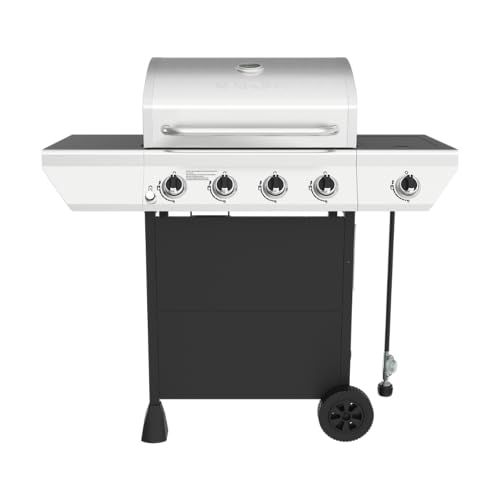
Recovery is the least discussed and most decisive skill in volume cooking. Every cold batch drops grate temperature; a grill that recovers slowly starts steaming food instead of searing it, and quality slides with every load. The Nexgrill with the stainless lid is built to resist that slide. Its listing confirms 526 square inches of cooking space, a total output figure of 52,000 BTU across four burners plus a side burner, electronic ignition, a built-in thermometer, and matte finish cast iron grates — and it is the grates that headline here, because cast iron is a heat battery that carries a grill through the loading dip.
In practice this is the pick for mixed, continuous cooking: burgers searing on one side while chicken finishes on the other, the side burner holding a pan of onions, finished food rotating to the coolest corner. The 526 square inches will not swallow the largest events in a single batch the way the 650 square inch pick can, but for gatherings in the ten-to-twenty range it keeps pace comfortably, and its recovery keeps quality even across the afternoon.
The trade-offs are honest ones. Cast iron asks for basic care — dry it and oil it lightly after big cooks — and the smaller area means the very largest events need one more batch than the biggest pick. Buyers cooking for crowds beyond twenty should start with the AMERLIFE. Buyers whose events are frequent, mixed, and quality-sensitive will find this the hardest-working middle in the guide.
It also travels between roles better than its size suggests. On a quiet weekend it runs happily as a family grill with two burners lit and the rest off, so owning it does not mean heating a cavern for four burgers. That dual life — event machine on Saturday, ordinary family grill on Tuesday — is what makes a mid-large grill like this easier to justify than a specialist that only earns its space a few times a year.
Best for: frequent event cooks who care about batch-to-batch consistency / Not suited for: the very largest single-batch events

Monument Grills Mesa II 4-Burner Gas Grill
Badge: Best Fast Start
Strengths
- Advanced Broil Zone gives a fierce finishing area within a volume layout
- Foldable side shelves adapt the grill to tight event spaces
- Stainless steel construction suits outdoor event duty
Trade-offs
- Listing title states no cooking area figure, so confirm it before planning batch sizes
- Broil zone rewards supervision at full load
- Foldable shelves hold less than fixed cabinet shelving
At a glance
- Fuel: propane gas
- Burners: 4
- Body: stainless steel
- Extras: Advanced Broil Zone, foldable side shelves (per listing title)
- Model: Mesa II 410FBZ
Events rarely start on time, and the Monument Mesa II is the pick for cooks who need to be cooking at full tilt minutes after deciding to start. The listing confirms a stainless steel four-burner design with an Advanced Broil Zone, foldable side shelves, and fast assembly positioning, under the Mesa II 410FBZ model name. The broil zone is the volume-relevant feature: a dedicated high-heat area lets you finish and colour food in seconds at the end of its cook, which keeps the main grates turning over instead of holding finished items while they wait for colour.
The foldable shelves are the second event virtue. Volume cooking happens in borrowed spaces — driveways, hall car parks, garden corners — and a grill whose shelves fold travels and stores in those spaces far more gracefully than a fixed cabinet design. Stainless construction shrugs off the knocks of event transport and cleans down quickly when the day is done.
The limitation to check is cooking area: the listing title does not state a square-inch figure, so confirm it on the listing and plan your batch maths from the confirmed number, not from the burner count. Four burners suggest a family-plus-event size rather than the largest class, and the broil zone, like any fierce heat source, needs supervision when the grill is fully loaded. For organisers who value a fast start and a flexible footprint, it is a genuinely practical event tool.
Best for: event organisers working in varied, borrowed spaces / Not suited for: cooks who need a confirmed maximum cooking area before buying

Weber Spirit E-425 Gas Grill
Badge: Best Premium for Smaller Events
Strengths
- Porcelain-enameled cast iron grates recover heat well between batches
- Sear Zone with Boost Burners finishes high volumes of steaks and chops properly
- Four burners support a workable sear-cook-hold layout
Trade-offs
- No side burner listed, which limits parallel sauce and side work
- Smaller event ceiling than the 626 and 650 sq. in. picks
- Premium-tier positioning in its class
At a glance
- Fuel: propane gas
- Burners: 4
- Grates: porcelain-enameled cast iron
- Extras: Sear Zone with Boost Burners, Weber Works rails (per listing title)
- Finish: black
Not every high-volume occasion is a hundred-person event. The team dinner, the extended-family Sunday, and the sports-club evening all sit in the eight-to-sixteen range, and for that band the Weber Spirit E-425 is the premium answer in this guide. Its listing confirms four burners, porcelain-enameled cast iron grates, a Sear Zone with Boost Burners, and Weber Works rails. The cast iron grates do the recovery work that volume cooking demands, and the sear zone means a full batch of steaks or chops can be finished with a proper crust rather than a grey shrug.
Four burners lay out cleanly for this scale: sear zone hot, two burners cooking, one low for holding. The accessory rails keep the tools of a busy service — tongs, thermometer, tray — on the grill instead of on the ground. For quality-focused smaller events, where the food is the point and the crowd is modest, this is the most refined tool in the set.
The limitations are capacity and the missing side burner. The listing names no side burner, so sauces and sides compete for grate space or happen in the kitchen, and events beyond its comfortable batch size will need disciplined relays. If your events are large, choose area over refinement and start at the top of this guide. If your events are smaller and the standard of the food matters most, this premium pick justifies itself every service.
Best for: quality-focused gatherings of roughly eight to sixteen / Not suited for: very large events or side-burner-heavy menus

IdeaMaxx 3-Burner Gas Grill
Badge: Best Compact Second Grill
Strengths
- Foldable shelves make it the easiest full-featured grill here to store and move
- Cast iron grates sear properly, not like a lightweight portable
- Three burners still allow a hot side and a holding side
Trade-offs
- Not a primary event grill for large crowds on its own
- Smaller area means it supports volume as a partner, not a solo act
- Cast iron needs the usual dry-and-oil care
At a glance
- Fuel: propane gas
- Burners: 3
- Total output: 38,200 BTU (per listing title)
- Grates: cast iron
- Extras: foldable side shelves
- Finish: black
Serious volume cooks often solve capacity with two grills rather than one giant one, and the IdeaMaxx is the partner grill in this guide. Its listing confirms three burners, cast iron grates, a total output figure of 38,200 BTU, and foldable side shelves. Parked beside a main grill, it doubles as the overflow searing station, the dedicated vegetable and fish grill, or the holding grill that keeps finished batches hot while the main grill keeps cooking. Its cast iron grates mean the overflow food is cooked properly, not apologetically.
On its own, it covers the small end of volume honestly: a team lunch, a scout group, or a family gathering in the six-to-ten range, cooked in a couple of disciplined batches. The foldable shelves then shrink it against a garage wall until the next event, which is more than any cabinet grill here can claim. For households whose big events are occasional, a mid-size main grill plus this as the stored-away second grill is a smarter spend than one enormous machine.
The limitation is the mirror of its virtue: it is not, solo, a large-event grill, and this guide does not badge it as one. Judge it as capacity insurance and small-event competence in one foldable package. The genuinely small satellite role belongs to the final pick below; the IdeaMaxx sits a clear class above it.
Best for: a second grill for overflow, and small events cooked solo / Not suited for: solo cooking for large crowds

Charbroil Portable 1-Burner Gas Grill
Badge: Best Portable Side Station
Strengths
- Truly portable: a separate station for dietary-separated or small-batch items
- Simple single-burner operation anyone at the event can run
- Aluminized steel body is light and easy to clean down
Trade-offs
- Cannot cook for a crowd: one burner and a small grate
- No zones, no holding area, no side capacity
- Included here as a satellite only; do not buy it as your volume grill
At a glance
- Fuel: propane gas
- Burners: 1
- Total output: 11,000 BTU (per listing title)
- Body: aluminized steel, black
- Style: portable tabletop class
- Model reference: 465133010 (per listing title)
This review exists so that no reader is misled. The Charbroil Portable is a single-burner tabletop-class grill whose listing confirms an output figure of 11,000 BTU and an aluminized steel body. It is a good small grill. It is not a high-volume grill, and if it were badged as one, this guide would deserve no trust on anything else. Its honest role at a volume event is as a satellite station, and in that role it is genuinely useful.
Satellite work is real work. The vegetarian burgers that must not share a grate with meat, the gluten-free items that need a clean surface, the small batch of seafood that would perfume everything else, the kids’ food that needs to happen now rather than after the main batches — a separate little grill handles all of it without breaking the main grill’s flow. Set it on a side table with its own tongs and it quietly removes the four most common disruptions to an event line.
Bought for that job, it is excellent value in use. Bought as your only grill for a crowd, it would be a serious mistake, and the comparison table and badges in this guide are written to prevent exactly that purchase. Every event cook needs a main grill from the five designs above; this portable is the optional extra that makes the main grill’s day easier.
Best for: a satellite station for separated or small-batch items at events / Not suited for: anyone’s main grill for volume cooking — choose a full-size pick instead
Comparison Table
Read the volume role column first. It states plainly what each grill can and cannot do at an event, including the portable pick’s satellite-only status.
| Pick | Cooking area | Burners and output (per listing) | Volume role | Listing |
|---|---|---|---|---|
| AMERLIFE 6-Burner Gas Grill with Side Burner | 650 sq. in. | 6 burners + side burner, 60,000 BTU total per listing | Largest batch capacity; full zone system | Check on Amazon |
| Nexgrill 4-Burner Gas Grill with Stainless Lid | 526 sq. in. | 4 burners + side burner, 52,000 BTU total per listing | Best recovery thanks to cast iron mass | Check on Amazon |
| Monument Grills Mesa II 4-Burner Gas Grill | Cooking area not stated in listing title | 4 burners with Advanced Broil Zone | Fast-start event pick; foldable shelves | Check on Amazon |
| Weber Spirit E-425 Gas Grill | Cooking area not stated in listing title | 4 burners with Sear Zone and Boost Burners | Premium finishing for smaller events | Check on Amazon |
| IdeaMaxx 3-Burner Gas Grill | Cooking area not stated in listing title | 3 burners, 38,200 BTU total per listing | Compact second grill; cast iron grates | Check on Amazon |
| Charbroil Portable 1-Burner Gas Grill | Small portable grate | 1 burner, 11,000 BTU total per listing | Satellite only — not a volume grill | Check on Amazon |
How to Choose the Right Grill for Best Grills for High Volume
Volume buying starts with arithmetic. Count the most people you realistically cook for at once, decide what they eat in the first round, and lay that food out mentally in a single layer with turning room between pieces. Burgers need roughly a palm of space each with gaps; chicken pieces need more; sausages need less but roll. The cooking area that holds that first round in one layer is your minimum. Then add a holding margin, because a grill filled edge to edge with raw food has nowhere to put finished food, and the line stalls.
Burner count is your zone budget. Two zones is the minimum for volume work — cooking and holding. Three or four zones let you sear, cook, finish, and hold simultaneously, which is where real throughput lives. Six burners, as on the largest pick here, suit the cook who runs an event like a kitchen line. A side burner rarely cooks the main event, but it constantly rescues it: sauces, beans, warming, and the separated side dish all live there instead of stealing grate space.
Weight recovery as heavily as capacity. The tenth batch should sear like the first, and that depends on grate mass and burner power working together. Cast iron grates, featured on several picks here, store heat and smooth out the dip when cold food lands. Thin grates on a powerful burner can still sag, because the heat has nowhere to live. If your events involve continuous cooking rather than one big batch, prioritise grate mass; if they involve one enormous batch and then holding, prioritise area.
Do not overlook clean-up as a volume feature. An event grill comes home, or stays home, covered in the evidence of two hundred servings. Grates that lift out in sections, drip trays that slide free, and surfaces that tolerate a stiff brush all decide whether the grill is ready for the next event or still wearing the last one. Several picks here were favoured partly because their layouts make that reset straightforward; a grill that is miserable to clean quietly becomes a grill that gets used less.
Finally, plan the station, not just the grill. Trays for raw and cooked food must live on opposite sides, tongs must be duplicated, and a spare propane tank is the cheapest insurance in event cooking. Confirm the stated cooking area and burner layout on the listing itself, check the latest price on Amazon, and remember the honest rule of this guide: a grill’s volume claim is its single-layer first round, not a marketing number.
How to Run a High-Volume Grill Session Without Chaos
Set the line up before any food appears. Establish a raw side and a cooked side and never let them swap. Lay out trays, two sets of tongs (one for raw, one for cooked), a thermometer, foil, and a holding plan. Preheat the grill fully with the lid down, then set your zones: hottest where food lands first, medium where it cooks through, low where it holds. Write the batch order down if the event is big; memory fails at hour two and paper does not.
Cook in disciplined batches. Load a full batch in one layer with gaps, close the lid, and leave it alone until it is ready to turn; constant turning is the enemy of both sear and speed. Move finished pieces to the holding zone or the warming rack, and start the next batch immediately so the grates never sit empty and cooling. Keep a simple rhythm — load, turn, move, load — and the fortieth piece will match the first. Use the side burner for sauces and sides in parallel rather than in sequence.
Manage the human side too. One person runs the grill; everyone else runs trays. A second cook reaching across a loaded grill slows everything and causes the only real accidents in event cooking. Serve in waves from the holding zone rather than piece by piece, and tell guests the wave times; a crowd that knows food lands every fifteen minutes queues happily.
Staff the event honestly. A single confident cook can run one large grill for a crowd if trays arrive and leave on time; the same cook cannot also plate, serve drinks, and answer the door. Assign a runner, protect the cook’s station from well-meaning helpers, and agree the serving waves in advance. Throughput is a team product long before it is a grill specification, and the best-equipped grill in this guide will still stall behind a chaotic station.
Close down methodically. Burn off residue on high for a few minutes, brush the grates, and let the grill cool before covering it. Empty drip trays once cool; a full tray is the most common cause of next-event flare-ups. Troubleshooting: Problem: later batches sear weakly → the grates have cooled from constant loading; pause two minutes with the lid down and burners up to recharge them, and load slightly smaller batches. Problem: finished food dries out while waiting → your holding zone is too hot; turn it to its lowest setting, add a foil tent, and hold food for shorter waves. Problem: flare-ups under fatty batches → trim the batch size, move food to a cooler zone until flames settle, and never use a water spray on a gas grill.
One Big Grill or Two Smaller Ones?
The two-grill strategy deserves serious consideration, and this guide’s shortlist is built to support it. One large grill gives you zones and simplicity: one fire to manage, one flow to run. Two mid-size grills give you separation and resilience: different foods at different temperatures, a dedicated grill for dietary-separated cooking, and a working grill if one fails mid-event. Several picks here, including the foldable IdeaMaxx, are sized and priced in use to play the second-grill role well.
The deciding factor is usually storage and crew. Two grills need two storage spots and ideally two confident operators. One big grill needs one of each. For an annual mega-event, renting or borrowing a second grill beats owning two. For monthly gatherings, owning the pair pays for itself in calm. Match the strategy to your calendar, not to the biggest day you can imagine.
Feeding a Crowd on a Schedule
Work backwards from serving time. Proteins that hold well — sausages, chicken thighs, pulled-style items cooked earlier and held — should anchor the first wave, because they forgive a crowd that arrives gradually. Fast, fragile items — burgers to order, fish, thin steaks — belong in later waves when the queue is predictable. This sequencing, more than raw grill size, is what makes an event feel abundant rather than frantic.
Tell the grill the schedule too. Preheat earlier than feels necessary, start the holding zone before the first batch finishes, and keep the side burner working on the items that wait best. Readers whose events are really about one fast food done perfectly will find a narrower, useful lens in Best Grills For Hotdogs, and those cooking skewers for a crowd should see Best Grills For Indian Kebab for grate-layout advice.
Fuel, Weather, and the Long Afternoon
Volume cooking exposes two variables that family dinners forgive: fuel and weather. A grill running four to six burners for hours works through propane at a pace that surprises first-time event cooks, and the only reliable policy is a full tank at the start plus a full spare within reach. Wind is the second variable. A breezy day strips heat from the lid and the holding zone first, so position the grill with shelter at its back, keep the lid closed between turns, and expect the windward side of the grate to run cooler; rotate batches accordingly rather than fighting the weather with maximum burner settings.
Rain deserves one sentence of planning rather than a paragraph of worry: a simple canopy over the cook, never enclosing the grill itself, keeps the line running safely, and food should move to covered holding as soon as it is done. Events are remembered for whether the food kept coming, and these small logistics are what keep it coming.
Common Buying Mistakes
The classic volume mistake is buying on the biggest number in the title. Output figures and burner counts impress, but single-layer cooking area and zone control decide events. A slightly smaller grill with a workable holding zone out-cooks a larger grill run at one temperature, because the line never stalls and finished food never waits on raw food’s schedule.
The second mistake is filling the grill completely. Edge-to-edge loading removes turning room, blocks airflow, and guarantees uneven cooking; the batch that was meant to save time takes longer and cooks worse. Leave gaps. The third mistake is neglecting the holding plan: food that finishes early and sits on a hot grate dries into leather, while food rushed off undercooked is worse. Set the low zone before you need it.
The final mistake is treating a portable grill as event capacity. This guide includes one portable pick as a satellite and labels it as such everywhere it appears. If a listing or a guide suggests a single-burner portable can feed a crowd, close it and come back to arithmetic: area, zones, recovery. Those three, confirmed on the listing, are the whole buying decision.
Final Recommendation
For most volume cooks, start with the AMERLIFE six-burner: the largest confirmed area, the fullest zone system, and a warming rack built for batch flow. Choose the Nexgrill 526 if batch-to-batch sear consistency is your priority, the Monument if you need a fast start in borrowed spaces, and the Weber Spirit E-425 if your gatherings are smaller and quality-led. Add the IdeaMaxx as a second grill when events grow, and the Charbroil Portable only as the satellite station it honestly is.
Buy the main grill first, run one event, and let experience tell you whether a second grill or a satellite is your real next need. That sequence, rather than buying everything at once, is how experienced event cooks build their setup.
AMERLIFE 6-Burner Gas Grill with Side Burner · Nexgrill 4-Burner Gas Grill with Stainless Lid · Monument Grills Mesa II 4-Burner Gas Grill
Frequently Asked Questions
How much cooking area do I need for twenty people?
Plan on holding the first round for twenty in a single layer with turning gaps. In practice that points to the largest class in this guide, around the 650 square inch design, or to a mid-size grill cooking in two disciplined batches with a holding zone. Area per person matters less than batch discipline; a well-run smaller grill out-serves a chaotic large one.
Is the portable pick in this guide really a high-volume grill?
No, and the guide says so wherever it appears. The Charbroil Portable is a single-burner satellite station for separated or small-batch items at an event. It cannot cook for a crowd. The five full-size picks are the volume grills; the portable is an optional helper beside one of them.
How do I stop later batches from cooking worse than the first?
Protect grate heat. Choose cast iron grates where you can, pause briefly with the lid down between batches to recharge the grates, avoid overloading any single batch, and keep the lid closed while food cooks. Most quality slide at events is heat management, not the grill’s fault or the cook’s.
Do I need a side burner for event cooking?
Not for the main food, but it constantly earns its space: sauces, beans, warming, and dietary-separated sides all live there instead of stealing grate area. Three of the full-size picks here include one. If your menus are grill-only, you can live without it; if sides matter, weight those picks higher.
One big grill or two smaller ones for a big party?
One big grill is simpler to run with one cook. Two grills give separation, different temperatures, and backup if one fails. Frequent hosts often end up with a main grill plus a compact second grill like the foldable pick in this guide. Occasional hosts should buy the main grill and borrow or rent the second.
Can I run a volume event on a mid-size grill?
Yes, with batch discipline. A mid-size four-burner grill cooking in planned waves, with a genuine low holding zone and food sequenced from forgiving to fragile, serves a large gathering well. What it cannot do is hold the entire first round at once, so the menu and the schedule must do the work the area cannot. Many experienced hosts prefer exactly this rhythm to one giant grill run chaotically.
How much propane does a long event use?
More than a family dinner, and larger grills use more because they heat larger chambers. There is no honest universal figure; it depends on zones used, wind, and duration. The practical rule is to start any event with a full tank and keep a spare on hand. Running out is the most preventable event failure there is.