Disclosure: topratedkitchenware.com is reader-supported. When you buy through links on our site, we may earn an affiliate commission from Amazon and other retailers, at no extra cost to you.
Where to buy
The six models below are the verified picks for this guide to best grills for steaks and burgers. Each name links to its Amazon listing, where you can check the latest price on Amazon, confirm the current configuration, and read the newest owner feedback before you decide.
- Nexgrill 4-Burner Gas Grill, 52,000 BTU
- Weber Original Kettle Premium Charcoal Grill, 22-Inch
- Monument Grills Mesa II 4-Burner Gas Grill
- AMERLIFE 6-Burner Gas Grill with Side Burner
- Royal Gourmet CC1830S Charcoal Grill and Offset Smoker
- Char-Broil Portable 1-Burner Gas Grill
Read the full guide ↓ for the ranking logic, the honest limitations of every pick, and the buying checks that matter more than any headline claim.
The best grills for steaks and burgers have to be two grills in one body. Steak wants a ferocious, concentrated sear and then a gentle finish; burgers want broad, even heat across a whole batch, room to move patties away from flare-ups, and a warm corner where finished burgers wait with the cheese melting. A grill that only does the dramatic part will burn your burgers while you admire your steak crusts, and a grill that only does the broad part will steam your ribeye. This guide ranks six verified grills, gas and charcoal both, by how completely they cover the whole classic menu.
At the top sits a cast-iron gas all-rounder, because it performs both jobs at a high level without asking you to manage a fire. Charcoal’s champion, the 22-inch kettle, takes second place on flavour and versatility that no gas grill fully matches. The list then runs through a fast broil-zone machine, a six-burner crowd grill, a charcoal barrel with an offset smoker for households whose steak-and-burger night sometimes becomes barbecue day, and one small portable for taking the menu on the road. If your grill has to travel to the game as well, Best Grills For Tailgaiting covers the portable branch of this same family.
One principle runs through every review: match the grill to your real ratio. A household that cooks burgers three times for every steak should weight batch capacity and evenness; a household built around Saturday steaks should weight the sear. The badges below make those weightings explicit, so you can shop by your own menu rather than by a generic ranking.
Key Takeaways
- Steak and burgers ask for opposite heat shapes: concentrated sear for one, broad even heat for the other.
- Cast-iron grates serve both jobs well, marking steaks and releasing burgers cleanly.
- Zone control is the peacemaker: a cooler area rescues burgers from flare-ups and rests finished steaks.
- Charcoal wins on flavour, gas wins on weeknight convenience; both have a rightful pick here.
- Capacity should match your usual batch: patties per round is the honest unit of burger capacity.
- Cheese goes on at the end, lid down for a brief melt, on every grill in this guide.
In this guide
Quick Picks
| Pick | Badge | Why it earns its place | Listing |
|---|---|---|---|
| Nexgrill 4-Burner Gas Grill, 52,000 BTU | Best Overall | Cast iron and 526 sq. in. cover family steak-and-burger nights. | Check on Amazon |
| Weber Original Kettle Premium Charcoal Grill, 22-Inch | Best Charcoal Pick | Charcoal flavour and kettle control for the classic pairing. | Check on Amazon |
| Monument Grills Mesa II 4-Burner Gas Grill | Best for Weeknights | Fast preheat and broil zone for after-work grill nights. | Check on Amazon |
| AMERLIFE 6-Burner Gas Grill with Side Burner | Best for a Crowd | 650 sq. in. cooks everyone’s steak and burger in one round. | Check on Amazon |
| Royal Gourmet CC1830S Charcoal Grill and Offset Smoker | Best for Smoke Lovers | Charcoal barrel that adds an offset smoker to the pairing. | Check on Amazon |
| Char-Broil Portable 1-Burner Gas Grill | Best Portable Pick | The travel option: burgers and modest steaks away from home. | Check on Amazon |
How These Picks Were Chosen
The pool was assessed against a two-part test. Part one was the steak test: grate material, heat concentration, and a finishing zone. Part two was the burger test: usable area in patties, evenness across the surface, and flare-up management through zoning. Picks that aced one test and failed the other were ranked below picks that were strong at both, which is why a balanced cast-iron gas grill leads and why the list’s biggest machine, a fine burger platform, sits fifth rather than first.
All specifications quoted come from the verified listings: burner counts, output ratings, cooking areas, grate materials, and named features such as sear zones, broil zones, dampers, and cleaning systems. Where a listing does not state a figure, we leave the gap visible. Our method is comparative desk research across maker documentation and owner reports, and we do not claim hands-on testing. For a menu this familiar, honesty about heat behaviour matters more than novelty, and every trade-off below is one owners actually report living with.
We also considered the supporting cast: side burners for onions and beans, cabinets and tables for the tray traffic a mixed menu creates, and cleaning systems, because burger fat is the dirtiest fuel in backyard cooking. Shoppers whose steak-and-burger nights happen at the stadium rather than the patio should jump from here to Best Grills For Tailgai, where the same menu is cooked on machines that fit in a car.
The 6 Best Options for Best grills for steaks and burgers
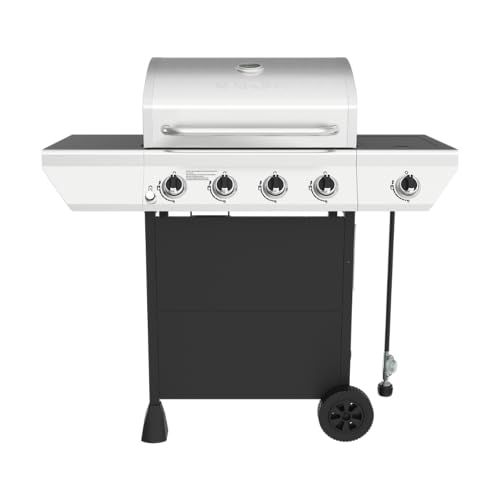
Nexgrill 4-Burner Gas Grill, 52,000 BTU
Badge: Best Overall
Strengths
- Cast iron grates and strong output make it a confident searing grill
- 526 sq. in. is a genuine family-plus-guests capacity without the largest footprint here
- Electronic ignition and built-in thermometer simplify the daily routine
Trade-offs
- Cast iron grates need oiling and care to avoid surface rust
- Less cooking room than the biggest Nexgrill when the whole street comes over
- Stainless lid still needs wiping to keep water spots and fingerprints at bay
At a glance
- Fuel: propane gas
- Burners: 4, plus side burner
- Total output: 52,000 BTU (maker rating)
- Cooking space: 526 sq. in.
- Grates: matte-finish cast iron
- Extras: built-in thermometer, electronic ignition, stainless steel lid
This second Nexgrill pairs four burners and a side burner with a maker rating of 52,000 BTU and 526 square inches of cooking space. The grates are matte-finish cast iron, which puts real searing mass under the food, and the lid is stainless steel over a cart the listing describes as portable, a combination aimed at owners who may need to wheel the grill in and out of a garage or around a patio. Electronic ignition and a built-in thermometer are both present, so the everyday routine is push-button lighting and lid-closed cooking with a temperature reference instead of guesswork. It sits in the middle of this pool on size, which for many households is exactly the point.
This Nexgrill is the family’s steak-and-burger station: cast-iron grates for the steaks, 526 square inches for a full round of burgers, and a side burner that turns the grill into the whole kitchen for onions, beans, or corn. It has no named sear zone, so you preheat thoroughly and let the iron do the marking, which it does gladly. Its honest limit is finesse: the heat map is broad rather than surgical, so mixed doneness in one batch takes arrangement and attention. For its tier, it covers the menu with the fewest compromises.
Best for: Family nights, mid tier / Not suited for: anyone whose needs run against that job — see the trade-offs above before you buy.

Weber Original Kettle Premium Charcoal Grill, 22-Inch
Badge: Best Charcoal Pick
Strengths
- Superb damper control for both searing and indirect cooking in one simple bowl
- One-Touch ash sweeping makes charcoal clean-up far less of a chore
- Light, durable, and backed by the deepest accessory range in charcoal grilling
Trade-offs
- 22-inch grate cooks for a family, but party batches need rounds
- Charcoal start-up and ash are part of every cook; there is no push-button option
- No work table of its own, so you will want a side surface for trays and tools
At a glance
- Fuel: charcoal
- Size: 22-inch kettle
- Extras: built-in lid thermometer, heat control dampers, One-Touch cleaning system
The 22-inch Weber Original Kettle Premium is the charcoal benchmark against which everything else in this pool is measured. The bowl-and-lid kettle shape manages heat beautifully with its dampers, the built-in lid thermometer takes the guesswork out of lid-down cooking, heat control dampers let you run anything from a hard sear over a chimney of coals to a patient indirect cook, and the One-Touch cleaning system sweeps ash into the catcher with a lever instead of a shovel. It is light enough to move around a garden, tough enough to live outside for years, and supported by an accessory ecosystem, from grates to rotisserie rings, that no other charcoal format matches.
The kettle cooks this menu the way it has been cooked for decades, and the flavour argument is unanswerable: charcoal-kissed burgers and steaks carry a depth gas cannot imitate. Technique is the price and the pleasure: a full chimney for a hot centre to sear steaks and cook burgers, coals banked later for finishing and holding. The Premium’s thermometer and dampers make that choreography manageable, and the One-Touch system deals with the ash afterwards. For cooks who grill on weekends and savour the ritual, this is the most satisfying pick here.
Best for: Flavour-first cooks / Not suited for: anyone whose needs run against that job — see the trade-offs above before you buy.

Monument Grills Mesa II 4-Burner Gas Grill
Badge: Best for Weeknights
Strengths
- Advanced Broil Zone gives a dedicated high-heat area for steaks and burgers
- Maker-claimed fast preheat suits weeknight cooking on a schedule
- Foldable shelves and highlighted fast assembly reduce the usual setup friction
Trade-offs
- Broil-zone designs reward learning; the hot area is intense and unforgiving of distraction
- Stainless finish needs regular wiping to look its best outdoors
- As with any feature-led model, confirm shelf and grate dimensions on the listing for your pans and trays
At a glance
- Fuel: propane gas
- Burners: 4
- Searing: Advanced Broil Zone
- Body: stainless steel
- Maker claim: reaches 500°F in 5 minutes
- Extras: foldable side shelves, fast assembly
- Model: Mesa II 410FBZ
The Monument Mesa II 410FBZ is a stainless steel four-burner built around an Advanced Broil Zone, the brand’s take on a high-heat searing area, and the maker claims the grill reaches 500°F in five minutes, which is a preheat speed claim worth noting because weeknight grilling lives and dies on how fast the grate is ready. Foldable side shelves keep the storage footprint smaller than the cooking capacity suggests, and the listing highlights fast assembly, a small mercy anyone who has spent a Saturday with a parts tray will appreciate. In this pool it is the design-forward stainless option for cooks who care about sear first and footprint second.
The Monument is built for the weeknight version of this menu: home late, grill hot in minutes by the maker’s claim, steaks into the Broil Zone, burgers across the main grate, dinner on the table while a slower grill would still be preheating. The broil zone gives thin steaks and smash-style burgers a properly aggressive finish, and the foldable shelves keep the machine storable in a garage between sessions. It asks for attentiveness, hot zones punish wandering minds, but for households whose grill nights are weekday events, its speed is a genuine feature, not a gimmick.
Best for: Weeknight speed / Not suited for: anyone whose needs run against that job — see the trade-offs above before you buy.

AMERLIFE 6-Burner Gas Grill with Side Burner
Badge: Best for a Crowd
Strengths
- 650 sq. in. and six burners cook for a crowd in one round, with zones to spare
- Cast iron grates give the big surface proper searing ability
- Warming rack and side burner keep finished food and sides moving together
Trade-offs
- The largest, heaviest format here; it needs a big patio and is effectively a fixed installation
- Six burners burn through propane quickly when everything runs at once
- Far more grill than a small household will use, and more to clean after every cook
At a glance
- Fuel: propane gas
- Burners: 6, plus side burner
- Total output: 60,000 BTU (maker rating)
- Cooking area: 650 sq. in.
- Grates: cast iron
- Extras: warming rack, built-in thermometer, regulating valve
The AMERLIFE is the capacity play: six main burners, a side burner, a maker rating of 60,000 BTU, and 650 square inches of cooking area, the largest surface in this pool. Six burners change the cooking maths completely. You can hold three distinct temperature zones at once, cook burgers for a team in a single round, and keep a warming rack loaded with finished food while the next batch sears. The grates are cast iron, a built-in thermometer and a regulating valve are listed, and the whole machine is unapologetically aimed at people who cook for crowds often enough that batch two and batch three have become the enemy. It needs a big, level home and an owner who will actually use the space.
When the menu is steaks and burgers for a crowd, this is the machine: 650 square inches means every burger in one round and every steak seared without queueing, on cast-iron grates with six burners to zone by doneness, well-done at one end, rare at the other. The warming rack holds finished burgers at serving temperature while the last steaks rest. It is far too much grill for a quiet Tuesday for two, and cleaning it after a party is a real job, but for the household that hosts, it converts the hardest part of the menu, volume, into the easiest.
Best for: Parties and big families / Not suited for: anyone whose needs run against that job — see the trade-offs above before you buy.

Royal Gourmet CC1830S Charcoal Grill and Offset Smoker
Badge: Best for Smoke Lovers
Strengths
- Offset smoker firebox enables true low-and-slow smoking, not just smoke flavouring
- 783 sq. in. total space is the largest cooking footprint in this pool
- Adjustable charcoal pan and side fuel door make heat management practical
Trade-offs
- Charcoal means longer start-up, ash clean-out, and active fire tending
- Barrel-plus-smoker footprint is large and the unit is a stay-at-home grill
- Temperature control is a learned skill; expect a few cooks to find your rhythm
At a glance
- Fuel: charcoal
- Format: barrel grill with offset smoker
- Total space: 783 sq. in.
- Extras: adjustable charcoal pan, side fuel door, lid thermometer, front and side tables
The Royal Gourmet CC1830S is a barrel charcoal grill with an attached offset smoker, and that offset firebox is the most important feature in this entire pool for anyone who cares about smoke. With 783 square inches of total space across the barrel and smoker, an adjustable charcoal pan, a side door for tending fuel, and a lid thermometer, it can grill directly over coals, cook indirectly, or run a genuine low-and-slow smoke with the fire offset from the food. Front and side tables give you working room for trays and tools. Charcoal asks more of the cook than gas in time and attention, and this design asks it in exchange for flavour nothing in a bottle reproduces.
The Royal Gourmet is the wildcard: a charcoal barrel that grills the classic menu over a wide coal bed and then, on another day, smokes ribs in its offset firebox. Burgers and steaks over charcoal carry the flavour this whole category romanticises, the adjustable charcoal pan lets you raise the fire for searing or drop it for gentler work, and the tables hold the production line. It asks the most of the cook, fire building, ash, patience, and gives the most back in range. For a household whose weekends are long and whose appetite for smoke is real, it is the enthusiast’s pick.
Best for: Smoke plus sear households / Not suited for: anyone whose needs run against that job — see the trade-offs above before you buy.

Char-Broil Portable 1-Burner Gas Grill
Badge: Best Portable Pick
Strengths
- Truly portable format that travels in a car and stores in a cupboard or garage corner
- Single burner is simple to light, simple to control, and economical on propane
- Fast setup suits spontaneous cooks, small households, and travel use
Trade-offs
- One heat zone only, so indirect cooking and mixed menus are very limited
- Small grate means cooking in batches for more than a few people
- Low total output struggles with thick steaks and windy, cold conditions
At a glance
- Fuel: propane gas
- Burners: 1
- Total output: 11,000 BTU (maker rating)
- Body: aluminised steel
- Format: portable, model 465133010
The Char-Broil Portable is a single-burner convective gas grill rated at 11,000 BTU, built from aluminised steel in a compact black format designed to travel. One burner means one heat zone and honest limits, and within those limits this is a proven little design: it lights fast, sips propane, fits in a car boot or a truck bed, and cooks burgers, dogs, sausages, and skewers for a small group without ceremony. It is the only pick in this pool you would genuinely carry to a stadium car park, a campsite, or a balcony with a strict size rule, and that portability is a feature no amount of burner count can substitute for.
The little Char-Broil is this menu’s travel specialist, included with its limits in plain view. One burner means one zone, so the steak-and-burger choreography becomes sequencing: sear the modest steaks first while the grate is at its hottest, rest them wrapped, then run the burgers in waves. It will not finish a thick ribeye like the big grills here, and it does not try to. What it does is put a real grilled meal, burgers, dogs, and a thinner steak, on a picnic table, a balcony, or a tailgate, from a machine that fits in the car. For away games and small spaces, that is a genuine answer to this keyword, not a token one.
Best for: Tailgates, camping, balconies / Not suited for: anyone whose needs run against that job — see the trade-offs above before you buy.
Comparison Table
| Pick | Format | Best use | Listing |
|---|---|---|---|
| Nexgrill 4-Burner Gas Grill, 52,000 BTU | Gas, 526 sq. in. | Family nights, mid tier | Check on Amazon |
| Weber Original Kettle Premium Charcoal Grill, 22-Inch | Charcoal, 22-inch kettle | Flavour-first cooks | Check on Amazon |
| Monument Grills Mesa II 4-Burner Gas Grill | Gas, broil zone | Weeknight speed | Check on Amazon |
| AMERLIFE 6-Burner Gas Grill with Side Burner | Gas, 650 sq. in. | Parties and big families | Check on Amazon |
| Royal Gourmet CC1830S Charcoal Grill and Offset Smoker | Charcoal, offset smoker | Smoke plus sear households | Check on Amazon |
| Char-Broil Portable 1-Burner Gas Grill | Gas, 1 burner, portable | Tailgates, camping, balconies | Check on Amazon |
How to Choose the Right Grill for Best grills for steaks and burgers
Think in heat maps, not temperatures
A mixed menu needs at least three behaviours from one grill: a searing hotspot, an even middle, and a gentle holding area. On gas, that map comes from burner zoning, with dedicated sear or broil zones making the hotspot explicit. On charcoal, you build the map yourself with coal placement, which is flexible but must be rebuilt every cook. When you read any grill’s marketing, translate it into a map: where is the hot corner, where do finished burgers wait, and where does a thick steak finish without burning? If you cannot answer, the grill will frustrate this menu.
Burger capacity is patties per round
Cooking area in square inches becomes real when converted: a standard patty needs roughly a four-inch circle plus breathing room, and crowding patties causes steaming and flare-ups. A 500-plus square inch grill cooks a family batch in one round; a 22-inch kettle cooks a respectable round with the edges used for holding; compact grills mean two rounds, which is fine if the first batch rests somewhere warm. Count your usual eaters, including the person who always wants a second burger, and size accordingly.
Flare-up management is a design feature
Burgers drip fat, fat flares, and flares scorch. Good designs fight this three ways: grates and flavour bars that vaporise drips below the food rather than pooling them, zones that let you slide patties out of the flames, and lids that calm a flare when closed briefly. Your technique matters too, leaner patties flare less and pressing patties squeezes juice into the fire, but the grill’s architecture decides how often you fight the battle at all. This is one reason cast-iron grates and generous zoning feature so heavily in the picks above.
The supporting features earn their keep on this menu
Steak-and-burger nights generate traffic: raw tray in, cooked tray out, buns, cheese, onions, sauces. Side shelves, tables, and a side burner stop being luxuries and become workflow. Likewise cleaning: burger fat coats everything, so grates that brush clean easily and drip trays that empty without gymnastics decide whether the grill gets used next week. The charcoal picks trade some of that convenience for flavour and ask for ash management in return; price that trade honestly for your household, and check Best Grills For Under $300 Dollars if you are weighing how far up the tiers this menu justifies going.
How to Run a Steak-and-Burger Night on One Grill
The secret to the combined menu is sequencing: the grill’s zones are set once, and the food flows through them in an order that has everything ready together. Steaks, which need a rest anyway, cook first; burgers, which wait for no one, cook last.
- Set up three zones before any food cooks: maximum heat for searing, medium for burgers, and low or off for holding and resting.
- Sear the steaks first over maximum heat, finish them in the gentle zone to temperature, then rest them, tented, in the holding area or on a warm platter.
- While steaks rest, cook the burgers over the medium zone, flipping once, moving any patty that flares into the gentle zone until the flames settle.
- Toast the buns cut-side down at the edge of the medium zone during the last minutes, watching them closely; buns go from pale to burnt in seconds.
- Add cheese to the burgers at the very end and close the lid briefly for a clean melt.
- Slice the rested steaks, plate the burgers, and serve together; the sequencing means nothing waits and nothing rushes.
- If doneness requests vary, arrange the grill by doneness from the start: rarest steaks and burgers in the gentlest positions, well-done at the hot end.
- Brush the grates and empty the drip tray after the meal, while the lessons and the residue are both fresh; burger fat left overnight is tomorrow’s flare-up.
Problem: Burgers flare constantly → The patties are fatty, the tray is full, or everything is parked over the hottest zone. Cook burgers in the medium zone, slide flaring patties aside, and clean the tray before the next session.
Problem: Steaks finish long before the burgers → Sequence, not speed, is the fix: steaks first, resting while burgers cook, is the order in the steps above; resting is a feature of steak, so use it as your buffer.
Problem: Cheese will not melt or burns → Add cheese only in the final minute and close the lid; the trapped heat melts it evenly. Cheese added early dries, slides, and burns on the grates.
Run this sequence twice and it becomes choreography: guests see a calm cook and a table where everything lands hot together, which is the entire point of the classic menu. When the same menu needs to happen away from home, Best Grills For Tailgaitings shows which compromises travel well.
Gas Versus Charcoal for the Classic Menu
Charcoal’s case is flavour and romance: smoke-kissed burgers, steaks with a fire-built crust, and the pleasure of tending a real fire. Its costs are time and variability: twenty minutes to a cooking fire, a heat map that fades as coals burn down, and ash at the end. The kettle in this guide narrows those costs with good dampers and ash handling, which is why it ranks second overall rather than as a niche pick.
Gas’s case is repeatability: the same heat map tonight as last Tuesday, ready in minutes, unbothered by wind-down or fuel judgement. For households grilling three weeknights a week, repeatability wins more dinners than romance does. Neither answer is wrong; the honest question is which cook you are on your ordinary evenings, and the picks above let you choose your answer at several tiers.
Smash Burgers and Thick Patties Need Different Grills Manners
Smash burgers, thin patties pressed onto a screaming-hot surface, want maximum contact heat: a cast-iron pan or griddle on the grill, or the broil and sear zones used boldly. They cook in moments, crust all over, and flare enthusiastically, so zone discipline matters. Thick pub patties want the opposite manners: medium heat, one flip, and patience, because a thick patty rushed over maximum heat burns outside before the centre cooks.
A grill that serves both styles well has a genuinely hot zone and a genuinely moderate one, which describes the top picks here. If your household has a house style, weight it: smash devotees should favour the sear-zone machines and a griddle accessory; thick-patty traditionalists should favour broad, even grates and generous holding space.
Building the Perfect Burger on Any of These Grills
Great burgers are decided before the grill: cold, loosely formed patties, seasoned assertively at the surface, with a shallow thumb dimple in the centre to counter puffing. On the grill, the rules are restraint: one flip, no pressing, cheese at the end, buns toasted at the edge. Sauce and toppings should be ready before the patties land, because a cooked burger waits badly and a built burger station makes the final minutes calm.
Within those rules, each pick here adds its own accent: charcoal smoke from the kettle and the barrel, broil-zone crust from the Monument, a hard sear from the Nexgrill’s cast iron. The perfect burger is less a recipe than a system, grill zones, sequence, and station, and once your system exists, it works identically on a Tuesday for two and a Saturday for twelve.
Steak-and-Burger Night Shopping and Prep Timeline
Shop the morning of, or the day before, and let prep do the heavy lifting. Patties formed and chilled, steaks salted and resting in the fridge, onions sliced, cheese portioned, buns out, sauces in bowls: when the grill lights, cooking is the only job left. Light the grill earlier than habit suggests, especially charcoal, and set the zones before the first guest asks when dinner is.
During the cook, one person grills and everyone else stays out of the zone map’s way; the fastest route to a burnt batch is a helpful crowd around the grate. Serve in the sequence the how-to describes, and clean while the grill is still warm enough to brush clean easily. The whole evening, done this way, feels effortless, and the effortlessness is entirely in the timeline.
Building a Burger Blend and Why It Matters More Than the Grill
Butchers and backyard legends agree on one thing: the blend decides the burger before the grill is lit. A single-grind chuck patty is the reliable classic, juicy and beefy; blends that add brisket or short rib deepen the flavour in ways guests notice without identifying. Fat content is the other dial: lean blends cook drier and flare less, richer blends taste luxurious and demand the flare management this guide’s zoning provides. Form patties cold, handle them minimally, and season the surface assertively rather than mixing salt through the meat, which firms the texture.
None of this requires a better grill, which is precisely the point: once your grill offers zones and honest heat, as the picks here do, the remaining quality lives in the meat and the method. Spend your learning energy there and your burger nights will quietly outclass restaurants.
Cheese, Buns, and the Supporting Cast
The supporting cast decides whether a good patty becomes a great burger. Cheese should be sliced to melt in the final minute under the lid: American cheese for the classic melt, aged cheddar for bite, Swiss for the mushroom route. Buns want toasting at the grate’s edge and enough structure to hold juice without turning to paste; the fashionable soft bun fails the second test by the third bite. Buttering the bun before toasting is the restaurant trick that home cooks most often skip and most immediately taste.
Set the toppings out as a station before the patties land: onions raw and grilled, pickles, sauces in bowls, lettuce washed and dry. The cook who builds the station first can run the grill calmly, and calm, at a hot grate full of burgers, is a flavour all its own. Every grill in this guide has the shelves, tables, or side burners to support that station, which is no accident of the selection.
Feeding Different Doneness From One Grate
Every mixed gathering contains the full doneness spectrum, and the grill can serve it without drama if the cook thinks in zones and sequence. Start the well-done patties and steaks first, in the honest heat; the medium group follows; the rare items go on last and come off first. Mark the groups by position, rare at the gentle end, well-done at the hot end, and the grate itself becomes your order ticket. A thermometer settles disputes that colour cannot.
Steaks complicate the picture helpfully, because their rest gives the burgers their window, as the how-to describes. Announce the system to your guests once, food comes off in waves by doneness, and nobody’s burger is sacrificed to somebody else’s ribeye. It is catering logic at backyard scale, and it works on every pick here from the kettle to the six-burner.
Bun Science: The Unsung Half of the Burger
A bun must do three jobs: hold juice without dissolving, toast without hardening, and stay out of the meat’s way. Brioche brings richness and a soft crumb that suits smashed patties; potato buns bring resilience for thick, juicy ones; the classic sesame bun remains the all-rounder. Whatever you choose, toast it at the grate’s edge, because a toasted face resists juice and a pale one surrenders to it.
Size the bun to the patty honestly. A patty that overhangs dramatically loses its edges to the fire and its juices to the board; a bun that dwarfs the patty turns dinner into bread. The grills here cook the patty; the shopper must marry it properly.
Onions Three Ways From the Same Grill
Raw onion brings bite and crunch and belongs on the classic build. Grilled onion, sliced thick and cooked at the grate’s edge until sweet and charred at the edges, belongs on the steakhouse build. Caramelised onion, slow and jammy, belongs in a pan on the side burner, where several picks in this guide quietly earn their keep while the patties cook.
Offering two styles costs the cook ten minutes and makes the table feel catered. It is the kind of small abundance that turns a grill night into the night people ask about, and it requires nothing the guide’s picks do not already provide.
The Children’s Menu From the Same Fire
Children at a steak-and-burger night need neither a separate menu nor a separate cook. Smaller patties from the same blend, cooked a little further, hot dogs rolling at the grate’s edge, and corn in its husk at the gentle zone cover every young appetite from the same fire and the same sequence. Keep a cooler corner of the grate as the children’s finishing zone, where nothing scorches while adults’ steaks rest.
Involve them where it is safe: choosing cheese, buttering buns, carrying the uncooked trays indoors. The grill night becomes a family ritual rather than a performance watched from the patio door, and the next generation of grillers is trained without a single lesson.
Cleaning After a Mixed Menu
Burger fat plus steak drippings is the dirtiest combination in backyard cooking, and the two-minute rule decides whether it matters: burn off, brush the grates hot, and empty the drip tray before it becomes tomorrow’s flare-up. Charcoal cooks sweep ash once cold and check the catcher; gas cooks confirm the tray and the grease cup are not quietly full.
Once a month in season, lift the grates and look at the burners or the bowl with honest eyes. Ten minutes of this prevents the mid-summer failure that always chooses a Saturday with guests. The picks in this guide were chosen partly for how kindly they accept this routine.
Doubling the Menu: When One Grill Becomes Two Stations
As gatherings grow, the elegant answer is often a second, smaller station rather than a bigger grill: the portable in this list running dogs and vegetables, or a kettle holding finished food warm, while the main grill runs the steaks and burgers. Two stations also separate the raw and cooked flows, which is a food-safety upgrade disguised as a capacity upgrade.
If your household hosts monthly, price that pairing before pricing a giant. The total often lands lower, the cooking gets calmer, and each machine remains right-sized for the ordinary weeks when the crowd is just the family.
Common Buying Mistakes
- Cooking everything over maximum heat. Steaks scorch, burgers flare, and nothing finishes together; zones and sequencing exist for this menu.
- Pressing burgers with the spatula. Pressing squeezes juice into the flames; it makes smoke, not crust, and dries the patty.
- Crowding the grate. Packed patties steam and flare; cook in rounds and hold finished food warm instead.
- Cheese on too early. Early cheese dries and burns; the final minute, lid down, is the whole technique.
- Skipping the steak rest to serve everything at once. Sequence the cook so the rest is built in; a rested steak and a fresh burger can absolutely share a plate.
Final Recommendation
The big Nexgrill, the 52,000 BTU model, is the complete answer for most households: cast-iron grates for the steaks, even four-burner breadth for the burgers, and a side burner for the supporting cast. Choose the Weber Kettle Premium when flavour and ritual lead, the Monument when the weeknight clock leads, and the Royal Gourmet when your weekends stretch from burgers into barbecue. The AMERLIFE owns the party, and the little Char-Broil portable takes the whole menu on the road.
Whichever you pick, run the sequencing in the how-to twice before judging it; this menu rewards system over improvisation. Readers whose next question is where to cook all this away from home will find Best Grills For Under $300 Dollard a useful budget cross-check for the portable end of the range.
Quick links to the top three: Nexgrill 4-Burner Gas Grill, 52,000 BTU, Weber Original Kettle Premium Charcoal Grill, 22-Inch, Monument Grills Mesa II 4-Burner Gas Grill.
Related guides
Frequently Asked Questions
Can one grill really be best for both steaks and burgers?
Yes, if it offers a heat map rather than a single temperature: a hot zone for searing, an even zone for patties, and a gentle zone for finishing and holding. The top picks here all provide that map, by burner zoning on gas or coal placement on charcoal. A grill with one uniform heat level forces compromises on one dish or the other, which is why the single-zone portable in this guide is ranked as a travel specialist rather than a leader.
Which fuel tastes better for burgers and steaks?
Charcoal, by most palates, adds a smoky depth that gas cannot fully reproduce, and both charcoal picks here deliver it. Gas counters with consistency and speed, and a well-seared gas steak with a proper crust beats a poorly managed charcoal steak every time. Choose by your schedule and your appetite for fire-tending; the flavour gap is real but smaller than the convenience gap for most households.
How do I stop burgers sticking and falling apart?
Start with a clean, fully preheated grate, handle patties cold and minimally, and flip once, when the first side has set and releases willingly. Patties tear when they are moved early or flipped repeatedly. A wide, thin spatula and a light touch do more than any spray or gadget, and cast-iron grates, used by most picks here, release burgers cleanly once the crust forms.
What order should I cook a mixed menu in?
Steaks first, burgers second, as the how-to section lays out. Steaks improve with a rest, which conveniently lasts exactly as long as a round of burgers takes, and burgers should go from grill to bun with no waiting. Buns toast in the final minutes and cheese melts in the final minute. Sequenced this way, everything reaches the table at its best simultaneously.
Do I need a griddle for smash burgers?
A flat surface makes smash burgers far easier and cleaner: a cast-iron pan or a griddle plate that fits your grill gives the full-contact crust and keeps the smashing fat out of the burners. Several grills here have the heat for it, especially the sear and broil zone models. Without a flat surface, cook patties conventionally; forcing the smash technique on open grates loses food through the bars.
How much grill do I need for a family of six?
For this menu, look at 500 square inches and up, or a 22-inch kettle used confidently, so a full round of burgers cooks at once while steaks rest. The Nexgrill and AMERLIFE in this guide are sized exactly for that household, and the Monument manages it with tighter choreography. Smaller grills can feed six in rounds, but the holding and resting dance gets demanding.


