Disclosure: topratedkitchenware.com is reader-supported. When you buy through links on our site, we may earn an affiliate commission from Amazon and other retailers, at no extra cost to you.
Where to buy
These are the verified picks for this guide to best hardline gas grills. Each linked name goes to its Amazon listing, where you can check the latest price on Amazon and confirm the current configuration before you decide. Picks shown without a link are reviewed in full below and are presented prose-only for the reason stated in their review.
- Char-Broil Performance Series 4-Burner Gas Grill Cabinet
- Nexgrill 4-Burner Propane Gas Grill with Side Burner
- IdeaMaxx 3-Burner Propane Gas Grill
- Weber Spirit E-425 Gas Grill
- Nexgrill 4-Burner Propane Gas Grill, Stainless Lid
- Monument Grills Mesa II 4-Burner Propane Gas Grill
Start with our top linked pick: Check on Amazon. Read the full guide ↓ for the detailed reviews, the buying checklist, and the how-to layer.
The best hardline gas grills are the permanent fixtures of the patio: full-size, plumbed-in-spirit gas cookers built to live in one spot and work like an outdoor range. Shoppers use the term for serious cart grills that anchor an outdoor kitchen — and for true hardline setups, where a natural gas line replaces the propane tank entirely. This guide covers six verified full-size gas grills that fit that permanent-fixture role, and it is honest about fuel plumbing: the models reviewed are propane carts as listed, so the buying guide explains exactly what a natural-gas hardline conversion involves and which buyers should order a factory natural-gas model instead.
That honesty is the point of the guide. A hardline installation is a commitment — a gas line run by a licensed professional, a fixed position, no rolling the grill across the patio on a whim. In exchange you get unlimited fuel, no tank swaps mid-cookout, and a grill that is always ready. The six carts below were chosen as the strongest foundations for that lifestyle: four-burner flexibility, real searing power, cabinets that hide the hardware, and build quality that justifies bolting your cooking life to one spot.
Key Takeaways
- Fuel and format first: the right choice in this guide depends on how you cook, not on brand fame.
- Our top linked recommendation is the Char-Broil Performance Series 4-Burner Gas Grill Cabinet — see its review for who it suits and who should skip it.
- Grate material and honest cooking area predict satisfaction better than headline output numbers.
- Every pick below was verified against the maker’s listing; specs quoted are the listing’s own.
- No static prices are printed in this guide — check the latest price on Amazon at decision time.
In this guide
Quick Picks
Six picks, six different jobs. The badge under each name is the shortest honest summary in this guide: if a badge matches your household, that pick deserves your closest read. Badges are repeated in the detailed reviews so you can cross-check the reasoning, and the comparison table after the reviews lines the six up side by side.
| Pick | Badge | Fuel | Cooking area | Listing |
|---|---|---|---|---|
| Char-Broil Performance Series 4-Burner Gas Grill Cabinet | Best Cabinet Gas Grill | Propane gas | Full-size cabinet cart cooking area | Check on Amazon |
| Nexgrill 4-Burner Propane Gas Grill with Side Burner | Best High-Output Gas Grill | Propane gas | 626 sq. in. cooking space | Check on Amazon |
| IdeaMaxx 3-Burner Propane Gas Grill | Best Compact Three-Burner | Propane gas | 3-burner cart cooking area | Check on Amazon |
| Weber Spirit E-425 Gas Grill | Best Premium Gas Grill | Propane gas | Full-size four-burner cooking area | Check on Amazon |
| Nexgrill 4-Burner Propane Gas Grill, Stainless Lid | Best Cast Iron Gas Grill | Propane gas | 526 sq. in. cooking space | Check on Amazon |
| Monument Grills Mesa II 4-Burner Propane Gas Grill | Best Broil Zone Gas Grill | Propane gas | Full-size four-burner cooking area | Check on Amazon |
Notice what the table does not contain: prices and ratings. Prices in this category move with seasons and promotions, and printed figures go stale, so this guide sorts by tier and fit instead — and sends you to the listing for the live number. If you are torn between two picks, the deciding factor is usually format: the cook who hosts chooses capacity, the cook who travels chooses portability, and everyone else should choose the control they will enjoy using weekly. Readers still narrowing the field may also find Best Hibachi Style Grills useful alongside this shortlist.
How These Picks Were Chosen
This guide is research-led. We compared the verified pick pool for the grills category against the promise inside the keyword itself — best hardline gas grills — and scored candidate models on the criteria that decide ownership satisfaction: fuel and format fit, honest cooking area, grate material, heat control (burner layout on gas, damper and firebox design on charcoal), included features that matter weekly, and the maker’s parts and support footprint. Models that failed the keyword’s core promise were not quietly linked anyway; where a pool model mismatched the keyword in a fundamental way, it is either presented prose-only with the reason stated, or the mismatch is called out in its review.
Specs in this guide come from the makers’ own listings as verified on 2026-11-20: burner counts, output figures, cooking areas, and named features are quoted as the listing states them, and where a figure is a total-system number rather than a primary-grate number, the review says so. We do not print prices or fixed ratings, because both change constantly and a guide that prints them becomes quietly wrong. We also make no hands-on testing claims: this is structured buying research, written to be checked — every linked pick leads to its listing so you can verify the current configuration yourself.
The shortlist deliberately spans formats rather than crowning six near-identical carts. A household that grills twice a week for four people and a household that hosts twenty twice a summer do not need the same machine, and a guide that pretends otherwise serves neither. Each review therefore ends with an explicit best-for and not-suited-for verdict. If your situation sits between two picks, the buying guide after the reviews is designed to break the tie, and the related shortlist at Best Has Grills Under $300 covers the neighboring version of the same question.
Detailed Reviews: Best hardline gas grills

Char-Broil Performance Series 4-Burner Gas Grill Cabinet
Badge: Best Cabinet Gas Grill
Strengths
- Enclosed cabinet hides the propane tank and stores tools out of sight
- Four burners plus side burner handle family meals and sides together
- Performance Series is a mainstream line with broad parts availability
Trade-offs
- Cabinet bases need a rinse-out habit to avoid trapped grease and moisture
- No thermometer detail in the listing title — verify features on the listing
- Black finish shows pollen and dust more than stainless
Mini spec box: Fuel: Propane gas. Burners/format: 4 burners + side burner. Output: Four-burner output (see listing for rating). Cooking area: Full-size cabinet cart cooking area. Grates: Performance Series cooking grates. Notable: Enclosed cabinet base, side burner, black finish.
The Performance Series cabinet model is Char-Broil’s tidy answer to the clutter problem: four burners and a side burner on top, and below, an enclosed cabinet that swallows the propane tank and gives your tools, brush, and drip pans a home that is not the patio floor. For households where the grill lives in plain sight — most patios, most of the year — that closed, black, furniture-like profile is a genuine quality-of-life upgrade over an open cart with a tank on display.
Four burners deliver the zoning flexibility this guide keeps recommending: direct heat for steaks, a low zone for finishing, room to keep finished food warm without overcooking. The cabinet does ask for one habit in return — open it up and wipe it out a few times a season, because enclosed bases can trap moisture and grease drips. Char-Broil’s mainstream presence is a quiet asset here too: consumables and common parts for the Performance line are widely stocked. For family cooking with a neat patio aesthetic, this is a well-rounded choice.
In practice, the Char-Broil Performance Series 4-Burner Gas Grill Cabinet succeeds or fails on repeatability: whether its propane gas heat feels the same this Saturday as it did last Saturday. The full-size cabinet cart cooking area sets its comfort zone for group size, while the enclosed cabinet base, side burner, black finish shapes the small conveniences you will notice weekly. Treat the performance series cooking grates well — brushed while warm, protected from weather — and this is the kind of grill that fades into the background of a household’s cooking life in the best possible way: always ready, rarely thought about, frequently used.
Best for: Families who want a tidy enclosed-cabinet grill with four-burner range and a side burner / Not suited for: Minimalists who prefer an open cart that hoses down in seconds

Nexgrill 4-Burner Propane Gas Grill with Side Burner
Badge: Best High-Output Gas Grill
Strengths
- 60,000 BTU across four burners plus side burner is serious heat for searing
- 626 sq. in. of cooking space suits large family meals and parties
- Electronic ignition and built-in thermometer make daily use easier
Trade-offs
- High output means faster propane use when all burners run hard
- Large cabinet cart needs a wide storage spot
- Stainless body needs regular wiping to stay bright
Mini spec box: Fuel: Propane gas. Burners/format: 4 burners + side burner. Output: 60,000 BTU total (per maker listing). Cooking area: 626 sq. in. cooking space. Grates: Stainless steel body format grates. Notable: Built-in thermometer, electronic ignition, double-door cabinet.
Nexgrill’s four-burner makes its case with numbers that matter: 60,000 BTU of total output and 626 square inches of cooking space, wrapped in a stainless body with a double-door cabinet. That is six-burner-class capacity in a four-burner cart, and it changes what a cookout looks like — a full load of burgers with room to spare, corn and peppers around the edges, and a side burner keeping beans hot instead of crowding the main grate. Electronic ignition and a built-in thermometer round out the daily-use basics.
High output cuts both ways: run everything on high and you will move through propane noticeably faster, and searing power this strong punishes distraction — thin foods go from perfect to overdone quickly. The cabinet cart is also a substantial piece of patio furniture that wants a level, permanent spot. For the household that actually cooks big — blended families, regular hosts, meal-prep grillers who batch-cook proteins for the week — those are the right trade-offs, and this Nexgrill earns its place near the top of the gas category.
Living with the Nexgrill 4-Burner Propane Gas Grill with Side Burner day to day is mostly about its propane gas rhythm. The 626 sq. in. cooking space gives you a clear sense of its natural party size, and the stainless steel body format grates is the surface you will know best — how it preheats, how it cleans, and how it treats delicate food. Its built-in thermometer, electronic ignition, double-door cabinet sounds like a spec-sheet detail until the first busy cook, when it quietly becomes part of your routine. Owners tend to settle into a pattern with a grill like this: a default zone layout, a default cleaning moment, and a short list of dishes it has effectively claimed as house specialties.
Best for: Big households and party hosts who want gas capacity close to a six-burner at a four-burner footprint / Not suited for: Small patios or two-person households that rarely cook more than four portions

IdeaMaxx 3-Burner Propane Gas Grill
Badge: Best Compact Three-Burner
Strengths
- Cast iron grates at a three-burner size deliver strong sear marks
- Foldable side shelves shrink the footprint for storage and transport
- 38,200 BTU is healthy output for a three-burner grill
Trade-offs
- Lesser-known brand with a thinner track record than legacy names
- No side burner
- Folding shelves support less weight than fixed steel shelves
Mini spec box: Fuel: Propane gas. Burners/format: 3 burners. Output: 38,200 BTU (per maker listing). Cooking area: 3-burner cart cooking area. Grates: Cast iron grates. Notable: Foldable side shelves for portable/patio/camping use.
IdeaMaxx pairs two features that rarely meet at this size: proper cast iron grates and foldable side shelves. The cast iron is the cooking story — 38,200 BTU across three burners driving grates that hold heat and mark food the way gas grills are supposed to. The folding shelves are the living-with-it story: shelves up for prep space while you cook, shelves down so the grill tucks against a wall, into a garage corner, or even travels to a campsite in a way fixed-shelf carts never will.
As with the other newer brands in this guide, the caveat is track record: IdeaMaxx does not yet have the decades of parts support behind it that the legacy names offer, and there is no side burner for sauce work. The folding shelves, while sturdy enough for tools and a tray, are not the place for a heavy cast iron Dutch oven. For renters, small patios, and anyone whose grill must earn a compact storage footprint, those are acceptable trades for cast iron performance at a three-burner size.
What defines ownership of the IdeaMaxx 3-Burner Propane Gas Grill is the combination of its 3 burners layout and its 3-burner cart cooking area. Together they decide how the grill behaves when the cook stops going to plan — guests arriving early, a side dish running long, a cut that needs five more gentle minutes. The foldable side shelves for portable/patio/camping use earns its keep in exactly those moments. Day to day, the cast iron grates asks for a simple, consistent cleaning habit and repays it with even cooking season after season.
Best for: Small-space cooks who want cast iron searing and a grill that folds down for storage / Not suited for: Party hosts or anyone who needs maximum shelf and storage space

Weber Spirit E-425 Gas Grill
Badge: Best Premium Gas Grill
Strengths
- Dedicated Sear Zone with Boost Burners delivers steakhouse-style crusts
- Porcelain-enameled cast-iron grates combine searing mass with easier care
- Weber Works rails accept a growing accessory system; Weber support is a long-term asset
Trade-offs
- Premium-tier positioning in the four-burner class
- Accessory ecosystem can tempt extra spending beyond the grill itself
- Four-burner cart is a permanent patio fixture, not a portable
Mini spec box: Fuel: Propane gas. Burners/format: 4 burners with Sear Zone. Output: Four-burner output with Boost Burners (see listing). Cooking area: Full-size four-burner cooking area. Grates: Porcelain-enameled cast-iron grates. Notable: Sear Zone with Boost Burners, Weber Works rails for accessories.
The Spirit E-425 is where this guide’s gas lineup turns premium, and the reason is the Sear Zone: a dedicated high-heat area with Boost Burners designed to put a deep, even crust on steaks and chops while the rest of the grate handles gentler work. Porcelain-enameled cast-iron grates are the ideal partner for that heat — cast iron’s searing mass with a coating that makes cleanup and rust management easier than bare iron. Weber Works rails along the front accept the brand’s accessory system, so the grill can grow with your habits.
Weber ownership is also a long-game argument: parts, covers, and support for the Spirit line are about as secure as this category gets, which matters on a grill you intend to keep for many seasons. The position is premium-tier, and this guide will not pretend otherwise — you are paying for searing performance, build, and backing rather than raw square inches. For the cook whose benchmark is a properly crusted ribeye and who keeps a grill for a decade, the E-425 is the four-burner to beat.
In practice, the Weber Spirit E-425 Gas Grill succeeds or fails on repeatability: whether its propane gas heat feels the same this Saturday as it did last Saturday. The full-size four-burner cooking area sets its comfort zone for group size, while the sear zone with boost burners, weber works rails for accessories shapes the small conveniences you will notice weekly. Treat the porcelain-enameled cast-iron grates well — brushed while warm, protected from weather — and this is the kind of grill that fades into the background of a household’s cooking life in the best possible way: always ready, rarely thought about, frequently used.
Best for: Steak lovers and quality-first buyers who want a four-burner built for high-heat searing and long ownership / Not suited for: Budget-first shoppers or anyone needing a grill that moves house easily
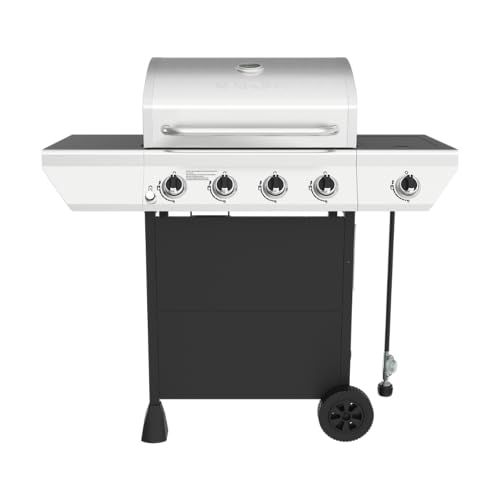
Nexgrill 4-Burner Propane Gas Grill, Stainless Lid
Badge: Best Cast Iron Gas Grill
Strengths
- 52,000 BTU and a side burner cover searing through side dishes
- Matte cast iron grate delivers strong heat retention and marks
- Built-in thermometer and electronic ignition are standard, not upsells
Trade-offs
- 526 sq. in. is mid-pack for four burners — big parties need batches
- Cast iron grate needs basic seasoning care
- Full cart size, not a storage-friendly compact
Mini spec box: Fuel: Propane gas. Burners/format: 4 burners + side burner. Output: 52,000 BTU (per maker listing). Cooking area: 526 sq. in. cooking space. Grates: Matte finish cast iron grate. Notable: Stainless steel lid, built-in thermometer, electronic ignition.
This Nexgrill is the balanced four-burner: 52,000 BTU, 526 square inches, a side burner, and — the detail cooks notice — a matte finish cast iron cooking grate. Cast iron changes the eating experience on a gas grill: better crust on burgers and steaks, better marks on chicken, and more forgiving heat when you open the lid to flip a full load. The stainless lid, built-in thermometer, and electronic ignition make it feel complete out of the box rather than like a base model waiting for upgrades.
At 526 square inches it is mid-pack for the class, so a true crowd still means cooking in waves, and cast iron asks for the usual light seasoning care after cleaning. Neither point is a deal-breaker for its intended buyer: a family of four to six that grills several times a week and wants one grill that sears properly, simmers a side, and does not demand a premium badge to do it. In a crowded four-burner field, the cast iron grate is its honest differentiator.
Living with the Nexgrill 4-Burner Propane Gas Grill, Stainless Lid day to day is mostly about its propane gas rhythm. The 526 sq. in. cooking space gives you a clear sense of its natural party size, and the matte finish cast iron grate is the surface you will know best — how it preheats, how it cleans, and how it treats delicate food. Its stainless steel lid, built-in thermometer, electronic ignition sounds like a spec-sheet detail until the first busy cook, when it quietly becomes part of your routine. Owners tend to settle into a pattern with a grill like this: a default zone layout, a default cleaning moment, and a short list of dishes it has effectively claimed as house specialties.
Best for: Families wanting a balanced four-burner with cast iron searing and a side burner / Not suited for: Hosts who need the largest possible grate in this class

Monument Grills Mesa II 4-Burner Propane Gas Grill
Badge: Best Broil Zone Gas Grill
Strengths
- Broil Zone adds a dedicated high-heat area for finishing and searing
- Foldable side shelves give prep space that disappears for storage
- Stainless body with a fast-assembly design shortens setup day
Trade-offs
- Premium-tier touches put it above basic four-burner pricing bands
- Broil Zone is a smaller area — it finishes food, it does not feed a crowd alone
- Newer model line: long-term owner data is still accumulating
Mini spec box: Fuel: Propane gas. Burners/format: 4 burners with Broil Zone. Output: Four-burner output (see listing). Cooking area: Full-size four-burner cooking area. Grates: Stainless steel outdoor grill grates. Notable: Advanced Broil Zone, foldable side shelves, fast assembly design, stainless steel body.
Monument’s Mesa II takes a different swing at the four-burner formula: an Advanced Broil Zone that concentrates heat for the jobs ordinary grates do indifferently — melting and browning cheese on burgers, crisping skin, finishing gratins in a cast iron pan, putting the final char on peppers. Around that headline, the spec is sensible: stainless body, four burners for zoning, and foldable side shelves that give you prep space during the cook and a slimmer cart afterward.
The maker positions this model on fast heating and fast assembly; treat speed claims as a bonus rather than the reason to buy — the durable reasons are the Broil Zone’s genuine usefulness and the folding-shelf practicality. As a newer model line, long-term owner history is thinner than the legacy brands in this guide, and its tier is above the basic four-burners. For cooks who regularly finish food with a blast of top heat, it offers something the standard four-burner layout simply does not.
What defines ownership of the Monument Grills Mesa II 4-Burner Propane Gas Grill is the combination of its 4 burners with broil zone layout and its full-size four-burner cooking area. Together they decide how the grill behaves when the cook stops going to plan — guests arriving early, a side dish running long, a cut that needs five more gentle minutes. The advanced broil zone, foldable side shelves, fast assembly design, stainless steel body earns its keep in exactly those moments. Day to day, the stainless steel outdoor grill grates asks for a simple, consistent cleaning habit and repays it with even cooking season after season.
Best for: Cooks who finish dishes with a high-heat broil and want storage-friendly folding shelves / Not suited for: Buyers who want the longest-proven model history in the class
Comparison Table
| Pick | Badge | Fuel | Format | Cooking area | Listing |
|---|---|---|---|---|---|
| Char-Broil Performance Series 4-Burner Gas Grill Cabinet | Best Cabinet Gas Grill | Propane gas | 4 burners + side burner | Full-size cabinet cart cooking area | Check on Amazon |
| Nexgrill 4-Burner Propane Gas Grill with Side Burner | Best High-Output Gas Grill | Propane gas | 4 burners + side burner | 626 sq. in. cooking space | Check on Amazon |
| IdeaMaxx 3-Burner Propane Gas Grill | Best Compact Three-Burner | Propane gas | 3 burners | 3-burner cart cooking area | Check on Amazon |
| Weber Spirit E-425 Gas Grill | Best Premium Gas Grill | Propane gas | 4 burners with Sear Zone | Full-size four-burner cooking area | Check on Amazon |
| Nexgrill 4-Burner Propane Gas Grill, Stainless Lid | Best Cast Iron Gas Grill | Propane gas | 4 burners + side burner | 526 sq. in. cooking space | Check on Amazon |
| Monument Grills Mesa II 4-Burner Propane Gas Grill | Best Broil Zone Gas Grill | Propane gas | 4 burners with Broil Zone | Full-size four-burner cooking area | Check on Amazon |
Read the table by columns, not rows: fix your fuel first, then your format, then compare cooking area inside that shortlist. Most regret in this category comes from reversing that order — falling for a huge grate in the wrong fuel, or a beloved fuel in a format that fights the patio.
How to Choose the Right Grill for Best hardline gas grills
Start with fuel, honestly. Gas is the weeknight fuel: fast to light, precise to hold, easy to shut down. Charcoal is the project fuel: slower, smokier, and for many cooks simply more fun and better tasting. The right answer is the fuel whose routine you will still enjoy on an ordinary Wednesday in month nine. Every other decision in this guide is downstream of that one, which is why the shortlist spans both rather than pretending the question is settled.
Size for the eighty-percent cook. Count your typical headcount, not your biggest party. Roughly, two to four people are well served by 300 to 400 square inches or a 22-inch kettle; five to eight want 450 to 600; beyond that, look at the six-burner and barrel formats or accept batch cooking with a warming rack. Oversized grills waste fuel and cleaning time on every small cook; undersized grills only hurt at parties, where batches and timing are manageable. Err toward the size of your normal life.
Fund the cooking system, not the cosmetics. Grates first — cast iron and porcelain-enameled cast iron sear best, porcelain-coated steel is the easy-care middle, thin chrome belongs on portables. Then burners or firebox design, then heat control you can feel: responsive dampers on charcoal, sensible burner spacing on gas. Lids, cabinets, and finishes matter for weather and tidiness, but they cook nothing. A useful cross-check while you decide is Best Healthy Grills, which approaches the same category from a neighboring angle.
Plan the whole ownership, not the purchase. Add the cover, the tank or the charcoal supply, the brush, and the thermometer to your mental budget from the start. Check assembled dimensions against your patio and storage, confirm the maker lists replacement grates and burners for the model, and register the warranty the week the grill arrives. Ownership satisfaction in this category is decided by these unglamorous steps far more than by any single feature on the box.
How to Grill Well: Setup, Cooking, and Care
Setup and first cook. Assemble on a level surface, keep every hardware bag until the manual is finished, and do a first empty burn or seasoning cook exactly as the maker directs — this burns off manufacturing residues and teaches you the grill’s basic behavior before food depends on it. On gas, check every connection with the maker’s leak-test method before the first ignition. On charcoal, run one chimney with no food and watch how the dampers move the temperature; that single experiment is worth a month of guessing.
The two-zone habit. Whatever your fuel, cook with a hot side and a safe side. Sear over the heat, finish on the gentle side, and use the safe side as a refuge when flare-ups or fast-cooking items demand it. Preheat fully — grates need to be properly hot to release food cleanly — and oil the food lightly rather than flooding the grate. Give food time before moving it: most sticking is just impatience, and most burning is a zone problem, not a recipe problem.
Cleaning and maintenance. Brush the grate while it is still warm after cooking, empty ash only when fully cold (charcoal), and keep the grease tray from filling (gas). A few times a season, check gas burner ports and tubes for blockages and charcoal dampers for free movement. Cover the grill between uses. These small habits are the entire difference between a grill that feels new in year three and one that feels tired in year one.
Troubleshooting. Problem: food sticks badly → the grate was not fully preheated or the food was moved too early; preheat longer and let the sear release naturally. Problem: temperatures will not climb on charcoal → check for damp fuel, blocked vents, or ash choking the fire; clear ash and open the intake. Problem: uneven heat on gas → look for clogged burner ports or a burner that has shifted; clean ports with the maker’s method and reseat the burner. Problem: constant flare-ups → trim excess fat, move food to the safe zone, and clean the grease path before the next cook.
Propane Cart or True Hardline: Understanding Your Options
A propane cart carries its fuel with it: a refillable tank in the cabinet, total placement freedom, and a regulator-and-hose system any owner can manage. A hardline natural gas grill connects to your home’s gas supply through a flexible line and quick-disconnect fitted by a licensed gas professional — never a DIY job. The cooking experience is identical once lit; natural gas burns slightly cooler per cubic foot, which is why hardline grills use different burner orifices and must be models designed or factory-converted for natural gas. Never connect a propane-configured grill to a gas line without the maker’s approved conversion, and in many cases a factory natural-gas version is the cleaner path.
Choose hardline when the grill’s home is permanent — an outdoor kitchen, a fixed patio corner — and your household grills often enough that tank management is a genuine annoyance. Choose propane when you may move house, rearrange the patio, or store the grill seasonally. Several makers of carts like the ones in this guide sell natural-gas siblings of the same designs; if hardline is your destination, shop those model numbers specifically and budget for the line installation. Guidance on the budget end of the same decision appears in Best Has Grills Under $300.
Designing the Permanent Grill Station
A fixed grill deserves a planned station. Allow clearance from siding and railings per the manual, a level heat-resistant surface under and around the cart, and lighting for evening cooks — a dark grate is how steaks get lost. Plan the work triangle: prep surface within a step, a landing zone for hot trays that is not the closed lid, and tool storage in the cabinet or a weatherproof box nearby. If a line is being run, that is also the moment to consider a stub for a future side burner or outdoor heater, since trenching twice is the expensive way to learn planning.
Weather discipline matters more for permanent grills, not less: a quality cover, a seasonal deep clean of burners and venturi tubes, and an annual check of hoses, connections, and the quick-disconnect keep a hardline setup safe and ready. A grill that never moves accumulates grease and weather in place, so the maintenance layer of this guide — written for exactly these fixtures — deserves a bookmark.
Common Buying Mistakes
Buying the party size for everyday life. The biggest grate in the store serves the two biggest days of your year and taxes the other fifty weekends. Size for the routine cook and manage parties with zones and batches. Comparing total area instead of primary area. Warming racks do not sear; compare the main grate. Ignoring grate material. It decides your sear, your sticking, and your cleaning life more than any electronic feature. Skipping the cover and the thermometer. The two cheapest purchases in grilling protect the most expensive one and improve every meal. Chasing output numbers alone. Heat you cannot control is just a faster way to burn dinner; zoning and dampers matter more. Shoppers who started from a neighboring shortlist, such as Best Healthy Indoor Grills, make these mistakes less often because the comparison habit carries over.
A final mistake deserves its own line: buying against your fuel patience. Every year, charcoal romantics buy gas grills they find boring and convenience seekers buy kettles they find burdensome, and both groups conclude that grilling is overrated. The grill is rarely the problem. Be honest about your Wednesday-night self, and the right pick in this guide becomes obvious.
Final Recommendation
Start with the Char-Broil Performance Series 4-Burner Gas Grill Cabinet. It is the linked pick that best matches the core promise of this keyword for the widest range of households, and its review above states plainly the cases where it is not the answer. If your situation leans the other way — a different fuel, a different headcount, a different patio — the Nexgrill 4-Burner Propane Gas Grill with Side Burner is the alternative we would shortlist next, for the reasons its own review lays out.
Whichever pick you choose, buy it as a system: the grill, the cover, the fuel plan, and the thermometer, all decided together. That system thinking, more than any single model choice, is what separates households that grill weekly for years from households whose grill becomes patio furniture. If you are still weighing neighboring versions of this decision, Best Heavy Duty Smoker Grills is the natural next read.
Storage deserves a sentence in any grill decision, because a grill lives somewhere for twelve months a year, not just on cooking days. Measure the storage spot before you fall for a spec sheet: cart width with shelves folded or removed, the height under a cover, and the path the grill must travel from patio to shelter. A grill that fits its home gets covered, cleaned, and used; a grill that fights its space quietly deteriorates and gets skipped on tired evenings.
Fuel logistics shape ownership more than most first-time buyers expect. Propane households should keep a spare tank or a gauge habit, because running dry mid-cook is the most preventable failure in gas grilling. Charcoal households should store fuel dry — damp charcoal lights poorly and burns unevenly — and keep a chimney starter, which replaces lighter fluid taste with a reliable fifteen-minute routine. Neither system is burdensome; both reward a small, consistent habit.
Weather changes how every grill in this guide behaves. Wind steals heat from kettles and barrels and can push gas flames around on exposed patios, so position matters: out of the prevailing wind, but never under a low overhang. Cold weather lengthens preheats and increases fuel use across every fuel type. None of this is a reason to avoid a category; it is a reason to place the grill thoughtfully on day one rather than after a frustrating season.
Accessories should be bought in the order they will be used: a cover and a good brush first, an instant-read thermometer second, and only then the enjoyable extras like baskets, griddles, and rotisseries. The thermometer deserves emphasis — it converts guessing into knowing for chicken, burgers, and roasts alike, and it improves the food from every pick in this guide more than any other single purchase at any tier.
Finally, judge a grill by its fifth year, not its first weekend. The questions that predict satisfaction are boring ones: can you still buy its grates and burners, does its ignition or damper system still work smoothly, and has its size matched your household’s real rhythm? The picks in this guide were chosen with those questions in the foreground, which is why honest limitations are stated in every review instead of being saved for the fine print.
Storage deserves a sentence in any grill decision, because a grill lives somewhere for twelve months a year, not just on cooking days. Measure the storage spot before you fall for a spec sheet: cart width with shelves folded or removed, the height under a cover, and the path the grill must travel from patio to shelter. A grill that fits its home gets covered, cleaned, and used; a grill that fights its space quietly deteriorates and gets skipped on tired evenings.
Fuel logistics shape ownership more than most first-time buyers expect. Propane households should keep a spare tank or a gauge habit, because running dry mid-cook is the most preventable failure in gas grilling. Charcoal households should store fuel dry — damp charcoal lights poorly and burns unevenly — and keep a chimney starter, which replaces lighter fluid taste with a reliable fifteen-minute routine. Neither system is burdensome; both reward a small, consistent habit.
Weather changes how every grill in this guide behaves. Wind steals heat from kettles and barrels and can push gas flames around on exposed patios, so position matters: out of the prevailing wind, but never under a low overhang. Cold weather lengthens preheats and increases fuel use across every fuel type. None of this is a reason to avoid a category; it is a reason to place the grill thoughtfully on day one rather than after a frustrating season.
Related guides
Frequently Asked Questions
What does hardline mean for a gas grill?
A hardline grill connects directly to a home natural gas line instead of a portable propane tank, using a professionally installed line and quick-disconnect. It never runs out of fuel mid-cook, but its position is fixed.
Can I convert one of these propane grills to natural gas?
Only with the manufacturer’s approved conversion kit or a factory natural-gas version of the model, and gas-line work should be done by a licensed professional. Burner orifices differ between fuels; never improvise a conversion.
Do natural gas and propane grills cook differently?
Once correctly configured, cooking is essentially the same. Natural gas is supplied at lower pressure and has less energy per cubic foot, which the grill’s design compensates for. Flavor differences are negligible.
How much does a hardline installation add to the project?
Costs vary widely with the distance from your gas supply and local labor rates, and this guide does not quote figures that would date quickly. Get quotes from licensed gas fitters, and consider adding a stub for future outdoor appliances while the line is open.
Is a hardline grill safer than a propane tank?
Both are safe when installed and maintained correctly. Hardline removes tank handling and storage; propane removes fixed plumbing. In both cases, annual leak checks and hose inspection are the owner’s job.
Can a hardline grill be moved later?
The quick-disconnect lets you detach the grill for service or patio work, but the station is effectively permanent. If you expect to rearrange or move house soon, a propane cart is the more flexible commitment.


