A heat exchanger espresso machine uses one boiler for both brewing and steam. A tube running through the boiler heats the brew water, so you can pull shots and steam milk at the same time without a second boiler.
The six machines below are well-known prosumer models from specialist makers, and many use an E61 group head. Dimensions, boiler size and water tank capacity differ by model, so check those details on the listing. We keep our notes general on purpose. We have not used these products ourselves, so please confirm the size, finish and what is included on the current listing before you buy.
As an Amazon Associate we earn from qualifying purchases. Links below are affiliate links, and they do not change the product information we give.
What to Look For
| Feature | Why it matters |
|---|---|
| Group head | An E61 group head is a common, durable design |
| Boiler size | A larger boiler recovers faster between shots |
| Water source | Tank models are simple; plumbed models suit permanent set-ups |
| Temperature control | A PID or a cooling flush helps keep shots consistent |
| Size and weight | Prosumer machines are heavy and need a stable bench |
In this guide
Specs at a Glance
| Machine | Group head | Water | Notes |
|---|---|---|---|
| Rocket Appartamento | E61 | Tank | Compact body |
| Rocket Mozzafiato Cronometro V | E61 | Check the listing | Shot timer |
| Lelit MaraX PL62X | E61 | Tank | PID control |
| Profitec Pro 500 | E61 | Tank or plumbed | Solid build |
| ECM Mechanika V Slim | E61 | Tank | Slim body |
| Quick Mill Silvano | E61 | Tank | Check version |
The 6 Best Heat Exchanger Espresso Machines
Top pickBest for small kitchens
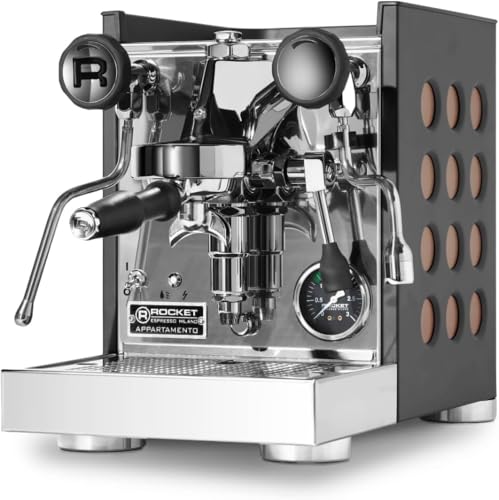
1. Rocket Appartamento
A compact heat exchanger machine from an Italian maker. It is known for its small footprint and classic looks. Check the listing for the tank size, because a smaller tank means more frequent refills during a long session.
Suits: small kitchens. Strengths: a compact build and a classic look. Weaknesses: smaller boiler. Skip it if you want a large boiler.
View Rocket Appartamento on Amazon
Best for enthusiasts
2. Rocket Mozzafiato Cronometro V
A heat exchanger machine with a built-in shot timer. It is aimed at enthusiasts who want a bit more refinement. Read the listing for the water options, since the plumbed option may need a separate kit.
Suits: enthusiasts. Strengths: a shot timer and a refined build. Weaknesses: larger than the Appartamento. Skip it if you have a small counter.
View Rocket Mozzafiato Cronometro V on Amazon

Best for people who like control
3. Lelit MaraX PL62X
A heat exchanger machine with a PID that helps control boiler temperature. It is known for its compact size and E61 group head. Because the PID helps with the temperature surge of a heat exchanger, new users often find shots easier to repeat.
Suits: people who like control. Strengths: PID temperature control. Weaknesses: some temperature learning curve. Skip it if you want a plain machine.
View Lelit MaraX PL62X on Amazon
Best for serious home baristas
4. Profitec Pro 500
A German-designed heat exchanger machine with an E61 group head. It is well regarded among home enthusiasts. Expect a machine with real weight, so plan counter space and check the cabinet height above it.
Suits: serious home baristas. Strengths: a solid build. Weaknesses: a bigger body. Skip it if you have little room.
View Profitec Pro 500 on Amazon
Best for compact kitchens
5. ECM Mechanika V Slim
A compact heat exchanger machine from a German maker with a slim body. It is designed for small kitchens. The slim body suits narrow counters, though the smaller footprint may mean a smaller drip tray.
Suits: compact kitchens. Strengths: a slim profile. Weaknesses: smaller tank. Skip it if you want a big tank.
View ECM Mechanika V Slim on Amazon
Best for espresso fans
6. Quick Mill Silvano
A heat exchanger espresso machine from an Italian maker. Check the listing for the version and its features. Specs differ between versions of this model, so match the exact name and features on the listing.
Suits: espresso fans. Strengths: a classic style. Weaknesses: features differ by version. Skip it if you want a specific spec.
View Quick Mill Silvano on Amazon
Care and Setup
- Backflush the group head as the manual advises.
- Descale on a regular schedule.
- Use filtered water to protect the boiler.
- Purge the group before each shot to manage temperature.
- Wipe the steam wand after every use.
Mistakes to Avoid
- Pulling a shot without flushing the group.
- Using hard water.
- Ignoring the heat-up time.
- Overfilling the tank.
- Skipping descaling.
How the Heat Exchanger Design Actually Works
In a heat exchanger machine, a single boiler holds water at a high temperature to make steam. A narrow tube runs through that boiler, and fresh water from the tank passes through the tube on its way to the group head. The hot boiler water heats the water in the tube without mixing with it, which is where the name comes from. That is how one boiler can serve both steaming and brewing.
The practical result is that the boiler runs hotter than brew temperature, and the water in the tube is heated as it travels. When the machine sits idle, the water in the tube and group can overheat. This is why the first shot after a pause can taste harsh if you pull it right away. The design is not flawed, but it does ask the user to manage temperature through routine rather than through a dial.
The upside is real. You can brew and steam without waiting for a switch between modes, which helps when making several milk drinks in a row. The machine also takes less space and has fewer parts than a dual boiler. Many enthusiasts like that the design uses simple, serviceable components. The trade-off is a modest learning curve and a bit of timing discipline, which the next section covers.
Temperature Surfing and Flushing Routines
Temperature surfing is the habit of running water through the group head for a set time before locking in the portafilter, so the brew water comes out at a steadier temperature. The right flush depends on the machine, how long it has been idle and how warm the room is. There is no universal number of seconds, so follow the manual and adjust by taste.
A simple way to begin is to flush after the machine reaches its operating state and again after any pause. Observe the water coming from the group. Early on it is very hot and may be steaming, then it settles as fresh water passes through the tube. Over several sessions you will find a routine that gives shots you like. Keeping notes on flush time, dose and shot time helps you repeat good results.
Machines with a PID controller or a temperature display make this easier because you can see the boiler state. Some models also include a cooling flush feature or a thermostat setting. Whichever you choose, the aim is consistency. Pull shots at a steady rhythm, flush the same way each time and avoid long gaps between drinks. If you make milk drinks, steam first or brew first in a pattern you can repeat. The skill is learnable, and many owners find it becomes automatic within a few weeks.
Group Head, Boiler and Build Quality Checks
The E61 group head is common in this category. It is a large brass assembly that is heated by water circulating from the boiler, which helps keep the group warm and stable. Its popularity means many replacement parts and tools are available, and many servicers are familiar with it. When comparing machines, note whether the group is E61 and how it is mounted.
Boiler size affects steam power and recovery. A larger boiler generally handles back-to-back milk drinks more comfortably, while a smaller one suits one or two drinks at a time. Boiler material also matters, with copper and stainless steel being typical. Both can work well, and the listing or manual should state which is used. Ask about the pump type too. Vibration pumps are common and compact, while rotary pumps are quieter and can be connected to a water line. Which you get varies by model, so check the listing.
Look at the details that show care in the build. Is the frame solid and the panels well fitted? Is the steam wand articulated and easy to position? Does the drip tray hold a useful amount and is it easy to remove? Is the pressure gauge easy to read? Also check what is supplied in the box, such as baskets and a portafilter, since you may need extras to dial in shots. If spares matter to you, ask the seller about parts and service support.
Space, Power and Plumbing Requirements
These machines are heavy and warm, so counter planning is part of the purchase. Measure the width, depth and height with the machine and its water tank in place, and leave room above for the tank lid or for refilling. Check that the counter is strong enough for the weight, and place the machine on a flat, stable and heat-tolerant surface. A mat or tray that can catch drips protects the counter.
Electrical needs deserve a look. Prosumer machines draw significant power, so plug into a wall outlet rather than an overloaded extension strip, and make sure the circuit can handle the load alongside other appliances. The listing and manual will list the voltage and power requirements. Models are made for particular regions, so confirm the electrical standard matches your home.
Water supply is the next decision. A tank is simple and needs no installation, but you must refill it and keep it clean. A plumbed connection removes the refill chore, yet it requires a water line, a filter and often a drain, and it is best installed properly. Some machines offer both options, with the plumbing kit sold separately. Whatever you choose, use water that suits the boiler, since very hard water causes scale and very soft water can be a problem for some parts. Check the maker’s water guidance.
Skill Level, Budget and When to Service
Heat exchanger machines suit people who enjoy the routine of making espresso and want a durable machine that can be maintained for years. If you want a push-button result with no learning, a simpler machine may be a better fit. If you like control, a PID model helps tame the learning curve. Think also about the grinder. A good espresso grinder is as important as the machine, and budgeting only for the machine can lead to disappointing shots.
Budget tiers in this group differ mostly in finish, temperature control and extras like shot timers or plumbing options. Entry-level units focus on core function, while higher-tier machines add refinement and flexibility. Pay for the features you will use, not for ones that look good on a spec sheet.
Plan on regular service. Water scale, worn gaskets and dirty group screens affect performance long before a machine fails. Typical signs that service is due include weak or uneven flow, a group head that leaks around the portafilter, strange noises from the pump, slow steam, or water pooling under the machine. A machine with worn gaskets can still last many years, as these are replaceable parts. Keep a log of descaling and backflush dates so you can spot patterns early.
Heat Exchanger Espresso Machines FAQ
What is a heat exchanger machine?
It has one boiler for brewing and steam. A tube heats the brew water as it passes through, so you can steam and brew at once.
Do I need to flush before a shot?
Many users run a short flush to cool the group water. Follow the maker’s advice for each model.
Is a heat exchanger better than a dual boiler?
It costs less and uses less space, but a dual boiler can offer more temperature stability.
How long does it take to warm up?
Prosumer machines often need a good while. Check the maker’s guidance.
Do I need a grinder to go with a heat exchanger machine?
Yes, and it should be a grinder made for espresso. Fresh, evenly ground coffee has a large effect on shot quality. Pre-ground coffee is usually not a good match for these machines.
What is a PID and do I need one?
A PID is a controller that helps hold boiler temperature steady. It is not required, but many users find it makes shots easier to repeat. Check the listing to see which models include one.
Can I leave the machine on all day?
Some owners do, while others use a timer to warm it before they wake. Follow the maker's guidance on idle time, and never leave it running unattended for long periods without checking the manual.
Why is my first shot bitter?
The group water may have overheated while the machine sat idle. A flush before the shot often helps. Grind, dose and shot time can also play a part.
What water should I use?
Use water that suits your machine and the maker's guidance, often filtered or softened. Very hard water speeds up scale. Check the manual before using distilled water, since some machines need some minerals.
How often should I backflush?
Follow the manual. Many users backflush with plain water after each session and use a cleaning product less often. Machines with certain valves are designed for backflushing, so confirm it applies to yours.
Is a plumbed-in setup worth it?
It saves refilling and suits a permanent spot, but it needs proper installation and a filter. If you move the machine or have no water line nearby, a tank is simpler.
Can I steam milk and pull a shot at once?
Yes, that is a main advantage of this design. Steam power depends on the boiler size, so check the listing if you often make several milk drinks in a row.
Steam Power and the Milk Drink Workflow
One of the quiet advantages of the heat exchanger layout is that the steam boiler is a real boiler, not an afterthought. Because the shot water passes through a tube inside that boiler, the machine keeps steam pressure ready at all times, and you can froth milk right after, or even during, a shot. That matters if your mornings involve two or three flat whites rather than a single straight espresso.
What to think about is how much milk you actually steam. A smaller boiler, like the compact size on the Rocket Appartamento, is perfectly workable for one or two drinks in a row, but a larger boiler recovers faster and holds steam pressure longer when you are making drinks for a household. If you regularly serve four or more milk drinks at a time, treat boiler volume as a tiebreaker between otherwise similar machines.
- Look at the steam wand: a four-hole tip gives a gentler, broader whirl than a single-hole tip, and a wand that moves freely on its joint makes pitcher positioning easier.
- Check whether the wand is a cool-touch design. Bare stainless gets hot and bakes milk onto the surface, so you will wipe it right after every use either way.
- Purge the wand for a second before and after steaming, so condensed water does not dilute the milk and leftover milk does not get pulled back into the tip.
A practical routine is to pull the shot first, then steam while the espresso is still fresh. Doing it the other way around leaves the shot sitting and losing its crema while you work on the milk.
Pump Types, Pressure and the OPV
Most machines in this category use a vibratory pump, the same style used across much of the home espresso world. It is compact, inexpensive and easy to replace, but it is audible. A rotary pump is quieter and is usually paired with a plumbed-in water line or a larger reservoir, and it tends to appear on pricier machines. Neither is automatically better for taste; the difference is mostly noise, serviceability and how the machine is meant to be installed.
The pressure at the group is controlled by an over-pressure valve, often shortened to OPV. Pumps are capable of pressure well above what a good shot needs, so the OPV bleeds off the excess and holds the brew pressure near the target, usually around 9 bar. Some machines ship with the OPV set on the high side, which can produce a harsh, fast shot even when your grind and dose are right.
- A pressure gauge on the front lets you see the pump pressure rather than guessing, which is useful when diagnosing a thin or bitter shot.
- The OPV is adjustable on many machines, but the process involves opening the case or using a portafilter fitted with a pressure gauge, so it is a job for a patient owner or a service shop.
- If you adjust it, change one thing at a time and keep notes, so you can tell whether the grinder or the valve caused the change.
Buying Used or Refurbished
Heat exchanger machines have a long working life, so the used market is active, and a secondhand E61 can be a sensible way into the category if you know what to inspect. The core metal parts, the boiler, group and frame, tend to outlast the wear items, so the questions are about condition and service history.
Ask for photos of the inside of the machine with the panels off. Look for white scale on fittings, green corrosion on brass, and any dampness around the pump or boiler connections. Ask how long the machine has been in use and what water the previous owner used, because hard water without softening is the leading cause of internal damage.
- Check that the heating element and pump run without unusual noise or tripping a breaker.
- Ask whether the group gasket, shower screen and steam valve seals have been replaced, and when.
- Confirm the voltage matches your country, since imported machines can be built for a different supply.
- If the seller offers a short return window or a receipt from a service technician, that is worth more than a low price.
Budget for a service even on a clean-looking machine. New gaskets and a descale are inexpensive compared with the cost of a surprise leak a month after purchase.
Descaling, Gaskets and Other Wear Parts
Beyond the daily routine, a few parts wear on a predictable schedule. The group gasket compresses over time, and when it hardens the portafilter will sit further around the group than it used to, or water will seep from the edge during a shot. The shower screen collects oils and fine grounds and gradually clogs, so an occasional soak or replacement keeps water spreading evenly across the puck.
Scale is the bigger long-term concern. Every heat exchanger machine heats water that carries dissolved minerals, and those minerals build up on the element and inside the exchanger tube. Using suitable water slows this down, but it does not stop it entirely. Follow the manufacturer guidance for descaling, and use a descaler that is safe for the metals inside your machine, since some acids attack brass and seals.
- Keep a small stock of spare gaskets and shower screens, which are cheap and quick to fit.
- Note the date of your last descale so you do not rely on memory.
- If you hear the pump straining, see weak flow, or notice a long delay before the steam valve delivers, suspect scale before assuming a failed part.
Frequently Asked Questions
What does the OPV do on an espresso machine?
The over-pressure valve limits the pressure the pump can send to the group. Without it, a vibratory pump can push well beyond what espresso needs. On many machines it is set to bleed off excess so brew pressure lands near 9 bar, and adjusting it can fix harsh, fast shots when grind settings are not the cause.
Is a rotary pump worth paying extra for?
A rotary pump is quieter and suits plumbed-in installations, but it does not change flavor on its own. If your machine sits in a small kitchen where noise matters, or you want a direct water line, it is attractive. If you fill a tank and tolerate some pump sound, a vibratory pump works fine.
Is it safe to buy a used E61 machine?
It can be, if you inspect it carefully. Ask for internal photos, look for scale and corrosion, and ask about water type and service dates. Expect to replace the group gasket and shower screen. A machine with documented service history is a better bet than a bargain with no records.
How often should I replace the group gasket?
There is no universal interval, since usage and water quality matter. A common rule is to inspect it every six months to a year. Replace it when it feels hard, cracked or flattened, when the portafilter travels further than before, or when water drips around the edge during extraction.
The Morning Ritual: Living With a Heat Exchanger Day After Day
A heat exchanger machine reorganizes the first half hour of a coffee drinker’s day, and it is worth imagining honestly before buying. The boiler needs real time to bring a large mass of metal and water to working temperature — not the few minutes of a small appliance, but a proper warm-up during which the group head, the portafilter and the cups all come to heat together. Owners build the ritual around it: the machine goes on first, by timer or by hand, and the kitchen’s other morning business happens while it wakes. Drinkers who need espresso in five minutes from a cold start will fight this machine forever; drinkers who love a ritual will find the wait becomes the pleasure’s opening act.
Once hot, the machine asks for the small ceremony of the cooling flush, and this is where heat exchanger ownership divides into those who understand their machine and those who merely own it. Water sitting in the exchanger runs hotter than brewing wants, so a short flush before the shot brings the group to temperature and, not incidentally, warms the cup and wets the shower screen. Performed as a habit — flush, lock in, pull — it takes seconds and becomes as automatic as rinsing a portafilter. The owners who skip it and then blame the beans for harsh shots are fighting physics that a three-second flush would have settled.
The rest of the day’s relationship is about readiness. A heat exchanger machine rewards being left in its rhythm: it holds temperature for the second coffee, the guest’s coffee, the afternoon coffee, with a consistency small machines cannot imitate, because its thermal mass is its temperament. The cost of that readiness is the warm-up and the counter it occupies while it waits. Everything in this category is that single trade, stated in different brass and steel: patience and presence in exchange for stability and steam.
Reading the Six Machines as Working Tools
The Rocket Appartamento is the machine that brought this class to a wider audience, and its appeal is legible at a glance: compact for its kind, handsome in a way that makes a kitchen feel deliberate, and built around the straightforward heat exchanger proposition without embellishment. It suits the drinker who wants the ritual and the results in the smallest honest footprint, and who will learn its flush and its moods the way you learn any good tool — by daily use.
The Rocket Mozzafiato Cronometro V steps up within the same house toward refinement: vibration-pump engineering with a shot timer and the finish of a machine meant to be looked at as much as used. Its buyer is the drinker who has already decided this is a long-term counter resident and wants the details — the gauge, the timer, the solidity of every control — to feel considered for years. The Lelit MaraX takes a different and cleverer road, building a reputation on taming the heat exchanger’s temperature behavior so the cooling flush matters less; for the drinker who loves the format but not the fuss, that engineering direction is the headline.
The Profitec Pro 500 represents the German school: restrained styling, serious internals, and the sense that every component was chosen by someone who expected to service it in a decade and be pleased with what they found. The ECM Mechanika V Slim makes a similar argument in a narrower body, answering the most common objection to this entire class — width — without surrendering the boiler-and-group substance that defines it. The Quick Mill Silvano is the group’s pragmatist, pairing the exchanger idea with an eye on efficiency and footprint for kitchens where the machine must justify every inch daily.
Between the six, the honest differences are footprint, temperature manners, finish and the details of the daily workflow — not a ladder from bad to good. A MaraX owner and an Appartamento owner are not drinking from different leagues; they are drinking from different philosophies about how much ritual they want the machine to carry and how much they are happy to perform themselves. Choose the philosophy and the machine follows.
Milk, Steam and the Drinks These Machines Are Really Bought For
Most heat exchanger machines are bought, whether the buyer admits it or not, for milk drinks. The defining party trick of the design — brewing and steaming at the same time, from one boiler — exists because a cappuccino household cannot wait between the shot and the steam without both suffering. Steam power in this class is generous and immediate compared with small single-boiler machines, and it changes what a home drinker can learn: with steam that does not run out mid-jug, milk texturing becomes a skill you can practice properly, one jug at a time, until the microfoam that once seemed like café magic becomes a Tuesday habit.
That power has a learning curve with a specific shape. The first weeks produce big, foamy milk, because strong steam punishes hesitation: the pitcher position, the tip’s depth and the roll of the milk must be decided quickly. The cure is volume of practice and small jugs — less milk, shorter steaming, faster feedback. Owners who persist through a month of imperfect cappuccinos emerge with a skill that justifies the machine every single morning, and most say the same thing afterward: the espresso was the excuse, but the milk is the daily joy.
It is worth being honest about the household arithmetic. If nobody in the home drinks milk drinks, much of this class’s advantage evaporates, and a simpler machine may serve better. If milk drinks are the household’s native language — flat whites for two every morning, cappuccinos for guests every weekend — then the heat exchanger’s simultaneous steam is not a feature on a list. It is the entire point, and it should be weighted accordingly against every other consideration in this guide.
Water In, Care Out: The Maintenance Contract
These machines are built like small commercial equipment and they expect to be kept like it. The contract begins with water. Scale is the slow enemy of every boiler, valve and exchanger passage, and the hardness of your water sets the timetable of your descaling whether you acknowledge it or not. Owners who feed the machine softened or sensibly filtered water from day one postpone that reckoning for years; owners who fill from a hard tap and never think again meet it as a repair bill. There is no third outcome, only a choice of when the subject is addressed.
The weekly contract is lighter: backflushing with water to rinse the group, wiping the steam wand the moment milk has touched it, emptying and rinsing the drip tray before it becomes an ecosystem. Monthly, a backflush with espresso machine cleaner keeps the group’s internals free of the coffee oils that otherwise season every shot with staleness. None of this is onerous — it is minutes, on a rhythm — but it is not optional either, and the honest buyer should hear that plainly: this class of machine rewards a keeper and punishes a neglecter more visibly than any pod or superautomatic ever will.
The yearly contract is wear parts. Group gaskets harden, shower screens tire, and a machine that is serviced on schedule — by its owner with basic confidence, or by a technician — behaves like new for a very long time, because the underlying engineering was designed to be opened, cleaned and renewed. That serviceability is the quiet reason these machines hold their value and their owners’ affection: they are not sealed appliances counting down to obsolescence, but instruments built for a decade of mornings, provided the human half of the partnership keeps the small, regular promises the machine cannot keep for itself.
Placement, Plumbing and the Countertop Reality
A heat exchanger machine is furniture as much as appliance, and placing it well is a decision with daily consequences. It needs clearance above for the cup warmer to be usable and for the reservoir to be filled without a wrestling match, or a water source arranged so filling is graceful. It needs a position where its warm-up hum and pump voice sit comfortably in the home’s acoustics, and where the morning workflow — grinder beside it, cups above it, sink within a step — forms a triangle the half-awake body can navigate without thought.
The plumbing question divides owners into two contented camps. Reservoir machines keep installation trivial and relocation possible, at the price of refilling and of a tank to keep clean. Plumbed machines vanish into the kitchen’s infrastructure and reward their owners with an almost commercial effortlessness, at the price of commitment to one spot and a more serious installation conversation. Neither is the advanced option; they are answers to different kitchens and different tenures, and the machines in this guide span both philosophies.
Power and heat deserve their sentence too: these are serious electrical appliances that warm a room corner and ask for a circuit treated with respect, not shared thoughtlessly with every other hungry device on the counter. Give the machine its space, its water and its circuit, and it will give back the thing no specification can promise — the feeling, every morning, that your kitchen contains a small, serious café that opens when you walk in, knows your drink, and never rushes you out.
The Grinder Question Nobody Escapes
Every machine in this guide is, in a sense, half a purchase. Espresso is ground seconds before it is brewed or it is merely coffee-flavored water under pressure, and a heat exchanger machine fed by a mediocre grinder will produce mediocre espresso with great steam. The grinder is not an accessory to this decision; it is the other half of it, and it deserves a comparable share of the budget and all of the same seriousness. Owners who plan the pair together — machine and grinder as one system, matched in capability — skip the most common disappointment in home espresso, which is a beautiful machine blamed for its partner’s shortcomings.
The practical signs of a grinder keeping up are simple: it doses consistently, adjusts in steps fine enough to move a shot’s timing by seconds rather than leaps, and retains so little old coffee that yesterday’s grounds do not season this morning’s shot. Pair any of the six machines here with that standard of grinder and fresh beans, and the remaining variable is the human — which is exactly where a hobby wants its variable to be, because humans improve with practice and machinery does not.
Learning the Machine’s Language
Somewhere in the second month of ownership, a heat exchanger machine stops being a set of instructions and becomes a set of signals. The sound of the pump settling into a shot, the look of the first drops gathering on the basket, the exact length of flush that brings the group sweet rather than scalding — these are a language, and fluency in it is the real product being bought. No manual delivers it; only mornings do.
That is why this class of machine holds its owners for years while simpler devices are upgraded away. A machine you have learned this intimately is not an appliance but an instrument, tuned to your beans, your water and your hand. Choose any of the six with your eyes open about the warm-up, the flush and the keeping of small maintenance promises, and the instrument will pay you back in the only currency that matters at seven in the morning: a cup that tastes like someone skilled made it, because someone did.
Guests, Weekends and the Machine as Host
The heat exchanger machine reveals a second personality when guests arrive, and for many owners it is the personality that justifies the purchase all by itself. A row of drinks — espressos for some, cappuccinos for others, an Americano stretched with hot water from the boiler — flows from a machine at full temperature without the pauses and recoveries that turn a smaller appliance’s owner into a short-order cook apologizing between courses. The host stays in the conversation, the drinks arrive in rhythm, and the kitchen briefly operates the way its centerpiece promises.
Weekend mornings are the quieter version of the same gift. Unhurried shots, a second round without a second warm-up, milk steamed while a shot pulls for the person still reading in bed — the machine’s thermal patience matches the day’s. If your coffee life is mostly solitary weekday fuel, weigh these social virtues lightly. If your kitchen is a gathering place and coffee is its ceremony, weigh them heavily: they are not extras on this class of machine, they are its native habitat, and a machine in its native habitat is the definition of a purchase that keeps satisfying.
A Decision Path for the Hesitant
If the choice among six serious machines feels paralyzing, shrink it with three questions. How much counter can the machine honestly own, in width and in height beneath the cabinets? That answer alone sorts the slim machines from the broad-shouldered ones. How much ritual do you want to perform yourself — is the cooling flush a pleasure of control or a chore you will resent by February? That answer separates the traditional designs from the temperature-taming ones. And is this a five-year appliance or a twenty-year instrument in your mind? That answer decides how much weight to give build tradition and serviceability against first cost.
Three honest answers leave most buyers with one or two machines standing, and between finalists at this level there is no wrong door — only the door that opens onto your kitchen. What lies behind every one of them is the same morning: a machine warm and waiting, a flush, a shot that runs like warm honey, steam when you want it. The rest is fit, finish and the pleasure of choosing well.
The Quiet Economics of Brewing at Home
Owners sometimes justify these machines with café arithmetic, and while the sums can genuinely favor the home machine in a household that drinks espresso daily, the deeper return is not financial. It is the conversion of a purchased habit into a practiced one: beans chosen deliberately, a skill accumulated morning by morning, a kitchen that smells of fresh coffee because coffee is actually made there. A heat exchanger machine is the enabling instrument of that conversion for households that want café form with home substance. Bought for that reason, and kept with the small fidelities this guide describes, it does not need to justify itself on a spreadsheet. It justifies itself at breakfast.
And on the mornings when everything aligns — fresh beans, a warmed cup, a shot that runs exactly as it should — the machine disappears entirely, and only the coffee remains. That disappearance is the highest achievement of any tool in this guide, and the surest sign the choice was right.
The Short Version
For small kitchens, the Rocket Appartamento. For a timer, the Mozzafiato. For PID control, the Lelit MaraX. For a solid build, the Profitec Pro 500. For a slim body, the ECM Mechanika V Slim. For classic style, the Quick Mill Silvano.


