Disclosure: topratedkitchenware.com is reader-supported. When you buy through links on our site, we may earn an affiliate commission from Amazon and other retailers, at no extra cost to you.
Where to buy
The six models below are the verified picks for this guide to the best home bbq grills. Each name links to its Amazon listing, where you can check the latest price on Amazon, confirm the current configuration, and read the newest owner feedback before you decide.
- Weber Spirit E-425 Gas Grill
- Monument Grills Mesa II 410FBZ 4-Burner Gas Grill
- Nexgrill 4-Burner Gas Grill with Side Burner, 626 Sq In
- Charbroil Performance Series 4-Burner Gas Grill Cabinet with Side Burner
- Nexgrill 4-Burner Gas Grill with Side Burner, 526 Sq In
- IdeaMaxx 3-Burner Propane Gas Grill with Cast Iron Grates
Read the full guide ↓ for the ranking logic, the honest limitations of every pick, and the party-tested checks that decide whether a grill survives game day.
The best home bbq grills are built for the days when the backyard fills up: ribs glazed at the last minute, burgers moving in waves, sausages rolling to the cool side while the next batch sears, and a cook who is somehow also the host, the bartender, and the person who knows where the spare tongs are. BBQ at home is a different job from weeknight grilling. The loads are bigger, the menu is wider, the timing is social rather than hungry, and the grill has to hold gentle indirect heat for ribs as happily as it blasts a sear zone for steaks. All six verified picks here are propane grills, because gas is the fuel that lets a host run that whole programme from one appliance without tending a fire, and they range from a premium four-burner with a true sear zone to a compact three-burner that folds its shelves away when the party ends.
Each pick is reviewed for BBQ service specifically: how much food it moves, how well it holds indirect heat for ribs and whole chickens, how its layout treats a cook feeding a crowd, and where its honest limits sit. You will also find a comparison table, a buying guide focused on capacity and zones, a how-to section on running a BBQ session from preheat to cleanup (including low-and-slow technique on a gas grill), and answers to the questions party hosts ask most. If your BBQ ambitions lean toward charcoal smoke rather than gas convenience, our notes on Best Home Charcoal Grills cover that tradition with the right equipment.
Key Takeaways
- BBQ hosting is a capacity and zones game: you need a hot zone for searing, a gentle zone for ribs and holding, and room for both at once.
- Indirect cooking is the core BBQ skill on a gas grill; burners off under the food, burners on beside it, lid down, patience on.
- A side burner is a party feature, not a luxury: sauces, beans, and corn stay hot without kitchen trips while guests are arriving.
- Cabinets and shelves decide whether a long cook feels organised or chaotic; trays and tools multiply during a party.
- Grate material still matters: cast iron and enameled cast iron hold heat through the constant lid openings that hosting involves.
- Check the latest price on Amazon for each pick before deciding, and measure your patio with the lid open and the shelves up.
In this guide
Quick Picks
| Pick | Badge | Why it earns its place | Listing |
|---|---|---|---|
| Weber Spirit E-425 Gas Grill | Best Overall | A sear zone with boost burners for the steak course and four-burner control for everything around it. | Check on Amazon |
| Monument Grills Mesa II 410FBZ | Best for Searing | A dedicated broil zone and a fast heat-up for hosts who sear in waves. | Check on Amazon |
| Nexgrill 4-Burner Gas Grill, 626 Sq In | Best for Parties | The largest listed cooking area here, with a side burner and cabinet storage for full productions. | Check on Amazon |
| Charbroil Performance Series 4-Burner Cabinet | Best for Organised Hosting | Cabinet storage and a side burner keep a long cook tidy and self-contained. | Check on Amazon |
| Nexgrill 4-Burner Gas Grill, 526 Sq In | Best Mid-Size All-Rounder | Four burners, a side burner, and cast iron grates in a mid-size footprint that suits most patios. | Check on Amazon |
| IdeaMaxx 3-Burner Propane Gas Grill | Best for Small-Space BBQ | Cast iron grates and folding shelves bring real BBQ capability to balconies and small decks. | Check on Amazon |
Badges here are written for hosts. A grill that shines for two on a Tuesday can fold under a Saturday load, and the reviews below grade every pick on the Saturday standard first.
How These Picks Were Chosen
This is a research-led guide built from a verified product pool. Every specification in the reviews comes from the listing data for that exact model: burner counts, listed output, cooking area where stated, grate material, and named features such as a sear zone, a broil zone, or foldable shelves. Where a listing does not state a figure, the guide leaves it out. No prices, star scores, or owner counts are printed, because they change constantly and because BBQ quality is decided by layout, heat, and technique rather than by a number on a page.
The ranking weighs hosting realities. First, working room: how much food cooks at once, and whether a gentle zone survives while the hot zone works. Second, heat character: sear zones and broil zones for the steak course, and stable low burners for indirect ribs. Third, the support act: side burners for sauces and sides, cabinets and shelves for the multiplying trays and tools, and grate finishes that survive sticky glazes and brush clean afterwards. Fourth, honest fit: each review names who should skip the pick, from the balcony host who will never fill a party-size grate to the rib specialist who should know that gas BBQ is an indirect-heat craft, not a smoker substitute. Readers whose search runs through a particular store channel can compare layouts with our notes on Best Home Depot Gas Grills as well.
The 6 Best Home BBQ Grills for Gatherings, Ribs, and Game Day

Weber Spirit E-425 Gas Grill
Badge: Best Overall
Strengths
- The Sear Zone with Boost Burners gives a party grill the one thing most lack: a genuinely hotter patch for steaks and burgers while the rest of the box holds gentle heat.
- Porcelain-enameled cast iron grates hold temperature through the constant lid openings of hosting and clean up well after glazed ribs.
- Four burners make true indirect setups easy: two on, two off, ribs resting over the cool side for as long as they need.
Trade-offs
- Premium positioning means its value is measured in years of parties, not in a single summer.
- It is a full-size grill; small patios should check the footprint with the lid open before falling for the feature list.
- The Weber Works accessory rails invite spending, and hosts should buy inserts for the food they actually cook.
Mini spec box: Burners: 4 · Feature: Sear Zone with Boost Burners · Grates: porcelain-enameled cast iron · Extras: Weber Works rails · Colour: black · Fuel: propane.
A great BBQ grill has to play two positions: linebacker and quarterback. The E-425’s sear zone is the linebacker, delivering the concentrated heat that crusts steaks and burgers even when the grate is loaded and the lid has been opened a dozen times for guests. The four-burner layout is the quarterback, running the rest of the play: ribs indirect on the cool side, corn holding at the back, sausages rolling through the middle lane as they finish. That combination is rare at home level, where most grills do one job well and improvise the other, and it is why this pick leads the guide.
For BBQ specifically, the indirect story deserves emphasis. Ribs, whole chickens, and thick pork shoulders on a gas grill live or die by stable, gentle, enclosed heat, and a four-burner box gives you the geography to build it: food over unlit burners, a drip pan beneath, lit burners alongside holding a steady low temperature with the lid down. The enameled grates then forgive the sticky, sugary glazes that BBQ cooking involves, brushing clean without the seasoning rituals of bare iron. Its limitation remains fit and positioning: it is the premium pick, sized and priced in spirit for households whose BBQ calendar is full. Occasional hosts will be served nearly as well by simpler picks below; weekly hosts will feel the difference every single Saturday.
Best for: serious home hosts who sear, roast, and run indirect BBQ from one grill / Not suited for: tiny patios or households that host once a year
Check on Amazon to see the current configuration and confirm dimensions before you buy.

Monument Grills Mesa II 410FBZ 4-Burner Gas Grill
Badge: Best for Searing
Strengths
- The Advanced Broil Zone concentrates heat for crust-building, so steak and burger waves move fast at a party.
- The listing highlights a quick heat-up, which suits hosts who light the grill as guests arrive rather than an hour before.
- Foldable side shelves give landing space during service and a smaller stored footprint after it.
Trade-offs
- The broil zone is a zone, not the whole grate, so very large steak batches still cook in rounds.
- Stainless steel needs regular wiping to keep its looks through a season of saucy cooks.
- Fast assembly is claimed, but any four-burner deserves a careful build and a proper leak check before its first party.
Mini spec box: Burners: 4 · Feature: Advanced Broil Zone · Heat-up highlighted in listing: 500°F in 5 mins · Shelves: foldable side shelves · Body: stainless steel · Model: Mesa II 410FBZ.
Parties sear in waves, and waves are what the Mesa II is built for. The broil zone runs hotter than the rest of the box, so burgers and steaks crust quickly and move to the gentle side to hold, freeing the hot patch for the next round. That rhythm, sear and hold, sear and hold, is the heartbeat of game-day cooking, and a dedicated zone makes it a layout decision instead of a juggling act. The fast heat-up highlighted in the listing supports the same rhythm at the start of the day, when the grill goes from cold to cooking while the first guests are still arriving.
The honest limits are size and shine. The broil zone concentrates heat in one area, so a dozen ribeyes will still queue, and the stainless exterior will show a season of parties unless you wipe it down as you go. Neither matters much if your BBQ style is steak-led and your gatherings are mid-size, which is precisely the host this grill serves best. Hosts whose menu leans toward long indirect cooks should weigh the Weber’s layout above; hosts whose menu leans toward seared food in rounds will find this the sharper tool.
Best for: hosts whose BBQ menu is steak- and burger-led and who cook in waves / Not suited for: very large single-batch searing or low-maintenance exterior expectations
Check on Amazon to see the current configuration and confirm the broil zone layout before you buy.

Nexgrill 4-Burner Gas Grill with Side Burner, 626 Sq In
Badge: Best for Parties
Strengths
- The largest listed cooking area in this guide, so a full party load cooks at once instead of in anxious relays.
- A side burner keeps beans, sauces, and corn at the grill, where the host actually is.
- The double-door cabinet hides the tank and the growing pile of party tools.
Trade-offs
- It is the biggest footprint here and claims patio space accordingly.
- The highest listed total output is spread over the largest area, so its heat is broad and capable rather than intensely focused.
- Big cooks mean big cleanups: more grate to brush and more surfaces to wipe.
Mini spec box: Burners: 4 plus side burner · Output listed as 60,000 BTU · Cooking space listed as 626 sq in · Body: stainless steel · Storage: double-door cabinet · Ignition: electronic · Thermometer: built-in.
Party maths is brutal: twenty burgers, a dozen sausages, a tray of chicken, and a vegetarian corner, all wanted within the same twenty minutes. This Nexgrill is the pick that makes that maths work, because its listed cooking area is the largest in the guide and its four burners let you zone the load instead of queuing it. Burgers sear on the hot side, chicken finishes in the middle, sausages and vegetables hold on the gentle side, and the side burner minds the beans. The host cooks one coordinated meal instead of three sequential ones, which is the difference between a party and a shift.
The trade-off is concentration. With the group’s joint-highest listed output spread across its largest grate, this grill’s gift is throughput, not a single ferocious hotspot, and steak purists should sear in smaller batches over the hottest lanes. It also asks for patio space and post-party cleaning in proportion to its size. For households whose BBQ is a recurring production with a real guest list, those are the right problems to have, and no other pick here solves the capacity problem as directly.
Best for: regular hosts cooking for crowds who need maximum working room / Not suited for: small patios or couples who rarely entertain
Check on Amazon to see the current configuration and confirm the footprint before you buy.

Charbroil Performance Series 4-Burner Gas Grill Cabinet with Side Burner
Badge: Best for Organised Hosting
Strengths
- The cabinet format swallows tools, foil, brushes, and the tank, keeping a long party cook organised instead of scattered.
- Four burners plus a side burner cover the complete hosting pattern: zones for food, a burner for sides and sauces.
- The black finish hides the fingerprints and splashes of a busy cook better than bright metal.
Trade-offs
- The listing leads with format rather than output figures, so judge it on layout and storage, not on headline heat.
- A cabinet grill is patio furniture, not a fold-away appliance; it stays where you put it.
- Enclosed storage still needs a seasonal clean-out, because outdoor cabinets collect dust and drips.
Mini spec box: Burners: 4 plus side burner · Format: cabinet with side burner · Colour: black · Model: 463253925 · Fuel: propane.
Long BBQ cooks generate clutter at a rate that surprises first-time hosts: raw trays, cooked trays, tongs, a thermometer, sauce bowls, foil, a rest tent for the ribs, and somewhere in the middle of it, the cook’s drink. The Performance cabinet is the pick that gives that clutter a door. Its four-burner layout runs the standard hosting pattern without fuss, the side burner keeps the sauce warm at elbow height, and when the party ends, the tools go behind the doors and the patio returns to being a patio. That organisational calm is a genuine performance feature across a four-hour cook, even if it never appears in a BTU table.
Judge it on those terms and it competes strongly; judge it as a spec-sheet duel and you will miss its point. Hosts who store their grill in a garage between uses, or who move it around the yard, will not benefit from the format. Hosts whose grill lives in place and works long Saturdays will appreciate it every single cook.
Best for: hosts whose grill lives on the patio and who value storage and a tidy long cook / Not suited for: anyone who stores the grill away or shops purely by output figures
Check on Amazon to see the current configuration and confirm the cabinet dimensions before you buy.
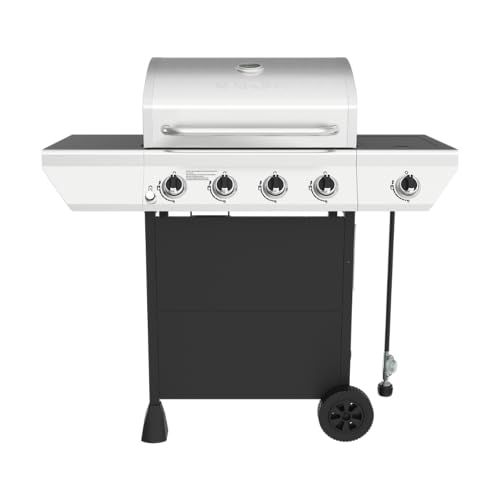
Nexgrill 4-Burner Gas Grill with Side Burner, 526 Sq In
Badge: Best Mid-Size All-Rounder
Strengths
- Four burners and a mid-size listed cooking area hit the balance most patios actually need: party-capable without dominating the deck.
- Matte finish cast iron grates store heat for better searing and better recovery between party batches.
- A side burner, electronic ignition, and a built-in thermometer cover the hosting basics without fuss.
Trade-offs
- It is an all-rounder by design, so specialists will find a sharper tool elsewhere in this guide for pure searing or pure capacity.
- The stainless lid shows heat discoloration over seasons of hard use.
- Assembly is a substantial job, as with any four-burner cabinet-style grill.
Mini spec box: Burners: 4 main plus side burner · Output listed as 52,000 BTU · Cooking space listed as 526 sq in · Grate: matte finish cast iron · Lid: stainless steel · Ignition: electronic · Thermometer: built-in.
Most households do not need the biggest grill or the sharpest sear zone; they need the grill that handles Tuesday and Saturday with equal competence, and that is this Nexgrill’s brief. The mid-size listed area covers a family load or a modest party, the cast iron grates give its searing real substance, and the four-burner layout supports the indirect setups that ribs and whole chickens require. The side burner rounds out the meal, and the whole package fits patios that the party-size pick above would overwhelm.
Its limitation is the all-rounder’s eternal one: it wins no single category outright. The Monument sears with more focus, the larger Nexgrill cooks with more room, and the Weber brings a premium ecosystem. But BBQ buying is a compromise sport, and for the household that hosts a dozen times a year and grills every week, this balance of size, heat, and features is the easiest recommendation in the guide to live with. Shoppers cross-checking the wider gas category can also scan Best Home Gas Grills for neighbouring four-burner layouts.
Best for: households wanting one balanced grill for weekly cooking and regular modest parties / Not suited for: specialists who want maximum sear focus or maximum capacity above all
Check on Amazon to see the current configuration before you buy.

IdeaMaxx 3-Burner Propane Gas Grill with Cast Iron Grates
Badge: Best for Small-Space BBQ
Strengths
- Cast iron grates give a compact grill genuine searing substance, which small grills often fake with thin metal.
- Foldable side shelves work during the party and disappear after it, a real virtue on balconies and small decks.
- Three burners concentrated under a modest area keep heat density healthy for burgers and steaks.
Trade-offs
- Party loads cook in batches; this is a small-gathering grill, not a crowd appliance.
- Cast iron asks for dry storage and light maintenance to stay at its best.
- No side burner is listed, so sauces and sides stay in the kitchen.
Mini spec box: Burners: 3 · Output listed as 38,200 BTU · Grates: cast iron · Shelves: foldable side shelves · Colour: black · Fuel: propane.
Small-space BBQ is a real category, not a consolation prize, and the IdeaMaxx treats it seriously. The design spends its budget where small grills usually cheat: the grate. Cast iron at this size means the burgers actually sear, the sausages actually colour, and the grill recovers between the batches that a compact capacity makes inevitable. Three burners still give you a hot side and a gentle side, which is the whole zoning game in miniature, and the folding shelves acknowledge the truth of balcony life, which is that the grill shares its square metres with chairs, plants, and people.
Its limits are capacity limits, plainly stated: a gathering of four to six eats well; a gathering of twelve eats in waves, and the cook should plan the menu accordingly, leading with foods that hold happily. For the small-patio household that refuses to give up real BBQ, it is the most honest pick in this guide, and its fold-away manners will be appreciated every single day it is not cooking. Readers with a very different small-space format in mind can see the countertop end of the category in Best Home Counter Grills.
Best for: balconies, small decks, and small gatherings that still want real searing / Not suited for: large parties or hosts who need a side burner
Check on Amazon to see the current configuration and confirm the folded dimensions before you buy.
Comparison Table
| Pick | Badge | Key attributes | Listing |
|---|---|---|---|
| Weber Spirit E-425 | Best Overall | 4 burners; Sear Zone with Boost Burners; porcelain-enameled cast iron grates | Check on Amazon |
| Monument Grills Mesa II 410FBZ | Best for Searing | 4 burners; Advanced Broil Zone; fast heat-up highlighted; folding shelves | Check on Amazon |
| Nexgrill 4-Burner, 626 Sq In | Best for Parties | 4 burners plus side burner; 60,000 BTU listed; 626 sq in listed; cabinet | Check on Amazon |
| Charbroil Performance Cabinet | Best for Organised Hosting | 4 burners plus side burner; cabinet format; black | Check on Amazon |
| Nexgrill 4-Burner, 526 Sq In | Best Mid-Size All-Rounder | 4 burners plus side burner; 52,000 BTU listed; 526 sq in listed; cast iron grate | Check on Amazon |
| IdeaMaxx 3-Burner | Best for Small-Space BBQ | 3 burners; 38,200 BTU listed; cast iron grates; folding shelves | Check on Amazon |
How to Choose a Home BBQ Grill for the Way You Host
Start with your real guest list. Count the mouths at your typical gathering, then count the food in grill loads: a party grill should hold one full round of the main protein for everyone, because rounds two and three can cook while round one is eaten. That simple test sorts this guide quickly: large, regular gatherings point to the biggest listed cooking area; gatherings of six to ten point to the mid-size four-burners; small patios and small guest lists point to the three-burner. Next, match the grill to your menu. Steak-led hosts should value a sear or broil zone. Rib- and chicken-led hosts should value four-burner indirect layouts and a lid that seals well enough to hold gentle heat. Sauce- and side-led hosts should value the side burner more than any other single feature.
Then think like a host, not a shopper. Where do trays land? Where do tools live? How does the patio feel at hour three of a cook, when the grill is hot, the cook is busy, and guests are circulating? Shelves, cabinets, and sane footprints answer those questions, and they are why two grills with similar burners can host so differently. Finally, respect the storage reality: a grill that lives outdoors all year needs a cover and finishes that forgive weather, while a grill that folds its shelves and rolls into a corner suits households whose patio changes jobs with the seasons. The right BBQ grill is the one that makes your next party easier than your last one.
How to Run a BBQ Session: Setup, Indirect Cooking, Cleaning, and Troubleshooting
Setup starts the day before the party: check the propane level, clean the grate, empty the grease tray, and confirm the igniter clicks strongly, because every one of those is a five-minute job today and a crisis at kickoff. Assemble carefully if the grill is new, and run the soapy-water leak check on hose connections before the first ignition of the season. On the day, preheat with the lid closed until the grate is fully soaked, then build your zones before any food appears: a hot zone for searing, a gentle zone for finishing and holding, and, for ribs and whole birds, an indirect zone with the burners beneath the food turned off and a drip pan in place.
For low-and-slow BBQ on gas, the method is patience plus a thermometer. Keep the lid down, hold a gentle, steady heat with the lit burners, turn the food occasionally for even exposure, and judge doneness by temperature and tenderness rather than by the clock. A smoker box or a foil pouch of wood chips over a lit burner can add a whisper of smoke; be honest that it is a whisper, not the deep smoke of a charcoal offset, and enjoy gas BBQ for its own strengths of control and calm. Glazes and sauces go on near the end, because their sugars burn over direct heat, and cooked food rests before slicing so the juices stay in the meat.
Cleaning after a party is a ritual worth automating: run the grill hot for a few minutes, brush the grate while warm, let everything cool, then empty the grease tray and wipe the exterior before the cover goes on. Problem: ribs cook unevenly, with one end done and the other tough → your indirect zone has a hot side; rotate the rack during the cook and check that the lit burners are not creeping up. Problem: flare-ups every time the lid opens → excess fat and a neglected grease tray; trim, clean, and move fatty food to the gentle zone to finish. Problem: burgers stick and tear in front of guests → the grate was not fully soaked or was dirty; preheat longer, clean properly, and let the crust form and release before flipping.
Gas BBQ Versus Charcoal BBQ: Choosing Your Tradition
Home BBQ has two honourable traditions, and this guide’s picks belong to the gas one. Gas offers control: zones at the turn of a knob, gentle indirect heat held steady for hours, and a cook who can host instead of fire-tending. Charcoal offers smoke, ritual, and the deepest fire flavour, at the price of attention, ash, and a learning curve that some cooks adore and others resent by the third cookout. Neither tradition is the authentic one; they are different crafts that happen to share a menu.
The useful question is which craft fits your Saturdays. If your parties are large, your time is short, and your favourite part is the table rather than the fire, gas is your tradition and every pick here serves it. If the fire itself is your favourite part and smoke is non-negotiable, follow that instinct into the charcoal category deliberately, where the shortlist behind Best Home Carcoal Grills leads, and compare kettles and barrels built for that craft. What you should not do is buy a gas grill expecting a smoker, or a charcoal grill expecting push-button calm; both disappointments are available free of charge to anyone who skips this paragraph.
A Party Timeline That Keeps the Cook at the Party
The difference between a host who enjoys the party and a host who works it is a timeline. Work backwards from eating time. Long indirect items such as ribs start first, hours ahead, and hold happily in the gentle zone or wrapped and resting while the grill changes jobs. Chicken follows, because it reheats and holds better than steak. Steaks and burgers cook last, in waves, as close to the table as possible, because their glory is measured in minutes. Sides ride the side burner and the gentle zones throughout, and buns toast in the final two minutes, never earlier, because a toasted bun waits for no one.
Build slack into that timeline on purpose. A grill load will run long, a guest will arrive late, a sauce will need rescuing, and the cook who planned for none of it becomes the evening’s cautionary tale. The picks in this guide support the timeline with hardware: zones that hold food safely, cabinets that stage the next tray, and side burners that keep sides warm without stealing grate space. Hardware plus a timeline is the whole secret, and it is a learnable one.
Building a BBQ Menu the Grill Can Actually Execute
Good hosts menu-plan around the grill’s zones, not against them. A classic, executable home BBQ menu has one long item, one fast item, and sides that hold. Ribs or a whole chicken take the indirect zone and the early hours; burgers, sausages, or steaks take the hot zone in the final stretch; corn, beans, and peppers live wherever there is gentle heat and forgive almost any timing. That structure means the grill is never asked to do two contradictory jobs at the same moment, which is the hidden cause of most disappointing cookouts: the hardware was fine, and the menu was a traffic jam.
Dietary range belongs in the same plan. A vegetable tray, halloumi, or plant-based burgers cook best in a defined corner of the grate, kept separate with its own tongs, and every grill in this guide has the zone width to honour that without shrinking the main event. Sauces split the same way: a sweet glaze for the final minutes of the ribs, a sharp sauce at the table for everything else, and nothing sugary over direct heat for longer than it takes to set. Dessert, for hosts who want the full performance, can ride the cooling grill: fruit halves caramelise beautifully over dying heat while the mains rest. Plan the menu in zones and courses, and even the compact IdeaMaxx throws a party that feels abundant; ignore the zones, and even the largest grill here will feel too small by the second round.
Drinks and pacing deserve one honest sentence each. Cold drinks should live away from the grill station so guests are not reaching across a hot workspace to find them, and the cook should eat something before the first wave lands, because hungry cooks rush sears and skip rests. These are not product features, and no listing will ever mention them, but they decide party quality as surely as any burner count in this guide.
Common Buying Mistakes
The first mistake is buying capacity for the biggest party you can imagine and then preheating it for four burgers all year. The second is expecting smoker results from a gas grill without learning indirect technique, then blaming the appliance for a method problem. The third is ignoring the support act: no shelves, no cabinet, no side burner, and a party cook that dissolves into tray-juggling. The fourth is glazing early, so sugary sauces burn black over direct heat while the meat beneath is still raw. The fifth is skipping the unglamorous checks: propane level, grease tray, hose condition, and a leak check at the season’s start.
After the Party: Storage, Covers, and Off-Season Care
BBQ grills earn their damage in the off hours, not during the cook. The post-party sequence that protects every pick in this guide is short: burn off residue while the grate is hot, brush it clean, let the grill cool completely, empty the grease tray, wipe the exterior, turn the supply off at the tank, and fit the cover once the metal is cool and dry. Covering a hot or wet grill traps moisture against the very surfaces you are protecting, which is why the patient version of this routine outperforms the hasty one across a whole season.
Across winter or any long break, the care deepens slightly. Clean the grates thoroughly, check burner ports for blockages and nesting insects, inspect the hose for cracks or stiffness, and store the tank upright, outdoors, and disconnected if the grill will sit for months. Stainless finishes appreciate a proper clean before the break so that grease and salt do not sit on them for a season, and cabinet interiors appreciate an empty-out, because a forgotten foil tray in November is a discovery nobody wants in April. None of this is skilled work; it is calendar work. Hosts who put the season-opening check and the season-closing clean on the calendar will find that their grill lights first time at the first party of the year, which is the moment when all of this quiet care becomes visible.
A final word on quantities, because hosts chronically under-buy the food that disappears and over-buy the food that waits. Burgers, sausages, and skewers vanish at a rate that surprises every first-time host, while elaborate sides often return to the kitchen barely touched. Shop generously for the fast grilled items, modestly for the complicated ones, and keep a reserve of simple extras that can hit the hot zone in minutes if the party outlasts the menu. The grills in this guide all recover heat quickly enough to handle that second wave gracefully, provided the grate was cleaned and the zones were set before the first guest arrived. Preparation, once again, is the feature no listing can sell you and every great barbecue quietly runs on.
Final Recommendation
Start with the Weber Spirit E-425 (Check on Amazon) if you host often and want the most complete BBQ tool here: a real sear zone for the steak course and four-burner control for ribs, chicken, and everything around them. If your parties are large, step to the Nexgrill 4-Burner with the biggest listed cooking area (Check on Amazon) and cook in one coordinated load instead of relays. If your patio is small, the IdeaMaxx 3-Burner (Check on Amazon) keeps the sear honest and folds away afterwards. The Monument suits sear-led hosts, the Charbroil Performance suits tidy ones, and the mid-size Nexgrill suits almost everyone in between. Choose for the parties you actually throw, learn the indirect method, and the grill will do the rest.
Frequently Asked Questions
Can you really barbecue ribs on a gas grill?
Yes, with indirect technique: burners off beneath the ribs, burners on beside them, lid down, gentle steady heat, and time. The result is tender, satisfying BBQ, though the smoke depth will be lighter than a charcoal smoker’s. A smoker box or chip pouch adds a hint of smoke; technique, not hardware, does the heavy lifting.
How much cooking area do I need for a party?
Plan for one full round of the main protein for all your guests at once; later rounds can cook while the first is eaten. Modest gatherings suit mid-size four-burner grills, large regular parties justify the biggest listed areas, and small gatherings are happier on a three-burner that preheats fast.
What is a sear zone, and do I need one?
A sear zone is a section of the grill designed to run hotter than the rest, for fast crust-building on steaks and burgers. Steak-led hosts benefit most; hosts whose menu is ribs, chicken, and sausages will use zone control and capacity far more. Buy for your menu, not for the feature list.
How do I stop flare-ups during a party?
Keep the grease tray empty and the grate clean, trim excess fat, and finish fatty foods in the gentle zone instead of over the hottest burners. When a flare comes, move the food rather than spraying water, and let the lid and a few seconds do the work.
Is a side burner worth it for BBQ?
For hosts, usually yes. Sauces, beans, corn, and glazes stay hot at the grill, the cook stays with the guests, and the kitchen stays out of the production. If your sides always come from the kitchen on trays, you will not miss it.
How far ahead can I cook before guests eat?
Indirect items such as ribs hold well and can finish ahead, then rest wrapped while the grill handles the fast food. Steaks and burgers should cook as close to eating as possible. Build your timeline backwards from the table, and let the holding-friendly foods absorb the schedule’s surprises.
Hosts also ask whether a home BBQ grill can handle winter or shoulder-season cooking, and the answer is yes with adjusted expectations: cold air and wind steal heat, lids should stay closed more faithfully, and preheats run longer. The four-burner picks here hold their zones respectably in cool weather, and the cook who dresses for the patio and plans a slightly longer timeline will eat just as well in November as in July.
How do I keep guests fed without cooking everything at once?
Cook in waves and design the menu so the waves overlap gracefully: something always resting, something always searing, and something always ready to eat. Start with foods that hold well, keep the hot zone for the food people are about to eat, and let the gentle zone act as your buffer. Guests experience that as abundance; the cook experiences it as a calm, repeatable rhythm instead of a single overwhelming deadline. It also means latecomers get freshly cooked food rather than the dried-out tail of a batch cooked an hour early, which is the kind of detail that makes people describe your barbecue as the good one.
What should I check before the first party of the season?
Propane level, hose condition with a soapy-water leak check, igniter strength, burner ports for blockages, a clean grate, and an empty grease tray. Twenty minutes in spring prevents every classic first-party failure.


