Disclosure: topratedkitchenware.com is reader-supported. When you buy through links on our site, we may earn an affiliate commission from Amazon and other retailers, at no extra cost to you.
Where to buy
The best home grills florida households can buy have to survive two things mainland grills never face at once: year-round cooking weather and year-round corrosion weather. All six picks in this guide are propane gas grills sold through Amazon, with current availability and the latest price on each product page. They were chosen and ranked with Florida conditions in the front of the evaluation — stainless and porcelain-enameled surfaces that resist humid, salty air; cabinets and folding designs that store fast when a storm is coming; and ignition systems that stay reliable through afternoon-thunderstorm season. Start with the linked list below, then read the full guide ↓ for the corrosion playbook, hurricane prep, and sizing advice.
- Weber Spirit E-425 Gas Grill
- Monument Grills Mesa II 4-Burner Propane Gas Grill
- Nexgrill 4-Burner Propane Gas Grill with Side Burner
- Charbroil Performance Series 4-Burner Gas Grill Cabinet with Side Burner
- Nexgrill 4-Burner Propane Gas Grill with Stainless Steel Lid
- IdeaMaxx 3-Burner Propane Gas Grill with Cast Iron Grates
Grilling in Florida is not a season; it is a lifestyle with weather interruptions. The same patio that hosts a cookout in January hosts one in July, and the grill that serves both has to shrug off humidity that rusts mainland equipment in a single summer, salt air that creeps inland for miles, sudden downpours that arrive at six o’clock sharp, and the occasional hurricane that turns every loose patio object into a liability. The best home grills florida families choose are therefore judged differently here: corrosion resistance counts as heavily as searing power, storage design counts as heavily as burner count, and a cover is not an accessory — it is standard equipment. This guide ranks six gas grills through that Florida lens and gives you the maintenance calendar that keeps any of them cooking through the state’s beautiful, brutal calendar.
Key Takeaways
- The Weber Spirit E-425 is the best overall Florida pick: porcelain-enameled cast-iron grates resist humid air, the Sear Zone with Boost Burners handles steaks, and Weber parts are easy to source statewide.
- The Monument Mesa II preheats to searing temperature in about five minutes per its maker — ideal for beating the afternoon thunderstorm window.
- Stainless steel bodies and lids, like the Nexgrill models here, are the practical choice within reach of salt air.
- The IdeaMaxx folds its shelves down and stores compactly — the easiest grill in this guide to move into a garage before a storm.
- In Florida, the cover-and-dry routine is not optional: grills die of moisture here, not of cooking.
- Hurricane prep for a grill is simple and specific: tank valve closed, tank secured or stored per local guidance, grill moved to shelter, loose parts inside.
In this guide
Quick Picks
| Pick | Badge | Fuel | Headline spec | Link |
|---|---|---|---|---|
| Weber Spirit E-425 Gas Grill | Best Overall for Florida | Propane gas | 4 burners, Sear Zone with Boost Burners | Check on Amazon |
| Monument Grills Mesa II 4-Burner | Fastest Preheat | Propane gas | Advanced Broil Zone, stainless steel, folding shelves | Check on Amazon |
| Nexgrill 4-Burner with Side Burner (60,000 BTU) | Most Powerful | Propane gas | 60,000 BTU, 626 sq. in. cooking space | Check on Amazon |
| Charbroil Performance Series 4-Burner Cabinet | Best Cabinet Storage | Propane gas | 4 burners plus side burner, enclosed cabinet | Check on Amazon |
| Nexgrill 4-Burner with Stainless Steel Lid | Best Mid-Size for the Coast | Propane gas | 52,000 BTU, 526 sq. in., matte cast iron grate | Check on Amazon |
| IdeaMaxx 3-Burner Propane Gas Grill | Best Storm-Season Storage | Propane gas | 38,200 BTU, cast iron grates, folding shelves | Check on Amazon |
How These Picks Were Chosen
This is a research-led guide built from verified manufacturer specifications and listing data, cross-checked against owner-feedback patterns from humid and coastal regions, where the failure stories are distinctive: rust freckles on painted steel within a season, igniters corroding in salty air, cabinet interiors mildewing, and grates pitting where mainland owners report none of it. It does not claim hands-on testing that never happened. Every pick is a full-size propane gas grill suited to a Florida home; the ranking then re-weights the usual criteria for the state.
Corrosion resistance was judged first among equals: stainless steel bodies and lids, porcelain-enameled cast-iron grates, and enclosed designs that keep weather off the gas path score highest, while painted steel and bare cast iron carry explicit care requirements in their reviews. Preheat speed mattered because Florida’s summer rain arrives on a schedule that punishes slow grills. Storage design mattered because hurricane season is five months long: folding shelves, cabinets that swallow loose parts, and footprints that fit a garage corner all earned real credit. Finally, parts availability was weighted heavily — in a state where a grill works twelve months a year, wear parts wear, and a brand whose burners and igniters are easy to source locally is worth money. Prices are excluded by design; use the tier positions here, then check the latest price on Amazon. Readers whose Florida home is a condo balcony should also review the indoor and small-space thinking in Best Home Indoor Grills, since many associations restrict open-flame grills entirely.
The 6 Best Home Grills Florida Homes Can Rely On

Weber Spirit E-425 Gas Grill
Badge: Best Overall for Florida
Strengths
- Porcelain-enameled cast-iron grates are the right grate for humid air: iron’s searing mass under a coating that resists rust and wipes clean.
- The Sear Zone with Boost Burners delivers genuine high-heat searing, then the four burners settle into even, oven-like cooking.
- Weber’s parts and dealer network is the deepest in the category — a real advantage where grills work all year.
Trade-offs
- Premium-tier positioning in this guide.
- It is a full-size cart grill; storm storage needs a planned garage or lanai spot.
- The black finish shows Florida pollen vividly between wipe-downs.
Mini spec box: Fuel: propane gas · Burners: 4, with Sear Zone and Boost Burners · Grates: porcelain-enameled cast iron · Extras: Weber Works rails · Color: black · Setting: outdoor home cooking.
The E-425 earns the top Florida spot by being the most complete answer to the state’s two demands: cook superbly, and do not rust while doing it. The porcelain enamel over cast iron is the key specification — Florida humidity finds bare iron and painted steel within a season, while enameled grates, kept brushed and dry under a cover, hold up year after year. The cooking itself needs no apology: four burners zone beautifully, and the Boost Burner sear zone produces the crust on steaks and fresh Gulf fish that standard gas burners only approximate. Weber Works rails add a prep system that suits pool-patio cooking, where everything happens outdoors and landing space is precious.
Ownership in Florida is where Weber’s infrastructure quietly wins. A grill that cooks in January and July wears igniters, burners, and grates at mainland double speed, and Weber parts are stocked across the state and online with model-level precision. Assembly is methodical; the result feels built rather than assembled. Pair it with a fitted cover and the dry-storage routine described later in this guide, and the E-425 is the closest thing Florida offers to a buy-it-for-the-decade grill. Its only real caveat is size: measure the lanai or garage corner it will shelter in before storm season, not during the first warning.
Best for: Florida households wanting one premium, long-service grill / Not suited for: the tightest lanais or purely occasional grillers

Monument Grills Mesa II 4-Burner Propane Gas Grill
Badge: Fastest Preheat
Strengths
- Maker-rated to reach 500°F in about five minutes — a genuine Florida advantage when the evening storm window is closing.
- The Advanced Broil Zone concentrates heat for hard sears, the gas grill’s traditional weak point.
- Stainless steel construction with foldable side shelves pairs corrosion resistance with storm-friendly storage.
Trade-offs
- Fast, fierce heat demands attention; delicate fish needs the cooler zones and a confident hand.
- Assembly is advertised as fast, but four-burner grills still deserve a careful hour and a leak check.
- Monument’s parts network is younger than Weber’s or Charbroil’s.
Mini spec box: Fuel: propane gas · Burners: 4, with Advanced Broil Zone · Body: stainless steel · Shelves: foldable side shelves · Preheat: maker’s rating, 500°F in 5 minutes · Model: Mesa II 410FBZ.
Every Florida griller knows the summer calculation: the sky over the patio goes dark at six, the radar shows a cell twenty minutes out, and dinner has to happen now or happen indoors. The Mesa II is built for that calculation. Its maker’s fast-preheat rating means the window between “light the grill” and “food on” shrinks to minutes, and the Advanced Broil Zone puts a hard sear on steaks, burgers, and mahi before the first raindrops arrive. Stainless construction suits the climate, and the foldable shelves — a feature that sounds minor in Ohio — matter in Florida, where the grill may need to roll into a sheltered corner quickly and often.
The rest of the package is a well-judged four-burner: zones for mixed loads, a footprint that suits lanais and pool decks, and assembly designed to be quicker than the category norm. The honest limitations are heat management and pedigree. A grill this eager to get hot rewards cooks who use their zones and their thermometer rather than running everything at maximum, and Monument, while established in the value-to-mid tier, does not yet match the legacy brands’ parts depth. For the Florida household whose enemy is the weather clock as much as rust, though, this is the most climate-aware pick in the guide.
Best for: Florida families racing afternoon storms and wanting fast sears / Not suited for: set-and-forget cooks who dislike managing high heat

Nexgrill 4-Burner Propane Gas Grill with Side Burner
Badge: Most Powerful
Strengths
- 60,000 BTU across 626 square inches: the strongest heat recovery here, built for Florida’s year-round party calendar.
- Stainless steel body with a double-door cabinet resists the climate and hides the tank and gear.
- Electronic ignition and a built-in thermometer keep the routine reliable through humid seasons.
Trade-offs
- The largest footprint in the guide; storm shelter space must be planned.
- Premium-tier positioning, and capacity small households will not use.
- Stainless near salt air still wants regular rinsing and wiping to stay bright.
Mini spec box: Fuel: propane gas · Burners: 4 + side burner · Output: 60,000 BTU · Cooking space: 626 sq. in. · Body: stainless steel · Ignition: electronic · Extras: built-in thermometer, double-door cabinet.
Florida entertaining does not respect mainland seasons — the cookout calendar runs from New Year’s to the holiday boat parades — and the big Nexgrill is the grill for households at the center of it. Six hundred twenty-six square inches and 60,000 BTU mean a full party load cooks in one round with heat to spare, the side burner keeps the black beans and the mojo sauce working outdoors, and the stainless double-door cabinet keeps the whole station composed on a pool deck. Electronic ignition matters in this climate more than most: push-button systems that stay dry inside a well-kept grill light reliably through the humid months when lesser starters get temperamental.
The Florida-specific care note is salt. Stainless steel resists corrosion superbly, but within a few miles of the coast, salt film accumulates and should be wiped or rinsed off regularly; a covered grill, wiped down after storm weeks, keeps its finish for years. The cabinet interior deserves the same attention as any enclosed space in this climate — dry it after storms rather than letting humidity sit. Households with the patio space and the guest list will find this the most capable Florida entertainer in the guide; smaller households should let the mid-size Nexgrill below make its case.
Best for: Florida entertainers and large families cooking year-round / Not suited for: small lanais or households cooking for two

Charbroil Performance Series 4-Burner Gas Grill Cabinet with Side Burner
Badge: Best Cabinet Storage
Strengths
- The enclosed cabinet swallows the tank, tools, and cover — and keeps loose items from becoming storm debris.
- Four burners plus a side burner deliver full cooking flexibility for family meals and guests.
- Charbroil’s wide parts availability suits a grill that will work twelve months a year.
Trade-offs
- The cabinet interior must be actively kept dry in Florida humidity; check it after storms.
- Assembly takes longer than an open cart’s.
- The black finish shows pollen and dust quickly in spring.
Mini spec box: Fuel: propane gas · Burners: 4 + side burner · Base: enclosed cabinet, black · Model: 463253925 · Setting: patio, lanai, and backyard cooking.
The Performance earns its Florida place on storage logic. Hurricane season turns the standard advice — keep your grill station tidy — into a safety matter, and a cabinet that holds the tank, the brush, the tools, and the cover inside a closed base is simply a better storm citizen than an open cart with accessories hanging off it. The cooking is full-size Charbroil: four burners for zoning, a side burner for the rest of the meal, and controls a new owner masters in one session.
The climate caveat is moisture management. An enclosed cabinet in Florida is a small room that breathes humid air; after storms and through the wettest months, open it on dry days, wipe the interior, and never store a damp cover inside it. Do that, and the cabinet is an asset — the tidiest, most lanai-friendly presence in this guide. Skip it, and the same enclosure becomes the first place mildew and rust freckles appear. For organized Florida households willing to keep that one habit, this is the composed, guest-ready pick, and its broader appeal is covered in the general roundup at Best Home Ourdoor Grills.
Best for: organized Florida households with lanais and pool patios / Not suited for: owners who will never open the cabinet between cooks
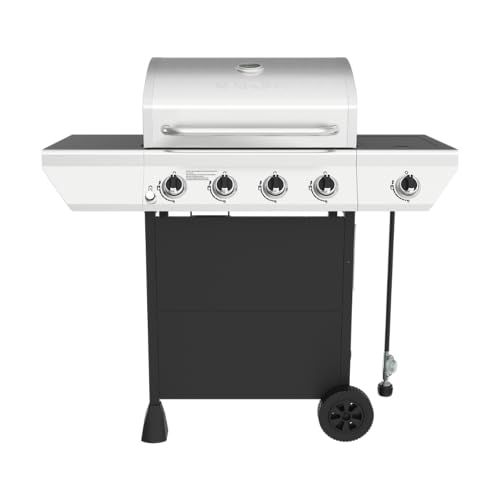
Nexgrill 4-Burner Propane Gas Grill with Stainless Steel Lid
Badge: Best Mid-Size for the Coast
Strengths
- 52,000 BTU across 526 square inches is the balanced power-to-size formula for most Florida families.
- The stainless steel lid shrugs off the two things Florida throws at lids: salt film and sun.
- Matte-finish cast iron grate delivers heavyweight searing with a forgiving surface.
Trade-offs
- Cast iron, even matte-finished, wants the brush-and-dry habit in humid air.
- No enclosed cabinet on this configuration; the tank lives on the cart.
- Mid-size means true crowd events still cook in two rounds.
Mini spec box: Fuel: propane gas · Burners: 4 + side burner · Output: 52,000 BTU · Cooking space: 526 sq. in. · Lid: stainless steel · Grate: matte-finish cast iron · Ignition: electronic · Extras: built-in thermometer.
If the 60,000 BTU Nexgrill is the party flagship, this is the Florida family’s daily driver. The size is the sweet spot — 526 square inches handles a family dinner with room to zone, and a modest gathering without a second round — while the specification reads like a coastal checklist: stainless lid, electronic ignition, a thermometer in the lid, and a side burner for the sides. The matte cast iron grate is the one component that asks something of its owner in this climate: brush it while warm, keep it dry under the cover, and it will sear beautifully for years; neglect it in August humidity and it will remind you why the routine exists.
Positioned in the mid tier, this Nexgrill is the pick for the household that grills three or four nights a week within sight of the water and wants stainless where it counts without paying flagship money. Its open cart is easier to dry out after storms than a cabinet, and its footprint shelters more easily than its bigger sibling’s. For a great many Florida homes, this is simply the right-sized answer.
Best for: coastal Florida families wanting stainless and balanced size / Not suited for: the largest party loads or cabinet-storage seekers

IdeaMaxx 3-Burner Propane Gas Grill with Cast Iron Grates
Badge: Best Storm-Season Storage
Strengths
- Foldable side shelves collapse the footprint for fast moves into a garage or storage room — the easiest storm prep in this guide.
- Cast iron grates hold serious heat for proper sears on a compact three-burner.
- 38,200 BTU is strong output for the format, with quick preheats between rain bands.
Trade-offs
- Bare cast iron grates in Florida humidity demand the strictest dry-and-season routine here.
- Three burners mean party loads cook in batches.
- A lesser-known brand; confirm parts and cover sourcing.
Mini spec box: Fuel: propane gas · Burners: 3 · Output: 38,200 BTU · Grates: cast iron · Shelves: foldable side shelves · Setting: patios, lanais, and compact outdoor spaces.
The IdeaMaxx is the Florida pick for homes where the grill’s storm plan is “bring it in.” Shelves fold, the footprint shrinks, and the whole unit rolls into a garage corner or storage room without the wrestling match a cabinet grill demands — a virtue that matters from June through November, and doubly in the condo and townhouse communities where lanai space is measured in inches. Between storms, it is a genuinely capable three-burner: cast iron grates that sear hard, output that preheats quickly in the gaps between rain bands, and zones enough for family dinners.
The cast iron caveat is amplified by the state. Florida humidity is unkind to uncoated iron, so this grill’s owner must be the most disciplined in the guide: brush while warm, dry thoroughly, season lightly, cover always. Households willing to keep that routine get the most storage-friendly grill here; households who know they will not should choose the porcelain-enameled Weber above and accept the bigger storm footprint. Renters and snowbirds who close up a Florida home for months will also appreciate how completely this grill tucks away — close the tank valve, fold, roll, and the patio is clear.
Best for: townhouses, condos with lanais, and storm-storage-first households / Not suited for: cast-iron-averse owners or big-party hosts
Comparison Table
| Pick | Fuel | Output / Size | Cooking area | Florida standout | Link |
|---|---|---|---|---|---|
| Weber Spirit E-425 | Propane gas | 4 burners + Sear Zone | Full-size four-burner area | Porcelain-enameled grates, deepest parts support | Check on Amazon |
| Monument Mesa II | Propane gas | 4 burners + Broil Zone | Four-burner cooking area | Maker-rated 500°F in 5 minutes, folding shelves | Check on Amazon |
| Nexgrill 4-Burner (60,000 BTU) | Propane gas | 60,000 BTU | 626 sq. in. | Stainless body, double-door cabinet | Check on Amazon |
| Charbroil Performance Cabinet | Propane gas | 4 burners + side burner | Full-size four-burner area | Enclosed storage for storm season | Check on Amazon |
| Nexgrill 4-Burner (52,000 BTU) | Propane gas | 52,000 BTU | 526 sq. in. | Stainless lid, balanced coastal size | Check on Amazon |
| IdeaMaxx 3-Burner | Propane gas | 38,200 BTU | Three-burner cooking area | Folding shelves for fast storm storage | Check on Amazon |
How to Choose a Grill That Survives Florida
Start with the corrosion map of your own home. Within a few miles of either coast, salt rides the air daily and every exterior surface is effectively marine-adjacent: prioritize stainless steel bodies and lids and porcelain-enameled grates, and budget for the cover from day one. Inland — Orlando, Gainesville, the interior counties — salt fades but humidity and afternoon rain remain, so the same materials still win, with painted steel acceptable if the grill lives under a lanai roof and a cover. Under a screened lanai, remember that smoke and grease collect on screens and ceilings; position the grill near the screen edge with airflow, and expect to clean screens more often.
Size with Florida’s calendar in mind. The planning rule of roughly 100 square inches of primary grate per person still holds, but Florida households entertain outdoors in every month, so the “occasional” crowd is less occasional — if your gatherings regularly reach eight or more, the 626-square-inch class stops being a luxury. Preheat speed deserves a line in the decision too: from June through September, the difference between a five-minute preheat and a fifteen-minute one is regularly the difference between grilling and giving up to the rain. Finally, make the storm plan before purchase: measure the garage or storage corner the grill will occupy in a hurricane, confirm the path it rolls to get there, and prefer folding shelves or cabinets that keep every loose part contained. A grill you cannot shelter is a grill Florida will eventually collect.
One regulatory note: many Florida condominiums and HOAs restrict grill type, size, or placement, and some prohibit open-flame cooking on balconies altogether. Check your community’s rules before ordering — where gas grills are banned on balconies, an electric model is the compliant path, a category distinct from everything in this guide and touched on in Best Home Smokeles Indoor Grills. Rules vary by building and county, and the time to learn yours is before the delivery truck, not after the first complaint.
How to Maintain a Grill in Florida’s Climate
The weekly rhythm. Brush grates while warm after every cook. Wipe exterior surfaces down — in coastal areas this removes the salt film before it works on the finish. Empty the grease tray on schedule; Florida heat turns neglected grease rancid and pest-attracting faster than any northern climate. Keep the cover going on once the grill is cool and dry, and on dry mornings after stormy nights, open the cover and let the whole station air out.
The monthly check. Inspect burner tubes for the mud-dauber wasps and spider webs that Florida insects supply generously — a blocked tube is the state’s signature grill failure. Check the cabinet interior, if your grill has one, for mildew and standing moisture. Test the igniter at every burner. Look at the hose and connections, and repeat the soapy-water leak check whenever a tank changes.
Hurricane preparation. When a storm threatens: close the tank valve, and secure or store tanks according to local emergency guidance — never bring a propane tank inside the living space. Move the grill to its planned shelter, fold shelves, close cabinets, and bring every loose accessory indoors. After the storm, inspect for water in the firebox and tubes, dry everything before the first lighting, and repeat the leak check. Readers building a full Florida outdoor kitchen rather than a single station will find wider layout notes in the homemade setups discussed at Best Homemade Gas Grills.
Troubleshooting.
- Problem: the grill will not light after a storm → water in the burner tubes or a soaked igniter are the usual causes. Let everything dry fully in the sun, clear the tubes, and retry; check the igniter electrode for corrosion.
- Problem: rust freckles appearing on steel surfaces → salt film left sitting. Clean with a stainless-safe cleaner, rinse, dry, and shorten your wipe-down interval; freckles caught early are cosmetic, not structural.
- Problem: flames weak on one side → an insect nest or web in that burner tube. Cool completely, remove and clear the tube with a venturi brush, and consider mesh screens where the design allows.
Florida Grilling Season Is All Year: A Cook’s Calendar
The state’s gift to grillers is a twelve-month season, and each stretch rewards a different strength from this guide. Winter brings the dry season: perfect grilling weather, holiday crowds, and the big Nexgrill’s moment. Spring adds pollen — wipe surfaces before guests judge your housekeeping — and the first real heat, when the Mesa II’s fast preheat starts paying rent. Summer is thunderstorm management: cook earlier, preheat faster, keep the cover discipline tight, and let the side burners carry the meal when a cell parks over the patio at the wrong moment. Fall is hurricane vigilance layered over the best football weather of the year; the IdeaMaxx and the cabinet Charbroil earn their storage logic here. Through all of it, the Florida pattern holds: the grill that survives is the one whose owner treats moisture as the enemy and the calendar as an ally. Even the state’s beloved open-fire traditions adapt — the wood-fired flavor some families chase at fish camps has its own category, explored in Best Home Wood Grills — but for the week-in, week-out Florida patio, the gas grills in this guide are the working answer.
Salt Air, Explained: How Far Inland the Coast Reaches Your Grill
Florida’s corrosion problem is not confined to beachfront property. Sea salt aerosol travels on the same sea breezes that make the state’s patios pleasant, and measurable salt deposition reaches miles inland — far enough that grill owners in Orlando suburbs report the freckled lids and pitted hardware that coastal owners consider normal. The mechanism is simple: salt film lands on metal, attracts moisture from humid air, and holds that moisture against the surface in a thin electrolyte layer that accelerates rust far beyond what rain alone would do. Painted steel fails first because the film creeps under any chip or scratch; bare cast iron rusts on contact; stainless steel and porcelain enamel resist because their surfaces give the film nothing to grip.
The countermeasure is rhythm, not chemistry. A wipe-down after cooking weekends — a damp cloth on cool stainless, a rinse where the manufacturer allows — removes the film before it works. Covers matter doubly here, because a covered grill collects far less airborne salt between cooks. Hardware deserves a glance at the monthly check: fasteners and hinges are the thinnest metal on any grill and the first place coastal corrosion shows. Owners within sight of the water should treat their grill the way boat owners treat brightwork — little and often — while inland owners can run the same routine at half frequency and get the same result. Either way, the picks in this guide were ranked with this map in mind: enamel and stainless where the state’s air is saltiest, honest care notes where a material asks for help.
Pool Patios and Lanais: Grilling Around Water and Screens
The classic Florida cooking space is not a yard; it is a pool patio inside a screen enclosure, and it changes how a grill should be chosen and placed. Screens trap smoke and grease vapor, so position the grill toward the enclosure’s edge, where airflow carries smoke out rather than across the pool and onto the ceiling panels. Grease will still film the nearest screens over a season — plan on an annual screen rinse as part of grill ownership, and keep the grill’s own grease tray emptied so the vapor load stays as clean as the cooking allows. Heat clearance matters around screen framing and lanai ceilings exactly as it does around siding: respect the manufacturer’s distances, and never tuck a grill into the covered corner where heat collects.
Water adds its own rules. Chlorinated pool splash is corrosive in its own right, so the grill should stand outside the splash zone of enthusiastic cannonballs, and any splash that lands on it should be rinsed rather than left to dry. Wet decks are slippery decks: the cook’s path between grill and kitchen door should be short, lit, and free of pool toys, because the person carrying a tray of raw chicken in one hand and tongs in the other is not watching their feet. Finally, Florida’s afternoon lightning is the one weather rule with no exceptions — when thunder is audible, grilling stops and everyone moves inside, grill session abandoned without debate. The meal can finish in the oven. A household that builds these pool-patio habits into its routine will find the grills in this guide entirely at home in the enclosure; the equipment was chosen for exactly this environment.
Fresh and Local: What Florida Grills Cook Best
A Florida grill earns its keep on the state’s own table. Gulf shrimp take ninety seconds a side on a hot zone and punish hesitation, which is why the fast-preheat and sear-zone picks in this guide matter beyond steaks. Whole snapper and mahi fillets want a well-oiled, fully preheated grate and the discipline to leave them alone until they release — the zone system again, with a gentle area ready when the fish comes off. Cuban-style pork, marinated in mojo, is a low-and-slow zone cook that any four-burner here handles beautifully with the lid down and one burner lit. Sweet corn, plantains, and peppers thrive on the medium zones while the mains rest.
Citrus deserves its own sentence, because Florida cooks grill with it constantly: halved oranges and lemons, cut side down for a minute, become a sauce base that makes plain chicken taste deliberate. Key lime, mango, and avocado all pass across Florida grates in season. None of this requires special equipment — it requires a grill that preheats honestly, zones reliably, and lights the hundredth time like the first. That is the through-line of this entire guide: Florida’s ingredients are generous twelve months a year, and the right grill is simply the one still ready, uncorroded and eager, every time the market bags come home.
Common Buying Mistakes
- Buying painted steel for a coastal patio. Salt air finds it within a season. Near the water, stainless and porcelain enamel are not upgrades; they are the baseline.
- Skipping the cover to save money. In Florida the cover is part of the grill. A fitted cover, used dry, adds seasons; its absence subtracts them.
- Ignoring the hurricane plan. If the grill cannot be sheltered or secured, storm season will make the decision for you.
- Storing a propane tank indoors during storms. Tanks stay outside, upright, secured, per emergency guidance — never in the living space or a sealed garage with ignition sources.
- Assuming balcony grilling is allowed. Florida condos and HOAs frequently restrict or prohibit it. Verify before purchase.
- Letting the cabinet become a swamp. Enclosed storage in humid air must be opened, wiped, and aired on a rhythm, or it grows the problems it was meant to prevent.
Final Recommendation
For most Florida households, buy the Weber Spirit E-425: its enameled grates, sear power, and unmatched parts support are the complete Florida package at the premium tier, and it is the grill this guide would park on its own patio. If your summers are a race against the radar, the Monument Mesa II and its five-minute preheat were designed for your evenings. Entertainers should take the Nexgrill 60,000 BTU and its party-sized grate; organized lanai owners, the Charbroil Performance cabinet; coastal families wanting balance, the 52,000 BTU Nexgrill; and townhouse or condo households, the folding IdeaMaxx. Whichever you choose, pair it with a fitted cover and the maintenance calendar above — in Florida, the routine is half the product.
Frequently Asked Questions
What grill material lasts longest in Florida?
Stainless steel bodies and lids paired with porcelain-enameled cast-iron grates offer the best longevity in Florida’s humidity and salt air. Stainless resists corrosion and wipes clean of salt film; the enamel layer protects cast iron’s searing mass from the moisture that rusts bare iron quickly here. Whatever the material, a fitted cover used on a cool, dry grill is the habit that turns material potential into actual years.
How do I prepare my grill for a hurricane?
Close the propane tank valve and secure or store the tank outdoors according to local emergency guidance — never inside the home. Move the grill itself into a garage or sheltered area, fold shelves, close cabinets, and bring all loose tools and accessories inside. After the storm, let everything dry, inspect burner tubes for water and debris, and run a leak check before the first cook.
Can I grill on a condo balcony in Florida?
It depends entirely on your building and local rules. Many Florida condominiums and HOAs prohibit open-flame grills on balconies, and fire codes restrict them in multi-family buildings. Check your association documents and local ordinances before buying. Where gas is prohibited, electric grills are usually the compliant alternative — a different category from the full-size outdoor grills ranked here.
Why does my grill struggle to light in humid weather?
Moisture is the usual culprit: damp igniter electrodes spark weakly, and insects — mud daubers especially — nest in burner tubes during wet months. Dry the grill in the sun, clean the electrode gently, and clear the tubes with a venturi brush. Persistent ignition trouble after drying points to a worn igniter module, an inexpensive and commonly stocked replacement on the major brands in this guide.
How often should I replace the cover on a Florida grill?
When it stops shedding water. Florida sun degrades cover fabrics steadily; once a cover cracks, tears at the seams, or lets water pool through onto the grill, it is decoration rather than protection. Inspect it at the start of hurricane season each year. A sound, fitted cover is cheap insurance compared with the corrosion it prevents.
Is a cabinet grill a good idea in Florida humidity?
Yes, with one habit attached. Cabinets keep tanks and tools contained — a real advantage in storm season and on tidy lanais — but enclosed spaces in humid air must be opened, wiped, and aired regularly so moisture does not sit against steel. Owners who keep that rhythm get the storage benefit without the mildew; owners who never open the doors should choose an open cart instead.
What should I cook first on a new grill in Florida?
Something forgiving that teaches you the grill’s hot spots: chicken thighs are the classic Florida answer, happy in zones and hard to ruin, with corn on the medium zone alongside. Save the expensive steaks and the delicate grouper for the second or third cook, once you know where your grill runs hot. The bread-slice test — toasting a grid of plain bread to map browning — remains the fastest five-minute education any new grill offers.
Does a grill need different care in South Florida versus the Panhandle?
The routine is the same; the intensity differs. South Florida’s year-round humidity and salt exposure ask for the full rhythm without a winter break — wipe-downs, cover discipline, and monthly tube checks in every month. The Panhandle gets a genuine cool season when use slows and an annual deep clean plus a dry storage month covers more of the work. Both regions share the two non-negotiables: never let salt film sit on metal, and never let insects homestead in the burner tubes. Adjust frequency to your coast, keep the habits themselves identical, and any pick in this guide will serve on either shoreline.
How do I keep insects and lizards out of my grill?
Florida wildlife treats an idle grill as furnished housing, so the defense is routine rather than warfare. Mud daubers and spiders block burner tubes — clear them monthly with a venturi brush and check before the first cook after any idle stretch. Lizards and frogs shelter in warm, dry fireboxes and cabinets; a grill used weekly rarely hosts them, while a stored grill should be inspected before lighting, every time, no exceptions. Keeping the cover on, the grease tray clean, and the cabinet dry removes the food and shelter that attract tenants in the first place. If you open a stored grill and find a nest of any kind, clear it completely and check the gas path before ignition. It is a five-minute Florida ritual that mainland owners never learn — and the difference between a grill that lights cleanly in October and one that becomes a story.
Florida rewards the households that grill the most and punishes the equipment that is maintained the least — which makes this state, paradoxically, the best place in the country to own a good grill and the worst place to own a neglected one. Every pick in this guide was chosen to land on the right side of that bargain. Choose yours, cover it, keep the rhythm, and the same grill that sears tonight’s snapper will be ready for the holiday cookout, the spring training gathering, and the first calm evening after storm season, year after year.


