Disclosure: topratedkitchenware.com is reader-supported. When you buy through links on our site, we may earn an affiliate commission from Amazon and other retailers, at no extra cost to you.
Where to buy
If you are shopping for best immrsion blenders, start with the six picks below. Linked picks carry a direct Amazon link so you can check the latest price on Amazon and confirm the current configuration before you decide. We never print a fixed price here, because prices and availability change. Every pick is a genuine corded immersion blender, so all six are linked.
- KitchenAid Variable Speed Corded Hand Blender KHBV53 — Best Overall. Check on Amazon for current listing details.
- Turelar Immersion Blender 400W 2-Speed — Best for Beginners. Check on Amazon for current listing details.
- Turelar Immersion Blender 1100W 5-in-1 Set — Most Versatile Set. Check on Amazon for current listing details.
- MasterChef Immersion Blender 400W — Best for Pureeing. Check on Amazon for current listing details.
- Ganiza Immersion Blender 5-in-1 1000W — Best for Daily Blending. Check on Amazon for current listing details.
- Vitamix Immersion Blender 5-Speed Bundle — Best Premium Pick. Check on Amazon for current listing details.
Read the full guide ↓ for how each pick handles the job, where each one compromises, and which households each one actually suits.
The search for the best immrsion blenders — yes, the spelling is mangled, but the product is unmistakable — is a search for the most useful small motor in the kitchen. An immersion blender blends soup in the pot it cooked in, turns a jug of ingredients into sauce in seconds, and then rinses clean under the tap while a countertop blender is still being disassembled. The six verified picks here are all corded models, spanning simple two-speed sticks, refined variable-speed designs and full five-in-one sets, so this guide is really about choosing your philosophy: pure blending focus, or one motor for every small job.
Start by being honest about your blending life. If it is ninety percent soup, sauces and smoothies, a single well-controlled stick will make you happier than a box of attachments. If your kitchen lacks a food processor and your cooking involves batters, whipped cream and chopped vegetables, the sets earn their keep. Motor ratings in this pool run from 400W to a stated 1100W, but the reviews below will keep reminding you that speed control and technique matter as much as the number.
Readers comparing formats can use our wider survey of 6 Best Immersion Blenders Corded And Cordless 2026 to see where these corded models sit against the cordless field, then come back here for the detailed verdicts.
Key Takeaways
- Immersion blenders win on cleanup and in-pot convenience, not raw power.
- Variable or trigger speed control is the feature that most improves daily results.
- 400W sticks are plenty for cooked soups and purees; thick and dry loads need the big-motor sets.
- Sets (Turelar 1100W, Ganiza) replace other appliances but demand storage.
- All six picks are corded: unlimited blending time, but you work near an outlet.
- Technique — full submersion, slow movement — fixes most ‘bad blender’ complaints.
In this guide
Quick Picks
| Pick | Badge | Headline spec | Why it is here |
|---|---|---|---|
| KitchenAid Variable Speed Corded Hand Blender KHBV53 | Best Overall | Removable 8-inch blending arm | Variable speed with its own blending jar |
| Turelar Immersion Blender 400W 2-Speed | Best for Beginners | 400W motor | Two-speed simplicity for first-time owners |
| Turelar Immersion Blender 1100W 5-in-1 Set | Most Versatile Set | 1100W motor | 1100W 5-in-1 set with trigger control |
| MasterChef Immersion Blender 400W | Best for Pureeing | 400W motor | Stainless pureeing stick, no fuss |
| Ganiza Immersion Blender 5-in-1 1000W | Best for Daily Blending | Max 1000W heavy-duty motor | 16 speeds on a heavy-duty motor |
| Vitamix Immersion Blender 5-Speed Bundle | Best Premium Pick | 5-speed control | 5-speed premium bundle, one-handed use |
The Quick Picks table is organised by intent rather than price tier, because in this category intent is what predicts satisfaction. Beginners should start at the simple end and feel no shame about it: a two-speed stick that gets used daily beats a flagship set that intimidates. Enthusiasts should read the set reviews carefully, since the attachments — not the blending — are what they are really buying. For the soup-and-smoothie overlap specifically, our focused roundup of 6 Best Immersion Blenders For Soups And Smoothies 2026 scores a similar field on just those two jobs.
How These Picks Were Chosen
The six picks were drawn from the verified immersion blender pool to span the real decision space of this category: a refined single stick with true variable speed, two simple 400W sticks, two full attachment sets at different power levels, and a premium brand-led option. We compared motor ratings as stated in the listings, speed control style, included accessories and construction, and we treated headline wattage with suspicion — in stick blenders, blade geometry, bell shape and speed control change results as much as the motor number does.
This guide is research-led: it is built from verified listing data and manufacturer specifications, not from staged hands-on testing we did not perform, and it says so openly. No pick carries a printed price or a rating score, because both change constantly and neither predicts whether your soup comes out silky. Where a model has an obvious limitation — a small motor, a bare kit, a forest of attachments to store — the review names it rather than burying it.
The 6 best immrsion blenders picks, reviewed in detail

KitchenAid Variable Speed Corded Hand Blender KHBV53
Badge: Best Overall
Strengths
- Variable speed starts gently, so soups do not splash
- Removable arm rinses clean in seconds
- Included jar is sized for sauces, dressings and smoothies
Trade-offs
- Corded design ties you to an outlet near the stove
- Single arm and jar kit, no whisk or chopper extras
- Jar is small for family-size smoothie batches
Key specs from the verified listing: Removable 8-inch blending arm; Variable speed control; Blending jar with lid included; Matte Black finish; Corded power.
KitchenAid’s KHBV53 is a corded hand blender with true variable speed, a removable 8-inch blending arm and its own blending jar with a lid. It is the control-focused pick: speed follows the trigger, so a pot of soup gets a gentle start instead of a eruption.
For everyday immersion blending, the winning traits are a head that circulates the whole vessel, speed you can start gently, and an arm that rinses clean before the food dries on it. In practice that makes it a fit for soup and sauce makers who blend in the pot and want finesse more than attachments. The review prose in this guide is research-led: we compared verified listing data, manufacturer specifications and the documented design of each model rather than claiming hands-on bench testing we did not do, and we would rather state that plainly than dress a desk comparison up as a lab report.
The honest limitation is that if you want one tool that also whips and chops, the single-purpose kit here will feel bare compared with the multi-piece sets. None of that makes it a bad buy; it defines the buyer it serves. Match this pick against your own routine — how often you use it, how much you make at once, and how much counter and cupboard space it can honestly claim — and the right answer usually becomes obvious.
Looked at as a weekly routine rather than a specification sheet, the KitchenAid Variable Speed Corded Hand Blender KHBV53 asks little of its owner beyond the basics its listing confirms: Removable 8-inch blending arm; Variable speed control; Blending jar with lid included; Matte Black finish; Corded power. Its clearest strength in practice — variable speed starts gently, so soups do not splash — is the one you will feel every time you use it, while its most relevant compromise — corded design ties you to an outlet near the stove — is the one to weigh before ordering rather than discover after. Owners who match a tool to their habits rarely regret a purchase in this category; owners who buy a headline and hope their habits change usually do.
Best for: Everyday soup and sauce makers wanting control / Not suited for: Anyone wanting attachments included
Check on Amazon to see the current listing, configuration and delivery options for the KitchenAid Variable Speed Corded Hand Blender KHBV53.

Turelar Immersion Blender 400W 2-Speed
Badge: Best for Beginners
Strengths
- Simple two-speed layout anyone can use immediately
- Ergonomic handle suits longer blending sessions
- Light, unfussy design stores in a drawer
Trade-offs
- Two speeds give less control than variable models
- 400W is the gentlest motor in this pool
- No extra attachments in the box
Key specs from the verified listing: 400W motor; 2 speed settings; BPA-free blending components; Ergonomic handle; Corded stick design.
This Turelar stick blender keeps things deliberately simple: a 400W corded motor, two speeds, BPA-free blending parts and an ergonomic grip. It is an emulsifier-first tool for soups, sauces and shakes rather than a full prep system.
For everyday immersion blending, the winning traits are a head that circulates the whole vessel, speed you can start gently, and an arm that rinses clean before the food dries on it. In practice that makes it a fit for first-time immersion blender owners and small kitchens that need the basics done well. The review prose in this guide is research-led: we compared verified listing data, manufacturer specifications and the documented design of each model rather than claiming hands-on bench testing we did not do, and we would rather state that plainly than dress a desk comparison up as a lab report.
The honest limitation is that dense jobs like thick hummus or frozen fruit will ask more of the motor than this class is built to give in long runs. None of that makes it a bad buy; it defines the buyer it serves. Match this pick against your own routine — how often you use it, how much you make at once, and how much counter and cupboard space it can honestly claim — and the right answer usually becomes obvious.
There is also the question of what living with the Turelar Immersion Blender 400W 2-Speed feels like after the first week. The verified configuration — 400W motor; 2 speed settings; BPA-free blending components; Ergonomic handle; Corded stick design — settles into a routine quickly, and the design choices behind it favour the jobs this guide keeps returning to. Where it asks for cooperation, the review has already named it: two speeds give less control than variable models. Where it simply gets on with the work, that is its headline strength at play: simple two-speed layout anyone can use immediately. Judge it on that balance, not on any single line of its listing.
Best for: First-time owners wanting instant simplicity / Not suited for: Frozen or very hard ingredients
Check on Amazon to see the current listing, configuration and delivery options for the Turelar Immersion Blender 400W 2-Speed.

Turelar Immersion Blender 1100W 5-in-1 Set
Badge: Most Versatile Set
Strengths
- Strongest motor rating in this pool
- Trigger variable speed mimics premium controls
- Accessory set covers whisking and chopping jobs too
Trade-offs
- More parts to store and wash than a plain stick
- High power needs a light trigger finger on liquids
- Set format costs more counter organisation than single sticks
Key specs from the verified listing: 1100W motor; 5-in-1 hand blender set; Trigger variable speed; Emulsion stick plus accessory kit; Corded power.
The second Turelar is a different animal: an 1100W, 5-in-1 corded set with trigger-controlled variable speed and accessories that extend it beyond blending into whisking and chopping. It aims to be the one prep motor a small kitchen owns.
For everyday immersion blending, the winning traits are a head that circulates the whole vessel, speed you can start gently, and an arm that rinses clean before the food dries on it. In practice that makes it a fit for cooks replacing several small appliances with one motor and a box of attachments. The review prose in this guide is research-led: we compared verified listing data, manufacturer specifications and the documented design of each model rather than claiming hands-on bench testing we did not do, and we would rather state that plainly than dress a desk comparison up as a lab report.
The honest limitation is that attachment kits reward organised owners; if the whisk lives in a junk drawer, you have bought complexity you will not use. None of that makes it a bad buy; it defines the buyer it serves. Match this pick against your own routine — how often you use it, how much you make at once, and how much counter and cupboard space it can honestly claim — and the right answer usually becomes obvious.
One more practical lens: who else in the household will use the Turelar Immersion Blender 1100W 5-in-1 Set, and for what? Its confirmed specification — 1100W motor; 5-in-1 hand blender set; Trigger variable speed; Emulsion stick plus accessory kit; Corded power — makes it approachable for some users and excessive or insufficient for others, and a purchase that serves two people’s routines is worth more than a theoretically superior one that serves a single narrow job. Its defining strength, that it can strongest motor rating in this pool, compounds in value the more often the machine is used, which is why frequency of use appears in every verdict in this guide.
Best for: Homes replacing several small appliances with one set / Not suited for: Drawer-only storage minimalists
Check on Amazon to see the current listing, configuration and delivery options for the Turelar Immersion Blender 1100W 5-in-1 Set.

MasterChef Immersion Blender 400W
Badge: Best for Pureeing
Strengths
- Stainless stick tolerates hot pots without worry
- Straightforward controls with nothing to learn
- Built for pureeing, the core immersion job
Trade-offs
- 400W class motor, so work in smaller batches
- No variable-speed finesse for delicate emulsions
- No accessory ecosystem in the box
Key specs from the verified listing: 400W motor; Stainless steel blending stick; Emulsifier/puree positioning; Handheld corded design.
MasterChef’s immersion blender is a 400W handheld with a stainless steel blending stick aimed squarely at pureeing and emulsifying: soups in the pot, sauces in the pan, baby food and dressings in a jug.
For everyday immersion blending, the winning traits are a head that circulates the whole vessel, speed you can start gently, and an arm that rinses clean before the food dries on it. In practice that makes it a fit for home cooks who want a dependable puree tool and already own a food processor for everything else. The review prose in this guide is research-led: we compared verified listing data, manufacturer specifications and the documented design of each model rather than claiming hands-on bench testing we did not do, and we would rather state that plainly than dress a desk comparison up as a lab report.
The honest limitation is that like the other 400W models, it prefers soft and cooked ingredients; raw, hard loads belong in a countertop machine. None of that makes it a bad buy; it defines the buyer it serves. Match this pick against your own routine — how often you use it, how much you make at once, and how much counter and cupboard space it can honestly claim — and the right answer usually becomes obvious.
Looked at as a weekly routine rather than a specification sheet, the MasterChef Immersion Blender 400W asks little of its owner beyond the basics its listing confirms: 400W motor; Stainless steel blending stick; Emulsifier/puree positioning; Handheld corded design. Its clearest strength in practice — stainless stick tolerates hot pots without worry — is the one you will feel every time you use it, while its most relevant compromise — 400w class motor, so work in smaller batches — is the one to weigh before ordering rather than discover after. Owners who match a tool to their habits rarely regret a purchase in this category; owners who buy a headline and hope their habits change usually do.
Best for: Puree-focused cooks with other tools for the rest / Not suited for: Delicate emulsion work needing fine low speeds
Check on Amazon to see the current listing, configuration and delivery options for the MasterChef Immersion Blender 400W.
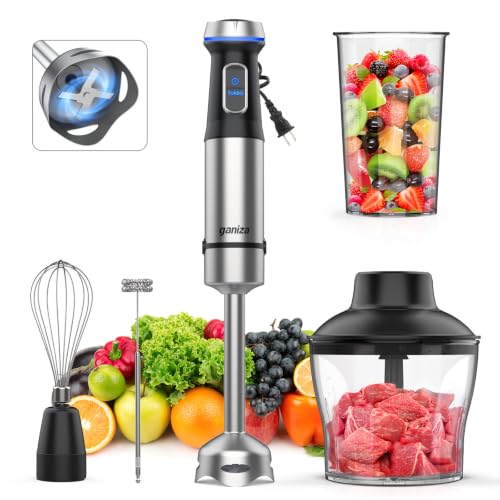
Ganiza Immersion Blender 5-in-1 1000W
Badge: Best for Daily Blending
Strengths
- 16 speeds give the widest control range in this pool
- Heavy-duty motor handles thicker mixtures
- Full accessory set covers most small prep tasks
Trade-offs
- Speed choice can overwhelm beginners at first
- Kit needs storage space a single stick does not
- Power still does not make it a nut-butter machine
Key specs from the verified listing: Max 1000W heavy-duty motor; 16 speed modes; 5-in-1 hand blender set; Stainless steel construction elements.
Ganiza’s 5-in-1 set pairs a heavy-duty motor rated up to 1000W with sixteen speed modes and a full attachment kit. Where the simple sticks offer two settings, this one offers a dial of possibilities for cooks who blend by feel.
For everyday immersion blending, the winning traits are a head that circulates the whole vessel, speed you can start gently, and an arm that rinses clean before the food dries on it. In practice that makes it a fit for enthusiasts who blend daily and want one system for soups, batters, whipping and chopping. The review prose in this guide is research-led: we compared verified listing data, manufacturer specifications and the documented design of each model rather than claiming hands-on bench testing we did not do, and we would rather state that plainly than dress a desk comparison up as a lab report.
The honest limitation is that sixteen speeds are only useful if you learn them; set-and-forget users may end up living on two settings anyway. None of that makes it a bad buy; it defines the buyer it serves. Match this pick against your own routine — how often you use it, how much you make at once, and how much counter and cupboard space it can honestly claim — and the right answer usually becomes obvious.
There is also the question of what living with the Ganiza Immersion Blender 5-in-1 1000W feels like after the first week. The verified configuration — Max 1000W heavy-duty motor; 16 speed modes; 5-in-1 hand blender set; Stainless steel construction elements — settles into a routine quickly, and the design choices behind it favour the jobs this guide keeps returning to. Where it asks for cooperation, the review has already named it: speed choice can overwhelm beginners at first. Where it simply gets on with the work, that is its headline strength at play: 16 speeds give the widest control range in this pool. Judge it on that balance, not on any single line of its listing.
Best for: Daily blenders who enjoy fine speed adjustment / Not suited for: Users who want two settings and no decisions
Check on Amazon to see the current listing, configuration and delivery options for the Ganiza Immersion Blender 5-in-1 1000W.

Vitamix Immersion Blender 5-Speed Bundle
Badge: Best Premium Pick
Strengths
- Five speeds balance simplicity with real control
- One-handed operation leaves a hand free for the pot
- Backed by the brand known for blending motors
Trade-offs
- Premium tier positioning within this pool
- Bundle is focused on blending, not a chopping system
- Corded design, unlike premium cordless rivals elsewhere
Key specs from the verified listing: 5-speed control; 3-piece bundle; Stainless steel and black finish; One-handed operation design.
Vitamix’s entry is a 5-speed immersion blender in stainless and black, sold as a 3-piece bundle and designed for one-handed operation. It applies the company’s blending-first philosophy to the stick format: motor, blade and speed control, nothing decorative.
For everyday immersion blending, the winning traits are a head that circulates the whole vessel, speed you can start gently, and an arm that rinses clean before the food dries on it. In practice that makes it a fit for Vitamix loyalists and daily soup makers who want brand-grade motor tuning in a drawer-sized tool. The review prose in this guide is research-led: we compared verified listing data, manufacturer specifications and the documented design of each model rather than claiming hands-on bench testing we did not do, and we would rather state that plainly than dress a desk comparison up as a lab report.
The honest limitation is that buyers wanting a full attachment ecosystem should compare the multi-piece sets, which trade some refinement for range. None of that makes it a bad buy; it defines the buyer it serves. Match this pick against your own routine — how often you use it, how much you make at once, and how much counter and cupboard space it can honestly claim — and the right answer usually becomes obvious.
One more practical lens: who else in the household will use the Vitamix Immersion Blender 5-Speed Bundle, and for what? Its confirmed specification — 5-speed control; 3-piece bundle; Stainless steel and black finish; One-handed operation design — makes it approachable for some users and excessive or insufficient for others, and a purchase that serves two people’s routines is worth more than a theoretically superior one that serves a single narrow job. Its defining strength, that it can five speeds balance simplicity with real control, compounds in value the more often the machine is used, which is why frequency of use appears in every verdict in this guide.
Best for: Premium buyers wanting one-handed, brand-grade blending / Not suited for: Shoppers who need a chopper in the box
Check on Amazon to see the current listing, configuration and delivery options for the Vitamix Immersion Blender 5-Speed Bundle.
Comparison Table
| Pick | Badge | Format | Control / feature | Standout point |
|---|---|---|---|---|
| KitchenAid Variable Speed Corded Hand Blender KHBV53 | Best Overall | Removable 8-inch blending arm | Variable speed control | Variable speed, jar included |
| Turelar Immersion Blender 400W 2-Speed | Best for Beginners | 400W motor | 2 speed settings | 2 speeds, 400W |
| Turelar Immersion Blender 1100W 5-in-1 Set | Most Versatile Set | 1100W motor | 5-in-1 hand blender set | 1100W set, trigger control |
| MasterChef Immersion Blender 400W | Best for Pureeing | 400W motor | Stainless steel blending stick | 400W stainless stick |
| Ganiza Immersion Blender 5-in-1 1000W | Best for Daily Blending | Max 1000W heavy-duty motor | 16 speed modes | 16 speeds, 5-in-1 set |
| Vitamix Immersion Blender 5-Speed Bundle | Best Premium Pick | 5-speed control | 3-piece bundle | 5 speeds, bundle format |
Side by side, the pool divides into three pairs: the control pair (KitchenAid, Vitamix), the simplicity pair (Turelar 400W, MasterChef) and the versatility pair (Turelar 1100W, Ganiza). Prices aside — this guide prints none — that pairing is the decision. Cross-pair comparisons mostly confuse; within-pair comparisons settle quickly on the details in the table. If you are also weighing the cordless route, our guide to 6 Best Cordless Immersion Blenders 2026 shows what you gain in freedom and give up in sustained power.
How to Choose the Right Option for best immrsion blenders
Decide what you will blend weekly. Cooked soups, sauces, dressings and soft smoothies: any pick here works, so buy control and cleanup. Thick batters, hummus-style purees and chopping: you need the big-motor sets, and you should still expect to work in batches. Ice and frozen-solid fruit: none of these is the right tool, whatever the marketing implies — that honesty will save you a motor.
Weigh control against simplicity. Variable and multi-speed designs reward cooks who blend by feel and punish nobody; two-speed designs reward cooks who want to press a button and think about dinner instead. Neither is a compromise if it matches your temperament. The enthusiasts’ end of this trade is explored further in our notes on Best High Powered Immersion Blenders, where sustained thick-mixture work is the whole brief.
Finally, plan the storage and the wash. Measure a drawer for a single stick; measure a cupboard shelf for a set. Check that arms detach for rinsing. And if your pots are very tall, confirm the arm length reaches the bottom with the head submerged — a detail that matters more than any specification printed in large type.
How to Use an Immersion Blender Well: Soups, Sauces and More
Technique decides more than hardware with a stick blender. Submerge the blade head fully before you switch on, or the first second will redecorate your kitchen. Start on a low speed, tilt the head slightly to start a vortex, and move slowly up, down and around the pot rather than holding still and drilling a hole in the middle. For hot soup, keep the head under the surface, switch off before lifting out, and give thick mixtures rest pauses so the motor stays in its comfort zone.
- Cut ingredients to similar sizes and add enough liquid to cover the blade head.
- Immerse fully, start low, then raise speed gradually.
- Move the head in slow circles, lifting slightly to draw floating pieces down.
- Blend in bursts for thick mixtures, resting the motor between rounds.
- Rinse the arm immediately; dried soup under a blade guard is tomorrow’s scrubbing job.
Problem: the blend splashes everywhere → what to do: the head was not fully submerged or the vessel is too shallow; switch off, use a deeper pot or jug, and restart on the lowest speed. Problem: chunks survive no matter how long you blend → what to do: the pieces started too big or too hard; cut smaller, cook longer, or finish stubborn loads in a countertop blender. Problem: the motor smells warm on thick mixtures → what to do: stop and rest it; work in smaller batches with more liquid rather than forcing a stick blender to do a food processor’s job.
Immersion Blender versus Countertop Blender: An Honest Division of Labour
The stick blender’s kingdom is hot, liquid and already cooked: soups in the pot, sauces in the pan, dressings in the jug. Inside that kingdom it is faster, quieter to clean and more precise than any countertop machine. Outside it — ice, frozen fruit, nuts, large raw batches — the countertop blender’s sealed jar, tamper and sheer sustained power win easily, and pretending otherwise burns out motors.
Many kitchens therefore end up with both, and that is not duplication: it is specialisation. If you can only own one, own the one whose kingdom you cook in weekly. The durability end of the stick-blender world, for cooks whose weekly kingdom is heavy, is covered in our roundup of Best Heavy Duty Immersion Blenders.
Getting Restaurant-Smooth Soup from a Stick Blender
Silky soup is technique, not equipment. Cook vegetables fully soft — a blender cannot fix undercooked carrot. Blend in the pot with the head submerged, moving in slow overlapping circles for a full minute longer than feels necessary; most lumpy soup is simply under-circulated soup. A knob of butter or a splash of cream added at the end emulsifies into a gloss that reads as ‘restaurant’ on the spoon.
For velvet textures, pass the blended soup through a sieve as the final step; even the best stick leaves fibre that only straining removes. Retail shoppers comparing these same models on the shelf can sanity-check current listings against our notes on Best Immersion Blenders At Walmart, which tracks the big-box end of this market.
Accessories, Attachments and What Is Actually Worth Owning
The immersion blender world divides into the stick itself and everything that can be bolted to its motor, and the economics of the second category deserve a clear-eyed look. Whisk attachments genuinely earn their place if you make whipped cream, egg whites or pancake batter weekly; they are faster than a hand whisk and less washing than a stand mixer for small volumes. Chopper bowls earn theirs if you dice onions, make breadcrumbs or blitz herbs in small quantities and do not own a food processor. Beakers and storage lids, by contrast, are mostly packaging poetry — any jug and any lid do the same work.
In this pool, the Turelar 1100W and Ganiza sets are the attachment plays, and their reviews judge them as systems. The KitchenAid’s included jar is the tasteful middle: one genuinely useful accessory, sized to the stick, with a lid that makes the jar a storage container for the sauce you just made. The single sticks from MasterChef and the simpler Turelar make the opposite argument — that the best accessory is a drawer with space in it and a blender you can rinse in ten seconds.
Before paying for any set, run the monthly test: name the month in which you would use each attachment at least twice. Attachments that fail the test are not bargains at any price; they are rent you pay in cupboard space forever. That single question, honestly answered, sorts this entire pool faster than any specification comparison.
Your First Month with an Immersion Blender: Jobs That Teach the Tool
Week one belongs to soup, because soup is forgiving and the feedback is instant: blend a pot you have made a dozen times and compare the texture against your old method. You will learn the submerged start, the slow circulation and the exact moment the vortex tells you the pot is done. Week two belongs to sauces and dressings, where the lesson is emulsion — oil added slowly to a moving base, speed kept low, and the small jar or a narrow jug doing half the work by confining the ingredients to the blade’s reach.
Week three is for the jobs that justify the sets: whipped cream in ninety seconds, breadcrumbs from the heel of a loaf, a small chopper bowl of onion that would have taken ten minutes by hand. This is also the week owners discover whether they bought the right philosophy — set owners either fall into a rhythm of attachments or quietly admit the stick alone would have done. Week four belongs to breakfast: smoothies in the beaker, pancake batter without lumps, and the first honest assessment of whether the countertop blender has been touched at all.
By the end of the month you will know your machine’s dialect: the speed it likes for mayonnaise, the batch size where it starts to labour, the sound that means the head has left the liquid. That fluency, not any specification, is what people are describing when they say a kitchen tool is ‘good’. Every pick in this pool can reach it; the differences are in how quickly, and at what cost in washing and storage, each one gets you there.
Keep the box and the receipt until the month is over. Returns in this category are rarely about defects; they are about philosophy mismatches discovered in week two. A month of honest use is the real review — this guide’s job is to make sure you start that month with the right candidate in hand.
One under-discussed buying factor is sound. Stick blenders are brief-use tools, but a high-pitched motor at full speed in a hard-surfaced kitchen is genuinely wearing if you blend daily. The variable-speed models earn quiet credit here: most real blending happens at middle speeds, reserving the scream for ten-second finishes. If you blend early while others sleep, that mid-speed competence matters more than any peak specification.
Longevity in this category is mostly about restraint. Motors die from sustained overload — thick, dry, oversized batches run without pauses — far more often than from age. Work in batches, add liquid generously, rest the motor on heavy jobs, and a mid-priced stick will outlast a flagship that was abused. The reviews above flag which picks forgive heavy use and which ones ask for a gentler hand.
Sound deserves one more mention for open-plan homes: a stick blender’s noise is intense but measured in seconds, and most households adapt by blending before conversations start rather than during them. The variable-speed models help here too, since finishing a soup at a moderate speed is dramatically quieter than the full-speed blast that two-speed models make unavoidable for the whole job.
If you cook for someone with limited grip strength, weigh handle shape and switch design as seriously as motor numbers. A trigger that must be squeezed hard for two minutes is a genuine barrier; a simple button and a balanced stick are not. The ergonomic claims in several of these listings are easy to dismiss as marketing until the first time you blend a full stockpot with tired hands.
Finally, register the purchase and keep the manual’s cleaning page. Stick blenders rarely fail electronically; they fail at seals, guards and blade assemblies that were cleaned late and forced often. Ten seconds of rinsing after every use is the entire maintenance philosophy of this category, and it is cheaper than any warranty.
Blending for one is the immersion blender’s secret superpower, and it deserves more emphasis than rankings usually give it. A single portion of soup, a lone smoothie, a small pan sauce for a solo dinner — a countertop blender makes all of these feel disproportionate, with a big jar to wash for a small reward, while the stick blender treats them as its natural scale of work. Solo cooks, who are underserved by most kitchen equipment design, are arguably this category’s ideal users, and every pick in this pool serves them without condescension.
There is a learning curve, but it is measured in days rather than months, and it is mostly about trust: trusting the vortex to pull ingredients down instead of stabbing at them, trusting a lower speed to emulsify better than a frantic one, trusting that a fully submerged head will not paint the ceiling. Owners who grant that trust in the first week tend to become the people who recommend immersion blenders to everyone they know — which, more than any marketing, is how this category grew.
Common Buying Mistakes
Switching on before submerging. The classic first-use mistake, and the messiest. Holding the head still. You will blend one smooth cylinder and leave the rest of the pot chunky; keep moving. Asking a stick to crush ice. Wrong tool; use the countertop blender and keep both machines alive. Buying attachments instead of control. Most owners benefit more from better speed control than from a whisk used twice a year. Letting the arm sit dirty. Dried soup under the guard is the one genuinely unpleasant clean in this category; rinse immediately. Ignoring vessel depth. A shallow bowl plus a powerful stick equals a redecorated kitchen.
Final Recommendation
The KitchenAid KHBV53 is the balanced first choice for most kitchens: real variable speed, a removable arm and its own jar, with nothing superfluous. The Vitamix bundle is the premium alternative for brand loyalists, the Ganiza and Turelar 1100W sets serve kitchens that need one motor to do everything, and the two 400W sticks are the honest, simple answers for cooked-food blending on a tighter brief. KitchenAid Variable Speed Corded Hand Blender KHBV53 remains on the shortlist for everyday soup and sauce makers wanting control. Turelar Immersion Blender 400W 2-Speed remains on the shortlist for first-time owners wanting instant simplicity. Turelar Immersion Blender 1100W 5-in-1 Set remains on the shortlist for homes replacing several small appliances with one set.
Frequently Asked Questions
Can an immersion blender replace a countertop blender?
For soups, sauces, dressings and soft smoothies, largely yes. For ice crushing, frozen-solid fruit, nut butters and large hard batches, a countertop machine is still the right tool. Most kitchens end up happiest owning the stick for daily work and borrowing power only when needed.
Why does my soup still have lumps?
Usually piece size and patience: ingredients cut unevenly, a head held in one spot, or blending stopped before the vortex has circulated everything. Move the head slowly through the whole pot and give dense vegetables time to cook soft first.
Are higher wattage stick blenders always better?
No. Wattage helps with thick and dense mixtures, but speed control, blade design and the shape of the blending head matter as much for smoothness and splashing. A well-controlled mid-power model often beats a crude powerful one on soup.
Can I blend in a non-stick pot?
You can, carefully: keep the head moving and avoid grinding the guard against the coating. Many cooks decant to a stainless pot or a deep jug for aggressive blending and keep non-stick for gentle finishing.
How do I clean under the blade guard?
Rinse immediately, then run the head for a few seconds in a jug of warm soapy water. Dried-on food is the real enemy; a stick blender cleaned within a minute of use almost never needs scrubbing.
Is cordless worth it over these corded models?
Cordless buys freedom from outlets and easier stove-side movement; corded buys unlimited run time and usually more power for the money. Every pick in this pool is corded, so if cordless matters, treat this guide as your performance baseline and compare carefully.


