Disclosure: topratedkitchenware.com is reader-supported. When you buy through links on our site, we may earn an affiliate commission from Amazon and other retailers, at no extra cost to you.
Where to buy
This guide applies a simple honesty test: a model only earns a purchase link here if its tier genuinely fits the word inexpensive. Four of the six verified models pass — capable, mainstream countertop ovens from Emeril, Oster and Chefman that sit in the accessible tiers of this category. Two do not: the Breville Smart Oven Air Fryer Pro and the Nuwave Bravo XL Pro are premium flagship machines, reviewed in full below as prose-only context, but carrying no links or photos, because linking a flagship from an inexpensive guide would mislead the very shoppers this page exists to serve. Start with the Emeril Lagasse 26QT — Check on Amazon — if you want the most capacity per unit of tier in this guide. No prices are printed anywhere here, because prices move; check the current figure at each link and hold it against the tier logic in this guide.
- Emeril Lagasse 26QT French Door Air Fryer Oven
- Nuwave Bravo XL Pro Air Fryer Toaster Oven (prose-only — premium flagship tier)
- Oster Extra-Large French Door Air Fryer Oven
- Emeril Lagasse Everyday 360 Air Fryer Oven
- Breville Smart Oven Air Fryer Pro (prose-only — premium flagship tier)
- Chefman XL 14-Quart Multifunctional Air Fryer
Read the full guide ↓
The best inexpensive air fryers are not the cheapest machines on the internet — they are the ones where every part of the price position is doing cooking work. Inexpensive, read honestly, is a tier judgement: mainstream brands, proven formats, function lists matched to real meals, and none of the flagship premiums charged for exotic programming, statement materials or sheer brand altitude. The four linked models in this guide are all countertop oven-style air fryers from the category’s value-conscious makers, and between them they cover family batch cooking, pan-based cooking, rotisserie all-rounding and big-basket-style oven batches — the full working range of home air frying, without a flagship in sight.
Why, then, are two flagships reviewed here at all? Because inexpensive shoppers meet the Breville Smart Oven Air Fryer Pro and the Nuwave Bravo XL Pro on every results page, usually with the heaviest marketing on the page. A useful guide should explain what that extra tier actually buys — deeper programming, a probe, a grill combo, statement build — and let you decide with open eyes whether your cooking needs it. Our judgement, stated plainly: for most households it does not, and the four linked machines will cook the same dinners. But the flagships are reviewed fairly and in full, as prose-only context, so the comparison is yours to make.
One discipline note: this guide never prints a price. Inexpensive is a position within the category, not a number, and numbers expire. Judge each linked model by its tier signals — brand positioning, function depth, materials, capacity — against its current figure at the link. Readers whose budget stretches further and who want sheer size can cross-check Best Large Capasity Air Fryers; readers who want the value end of the wider category in one place are already reading the right page.
Key Takeaways
- Four linked picks pass the tier test: the Emeril 26QT, the Oster French Door oven, the Emeril Everyday 360 and the Chefman XL 14-Quart — all mainstream countertop ovens with real capacity and honest function lists.
- Two assigned models are premium flagships — the Breville Smart Oven Air Fryer Pro and the Nuwave Bravo XL Pro — and are therefore prose-only here: full reviews, no links, no photos.
- The Emeril 26QT is the capacity-per-tier champion: a 26QT French door oven with 24 presets sits remarkably low in the category’s tier structure for what it cooks.
- The Chefman XL is the batch value pick: 14 quarts, a windowed door, rotisserie and dehydrating from a value-led brand.
- Inexpensive should never mean flimsy: every linked pick here is a full-size oven-format machine with family capacity, not a mini novelty fryer.
- Compare tiers, not printed prices: this guide prints none, and the current figure at each link is the only number that should enter your decision.
In this guide
Quick Picks
| Pick | Badge | Value case | Link |
|---|---|---|---|
| Emeril Lagasse 26QT French Door Air Fryer Oven | Best Value for Big Families | 26QT French door oven, 24 presets, six accessories included | Check on Amazon |
| Nuwave Bravo XL Pro Air Fryer Toaster Oven | Premium Flagship — Context Only | 30QT, 142 presets, probe, grill combo — a flagship tier, reviewed prose-only | Prose-only, no link |
| Oster Extra-Large French Door Air Fryer Oven | Best Value for Pan Cooking | French doors, fits 15 x 12 inch pans, 6 presets, auto-shutoff timer | Check on Amazon |
| Emeril Lagasse Everyday 360 Air Fryer Oven | Best Value All-Rounder | 9-in-1 with rotisserie and 360° convection | Check on Amazon |
| Breville Smart Oven Air Fryer Pro | Premium Flagship — Context Only | 13 functions in brushed stainless steel — a flagship tier, reviewed prose-only | Prose-only, no link |
| Chefman XL 14-Quart Multifunctional Air Fryer | Best Value for Big Batches | XL 14-quart, windowed door, touchscreen, rotisserie and dehydrator functions | Check on Amazon |
How These Picks Were Chosen
The method was tier-first. We took the six verified models assigned to this guide and sorted them by where they sit in the category’s qualitative structure — brand positioning, function depth, materials and format ambition — using only what their listings state. Four models sit in the accessible mainstream: two Emeril ovens, the Oster and the Chefman, all from value-conscious lines, all full-size working machines. Two sit unmistakably at the flagship end: Breville’s “Pro” flagship in brushed stainless with thirteen functions, and Nuwave’s “Pro” flagship with a 30QT cavity, 142 presets, a probe and a grill combo. Under this site’s honesty rules, the flagship pair cannot carry links in an inexpensive guide, so they are reviewed prose-only with the reasoning stated in the open.
Within the linked four, ranking follows value density: how much verified cooking capability — capacity, functions that map to meals, useful hardware like French doors or a viewing window — each model delivers for its tier. That is why a 26QT oven leads a value guide without embarrassment: capacity is the most expensive thing in this category, and the Emeril delivers it from a mainstream line.
This is research-based guidance from verified listing data. No prices, ratings or review counts are printed, by design; tier language (“premium-tier”, “accessible tier”) is qualitative positioning, and the current price at each link is yours to check. Brand-curious readers can compare how single makers price their ranges in guides such as Best Innsky Air Fryers, where one brand’s whole ladder is laid out.
The Best Inexpensive Air Fryers — Plus the Two Flagships, Honestly Labelled
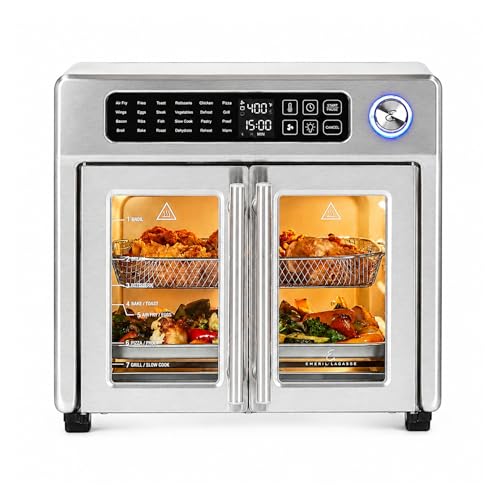
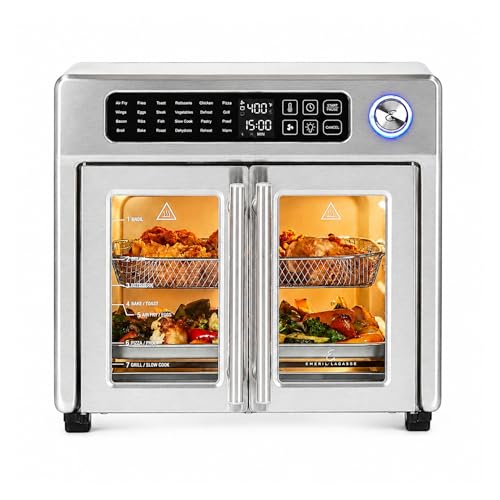
Emeril Lagasse 26QT French Door Air Fryer Oven
Badge: Best Value for Big Families
Strengths
- 26QT extra large interior from a mainstream line — flagship-scale capacity without flagship positioning.
- 24 one-touch presets give the whole household reliable starting points at no extra tier cost.
- French doors, a feature usually sold at a premium, included in an accessible package.
- Six cooking accessories included per the listing, so the value is not clawed back in add-ons.
Trade-offs
- Large footprint — the counter cost of all that capacity.
- Single cavity cooks in sequence rather than in synced zones.
- Preset abundance is wasted on households that cook two things on repeat.
Mini spec box
- Capacity: 26QT, extra large interior
- Doors: French door
- Presets: 24 one-touch preset options
- Type: countertop convection cooker / air fryer toaster oven
- Included: six cooking accessories
Value in this category is mostly capacity, because capacity is what the expensive machines charge for. The Emeril 26QT breaks that pattern: a genuinely extra-large French door oven, with a preset bank deeper than many premium rivals and the accessories in the box, from a line positioned for ordinary households. A family that batch-cooks — Sunday trays, weeknight reheats, a whole chicken with room to spare — gets the working life of a much fancier machine here, and the savings compound every week the machine displaces the main oven and the takeaway.
The French doors deserve emphasis in a value guide, because door hardware is where inexpensive ovens usually confess their tier. These open wide, serve heavy trays calmly, and make the big cavity usable rather than merely large. Add the preset depth — which lets every family member reproduce the same results — and the 26QT reads less like a budget compromise and more like a category pricing accident in the buyer’s favour.
Its honest limitations are the ones size always brings: it needs a serious counter, and its single cavity sequences components rather than syncing them. Households of two may find its scale more than the mission needs, in which case the Everyday 360 below keeps the same brand value in a smaller body. For families, though, this is the first link to click.
It also future-proofs a growing household better than any other linked pick. Families rarely shrink their cooking; children grow into teenagers, and teenagers eat like athletes. A 26QT cavity bought in an accessible tier today absorbs that growth without a second purchase — the buy-once principle operating across years rather than months, which is where the largest savings in this whole category quietly live.
Best for: families wanting maximum verified capacity in an accessible tier / Not suited for: small counters and two-person households
Nuwave Bravo XL Pro Air Fryer Toaster Oven — Prose-Only Flagship
Badge: Premium Flagship — Context Only
Strengths
- 30QT stainless cavity with a grill combo — the largest, most ambitious oven in this guide.
- 142 presets and a stated 50-500F range give it the deepest control library here.
- A probe is included per the listing, for temperature-verified roasts.
- The listing states PFAS Free, a materials statement the value tier rarely makes.
Trade-offs
- It is a premium flagship — by positioning, by specification depth and by ambition — which is precisely why it carries no link in an inexpensive guide.
- Very large footprint and a learning curve to match its library.
- Most households will use a fraction of its preset range.
Mini spec box
- Capacity: 30QT
- Presets: 142
- Temperature range: 50-500F (as stated in the listing)
- Extras: probe, grill combo
- Materials statement: PFAS Free (as stated in the listing)
- Body: stainless steel
Fairness first: the Nuwave Bravo XL Pro is an impressive machine. Its cavity swallows what the linked ovens cannot, its probe brings a level of doneness certainty that genuinely improves roasts, its grill combo adds a searing register the others lack, and its materials statement leads the field. If this were a flagship guide, it would be a headline pick, and nothing in this review should be read as a quality judgement against it.
But this is an inexpensive guide, and the Nuwave is not an inexpensive air fryer by any honest reading of its tier. “Pro” flagship positioning, a 142-preset library and a 30QT stainless body are the category’s premium signals, all present at once. Linking it here would tell value shoppers that the flagship is the sensible budget choice, which is the oldest trick in affiliate publishing — and the reason this guide exists in its current form. It is included so you can see exactly what the extra tier buys and decide, eyes open, whether your cooking justifies leaving the inexpensive brief. For most households reading a value guide, it does not.
One more fairness note: its stated temperature span and preset depth mean it can also serve as the precision instrument in a mixed kitchen — the machine a keen cook reaches for when a recipe is fussy. None of that excellence is in dispute here. The only claim this guide makes about the Nuwave is a classification: flagship. Classifications are what shopping guides are for, and this one is labelled so that your money follows your actual brief.
Best for: readers who came for value but discover they actually want a flagship — decide deliberately / Not suited for: anyone whose budget brief is genuinely inexpensive

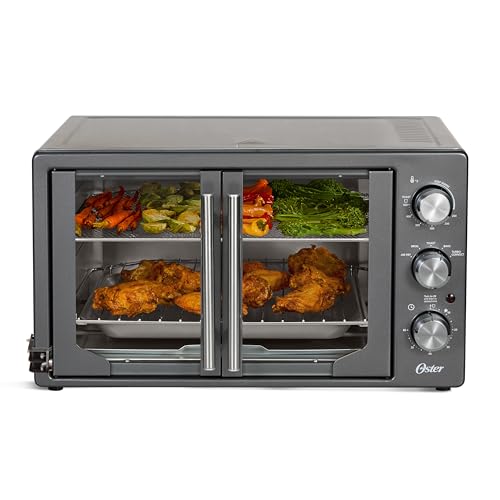
Oster Extra-Large French Door Air Fryer Oven
Badge: Best Value for Pan Cooking
Strengths
- Fits 15 x 12 inch pans — the largest stated pan fit in this guide, from an accessible line.
- French doors at a mainstream tier, where rivals usually offer a basic drop-down door.
- Six presets keep the machine simple, and simple machines stay in service for years.
- Auto-shutoff timer adds family-grade safety without flagship pricing.
- The maker’s listing frames it as using 99.5% less oil than deep frying — the method claim that matters, stated by the maker.
Trade-offs
- No rotisserie or dehydrate function in the verified listing.
- Extra-large footprint, like the Emeril 26QT.
- The shortest preset list among the linked picks.
Mini spec box
- Format: countertop oven with French doors
- Pan fit: 15 x 12 inch pans
- Presets: 6 cooking presets
- Safety: auto-shutoff timer
The Oster makes the value case through subtraction. Six presets instead of twenty-four or a hundred and forty-two; a pan fit instead of a preset library; French doors and an auto-shutoff instead of probes and programmes. What remains is exactly what pan-cooking households use: a big, calm oven that takes the dishes they already own, crisps tray food with a light coating of oil, and asks almost nothing in learning or maintenance. In cost-per-year-of-service terms — the only value maths that matters — a simple machine used daily for years beats a complex one used monthly, and the Oster is engineered for the daily side of that equation.
It also protects the household budget in a subtler way: compatibility. A fryer that fits your existing 15 x 12 inch pans does not trigger the accessory spending that oddly-sized machines do, and its French doors remove the dropped-tray accidents that waste food and tempers. Value is not only the purchase tier; it is the total cost of the cooking life around the machine, and the Oster keeps that whole life cheap.
Its honest limitations are range and size. Project cooks wanting rotisserie or dehydrating should take the Emeril 360 or the Chefman; small kitchens should measure carefully. As a straightforward, pan-first value oven, it is one of the easiest recommendations in this guide.
There is a repairability-of-routine point too: with six presets and no software theatre, there is very little about the Oster that can confuse, drift or demand an update. A grandparent, a teenager and a tired parent all get the same machine every day. In value terms, that predictability is a feature with a long half-life — the appliance’s thousandth use resembles its first, which is more than complex machines always manage.
Best for: pan-cooking households that want French doors and simplicity in an accessible tier / Not suited for: rotisserie and dehydrate projects
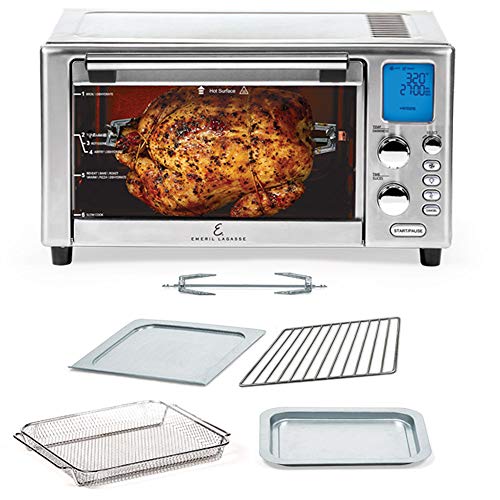
Emeril Lagasse Everyday 360 Air Fryer Oven
Badge: Best Value All-Rounder
Strengths
- 9-in-1 functions including rotisserie — a feature set that usually costs a tier more.
- 360° convection is the maker’s all-around air system for even browning.
- Everyday sizing suits the standard toaster-oven spot in most kitchens.
- A legible, generalist proposition that any household member can operate.
Trade-offs
- No pan fit or pizza diameter is stated in the verified title.
- Less batch capacity than the 26QT Emeril and the Chefman XL.
- Rotisserie parts add a little washing and storage.
Mini spec box
- Format: countertop oven, 9-in-1
- Air system: 360° convection
- Included cooking style: rotisserie
If the 26QT is the value pick for scale, the Everyday 360 is the value pick for range. Rotisserie is the headline: whole chickens are among the most economical family meals there are, and a machine that roasts them beautifully at home, in an accessible tier, pays its household back in displaced rotisserie-counter and takeaway spending all year. Around that centrepiece, nine functions cover the everyday canon without a wasted mode, and the convection system keeps results even enough that the machine feels more expensive than its tier.
It is also the linked pick most likely to satisfy a household that can only buy one appliance and cannot predict its own cooking. Bakers, roasters, toast-makers and reheaters all find their job in its list; only dedicated dehydrators and very large families need to look elsewhere in the linked four. That breadth-per-tier is the definition of a value all-rounder, and it is why this model anchors so many of this site’s oven guides.
Its honest limitation is capacity information: with no stated pan or pizza fit, planners should confirm dimensions at the listing, and batch households should step up to its bigger sibling. For the median kitchen, though, the Everyday 360 is the safest inexpensive click in this guide.
Think of it as the hire that can cover every shift. Other linked picks specialise — capacity, pans, batches — while the 360 simply refuses to be the wrong answer to any ordinary cooking question a household asks in a month. For a buyer paralysed by comparison, that refusal is the value: one decision, made once, that keeps being right in small ways every day.
Best for: households wanting one accessible oven that also does rotisserie / Not suited for: large-batch cooks and dimension-first planners
Breville Smart Oven Air Fryer Pro (BOV900BSS) — Prose-Only Flagship
Badge: Premium Flagship — Context Only
Strengths
- 13 functions — the deepest programmed repertoire among countertop ovens in this guide.
- Brushed stainless steel construction with a flagship finish.
- The maker states its convection setting reduces cook time by up to 30%.
- A long-established premium name in countertop cooking.
Trade-offs
- A premium flagship tier — the opposite of this guide’s brief, and therefore prose-only with no link or photo.
- No stated pizza or pan fit in the verified title.
- Its breadth is surplus for households that air fry a handful of staples.
Mini spec box
- Model: BOV900BSS
- Functions: 13, including roast, bake, dehydrate and air fry
- Finish: brushed stainless steel
- Convection: yes
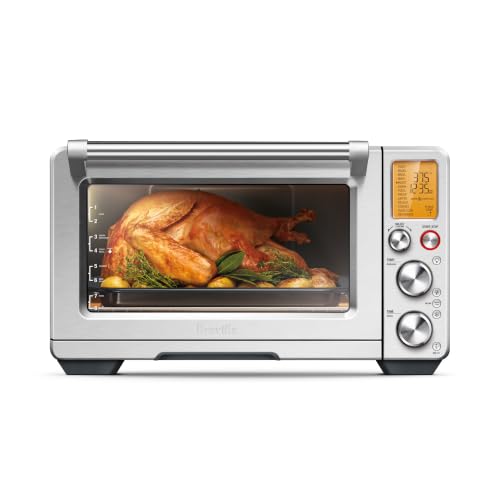
The Breville is the machine inexpensive shoppers are most often upsold toward, so it earns a clear-eyed paragraph. What the flagship tier buys here is programming depth and finish: thirteen functions that treat baking, roasting and dehydrating as distinct engineered behaviours, and a stainless body that looks and ages like a permanent appliance. Keen bakers and cooks who will genuinely work through that repertoire can justify it in a flagship guide’s terms, and we will not pretend otherwise.
What it does not buy is better fries. The core air frying physics — hot moving air on dry, spaced food — is identical in the linked Chefman and Emerils, which is why a value guide cannot link the Breville with a straight face. If your cooking is the household canon, the flagship premium purchases functions you will open twice. If your cooking is a hobby with a repertoire, you are not an inexpensive shopper at all — you are a flagship shopper with a value guide open, and the honest move is to go and read a flagship guide, several of which this site publishes, rather than to stretch this one’s brief.
And a note for completeness: in this site’s wider coverage the Breville appears, linked and recommended, in the premium and food-focused guides where its tier is the brief. Its prose-only status is local to this page’s keyword, not a verdict on the machine. Honest guides classify per question asked; ask a flagship question and this same oven is a headline answer.
Best for: keen cooks who knowingly choose the flagship tier / Not suited for: the inexpensive brief this guide serves

Chefman XL 14-Quart Multifunctional Air Fryer
Badge: Best Value for Big Batches
Strengths
- XL 14-quart cavity from a value-led brand — batch capacity as the core proposition.
- Windowed door lets you watch browning, a feature the value tier usually omits.
- Rotisserie and food dehydrator functions included alongside bake, broil and reheat.
- Touchscreen controls give it a modern feel without a flagship tier.
Trade-offs
- Touchscreen plus greasy hands is a recurring wipe-down.
- XL footprint in a black finish only, per the verified listing.
- Six functions is a shorter list than the Emeril 26QT’s preset bank.
Mini spec box
- Capacity: XL 14-quart
- Functions: 6-in-1, including rotisserie, dehydrate, bake, broil, reheat
- Controls: touchscreen
- Door: windowed
Chefman’s whole brand logic is visible in this machine: take the features people actually photograph in premium listings — a big cavity, a viewing window, a touchscreen, rotisserie, a dehydrator — and deliver them from a value-led line. Fourteen quarts is family batch territory, and the window is the feature that punches furthest above the tier, because watching food brown is both a quality tool and the thing that makes an inexpensive machine feel delightful rather than cheap.
The function set is equally well judged for the money-conscious household: rotisserie for economical whole birds, dehydrate for turning a glut of fruit into snacks instead of waste, reheat for making leftovers a strategy rather than a sadness. Each of those displaces spending elsewhere in the household budget, which is the grown-up definition of an inexpensive appliance — not the lowest tier on the shelf, but the machine whose working life keeps saving.
Its honest limitations are the touchscreen’s fingerprint-and-flour reality and the XL footprint in a single black finish. Kitchens that cook messy and often may prefer the dial-and-door simplicity of the Oster or Emerils. For batch-cooking families, though, the Chefman XL is the value pick with the fewest apologies in this guide — and size-first shoppers can compare its quart claim against Best Large Quart Air Fryers.
Weekend economics complete its case: a dehydrator session turning marked-down fruit into a week’s snacks, a rotisserie chicken providing two dinners and a lunch, a 14-quart batch of wedges feeding a crowd that would otherwise have ordered in. Run those three plays monthly and the Chefman’s tier looks less like a purchase and more like a household policy — which is the strongest thing that can be said about any inexpensive appliance.
Best for: families wanting batch capacity, a viewing window and rotisserie-plus-dehydrate range in a value tier / Not suited for: small counters and dial devotees
Comparison Table
| Model | Tier reading | Capacity anchor | Standout | Link |
|---|---|---|---|---|
| Emeril 26QT French Door | Accessible mainstream | 26QT interior | 24 presets, French doors, accessories included | Check on Amazon |
| Nuwave Bravo XL Pro | Premium flagship | 30QT cavity | Probe, grill combo, 142 presets | Prose-only |
| Oster French Door | Accessible mainstream | 15 x 12 inch pans | Simplicity, pan fit, auto-shutoff | Check on Amazon |
| Emeril Everyday 360 | Accessible mainstream | Not stated in title | Rotisserie in a 9-in-1 all-rounder | Check on Amazon |
| Breville Smart Oven Pro | Premium flagship | Not stated in title | 13 functions, stainless flagship build | Prose-only |
| Chefman XL 14-Quart | Accessible, value-led | 14-quart cavity | Windowed door, rotisserie + dehydrate | Check on Amazon |
How to Choose an Inexpensive Air Fryer Without Buying Twice
The expensive way to buy inexpensive is to buy twice: a too-small or too-flimsy machine first, then the real one a year later. Avoid it by sizing from your household, not from the shelf. The linked four are all full-size working ovens; choose among them by cooking pattern. Batch and family cooking: the Emeril 26QT or the Chefman XL. Pan and casserole cooking: the Oster. One-machine range with rotisserie: the Everyday 360. Every one of those choices is a buy-once answer for its pattern, which is the entire economics of this category.
Read tiers through signals, not adjectives. A value-led brand name, a function list that maps to meals, included accessories and a format shared with pricier siblings are the signals of honest inexpensive. A “Pro” suffix, a three-figure preset count, a probe, exotic materials statements and statement finishes are flagship signals — admirable, and not this brief. When a listing mixes the two vocabularies, believe the flagship signals; they are what you will be charged for.
Finally, count the whole cost of the cooking life: accessories in the box (the Emeril 26QT’s six), compatibility with pans you own (the Oster), waste displaced (the Chefman’s dehydrator, both Emerils’ rotisseries) and the main-oven sessions avoided. Inexpensive is a total, not a tag. Readers comparing the very largest value options can extend the audit with Best Large Size Air Fryers.
One more sizing honesty check belongs in every value purchase: count your eaters eighteen months from now, not just tonight. Households grow into teenagers and shrink into empty nests, and the inexpensive machine that fits the near future beats the perfect fit for a present that is already changing. The linked four span enough capacity range — from the Everyday 360’s everyday body to the 26QT’s family cavern — that one of them is the right size for almost any honest answer to that question.
How to Get Flagship Results on an Inexpensive Machine
- Master the single layer. Spacing is free, and it is responsible for more crisping quality than any price gap in this category.
- Preheat briefly and dry food thoroughly. Two free habits that close most of the perceived gap between tiers.
- Use the included accessories fully — the racks, trays and rotisserie hardware in the box are capability you have already paid for.
- Cook the economical repertoire: whole birds on the rotisserie models, tray vegetables in the big cavities, leftovers reheated instead of replaced. The machine’s savings live in the menu.
- Maintain it like an asset: wipe while warm, wash trays promptly, keep the cavity floor clean. A cared-for value machine in year four outperforms a neglected flagship in year two.
Troubleshooting, value edition:
- Problem: results feel inconsistent compared with a friend’s fancier machine → check the free variables first: load size, food dryness, tray rotation. Tier gaps are usually technique gaps in disguise.
- Problem: the machine feels too small within months → the household sized for today’s eaters, not this year’s; batch in two synced sessions where possible, and let the next purchase be a capacity step, not a tier step.
- Problem: accessories and parts clutter the drawers → store the kit in one box by the machine; a value machine’s included extras only save money if they are findable.
What the Flagship Tier Actually Buys — and When It Is Worth It
To close the comparison honestly: the flagship tier buys programming depth (the Breville’s thirteen engineered functions), precision hardware (the Nuwave’s probe), extra cooking registers (its grill combo), statement materials and finishes, and in the Nuwave’s case a stated PFAS Free construction. Those are real goods. They are worth their tier to cooks whose repertoire uses them weekly — serious bakers, roast perfectionists, materials-led buyers — and they are worth approximately nothing to a household whose week is fries, vegetables, reheats and a Sunday chicken, because that week is fully cooked by the linked four. The inexpensive shopper’s skill is not finding the lowest tier; it is refusing to rent capability their menu never uses. If, reading the prose-only reviews, you recognised your own cooking in the flagship features, take that recognition seriously and buy the flagship deliberately — just do not let a results page make the decision by adjective.
The Total Cost of a Cooking Life
Run the honest arithmetic of ownership, in words rather than figures, because the figures are yours to check at the links. A value oven that cooks five dinners a week displaces main-oven sessions, takeaway orders and wasted leftovers at a rate no flagship needs to match — it only needs to be used, and used is what simple, right-sized machines are. Add the in-box accessories that spare separate purchases, the existing pans that keep working, the rotisserie chickens that replace bought ones, and the dehydrated snacks that replace packaged ones, and the linked four in this guide are not merely inexpensive to buy; they are inexpensive to live with, which is the larger half of the equation.
The reverse arithmetic is the warning. A flagship bought on a value budget does not just cost its tier once; it raises the household’s expectations for every neighbouring appliance, anchors accessory spending at flagship levels, and — most subtly — makes its owner cook to justify it, which is a pleasant hobby and a poor budget strategy. Buy the tier your menu needs, keep the difference in the household, and let the cooking, not the appliance, be the impressive part of dinner.
Value Traps: Where Inexpensive Goes Wrong
Three traps catch value shoppers in this category, and naming them is a service. The first is the mini-fryer trap: a tiny pod at the very bottom of the tier structure that cooks for one, batches for everyone else, and is replaced within the year by a real machine — the most expensive inexpensive purchase there is. Every linked pick in this guide is a deliberate refusal of that trap: full-size ovens, family capacities, buy-once formats. The second trap is the feature-count mirage, where a long list of minor modes disguises a small cavity and a weak core; judge a value machine by its cavity, its door and its three most-used functions, and let the rest of the list be garnish.
The third trap is the quietest: the unbranded gamble, a machine with no verifiable listing data behind it at all. This guide’s pool is verified catalogue stock from named makers — Emeril, Oster, Chefman and, in the flagship seats, Breville and Nuwave — because a value purchase you cannot research is not value, it is variance. When the choice is between a known mainstream machine and an unknown one a tier lower, the known machine is the inexpensive choice in every sense that survives contact with year two.
Common Buying Mistakes
- Confusing inexpensive with smallest. Tiny novelty fryers are cheap to buy and expensive per meal cooked; the linked full-size ovens are the real value.
- Letting a flagship’s marketing set the budget. “Pro” models in a value search are how inexpensive briefs die; this guide labels them prose-only for exactly that reason.
- Ignoring included accessories. A machine with its racks, trays and rotisserie kit in the box can be worth more than a bare machine a tier lower.
- Paying for preset counts. Twenty-four presets is generous; a hundred and forty-two is a library. Neither cooks dinner better than the six honest functions on the Oster when the food is dry and spaced.
- Skipping the pan-fit check. Compatibility with bakeware you own is real money saved; the Oster’s stated pan fit is a budget feature, not a footnote.
Keep the receipt and the packaging through the first fortnight of real cooking, whatever tier you buy. Value is proven across actual dinners — a door swing, a batch size, a control style that either fits the household or does not — and a fortnight of family meals is the only honest trial. The linked machines in this guide were chosen to survive that trial in their respective households; give yours the chance to prove it before the box goes.
A last word on timing a value purchase: tiers are stable, but individual listings drift with seasons and stock, so the inexpensive shopper’s advantage is patience within a decision, not delay of it. Decide the model by the logic in this guide, then take the current figure at the link as the final input. A well-chosen machine bought at an ordinary moment beats a poorly chosen one bought at a dramatic discount, every single time. Value, in the end, is a habit of choosing — and this category rewards the habit generously.
Final Recommendation
For inexpensive capacity and range, buy the Emeril Lagasse 26QT French Door Oven — nothing linked here cooks more per unit of tier. For batch families who want to watch food cook, take the Chefman XL 14-Quart; for pan cooks, the Oster; for one-machine range with rotisserie, the Emeril Everyday 360. And if the two prose-only flagships tempted you, let them — but buy them as flagships, on a flagship budget, for flagship reasons, not because a value guide pretended they were bargains.
Frequently Asked Questions
Why are two models in this guide not linked?
Because their tiers contradict the keyword. The Breville Smart Oven Air Fryer Pro and the Nuwave Bravo XL Pro are premium flagship machines — by positioning, specification depth and build — so in an inexpensive guide they are reviewed in full as prose-only context, with no purchase links and no photos. The four linked models are the ones whose tiers honestly fit the brief. The rule exists so that a value shopper can trust every link on the page.
Are inexpensive air fryers worse at cooking?
At the core job, no. Air frying is hot moving air applied to dry, spaced food, and the linked machines here — full-size convection ovens from mainstream lines — do that job completely. What the flagship tier adds is programming depth, precision extras and finishes, not a different physics. Technique gaps explain most perceived quality gaps between tiers, which is why the how-to section above is written as a tier-leveller.
What is the best inexpensive air fryer for a family?
The Emeril 26QT, on this guide’s verified evidence: the largest linked capacity, French doors for family trays, 24 presets every member can use, and accessories in the box. Families that prefer watching food cook and want dehydrating as well should take the Chefman XL instead. Both are full-size machines; neither asks a family to batch its way through dinner in a mini fryer.
Is a bigger inexpensive oven better than a smaller one?
Only if your household cooks at that scale. Capacity is the main thing money buys in this category, so a big value oven is a genuine bargain for a big household — and a counter-hogging mistake for a couple, who will heat unused air nightly. Size to the eaters: the Everyday 360 exists in this guide precisely as the smaller-body value answer.
Should I just save longer and buy the Breville or the Nuwave?
Only if your cooking will use what the tier buys: the Breville’s thirteen-function repertoire, or the Nuwave’s probe, grill combo and preset library. If your week is the household canon, the linked four cook it fully and the saved difference is real money kept. Deliberate flagship purchases are respectable; accidental ones, made because marketing blurred the tiers, are what this guide exists to prevent.
How long should an inexpensive air fryer last?
Years of daily use, if it is a full-size machine from a mainstream line and is kept clean — which describes the linked four. The parts that age are surfaces, fans and door hardware, and they age at roughly the same rate across tiers when the care is equal. Buy the size and format you will use daily, maintain it in the small, and an inexpensive machine’s cost per year of service becomes very hard for any flagship to beat.
Which inexpensive pick is best for a small household?
The Emeril Everyday 360, because it keeps the full all-rounder repertoire — including rotisserie — in the most moderate body among the linked four, so a couple or a small family is not heating a cavern for two portions. Small households that cook in pans and want the quiet life can also consider the Oster if the counter allows its extra-large frame, but for most smaller homes the 360’s balance of size, range and tier is the value answer.
Do inexpensive air fryers use more energy than premium ones?
Energy use tracks wattage, cavity size and cooking time far more than tier. A right-sized value oven cooking a family dinner in one session is an efficient tool by any measure; an oversized machine of any tier heating empty air for a snack is not. The frugal habit is the same one this guide recommends for cooking quality — match the machine to the meal, cook in full sensible loads, and let the countertop oven displace the full-size oven for the small and medium jobs that fill a week.