Disclosure: topratedkitchenware.com is reader-supported. When you buy through links on our site, we may earn an affiliate commission from Amazon and other retailers, at no extra cost to you.
Where to buy
This guide to the best inexpensive immersion blenders brings together six verified stick blenders you can order online today. Each name below links to its Amazon listing, and every detailed review further down carries its own Check on Amazon link so you can check the latest price on Amazon for the exact model you are reading about. True to this guide’s subject, no prices are printed anywhere in it: inexpensive is judged here as a design quality — capability per part, per complication, per thing that can go wrong — and you can check the latest price on Amazon for whichever pick earns your click.
- Turelar 1100W 5-in-1 Hand Blender Set with Food Processor — Best Value System. buyers who want processor-set capability at the simpler end of the brand spectrum
- Ganiza Immersion Blender 5-in-1, Max 1000W, 16 Speed — Best Value Kit With Stated Capacities. buyers who want a full kit and appreciate capacities printed in the title
- MasterChef Immersion Blender, 400W, Variable Speed and Turbo — Best Value Focused Stick. buyers who want variable control without paying for a bundle
- Bonsenkitchen Immersion Hand Blender — Best Minimal-Spend Design. buyers who want the simplest, lowest-friction route into stick blending
- KitchenAid KHBV83 Variable Speed Hand Blender with Attachments — Step-Up Contrast — Premium System. buyers who decide the trigger control and full attachment system are worth stepping up for
- Vitamix 5-Speed Immersion Blender 3-Piece Bundle — Step-Up Contrast — Premium Bundle. buyers who want one-handed operation, a storage case and a premium maker, with eyes open about tier
Read the full guide ↓ for badges, honest trade-offs, a comparison table and the buying advice that helps you choose between them.
Shopping for the best inexpensive immersion blenders teaches a useful lesson quickly: in this category, money and satisfaction are only loosely related. A stick blender is a simple machine — a motor, a shaft, a blade, a control — and the inexpensive end of the market has had decades to perfect that simplicity. What extra money buys is usually not better soup; it is bundles, speed ranges, brand infrastructure and premium feel. What it never buys is immunity from the things that actually ruin a cheap blender purchase: the wrong vessel, the strained motor on an oversized job, the kit of attachments abandoned in a cupboard. This guide judges six verified picks through that value lens, qualitatively and without printing a single price.
The line-up makes the lens necessary. It contains two picks that sit, by design and reputation, at the premium tier of this category — a Vitamix bundle and a KitchenAid system — included deliberately as the step-up contrasts: the reference points that show what stepping up actually adds, so you can decide whether it adds it for you. Against them stand the value contenders: a 5-in-1 Turelar set with a food processor named in its title, a Ganiza kit stating its beaker and chopper capacities outright, a focused MasterChef stick, and a simple Bonsenkitchen two-speed blender that asks almost nothing of its owner.
Read the badges in that spirit. “Best value” here means the most genuine capability delivered with the least ownership friction at the simpler end of the design spectrum — not a price claim this guide cannot verify and will not print. Prices move constantly in this category, bundles shift, and a figure printed today would mislead next month; the links exist so you can see the live number at the moment it matters, attached to the exact model the review describes.
If your value question is really about a specific job, the specialised guides in this programme — Best Electric Hand Blenders among them — apply the same honesty to narrower briefs.
Key Takeaways
- Inexpensive is judged qualitatively here: capability per part and per complication, with no prices printed — check the latest price on Amazon on the exact model instead.
- The value centre of this line-up is the Turelar 1100W 5-in-1 set and the Ganiza kit: system capability in simpler-brand packaging.
- The MasterChef and Bonsenkitchen are the focused value plays: one job, minimal parts, minimal friction.
- The Vitamix and KitchenAid picks are included as honest step-up contrasts, sitting at the premium tier of the category by design — buy them for feel, systems and support, not for value arithmetic.
- The commonest false economy is the under-bought vessel: a tall blending cup you already own makes any of these perform better.
- Attachments only count as value if your cooking uses them weekly; otherwise they are cost and cupboard, not capability.
In this guide
Quick Picks
Badges here are value badges: what each pick delivers relative to the simplicity it asks of you. The two premium-tier picks are badged as what they are — step-ups — so the contrast stays honest.
- Best Value System: Turelar 1100W 5-in-1 Hand Blender Set with Food Processor — a 5-in-1 set naming a food processor, with trigger control and the highest listed wattage here — system capability, simply packaged.
- Best Value Kit With Stated Capacities: Ganiza Immersion Blender 5-in-1, Max 1000W, 16 Speed — 16 speeds, an 800ml beaker and a 600ml chopper with capacities stated in the title — a lot of specified kit.
- Best Value Focused Stick: MasterChef Immersion Blender, 400W, Variable Speed and Turbo — 400W with variable speed and Turbo Boost, and nothing else to pay for, wash or store.
- Best Minimal-Spend Design: Bonsenkitchen Immersion Hand Blender — two speeds, stainless blades, and a title that lists smoothies, purees, baby food and emulsions — the category, distilled.
- Step-Up Contrast — Premium System: KitchenAid KHBV83 Variable Speed Hand Blender with Attachments — included as the honest step-up: a major-brand trigger system with pitcher, whisk and chopper — judge it against the value sets, not beside them.
- Step-Up Contrast — Premium Bundle: Vitamix 5-Speed Immersion Blender 3-Piece Bundle — the premium reference point: 5 speeds, one-handed operation as listed, whisk and case — included so value claims elsewhere can be measured.
How These Picks Were Chosen
The pool was verified on 2026-11-20; every ASIN, title and image comes from that checked pool, and spec boxes print only stated facts. The value method then assessed each pick on four qualitative axes: capability breadth (what the title shows it can do), control quality, ownership friction (parts, washing, storage, cord), and tier positioning, judged from design and bundle rather than from any price, because none is printed in this guide by design.
Tier language is used carefully. When this guide calls the Vitamix and KitchenAid premium-tier, it is describing their design positioning — a storage-cased bundle from a premium blending name; a trigger-controlled attachment system from a major kitchen brand — not quoting figures. When it calls the Bonsenkitchen a lower-cost design, it means the simpler end of the spectrum: two speeds, no bundle, no claims beyond the core job. Readers can verify the live tier reality in seconds at the links, which is exactly why the guide leaves numbers there.
No ratings or review counts are printed, and no testing is fabricated. Readers cross-shopping the general field will find the same picks weighed without the value lens in Best Heavy Duty Immersion Blenders.
The 6 Best Inexpensive Immersion Blenders, Reviewed in Detail

Turelar 1100W 5-in-1 Hand Blender Set with Food Processor
Badge: Best Value System
Strengths
- The food processor attachment is named outright, which is the point of this set
- Trigger variable speed gives graded control for both blending and processing
- Highest listed wattage in these line-ups, with anti-scratch positioning
Trade-offs
- A multi-part set needs cupboard room and more washing-up
- High power demands a firm grip and a steady bowl when processing
- Frother is a light-duty extra, not a reason to buy the set
Key specs from the verified listing title
- 1100W motor as listed
- 5-in-1 set with food processor attachment
- Trigger variable speed control
- Includes whisk and frother
- Anti-scratch design as listed
The Turelar 1100W set is this guide’s value centre, and the reasoning is structural rather than numerical. A food processor attachment, a whisk and a frother around one motor means three appliances’ worth of jobs from one purchase and one drawer footprint; the trigger variable speed that would headline a pricier system is here; and the stated 1100W is the highest figure in this line-up. Capability per complication is the value formula, and on stated evidence this set maximises the numerator.
The honest deductions are ownership-side. Five-in-one means five-in-the-sink: bowl, lid, blade, whisk, frother and stick all take turns under the tap, and the set needs a real storage plan. The frother, for most households, is a passenger. Buyers who cook the way the set imagines — blending and small processing most days — will feel they have beaten the category’s pricing logic; buyers who blend soup twice a week will simply own more plastic than they needed.
As with every pick here, verify the live bundle at the link before ordering, because sets in this tier vary their contents between configurations. Judged on the verified title in this pool, though, this is the most capability a value shopper can reasonably ask one purchase to carry.
Best for: buyers who want processor-set capability at the simpler end of the brand spectrum / Not suited for: anyone who will not wash and store a multi-part set
Check on Amazon — check the latest price on Amazon for this exact model before you decide.
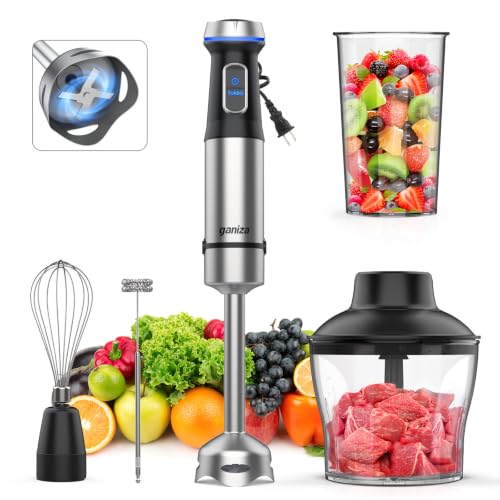
Ganiza Immersion Blender 5-in-1, Max 1000W, 16 Speed
Badge: Best Value Kit With Stated Capacities
Strengths
- The only pick here that states both beaker and chopper capacities outright
- 16 speeds plus a high listed wattage give the widest control range in this group
- Full 5-in-1 kit covers blending, chopping, whisking and frothing
Trade-offs
- Five-in-one kits generate the most washing-up and storage bulk
- Sixteen speeds exceed what most recipes can meaningfully distinguish
- Max wattage wording means technique still matters more than the headline number
Key specs from the verified listing title
- Max 1000W heavy duty motor as listed
- 16 speed modes
- 800ml mixing beaker included
- 600ml chopper included
- Also includes whisk and milk frother
The Ganiza runs the Turelar close on value, with a different flavour of honesty: its title states its beaker at 800ml and its chopper at 600ml, so a buyer knows the working sizes before ordering rather than after unboxing. Sixteen speed modes and a motor listed at max 1000W complete a specification that, in a premium badge, would be marketed at length; here it arrives in a value-tier package, and the guide credits the substance over the badge.
In value terms, stated capacities matter beyond convenience. A 600ml chopper defines the batch sizes the kit genuinely serves, which prevents the classic false economy of buying a kit too small for your household and replacing it within the year. The whisk and frother round out the same one-motor philosophy as its rival set.
The counterweights mirror the Turelar’s: parts, washing, storage, and a “max” wattage that should be read as a ceiling. Between the two value systems, choose on control style — trigger versus speed modes — and on which stated bundle matches your vessels and batch sizes. Either is a defensible centre for a value-first kitchen.
Best for: buyers who want a full kit and appreciate capacities printed in the title / Not suited for: anyone who prefers the fewest possible components
Check on Amazon — check the latest price on Amazon for this exact model before you decide.

MasterChef Immersion Blender, 400W, Variable Speed and Turbo
Badge: Best Value Focused Stick
Strengths
- Variable speed plus a separate Turbo Boost covers gentle and stubborn moments
- 400W rating with a stainless stick suits hot pots and cold drinks
- Easy-clean positioning matches how these tools are actually bought: for frequent use
Trade-offs
- No attachments or beaker are named in the verified title
- Turbo is for short bursts, not a substitute for steady technique
- Brand support networks differ from the biggest legacy names; check listing details
Key specs from the verified listing title
- 400W motor
- Variable speed control with Turbo Boost
- Stainless steel blending stick
- Easy-clean positioning as listed
- Corded handheld design
The MasterChef is the value pick for buyers who have done the attachment maths and answered “never use them”. Its verified title concentrates the spend where a stick blender’s quality actually lives: a 400W motor, variable speed control — a feature this guide repeatedly identifies as the one that improves daily results — and a Turbo Boost for finishing, in an easy-clean stainless stick. Everything not in the title is money not spent on parts that would live in a cupboard.
That concentration shows in ownership. One piece to rinse, one drawer slot, one control to learn. For soups, smoothies, purees and sauces, the core repertoire is fully covered, and the variable control gives it a finesse the two-speed value sticks cannot match at the start of a blend.
The condition is your existing kitchen: no beaker is named, so a suitable tall vessel must come from your cupboards, and chopping stays with your knife or a separate tool. If those conditions hold, this is arguably the purest value in the guide — capability bought by the gram, with nothing decorative attached.
Best for: buyers who want variable control without paying for a bundle / Not suited for: anyone who needs a beaker or chopper in the box
Check on Amazon — check the latest price on Amazon for this exact model before you decide.

Bonsenkitchen Immersion Hand Blender
Badge: Best Minimal-Spend Design
Strengths
- Simple two-speed layout is easy to learn and hard to mis-set
- Stainless steel blades suit hot soup as well as cold drinks
- The listing itself names smoothies, purees and emulsions as core jobs
Trade-offs
- No wattage is stated in the verified title, so power comparisons stay cautious
- Two speeds give less fine control than a variable trigger or dial
- No chopper, whisk or beaker is named in the verified title
Key specs from the verified listing title
- Electric corded stick blender
- Stainless steel blades
- 2 mixing speeds
- Listed for smoothies, puree, baby food, soup and emulsions
- No wattage is stated in the verified title
The Bonsenkitchen represents the floor of sensible spending in this category: an electric stick with stainless steel blades and two mixing speeds, whose title lists smoothies, puree, baby food, soup and emulsions as its work. For a first stick blender, a second-home kitchen, a student kitchen or a dedicated single-purpose buy, that distillation is a legitimate endpoint rather than a compromise — the core job, done with the least possible machinery.
Value judgement requires the gaps to be stated as plainly as the virtues. No wattage appears in the verified title, so no power comparison is offered; two speeds are the whole control story; no beaker, whisk or chopper is named. A buyer who grows into daily frozen smoothies or weekly processing will outgrow it and should start one tier up instead.
Within its honest territory, though, it delivers the category’s essential magic — blend in the vessel, rinse in seconds — at the simplest end of the design spectrum. Many kitchens have kept exactly such a stick for years of soups and baby food, which is the only durability evidence a listing-based guide should ever imply: the design’s, not the unit’s, track record.
Best for: buyers who want the simplest, lowest-friction route into stick blending / Not suited for: anyone who wants stated wattage or fine control
Check on Amazon — check the latest price on Amazon for this exact model before you decide.

KitchenAid KHBV83 Variable Speed Hand Blender with Attachments
Badge: Step-Up Contrast — Premium System
Strengths
- Variable speed trigger lets you feather power instead of jumping between fixed steps
- Chopper and whisk attachments widen the job list well beyond blending
- Removable 8-inch arm reaches into deeper pots and tall pitchers
Trade-offs
- Corded design ties you to an outlet and a workable cord path
- Attachment set means more parts to wash, dry and store
- Trigger control rewards a steady hand; squeezing too hard too fast can surge liquid
Key specs from the verified listing title
- Corded hand blender, model KHBV83
- Variable speed trigger control
- Removable 8-inch blending arm
- Includes blending pitcher, whisk and chopper attachments
- Finish listed as Black Matte
The KitchenAid KHBV83 is in this guide to make the value picks legible. It is a genuinely excellent system: a variable speed trigger that feathers power beautifully, a removable 8-inch arm, and a blending pitcher, whisk and chopper completing the set. It also sits, by brand and bundle design, at the premium tier of this category — and an inexpensive guide that hid that fact, or quietly ranked it as a bargain, would be failing its readers.
So read it as the reference standard. Everything the value sets claim — trigger-style control, a chopper, a whisk, a vessel — is here in its most polished form, and the comparison tells you exactly what the step-up buys: refinement of feel, the pitcher in the box, and a major brand’s ecosystem behind the product. What it does not buy is a different category of result in the cup or the pot; the Turelar and Ganiza sets cover the same job list on stated evidence.
Buy it if those refinements are worth their tier to you — many cooks reasonably decide they are, for a tool used daily for years. Buy the value sets if the arithmetic leads. Either decision, made with this contrast in view, is a good one; the only bad decision is paying the premium by accident because a guide called everything a bargain.
Best for: buyers who decide the trigger control and full attachment system are worth stepping up for / Not suited for: value-first buyers, who get more capability per complication below
Check on Amazon — check the latest price on Amazon for this exact model before you decide.

Vitamix 5-Speed Immersion Blender 3-Piece Bundle
Badge: Step-Up Contrast — Premium Bundle
Strengths
- One-handed operation is a genuine ergonomic differentiator at the stove
- Storage case keeps the whisk and stick together instead of loose in a drawer
- 5-foot cord gives useful reach around a kitchen island or range
Trade-offs
- Premium-tier positioning in a category with many simpler options
- Five speeds, not a stepless trigger, so control is stepped
- No chopper bowl is named in the verified title
Key specs from the verified listing title
- 5-speed control
- One-handed operation as listed
- Stainless steel blades
- Whisk and storage case included
- 5-foot cord; blends in any container as listed
The Vitamix bundle completes the honest frame. By design positioning it is the premium end of this line-up: a 3-piece bundle with 5-speed control, one-handed operation as listed, stainless blades, a whisk and a storage case, on a 5-foot cord, from the name most associated with premium blending. In an inexpensive guide its role is not to be recommended as a bargain — it is to show what the top of the category looks like, so the value picks below it can be judged against the real alternative rather than against a straw man.
What the premium buys, stated fairly: the one-handed control experience, the case that keeps a kit a kit, the cord length treated as a specification, and the confidence of a flagship maker’s product line. What it does not include is a chopper, so on capability breadth the value sets above actually exceed it — a fact worth sitting with, because it captures this category’s whole pricing story in one comparison.
Choose it if feel, tidiness and brand infrastructure top your personal value equation; many owners will never regret it. Choose the sets and sticks above if the equation is capability per complication. This guide’s loyalty is to the equation, not to a tier — and it trusts you with both ends of it.
Best for: buyers who want one-handed operation, a storage case and a premium maker, with eyes open about tier / Not suited for: anyone shopping this keyword for value arithmetic
Check on Amazon — check the latest price on Amazon for this exact model before you decide.
Comparison Table
Read the extras and control columns as the value story: the two step-up contrasts are marked in their badges, and the table makes no price claims of any kind — that check belongs to the live listings, at the moment you buy.
| Pick | Badge | Control | Stated power | Included extras named in title | Link |
|---|---|---|---|---|---|
| Turelar 1100W 5-in-1 Hand Blender Set with Food Processor | Best Value System | Trigger variable speed | 1100W as listed | Food processor, whisk, frother | Check on Amazon |
| Ganiza Immersion Blender 5-in-1, Max 1000W, 16 Speed | Best Value Kit With Stated Capacities | 16 speed modes | Max 1000W as listed | 800ml beaker, 600ml chopper, whisk, milk frother | Check on Amazon |
| MasterChef Immersion Blender, 400W, Variable Speed and Turbo | Best Value Focused Stick | Variable speed plus Turbo Boost | 400W | None named in verified title | Check on Amazon |
| Bonsenkitchen Immersion Hand Blender | Best Minimal-Spend Design | 2 mixing speeds | Not stated in verified title | None named in verified title | Check on Amazon |
| KitchenAid KHBV83 Variable Speed Hand Blender with Attachments | Step-Up Contrast — Premium System | Variable speed trigger | Not stated in verified title | Blending pitcher, whisk, chopper | Check on Amazon |
| Vitamix 5-Speed Immersion Blender 3-Piece Bundle | Step-Up Contrast — Premium Bundle | 5-speed control | Not stated in verified title | Whisk, storage case | Check on Amazon |
How to Choose Inexpensive immersion blenders
Define value before you shop, in your own terms. For some kitchens value is capability per purchase: the sets that blend, chop and whisk from one motor. For others it is capability per minute of ownership: the focused stick that rinses in ten seconds and never asks for storage. Both definitions are honoured in the badges above, and confusing them is how satisfied buyers become disappointed owners.
Audit your vessel situation, because it silently reprices every pick. A household with a tall, sturdy blending cup already owns the missing half of the focused sticks’ value case. A household without one should count a beaker-included kit (Ganiza) or a pitcher system (KitchenAid) at its true, higher effective value, because the alternative is a separate purchase or a month of splashing.
Treat attachments as a subscription you pay in washing. Each included part charges you a small fee in time, every use, forever. That fee is worth paying for parts your cooking exercises weekly — a chopper for daily prep cooks, a whisk for bakers — and pure loss for parts it does not. The frother question alone separates honest value buyers from bundle collectors: if milk foam is not in your life, its presence in a title adds nothing to the set’s value to you.
Finally, do the live check properly. Open the finalists’ listings, confirm the exact bundle in each — sets in this tier vary — and compare the live figures against the capability table in this guide, not against a printed number here, because this guide prints none on principle. Then buy the pick whose total routine you can describe happily: what it blends, what it washes, where it lives. That description, not a tier label, is what inexpensive done right feels like. Readers whose value question extends to sheer handling effort can continue in Best Lightweight Immersion Blenders, which applies stated-evidence discipline to that angle.
How to Keep an Inexpensive Blender Feeling Expensive: Care and Technique
The gap between a cheap blender that delights for years and one that disappoints in months is mostly technique and care, both free. This section is the highest-value reading in the guide, in the most literal sense.
- Always start submerged and low: the gentle start protects the motor, the mixture and your walls, and costs nothing.
- Match the job to the tool’s scale: single servings and small batches, in bursts, with movement — the rhythm every pick here was designed around.
- Keep frozen pieces small and liquid sufficient; forcing a stalled blend is how modest motors get old before their time.
- Rinse the arm immediately after every use and dry the blade area before storage; residue and damp, not price tier, are what make blenders feel tired.
- Store the whole kit together, cord loosely coiled, blades visible and safe; a tool that is easy to reach gets used gently and often.
- Re-read your own routine twice a year: if a part has not been touched in six months, your next purchase should be simpler, and if one job strains weekly, it should be more capable.
Technique upgrades are the other free performance. Liquid-first smoothie building, greens blended into the base liquid before fruit, soup blended off the fiercest heat, chopper bowls pulsed rather than run — each habit raises the result of any pick in this guide by more than a tier step would. The value shopper’s real edge is not finding a mispriced product; it is extracting full performance from a fairly priced one.
And when a pick does reach the end of its life, replace by the lesson, not by the label: buy for the job that strained, keep the parts of the routine that worked, and let the focused sticks and honest sets in this guide be the shortlist you return to.
Troubleshooting
Problem: the blender struggles with a frozen smoothie → the pieces are too large or the liquid too low for its class. Shrink the pieces, add liquid, blend in bursts, or accept that this recipe belongs a tier up.
Problem: an attachment has never been used → it was bought as bundle optimism. Store it with the stick for one honest month of trial; if it stays untouched, simplify next time and spend the difference on vessels you will use.
Problem: cleaning feels like a chore that puts you off blending → residue is drying on. Rinse immediately, in a jug of warm soapy water with a few seconds of running if the maker allows, and the chore mostly vanishes at any tier.
Problem: the purchase feels like a false economy within weeks → the job outgrew the tool, not the tool failed. Name the specific job that strains, and let it — alone — define the step-up you actually need.
The Step-Up Question: What Premium Actually Buys in This Category
This line-up’s two premium-tier picks make the step-up unusually legible, because their titles emphasise experience over arithmetic. The KitchenAid sells a trigger’s finesse and a complete, pitcher-centred system. The Vitamix sells one-handed operation, a storage case and a flagship name. Neither sells a chopper the value sets lack — the Vitamix does not include one at all — and neither claims a blending result the simpler tools cannot approach with good technique. Premium, here, is polish, infrastructure and feel.
None of that makes premium foolish. A tool used daily for years amortises feel like nothing else in the kitchen, and support ecosystems matter when something fails. The inexpensive shopper’s task is simply to buy polish knowingly, as polish — not to pay for it accidentally while believing they bought capability. This guide has marked the tiers in the badges so that choice stays conscious.
False Economies: the Three Ways Cheap Blenders Get Expensive
The first false economy is under-buying the job: a stick strained weekly on frozen mixtures or family batches will be replaced, and two purchases cost more than the right one. The second is over-buying the bundle: attachments that are never used were not free, whatever the set’s positioning, and they tax storage and washing forever. The third is neglecting the vessel: blending in a too-small cup wastes ingredients, time and goodwill, and quietly makes a capable tool feel cheap.
Against all three, the defence is the same unglamorous discipline this guide has applied throughout — count your jobs, state your tier, check the live bundle, and invest the savings in technique. Inexpensive done right is not the lowest number at checkout; it is the lowest cost per year of happy use. Shoppers who want the same discipline applied to the kitchen-wide picture can continue in Best Kitchen Hand Blenders.
The One Accessory Worth Buying Separately
Value guides usually end at the product, but the highest-return purchase around any inexpensive blender is not a blender at all: it is the tall, sturdy blending vessel, if your kitchen lacks one. A stick blender’s results are half vessel — submersion depth, vortex room, splash control — and a household that pairs a simple Bonsenkitchen or MasterChef with a proper blending cup owns, in effect, a better system than a household blending with a premium stick in a cereal bowl. When the sets in this guide include beakers and pitchers, that inclusion is real value, and when they do not, the vessel is where a small part of the saving should be deliberately spent.
The same logic governs the second-best accessory: none. Value discipline means resisting the ecosystem of gadgets that gathers around a simple tool, each individually plausible and collectively a second purchase price. The picks above were chosen because their titles describe complete answers to their jobs; let them be complete, and let the vessel be the one considered exception.
Reading a Listing Like a Value Analyst
Since this guide prints no prices, its last service is to teach the check it performs qualitatively, so you can perform it at the live listing. Read the title first, as this guide did: what is actually named — motor, speeds, attachments, capacities — and what is merely implied by photography or by the brand’s other products? Then read the bundle contents as a separate list and match them, item by item, against the title’s promises; in this category the gap between the two is where disappointment is manufactured. Then weigh what remains against your counted jobs, not your imagined ones.
Finally, apply the tier question consciously. If the live figure places a pick in a tier its design does not argue for — premium money for a bare stick, or a set priced as if its attachments were full appliances — the value answer is to walk to the pick in this guide whose design does argue for its tier. Value is not a hunt for the lowest number; it is the refusal to pay for a story the product itself does not tell.
When Inexpensive Is the Wrong Brief
Honesty about a keyword includes naming its limits. There are kitchens for which the inexpensive brief, however well executed, is the wrong starting point: the household blending for a member with strict texture needs after illness, where control finesse is a medical-adjacent requirement; the enthusiastic cook whose daily frozen and processing work will strain value-tier tools into early replacement; the shared household where a blender is used by six hands a day and infrastructure — support, parts, a case that keeps order — is worth its premium. For those readers, the step-up contrasts in this guide are not decorations but the actual recommendations, and the value picks are the honest baseline they stepped up from.
Naming this matters because a value guide that cannot say “not this brief” will eventually sell the wrong tool to the wrong kitchen in the name of saving. The discipline runs the other way too: most kitchens are not those kitchens, and for the mainstream repertoire — soups, smoothies, purees, sauces, light prep — the value centre of this line-up is not a compromise at all. Knowing which kitchen is yours is the entire skill this keyword demands, and it cannot be bought at any tier.
Common Buying Mistakes
The first mistake is shopping this keyword by the lowest live figure alone, without the capability table: the cheapest box that cannot do your weekly job is the most expensive purchase in the guide, because it will be made twice.
The second mistake is the mirror image — assuming the premium picks must blend better because they sit at the premium tier. Their own titles argue feel and systems, not a different class of result, and the value sets match or exceed their attachment breadth.
Third, do not count attachments you will not use as savings. Fourth, do not ignore the vessel your kitchen lacks when comparing a bare stick against a beaker kit. Finally, do not print, save or rely on any price you saw in a guide — including the absence of one here: check the live listing for the exact bundle at the moment of purchase, every time.
Final Recommendation
For value-first buyers, make the Turelar 1100W set your first check: processor-set capability, trigger control and the highest stated wattage in the guide, in simpler-tier packaging. Run the Ganiza alongside it if stated capacities and speed modes suit your batches better, and choose between them on control style and bundle fit.
Choose the MasterChef if your honest job list needs no attachments, the Bonsenkitchen if you want the simplest possible entry into the category, and either premium pick — KitchenAid for the system, Vitamix for the ownership experience — only as a conscious step-up, bought for polish with your eyes open. That is the whole philosophy of this guide in one paragraph: inexpensive is a way of seeing, not a number, and every link here lets you verify the number live once your seeing is done.
Start your shortlist here: Turelar 1100W 5-in-1 Hand Blender Set with Food Processor, Ganiza Immersion Blender 5-in-1, Max 1000W, 16 Speed, MasterChef Immersion Blender, 400W, Variable Speed and Turbo. Each link goes to the exact model reviewed above, so you can check the latest price on Amazon and confirm the current bundle before ordering.
Related guides
Frequently Asked Questions
Why does this guide print no prices in an inexpensive guide?
Because prices in this category move constantly and bundles shift, so any printed figure would mislead quickly — and a wrong figure in a value guide is worse than none. Inexpensive is judged here qualitatively, by capability, control and ownership friction, and each linked pick lets you check the latest price on Amazon for the exact model at the moment you buy.
Are the premium picks in this guide mistakes?
No — they are included deliberately as step-up contrasts, and badged as such. They show what the premium tier actually buys (control polish, systems, storage, brand infrastructure) so you can decide consciously whether it buys it for you. Several picks below them match their capability breadth at a simpler tier.
Which pick offers the most capability for a value buyer?
The two 5-in-1 sets: the Turelar 1100W, whose title names a food processor with trigger control, and the Ganiza, which states its 800ml beaker and 600ml chopper capacities outright. Choose between them on control style and on which stated bundle fits your batch sizes.
Is a very simple two-speed blender a false economy?
Only if your jobs outgrow it. For soups, purees, baby food and soft smoothies, a simple stick like the Bonsenkitchen covers the ground with the least ownership friction in the guide. It becomes a false economy when a household blends frozen mixtures daily and strains it weekly — the job, not the price, decides.
What hidden costs should I count beyond the blender itself?
A suitable tall vessel if your kitchen lacks one, storage for any multi-part set, and the washing time each attachment charges per use. Counted honestly, those costs sometimes move a bare stick ahead of a kit, and sometimes the reverse — which is why this guide prices routines, not just products.
How long should an inexpensive immersion blender last?
No listing can promise a lifespan, and this guide invents none. What the evidence supports is that the design class is simple and durable when used at its scale — bursts, right-sized jobs, immediate rinsing. Technique and care, both free, are the strongest lifespan variables a buyer controls.


