An extractor hood pulls smoke, steam and grease from the air above your cooktop and either vents it outdoors or filters it back into the room. A good one keeps the kitchen cleaner and reduces cooking odors. The right hood depends on your cooktop width, ceiling height and whether you can run a duct to the outside.
The six hoods below include under-cabinet, wall-mount and convertible models. We have not used these products ourselves, so confirm the width, venting type and filter requirements on the current listing before you buy. Airflow and noise claims are the makers’ own, and we leave exact figures to the listing. Hood lines are sold in several widths and finishes, so treat the names here as product families and pick the exact model that matches your cooktop on the current listing.
As an Amazon Associate we earn from qualifying purchases. Links below are affiliate links, and they do not change the product information we give.
What to Look For
| Feature | Why it matters |
|---|---|
| Width | Choose a hood at least as wide as your cooktop |
| Venting | Ducted hoods vent outside; ductless ones recirculate air |
| Airflow | Higher airflow clears heavy cooking better but may be louder |
| Filters | Baffle or mesh filters need regular cleaning or replacement |
In this guide
Specs at a Glance
| Hood | Style | Venting | Notes |
|---|---|---|---|
| Broan-NuTone 41000 Series | Under-cabinet | Ducted or ductless, check listing | Multiple widths |
| Cosmo 5MU30 | Under-cabinet | Ducted or ductless, check listing | Stainless steel |
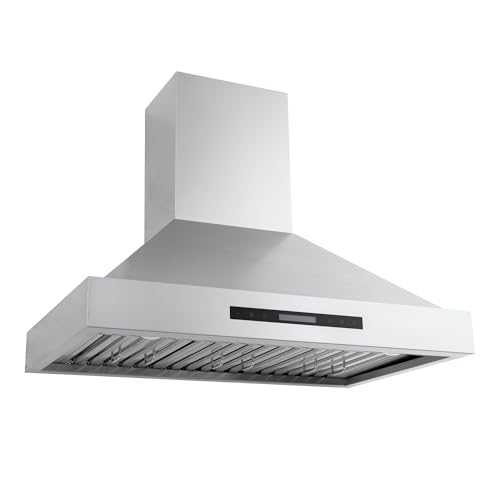
| ZLINE wall mount hood | Wall-mount chimney | Ducted, check listing | Stainless steel |
| Hauslane Chef Series | Wall-mount | Ducted or convertible, check listing | Stainless steel |
| Winflo wall mount hood | Wall-mount | Ducted or ductless, check listing | Stainless steel |
| Broan-NuTone Allure | Under-cabinet | Ducted or ductless, check listing | Several finishes |
The 6 Best Kitchen Extractor Hoods
Top pickBest for standard kitchen ranges
1. Broan-NuTone 41000 Series Under-Cabinet Range Hood
A long-running under-cabinet hood line from a major ventilation brand. It is made for standard kitchens with a cabinet above the range.
Suits: standard kitchen ranges. Strengths: familiar design and sizes. Weaknesses: basic styling. Skip it if you want a statement hood.
View Broan-NuTone 41000 Series Hood on Amazon
Best for small kitchens
2. Cosmo 5MU30 Under-Cabinet Range Hood
A stainless steel under-cabinet hood with push-button controls and a slim profile. It suits compact kitchens.
Suits: small kitchens. Strengths: slim profile and stainless finish. Weaknesses: basic noise levels. Skip it if you want a chimney-style hood.
View Cosmo 5MU30 Hood on Amazon

Best for design-forward kitchens
3. ZLINE Wall Mount Range Hood
A chimney-style hood in stainless steel that mounts to the wall above the range. It is a focal point as much as a ventilator.
Suits: design-forward kitchens. Strengths: strong looks and build. Weaknesses: takes installation work. Skip it if you have a low ceiling.

Best for modern kitchens
4. Hauslane Chef Series Wall Mount Range Hood
A modern wall-mount hood with a clean design. It is popular with homeowners upgrading a cooktop area.
Suits: modern kitchens. Strengths: contemporary style. Weaknesses: check the venting kit needed. Skip it if you want an under-cabinet model.
View Hauslane Chef Series Hood on Amazon
Best for home remodels
5. Winflo Wall Mount Range Hood
A stainless wall-mount hood with multiple speeds. It is aimed at cooks who want a visible upgrade over a basic hood.
Suits: home remodels. Strengths: style and speed settings. Weaknesses: install effort. Skip it if you need the simplest install.
View Winflo Wall Mount Hood on Amazon
Best for everyday cooking
6. Broan-NuTone Allure Series Range Hood
An under-cabinet hood line in several finishes with lighting and multiple fan speeds. It stays unobtrusive in most kitchens.
Suits: everyday cooking. Strengths: an unobtrusive design and lighting. Weaknesses: fewer premium features. Skip it if you want a chimney hood.
View Broan-NuTone Allure Series Hood on Amazon
Care and Setup
- Clean metal filters regularly in warm soapy water.
- Replace charcoal filters on ductless hoods as the maker directs.
- Wipe the hood exterior to prevent grease buildup.
- Replace lights when they fail, using the specified bulbs.
Mistakes to Avoid
- Choosing a hood narrower than the cooktop.
- Ignoring duct size and run when buying a ducted model.
- Skipping filter cleaning for months.
- Forgetting to check the mounting height.
Airflow Ratings and Your Cooking Style
Airflow is usually given as a volume of air moved per minute, and it is one of the most important numbers on a hood listing. A higher rating means the fan can move more air, which helps with heavy frying, wok cooking and gas burners that put out a lot of heat and steam. A lower rating can be enough for light simmering and occasional use on an electric cooktop.
Do not just chase the biggest number. A powerful fan can be loud, and it needs enough duct capacity and make-up air to work properly. If your kitchen is small or tightly sealed, a very strong hood may struggle to pull air without a window or door cracked open. The right level depends on the cooktop type and how you cook.
- Light cooking: boiling, simmering and baking generally need modest airflow.
- Regular frying and searing: look for a stronger fan and good grease filters.
- High-output gas ranges: check the maker’s or installer’s guidance on sizing, since larger burners create more heat and fumes.
Airflow claims are the maker’s own and may be measured under ideal conditions. Real performance is affected by duct length, bends and the height of the hood above the cooktop. Read the listing carefully, and when in doubt ask a qualified installer.
Duct Planning and Installation Checks
A ducted hood is only as good as its duct. A short, straight run to the outside lets the fan move air freely. Long runs, sharp elbows and narrow pipe reduce airflow and increase noise. Before you buy, find out where the duct will go: up through the ceiling, out the back wall or through a cabinet. Check the duct size the hood needs, and make sure the existing duct or the new one matches.
Think about mounting too. Under-cabinet hoods need a cabinet above the range at a suitable height and enough room for the hood’s depth. Wall-mount chimney hoods need a flat wall and a ceiling with room for the chimney, and they usually need a stronger fixing into the wall. Check the manual or listing for the recommended distance between the cooktop and the hood, since mounting too low is a safety issue and too high reduces capture.
- Confirm the power source and whether an outlet or hardwiring is needed.
- Check local building rules, which may restrict duct routing and require certain materials.
- Consider hiring a qualified professional for wiring, venting and wall fixing.
If you cannot run a duct outside, a ductless or recirculating hood with a charcoal filter is an option, though it removes less steam and heat than a ducted one.
Noise, Controls and Lighting
A hood you hate listening to is a hood you will not use. Noise depends on fan speed, the quality of the motor and how smooth the ducting is. Many hoods list a noise rating, but the number and the way it is measured vary, so treat it as a guide. A fan that is loud at its highest setting can still be pleasant at a lower one, so look at how many speeds are available.
Controls vary from simple rocker switches to push buttons, sliders and touch panels. Choose controls that are easy to operate with wet or greasy hands, and consider whether you want a delay-off function that keeps the fan running for a short time after cooking. Not every model has one, so check the listing.
Lighting is a practical detail that many buyers overlook. A hood light shines on the cooktop and makes it easier to see what is cooking. Check what type of bulb it uses and whether replacements are easy to find. LED lights generally last long and give off less heat, but confirm the details on the listing. Also look at how the light is positioned, since a bright light that glares in your eyes can be annoying while you cook.
Filters and Grease Management
Filters are the part of a hood that you will handle most. Metal mesh and baffle filters capture grease and can usually be washed, which makes them popular for ducted hoods. Charcoal filters, used in ductless hoods, absorb odors but cannot be washed and must be replaced on a schedule set by the maker. Check what filter type the hood uses and how easy it is to remove and replace.
Baffle filters are often considered more efficient at catching grease, but the details vary by model. Mesh filters are simple and common, but they clog more quickly if you fry often. Either way, grease buildup reduces airflow and creates a fire hazard, so cleaning matters.
- Remove metal filters and soak them in hot soapy water, scrubbing gently with a brush.
- Check whether they are dishwasher-safe, and follow the maker’s guidance.
- Wipe the inside of the hood where grease collects, with the power off.
- Keep spare charcoal filters on hand if you use a ductless model.
If you cook with lots of oil, set a reminder to check the filters more often than the manual’s minimum. Dirty filters are the most common cause of a hood that seems to have lost power.
Choosing a Style and Questions to Ask
Style should follow function. Under-cabinet hoods are compact and suit standard kitchens, wall-mount chimney hoods become a visual feature, and island hoods hang from the ceiling. Choose the form that fits your space and your ventilation plan, and then consider the finish. Stainless steel is common and wipes clean, though fingerprints and grease show, so choose a brushed finish if that matters to you.
Before you buy, ask a few questions:
- Is the hood at least as wide as my cooktop, and does it fit the mounting space?
- Do I have a way to vent outdoors, or do I need a ductless setup?
- What are the replacement filter and bulb needs?
- Who will install it, and are there any special tools or wiring needs?
- What does the warranty cover and for how long?
Replace a hood when the motor becomes very loud, when it fails to clear smoke despite clean filters and a clear duct, or when parts are no longer available. Also reconsider if you change your cooktop, since a new burner layout may need a different size. Budget tiers generally differ in motor quality, controls and finish, so decide which of those matter most to you.
How to Read an Extractor Hood Listing Without Guesswork
A hood listing can look like a wall of numbers, but only a handful of lines decide whether the unit suits your kitchen. Begin with the width, because the hood should sit over the whole cooking surface, and then check the stated airflow figure and the duct size it expects. A listing that names a round duct diameter tells you what the unit is built to connect to, and a mismatch means adapters and extra planning.
Next, look for the noise figure and whether it is given at the top fan speed or at a lower one. Makers often quote the quietest setting in large type, so read the fine print. Finally, scan for the filter type, the control style and the bulb or lamp format, since these shape your running costs and your upkeep routine for years.
- Width and depth: confirm both against your cooktop and the cabinet space above it.
- Duct connection: note the size, the direction of exit and whether a damper is included.
- Filter style: baffle, mesh or charcoal, and whether the filter can go in a dishwasher.
- Lighting: built-in lamps or a bulb you must source yourself.
- Controls: push buttons, sliders or a touch panel, and whether a timer is present.
Ducted or Recirculating: A Decision Guide by Kitchen Type
Your building often makes this choice for you. A kitchen on an outside wall with room for a short straight duct run is a natural fit for a vented unit, while an interior kitchen in a flat may only allow a recirculating setup. The table below matches common situations to the usual direction, though your local rules and the maker’s manual have the final word.
| Situation | Usual direction | Why it fits |
|---|---|---|
| Outside wall right behind the cooktop | Vented outdoors | Short duct, fewer bends, stronger real-world extraction |
| Interior kitchen, no route to outside | Recirculating with charcoal filter | No duct work needed, filters must be swapped on schedule |
| Rental where walls cannot be altered | Recirculating | Easy to remove when you move |
| Heavy frying and searing | Vented outdoors | Moves grease and steam out of the home |
| Occasional light cooking | Either | Choose by space and noise preference |
A Short Glossary for Hood Shoppers
Hood shopping comes with its own jargon. These plain definitions should keep the product pages from feeling like a foreign language.
- Capture area: the footprint under the hood where rising smoke and steam are drawn in.
- Baffle filter: a set of angled metal plates that force grease to drop out of the air stream.
- Damper: a flap in the duct that opens when the fan runs and closes when it stops, limiting drafts.
- Transition: the fitting that joins the hood outlet to the round duct.
- Make-up air: fresh air that enters the home to replace what the hood pushes out.
- Delay-off: a timer that keeps the fan running briefly after you finish cooking.
Hood Installation: Maker Instructions Versus a Licensed Tradesperson
Mounting a hood is mostly a matter of careful measuring and secure fixing, yet some parts of the job belong with a licensed tradesperson. Electrical connections, new wiring runs and any work that cuts through an exterior wall or roof should follow the maker’s instructions and your local building rules. If you have a gas cooktop, ask a qualified professional about clearances and make-up air needs before you commit to a model.
For everything else, the manual is your friend. It will state the minimum height above the cooking surface, the weight the wall must carry and the recommended duct material. Keep it with your purchase records so the next owner or installer can find it quickly.
Sizing a Hood for the Way Your Kitchen Is Laid Out
Fit is about more than the headline width. A hood that matches the cooktop edge to edge captures less than one that overhangs a little on each side, because rising heat spreads outward as it climbs. Many makers suggest a hood at least as wide as the cooktop, and some advise a slightly wider one for wall-mounted styles. Check the manual for the mounting height they recommend, since a unit hung too high loses capture and one hung too low can become a hazard for your head and a nuisance when you lift tall pots.
Think about the room around the hood as well. A tall chimney section needs ceiling clearance and a path for the duct, while a slim under-cabinet unit needs a flat underside and a stud or cabinet frame strong enough to carry it. Walk through these points with a tape measure before you fall for any design.
- Measure the cooktop width and the cabinet or wall space above it.
- Note the ceiling height and any soffits that block a duct route.
- Mark where the power supply will come from.
- Compare each of those numbers with the maker’s installation sheet.
Doing this on paper takes ten minutes and prevents most returns.
What a Hood Actually Does During a Real Meal
It helps to watch a hood work across one honest dinner: onions softening, a steak searing, a pot of pasta at a rolling boil, something finishing in the oven below. Each event sends up a different mixture. The searing pan produces a fast, greasy plume that rises with force and spreads the moment it passes the hood’s capture area, which is why searing is the test that separates adequate hoods from good ones. The boiling pot produces a gentle, wide cloud of steam that almost any hood handles, provided it is switched on before the water boils rather than after the cloud has filled the room. The oven contributes little until its door opens, releasing a stored breath of heat and vapour that a hood on a low, patient setting catches better than one switched to maximum in a panic.
Timing is the user’s half of the system. A hood started a minute before cooking begins establishes an upward current that guides the plume; a hood started after the kitchen smells of frying is chasing vapour that has already escaped into the room’s corners, onto the cabinets and into the soft furnishings. Running the hood for some minutes after cooking ends clears what lingers, and the delay-off features on several picks in this guide exist precisely because cooks forget this second half of the job.
Open a window or door slightly in another part of the home and most hoods work better, because the fan needs replacement air to move. A powerful hood in a sealed modern kitchen can labour against its own vacuum, growing louder while moving less, a paradox that explains many disappointed reviews of perfectly capable machines. The hood is a system of air in and air out, and the cook manages half of it.
Capture Area, Canopy Shape and Cooking Position
Specifications speak of airflow, but capture is geometry. A hood captures what rises into its canopy, and vapour that drifts forward of the front edge, as it does from the front burners where most searing happens, escapes regardless of the fan’s strength. Deep canopies and designs that extend coverage toward the front of the hob earn their keep exactly there. Wall-mounted chimney styles in this guide generally offer generous depth; slim under-cabinet models trade some of that coverage for their discreet profile, which suits gentler cooking better than nightly high-heat searing.
Your own habits shift the geometry too. Cooking on the back burners when a dish is smoky, a habit worth cultivating with any hood, places the plume squarely under the canopy and can make a modest hood perform like a stronger one. Lids, used at a tilt to vent steam toward the back, direct vapour where the hood can take it. These are free techniques, available with every model listed, and together they matter as much as a step up in fan power.
Height completes the picture. A hood mounted higher than the maker’s range gives vapour room to spread and cool before capture, and no fan setting fully compensates. When planning installation, treat the stated mounting height as a performance specification rather than a suggestion, and if a tall cook’s headroom argues for higher, compensate honestly with a wider or deeper canopy rather than hoping power will paper over physics.
Grease: Where It Goes and Why Filters Decide Longevity
Every vapour a hood captures carries grease, and the filter’s job is to strip that grease out before it coats the fan, the duct and eventually the kitchen. Mesh and baffle filters in the picks listed here are washable, and their condition is the single largest factor in how a hood performs in its third year compared with its first. A filter heavy with old grease restricts airflow, raises noise and leaves the fan working against a blockage it was never designed for, so the powerful hood that seems to have faded has usually just been breathing through a clogged filter.
Washing rhythm should follow cooking style rather than the calendar alone. A household that fries and sears daily loads filters several times faster than one that mostly boils and bakes, and both should learn their own interval by inspection: hold the filter to the light, and when the mesh looks furred rather than open, wash it. Most metal filters tolerate the dishwasher, though hand washing in hot soapy water is gentler on their finish and lets you see the grease actually leaving.
Recirculating hoods add charcoal filters, which trap odours and are consumables with a finite life; once saturated, they quietly stop contributing while the fan still sounds busy. Note the replacement interval when you buy, keep a spare if your cooking is heavy, and remember that a recirculating hood manages odour and some grease but cannot remove heat and moisture from the room the way a ducted hood does, which is why steamy kitchens feel the difference most.
Noise in Honest Terms
Hood noise decides whether the machine gets used, and an unused hood, however powerful, extracts nothing. Judge noise at the speed you will actually run, which for most cooking is the middle setting, not the maximum that dominates specification sheets. A hood that is tolerable at conversation level on its middle speed will be switched on early and left running, capturing far more over a year than a louder, stronger rival that the cook reaches for only when the room is already full of smoke.
Installation shapes noise as much as the fan does. Smooth, short duct runs with gentle bends keep air quiet; corrugated runs, sharp elbows and a flapping external vent add their own soundtrack and steal performance. The hood’s mounting matters too: a unit fixed firmly to a solid wall or properly supported cabinet hums less than one vibrating against a hollow panel. When a new hood seems unexpectedly loud, check the installation before blaming the machine, because a loose screw or a transit bracket left in place is a common and curable culprit.
Households with open-plan living should weight noise even more heavily, since the hood shares air with the sofa and the television. For them, a slightly larger hood run slowly often beats a smaller hood run hard: moving the same air at lower speed is generally quieter, and the wider canopy captures better at that gentle pace. It is one of the few cases where buying more hood than the hob strictly needs is the restrained choice.
Lighting, Controls and the Small Features That Add Up
Hood lighting is task lighting for the most dangerous worktop in the house, and its quality shows every evening. Lights set toward the front of the canopy illuminate the front burners where pans are watched most; lights that leave the front rings in shadow are a design failure no bulb upgrade fully fixes. Warm or neutral light that renders food honestly helps you judge a sear and a sauce, and dimmable or multi-level lighting doubles as the kitchen’s evening ambience in open-plan rooms.
Controls are used with greasy, wet, hurried hands, so their design is a practical matter. Push buttons that can be found by touch, sliders that respond to a knuckle, and controls placed at the front edge all survive real cooking better than a glossy touch panel that demands a clean fingertip and a menu. Remote controls solve the reach problem and create a lost-remote problem; weigh both honestly against your household’s habits.
Heat sensors, timers and filter reminders earn mixed verdicts. A reminder that prompts filter washing protects performance, which this guide has argued is the hood’s long game, while automatic fan features help the forgetful and mildly annoy the deliberate. None of these should outrank capture, noise and ducting in your decision, but between two otherwise equal hoods, they are a fair tiebreaker.
Planning the Installation Day
A hood installation touches electrics, ducting, wall fixings and cabinet work, and a calm installation day is planned like a small project. Confirm the duct route before the unit arrives, including where it exits the building and what the external termination needs, because discovering a joist or a pipe in the planned path mid-installation is how tidy jobs become improvised ones. Have the maker’s template, the correct fixings for your wall type and a second pair of hands arranged in advance; hoods are awkward, top-heavy objects to hold at head height while marking holes.
Know which parts belong to a professional in your area. Electrical connections, gas-adjacent work and structural alterations carry rules that vary by place, and this guide’s consistent advice is to follow the maker’s instructions and local requirements rather than enthusiasm. A licensed tradesperson for the regulated parts and your own labour for the cosmetic parts is the division most households settle on, and it keeps warranties and insurers calm as well.
After installation, commission the hood like you mean it. Test every speed, check that external flaps open and close, hold a tissue near the canopy’s edges to see the draw, and cook something smoky within the first days while any snagging can still be put right under the installer’s visit. A hood proven in its first week tends to be trusted for years.
Costs Beyond the Purchase
The honest price of a hood includes its running life: charcoal filters for recirculating models on their replacement cycle, electricity that is modest but real for a fan run daily, the occasional bulb or control part, and the cleaning products and effort that keep filters honest. Ducted models shift the balance, spending more on installation and almost nothing on consumables, which is why a ducted hood that looks expensive in year one often becomes the cheaper machine by year five.
Energy has a subtler line in the ledger: a ducted hood removes warmed or cooled air from the house while it runs, which is the price of genuinely removing moisture and odour, and shorter, purposeful running, on before cooking and a few minutes after, keeps that price proportionate. Recirculating models keep the air and its heat but ask the charcoal subscription instead. Neither is free; each simply bills a different account, and choosing with eyes open prevents the resentment that makes owners stop using the machine.
Hoods in Open-Plan Homes: Managing Sound and Smell Across Rooms
Open-plan living abolished the kitchen door, and with it the cook’s ability to close away a frying session. The hood now works for the whole living space, and its failures are experienced on the sofa an hour later, in cushions that hold the smell of lunch. This raises the value of capture over raw power even further: vapour caught at the canopy never reaches the soft furnishings, while vapour merely diluted by a strong fan still tours the room on its way out. Run the hood early, run it on the setting that keeps the plume obedient rather than the loudest available, and let it run on after cooking while the room settles, using a delay-off setting if the model offers one.
Cooking choices can cooperate with the architecture. The smokiest techniques, hard searing, blackening, deep frying, are worth scheduling when the living space can spare them, and worth doing on the back burners under the canopy’s best coverage. A lidded approach to frying, splatter screens and a window cracked open on the far side of the plan all reduce the load the hood must carry alone. None of this is a reason to cook timidly; it is the set of small alliances that lets an open-plan home host both a cook and a reader in the same air.
Soft furnishings near the kitchen deserve a thought in the maintenance rhythm too. Curtains, cushions and throws in the cooking zone gather what the hood misses, and washing them on the same cycle as the hood’s filters keeps the whole system honest. When a home smells of cooking despite a working hood, the textiles are usually the archive, and a laundry day can restore what no fan setting could.
Replacing an Old Hood: What the Swap Involves
Replacing a hood is easier than a first installation and trickier than it looks, because the old unit leaves behind a duct, a power supply and a set of holes that may or may not suit the new one. Begin by establishing what you have: the duct’s diameter and route, whether the supply is plugged or wired, and the condition of the wall or cabinet the new hood will hang from. A like-for-like swap in size and ducting can be an afternoon’s work; a change of style, from under-cabinet to chimney, is a small renovation and should be planned as one, with the old hood’s removal, making good the wall, and the new chimney’s alignment all sequenced before anyone lifts a screwdriver.
Dispose of the old unit responsibly, since it is mostly metal and belongs in the recycling stream rather than general waste, and local rules or retailer take-back schemes often make that easy. Before the new hood’s first week ends, repeat the commissioning checks: every speed, the lights, the external flap, a smoky test dish. A replacement hood enjoys one advantage a first installation lacks, a cook who already knows their habits, so set the new machine’s defaults, its delay timer, its reminder schedule, to match the cooking you actually do rather than the cooking the manual imagines.
Hoods and Hob Types: Gas, Electric and Induction Compared
Each hob type loads a hood differently. Gas adds its own combustion moisture and heat to whatever the pans produce, and its flames push a rising current that helps vapour reach the canopy while also warming the room the hood is trying to clear. Electric radiant hobs produce pan vapour without combustion, arriving in slower, cooler plumes that a hood catches easily when it is running before the cooking starts. Induction produces the least ambient heat of all, since the pan is the hot object, yet frying and searing on induction still send up the same greasy plume as any other hob, which is why induction kitchens still need real extraction and why the cooktop’s modernity is no argument for a token hood.
Powerful gas hobs in small kitchens make the strongest case for ducted extraction, because the moisture alone, added hour after hour through a winter of cooking, finds its way into walls and windows if it is not shown the door. Recirculating hoods in gas kitchens should be chosen with that moisture limit understood, and supported by the room’s general ventilation. Matching the hood’s philosophy to the hob’s habits, rather than to the kitchen’s looks, is the decision this comparison exists to inform.
What to Measure Before You Order a Hood
Five measurements prevent most ordering mistakes. The hob’s width, which the canopy should at least match. The height from hob to the hood’s intended mounting point, checked against the maker’s stated range. The distance and route from the hood’s outlet to the outside, paced out honestly including bends. The cabinet or wall space the body and chimney must occupy, including ceiling height for chimney models. And the position of the power supply relative to the unit’s connection point. Written down together, those five numbers let you test any listing in this guide in minutes and discard the models your kitchen cannot host, however much you like their looks.
Add two observations to the measurements: where the joists and pipes run, as far as you can establish them, and which way the room’s doors and windows move air on a still day. A hood ordered with the room’s airflow in mind, not fighting a draught that pulls the plume sideways, starts its life with an advantage no specification can confer later.
The First Week With a New Hood: A Short Routine
Give a new hood a deliberate first week and it will teach you its character while everything is still adjustable. Cook something from each of your regular repertoires, a gentle soup, a full fry-up, a long simmer, and notice at which speed each meal stays contained and comfortable. Note the speed that handles your ordinary searing without drama; that becomes your default, the setting your hand finds without thought. Check the filters at the week’s end even though they will be nearly clean, simply to learn how they remove and refit while your hands are calm and the kitchen is not full of steam. Read the manual’s maintenance pages in the same week, not because anything is due, but because knowing what will be due, and when, turns the hood’s upkeep from a series of surprises into a calendar you already understand.
A Note on Renting With an Existing Hood
Tenants inherit hoods rather than choosing them, and the inherited hood deserves the same first-week audit as a new one: filters out and washed before the first frying session, speeds and lights tested, the external vent checked for a free flap, and the landlord informed in writing if the machine is damaged, missing filters or plainly not working. Most tenancy disputes about extraction begin with a hood that was already failing when the tenant arrived and was never reported. A tenant who documents the starting condition, keeps the filters clean during the tenancy and reports faults promptly has done everything the situation reasonably asks, and cooks in a kitchen whose air is better for it every single day.
Extractor Hood FAQ
What is the difference between ducted and ductless?
Ducted hoods vent air outside, while ductless hoods filter air and push it back into the room.
How wide should a hood be?
At least as wide as the cooktop, and ideally slightly wider for better capture. Wider hoods catch more rising smoke.
Are range hoods loud?
Many are at high speed. Check the listing for noise ratings, and use a lower speed when you can. A higher fan speed clears the air quickly, while lower settings are better for light cooking.
How often should filters be cleaned?
Metal filters are often cleaned monthly, but follow the maker’s guidance for your cooking habits.
Do I need a hood over an electric cooktop?
Electric cooktops still produce steam, grease and odors, so a hood helps even though there is no flame. The airflow needed may be lower than for a powerful gas range. Check local rules and the maker's guidance.
What happens if my hood is too small?
It will not capture all the rising smoke and steam, so some escapes into the room. Choose a hood at least as wide as the cooktop, ideally a little wider, and mount it at the recommended height.
Can I install a ducted hood myself?
Some people can, but venting, wiring and wall fixing are tasks where mistakes cause safety problems. If you are not confident, hire a qualified installer and check local rules first.
How long do charcoal filters last?
It depends on the model and how much you cook, so follow the maker's recommendation. When the hood stops reducing odors, the filter is probably spent.
Why does my hood seem to have lost power?
Clogged grease filters and blocked or kinked ducts are the usual reasons. Clean the filters, check the duct for obstructions, and make sure a door or window is not creating a draft that fights the fan.
Is a delay-off feature worth having?
It keeps the fan running briefly after you finish cooking to clear leftover steam and odors. It is convenient, but not every hood has it, so check the listing if it matters to you.
What finish is easiest to keep clean?
Brushed stainless steel hides smudges better than polished finishes, and smooth surfaces wipe clean fastest. Wipe grease away promptly and avoid abrasive pads that scratch.
Why does my hood drip grease?
Dripping usually means the filters are saturated and grease is collecting in the canopy faster than it drains to them. Remove and wash the filters thoroughly, wipe the canopy’s interior surfaces, and shorten your washing interval. If dripping continues with clean filters, check that the hood is level, since a tilted unit pools grease at one corner.
Can I vent a hood into the loft or a wall cavity?
No. Ducting must terminate outside the building; venting into a loft or cavity deposits moisture and grease where they cause damage and smells that are hard to trace. Plan a route to an external wall or the roof, and use the termination type the maker and local rules require.
Does a hood help with steam from a dishwasher or kettle?
Only marginally, since those sources are usually away from the canopy. A ducted hood lowers the room’s overall humidity while it runs, but the practical fix for kettle and dishwasher steam is placement and ventilation generally, not the hood. Position the kettle near the hood if steam is a persistent nuisance.
How do I know if my duct is blocked?
Warning signs are falling performance with clean filters, whistling or rattling at the external vent, and a flap that barely opens. Birds’ nests and collapsed flexible duct are common causes. Inspect from the outside first, and have the run checked if performance does not return after filter washing.
Is a remote control worth having?
It helps where controls are high or the cook’s hands are often full, and in open-plan rooms where you may want to adjust the fan from the table. It is a convenience rather than a performance feature, so let capture, ducting and noise decide the purchase first.
What should I check before drilling for a wall-mounted hood?
Confirm what is inside the wall along the fixing line and duct path, pipes and cables included, verify the wall can carry the unit’s weight with the specified fixings, and check the chimney’s alignment with the hob below. A stud and service check before drilling prevents the day’s worst surprises.
The Short Version
For an under-cabinet standby, the Broan-NuTone 41000. For a slim stainless under-cabinet hood, the Cosmo 5MU30. For a premium stainless chimney hood, the ZLINE. For a modern wall mount, the Hauslane Chef Series. For an attractive mid-range hood, the Winflo. For a polished everyday hood, the Broan-NuTone Allure. If you cannot vent outdoors, look for a model sold as ductless or convertible and plan to replace its filters on schedule. Installation may call for a professional, so read the mounting instructions and the venting requirements on the listing before you commit.
Related Guides
- 6 Best Range Hoods: Under Cabinet, Wall Mount and Insert (2026)
- 6 Best Kitchen Hoods: Wall Mount and Under-Cabinet (2026)
- 6 Best Kitchen Ventilation Hoods: Under-Cabinet and Wall Mount
- 6 Best Kitchen Hood Vents: Under-Cabinet and Wall Mount (2026)
- 6 Best Pot Racks for Kitchen Storage: Wall, Ceiling, Cabinet