Disclosure: topratedkitchenware.com is reader-supported. When you buy through links on our site, we may earn an affiliate commission from Amazon and other retailers, at no extra cost to you.
Where to buy
The six faucets below are the verified picks for this guide to best kitchen faucets for well water. Each name links to its Amazon listing, where you can check the latest price on Amazon, confirm the current configuration and deck fit, and read the newest owner feedback before you decide.
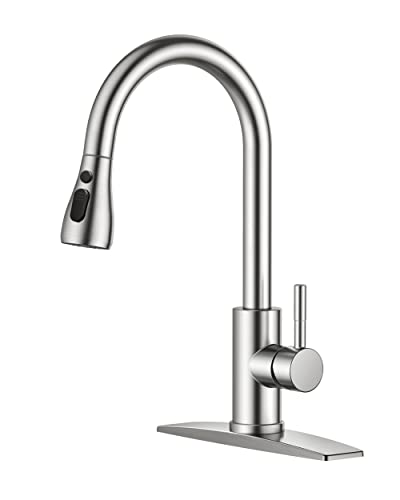
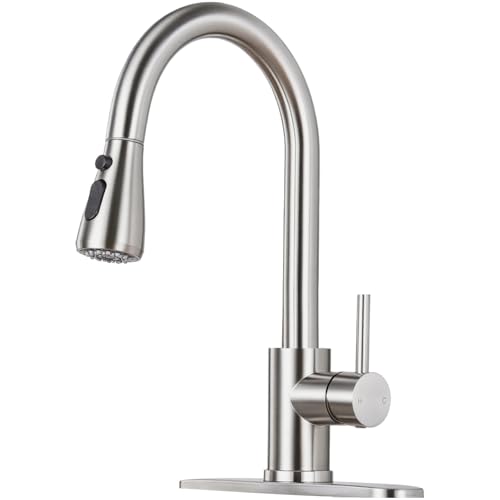
- VFAUOSIT Pull-Down Kitchen Faucet
- WEWE High-Arc Pull-Down Kitchen Faucet
- FORIOUS Pull-Down Kitchen Faucet
- Moen Essie Pulldown Kitchen Faucet 87014SRS
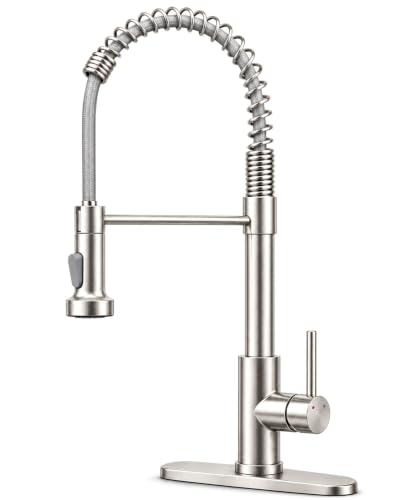
- OWOFAN Spring Kitchen Faucet with Pull Down Sprayer
- WEWE Pull-Down Kitchen Faucet (Tool-Free Install)
Read the full guide ↓ for the ranking logic, the honest limitations of every pick, and the checks that matter more than any headline claim.
Well water is hard on faucets in ways city water is not, and the best kitchen faucets for well water are the ones designed for that punishment. Private wells deliver water that can carry fine sediment, dissolved iron and heavy mineral loads, with pressure that swings as the pump cycles. Sediment loads screens and aerators; minerals crust spray nozzles and spot finishes; iron can stain and can roughen valve surfaces over time. A faucet that is delightful on treated city water can be a clogged, spotted chore within a year on a well.
The six picks below were chosen for well-water resilience: stainless bodies that shrug off mineral exposure, ceramic cartridges, spray faces you can clean in seconds rather than soak for hours, and finishes that hide the spotting well water causes between cleanings. The reviews are blunt about the other half of the equation — filtration and maintenance — because no faucet alone defeats a sediment-heavy supply. If a tall spout is part of your plan, the companion guide to Best Kitchen Faucets High Arc covers how arc height interacts with pressure and splash at the sink.
Key Takeaways
- On well water, cleanability is the top faucet spec: rub-clean nozzles and accessible screens beat sealed designs.
- Sediment is the enemy upstream of the faucet — a whole-house sediment filter protects every fixture, not just the kitchen.
- Stainless bodies and ceramic cartridges tolerate mineral-heavy water better than plated bodies and washer valves.
- Brushed and spot-resistant finishes hide the spotting that mineral water guarantees between cleanings.
- Pressure swings from a cycling pump reward simple, robust valve gear over delicate mechanisms.
In this guide
Quick Picks
Six faucets made the final cut for best kitchen faucets for well water. The table gives the short version; the detailed reviews below give the full reasoning, the trade-offs and the buyer each faucet suits best.
| Pick | Badge | Why it stands out | Listing |
|---|---|---|---|
| VFAUOSIT Pull-Down Kitchen Faucet | Best Overall | Compact bar-sink proportions suit smaller sinks and secondary prep areas. | Check on Amazon |
| WEWE High-Arc Pull-Down Kitchen Faucet | Best for Mineral Build-Up | Soft silicone nozzles wipe clean with a fingertip when mineral film builds up. | Check on Amazon |
| FORIOUS Pull-Down Kitchen Faucet | Best Classic Simplicity | Classic high-arc silhouette pairs with farmhouse and traditional kitchens. | Check on Amazon |
| Moen Essie Pulldown Kitchen Faucet 87014SRS | Best Brand Support | Established national brand with widely available replacement parts. | Check on Amazon |
| OWOFAN Spring Kitchen Faucet with Pull Down Sprayer | Best Sealed Spring Design | Exposed spring design gives the sprayer a wide, flexible working arc. | Check on Amazon |
| WEWE Pull-Down Kitchen Faucet (Tool-Free Install) | Easiest Install and Upkeep | Tool-free installation design targets confident DIY fitting. | Check on Amazon |
How These Picks Were Chosen
Shortlisting started with a simple filter: the listing had to state, in plain terms, what the faucet is made of, how it installs and how its sprayer works. Models that hid behind lifestyle photography and adjectives fell away quickly. We then compared the survivors on cartridge type, swivel and reach, nozzle cleaning design, finish technology and certification for drinking-water contact. The six faucets below are the ones that survived with the fewest unanswered questions.
Badges were assigned after ranking, not before. Best Overall went to the faucet with the fewest compromises across construction, fit and upkeep. Other badges mark genuine specialisations — easiest installation, easiest cleaning, the brand-support choice, the style statement — so a reader who cares most about one dimension can jump straight to the relevant review. Where two picks are close, the reviews say so and explain the deciding factor.
Two ground rules shaped everything you will read. First, no invented information: if a maker does not publish a specification, we leave it out and tell you it is unstated. Second, no frozen numbers: prices and ratings change too quickly to print honestly, so this guide uses qualitative tier language and sends you to the live listing for the current figures. The research is ours; the final value judgement, with live numbers in front of you, is yours.
The 6 Best Options for Best Kitchen Faucets for Well Water

VFAUOSIT Pull-Down Kitchen Faucet
Badge: Best Overall
The VFAUOSIT is the compact member of this line-up: a modern pull-down faucet positioned by its maker for bar sinks, which means a slimmer body and a shorter visual footprint than a full-size chef-style model. Its spray head offers three modes and rides on a 23-inch retractable hose, long enough to reach around a sink basin and into a pot set beside it. The listing emphasises lead-free construction certified to NSF 61/372 with cUPC listing, a cold-start handle that defaults to cold water when centred, and a tool-free installation design intended to shorten the swap from an old faucet. For households that want pull-down convenience without a towering spout, this is the scaled-down interpretation of the idea.
The VFAUOSIT takes Best Overall for wells because its certified lead-free construction and three-mode head are paired with a compact, simple format — fewer crevices for mineral to colonise, and an easy head to remove and rinse.
Strengths
- Compact bar-sink proportions suit smaller sinks and secondary prep areas
- Three spray modes cover rinsing, filling and a wider sweep for produce
- Lead-free construction with NSF 61/372 and cUPC listings for drinking-water contact
Trade-offs
- Bar-sink sizing can feel undersized over a deep, wide main sink
- Tool-free fittings still need a careful leak check after the first day of use
- Cold-start handle behaviour takes a few days to become habit
Mini spec box
- Style: Pull-down sprayer, modern bar sink faucet
- Spray modes: 3
- Retractable hose: 23 in
- Certifications in listing: Lead-free, NSF 61/372, cUPC
- Handle safety: Cold-start design
- Installation: Tool-free design
Best for: buyers who want best overall in a pull-down, bar sink design / Not suited for: buyers whose deck, clearance or style needs point to a different pick in this guide
WEWE High-Arc Pull-Down Kitchen Faucet
Badge: Best for Mineral Build-Up
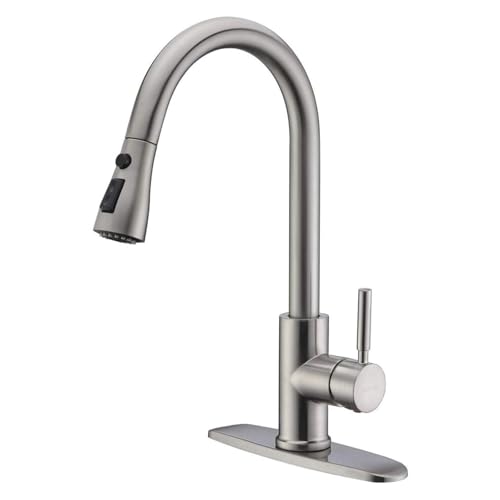
This WEWE high-arc model is the specification-rich all-rounder of the group. The body is SUS 304 stainless steel in brushed nickel, the spout swivels a full 360 degrees, and the pull-down head reaches about 20 inches with three spray modes. Its most practical detail is the soft silicone nozzle face: instead of soaking the head in vinegar when the spray pattern frays, you rub the nozzles with a fingertip to break up mineral film. A ceramic cartridge handles the daily open-close cycling, and the faucet fits either a single-hole deck or a three-hole deck with its plate. It is the design that asks the fewest compromises from a typical family kitchen.
The WEWE high-arc is the mineral-fighting specialist: its soft silicone nozzles are rubbed clean with a fingertip, turning the weekly well-water chore into ten seconds, and its SUS 304 body tolerates the chemistry indefinitely.
Strengths
- Soft silicone nozzles wipe clean with a fingertip when mineral film builds up
- Full 360-degree swivel plus a 20-inch pull-down reach covers wide double basins
- SUS 304 stainless body and ceramic cartridge are the durable-spec pairing to look for
Trade-offs
- High arc needs cabinet clearance above the sink on some layouts
- Brushed nickel hides spots well but still shows grease film near the handle
- Three-hole installs rely on the deck plate look, which not everyone likes
Mini spec box
- Style: High-arc pull-down
- Finish: Brushed nickel
- Spray modes: 3
- Swivel: 360°
- Pull-down reach: 20 in
- Body: SUS 304 stainless steel
- Installation: 1- or 3-hole
- Cartridge: Ceramic
Best for: buyers who want best for mineral build-up in a high-arc pull-down design / Not suited for: buyers whose deck, clearance or style needs point to a different pick in this guide

FORIOUS Pull-Down Kitchen Faucet
Badge: Best Classic Simplicity
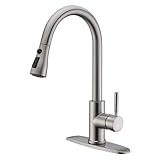
The FORIOUS takes the classic route: a traditional high-arc profile in brushed nickel over stainless steel, a single lever handle, and a pull-down sprayer for the jobs a fixed spout cannot reach. It ships with a deck plate so the same faucet covers a one-hole or three-hole sink deck, and the maker is unusually explicit that the design also serves farmhouse, camper, laundry, RV and bar sinks. That versatility matters for buyers furnishing a second sink or a utility space with the same hardware as the main kitchen. The listing is lighter on engineering detail than some competitors, so the appeal here is the proven shape, the flexible fit and the breadth of settings it suits.
The FORIOUS suits well owners who value mechanical simplicity: a classic single-handle pull-down with fewer modes and mechanisms for sediment to trouble, in stainless under brushed nickel.
Strengths
- Classic high-arc silhouette pairs with farmhouse and traditional kitchens
- Single-handle control is simple for every age of user
- Maker explicitly rates it for laundry, RV and bar sinks as well as kitchens
Trade-offs
- Listing gives fewer hard specifications than some rivals here
- Classic styling is less at home in ultra-minimal modern kitchens
- Pull-down head is a moving part that eventually needs inspection
Mini spec box
- Style: Classic high-arc pull-down
- Finish: Brushed nickel on stainless steel
- Handle: Single handle
- Installation: Deck plate for 1 or 3 hole
- Suggested uses in listing: Farmhouse, camper, laundry, RV, bar sinks
Best for: buyers who want best classic simplicity in a classic high-arc pull-down design / Not suited for: buyers whose deck, clearance or style needs point to a different pick in this guide
Moen Essie Pulldown Kitchen Faucet 87014SRS
Badge: Best Brand Support
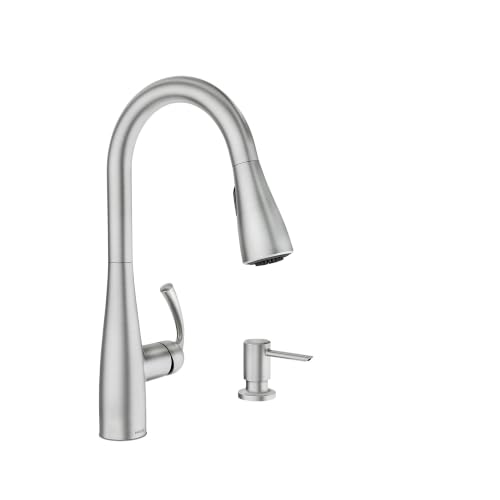
The Moen Essie is the brand-name anchor of this group. Moen is one of the long-established American faucet makers, and the Essie pairs its pulldown format with the Spot Resist Stainless finish, which is formulated to reduce the appearance of fingerprints and water spots between cleanings. The model number 87014SRS identifies the exact configuration, which helps when you need a cartridge, a hose or a finish-matching accessory years later: parts for major-brand faucets are stocked by far more retailers than parts for obscure imports. The listing title keeps its claims modest, so treat the Essie as the conservative choice — a known maker, a spot-hiding finish and a shape that fits almost any kitchen.
The Moen Essie brings the support network a well household needs — cartridges and aerators stocked everywhere — because on a well, the faucet that can be serviced this week beats the exotic one serviced next month.
Strengths
- Established national brand with widely available replacement parts
- Spot Resist finish is designed to show fewer fingerprints and water spots
- Clean, transitional styling works across most kitchen styles
Trade-offs
- Listing title states fewer features than the value brands, so check details carefully
- Brand-name ranges usually sit in a higher qualitative price tier
- Pulldown hose and cartridge are wear parts like any moving design
Mini spec box
- Style: Pulldown kitchen faucet
- Finish: Spot Resist Stainless
- Model: 87014SRS
- Brand: Moen
Best for: buyers who want best brand support in a pulldown design / Not suited for: buyers whose deck, clearance or style needs point to a different pick in this guide

OWOFAN Spring Kitchen Faucet with Pull Down Sprayer
Badge: Best Sealed Spring Design
The OWOFAN is the commercial-look option: an exposed spring spout, borrowed from professional kitchens, with a pull-down sprayer at the end of it. The spring lets the head sweep a broad arc and park back in its holder, which suits cooks who constantly swing between sink, pots and prep bowls. Construction is lead-free, NSF certified stainless steel in brushed nickel, controlled by a single handle, and the included deck plate adapts it to one-hole or three-hole decks. The maker suggests farmhouse kitchens, RVs, bars and laundry rooms alongside standard kitchens. Choose it for the working style and the drama of the silhouette; skip it if your kitchen leans quiet and traditional.
The OWOFAN’s spring design keeps its sprayer up and out of the basin splash zone, and its brushed finish hides iron-tinted spotting better than a polished surface would.
Strengths
- Exposed spring design gives the sprayer a wide, flexible working arc
- Lead-free, NSF certified stainless steel construction
- Deck plate covers 1- or 3-hole decks with one package
Trade-offs
- Commercial spring look is a strong style statement not every kitchen wants
- Taller spring profile needs vertical clearance
- More joints and flex points to wipe down than a smooth spout
Mini spec box
- Style: Spring faucet with pull-down sprayer
- Finish: Brushed nickel
- Handle: Single handle
- Material: Lead-free, NSF certified stainless steel
- Installation: 1 or 3-hole deck plate
- Suggested uses in listing: Farmhouse, RV, bar, laundry room
Best for: buyers who want best sealed spring design in a spring pull-down design / Not suited for: buyers whose deck, clearance or style needs point to a different pick in this guide

WEWE Pull-Down Kitchen Faucet (Tool-Free Install)
Badge: Easiest Install and Upkeep
This second WEWE entry leans into installation and upkeep. The high-arc pull-down body is SUS 304 stainless steel in brushed nickel with a 360-degree swivel, three spray modes, a ceramic cartridge and easy-clean nozzles. What separates it from its sibling is the fitting story: a tool-free installation design for a one-hole deck and 304 braided supply hoses in the package, so the parts that most often send a DIYer back to the store are already decided. If your plan is a weekend swap without a plumber’s invoice, this is the pick engineered around that plan — provided your sink deck is the one-hole layout it is listed for, or you confirm the deck-plate situation on the listing first.
The tool-free WEWE pairs easy-clean nozzles with the easiest installation here — valuable on wells, where faucets are replaced and serviced by their owners more often than in town.
Strengths
- Tool-free installation design targets confident DIY fitting
- Braided 304 supply hoses are included rather than assumed
- Easy-clean nozzles and ceramic cartridge simplify long-term upkeep
Trade-offs
- Listed as a 1-hole fit, so three-hole decks need the plate situation checked
- High arc needs the usual clearance check under cabinets
- Newer listing means a shorter public track record than legacy brands
Mini spec box
- Style: High-arc pull-down
- Finish: Brushed nickel
- Spray modes: 3
- Swivel: 360°
- Body: SUS 304 stainless steel
- Installation: 1-hole fit, tool-free install design
- Cartridge: Ceramic
- Supply lines: 304 braided hoses
- Nozzles: Easy-clean design
Best for: buyers who want easiest install and upkeep in a high-arc pull-down design / Not suited for: buyers whose deck, clearance or style needs point to a different pick in this guide
Comparison Table
Only attributes stated in the makers’ listings are compared here — no prices, no ratings, and no invented specifications. Where a listing does not state an attribute, the table says so.
| Pick | Style | Finish | Spray | Swivel | Hole fit | Badge | Listing |
|---|---|---|---|---|---|---|---|
| VFAUOSIT Pull-Down Kitchen Faucet | Pull-down, bar sink | Not stated in listing title | 3 spray modes | Not stated in listing title | See listing details | Best Overall | Check on Amazon |
| WEWE High-Arc Pull-Down Kitchen Faucet | High-arc pull-down | Brushed nickel | 3-mode sprayer | 360° | 1 or 3 hole | Best for Mineral Build-Up | Check on Amazon |
| FORIOUS Pull-Down Kitchen Faucet | Classic high-arc pull-down | Brushed nickel | Pull-down sprayer | Not stated in listing title | 1 or 3 hole (deck plate) | Best Classic Simplicity | Check on Amazon |
| Moen Essie Pulldown Kitchen Faucet 87014SRS | Pulldown | Spot Resist Stainless | Pulldown sprayer | Not stated in listing title | See listing details | Best Brand Support | Check on Amazon |
| OWOFAN Spring Kitchen Faucet with Pull Down Sprayer | Spring pull-down | Brushed nickel | Pull-down sprayer | Spring arc | 1 or 3 hole (deck plate) | Best Sealed Spring Design | Check on Amazon |
| WEWE Pull-Down Kitchen Faucet (Tool-Free Install) | High-arc pull-down | Brushed nickel | 3-mode sprayer | 360° | 1 hole | Easiest Install and Upkeep | Check on Amazon |
How to Choose a Kitchen Faucet That Fits Your Kitchen
The first measurement is not the faucet — it is the sink. Count deck holes, note whether a deck plate could cover them, and check what already lives on the deck: dispensers, air gaps, filtered-water taps. Then measure the vertical space above the sink and the distance from the mounting hole to the backsplash, because handle swing and arc height both need room. Every review in this guide states the fit it is listed for; treat any mismatch as a hard stop, not a detail to improvise around on installation day.
Next, match the spout to your cookware. If stockpots, canning kettles or a tall water filter pitcher are weekly items, a high arc earns its height every day. If your cooking is sheet-pan and saucepan scale, a mid-height arc reduces splash in a shallow basin. Reach should put the stream near the middle of the basin you use most. Swivel range is the multiplier: a full 360-degree swivel serves double basins and lets you park the spout out of the way for big items, while a limited swivel keeps a small sink calm and splash-free.
Sprayer design is a workflow choice. Pull-down sprayers dominate modern kitchens because the head docks neatly in the spout and the hose reach handles pots on the counter beside the sink. Spring-style sprayers trade that tidy look for a freer, more directable sweep — wonderful for heavy cleanup, more demanding to keep polished. Touchless activation, offered by two picks in this guide, solves a different problem entirely: starting water with raw-food hands. Decide which problem you actually have; paying for a solution to someone else’s problem is the classic faucet mistake.
Under the counter, the specification sheet matters more than the silhouette. Prefer a stainless steel body — the SUS 304 grade appears across this guide — over plated zinc or plastic, and a ceramic cartridge over unnamed valve gear. For water safety, lead-free construction with NSF/ANSI 61 and 372 certification, and cUPC listing, are the marks of a faucet built for drinking water. Also inspect your under-sink space: pull-down hoses hang in a loop with a counterweight, and that loop needs a clear drop. A cabinet packed tight with a disposal and filter housings can still work, but route the loop deliberately at installation instead of discovering the snag later.
Finish selection is a maintenance contract. Brushed nickel is the forgiving default: it blurs spots, matches stainless sinks and appliances, and ages gracefully. Spot-resistant stainless finishes go further for households that hate wiping. Matte black delivers the strongest look and asks the most frequent wiping in hard-water homes. Chrome, where offered, is bright and inexpensive to produce but shows every droplet. Choose with your water and your habits in view, not just the showroom photograph.
Budget thinking works best in tiers. Lower tiers buy the silhouette and the sprayer; the compromises hide in body material and cartridge quality. Middle tiers are the value sweet spot for a keeper kitchen: stainless, ceramic, cleanable nozzles, stated certifications. Upper tiers buy brand support, finish technology and conveniences like sensors. Because this guide prints no fixed prices, use the tiers to shortlist, then check the live figure on each listing and judge whether the step up buys something you will feel weekly — that is the honest test of value.
How to Install and Look After Your New Faucet
Preparation decides how installation day feels. Photograph the under-sink plumbing before you touch it, lay out the new faucet’s parts against the manual’s diagram, and confirm the kit includes what your deck needs — plate, hoses, weight, fasteners. Turn off both stops, drain the old faucet, and remove it. Clean the deck to bare, smooth surface; a new faucet seated on old debris will rock, and a rocking faucet eventually leaks. If your sink is thin stainless, confirm whether a stabiliser or thicker mounting surface is recommended, because flex at the deck translates into wobble at the spout.
Mount the faucet, pass the hoses through, and secure it from below, alternating snugness so it seats evenly. Connect supplies to their stops — hot on the left in standard practice — and route the pull-down hose in a smooth loop with the counterweight clipped at the marked point, clear of the disposal body and stored bottles. Open the stops, flush the lines through the spout before stressing the spray head, and run the full inspection: every mode, every direction of swivel, full hose travel, and a dry paper towel over every joint you touched.
The first week teaches you the faucet. Learn the handle’s temperature geography — where your preferred washing-up warmth sits — and, on cold-start designs, the new habit of pushing past centre for hot. Practise docking the sprayer until it is automatic. Give the finish its routine from day one: a soft-cloth wipe as the kitchen closes, which prevents the mineral edging that later demands real scrubbing. If anything weeps, drips or feels wrong, address it in this week, while the installation is fresh in your mind and every joint is easy to reach.
Longer-term care is light but specific. Keep the nozzle face clean — rub-clean silicone designs need seconds weekly, other heads benefit from a monthly vinegar soak in a cup hung from the spout. Keep the hose loop’s path clear when you rearrange under-sink storage. Keep the manual and the model number somewhere findable; the cartridge and hose are the two parts a long-lived faucet eventually wants, and the model number is how you order the right ones in minutes instead of guessing. For branded picks, that parts trail runs through normal retail channels; for value brands, save the seller’s details with the manual.
Three problems cover most service calls. Problem: handle becomes stiff or temperature control turns vague → mineral build-up or a tiring cartridge; flush first, then plan the cartridge. Problem: spray head leaks at its joint or the hose weeps → inspect the connection washers and the hose for chafe where it passes the cabinet edge; washers are cheap, hoses are replaceable, and both beat a new faucet. Problem: sensor models respond erratically → clean the sensor window, replace the batteries, and check that a reflective pan parked by the sink is not triggering it. Diagnose cheap causes first; faucets are simple machines, and most faults are simple too.
Filtration: The Upstream Half of the Answer
Every well-water faucet conversation should start one step before the faucet. A sediment filter on the main line — sized to your household and changed on schedule — removes the grit that loads aerators, scratches cartridge surfaces and seeds mineral crust. If your well runs iron, an iron treatment stage protects finishes and flavour together; if hardness is the issue, softening protects every water-using appliance you own, the faucet included. None of this is exotic equipment, and all of it multiplies the life of whichever pick you choose from this guide.
At the kitchen itself, keep expectations ordered: the faucet is the last line of defence, not the first. Its screens and aerator are sacrificial parts designed to catch what filtration misses, which is why the picks here favour accessible, cleanable designs. If you are also choosing for a second property or a rental on a well, the simpler end of this list — the FORIOUS pattern — minimises what a tenant can neglect. Retail-channel equivalents for comparison appear in Best Kitchen Faucets Home Depot, but the filtration-first logic applies regardless of where the faucet is bought.
A Maintenance Calendar for Well-Water Faucets
Well water rewards rhythm. Weekly, rub the spray face clean — with the silicone-nozzle WEWE picks this is a fingertip job — and wipe the finish before mineral dries into scale. Monthly, unscrew the spray head or aerator, rinse the screen against the flow, and check the basin for the first orange blush of iron staining, which is your early warning that treatment media needs attention. Seasonally, inspect the hose loop and connections under the sink, exercise the shut-off stops, and note the pressure tank’s behaviour: short-cycling pumps hammer faucets with pressure swings.
Annually, review the whole chain: sediment filter condition, softener or iron media status, and the cartridge’s feel. A handle that has grown gritty or a spout that drips after shut-off is the cartridge reporting sediment wear — replace it, and the faucet is itself again. Owners who keep this calendar report faucets lasting as long on wells as in town; owners who skip it conclude, wrongly, that wells simply eat faucets. The forum veterans in Best Kitchen Faucets Gardenweb tell the same story from the other side: every ‘my faucet died in a year’ thread eventually reveals a maintenance calendar that never existed.
Iron, Manganese and Sulphur: Reading Your Well’s Signature
Wells speak in stains and smells, and a faucet owner who can read them maintains the whole system better. Orange and rust-brown staining in the basin points to iron; black staining suggests manganese; a rotten-egg note is hydrogen sulphur gas. Each has treatment answers upstream — oxidation and filtration for iron and manganese, aeration or carbon for sulphur — and each punishes faucets differently in the meantime: iron films finishes and seeds rough deposits in aerators, manganese blackens quietly, sulphur water is unkind to some metals and to the user’s patience. The faucet choices in this guide — stainless bodies, cleanable faces, forgiving finishes — are the defensive line while treatment does the real work.
Testing beats guessing. A proper well-water test, repeated every year or two, tells you hardness, iron, pH and sediment character in numbers, and those numbers size the filtration that protects every fixture you own. Acidic water deserves special attention because low pH is corrosive to metal plumbing over time; if your test shows it, raise it with your water-treatment provider before blaming any faucet for early wear. The faucet is the most visible reporter of your water’s behaviour — the appliance that shows you, daily, what the system upstream is doing.
Winter, Power Cuts and the Well Household’s Faucet Habits
Well households live with two realities town households forget: the water stops when the power does, and outbuildings and seasonal cabins freeze. For the main home, a power cut means the pump stops and pressure fades — one more reason this guide favours simple, robust manual faucets for wells: there is nothing electronic to confuse when pressure returns, and no sensor waiting on a battery after a stormy week. When power returns and the pump cycles, open the kitchen faucet slowly and let air and any stirred sediment clear through the spray head with its screen rinsed afterwards; a well system burps after every outage, and the kitchen faucet is where it shows.
For cabins and seasonal properties on wells, choose and winterise together: a faucet whose supply lines can be fully drained, whose spray head can be removed and emptied, and whose cartridge will not be ruined by a hard freeze if a little water remains. The simpler picks in this guide — the classic FORIOUS pattern above all — suit that life honestly. Drain down in autumn, flush and rinse screens in spring, and the same faucet serves for decades of seasons, which is the well owner’s definition of a good purchase.
Under the Sink: The Half of the Faucet Nobody Photographs
Half of every faucet installation lives in the dark: supply stops, braided lines, the mounting hardware, the pull-down hose loop and its counterweight. That hidden half decides reliability more than the visible half decides beauty. Stops that open and close cleanly make every future service job trivial; corroded stops turn a cartridge swap into a plumbing callout. Braided stainless supply lines — included with several picks in this guide — resist the kinking and fatigue that plain lines suffer, and correct hot-to-cold connection at installation is what makes the handle’s temperature geography match its markings for the next decade.
The hose loop deserves its own paragraph because it is the most mismanaged component in modern kitchens. A pull-down hose hangs in a loop below the sink with a weight that pulls the head home. That loop needs a clear, smooth path: not draped over a disposal’s shoulder, not sawing across a shelf edge, not buried under stored bottles that shift every time the cabinet opens. Five minutes spent routing and, if needed, guiding the loop at installation buys years of clean retraction. Most ‘my sprayer stopped docking’ stories end at this loop, not at the faucet.
Finally, leave the installation auditable. Keep the manual and model number in a kitchen drawer, note the cartridge type, and leave a dry sheet of cardboard under the connections for the first week so any weep announces itself on paper instead of in a swollen cabinet floor months later. The picks in this guide were chosen partly for how kindly they treat this hidden half — stated hose arrangements, included lines, mounting systems a homeowner can service — because a faucet is a fifteen-year relationship with your plumbing, not a photograph.
The Well Owner’s Faucet, Five Years On
Picture the two ownership stories a well can write. In the first, a sealed-design faucet goes in with no filtration ahead of it; the spray face scales within months, the owner soaks it twice, gives up, and by year three the faucet is a spotted, spitting chore whose replacement is already being browsed. In the second, a sediment filter guards the line, the faucet’s nozzles rub clean in seconds each week, the screen gets its monthly rinse, and at year five the faucet looks and behaves much as it did at installation — its cartridge perhaps renewed once, on schedule, like a filter.
Every pick in this guide was chosen to star in the second story, and the difference between the stories is mostly the calendar, not the catalogue. That is genuinely good news for well households: the water you have is workable, the equipment is adequate, and the discipline required is measured in seconds per week. Choose the cleanable faucet, guard it with filtration, keep the rhythm — and the well stops being the reason your kitchen hardware ages early.
Well ownership has always been a competence: you are your own water utility, and the kitchen faucet is where that utility meets daily life most visibly. The households that thrive on wells are not the ones with the most elaborate treatment plants; they are the ones with a tested supply, a maintained filter, cleanable fixtures and a calendar. This guide’s six faucets fit that philosophy precisely — stainless, ceramic where it counts, honest about their limits, and easy to service by the person who owns the well. Add the rhythm, and the water takes care of the kitchen as reliably as any town supply.
Keep one spare part on hand from the start: a replacement screen and aerator set for your chosen faucet, bought while the model number is fresh and the listing is open in front of you. On a well, screens are consumables in a way town households never learn, and the difference between a five-minute swap and a week of frayed spray is a small packet in the drawer under the sink. Add the cartridge to that drawer in year five if the handle feel changes. Preparedness, at this scale, is simply what well ownership looks like when it is going well.
Start the rhythm the week the faucet goes in, while the habit is new and the spray face is still pristine: a Sunday rub of the nozzles, a monthly rinse of the screen, a glance at the filter’s change date. Habits formed in week one are the ones still running in year five — and on well water, year five is exactly where they pay.
Common Buying Mistakes
Well households make a few distinctive faucet mistakes, usually by shopping as if they were on city water:
- Buying by silhouette alone and discovering the deck fit, handle clearance or hose loop does not work in your cabinet.
- Skipping the under-sink inspection: a pull-down hose loop needs a clear drop, and a packed cabinet is the top cause of poor retraction.
- Choosing a finish for the photograph instead of your water — matte and polished finishes show hard-water film far faster than brushed ones.
- Ignoring certifications: a kitchen faucet is a drinking-water device, and lead-free, NSF-verified construction is not a luxury detail.
- Over-tightening connections at installation until washers distort, then blaming the faucet for the weep that follows.
- Letting the spray face clog for a year and concluding the faucet has weak pressure, when ten seconds of nozzle cleaning was the whole problem.
- Forgetting the shut-off stops: never exercising them means they seize, and the day you need them is the day that matters.
- Ordering before measuring arc height against the cabinet, shelf or window above the sink.
Final Recommendation
For most well-water kitchens, start with the VFAUOSIT for certified, simple, cleanable design, or the WEWE high-arc if mineral build-up is your dominant battle — its rub-clean nozzles are the single most useful well-water feature in this guide. Choose the Moen Essie when local parts availability matters most, the FORIOUS for mechanical simplicity, the OWOFAN for a spring design that stays out of the splash zone, and the tool-free WEWE when you service your own plumbing. Pair any of them with a maintained sediment filter and the weekly ten-second nozzle routine, and well water stops being a faucet problem. For the decade-scale view of what survives rural water, Best Kitchen Faucets From 10 Years Ago is a fitting last read.
Our three headline recommendations, with live listings: VFAUOSIT Pull-Down Kitchen Faucet WEWE High-Arc Pull-Down Kitchen Faucet FORIOUS Pull-Down Kitchen Faucet — check the latest price on Amazon for each before you decide.
Frequently Asked Questions
What faucet features matter most on well water?
Cleanability first: rub-clean or easily removed spray faces and accessible aerator screens. Then materials — stainless bodies and ceramic cartridges tolerate minerals and sediment best — and finishes that hide spotting, like brushed nickel or spot-resistant stainless.
Do I need a filter if I buy a well-water faucet?
The faucet and the filter do different jobs. A sediment filter upstream protects the faucet, the dishwasher, the water heater and every other fixture; the faucet’s own screens only catch what reaches them. A maintained whole-house sediment filter is the highest-value well-water purchase, ahead of any faucet upgrade.
How often should I clean the spray head on a well?
Weekly for the nozzle face — seconds with rub-clean silicone designs — and monthly for the screen behind it. Heavy-sediment wells may need the screen rinsed more often; let the spray pattern tell you, since fraying and spitting are the visible symptoms of loading.
Will well water damage a stainless steel faucet?
SUS 304 stainless, used by several picks here, tolerates mineral-heavy water very well. The vulnerable parts are screens, aerators and cartridges, which load with sediment — all cleanable or replaceable. Finishes spot but are not harmed by minerals themselves; iron staining is a treatment issue upstream.
Does pump pressure cycling affect faucet choice?
Yes, mildly: pressure swings reward robust, simple valve gear and secure hose connections. Ceramic cartridges handle cycling well. If your pump short-cycles noticeably, have the pressure tank checked — the faucet is reporting a system issue, not causing one.
Are touchless faucets a good idea on well water?
They work, but this guide’s well-water shortlist favours manual designs for a reason: sediment and mineral maintenance is simpler with fewer electronic parts near the water path, and well households tend to service their own fixtures. If you love touchless, keep the sensor window on the same weekly wipe routine.