Disclosure: topratedkitchenware.com is reader-supported. When you buy through links on our site, we may earn an affiliate commission from Amazon and other retailers, at no extra cost to you.
Where to buy
This guide to best kitchen faucets non leaking brings together six verified picks you can order online today. Each name below links to its Amazon listing, and every detailed review further down carries its own Check on Amazon link so you can check the latest price on Amazon for the exact model you are reading about. Prices in this category move often, which is why this guide links out instead of printing figures that would age badly.
- LUFG Brushed Nickel Pull-Down Kitchen Faucet — Best Overall. Best for triple-certified stainless build with a full swivel.
- Moen Adler Pulldown Kitchen Faucet 87233SRS — Best for Easy Servicing. Best for legacy parts support when a cartridge ages.
- Lufeidra Pull-Down Kitchen Faucet — Best Cartridge Value. Best for ceramic cartridge on a flexible 1 or 3-hole fit.
- FEELSO Pull-Down Kitchen Faucet — Best Certified Choice. Best for lead-free NSF construction with high-arc clearance.
- WEWE Touchless Kitchen Faucet with Soap Dispenser — Best Touchless Pick. Best for sensor convenience on ceramic and stainless internals.
- GIMILI Matte Black Touchless Kitchen Faucet — Best Statement Finish. Best for matte black spring design with hands-free control.
Read the full guide ↓ for badges, honest trade-offs, a comparison table and the buying advice that helps you choose between them.
Nobody shops for the best kitchen faucets non leaking because a faucet is exciting; they shop for it because the current one drips at 2 a.m., swells the cabinet floor, or leaves a permanent damp ring under the sink. Leaks are the defining failure of this category, and they are almost never random. They come from worn cartridges, scored seals, loose supply connections and hoses that have flexed once too often. This guide therefore ranks faucets the way a plumber would: by cartridge design, body material, certification and how gracefully each model can be serviced when a seal eventually ages.
Two honest notes before the picks. First, no faucet is leak-proof forever; the realistic goal is a design whose seals are high quality, whose wear parts are replaceable, and whose connections are standard. Second, installation quality matters as much as the faucet itself, so the guide closes with the checks that keep a good faucet dry. The six picks below span certified value brands, a legacy name with deep parts support, and two touchless models whose underlying cartridges still do the sealing work.
Key Takeaways
- Most kitchen faucet leaks trace back to the cartridge, so ceramic cartridge designs anchor this list.
- Stainless steel bodies resist the internal corrosion that undermines seals in cheaper plated bodies.
- Certifications such as NSF 61/372 and cUPC speak to materials and lead content, not marketing claims.
- A faucet that can be serviced — replaceable cartridge, standard connections — beats one that must be replaced whole.
- Half of ‘faucet leaks’ are actually connection leaks, so the install checks in this guide matter as much as the pick.
In this guide
Quick Picks
Six picks, six distinct jobs. The badges below are used again in the detailed reviews, so you can track a favourite from this summary straight to its full assessment, its strengths and trade-offs, and its honest limitation.
| Pick | Badge | Who it suits |
|---|---|---|
| LUFG Brushed Nickel Pull-Down Kitchen Faucet | Best Overall | Best for triple-certified stainless build with a full swivel |
| Moen Adler Pulldown Kitchen Faucet 87233SRS | Best for Easy Servicing | Best for legacy parts support when a cartridge ages |
| Lufeidra Pull-Down Kitchen Faucet | Best Cartridge Value | Best for ceramic cartridge on a flexible 1 or 3-hole fit |
| FEELSO Pull-Down Kitchen Faucet | Best Certified Choice | Best for lead-free NSF construction with high-arc clearance |
| WEWE Touchless Kitchen Faucet with Soap Dispenser | Best Touchless Pick | Best for sensor convenience on ceramic and stainless internals |
| GIMILI Matte Black Touchless Kitchen Faucet | Best Statement Finish | Best for matte black spring design with hands-free control |
How These Picks Were Chosen
Every model in this guide comes from the verified kitchen faucet pick pool, with details cross-checked against Creators API listing data at the time of writing. That verification step matters in this category, where the same silhouette is sold under shifting names and variant finishes. We then ranked candidates against the angle of this specific guide, because the best faucet for one brief is rarely the best for another, and we weighted the unglamorous evidence: cartridge design, body material, certifications, mounting flexibility and hose specifications.
Our method is transparent about what it is. This is a research-based comparison built from specifications, documentation and recurring owner-experience patterns, not a claim of hands-on laboratory testing. When a specification could not be verified from the pool data, the review leaves it out instead of inventing it, and a few reviews below flag exactly where a listing is thin. We also exclude prices and fixed ratings on principle: both move too fast for print to stay truthful, so each pick carries a link to its live listing where the current facts live.
Best kitchen faucets non leaking: all 6 picks in detail
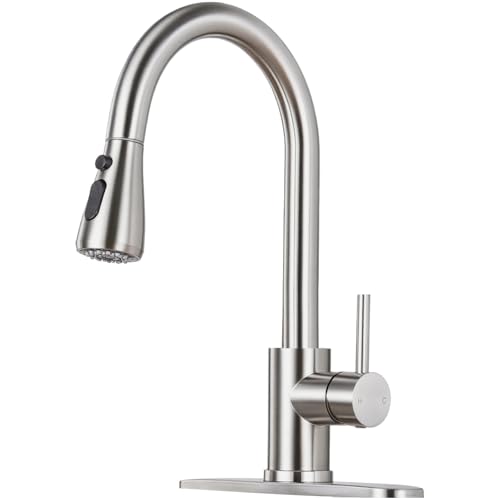
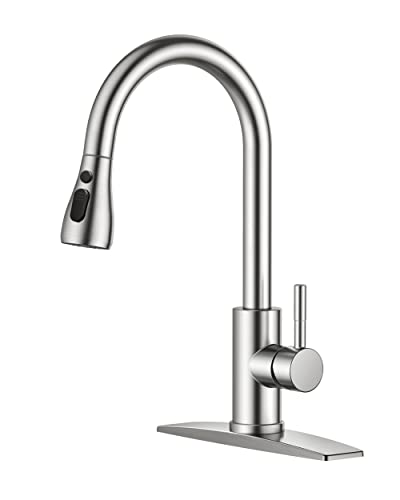
LUFG Brushed Nickel Pull-Down Kitchen Faucet
Badge: Best Overall
Strengths
- Triple certification listing (NSF372, NSF61 and cUPC) is the strongest compliance paperwork in this pool.
- SUS 304 stainless construction with a 360-degree swivel suits both kitchen sinks and utility, RV and bar installs.
- Deck plate is included in the box, easing 1 or 3-hole changeovers.
Trade-offs
- A newer value brand, so the long-term track record is thinner than the legacy names in this guide.
- Three spray modes are switched at the head, which some cooks find less intuitive than a rocker switch.
- Brushed nickel needs routine wiping in hard-water homes to stay looking even.
Key specs
- Finish: Brushed Nickel
- Material: SUS 304 stainless steel
- Handle: Single handle
- Spray modes: 3 spray modes
- Swivel: 360° swivel spout
- Certification: NSF372, NSF61, cUPC
- Mounting: Deck plate included
LUFG leads with paperwork, and for a kitchen faucet that is a genuinely good place to start. The listing carries NSF372 and NSF61 certification plus cUPC, which speaks to lead content and material safety testing rather than marketing language. Underneath, the body is SUS 304 stainless steel with a single-handle control and a pull-down sprayer offering three modes. The spout swivels a full 360 degrees, which makes this one of the more flexible picks for double sinks, laundry tubs and the RV and bar sinks LUFG names in its own listing. A deck plate is included, so the same unit can land on a single-hole or three-hole deck without a second purchase. Nothing here is electronic: flow and temperature are set by the handle and the ceramic sealing surfaces inside do the long-term work. If your shortlist starts with certifications and stainless construction, LUFG makes a strong, plain-spoken case for itself.
LUFG’s certification set and stainless body address the two slow leak causes buyers can actually screen for before purchase.
The LUFG rewards owners who keep its paperwork. Save the certification and model documentation somewhere findable, because a faucet bought partly for its compliance story should be able to prove that story to a future plumber, landlord or home buyer. In daily life, the full-circle swivel invites one good habit: return the spout to centre after washing up, which keeps the hose loop hanging in its natural path and the head docked squarely. The three spray modes are worth learning with wet hands in the first week, so that switching becomes muscle memory rather than a mid-wash experiment conducted through soapy fingers.
Best for: Certification-focused buyers, and households wanting one faucet pattern that also suits laundry, bar or RV sinks / Not suited for: Buyers who want a decades-long brand track record or a spot-resistant finish

Moen Adler Pulldown Kitchen Faucet 87233SRS
Badge: Best for Easy Servicing
Strengths
- Moen is a legacy plumbing brand with broad parts availability through normal retail channels.
- Spot Resist Stainless finish is designed to hide fingerprints and water spots between cleanings.
- The Adler line is a mainstream, widely installed design, so plumber familiarity is high.
Trade-offs
- The verified listing data for this model is lean, so confirm spray modes and mounting details on the listing before ordering.
- Legacy-brand pricing position is generally above the value brands in this pool for similar headline features.
- Pulldown head style is conventional rather than spring or high-design, which style-led buyers may find plain.
Key specs
- Finish: Spot Resist Stainless
- Type: Pulldown kitchen faucet
- Model: 87233SRS (Adler collection)
The Moen Adler is the establishment choice in this group: a pulldown kitchen faucet from one of the most widely installed plumbing brands in North America. The practical advantage of that position shows up years later, when a cartridge or hose eventually needs attention and parts, documentation and plumber familiarity are all easy to find. The Spot Resist Stainless finish is the other headline: it is formulated to shrug off the fingerprints and water spots that show quickly on plain brushed finishes, which matters in busy family kitchens where nobody wipes the faucet after every use. The Adler design itself is deliberately mainstream, a curved pulldown silhouette that sits comfortably in transitional and traditional kitchens rather than making a statement. Operation is fully manual, with a single handle setting temperature and flow, and the pulldown head covering rinsing and filling at the sink. Buyers who rank long-term serviceability and finish behaviour above novelty will find the Adler easy to justify.
The Adler’s leak defence is time: when its cartridge eventually wears, a replacement is easy to find and fit.
Adler ownership is deliberately boring, and that is the compliment it deserves. The finish wipes clean without ceremony, the handle action stays familiar to every guest, and when the cartridge eventually asks for attention, the replacement is a mainstream part that competent DIYers and every plumber already know. Keep the model number — 87233SRS — recorded with your home documents, because that string is the key that unlocks the correct cartridge, hose and trim parts years from now without guesswork. Beyond that, the Adler asks only for the standard courtesies: a soft cloth, a descaled aerator, and an under-sink glance whenever you are down there for the bin bags anyway.
Best for: Buyers who value brand support, parts availability and a spot-resistant finish in a family kitchen / Not suited for: Buyers chasing the longest feature list for the money, or a bold designer silhouette


Lufeidra Pull-Down Kitchen Faucet
Badge: Best Cartridge Value
Strengths
- Ceramic cartridge and SUS304 stainless body cover the two internals that matter most for drip-free years.
- Fits both 1 and 3-hole decks, which simplifies matching an existing sink.
- Lufeidra positions it for kitchen, laundry, RV and bar use, reflecting a compact, adaptable footprint.
Trade-offs
- The listing’s ‘pot filler’ phrasing is loose language for a sink faucet; treat it as a pull-down sink faucet, not a stove-mounted pot filler.
- Value-brand documentation is thinner than the legacy brands, so keep the listing details saved after purchase.
- No spot-resistant finish technology is claimed, so hard-water spotting needs routine wiping.
Key specs
- Finish: Brushed Nickel
- Material: SUS304 stainless steel
- Cartridge: Ceramic cartridge
- Mounting: Fits 1- or 3-hole
- Sprayer: Pull-down sprayer
Lufeidra’s entry covers the fundamentals in the right order: a SUS304 stainless steel body, a ceramic cartridge at the sealing heart of the faucet, and a pull-down sprayer on a brushed nickel finish that matches most stainless kitchens. It fits 1 or 3-hole decks, which removes the most common ordering mistake in this category, and the brand positions the same faucet for kitchen sinks, laundry tubs, RVs and bar sinks, a hint that the footprint is compact and the installation undemanding. One wording note, in the interest of honesty: the listing calls it a ‘classic pot filler faucet’, but this is a deck-mounted sink faucet with a pull-down sprayer, not a wall-mounted stove pot filler, and it should be bought as the former. Used that way, it is a sensible mechanical faucet with no electronics to maintain, a cartridge design associated with drip resistance, and the flexible reach that makes pull-down heads so much easier to live with than fixed spouts.
Lufeidra’s ceramic cartridge is the key line in its specification, because the cartridge is where spout drips are born.
Lufeidra ownership starts with buying it for what it is: a deck-mounted pull-down sink faucet with a ceramic cartridge and a stainless body, whatever extra phrases the listing borrows. Owners who make that mental note get a straightforward machine in return. The 1 or 3-hole flexibility means the faucet can follow you from one sink to another — main kitchen today, laundry or bar sink after a remodel — which quietly extends its useful life beyond a single installation. Keep the listing’s specification page saved, since value-brand documentation lives online rather than in a printed archive, and photograph the under-sink connections at install for the same reason.
Best for: Buyers wanting ceramic-cartridge, stainless construction that fits either 1 or 3-hole sinks, including secondary sinks / Not suited for: Anyone actually shopping for a stove-mounted pot filler, or buyers who want maximum published documentation

FEELSO Pull-Down Kitchen Faucet
Badge: Best Certified Choice
Strengths
- Lead-free NSF certification is stated up front, which simplifies safety-focused shortlisting.
- High-arc spout clears tall pots and pitchers that frustrate low-arc owners.
- 1 or 3-hole compatibility plus farmhouse, laundry, RV and bar positioning makes it a flexible spare-sink option too.
Trade-offs
- High-arc designs splash more in shallow sinks if the spray head is used carelessly at full flow.
- The verified listing does not headline a ceramic cartridge, so check the listing internals before ordering if that is a must-have.
- Brushed nickel finish is not a spot-resistant formulation.
Key specs
- Finish: Brushed Nickel
- Certification: Lead-Free, NSF Certified
- Spout: High arc
- Material: Stainless steel
- Handle: Single handle
- Mounting: 1 or 3 hole
FEELSO keeps its pitch simple: a high-arc, single-handle pull-down faucet in brushed nickel stainless steel, listed as lead-free and NSF certified. The high arc is the functional headline, because vertical clearance is the quiet frustration of kitchen sinks: the stockpot that will not fit under the spout, the pitcher that has to be tilted, the baking tray that cannot sit flat. A pull-down head on a high arc solves all three, letting you bring the water to the vessel instead of the other way round. Mounting covers 1 or 3-hole sinks, and FEELSO positions the faucet beyond the main kitchen as well, naming farmhouse, laundry, RV and bar use. Everything is manual, with the single handle blending temperature as you lift and turn, so there is nothing electronic to configure or power. For shoppers who want certification stated plainly and generous clearance over the basin, FEELSO is a tidy, uncomplicated candidate.
FEELSO states lead-free NSF certification plainly; pair it with careful supply-line seating to keep the whole install dry.
FEELSO ownership is dominated by one pleasant fact: tall things fit. Stockpots slide under the arc, pitchers stand upright, and the pull-down head covers the rest. The corresponding habit is splash discipline — in a shallow basin, start fills with the head lowered and the handle opened gradually, and the high arc never gets the chance to misbehave. Because the headline data does not dwell on cartridge specifics, owners who care about that detail should confirm it on the listing before purchase and save the answer with their records. The lead-free NSF certification, by contrast, is stated plainly, and it is the line that will matter most if the faucet is ever questioned by a landlord, inspector or buyer.
Best for: Cooks who regularly fill tall vessels, and buyers who want lead-free NSF certification stated on the listing / Not suited for: Shallow sinks prone to splashing under high arcs, or buyers who need cartridge details confirmed in the headline specs
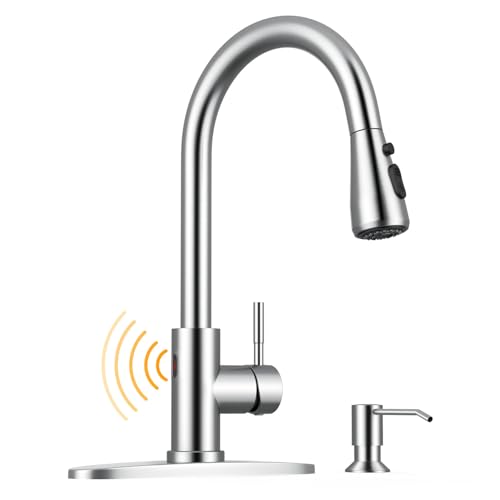
WEWE Touchless Kitchen Faucet with Soap Dispenser
Badge: Best Touchless Pick
Strengths
- Touchless activation keeps raw-food and dough-covered hands off the handle, the most hygienic way to run water mid-recipe.
- Under the sensor it keeps the proven internals: SUS 304 body, ceramic cartridge and a 3-mode pull-down sprayer.
- The included soap dispenser fills a spare deck hole neatly and matches the brushed nickel finish.
Trade-offs
- Sensor operation needs power (batteries or adapter depending on setup), which purely mechanical faucets never ask for.
- The control box and sensor wiring take under-sink space and add one more thing to check if behaviour ever changes.
- Electronic activation is a deliberate step away from the simplest possible faucet, so minimalists should choose a manual model instead.
Key specs
- Finish: Brushed Nickel
- Operation: Touchless sensor
- Spray modes: 3-mode sprayer
- Swivel: 360°
- Material: SUS 304 stainless steel
- Cartridge: Ceramic cartridge
- Mounting: 1- or 3-hole fit
- Extras: Soap dispenser included, easy-clean nozzles
This WEWE set adds a sensor to an otherwise familiar formula. The faucet itself is SUS 304 stainless steel with a ceramic cartridge, a 360-degree swivel and a 3-mode pull-down sprayer with easy-clean nozzles, and the box adds a matching soap dispenser that conveniently fills a spare hole on a 1 or 3-hole deck. The touchless activation earns its place in kitchens where hands are routinely covered in flour, marinade or raw chicken: water starts and stops without touching the handle, which keeps the handle cleaner and shortens the cleanup loop. The honest trade-off is complexity. A sensor faucet needs power, carries a small control unit under the sink, and gives you electronics to think about in a room full of water and steam. For many households that trade is worth it every single day; for buyers who want the absolute simplest machine, the manual WEWE models in this guide deliver the same core internals without the sensor. Either way, the underlying cartridge and stainless construction are the right foundations.
Even as a touchless model, this WEWE seals water the old way, with a ceramic cartridge doing the work behind the sensor.
Owning the WEWE touchless set means managing one small system, not just a faucet. Keep spare batteries where you keep the torch, learn where the sensor’s manual override lives before you need it with dough on your hands, and give the control unit under the sink the same dry, clear space you give the hose loop. The soap dispenser earns a routine too: refill it before it runs dry and gulps air, and wipe its pump stem when you wipe the deck. In exchange, the kitchen gains the most forgiving workflow in this guide — water that starts when your hands are at their worst — built on internals, the SUS 304 body and ceramic cartridge, that ask for nothing exotic in return.
Best for: Messy, hands-on cooks who want touchless activation plus a matching soap dispenser, on proven stainless and ceramic internals / Not suited for: Buyers who want a purely mechanical faucet with no batteries, sensors or control box
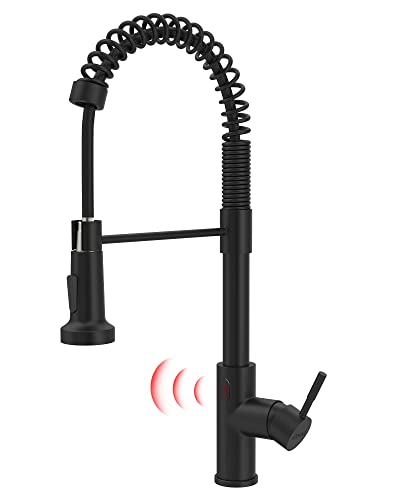
GIMILI Matte Black Touchless Kitchen Faucet
Badge: Best Statement Finish
Strengths
- Motion-sensor, hands-free control is the fastest way to start water with full or messy hands.
- Matte black finish over a spring pull-down silhouette gives modern farmhouse kitchens a strong focal point.
- Single-hole installation keeps the deck clean and the swap simple on compatible sinks.
Trade-offs
- Single-hole mounting only, so multi-hole sinks need a deck solution confirmed first.
- Sensor power and electronics add maintenance that manual faucets never require.
- Matte black shows light-coloured mineral deposits clearly in hard-water homes.
Key specs
- Finish: Matte Black
- Operation: Motion sensor activated, hands-free
- Sprayer: Spring pull-down sprayer
- Handle: Single handle
- Mounting: Single hole installation
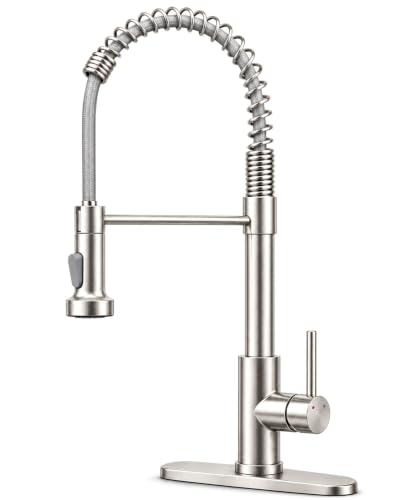
GIMILI pairs the two boldest choices in this pool: a matte black finish and motion-sensor activation, wrapped around a spring pull-down sprayer in a modern farmhouse silhouette. Wave a hand and the water runs; that single interaction changes kitchen rhythm more than most upgrades, because it removes the handle from the messiest moments of cooking entirely. The spring spout gives the head a wide, flexible reach for rinsing down a big sink, and the single handle still sets your temperature blend so the sensor is only deciding on and off, not how warm the water is. Installation is single-hole, which suits modern sinks and keeps the deck uncluttered. The caveats are the honest companions of any sensor faucet: it needs power, it puts electronics under the sink, and matte black will show pale limescale deposits if your water is hard and wiping is rare. For a statement kitchen that cooks seriously, those are manageable terms.
GIMILI’s sensor only decides when water runs; its drip behaviour still depends on seals and correct single-hole seating.
GIMILI ownership is a study in visible cause and effect. The matte black finish shows exactly what your water leaves behind, which makes owners of this faucet either diligent wipers or converts to a softener — there is no third outcome in hard-water homes. The sensor wants the same respect as any small electronic: power kept fresh, connections dry, and a household that knows the manual handle still governs temperature. The spring head, meanwhile, should be guided home rather than released to snap, a habit that protects both the dock and the finish. Treat those three routines as the price of the statement, and the statement keeps paying you back every time you walk into the kitchen.
Best for: Modern farmhouse kitchens wanting a matte black statement piece with hands-free sensor control / Not suited for: Multi-hole sinks without adaptation, hard-water homes that dislike wiping finishes, or mechanical-only buyers
Comparison Table
The table below lines the six picks up on the attributes buyers compare most: badge, headline finish or format, and the job each one does best. Use it with the detailed reviews rather than instead of them, because the trade-offs that decide ownership rarely fit in a cell.
| Pick | Badge | Finish / Format | Who it suits | Listing |
|---|---|---|---|---|
| LUFG Brushed Nickel Pull-Down Kitchen Faucet | Best Overall | Brushed Nickel | Best for triple-certified stainless build with a full swivel | Check on Amazon |
| Moen Adler Pulldown Kitchen Faucet 87233SRS | Best for Easy Servicing | Spot Resist Stainless | Best for legacy parts support when a cartridge ages | Check on Amazon |
| Lufeidra Pull-Down Kitchen Faucet | Best Cartridge Value | Brushed Nickel | Best for ceramic cartridge on a flexible 1 or 3-hole fit | Check on Amazon |
| FEELSO Pull-Down Kitchen Faucet | Best Certified Choice | Brushed Nickel | Best for lead-free NSF construction with high-arc clearance | Check on Amazon |
| WEWE Touchless Kitchen Faucet with Soap Dispenser | Best Touchless Pick | Brushed Nickel | Best for sensor convenience on ceramic and stainless internals | Check on Amazon |
| GIMILI Matte Black Touchless Kitchen Faucet | Best Statement Finish | Matte Black | Best for matte black spring design with hands-free control | Check on Amazon |
How to Choose a Kitchen Faucet That Fits Your Life
Work from the sink outward. Your existing deck is the first constraint: hole count, hole spacing and whatever currently occupies them decide which faucets are even candidates. Your basin is the second: depth governs sensible spout height, and width governs useful hose reach. Your water is the third: hard water argues for cleanable nozzles and ceramic cartridges, while soft water lets you choose on style with a freer hand. Only after those three should a catalogue photo be allowed to influence you.
On internals, the hierarchy is stable across every guide in this series. Cartridge first, because it is the seal that cycles every time you touch the handle, and ceramic discs are the longest-lived common design. Body second, because stainless and solid-metal bodies protect the cartridge’s seat from corrosion. Paperwork third: NSF 61 and 372 plus cUPC tell you the materials story has been tested rather than asserted. A faucet that wins on all three will outlast one that wins on silhouette, every single time.
Format follows cooking style. Batch cooks and canners want arc height and reach. Bakers and parents washing bottles want a head that comes down into the sink and modes that run gentle. Households with a second prep sink can split duties: the showpiece at the main sink, the workhorse at the island. Pull-down heads dominate our picks because they bend to all three briefs, but the honest test is your own week of cooking, not our preference.
Treat the finish as a cleaning contract you are signing. Spot-resistant finishes forgive a busy household. Brushed finishes ask for a weekly wipe and repay it with warmth. Dark matte finishes ask for the most and give back the most drama. Match the contract to the household that will actually hold the cloth, not the household in the photograph.
Close the decision with logistics: confirm what is in the box, whether your angle stops are standard, and whether you are installing it yourself or booking a plumber. If a professional is fitting it, buying the faucet they know and can source parts for has a value that never appears on a specification sheet.
Shop for the seal, not the silhouette. Put ceramic cartridge and stainless or solid-metal body at the top of your filter, then confirm the cartridge is a replaceable part rather than a sealed-for-life unit. Check that supply connections are standard sizes for your angle stops, and if your home has high water pressure, know that excessive pressure stresses every seal in the house; a pressure check is cheaper than a second faucet.
Installing and Maintaining a Pull-Down Faucet, Step by Step
Preparation decides how the install feels. Test the under-sink angle stops a day early and replace the plan — not the faucet — if they refuse to close. Gather a basin wrench, adjustable wrench, towels, a bucket and a flashlight. Photograph the old setup, then shut the water, open the old faucet to drain pressure, and disconnect the supply lines into the bucket. Remove the old mounting hardware, lift the faucet clear, and scrape the deck clean; old putty and grit are the enemies of new seals.
With the new faucet, dry-fit first: confirm the deck plate covers your holes, the handle swings without meeting the backsplash, and the spout arc clears anything above the sink. Mount the body, tightening hardware evenly in small passes. Connect supplies snugly — washer-sealed fittings need firm, not heroic, torque. Join the pull-down hose, clip on the counterweight where the manual indicates, and route the loop so it hangs freely. Open the stops a quarter turn at a time, checking each joint with a dry hand, then flush the line for a minute before installing the aerator.
Maintenance is a short calendar. Weekly: a soft-cloth wipe of the finish, and a fingertip rub of silicone nozzles in hard-water areas. Quarterly: unscrew and vinegar-soak the aerator, flush the spray head’s inlet screen, and glance under the sink with a flashlight for the first sheen of any weep. Yearly: exercise the angle stops themselves, so they remain usable the day you truly need them.
Problem: the handle feels stiff or gritty → mineral buildup or debris is in the cartridge area; flush the screens first, and treat a persistent gritty feel as a cartridge conversation. Problem: the head will not retract fully → the counterweight is snagging or has slipped; clear the hose loop’s path and reset the weight’s position. Problem: flow drops suddenly after plumbing work nearby → debris has reached the aerator or head screen; clean both before diagnosing anything deeper.
After any install or cartridge change, run the paper towel test: dry every connection, wrap connections in dry tissue, run the faucet hard for two minutes, then check the tissue. Repeat the next day. That simple ritual catches the slow weeps that cause nearly all under-sink water damage, months before they would announce themselves as a warped cabinet floor.
Where Kitchen Faucets Actually Leak, and Why
Leaks have addresses. A spout that drips after shutoff lives in the cartridge, where worn discs or seals let water creep through. A damp handle base points to cartridge O-rings. Water under the cabinet usually comes from the supply connections, the pull-down hose or its coupling, not the faucet body at all. A spray head that weeps at its face often just has mineral grit lodged in its seals. Naming the address matters, because four of those five are fixable in under an hour with the water off.
This is why cartridge quality dominates this guide’s rankings, and why our coverage of Best Kitchen Faucets Non Splashing models pairs naturally with it: the same mineral buildup that bends spray patterns also attacks seals. In hard-water regions the effect compounds, which is why local roundups like Best Kitchen Faucets Orlando and Best Kitchen Faucets Paducah Ky keep returning to descaling habits.
The slow, expensive leak is the one you cannot see: a supply fitting weeping a teaspoon a day into the cabinet floor. Any new faucet install should end with a dry paper towel test under every connection, repeated the next morning. Catching a weep at install is the difference between a dry decade and a swollen cabinet.
Cartridges, Seals and the Science of Staying Dry
A ceramic disc cartridge seals with two polished discs whose surfaces are so flat that water tension itself helps them mate. That hardness is why ceramic designs resist the grit scoring that opens leak paths in softer washer and ball systems. Stainless bodies support the cartridge by refusing to corrode around it; a plated zinc body can pit internally over years, and a pitted seat will defeat even a new cartridge.
Temperature discipline helps too. Water heaters set excessively hot accelerate seal aging throughout the house, faucets included. Keeping the heater at a sensible setting is free leak prevention. If you are timing a purchase around a promotion, the patterns in Best Kitchen Faucets On Sale listings are worth a look, but never let a discount talk you out of the cartridge and body specifications that keep a faucet dry.
Finally, respect the hose. On pull-down models the hose flexes thousands of times, and it leaks when it is kinked, abraded by stored bottles, or left with its counterweight snagging. A clear under-sink path is a leak-prevention feature you build yourself at install time.
A Leak-Check Routine That Takes Five Minutes Twice a Year
Non-leaking ownership is a routine, not a purchase, and the routine is short enough to attach to something you already do — changing the clock, servicing the smoke alarms, the first cool weekend of autumn. Twice a year, clear the under-sink cabinet enough to see, dry every visible connection with a cloth, and then run the faucet hard: full hot, full cold, spray head extended and waved through its range. Follow with a dry hand or a sheet of tissue around each joint in turn. Tissue is the better instrument; it shows a weep you cannot yet feel and cannot see.
While you are down there, exercise the angle stops a quarter turn and back, so they remain tools rather than ornaments, and check the pull-down hose along its whole loop for the shiny rub marks that announce abrasion before it becomes a leak. Look at the spray head’s connection, the supply nuts and the base of the faucet from below. Then look up: water staining on the cabinet floor tells a history, and a new stain line tells you the story is still being written.
Finish by writing the date on a card taped inside the cabinet door. It sounds fussy until the day you find moisture and need to know whether it is this week’s news or last year’s, dried and done. Pair that card with the faucet’s model number and cartridge reference, and you have converted the two most common leak panics — ‘is this new?’ and ‘what part does it need?’ — into answered questions. Five minutes, twice a year, is the entire premium on the cheapest insurance in the kitchen.
Common Buying Mistakes
Common mistake one: falling for the silhouette before checking the deck. A faucet that needs three holes installed on a one-hole sink, or the reverse without a plate, turns a Saturday project into a returns process. Mistake two: treating the cartridge as a detail. It is the faucet, functionally; an unspecified cartridge in a primary kitchen is a drip with a countdown. Mistake three: assuming all ‘brushed nickel’ matches. Finishes vary by brand and by batch of light in your kitchen, so compare against your appliance and hardware finishes in daylight before committing.
Mistake four is installation force: supply fittings cranked past snug, mounting nuts torqued unevenly until the body tilts, hoses twisted during connection until they kink at rest. Every one of those creates the leak the owner later blames on the faucet. Mistake five is cabinet Tetris — refilling the under-sink space until the hose loop and counterweight have nowhere to travel. Mistake six is skipping the leak check because the install ‘looked dry’; the slow weep that ruins cabinet floors is invisible for weeks unless you test with dry tissue on day one and day two. Avoid those six, and you have avoided most of this category’s unhappy endings.
Final Recommendation
For the strongest leak-resistance paperwork in the group, start with the LUFG: stainless construction, a full certification set and a swivelling pull-down design. Choose the Moen Adler if your priority is the easiest possible cartridge replacement years from now, and consider Lufeidra when you want ceramic-cartridge internals on a flexible 1 or 3-hole fit without paying for a legacy badge.
Whichever model you install, finish the job with the dry-tissue test under every connection and repeat it the next morning. A non-leaking kitchen is equal parts good cartridge and careful install, and the second half is entirely in your hands.
Our three headline picks to compare first: LUFG Brushed Nickel Pull-Down Kitchen Faucet Moen Adler Pulldown Kitchen Faucet 87233SRS Lufeidra Pull-Down Kitchen Faucet. Open each listing, confirm the variant and configuration against your sink, and let the detailed reviews above settle the rest.
Frequently Asked Questions
What is the most common cause of a leaking kitchen faucet?
A worn cartridge is the leading cause of spout drips, because its sealing surfaces handle every on-off cycle and every grain of grit in the water. Connection leaks run a close second, especially after an install where a supply fitting was slightly under-tightened or cross-threaded. The good news is that both causes are repairable: cartridges swap out, and connections can be reseated with the water safely off.
Does a ceramic cartridge really leak less than other types?
Ceramic discs are exceptionally hard and flat, so they resist the scoring and erosion that open leak paths in rubber washers and softer seal materials. That is why ceramic designs dominate this guide. They are not immortal — grit can still damage a disc, and O-rings around the cartridge still age — but as a sealing technology it gives you the longest expected drip-free interval.
Can hard water cause a faucet to leak?
Yes, indirectly. Mineral scale builds on cartridge surfaces and spray-head seals, holding them fractionally open and abrading them as they move. Homes with hard water should favour faucets with easy-clean nozzles, wipe spray faces regularly, and descale aerators before spray distortion appears. A whole-home softener, where fitted, extends the life of every seal in the house.
Should I repair a leaking faucet or replace it?
Repair first when the faucet body is sound and the leak traces to a cartridge, O-ring or connection, especially on a quality brand with available parts. Replacement makes sense when the body itself is corroded, the finish is failing, parts are unavailable, or you are paying for repeated callouts on an old unit. The picks in this guide were chosen partly because their wear parts are conventional and serviceable.
Why is there water under my sink but the faucet looks dry?
Under-sink moisture usually comes from below-deck components: supply line fittings, the pull-down hose or its coupling, the spray head connection, or even the sink’s own drain and disposal flanges. Dry everything, then run the faucet and watch each connection in turn. Water follows gravity and can travel along a hose, so the wettest point is not always the source.
How tight should supply connections be?
Snug, not forced. Most modern supply fittings seal on a washer or O-ring and need hand-tight plus a modest wrench turn, following the faucet’s instructions. Over-tightening cracks nuts and deforms seals, creating the very leak you were avoiding. If a connection weeps, shut the water off, back it off, inspect the seal, and reseat it rather than simply cranking harder.