A coffee scale weighs beans and water so your brew ratio is repeatable, and the best ones respond quickly and read in small increments. Many include a timer, which helps with pour-over, where you pour in stages and watch the clock. Even a simple scale improves a morning routine over measuring by scoop. Look for a platform large enough for your server or mug, and a surface that is easy to wipe clean after drips.
The six picks below range from premium app-connected scales to simple, reliable models, so you can match one to how detailed you want to be. We have not used these products ourselves, so confirm sizes, display and battery details on the current listing before you buy. Speed and accuracy claims are the makers’ own.
As an Amazon Associate we earn from qualifying purchases. Links below are affiliate links, and they do not change the product information we give.
What to Look For
| Feature | Why it matters |
|---|---|
| Response speed | A quick display keeps up with a steady pour |
| Timer | A built-in timer saves juggling a phone |
| Resolution | Finer increments help with espresso doses |
| Water resistance | Spills happen, so a protected surface and a removable mat help |
| Size | Make sure your kettle and dripper fit on the platform |
In this guide
Specs at a Glance
| Scale | Type | Timer | Notes |
|---|---|---|---|
| Acaia Lunar | Espresso scale | Yes | Premium, with app support |
| Acaia Pearl | Pour-over scale | Yes | Larger platform |
| Hario V60 Drip Scale | Pour-over scale | Yes | Made for V60 |
| Timemore Black Mirror Basic Plus | Pour-over scale | Yes | Value |
| Brewista Smart Scale II | Pour-over scale | Yes | Dedicated coffee scale |
| Escali Primo Scale | General scale | No | All-purpose |
The 6 Best Kitchen Scales for Coffee Brewing
Top pickBest for espresso and pour-over
1. Acaia Lunar Scale
A compact premium scale with a built-in timer, aimed at espresso and pour-over. It is a favorite among coffee enthusiasts. Its quick readings help you dial in espresso doses by the fraction of a gram. It is built to sit under an espresso portafilter and drip tray as well. Check how long the battery lasts between charges before you commit. Check the app and battery details.
Suits: espresso and pour-over. Strengths: fast response. Weaknesses: a premium feel. Skip it if you want a basic scale.
Best for pour-over fans
2. Acaia Pearl Scale
A larger premium scale with timer and app features, suited to pour-over brewing and bigger setups. The extra space helps when you brew into a large carafe. Expect it to look at home on a serious coffee bar.
Suits: pour-over fans. Strengths: room for a kettle. Weaknesses: a larger footprint. Skip it if you want a small scale.

Best for v60 users
3. Hario V60 Drip Scale
A classic pour-over scale from the maker of the V60 dripper, with a built-in timer and a compact design. Its compact shape fits beside most kettles without crowding. It is a design many pour-over fans know well. Confirm the timer behavior on the listing, because it varies by model. Check the platform size.
Suits: V60 users. Strengths: a purpose-made design. Weaknesses: it is less speedy than premium scales. Skip it if you need app support.

Best for value seekers
4. Timemore Black Mirror Basic Plus Scale
A popular coffee scale with a built-in timer and a clean look, positioned as a value pick. Its mirror-style finish looks sharp but shows fingerprints. It sits in the middle of the market for features and finish. Check the included mat.
Suits: value seekers. Strengths: solid features for the cost. Weaknesses: a less refined finish. Skip it if you want premium build.
View Timemore Black Mirror Basic Plus on Amazon
Best for pour-over
5. Brewista Smart Scale II
A dedicated coffee scale with a timer and a reputation for being reliable. It is a steady pick if you want reliability over extra features. Check the listing for the exact weight limit and display details.
Suits: pour-over. Strengths: a sturdy design. Weaknesses: it lacks the premium app. Skip it if you want app features.
View Brewista Smart Scale II on Amazon
Best for beans and baking
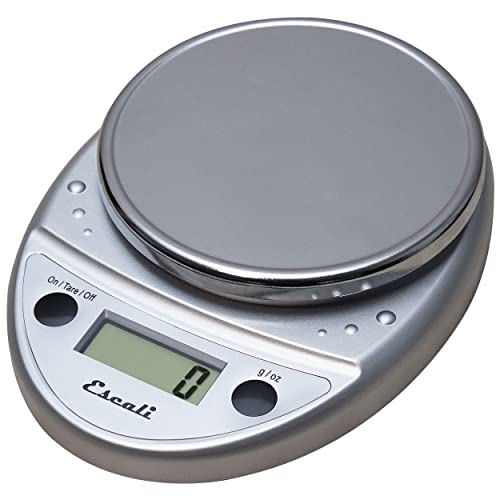
6. Escali Primo Digital Kitchen Scale
A simple, widely used kitchen scale that handles beans and baking alike. It does not include a timer. It is the choice if baking and beans share one scale. Check the listing for the maximum weight if you also use it for larger baking jobs. Pair it with a phone timer if needed.
Suits: beans and baking. Strengths: simple and versatile. Weaknesses: no timer. Skip it if you need timed pours.

Care and Setup
- Wipe spills right away and dry the surface.
- Keep the scale off hot surfaces.
- Replace or recharge the battery before it gets low.
- Tare with your vessel in place before pouring.
Mistakes to Avoid
- Pouring too fast for the scale to register.
- Resting a hot kettle on the platform.
- Forgetting to tare.
- Buying a scale with no timer and relying on guesswork.
Resolution, Capacity and Response Time
Three numbers describe how a scale behaves. Resolution is the smallest step it displays, such as a tenth of a gram. Capacity is the most weight it can handle. Response time is how quickly the display updates after you add or remove weight. For coffee, all three matter together, and you rarely need the extreme end of any of them.
A finer resolution helps when weighing doses for espresso, where a fraction of a gram changes the shot. For pour-over and drip, a tenth-of-a-gram step is usually plenty, and you are weighing water in larger amounts. Capacity must cover your server or mug plus the water, so check the listed limit and add up the weight of your vessels. A scale that maxes out mid-pour shows an error and spoils your timing.
Response time matters most for pour-over. A slow display lags behind the stream and makes it hard to hit a target at a given moment. Look for descriptions of fast response, but remember these are the makers’ claims. Auto-tare and auto-off features can help or annoy, so check how they behave. A scale that turns off during a long bloom wait is frustrating.
Platform Size, Surface and Spill Resistance
The platform must fit your gear. A drip cone, a server and a kettle all need stable footing, and a small platform can leave a wide-based server hanging over the edge, which can tilt the reading. Measure the base of your largest vessel and compare it with the platform size. For espresso, check whether the scale fits under the portafilter on the drip tray, and whether the height clears the spout.
The surface affects cleaning. A flat, smooth top wipes clean easily, while seams and buttons collect grounds and moisture. Silicone mats protect the surface and prevent sliding. A removable mat is easy to wash. Some scales state water resistance. Treat that as protection against splashes, not submersion, and follow the maker’s guidance.
Think about the display too. It should be easy to read from where you stand and not hidden by your server or kettle. Backlighting helps in dim kitchens. Large digits help when you are pouring. Buttons should be easy to press with wet hands. Look at the weight of the scale itself, because a heavier base tends to stay put, while a light one can slide.
Timers, Ratios and Brewing Workflow
A built-in timer removes the need for a phone and lets you start timing as the water hits the coffee. Some scales start the timer automatically on the first drop of water, and others use a button. Auto-start is convenient but can misfire, so learn how yours works. A timer that can pause and resume handles interruptions.
A brew ratio is the weight of water divided by the weight of coffee. A common starting point is somewhere between fifteen and seventeen parts water to one part coffee, but taste is the guide. Weigh the coffee, tare the scale, then weigh the water as you pour. Write down the ratio and the time so you can repeat what you enjoy. Change one thing at a time.
For espresso, weigh the dose in the basket, then weigh the liquid output in the cup. The output weight compared with the dose is often used as a ratio. A scale that fits under the cup and reads quickly lets you stop the shot at the right weight. For pour-over, use the scale to pour in stages, such as a bloom followed by pulses. A scale with a flow rate display can help refine pouring, but is not required.
Power, Connectivity and Extra Features
Scales run on replaceable batteries or built-in rechargeable ones. Rechargeable models use a cable, and battery life varies. Replaceable batteries are easy to swap but must be in stock. Check what the listing says about battery type and life, and keep a spare if the scale is essential to your morning.
Some scales connect to a phone app to log recipes, show a flow curve and guide your pour. This can be useful when learning, but it adds complexity and depends on the app being maintained. Consider whether you will use it. The scale should work on its own without a phone. Check that updates and support are available if you rely on the app.
Look out for extras that suit you: unit switching between grams and ounces, a tare button that is easy to reach, an auto-off setting you can adjust and a low-battery warning. Also note any calibration feature. A scale should read zero when empty and return to zero when you remove weight. If it drifts, try recalibrating following the manual.
Calibration, Care and Signs It Is Time to Replace
Check the accuracy now and then with an object of known weight, such as a fresh coin or a sealed item whose weight is printed on the package. If the reading differs by more than you accept, try recalibrating following the manual. Place the scale on a flat, hard surface, away from drafts and vibrations, since these can disturb the reading.
Clean the scale with a slightly damp cloth, avoiding harsh chemicals. Do not pour water onto the unit. Dry it after use. Remove the battery if you store it for long periods. Keep it away from steam from the kettle, which can enter the electronics. Do not place heavy objects over the capacity, and avoid dropping the scale.
Signs that it should be replaced include readings that wander, a sluggish display, buttons that do not respond, a cracked platform or a battery that drains quickly. Try fresh batteries or a different surface first. If the problem continues, check the warranty on the listing. Before buying a new scale, consider what you missed in the old one, such as speed, size or a timer, and use that to choose the next one.
Coffee Scale FAQ
Do I need a coffee scale?
Not strictly, but a scale makes brews repeatable and removes guesswork.
What ratio should I use?
Many brewers start with a common ratio and adjust to taste.
Is a built-in timer necessary?
It is useful for pour-over, but you can use your phone.
Are app-connected scales worth it?
They suit people who want brew logging, but they cost more.
What resolution do I need for pour-over?
A step of a tenth of a gram is usually enough for pour-over. For espresso doses, a finer reading can help, but check the scale's stated resolution.
Why does my scale drift?
Drift can come from low batteries, a draft, a vibrating surface or moisture. Try a fresh battery, a flat surface and a dry scale, then recalibrate following the manual.
Can I use a regular kitchen scale for coffee?
You can, though a general scale may respond slowly and lack a timer. It works for weighing beans but is less comfortable for timed pouring.
Should I weigh the beans or the grounds?
Beans, before grinding. Some coffee stays in the grinder, so weigh the beans you add and the dose you use for brewing, and be consistent.
How do I protect the scale from spills?
Use a silicone mat, wipe up spills right away and keep the scale away from steam. Water resistance, if listed, is usually for splashes only.
How do I use the tare function?
Place your empty vessel on the scale and press tare to set zero. Then add coffee or water and read the net weight.
Is an app-connected scale worth it?
It can help you track recipes and flow, but you may not need it. Choose it only if you will use the extra data, and check that the scale also works without the app.
Brew Methods and the Scale Behavior They Reward
A scale suits some brewing styles better than others, so the useful question is what you make most often. Pour-over means weighing the dose, the dripper plus a server, then watching the water total rise in small steps. The scale must respond quickly to a thin stream and avoid lag, and a built-in timer saves juggling a phone. Espresso asks for the opposite kind of precision: you weigh dose in and liquid out on a small platform that fits under a portafilter and cup, ideally with a platform low enough to fit under the spout.
Immersion brewing such as French press and AeroPress is the most forgiving. You pour, stir and wait, so a basic scale with a solid tare button works well. Cold brew introduces larger batches and weights, which makes capacity more relevant than resolution. If you brew for a group, check that the maximum load covers a full carafe plus water with room to spare.
- Pour-over: fast response, a timer and a platform wide enough to hold the server.
- Espresso: compact footprint, low profile, water resistance and a quick stable reading.
- French press and AeroPress: tare, a clear display and reasonable capacity.
- Cold brew or batch: higher capacity and a larger platform, with less need for fine steps.
Matching the scale to the method avoids paying for features you will not use. A tight espresso scale such as the Acaia Lunar, described earlier in this guide, makes less sense for a household that only brews large pitchers.
Dialing In With Ratios, Yield and Repeatability
Weighing does not make coffee taste good on its own. It makes your results repeatable so you can change one thing at a time. Start with a ratio, such as grams of water to grams of coffee, and record it with the grind setting, water temperature and brew time. If the cup tastes sour or thin, finer grind or longer contact time may help; if bitter or harsh, go coarser or shorten the brew. Making a single change per brew teaches you far more than guessing.
For espresso, yield is the weight of the liquid in the cup, and the ratio of dose to yield together with the time describes the shot. A scale that reads quickly lets you stop the shot at a target weight instead of a target time. Small differences matter because a few grams of difference in a small shot is a large percentage.
Keep a simple log. A notebook or notes app with date, coffee, dose, water, grind and impressions turns your scale into a tool for learning rather than a gadget. After a few weeks you will see patterns, such as how a fresher roast needs a slightly different grind, that you would not notice by eye.
Stable Readings: Surfaces, Pour Technique and Drift
A scale is only as good as its environment. Place it on a firm, level counter and not on a towel or soft mat, since flex introduces drift. Keep it away from the steam of a kettle and the vibration of a grinder. Tare after the vessel and filter are in place, and pour in a steady stream rather than splashing, because a sudden drop of water momentarily overstates the weight on some models.
Temperature is a hidden factor. A hot server on the platform can heat the sensor and shift the reading slightly, and a cold counter can do the opposite. Give the scale a minute after you switch it on, particularly if it has been in a cold place. If readings drift while nothing is on the platform, check the battery level first, then the surface, and then consider recalibration if the maker provides a method.
Finally, keep an eye on moisture. Most coffee scales tolerate splashes but not submersion, so wipe the platform after use and never run it under water unless the maker states it is rated for that.
Choosing for a Small Kitchen or Travel
If counter space is limited or you carry a brew kit to the office or on trips, size and power matter more than extras. Look for a slim body that stores in a drawer, a platform that still fits your smallest dripper and cup, and a power source you can replace easily, such as common batteries or a standard cable. A silicone cover or case protects the platform and buttons in a bag. Check the auto-off setting too, since a scale that shuts off mid-pour is frustrating, and one that never shuts off drains the battery.
Consider how you will clean it away from home. A wipeable top and sealed buttons make that quick. If you share the scale with others, keep the units set to grams, since switching to ounces mid-brew spoils a recipe and is easy to do by accident. Finally, test the scale with a known weight, such as a sealed package whose weight is printed on it, to confirm it reads sensibly before you rely on it on a trip.
Frequently Asked Questions
Which coffee brewing method benefits most from a scale?
Pour-over and espresso gain the most, because small differences in dose, water or yield change the taste noticeably. Immersion methods such as French press are more forgiving, so a simpler scale with a reliable tare function is usually enough.
How do I keep a coffee scale reading steady?
Use a firm, level counter, keep it away from steam and grinder vibration, tare after placing the vessel, and pour in a steady stream. Replace weak batteries and give the scale a moment to settle after powering on, especially in a cold kitchen.
How should I log my coffee brews?
Write down date, beans, dose, water weight, grind setting, brew time and a note on taste. Change one variable per brew. After a few weeks the log shows which adjustments improved the cup and which did not.
Does a hot server affect a coffee scale reading?
It can. Heat may shift the sensor slightly, and steam can reach the electronics. Let the scale settle, tare once the vessel is in place, and use a heat-safe mat if the maker recommends one. Follow the manual for temperature limits.
Going Deeper: Getting the Most From a Coffee Scale
A coffee scale looks like one of the simplest tools on the counter, yet it quietly decides whether a recipe can be repeated or whether every morning becomes a fresh guess. The picks above cover a wide range, from fast, compact espresso scales to larger pour-over models and one straightforward kitchen scale that happens to work well for brewing. What separates a satisfying purchase from a frustrating one is rarely a single headline feature. It is the match between the scale, the brewer you reach for most, the size of your vessels, and the way you like to work when you are still half awake. This section slows the decision down and looks at how a scale behaves across weeks of real brewing rather than across a single first impression.
Matching the Choice to the Way You Actually Work
If espresso is your main drink, your scale lives in one of the harshest spots in the kitchen. It has to fit on a drip tray, react quickly enough that you can stop a shot by weight rather than by watching a timer and hoping, and shrug off splashes. Small footprint and fast response matter more here than a huge platform. A scale that is wonderful for a big pour-over carafe may simply be too wide for the tray, so measure the tray before you fall for a larger model, and think about how the display will read when a portafilter and cup are sitting on top of it.
If pour-over is your ritual, the priorities shift. You want a platform that holds a server comfortably, a display you can read at an angle while you pour, and a timer that starts when you start, not after a fumble through menus. Stability matters because a slow, circular pour keeps adding small amounts of water; a scale that jumps around makes it hard to know where you are in the recipe. Many pour-over brewers also weigh beans on the same scale, so a surface that is easy to wipe clean between the dry and wet stages earns its keep every single day.
If you brew a bit of everything, or you share the kitchen with people who bake and cook, versatility becomes the deciding factor. A general scale that handles a mixing bowl, a batch of dough and a Chemex with equal calm may serve the household better than a specialist that only shines at one job. In that case, look at the picks above through a household lens: how easy is it to store, how quickly can someone else figure it out without instructions, and does it survive being borrowed, stacked in a cupboard and pulled out again daily? The best scale is the one that stays on the counter because nobody finds it annoying.
The Criteria That Matter Most, Revisited
Specifications only help when you translate them into brewing behaviour. These are the criteria worth revisiting once you have read the individual reviews, because they are the ones that show up in daily use rather than on a product page.
- Response speed: A scale that lags behind your pour forces you to anticipate and overshoot. For espresso especially, a quick, settled reading lets you cut the shot at the yield you planned instead of guessing a second early.
- Readability in place: Check where the display sits relative to your vessel. A bright screen hidden under a wide server is no help, so think about your largest carafe and your usual cup before deciding that any display will do.
- Platform and footprint: Match the platform to your biggest brewing vessel and the footprint to your smallest surface, which for espresso is the drip tray. A scale should sit flat and stable in both places, not rock on an edge.
- Timer workflow: Some brewers love an automatic timer, others prefer a simple manual start. Neither is better in the abstract. What matters is that the timer behaves the same way every morning, so the routine becomes muscle memory.
- Water resistance in practice: Coffee brewing is wet. Spills run under servers, steam condenses, and rinsed portafilters drip. A scale that tolerates splashes and wipes clean without water creeping into seams will simply live longer in this job.
- Power routine: Rechargeable scales are convenient until they are flat at the worst moment; battery models ask for spares in a drawer. Pick the routine that fits your habits, and note how the scale warns you before it gives up.
Notice that none of these criteria is about owning the most advanced model. A scale that responds quickly, reads clearly and fits your brewer will produce better coffee than a feature-packed model that fights your setup. Use the reviews above to shortlist, then run your own brewer, vessel and counter space through this list. The right answer usually becomes obvious once the scale is imagined in its actual place, at your actual hour of the morning, with your actual hands pouring.
A Step-by-Step Routine That Works
A consistent weighing routine removes most of the mystery from brewing. The sequence below works for pour-over and, with the obvious change of vessel, for espresso as well.
- Start level and settled: Place the scale on a firm, level surface away from the edge of the counter and let it finish its start-up before anything touches it. A scale switched on while a cup is already sitting on it begins the session confused.
- Weigh the dry dose first: Weigh beans or grounds before water enters the picture, in the vessel you will brew in where possible. Fewer transfers mean fewer grounds lost on rims and spoons, and a dose you can trust.
- Tare with everything in place: Set the brewer, filter and server on the scale exactly as they will be during brewing, rinse the filter if that is your habit, empty the rinse water, then tare. The number you watch from here is water added, nothing else.
- Pour or pull to the number: Work to the target weight rather than the clock. Add water in stages for pour-over, or stop the shot at the planned yield for espresso, remembering that a little liquid keeps dripping after you stop.
- Record one line: Write down the dose, the water or yield, the total time and a few words on taste. One honest line per brew builds a picture within a fortnight that no amount of guessing can match.
- Reset the station: Empty, rinse, dry the platform and leave the scale clean. Grounds and coffee oils left on the surface are the main reason a good scale starts to look tired and read oddly.
The routine feels fussy for the first few days and invisible after that. That is the point. When weighing becomes automatic, your attention moves back to the variables that actually change the cup, such as grind and water temperature, and the scale stops being a gadget you operate and becomes part of the bench, like the kettle. If a new scale disrupts this flow with menus, modes or a timer that behaves differently each time, that friction is real information about whether it suits you, whatever its specifications promise.
Troubleshooting: Problems, Causes and Fixes
The reading drifts or creeps upward
Drift usually has a mundane cause. Check for draughts from a window or fan, vibration from a grinder or fridge, a cable or cloth touching the platform, and heat from a server warming the sensor. Move the scale to a calmer spot, let it settle, and try again before assuming it is faulty. Low batteries also produce wandering numbers, so rule those out early.
The display lags behind the pour
A slow response shows up as overshooting your target again and again. Pour a little more gently near the end, stop slightly early and let the last drips land, and check whether a power-saving or averaging mode is smoothing the reading. If the lag appears only with espresso, where every gram arrives fast, that is a sign the scale is better suited to slower brewing methods.
Water gets where it should not
Wipe spills immediately rather than letting coffee pool around the edges of the platform, and never rinse a scale under the tap unless the maker explicitly allows it. If a scale gets a soaking, switch it off, dry it thoroughly and give it time before using it again. Repeated small spills do more harm than one dramatic one, because moisture creeps in slowly.
The scale disagrees with another scale
Two scales disagreeing by a small amount is common and rarely matters for coffee, where consistency with your own scale is what makes recipes repeatable. Check both on a level surface with the same object in the centre of the platform. If one jumps around or changes its answer between repeats, trust the steadier one and investigate the other.
Care, Storage and Making It Last
Daily care takes less than a minute. Brush loose grounds off the platform before they get wet and sticky, wipe the surface with a slightly damp cloth, and keep coffee oils from building up around the display. Avoid harsh cleaners and soaking, and never use the scale as a resting place for a hot portafilter or a pan straight off the stove, since heat is hard on the sensor and the surface alike.
Storage shapes a scale’s life more than most owners expect. Keep it flat rather than on its edge, do not stack heavy bowls on top of it in a cupboard, and if it will sit unused for a long stretch, follow the maker’s guidance on batteries or charge. A scale stored under a pile of cookware can develop exactly the kind of sensor sulk that later gets blamed on electronics.
Finally, recalibrate or at least sanity-check the scale now and then, especially after a move, a drop or a battery change. A known reference weight, used the same way each time, tells you whether the numbers you are brewing to are still the numbers you think they are. Caught early, most problems are a cleaning, a fresh battery or a better spot on the counter. Caught late, they become a replacement you did not need to buy.
Extra Questions, Answered
Should I weigh water instead of measuring it in a jug?
Yes, if you want repeatable coffee. Volume changes with temperature and is hard to read accurately in a hurry, while weight is weight. Weighing the water as it lands in the brewer also shows you your pouring pace, which a jug measurement never reveals.
Where should the scale sit during brewing?
On the firmest, flattest part of the counter, away from the sink edge, the grinder’s vibration and any heat source. For espresso it sits on the drip tray, so check the tray dimensions against the scale before buying rather than after.
How often should I replace the batteries or recharge?
Follow the low-power warning rather than a calendar, but keep spares or a cable within reach of the coffee station. A scale that dies mid-brew teaches you this lesson once; a small habit of topping up charge or swapping batteries at the warning stage prevents it entirely.
Can one scale serve both espresso and pour-over?
Often, yes, provided it fits the drip tray and still offers a platform large enough for your server. That in-between size is exactly what several picks above aim at. If your pour-over vessel is very large or your tray very small, a single scale may involve a compromise at one end.
Why does the weight change when I set the cup down again?
Because placement matters. A vessel sitting off-centre, touching a cable, or resting partly on the machine can shift the reading. Centre the vessel, keep everything clear of the platform edges, and let the number settle for a moment before you treat it as final.
How the Picks Differ Once They Live on Your Counter
Reading the six reviews in sequence, a pattern emerges that the specification table cannot show. The espresso-focused models in the list, such as the Acaia Lunar and the Brewista Smart Scale II, are built around speed and a small footprint, because their working surface is a drip tray and their working moment is a thirty-second shot. The pour-over oriented models, such as the Acaia Pearl and the Hario V60 Drip Scale, trade a little of that compactness for a platform that welcomes a server and a timer workflow that suits a slower pour. The Timemore Black Mirror Basic Plus sits in the middle ground that many home brewers actually inhabit, while the Escali Primo represents the honest generalist: a kitchen scale first, pressed into coffee service, and none the worse for it if your brewing is mostly immersion or drip.
That spread is useful because it mirrors how home coffee setups evolve. Many people begin with a general scale, discover pour-over, then add espresso a year or two later, and each stage changes what the scale must do. If you know espresso is coming, buying the tray-friendly size now saves a second purchase. If your brewing has been stable for years, buy for the brewer in front of you and ignore the hypothetical one. The most common waste in this category is paying for connectivity and modes that a settled routine never touches, while the most common regret is a platform that does not fit the vessel bought six months later.
The First Week With a New Scale: What to Check
Spend the first week testing the scale against your own routine rather than against its feature list. Brew your usual drink at your usual hour and notice where your eyes go, whether the timer starts the way you expect, and whether the vessel you love most sits securely. Make one espresso and one large pour-over even if you favour one method, because the extremes reveal fit problems that a single familiar brew hides. Check how the scale behaves when the counter is wet, when the grinder runs beside it, and when someone else in the household uses it without your coaching.
Also test the boring logistics in that first week, while returning or exchanging is still simple. Charge it fully or fit fresh batteries and note how it warns you as power fades. Wipe it down after a spill and see whether coffee creeps anywhere it should not. Store it in its intended cupboard and take it out again the next morning. A scale that passes the brewing tests but fails the storage test will end up living somewhere inconvenient, and a scale that lives inconveniently gets used less, which quietly defeats the entire purpose of owning it.
When a Coffee Scale Is Worth Replacing
Replace a coffee scale when it stops being trustworthy, not when a newer model appears. The honest signals are readings that wander on a still counter, a platform or casing damaged by a drop, a timer or button that works only sometimes, and power problems that return soon after charging or fresh batteries. Any one of those undermines the single job the tool exists for, which is giving you a number you can build a recipe on. Cosmetic wear, by contrast, is meaningless; a stained, scuffed scale that reads steadily is doing its work perfectly.
There is also a legitimate upgrade path that has nothing to do with failure. If your brewing changes, the scale may need to change with it: moving from French press to espresso asks far more of response speed and footprint than your old scale was ever designed to give. In that case the older scale usually retires gracefully to baking and general kitchen duty, where its steadiness is still valuable. Thinking of the purchase as assigning the right scale to the right job, rather than chasing the best scale in the abstract, keeps both the coffee and the spending under control.
More Questions, Answered
Should the scale stay on the counter permanently?
If you brew daily, yes, if space allows. A scale that lives where it is used gets used; one that must be fetched from a cupboard slowly drops out of the routine. Just keep its permanent spot away from the sink’s splash zone and the direct heat of the stove.
Does a scale help with French press and other immersion brewers?
It does, even though immersion methods forgive small errors. Weighing the dose and water keeps a press consistent from day to day and makes it far easier to adjust strength deliberately instead of by mood. The benefit is repeatability rather than rescue.
What should I do if the scale gets wet inside?
Switch it off, dry the outside, and leave it somewhere airy to dry completely before using it again. Do not brew on it while it behaves erratically after a soaking. If readings stay unstable once it is fully dry, that is a genuine fault rather than a bad morning.
In the end, a coffee scale earns its place by disappearing into the routine. Choose the pick above that fits your brewer, your tray or counter, and your patience for charging and menus, then brew with it daily for a couple of weeks before judging. By then the numbers will have started doing their quiet work: recipes will repeat, adjustments will make sense, and the occasional great cup will stop being an accident you cannot reproduce.
The Short Version
For espresso, the Acaia Lunar. For a larger platform, the Acaia Pearl. For V60 fans, the Hario. For value, the Timemore. For reliability, the Brewista. For basic use, the Escali. Pick one to match how precise you want to be, and how much you want to spend on extras such as an app.


