Disclosure: topratedkitchenware.com is reader-supported. When you buy through links on our site, we may earn an affiliate commission from Amazon and other retailers, at no extra cost to you.
Where to buy
For the best kitchen three hole pull out faucets brushed chrome, one market reality shapes this whole guide: the classic low-arc pull-out faucet has largely been succeeded by the high-arc pull-down, and the verified pool reflects that — the linked picks below are pull-down designs that do the pull-out job on three-hole decks, with their hole fit documented. Two further models are covered prose-only, with the reasons stated plainly in their reviews.
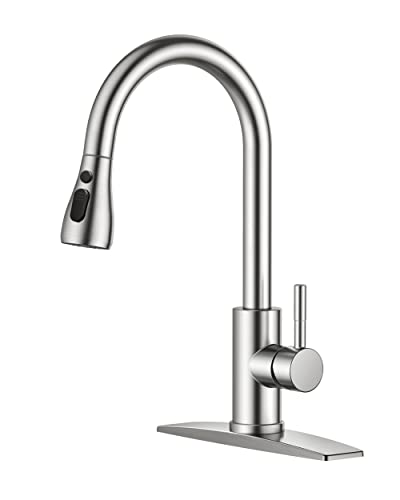
- Lufeidra Kitchen Faucet with Pull-Down Sprayer — Best Overall. Check on Amazon
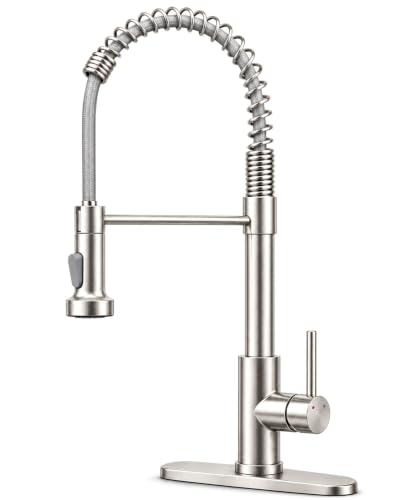
- FEELSO Kitchen Faucet with Pull Down Sprayer — Best Value Pick.
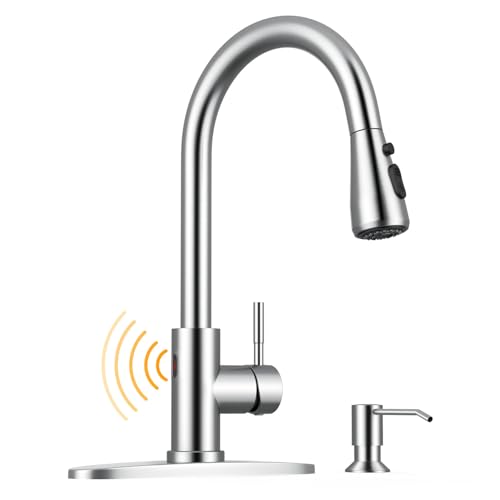
- WEWE Touchless Kitchen Faucet with Soap Dispenser Set — Best Touchless Option.
- GIMILI Matte Black Touchless Kitchen Faucet — Prose-Only: Single-Hole, Matte Black (covered in prose only; see its review for why).
- VFAUOSIT Kitchen Faucet with Pull Down Sprayer — Prose-Only: Bar Format, Hole Fit Undocumented (covered in prose only; see its review for why).
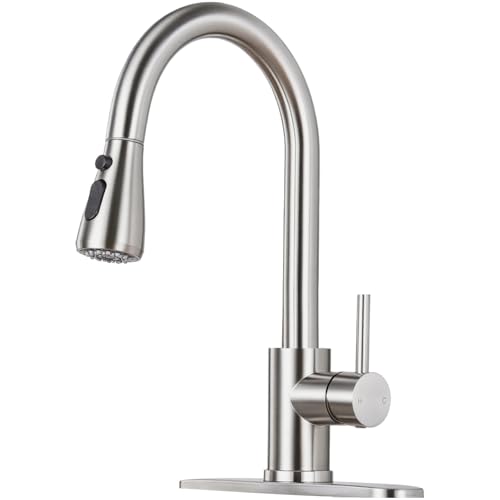
- WEWE High-Arc Pull-Down Kitchen Faucet — Best Documented Reach.
Read the full guide ↓
The pull-out faucet earned its following honestly: grab the spray head, pull it toward you on its hose, and the water goes where the work is — into the pot on the counter, across the big pan that will not sit flat in the sink, down to the bucket on the floor. Shoppers searching for the best kitchen three hole pull out faucets brushed chrome usually have a three-hole deck, a brushed silver finish to match, and that pull-the-water-to-the-work habit. This guide serves all three parts of the brief, and it is transparent about where the modern market has moved.
Here is the movement: the traditional pull-out — a low arc whose head pulls straight out — has been steadily replaced by the pull-down, a high arc whose head pulls down into the sink and reaches nearly as far on its hose. In the verified pool for this guide, every linkable model is a pull-down, and rather than pretend otherwise, we rank them as what they are: the current, better-stocked way to get pull-out function, with three-hole fit documented in their listings. Two models are prose-only. One is a single-hole matte black design that misses the brief twice; the other is a compact bar-sink faucet whose verified data does not document a three-hole fit at all.
Finish gets the same honesty treatment as in our companion guide: the linked picks wear brushed nickel, the brushed silver-tone family’s most common current finish, rather than true brushed chrome — close in look, warmer in tone, and named accurately in every spec box below. If the pull-out mechanism itself is your obsession, the reach figures and hose details in the detailed reviews are where to linger; our notes on Best Kitchen Wall Faucets Consumer Reports cover the alternative for decks with no usable holes at all.
Key Takeaways
- The classic pull-out faucet has been succeeded by the pull-down: same hose-driven reach, better pot clearance, far more models to choose from. The linked picks here are pull-downs, labeled as such.
- Three-hole fit is documented for all four linked picks — an explicit 1- or 3-hole listing or an included path to cover the deck.
- Reach is a number worth comparing: one pick documents a 20-inch pull-down reach, the figure that decides whether the sprayer truly leaves the sink.
- Two picks are prose-only — a single-hole matte black model, and a bar-sink model with no documented three-hole fit. Neither is linked as if it matched.
- Finishes in the pool are brushed nickel, not true brushed chrome; the difference is a warm-versus-cool tone, named honestly throughout.
- Hose behavior — smooth extension, clean retraction, a weight that clears under-sink clutter — matters more to daily satisfaction than any spray-mode count.
In this guide
Quick Picks
The short version. Mechanism, hole fit, and finish are stated as the verified listings state them.
| Pick | Badge | Why it stands out | Listing |
|---|---|---|---|
| Lufeidra pull-down | Best Overall | Explicit 1- or 3-hole fit, SUS304 body, ceramic cartridge, classic styling. | Check on Amazon |
| FEELSO pull-down | Best Value Pick | Lead-free NSF-certified stainless build listed for 1 or 3 holes, high arc. | Check on Amazon |
| WEWE touchless set | Best Touchless Option | Sensor operation, soap dispenser for a spare hole, 360-degree swivel, 3 modes. | Check on Amazon |
| GIMILI touchless | Prose-Only: Single-Hole, Matte Black | Spring pull-down with sensor — but single-hole mounting and black finish miss this brief. | Prose only |
| VFAUOSIT pull-down | Prose-Only: Bar Format, Hole Fit Undocumented | Long documented hose and fast-install claims, but sold as a bar sink faucet with no stated three-hole fit. | Prose only |
| WEWE high-arc pull-down | Best Documented Reach | 20-inch pull-down reach, 360-degree swivel, rub-clean silicone nozzles, SUS 304. | Check on Amazon |
How These Picks Were Chosen
This guide is research-led: we compared verified listing data, and only models whose identity, mechanism, and mounting could be confirmed were linked. Three filters did the work. First, the faucet had to deliver pull-out function — a spray head on a hose that leaves the spout and travels. Second, its three-hole story had to be documented, not assumed: an explicit 1- or 3-hole fit in the verified data. Third, its finish had to sit in the brushed silver-tone family; brushed nickel qualifies as the family’s current standard-bearer, while matte black does not.
The mechanism filter needs a paragraph of its own, because it shaped this guide more than any other. True pull-out faucets — low arc, head pulling horizontally out of the spout — have become a niche. The verified pool for this keyword contains pull-down designs instead, and we made a deliberate editorial choice: rank the pull-downs openly as the functional successors they are, explaining the difference in a dedicated section below, rather than either abandoning the keyword or mislabeling pull-downs as pull-outs. A pull-down’s hose reach, spray modes, and docking do the same jobs; the geometry of the pull differs, and for most sinks it differs in the user’s favor.
Two models failed the filters and were demoted to prose. The GIMILI fails twice — single-hole mounting and a matte black finish — so it appears as a clearly labeled prose entry. The VFAUOSIT is subtler: its verified data documents an appealing package for a bar sink, including a long retractable hose, but it never documents a three-hole kitchen fit, and this guide does not link mounting claims it cannot verify. Both reviews explain the reasoning in full, because a guide that hides its exclusions teaches you nothing.
Durability signals broke the remaining ties: stainless construction, ceramic cartridges, and drinking-water certifications. Readers whose remodel goes further than the faucet — new sink, new deck, new layout — may also want our research on Best Kitchen Waterfall Faucets, a spout style that takes the opposite approach to water delivery.
The 6 Best Kitchen Three Hole Pull Out Faucets Brushed Chrome Shoppers Can Buy Today

Lufeidra Kitchen Faucet with Pull-Down Sprayer
Badge: Best Overall
Strengths
- Explicit 1- or 3-hole fit stated in the verified listing
- SUS304 stainless body with a ceramic cartridge
- Classic styling suits the traditional decks that carry three holes
Trade-offs
- Mechanism is pull-down, not a classic low-arc pull-out
- Finish is brushed nickel rather than brushed chrome
- Spray detail is plainer than the explicit 3-mode models
Key specs (from verified listing data):
- Mounting: Fits 1- or 3-hole
- Mechanism: Pull-down sprayer
- Body: SUS304 stainless steel
- Cartridge: Ceramic
- Finish: Brushed nickel
The Lufeidra leads this guide because it satisfies the brief’s verifiable parts without asterisks: the listing states a 1- or 3-hole fit, the body is SUS304 stainless steel, the cartridge is ceramic, and the styling is the classic, high-clearance shape that traditional three-hole decks wear best. Its sprayer pulls down from the arc rather than out from a low spout — the modern arrangement — and for the jobs pull-out owners actually do, filling and rinsing beyond the spout’s fixed reach, the hose does the same work.
Consider the classic pot-filler styling for a moment, because on a three-hole deck it is more than decoration. Those decks usually belong to deep, traditional sinks, and a tall arc with a pull-down head gives them the two things their original faucets lacked: clearance for stockpots standing in the basin, and a hose for everything that cannot stand in the basin at all. The Lufeidra’s design brief reads like it was written for exactly that retrofit.
The internals support a long, quiet ownership. Ceramic cartridges are the standard defense against the slow drip that plagued washer-era faucets, and a stainless body shrugs off the corrosion that makes lesser faucets feel old at the joints. The listing also names laundry, RV, and bar sinks among its uses, which speaks to compact, tolerant proportions — useful in galley kitchens where a three-hole deck comes with very little counter around it.
The honest caveats: if your heart is set on the literal pull-out gesture — head sliding horizontally out of a low spout — this is not that mechanism, and no linked pick in this guide is; the market has moved. The finish is brushed nickel, warmer than chrome. And the spray offering is workmanlike rather than headline-grabbing. What you get instead is the brief’s documented essentials, executed without drama.
Best for: three-hole traditional decks wanting documented fit and durable internals. / Not suited for: purists who want the literal low-arc pull-out mechanism.

FEELSO Kitchen Faucet with Pull Down Sprayer
Badge: Best Value Pick
Strengths
- Listed for 1 or 3 hole installation in the verified data
- Lead-free, NSF-certified stainless steel construction
- High arc plus pull-down hose covers deep, older three-hole sinks
Trade-offs
- Pull-down mechanism rather than classic pull-out
- Brushed nickel finish, not brushed chrome
- Spray-mode specifics are thinner in the verified data than 3-mode rivals
Key specs (from verified listing data):
- Mounting: 1 or 3 hole
- Mechanism: Pull-down sprayer
- Body: Stainless steel, lead-free
- Certification: NSF certified
- Spout: High arc
The FEELSO is the value route into this brief, and its paperwork is in order: 1 or 3 hole installation in the verified listing, a lead-free stainless steel body, NSF certification, and a high-arc spout with a pull-down sprayer. For the price-sensitive version of this project — the rental refresh, the first-home fix, the inherited kitchen that needs function now and flourish later — it covers the documented essentials and stops there, which is exactly what a value pick should do.
The high arc is doing quiet heavy lifting here. Three-hole sinks skew deep and generous, and deep sinks punish low faucets: pots must be tilted, buckets cannot be filled, and the sprayer becomes the only way water reaches the corners. A high arc standing over a deep basin, with a hose-fed head that pulls down into it, converts an old sink’s worst trait into working room. This is the pairing that makes pull-down designs such natural successors to pull-outs on older decks.
Day to day, the single-handle format keeps the deck calm — one control, a covered plate, nothing else competing for the eye — and the listing’s wider positioning for farmhouse, laundry, RV, and bar sinks suggests a faucet built to tolerate varied installations rather than pampered ones. If your three-hole deck lives in a hard-working utility-minded kitchen, that tolerance is a feature, not a footnote.
As with the Lufeidra, the mechanism is pull-down, and the finish is brushed nickel with its warmer tone. The verified data is also thinner on spray-mode specifics than the explicit three-mode listings elsewhere in this guide, so confirm the spray details on the listing if modes are a deciding factor for you. None of that undermines the core proposition: documented hole fit, certified metal construction, and hose-driven reach at a value-tier positioning.
Best for: budget-conscious three-hole upgrades and deep older sinks. / Not suited for: buyers who decide by spray-mode lists or want the classic pull-out gesture.
WEWE Touchless Kitchen Faucet with Soap Dispenser Set
Badge: Best Touchless Option
Strengths
- Touchless sensor frees both hands for hose work
- Soap dispenser in the set gives a spare hole a daily job
- 360-degree swivel, 3 spray modes, SUS 304 body, ceramic cartridge — all documented
Trade-offs
- Pull-down mechanism, not classic pull-out
- Brushed nickel rather than brushed chrome
- Sensor power management is a maintenance category manual faucets avoid
Key specs (from verified listing data):
- Operation: Touchless sensor
- Mechanism: Pull-down hose
- Included: Soap dispenser set
- Swivel: 360 degrees
- Spray modes: 3
- Body: SUS 304 stainless steel
- Mounting: 1- or 3-hole fit
Pull-out and pull-down faucets share an ergonomic truth: the moment the spray head leaves the spout, both of your hands are involved — one holds the head, the other holds the thing being rinsed. That is precisely the moment a touchless faucet earns its premium. This WEWE set lets the sensor handle activation while your hands handle the hose and the roasting pan, and on messy cooking days that division of labor feels less like a luxury than like the obvious design.
The three-hole story is the most inventive in this guide. The set bundles a soap dispenser, so a deck with spare holes ends up with more function, not just a cover plate: dispenser in one hole, single-handle faucet in another, and a deck that looks designed rather than adapted. The verified data rounds out the brief — 1- or 3-hole fit, 360-degree swivel, three spray modes, SUS 304 body, ceramic cartridge, easy-clean nozzles. It is the fullest specification in this guide, attached to the cleverest use of the deck.
In hose terms, the touchless format changes technique slightly for the better. Because activation does not require a free hand on a handle, you can pull the head to its target first and start the water second — the order pull-out owners have always wished for when aiming into a pot on the counter. The spray modes then cover the usual spread from gentle stream to scouring spray.
The caveats are the standing ones for this guide, plus one. Mechanism: pull-down, not classic pull-out. Finish: brushed nickel, not brushed chrome. And the sensor introduces power management — batteries or an adapter — as a small, real maintenance category. Installation also runs longer than a manual faucet’s, with sensor hardware joining the dispenser under the deck. For cooks whose hands are perpetually full, none of that outweighs the benefit; for minimalists, the manual picks above are the cleaner answer.
Best for: messy, hands-full cooks on three-hole decks who want a dispenser in the bargain. / Not suited for: zero-electronics kitchens or classic pull-out purists.
GIMILI Matte Black Touchless Kitchen Faucet
Badge: Prose-Only: Single-Hole, Matte Black
Strengths
- Motion-sensor, hands-free operation with a spring pull-down sprayer
- Matte black finish is striking in the right kitchen
- Single-handle temperature control is simple to live with
Trade-offs
- Single-hole installation only — misses the three-hole brief outright
- Matte black finish is the opposite of the brushed brief
- Sensor and spring add complexity and power needs
Key specs (from verified listing data):
- Operation: Motion sensor, hands-free
- Mounting: Single hole installation
- Finish: Matte black
- Sprayer type: Spring pull-down
- Handle: Single
We will not bury the lede: this faucet does not fit the keyword. Its verified listing specifies single-hole installation and a matte black finish — a miss on the mounting, a miss on the finish — so it is reviewed here in prose, without a link or image, for completeness and for the minority of readers whose project it actually matches. If your sink has three holes and your finish brief is brushed metal, your list is the four linked picks in this guide.
Judged on its own terms, the GIMILI is a coherent modern design. The exposed spring holds the spray head at working height in the pre-rinse style, the motion sensor activates the water hands-free, and the single handle sets temperature in the background. In a kitchen designed around matte black — black fixtures against pale counters — it looks intentional and current, and the farmhouse-meets-industrial styling has a genuine following.
Its pull mechanics are also legitimately interesting in a guide about hoses. A spring-held head does not dock inside a spout the way the pull-downs here do; it hangs in its spring cradle, always visible, always grabbable. Owners who use the sprayer constantly sometimes prefer that honesty of design — the tool is out, not stored.
None of that changes the match. Guides lose their value the moment they link a product as if it fit a brief it fails, so this one stands as a labeled exception: a good faucet for a different keyword — single-hole, matte black, touchless — and a clear non-answer to this one.
Best for: single-hole projects deliberately choosing matte black and sensor operation. / Not suited for: three-hole sinks or brushed-finish briefs — this guide’s entire subject.
VFAUOSIT Kitchen Faucet with Pull Down Sprayer
Badge: Prose-Only: Bar Format, Hole Fit Undocumented
Strengths
- Long 23-inch retractable hose documented in the verified listing
- Lead-free with NSF 61/372 and cUPC marks listed
- Cold-start safety and a claimed 10-minute tool-free install
Trade-offs
- Sold as a bar sink faucet; no three-hole kitchen fit is documented
- Material and cartridge details are not stated in the verified data
- Compact bar format is undersized in spirit for a main family sink
Key specs (from verified listing data):
- Format: Bar sink faucet (per listing)
- Mechanism: Pull-down sprayer
- Hose: 23in retractable
- Spray modes: 3
- Certifications: NSF 61/372, cUPC
- Safety: Cold-start
The VFAUOSIT is the near-miss of this guide, and its review explains a rule we apply everywhere: we link what the verified data documents, not what it merely suggests. What the data documents is genuinely appealing — a pull-down sprayer with a 23-inch retractable hose, three spray modes, lead-free construction with NSF 61/372 and cUPC marks, cold-start safety that defaults the water cold, and a claimed ten-minute tool-free installation. What it does not document is the brief: the listing presents this as a bar sink faucet, and nowhere in the verified data is a three-hole kitchen fit stated.
That distinction is not pedantry. A bar faucet is proportioned for a small secondary sink, and a three-hole kitchen deck is a specific mounting commitment. Could a compact faucet physically sit on a kitchen deck with the right plate? Possibly — but “possibly, with parts unknown” is not a recommendation a guide should link. So the VFAUOSIT appears here in prose: fully described, honestly praised where the data supports it, and not sold as a three-hole kitchen answer.
Where it does belong is easy to picture. A wet bar, a butler’s pantry, a basement entertainment sink — small decks where its documented hose length is almost comically generous and its fast-install design shines. The cold-start feature suits those spaces too, where a faucet may sit unused for weeks and should never surprise anyone with hot water.
If your project is that secondary sink, this model deserves a look by name. If your project is the keyword — a three-hole kitchen deck in a brushed finish — the documented answers are the four linked picks, and this review exists so you know this one was considered and set aside for a stated reason, not overlooked.
Best for: bar and pantry sinks wanting a long hose and fast install. / Not suited for: three-hole kitchen decks — the fit is not documented, so it is not linked here.
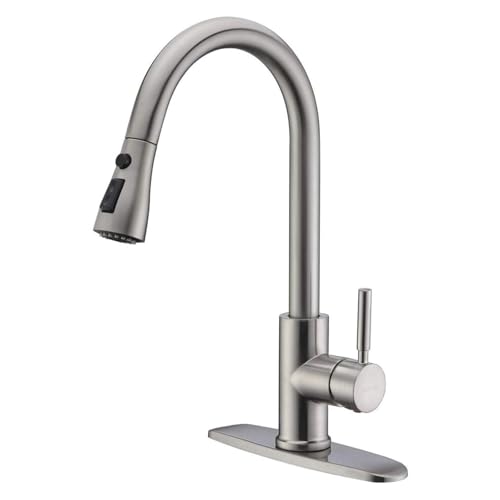
WEWE High-Arc Pull-Down Kitchen Faucet
Badge: Best Documented Reach
Strengths
- 20-inch pull-down reach documented — the longest stated figure among linked picks
- 360-degree swivel and 3 spray modes in the verified data
- Soft silicone nozzles clear scale with a fingertip rub
Trade-offs
- Finish is brushed nickel, not brushed chrome
- High arc needs vertical clearance above the deck
- Shares its brand’s naming with several similar models — verify the exact listing
Key specs (from verified listing data):
- Reach: 20-inch pull-down reach (stated)
- Swivel: 360 degrees
- Spray modes: 3
- Nozzles: Soft silicone, rub-clean
- Body: SUS 304 stainless steel
- Cartridge: Ceramic
- Mounting: 1- or 3-hole fit
Reach is the whole romance of the pull-out idea, so it is fitting that this guide’s most documented reach belongs to its closing pick. The WEWE high-arc model’s verified listing states a 20-inch pull-down reach — a concrete number in a category full of adjectives — alongside a 360-degree swivel, three spray modes, a SUS 304 stainless body, and a ceramic cartridge. For a three-hole deck, the listing also states a 1- or 3-hole fit. On documented evidence alone, this is the most completely specified linked pick in the guide.
Twenty inches of reach changes what the sink is for. The sprayer leaves the basin entirely: it fills the pot sitting on the counter, rinses the baking sheet propped against the backsplash, and reaches the floor-level bucket that pull-out owners have always used as their benchmark. Combined with the full-circle swivel, the faucet’s working territory extends well beyond the sink’s rim in every direction — the practical definition of the pull-out promise, delivered by pull-down hardware.
The maintenance detail deserves its line: the spray face uses soft silicone nozzles designed to be cleared of scale with a fingertip rub. In hard-water homes, spray patterns degrade long before faucets fail, and a nozzle you can clean in five seconds, mid-task, with wet hands, is the difference between a faucet that performs in year three and one that merely survives. It is a small specification that signals a maker thinking about ownership rather than unboxing.
The standing caveats apply — brushed nickel rather than chrome, pull-down rather than classic pull-out, and a high arc that demands vertical clearance under shelves or window trim. There is also a housekeeping note: this brand sells several similar models, so verify the exact listing and its stated reach before ordering. Do that, and this is the pick for buyers who shop by documented numbers — readers who also weigh the durability angle in Best Long Lasting All Metal Kitchen Faucets will find the same evidence-first philosophy there.
Best for: reach-driven buyers who want the documented numbers, on three-hole decks. / Not suited for: low-clearance decks, or anyone set on true chrome or a classic pull-out.
Comparison Table
Mechanism, mounting, and finish are stated exactly as the verified data states them. No prices, no ratings.
| Model | Mechanism | Three-hole evidence | Actual finish | Listing |
|---|---|---|---|---|
| Lufeidra pull-down | Pull-down | Fits 1- or 3-hole (stated) | Brushed nickel | Check on Amazon |
| FEELSO pull-down | Pull-down | 1 or 3 hole (stated) | Brushed nickel | Check on Amazon |
| WEWE touchless set | Pull-down | 1- or 3-hole fit (stated) | Brushed nickel | Check on Amazon |
| GIMILI touchless | Spring pull-down | Single hole only — misses brief | Matte black | Prose only |
| VFAUOSIT pull-down | Pull-down | Not documented — bar faucet | — | Prose only |
| WEWE high-arc pull-down | Pull-down, 20-inch reach | 1- or 3-hole fit (stated) | Brushed nickel | Check on Amazon |
How to Choose Between Pull-Out Function and Everything Else
Start with the reach audit, because it decides whether you need a hose at all. List the jobs your current faucet fails: the pot that only fits on the counter, the sheet pan that must be rinsed at an angle, the pet bowl filled at floor level, the watering can too tall for the arc. If that list is short and sink-bound, a good swivel spout may serve you as well as any hose. If it is long and scattered around the kitchen, hose reach is your headline specification — and documented reach, like the 20-inch figure on the WEWE high-arc, beats any marketing adjective.
Second, settle the mechanism question with your eyes open. The classic pull-out keeps a low, traditional profile and pulls horizontally; the pull-down clears tall pots and pulls vertically into the basin. On a three-hole deck — usually a traditional, deep sink — either can work, but the pull-down’s clearance advantage is real, and its dominance of the current market means more choice, more finishes, and easier parts support. Choosing pull-down in 2026 is not settling; it is following where the engineering went.
Third, verify the deck before the faucet. Measure the hole spread, check deck thickness, and decide the fate of every hole — plate, dispenser, or accessory — before ordering. Then confirm the chosen model’s fit claim on its listing, because “fits most sinks” is not a specification and an explicit 1- or 3-hole statement is. The four linked picks here all carry that statement in their verified data; hold any alternative to the same standard.
Finally, think about the hose as a system: its length, its weight, and its neighborhood under the sink. A long hose with a weight that snags on the disposal delivers half its promise. Buyers planning a full luxury tier step-up, rather than a functional one, will find a different set of trade-offs in our research on Best Kohler Kitchen Faucets — but for three-hole pull-out function, documented fit and documented reach are the whole game.
One more consideration belongs in the choosing, not the installing: who else uses this sink? A hose-driven faucet is the most shareable design in the kitchen — children can pull the head down to their level instead of climbing and splashing, anyone with limited reach or grip strength can bring the water to the work rather than leaning into the basin, and a seated user at an accessible sink gains more from a traveling spray head than from any other faucet feature. If your household spans heights and abilities, weight the documented reach figures even more heavily than this guide already does, and favor the models whose spray heads are light in the hand. The best pull-out brief was never really about the faucet. It is about water that comes to the person, wherever the person and the work happen to be.
How to Install and Care for a Hose-Driven Faucet
Installation mirrors any single-handle conversion, with the hose as the main character. After shutoff and removal of the old faucet, clean the deck until the plate sits flat, mount the new faucet, and then — before connecting anything else — route the sprayer hose through the spout and hang its weight. The weight’s position on the hose sets the retraction feel: too high and the head docks weakly, too low and the hose runs out of travel early. Slide it, test the pull, and only then make the final connections.
Under the sink, give the hose a clean neighborhood. It should hang in an open loop, clear of the disposal body, stored bottles, and the supply lines. Every object in that loop is a future snag, and snags are the number-one cause of the complaint that a pull-down “stopped retracting.” A few minutes of rearranging under-sink storage at install time prevents years of minor irritation.
Care is mostly scale management. Rub silicone nozzles clear with a fingertip when the spray pattern splutters; soak a clogged spray face in vinegar when rubbing is not enough. Exercise the hose through its full travel weekly — hoses that live at one extension develop a memory and a stiff spot at exactly that point. And check the weight’s set screw once a year; vibration loosens them slowly, and a migrated weight quietly shortens your reach.
Troubleshooting, in the usual order. Problem: the head will not stay docked → the weight has migrated or the hose loop is obstructed; reposition and clear before blaming the faucet. Problem: reach feels shorter than it was → check for a kink where the hose passes the deck and for new under-sink clutter. Problem: spray is weak or lopsided → scale in the nozzles or debris in the spray face; clean before concluding anything mechanical. Hose systems fail simply, and they usually announce exactly where.
Pull-Out vs Pull-Down: An Honest Accounting
The pull-out came first: a low-arc faucet whose head unlocked and pulled toward the user on a hose, revolutionary against the fixed spouts and side sprayers it replaced. Its limits were geometric. A low arc cannot clear a stockpot, so the pot had to come out of the sink to be filled — by the hose, admittedly, but out all the same — and the head’s horizontal travel favored tasks in front of the sink over tasks in it.
The pull-down inverted the arrangement: a high arc for clearance, and a head that pulls down into the basin, reaching the corners, the propped sheet pan, and — on a long enough hose — the counter and floor beyond. What it surrendered was the low profile and the particular horizontal gesture. What it gained was everything else, which is why manufacturers, and therefore pools like this guide’s, are now overwhelmingly pull-down.
Our advice is to shop the function, not the noun. If your tasks are the classic pull-out tasks, a documented-reach pull-down performs them as well or better, and this guide’s picks are ranked on exactly that basis. If the low-arc look is itself the requirement — a period kitchen, a window that forbids height — then shop the shrinking pull-out niche deliberately, and expect a longer search. Either way, insist on the two documentations this guide insisted on: hole fit in writing, reach in numbers.
Hose Length, Docking, and Weights: The Hardware Nobody Advertises
Pull-out function lives or dies on three components that listings mention only when they are proud of them: the hose, the dock, and the counterweight. Understanding them turns vague product pages into readable evidence. Start with the hose. Its stated length — where stated at all — is the ceiling on your reach, but the usable reach is always shorter: some hose stays inside the spout, some is consumed by the curve down through the deck, and the weight needs its own straight run to travel. A documented figure like the 20-inch pull-down reach on the WEWE high-arc pick is valuable precisely because it describes the delivered travel rather than the raw hose in the box.
Docking is the second tell. A spray head can dock by friction, by a magnet, or by resting in a shaped cradle, and each ages differently. Friction docks loosen as the mating surfaces polish with use. Magnetic docks keep their grip but add a part that must stay clean of metallic grit. Cradle and spring docks — the arrangement on the prose-only GIMILI — never hide the head at all, trading a clean silhouette for constant readiness. None of these is objectively best; the right question is which failure mode you would rather manage in year four, a head that droops slightly or a cradle that shows the tool.
The counterweight is the third, and the most neglected. It is a simple mass clamped to the hose under the sink, and its position sets both the retraction strength and the effective reach. Too close to the head and retraction feels weak; too far and the hose runs out of travel before the head is fully home in your hand. Good designs make the weight repositionable without tools, because the right spot depends on your cabinet’s contents, not the factory’s guess. When you read a listing, any sentence about the weight — adjustable, tool-free, pre-positioned — is a sentence about a maker who has watched real installs.
Put together, these three parts explain why two faucets with identical headline specifications can feel completely different in a showroom pull test, and why this guide weighted documented reach and hose details so heavily in its ranking. The spray modes will impress you for a week. The hose system is what you will judge the faucet by for a decade.
Three-Hole Decks in Older Homes: What the Faucet Cannot Fix
A final piece of context for this keyword’s typical shopper: three-hole decks usually live in older kitchens, and older kitchens hide variables no faucet specification covers. Shutoff valves that have not moved in fifteen years may not close fully, turning a simple swap into a whole-house water shutdown. Supply lines may be rigid copper rather than flexible connectors, cut to lengths that suited the old faucet exactly. The deck itself may be a heavy cast-iron sink whose holes were drilled generously, so a modern plate covers them with less overlap than the photographs suggest.
None of this argues against the project — a hose-driven faucet transforms an older sink more than almost any other single change — but it argues for sequencing. Test your shutoffs a week before the faucet arrives. Photograph the under-sink layout and measure the supply connections while you are there. And keep the old faucet until the new one has run for a week; if anything about the new install misbehaves, the old hardware is your fallback rather than a memory. The four linked picks in this guide were chosen partly for tolerant, standard fittings — but tolerance is not magic, and the kitchens that need these faucets most are the ones that reward a little reconnaissance.
Common Buying Mistakes
The first mistake is shopping the noun instead of the function — rejecting every pull-down on principle and ending with a worse faucet that happens to match a word. The second is the mirror image: ordering a “pull-out style” listing without noticing the mechanism, the hole fit, or the finish it actually specifies. The third is ignoring reach figures entirely, then discovering the sprayer barely clears the sink it was bought to escape.
Fourth, buyers forget the under-sink neighborhood and blame the faucet for a hose that snags on their own cleaning bottles. Fifth, they leave the third hole’s fate undecided until install day. And sixth, they skip the final listing check — the step that would have caught the single-hole specification, the bar-sink format, or the changed box contents. Every prose-only entry in this guide exists because a listing, read carefully, said something different from its search snippet. Read carefully.
Final Recommendation
Start with the Lufeidra pull-down for the brief’s cleanest documented package — explicit 1- or 3-hole fit, SUS304 body, ceramic cartridge — or the WEWE high-arc if documented reach is your deciding number, with its stated 20-inch pull-down and rub-clean nozzles. The FEELSO covers the same brief at a value-tier positioning, and the WEWE touchless set is the choice when a spare hole should become a soap dispenser and your hands are never free.
And hold the line this guide held: the GIMILI and the VFAUOSIT are reasonable faucets for other projects, reviewed honestly in prose, but neither documents this brief — one is single-hole and matte black, the other a bar faucet with no stated three-hole fit. A three-hole brushed deck deserves picks whose listings say so.
Frequently Asked Questions
Are pull-down faucets really a substitute for pull-out faucets?
For the tasks that define the category — filling and rinsing beyond the spout’s fixed reach — yes. The hose does the same work; only the direction of the pull differs, and the pull-down’s high arc adds pot clearance the classic pull-out cannot match. If the low-arc look itself is the requirement, that is an aesthetic brief, and worth shopping deliberately.
How much hose reach do I need?
Enough to clear the sink’s rim and reach your usual out-of-sink targets — a pot on the adjacent counter is the common benchmark. One linked pick here documents a 20-inch pull-down reach. Treat undocumented reach claims as unknown, and prefer models that state a figure.
Will these faucets fit my three-hole sink?
The four linked picks all state a 1- or 3-hole fit in their verified data. The two prose-only models do not — one is single-hole only, the other documents no kitchen hole fit — which is exactly why they are not linked. Whatever you buy, confirm the fit statement on the listing at order time.
Is brushed nickel a mismatch in a brushed chrome kitchen?
It is a near match, not an exact one: same brushed silver family, warmer tone. In a kitchen mixing brushed metals it blends in. Against polished chrome fixtures it will read as a deliberate or accidental contrast, so decide which before installing.
Why does my pull-down sprayer not retract fully?
Almost always the hose’s neighborhood: a migrated counterweight, an obstructed loop, or new clutter under the sink. Clear the loop, reposition the weight on the hose, and test again before assuming a defect. Exercising the full hose travel weekly also prevents the stiff spot that mimics the problem.
What is cold-start, mentioned on one of the prose-only picks?
A handle design that defaults to cold water when the lever sits in its neutral position, so the water heater does not fire for every quick rinse. It is a thoughtful feature — noted on the VFAUOSIT — but it does not substitute for a documented three-hole fit, which is why that model remains prose-only in this guide.