Sourdough has a hard, chewy crust and a soft, airy crumb, which is a tough combination for a plain blade. A serrated bread knife grips the crust and saws through without crushing the crumb. A long blade lets you slice a whole boule in one pass. Look for a blade long enough to span the loaf, with teeth that stay sharp through hard crusts.
The six knives below cover a range of lengths, edge styles and handle materials, from workhorse commercial designs to premium Japanese and German models. We have not used these knives ourselves, so please confirm the blade length, steel and handle material on the current listing before buying. Sharpness and edge-life claims are the makers’ own.
As an Amazon Associate we earn from qualifying purchases. Links below are affiliate links, and they do not change the product information we give.
What to Look For
| Feature | Why it matters |
|---|---|
| Blade length | A long blade clears a large loaf in one stroke |
| Serrations | Deep, pointed teeth bite a hard crust; shallow waves are gentler |
| Handle | A comfortable grip matters when sawing through dense loaves |
| Blade shape | An offset or curved blade keeps knuckles clear of the board |
| Steel | Stain-resistant steel is easier to care for; harder steel holds an edge longer |
In this guide
Specs at a Glance
| Knife | Style | Handle | Notes |
|---|---|---|---|
| Victorinox Fibrox Pro Bread Knife | Wavy serrated blade | Textured plastic | A long-running restaurant-style choice |
| Mercer Culinary Millennia Bread Knife | Wavy edge | Santoprene and polypropylene | Commercial-style build |
| Wusthof Classic Bread Knife | Double-serrated blade | Riveted polymer | German forged design |
| Shun Classic Bread Knife | Serrated blade | Pakkawood | Japanese-style styling |
| Tojiro DP Bread Slicer | Serrated blade | Wood-style handle | Japanese steel blade |
| Dalstrong Shogun Series Bread Knife | Serrated blade | G10 | Modern, showy design |
The 6 Best Bread Knives for Slicing Sourdough

Top pickBest for everyday bakers
1. Victorinox Fibrox Pro Bread Knife
A long serrated bread knife with a textured, grippy handle. It is a favorite of cooks who want a dependable knife without luxury styling.
Suits: everyday bakers. Strengths: sturdy build and a trusted maker. Weaknesses: plain look. Skip it if you want a decorative handle.

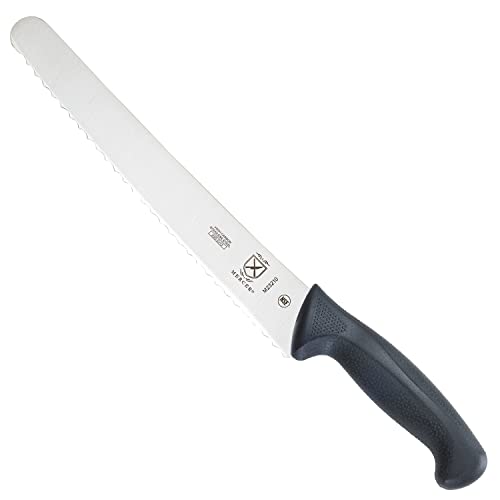
Best for budget-friendly bread lovers
2. Mercer Culinary Millennia Wavy Edge Bread Knife
A commercial-style bread knife with a wavy edge and a non-slip handle. It handles crusty loaves and is a common pick in professional kitchens.
Suits: budget-friendly bread lovers. Strengths: good grip and a simple design. Weaknesses: handle feels lightweight. Skip it if you want forged steel.


Best for those who like a weighty blade
3. Wusthof Classic Bread Knife
A forged German bread knife with a double-serrated edge and a classic riveted handle. It has the heft many cooks like for dense crusts.
Suits: those who like a weighty blade. Strengths: German steel and a balanced feel. Weaknesses: higher cost than basic knives. Skip it if you prefer a light knife.


Best for cooks who like Japanese styling
4. Shun Classic Bread Knife
A Japanese-style serrated knife with a wood-like handle and a polished look. It is built for clean slices through crusty bread.
Suits: cooks who like Japanese styling. Strengths: sharp, clean cuts and a handsome look. Weaknesses: handle shape suits some hands better than others. Skip it if you want a rugged commercial knife.

Best for home bakers
5. Tojiro DP Bread Slicer
A Japanese serrated knife with a sharp, thin blade. It is known among bread bakers for easy slicing of soft crumbs.
Suits: home bakers. Strengths: thin blade and clean cuts. Weaknesses: handle is plain. Skip it if you want a thick forged blade.
View Tojiro DP Bread Slicer on Amazon
Best for gift buyers and showmen
6. Dalstrong Shogun Series Bread Knife
A modern bread knife with a long blade and a G10 handle. It is made for show as well as slicing, with a bold, premium look.
Suits: gift buyers and showmen. Strengths: striking look and comfortable handle. Weaknesses: design is bolder than needed. Skip it if you want a plain tool.
View Dalstrong Shogun Bread Knife on Amazon
Care and Setup
- Hand wash the knife and dry it right away.
- Store it in a sheath or block to protect the teeth.
- Let hot loaves cool before slicing for neater cuts.
- Use a long, easy sawing motion rather than pressing down.
- Wipe the serrations with a damp cloth, moving away from the edge.
Mistakes to Avoid
- Pressing down hard instead of sawing.
- Cutting on a glass or stone surface.
- Using a short knife on a large boule.
- Throwing the knife in the dishwasher.
- Slicing a loaf that is still warm and steaming.
Serration Patterns Explained
The teeth on a bread knife do the work that a plain edge cannot. A crust is hard and a crumb is soft, and the serrations bite into the crust first, then saw through the interior without squashing it. Not all serrations are the same, and the pattern changes how the knife behaves.
Pointed, scalloped teeth with deep gullets grip hard crusts well and cut aggressively. They suit rustic loaves with thick, chewy crusts, but they can create more crumbs on soft interiors. Wavy or shallow serrations cut smoothly and often make cleaner slices through delicate crumbs, but may need more pressure to start on very hard crust. Double-serrated or combined patterns use two tooth sizes along the edge, aiming to start a cut and finish it cleanly.
Spacing matters too. Wide teeth bite deeply and work quickly on hearty crusts. Fine teeth leave a tidier surface on softer bread but may skate on a hard, floury crust. For sourdough, which is often chewy and has an open crumb, look for a pattern that grips the crust and moves through the crumb without tearing it. Check photos on the listing and consider whether you cut mostly large rustic boules, softer sandwich loaves or both.
Blade Length, Shape and Flexibility
Length determines how much of the loaf you can cut in one pass. A blade should be longer than the loaf is wide, so you can saw through without pressing. For a typical boule or batard, a long blade gives you room to draw the knife back and forth. For small rolls or baguettes, a shorter blade may feel more controlled and easier to store.
Shape also varies. Some bread knives have a straight spine and a gentle curve, while others are offset, with a bend in the handle that keeps your knuckles above the cutting board. An offset design is helpful for tall loaves and for people who struggle with knuckle clearance. Blade height affects stability, and taller blades guide the cut more steadily, though they can feel bulky in a drawer.
- Choose a longer blade for large rustic loaves and for slicing in one pass.
- Choose a shorter blade for small loaves or if storage space is tight.
- Consider an offset handle if your knuckles hit the board.
- Check whether the tip is rounded or pointed, since a pointed tip can help start cuts but is easier to damage.
Flexibility is a matter of taste. A stiffer blade resists bending on hard crust, while a flexible one follows the loaf more easily. Check the listing for descriptions, and remember that the feel is subjective.
Handles, Balance and Comfort
You will be sawing back and forth, often with a slippery or floury hand, so the handle matters. Synthetic handles tend to be grippy and easy to clean, which suits busy kitchens. Wood looks warm and feels pleasant but needs more care, since it should not sit in water. Composite materials sit between them. Whatever material you choose, look for a shape that fits your hand without pressing on your fingers.
Balance affects control. A knife that feels blade-heavy may cut forcefully but tire your wrist, and a handle-heavy one may feel clumsy. Many cooks prefer a knife that balances near the bolster, where the blade meets the handle. If you can, hold the knife with a pinch grip near the front of the handle to see how it feels. If you cannot test in person, read the listing for weight and shape, and consider your hand size.
- Check that the handle is securely attached with no gaps where food can lodge.
- Look for a bolster or guard that protects your fingers.
- Consider left- and right-handed comfort, since most serrated knives are symmetric.
- Avoid handles with sharp edges that dig into your palm during long slicing.
Those with arthritis or weak grip may value a larger, softer handle and a lighter blade.
Slicing Technique for Crusty Loaves
Even the best knife needs good technique. Let the loaf cool completely, since warm bread is gummy and compresses under the blade. Place it on a stable cutting board, ideally one with a groove or a tray to catch crumbs. A damp cloth under the board stops it sliding.
Hold the loaf with your non-cutting hand, fingers curled back, away from the blade. Start the cut at the crust with a few light strokes, using the back-and-forth sawing motion. Let the teeth do the work and avoid pressing down, which squashes the crumb. Use the whole length of the blade, drawing it toward you and pushing it away, and keep your wrist relaxed.
- For round loaves, cut in half first, then lay each half cut-side down to slice stably.
- For tall loaves, rotate the loaf onto its side if it helps keep the slices even.
- For thin slices, use a steady rhythm and a lighter touch.
- For very hard crusts, start with the heel and work through.
If slices tear, the knife may be dull or the bread may be too fresh. Resting bread for a few hours after baking improves slicing. Store the cut loaf cut-side down on a board or in a bread bag, so the crumb stays moist.
Sharpening, Storage and Long-Term Care
Serrated knives stay sharp longer than plain edges, because only the tips of the teeth touch the board. They still wear, and a dull bread knife will crush crust instead of cutting it. Signs include slipping on the crust, tearing slices and needing extra pressure.
Sharpening a serrated blade is different from sharpening a straight edge. Each tooth needs its own attention, usually with a tapered rod that fits the gullets, or with a professional service. Follow the maker’s advice, and do not use a regular flat sharpener, which can damage the pattern. Many owners send a bread knife for professional sharpening every so often, depending on use.
- Hand wash and dry the knife soon after use, to protect the edge and handle.
- Do not use the dishwasher, where knocks and detergent can dull the teeth.
- Use a wooden or soft plastic board, not glass, stone or ceramic.
- Store the knife in a sheath, block or on a magnetic strip so the teeth do not bang against other utensils.
- Wipe crumbs from the serrations with a damp cloth, moving along the blade away from the edge.
Replace the knife if the blade is bent, teeth are missing, the handle is loose or the knife can no longer be sharpened to cut cleanly.
Sourdough Bread Knife FAQ
Can I sharpen a serrated knife?
Yes, with a tapered rod or a service that handles serrated edges. Many bakers rely on professional sharpening every year or two.
How long should my bread knife be?
A blade of about ten inches suits most loaves. Smaller loaves can be sliced with a shorter blade.
Should I let sourdough cool before slicing?
Yes. A fully cooled loaf slices cleanly and keeps the crumb from smearing.
Is a serrated knife better than a straight one for sourdough?
For crusty bread, yes. The teeth bite through the crust while a straight edge tends to skid and squash the loaf.
Can a bread knife be used for anything other than bread?
Yes. It handles tomatoes, cakes, citrus and other items with a firm skin and soft interior. Keep it clean between uses, and wipe it before cutting bread so flavours do not transfer.
How do I stop crumbs flying everywhere?
Use a board with a groove or put a tray under it, and slice with a light sawing motion instead of pressing. Cutting a cooled loaf helps too.
Is a longer knife always better?
Not always. A long blade is convenient for big loaves, but it takes more space and may feel unwieldy on small ones. Choose a length that suits your usual bread and storage.
How can I tell if my bread knife is dull?
If it slips on the crust, tears the crumb or needs extra pressure, it is probably dull. Test it on a tomato or a soft loaf and see if it cuts cleanly.
Should I buy an offset bread knife?
An offset handle gives knuckle clearance, which helps on tall loaves and in thicker cutting boards. If you find your knuckles hit the board, it is worth considering.
Does the steel in the blade matter?
It affects edge retention and ease of care, and different makers use different steels. Check the listing for the steel type and care advice, and remember that proper maintenance matters as much as the material.
Why does warm sourdough squash when I cut it?
The crumb is still setting as it cools, so it stays gummy and soft. Let the loaf rest until fully cool for clean slices.
Why Serrated Edges Handle Crusty Loaves Better
A well-baked sourdough has a hard, thick crust and a soft, open crumb, and those two conditions pull against each other. A smooth blade has to push through the crust, and the force of pushing tends to squash the soft interior. A serrated edge works differently. The points bite into the crust first, so the blade cuts with a sawing motion rather than a push, and less downward pressure is needed. That keeps the slice even and the crumb intact.
Because serrations do the gripping, the knife does not need to be razor-sharp across its full length, and it stays useful for longer between sharpenings. The trade-off is that a serrated knife leaves a slightly rougher cut than a straight edge, which rarely matters on bread. For a very soft loaf, a lighter touch and a longer blade help even more.
Picking a Knife by Loaf Size and Kitchen Habits
The right knife depends on what you bake or buy. A large boule or batard needs a blade that is long enough to cut through in a single stroke, while a small loaf can be handled by a shorter knife. If you slice a loaf only a few times a week, a basic, dependable knife may be all you need. If you slice dozens of loaves a month, or serve guests, a more refined knife may make sense.
- Large boules: a longer blade gives clearance and fewer strokes.
- Small loaves and rolls: a shorter blade is nimbler and easier to store.
- Bakers with arthritis or weak grip: a lighter knife with a comfortable handle.
- Small kitchens: a knife that fits your drawer or block.
Also think about left-handed use. Most serrated knives are symmetrical, but a few have an angle ground on one side. Check this before you buy if you are left-handed.
Cutting Beyond Sourdough: Other Uses at the Counter
A good bread knife is rarely a one-trick tool. The same serrated edge handles tomatoes, citrus, cakes and layered sandwiches without crushing them. It works well on soft cakes that tend to compress under a straight blade and on thick-skinned fruit. For these jobs, use a gentle sawing motion and avoid forcing the blade.
It is not ideal for everything, though. Serrations make a mess of meat and hard cheeses, and trying to cut dense vegetables can chip or dull the teeth. Keep it for soft or crusty items and use a straight-edge knife for the rest. Doing so also helps the serrations last.
Where to Keep a Bread Knife and How to Cut Safely
Storage matters. A knife thrown loose into a drawer can dull and also cause injuries. Use a block, a magnetic strip or a blade guard. For safety while cutting, steady the loaf with a flat or curled hand, place a damp towel under the board so it does not slide, and let the knife do the work.
How a Bread Knife Fits Into a Small Knife Set
Many home cooks own an assortment of knives but only a few that earn regular use. A bread knife is one of the three most useful, alongside a chef’s knife and a paring knife. Because the serrated edge does a job that no other knife handles as well, it is worth owning even if the rest of your set is minimal. If you are on a tight budget, it is often wiser to spend a bit more on the bread knife than on a large block of mediocre blades.
Consider what you slice most. If you bake sourdough weekly, a dedicated, high-quality bread knife saves time and reduces waste. If bread is an occasional item, a simple model is enough. Either way, the edge should be treated as a specialist tool: used for bread and soft foods, hand-washed, and stored safely.
Signs It Is Time to Replace Your Bread Knife
Serrated knives do not announce when they are worn, but the clues are consistent. If you notice yourself pressing down harder, the loaf tearing instead of cutting cleanly, or crumbs flying where they did not before, the serrations may be rounded. A bent blade, a loose handle or visible rust are also reasons to retire a knife. Because serrated edges are tricky to sharpen at home, many people simply replace them once they wear out, though some can be refreshed with a tapered rod or a professional service.
Before replacing, check that the issue is not technique. Fresh bread, a stable board and a long sawing stroke solve many complaints without any new gear.
If you do replace it, look for a blade length that suits your usual loaf, a comfortable handle, and teeth that appear evenly cut with no gaps or rough spots. Reading owner feedback about durability can also reveal whether a model keeps its bite after months of regular use.
Frequently Asked Questions
What is the best cutting board for slicing sourdough?
A wooden or thick plastic board with a groove or a cloth beneath it works well. Wood is gentler on the edge, and a groove catches crumbs. Avoid glass or stone, which dull the knife quickly. A stable, non-slip surface matters more than the material.
Can a bread knife cut bagels safely?
Yes, with care. A serrated knife grips the crust, but a bagel is round and slippery, so use a stable board and a steady hand or a bagel guard. Cut slowly and keep your fingers well away from the edge.
Why does my bread knife tear the crumb?
Tearing usually comes from a dull blade, pressing down instead of sawing, or cutting bread that is still warm. Cool the loaf fully, use long, light strokes, and check whether the serrations are worn. A knife that is too short can also cause ragged cuts.
Do I need a separate knife for cake?
Not necessarily. A serrated bread knife often works well on sponge and layer cakes. If you bake cake often and want very clean slices, a long, thin slicing knife can give a smoother cut, but it is an optional extra.
Going Deeper: Getting the Most From a Bread Knife for Sourdough
Sourdough is the loaf that exposes a weak bread knife. The crust is hard enough to skid a dull edge across its surface, while the crumb inside is soft enough to crush under pressure, so the knife has to bite and glide at the same time. The six picks above approach that problem with different serration patterns, blade lengths and handle shapes, and the right choice depends on the loaves you actually bake or buy: their size, how dark you take the crust, and whether you slice a little every day or a whole loaf at once for the freezer. This section looks past the first slice and considers how each style of knife behaves across months of loaves.
Matching the Choice to the Way You Actually Work
If you bake large boules at home, your knife works hardest at the first cut, when the loaf is at its widest and the crust at its toughest. Length is your friend here, because a longer blade lets you saw with the whole edge instead of scrubbing back and forth in one spot, which tears the crumb. You also need a handle that stays comfortable through a full loaf, since home bakers often slice the entire loaf in one session. A knife that feels fine for two slices can become tiring by slice twelve, so imagine the whole job, not the first cut.
If you mostly buy bakery sourdough and slice as you eat, the demands are gentler but more frequent. The knife comes out twice a day for a few slices, so easy storage, a handle that is safe to grab quickly, and an edge that shrugs off daily contact with the board matter more than maximum length. This is also the pattern where a mid-priced knife often makes the most sense, because it will be used constantly but never asked to perform heroics on an oversized, extra-dark loaf.
If your counter sees more than bread, be honest about that too. Many bread knives spend their lives slicing tomatoes, melons, cakes and roasted vegetables as much as loaves. A knife bought only for sourdough still earns its place faster if it handles those jobs gracefully. Think about what else you cut in a normal week, and favour the pick whose blade shape and handle suit that wider list, rather than optimising for a single perfect loaf that appears once a month.
The Criteria That Matter Most, Revisited
Bread knife specifications are easy to list and easy to misread. These are the points that decide how the knife behaves on a real crust, translated from the numbers into slicing terms.
- Serration shape: Wide, scalloped teeth tend to glide through crust with less tearing, while fine, pointed teeth bite aggressively but can shred a tender crumb. Match the pattern to your loaves: the darker and thicker the crust, the more bite you need at the start of the cut.
- Usable blade length: Measure the toothed part, not the whole blade. The serrated section should be longer than your widest loaf is wide, so each stroke uses fresh teeth instead of grinding in one place.
- Blade stiffness: A blade that flexes sideways wanders through a tall loaf and produces wedges instead of slices. Some flex helps with curved crusts, but for straight, even slices through dense bread, a steadier blade is easier to control.
- Handle clearance: Your knuckles need room above the board at the bottom of the stroke. Offset handles solve this elegantly; straight handles solve it with length. Either way, check that you can finish a slice without rapping the board.
- Weight and balance: Heavier is not better here. Slicing is a sawing motion, and a knife that is light enough to move back and forth without effort, with balance near the handle, will cut cleaner slices at the end of a loaf than a hefty blade you are fighting.
- Edge care reality: Serrated edges stay useful for a long time but are awkward to restore. Consider honestly whether you will ever have the knife professionally sharpened, and favour a knife whose edge life suits your answer.
The pattern across these criteria is that control beats aggression. A knife you can guide in long, light strokes will outperform a fiercer knife that you have to push. When you compare the picks above, picture the thickest crust and the softest crumb you regularly meet, and choose the knife that handles both ends of that range without changing your technique.
A Step-by-Step Routine That Works
Good slicing technique rescues an average knife and ruins a good one when ignored. This short routine suits almost any sourdough loaf and any knife in the list above.
- Let the loaf cool properly: Warm sourdough has a gummy crumb that no knife can slice cleanly. Wait until the loaf is fully cool to the touch before cutting, however good it smells. This single habit improves slices more than any purchase.
- Stabilise the board: Put a damp cloth or a non-slip mat under the board so it cannot skate as you saw. A moving board is the main cause of uneven slices and most of the risk in the whole job.
- Start with the teeth, not pressure: Rest the blade on the crust and draw it back so the serrations bite, then saw in long strokes using the full length of the edge. Let the teeth do the work; pressing down crushes the crumb before the cut begins.
- Guide the slice with your other hand: Hold the loaf gently with fingers curled away from the blade, or steady the already-cut portion so it does not tear away at the last moment. Support matters most on the final third of the loaf.
- Cut to a plan: Decide the thickness before you start and keep your eyes on the previous slice as a guide. Slicing the whole loaf at once suits freezing; slicing as you go keeps the crumb fresher for daily eating.
- Wipe the blade as you work: Crumb and moisture build up on the edge and drag through later slices. A quick wipe with a dry cloth between loaves, or halfway through a big one, keeps the cut clean.
Most ragged slices blamed on a knife are really technique: bread cut warm, pressure instead of sawing, or a board sliding on the counter. Run this routine for a few loaves before concluding that your current knife has failed. If clean slices still elude you with a cool loaf and long strokes, then the edge itself is the problem, and the picks above become a genuine upgrade rather than an expensive experiment.
Troubleshooting: Problems, Causes and Fixes
The knife skids across the crust
Skidding means the teeth are not biting, either because the edge is worn or because the stroke is too tentative. Start the cut at the heel of the blade with a deliberate draw backwards, and use the corner of the loaf where the crust is thinner if the top is exceptionally hard. If every loaf skids, the serrations have flattened and the knife is nearing retirement.
Slices come out as wedges
Wedges happen when the blade wanders or the loaf shifts mid-cut. Slow down, keep the blade vertical rather than angled toward your guiding hand, and check the board is not moving. A blade that flexes a lot makes this worse, which is worth remembering if it happens with every loaf and every technique adjustment.
The crumb tears and balls up
Tearing usually means the bread is warm, the stroke is too short, or the teeth are too aggressive for a delicate crumb. Cool the loaf, lengthen the stroke, and lighten your hand. For very soft, enriched loaves, the gentlest scalloped edge in your drawer will always beat the fiercest one.
Crumbs everywhere except the board
Some crumb scatter is the tax sourdough charges. Reduce it by slicing on a large board with a groove, cutting with smooth strokes instead of a frantic sawing, and tipping the board to the bin or compost in one motion afterwards. A knife that cuts cleanly genuinely produces fewer crumbs, because torn crumb is what flies.
Care, Storage and Making It Last
Wash a bread knife by hand and dry it straight away, even if the maker tolerates a dishwasher. The machine rattles the edge against racks and other tools, and serrations suffer quietly until one day they simply stop biting. A quick wash, a dry with a cloth, and the knife is ready to store; it is a two-minute habit that adds years to the edge.
Storage is where most serrated edges die. Loose in a drawer, the teeth knock against every other utensil. A sheath, a magnetic strip, a slot in a block or even a simple edge guard keeps the serrations intact. If you use a strip, place the knife spine-first so the teeth are not dragged across the magnet each time.
Sharpening a serrated edge is possible but fiddly: each tooth needs attention from the flat side and the bevelled side, usually with a tapered rod, and many owners reasonably hand the job to a professional. Plan on that basis. A well-kept bread knife should give long service before it needs help, and when slices start tearing despite good technique and a cool loaf, that is the honest signal to sharpen or replace rather than to press harder.
Extra Questions, Answered
Is an offset bread knife worth it?
For people who slice whole loaves down to the board, often yes, because the dropped handle keeps your knuckles clear for the full stroke. For occasional slicing of a few pieces, a straight handle of decent length does the same job with less fuss. It is a comfort feature, not a cutting-quality feature.
What thickness should I slice sourdough?
Thick enough to support toppings and toasting without drying out, thin enough to bite through comfortably. Most home bakers settle on slices they can toast evenly and use for sandwiches; consistency from slice to slice matters more than hitting any particular measurement.
Can I slice sourdough with an electric knife?
You can, and for very large batches or hands that find sawing difficult it is a practical option. Most bakers still prefer a manual knife for control and quiet, but there is no rule that the job must be done by hand if another tool serves you better.
Why does the last slice always fall apart?
The final piece has nothing supporting it, so it flexes away from the blade and tears. Turn the remaining piece cut-side down and slice it flat on the board, or steady it firmly with your palm well clear of the edge. Supporting the piece matters more than the knife at that stage.
Should a bread knife live in a knife block?
Only if the slot fits without forcing the teeth against the wood each time. A block that grips the serrations wears them; a loose slot, a strip or a sheath is kinder. Whichever you choose, the goal is the same: the edge touches nothing hard between uses.
How the Picks Differ at the Board
The six knives above divide along lines that matter every time you slice. The Victorinox Fibrox Pro and the Mercer Culinary Millennia represent the working end of the range: grippy handles, honest steel and edges designed to be used hard and replaced without grief when they finally tire. The Wusthof Classic and the Shun Classic bring the fit, finish and balance of a considered knife collection, for cooks who handle their knives daily and notice such things. The Tojiro DP Bread Slicer and the Dalstrong Shogun Series appeal to buyers who enjoy a more distinctive blade and handle design alongside the cutting itself.
None of those groupings is a ranking. A bakery worker slicing forty loaves a day and a home baker slicing two are shopping for different virtues, and the list is built to serve both. What unites all six is that each can do the core job, biting a hard crust and gliding through a soft crumb, provided the loaf has cooled and the stroke is long. Choose your group by your hands, your loaves and your storage, then choose within it by the details in the reviews: handle shape, blade length and how the knife will be kept between uses.
Slicing for the Freezer, the Table and the Lunchbox
How you intend to eat the loaf should steer how you slice it. For the freezer, slice the whole cooled loaf in one session, because a frozen loaf is miserable to cut later, and freeze the slices so they can be taken out a few at a time and toasted straight from frozen. Even thickness matters here more than anywhere, since uneven slices toast unevenly. Your longest, steadiest knife earns its place on freezing day, and it is worth wiping the blade between halves of the loaf to keep the later slices as clean as the first.
For the table, slice as you serve if the meal allows it, because bread cut at the last moment keeps its crumb supple and its crust crisp. For sandwiches and lunchboxes, slightly thicker slices stand up to fillings and travel without tearing, and a gentle sawing stroke keeps soft fillings-side crumb from compressing. None of this requires different knives, but it does reward the cook who thinks about the destination of the slice before the first cut, rather than discovering halfway through that the loaf was sliced for toast when it was needed for sandwiches.
When a Bread Knife Has Earned Its Replacement
A serrated knife rarely announces its retirement dramatically. Instead the signs accumulate: the blade begins to skid on crusts it once bit, slices tear on loaves that used to cut cleanly, and you notice your hand pressing harder, which is both a quality problem and a safety one, since force is what turns a slip into an injury. Before replacing, rule out the impostors: a warm loaf, a sliding board, a blade fouled with crumb. If a cool loaf, a steady board and a clean blade still tear, the teeth have genuinely flattened.
At that point the choice is professional sharpening or replacement, and the honest deciding factor is the knife’s tier. A treasured, well-made knife deserves the sharpening bench; an inexpensive workhorse that has sliced faithfully for years has usually repaid its cost, and a fresh one restores the pleasure immediately. Either way, do not demote a dull bread knife to other kitchen jobs out of thrift. A dull serrated blade is worse than useless on tomatoes and cakes; it is the knife most likely to slip, because you push it hardest.
A Note on Hands, Handles and Confidence
One under-discussed factor in bread slicing is simple confidence. People press, saw frantically or rush because they do not trust the blade, and the loaf suffers for it. A handle that fills your hand without forcing a tight grip, and a blade long enough that you never feel you are running out of edge, both build the calm that good slices come from. If your hands are small, a slimmer handle you can wrap fully will feel safer than a grand one you perch on; if your hands are large, the opposite applies. When comparing the picks above, treat handle descriptions as seriously as blade descriptions, because your hand is on the handle for every second of every cut, and comfort there quietly decides how much force you use and how straight your slices run.
More Questions, Answered
Should I cut sourdough on the day it is baked?
You can, once it has cooled fully, and the flavour rewards patience. Cutting early, while the crumb is still setting, gives gummy slices whatever knife you own. If you bake in the morning for the evening meal, the loaf will be in perfect slicing condition by the time you need it.
How do I slice a very tall loaf evenly?
Turn the loaf on its side and slice through the narrower profile, supporting it with your guiding hand on top. This shortens the cut, steadies the loaf and makes even thickness much easier to judge than wrestling through the full height of a proud boule.
Can a bread knife damage a cutting board?
Any knife can, but serrated edges are relatively kind because the sawing motion spreads contact. Wood and good plastic boards handle it well. Glass and stone boards are the real problem in the pairing, and they damage the knife far faster than the knife damages them.
A bread knife is a modest purchase that touches every loaf you eat, which is why the right one feels like a disproportionate upgrade. Match the pick above to your loaf size, your slicing habits and your willingness to maintain a serrated edge, then give technique a fair chance to do its share of the work. Cool bread, long strokes and a steady board, paired with an edge that still bites, will turn sourdough from a wrestling match into the quiet pleasure it is supposed to be.
The Short Version
For a dependable workhorse, the Victorinox Fibrox Pro. For a budget-friendly wavy edge, the Mercer Millennia. For heft, the Wusthof Classic. For Japanese style, the Shun Classic. For a thin slicer, the Tojiro DP. For a bold look, the Dalstrong Shogun.

