Disclosure: topratedkitchenware.com is reader-supported. When you buy through links on our site, we may earn an affiliate commission from Amazon and other retailers, at no extra cost to you.
Where to buy
The best kpod and brew combo coffee makers solve one specific problem: a household that wants pods for speed, grounds for choice, and in the best cases a carafe for company, without owning three machines. Three picks in the verified pool genuinely brew both pods and grounds, and they are linked below. Three further machines are drip-only brewers, included prose-only as honest comparisons with no link and no image.
- Hamilton Beach FlexBrew Advanced 4-in-1 Single Serve — check the latest price on Amazon
- Hamilton Beach FlexBrew Advanced 5-in-1 Drip & Single Serve — check the latest price on Amazon
- Ninja Single Serve Coffee Maker, PB051 — check the latest price on Amazon
- BLACK+DECKER 12 Cup Thermal Programmable, CM2046S —
- Cuisinart PerfecTemp 12-Cup Thermal Drip, DCC-3400NAS —
- BLACK+DECKER CaféCraft 12-Cup Thermal, Hot & Iced —
Read the full guide ↓
Combo coffee makers exist because real households are inconsistent, and the best kpod and brew combo coffee makers are the ones that respect that inconsistency instead of punishing it. One partner leaves at six and wants a pod. The other works from home and brews grounds properly at nine. Weekend guests need a pot. A single-format machine serves one of those people well and the others badly, which is how kitchens end up with a pod machine, a drip brewer and a kettle all fighting for the same counter.
This guide sorts the verified pool into machines that truly combine formats and machines that merely sit nearby. Three picks brew pods and grounds, in single-serve or dual-format designs, and they carry the links and images. Three drip-only machines are reviewed prose-only, not as failures, but as the comparison class that helps you decide whether you need a combo at all. The vocabulary matters, the reservoirs matter, and your actual weekly pattern matters most of all.
Key Takeaways
- Three picks genuinely combine pods and grounds: two Hamilton Beach FlexBrew models and the Ninja PB051, and they are the linked picks.
- The FlexBrew 5-in-1 is the only pick with a true carafe side, pairing a 12-cup thermal drip brewer with a single-serve pod and grounds station.
- Three pool machines are drip-only and are reviewed prose-only as comparisons, with no link and no image.
- Decide first whether your combo need is pods-plus-grounds in one cup size, or pots-plus-pods across formats; they lead to different picks.
- Reservoir size quietly decides daily happiness: 45, 56 and 60 oz options appear among the linked picks.
In this guide
Quick Picks
Linked combo machines come first, in the order that best matches the keyword: single-serve flexibility, then the full dual-format machine, then the style-led Ninja. The drip-only comparisons follow, clearly labelled prose-only.
| Pick | Badge | Best for | Check |
|---|---|---|---|
| Hamilton Beach FlexBrew Advanced 4-in-1 Single Serve | Best Pod-and-Grounds Single Serve | Solo and couple households that switch between pods and grounds | Check on Amazon |
| Hamilton Beach FlexBrew Advanced 5-in-1 Drip & Single Serve | Best Overall Combo | Mixed households where some drinkers want a pot and others want a pod | Check on Amazon |
| Ninja Single Serve Coffee Maker, PB051 | Best for Brew Styles | Variety-seeking single-serve drinkers who use both pods and grounds | Check on Amazon |
| BLACK+DECKER 12 Cup Thermal Programmable, CM2046S | Prose-Only Comparison: Drip-Only Brewer | Readers who discover they only need a pot brewer after all | Prose-only comparison (no link) |
| Cuisinart PerfecTemp 12-Cup Thermal Drip, DCC-3400NAS | Prose-Only Comparison: Premium Drip-Only | Comparison readers benchmarking drip quality | Prose-only comparison (no link) |
| BLACK+DECKER CaféCraft 12-Cup Thermal, Hot & Iced | Prose-Only Comparison: Drip-Only With Iced Mode | Pot-only households tempted by an iced mode | Prose-only comparison (no link) |
How These Picks Were Chosen
Eligibility for this guide was mechanical and strict: a linked pick had to brew pods and also brew ground coffee, because that dual input is the entire meaning of a pod-and-brew combo. Each pool machine’s verified listing was checked for a pod path and a grounds path. Three machines passed both tests. Three machines, however good as drip brewers, had no pod function at all, and they were moved to prose-only comparison status rather than being allowed to dilute the keyword’s promise.
Among the eligible machines, the comparison weighed format range, reservoir capacity, carafe presence, hot and iced capability and the cleaning burden that multi-format machines honestly carry. This is a research-led guide built from verified listings and category knowledge, not a claim of hands-on bench testing, and its spec boxes use only data present in the verified pool.
No prices or fixed ratings are printed, because both drift constantly. Linked picks carry a check-price prompt instead, and prose-only picks carry qualitative positioning, so the guide stays accurate long after any single shopping day.
The Best Kpod and Brew Combo Coffee Makers, Plus Three Drip-Only Comparisons
The three linked machines below each brew pods and grounds, and each carries its verified image. The three comparisons that follow are drip-only brewers, reviewed in prose with no link and no image, included so you can see exactly what a combo adds over a good pot machine. For the wider pod landscape, our roundup of 6 Best Pod Coffee Makers Keurig Nespresso And More 2026 is a useful companion.

Hamilton Beach FlexBrew Advanced 4-in-1 Single Serve
Badge: Best Pod-and-Grounds Single Serve
Strengths
- Uses pod packs and ground coffee, so one machine covers both habits
- Removable 45 oz reservoir beats fill-per-cup minis for daily use
- Hot and iced coffee modes in one single-serve footprint
Trade-offs
- Single-serve only: there is no carafe side for a full pot
- Pod and grounds versatility adds parts to rinse between modes
- 45 oz reservoir is mid-size, so busy households refill more often
Key specs (from the verified listing)
- Modes: 4-in-1 single serve
- Coffee types: Pod packs and grounds
- Reservoir: Removable 45 oz reservoir
- Drinks: Hot and iced coffee
The FlexBrew Advanced 4-in-1 is a genuine pod-and-brew machine in the single-serve sense: it takes pod packs when speed matters and loose grounds when you want your own coffee, from one removable 45 oz reservoir. That dual input is the heart of the combo idea, and this model delivers it without demanding carafe space on the counter.
Hot and iced modes widen its day further, covering a morning mug and an afternoon iced coffee without a second appliance. The honest boundary is batch size. When guests arrive and a pot is the right answer, a single-serve combo cannot stretch to meet it, which is exactly the gap the 5-in-1 model below was built to close.
For the combo brief, this 4-in-1 is the purest single-serve expression: two coffee inputs, one cup at a time, and no carafe pretending to be involved.
Best for: Solo and couple households that switch between pods and grounds / Not suited for: Anyone who regularly brews a full pot for a table of people
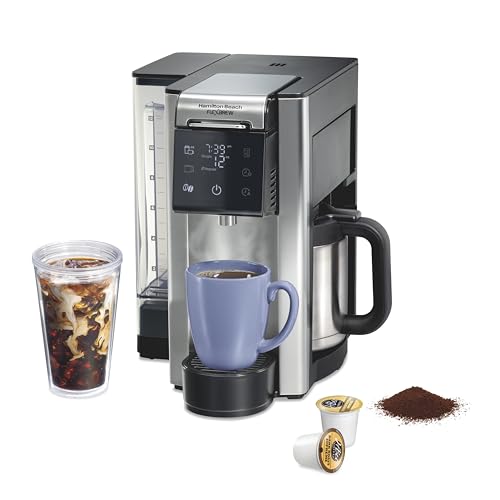
Hamilton Beach FlexBrew Advanced 5-in-1 Drip & Single Serve
Badge: Best Overall Combo
Strengths
- True two-format machine: 12-cup thermal drip plus single-serve pods and grounds
- Removable 60 oz reservoir feeds a flexible, programmable routine
- Thermal carafe keeps a pot hot without a scorching warming plate
Trade-offs
- The largest footprint in this roundup, so measure cabinet clearance first
- More modes mean more parts, settings and cleaning touchpoints
- Households that only ever brew one format pay for flexibility they may not use
Key specs (from the verified listing)
- Modes: 5-in-1 drip and single serve
- Carafe side: 12 cup thermal, programmable
- Single-serve side: Pods and grounds
- Reservoir: Removable 60 oz reservoir
- Drinks: Hot and iced coffee
If the combo brief means a pot on Saturday and a pod on Tuesday, this 5-in-1 FlexBrew is the most complete answer in the pool. One side is a programmable 12-cup thermal drip brewer; the other is a single-serve station for pods and grounds, fed by a removable 60 oz reservoir. It is two machines’ worth of routine in one chassis.
The thermal carafe deserves its mention: coffee held in an insulated carafe avoids the stewed taste a hot plate can give a pot that sits. The cost of all this range is size and complexity. Counters are finite and settings multiply, so this pick rewards households that will genuinely use both sides every week.
This is the machine the keyword describes most completely, because it is the only pick where a full pot and a single pod genuinely share one counter footprint.
Best for: Mixed households where some drinkers want a pot and others want a pod / Not suited for: Minimalist counters or single-format drinkers

Ninja Single Serve Coffee Maker, PB051
Badge: Best for Brew Styles
Strengths
- Takes K-Cup pods and grounds, covering the two main single-serve inputs
- Four brewing styles give more drink variety than a basic pod machine
- 56 oz removable reservoir and cup sizes up to 24 oz suit big mugs and travel cups
Trade-offs
- Single-serve format only, with no carafe side for groups
- Style choices add a small learning curve over one-button brewers
- Large travel-cup sizes can dilute a small pod if you are not careful with ratios
Key specs (from the verified listing)
- Coffee types: K-Cup pods and grounds
- Styles: 4 styles of brewing
- Cup sizes: Up to 24 oz
- Reservoir: 56 oz removable reservoir
- Model: PB051
Ninja’s PB051 approaches the combo idea through styles rather than sides: pods or grounds in, four brewing styles out, with cup sizes running up to 24 oz and a 56 oz removable reservoir behind it. For a single drinker whose taste changes by the day, that range covers more moods than a fixed pod routine.
The large maximum cup size is a genuine differentiator for travel-mug households, provided you match pod or grounds quantity to the volume so a big cup does not taste thin. Like the 4-in-1 above, it stops at single-serve. Within that boundary, it is the most expressive machine in this roundup.
Ninja’s entry reframes the combo as a styles question, and for drinkers whose variety is about the cup rather than the batch, that reframing is the right one.
Best for: Variety-seeking single-serve drinkers who use both pods and grounds / Not suited for: Households needing a carafe for shared pots
BLACK+DECKER 12 Cup Thermal Programmable, CM2046S
Badge: Prose-Only Comparison: Drip-Only Brewer
Prose-only entry: Drip-only machine with no pod or single-serve function, so it does not meet the pod-and-brew combo brief; presented prose-only as a pot-brewing comparison. It is reviewed in full below, with no Amazon link and no product image.
Strengths
- 12-cup thermal carafe with programmable convenience
- Brew strength control and VORTEX showerhead aim for even extraction
- A straightforward pot brewer with no pod parts to manage
Trade-offs
- Drip only: it cannot brew a pod, so it fails the combo brief
- No single-serve side for one quick cup
- Thermal carafe models need the lid rinsed carefully to stay fresh
Key specs (from the verified listing)
- Capacity: 12 cup thermal carafe
- Features: Programmable, brew strength control
- Technology: VORTEX Technology
- Model: CM2046S
This BLACK+DECKER is documented prose-only because it is a drip-only machine: a capable 12-cup thermal programmable brewer with brew strength control and a VORTEX showerhead, but no pod or single-serve function at all. In a combo guide, capability in the wrong category does not earn a link.
Its value here is as a measuring stick. If reading about combo machines makes you realise you only ever brew pots, a dedicated drip brewer like this class is the simpler purchase. If you truly split your week between pots and pods, stay with the linked FlexBrew 5-in-1 above.
As a comparison, this drip brewer marks what you give up when you choose a combo: nothing in pot quality is automatic, and a dedicated machine sets a real standard.
Best for: Readers who discover they only need a pot brewer after all / Not suited for: Pod drinkers, since there is no pod function
Cuisinart PerfecTemp 12-Cup Thermal Drip, DCC-3400NAS
Badge: Prose-Only Comparison: Premium Drip-Only
Prose-only entry: Drip-only machine with no pod or single-serve function, so it does not meet the pod-and-brew combo brief; presented prose-only as a premium drip comparison. It is reviewed in full below, with no Amazon link and no product image.
Strengths
- Double-wall stainless thermal carafe holds heat without a hot plate
- PerfecTemp hotter brewing and brew strength control target a fuller cup
- Polished drip-only design with a long category track record
Trade-offs
- No pod or single-serve capability, so it does not meet the combo brief
- Premium drip positioning without the flexibility combo buyers came for
- Thermal carafe is heavier to pour than glass
Key specs (from the verified listing)
- Capacity: 12-cup thermal carafe
- Carafe: Double-wall stainless steel
- Features: PerfecTemp hotter brewing, brew strength control
- Model: DCC-3400NAS
Cuisinart’s PerfecTemp thermal is another prose-only comparison entry: an accomplished drip brewer with a double-wall stainless carafe and hotter brewing, but no way to brew a pod. It represents the premium end of the drip-only world that combo shoppers are choosing to leave, or to combine.
Consider it the quality bar for the pot side of a combo. If a two-format machine’s drip side tastes noticeably worse than a dedicated brewer of this class, the convenience may not be worth it. That is the standard the linked combo picks should be judged against.
This premium drip machine is the extraction benchmark in the pool, included so combo shoppers can judge whether flexibility is costing them cup quality.
Best for: Comparison readers benchmarking drip quality / Not suited for: Anyone who needs pods or single cups
BLACK+DECKER CaféCraft 12-Cup Thermal, Hot & Iced
Badge: Prose-Only Comparison: Drip-Only With Iced Mode
Prose-only entry: Drip-only machine with no pod or single-serve function, so it does not meet the pod-and-brew combo brief; presented prose-only to clarify that hot-and-iced is a temperature feature, not a format combo. It is reviewed in full below, with no Amazon link and no product image.
Strengths
- 12-cup thermal pot brewing with programmable timing
- Hot and iced drip modes broaden a pot brewer’s range
- Simple controls for households that want a pot and little else
Trade-offs
- Still drip-only: no pod holder, no single-serve grounds basket
- Iced mode brews a pot format, not a single iced cup on demand
- Does not solve the one-cup problem that sends buyers to combo machines
Key specs (from the verified listing)
- Capacity: 12-cup thermal
- Modes: Hot and iced, programmable
- Brand line: CaféCraft
The CaféCraft closes the comparison set prose-only. It is a 12-cup thermal drip machine with a programmable routine and a hot-and-iced twist, which makes it a versatile pot brewer, but versatility within one format is not a combo. There is no pod path and no single-serve side.
It earns its paragraph by clarifying the vocabulary of this category: hot-and-iced is a temperature feature, while pod-and-brew is a format feature. Buyers who need the format feature should choose from the linked picks; buyers who only need the temperature feature have simpler options like this class.
The CaféCraft comparison closes the set by separating temperature flexibility from format flexibility, a distinction worth keeping for any future coffee purchase.
Best for: Pot-only households tempted by an iced mode / Not suited for: Pod and single-cup drinkers
Comparison Table
Read the table by format first and features second. The linked rows are the only ones with two coffee inputs; the prose-only rows show what a dedicated pot brewer offers when format range is not required.
| Pick | Badge | Key attribute | Check |
|---|---|---|---|
| Hamilton Beach FlexBrew Advanced 4-in-1 Single Serve | Best Pod-and-Grounds Single Serve | 4-in-1 single serve | Check on Amazon |
| Hamilton Beach FlexBrew Advanced 5-in-1 Drip & Single Serve | Best Overall Combo | 5-in-1 drip and single serve | Check on Amazon |
| Ninja Single Serve Coffee Maker, PB051 | Best for Brew Styles | K-Cup pods and grounds | Check on Amazon |
| BLACK+DECKER 12 Cup Thermal Programmable, CM2046S | Prose-Only Comparison: Drip-Only Brewer | 12 cup thermal carafe | — |
| Cuisinart PerfecTemp 12-Cup Thermal Drip, DCC-3400NAS | Prose-Only Comparison: Premium Drip-Only | 12-cup thermal carafe | — |
| BLACK+DECKER CaféCraft 12-Cup Thermal, Hot & Iced | Prose-Only Comparison: Drip-Only With Iced Mode | 12-cup thermal | — |
How to Choose a Pod and Brew Combo Coffee Maker
Combo machines fail buyers in a predictable way: the buyer imagines using every mode, then lives on one. The defence is to choose by your dominant pattern and treat the second format as insurance, not as the main event. A household that brews grounds daily and pods monthly needs a different machine from a pod household that hosts a pot-drinking family at holidays. Shoppers comparing formats may also enjoy 6 Best Percolator Coffee Makers Stovetop Camp And Electric.
Format vocabulary deserves a minute before money moves. Single-serve combos take pods and grounds for one cup. Dual-format machines add a carafe side for pots. Hot-and-iced describes temperature, not format. Keeping those three ideas separate prevents the most common disappointment in this category.
Single-serve combo or dual-format machine?
If every drink in your house is made one cup at a time, a single-serve combo like the FlexBrew 4-in-1 or the Ninja PB051 covers pods and grounds without carafe bulk. If a pot appears weekly, for guests, meetings or a household coffee round, only a dual-format machine like the FlexBrew 5-in-1 truly answers, and its larger footprint is the fair price of the second format.
Reservoir size and refill rhythm
Reservoirs in the linked picks run from 45 to 60 oz, and the difference shows up as refills per week. A solo drinker barely notices a 45 oz tank. A couple brewing morning cups plus afternoon iced coffees will refill a small tank often enough to care. Removable reservoirs, which all three linked picks offer, matter as much as size, because a tank you can carry to the sink gets cleaned properly.
Grounds handling and cleanup honesty
Every grounds mode creates a small reusable basket or filter to empty and rinse, and every pod mode creates pod waste. Combo ownership is therefore a two-stream cleanup habit. Buyers who know they will resent rinsing a grounds basket should be honest now and choose a pod-led routine, rather than discovering it in month two and abandoning the feature they paid for.
Iced coffee: mode or afterthought?
Hot and iced capability appears across this pool, but it means different things. On single-serve combos it usually means a concentrated brew over ice in your cup. On pot machines it means a batch for the fridge. Decide which iced drink you actually make, a single afternoon glass or a pitcher, and match the machine’s version of iced to it.
Counter footprint and cabinet height
Dual-format machines are the widest and tallest in this roundup. Measure the counter run and the gap to your wall cabinets, including the height with the lid or pod lever open, because combo machines often need clearance above for loading. A machine that cannot open fully under your cabinets will annoy you every single morning.
How to Run a Combo Coffee Maker Day to Day
A combo machine settles into a household best when each format has a small ritual. Keep pods in a drawer or caddy by the machine, keep the grounds basket rinsed and dry between uses, and decide which format owns the weekday morning so nobody is hunting for parts while half awake. The machine can do everything; your routine should still have a default. If counter space is your constraint, see 6 Best Multipurpose Coffee Makers Pods And Grounds 2026.
Water discipline matters more on combos, because a shared reservoir feeds every format. Fill with fresh water, empty and rinse the tank weekly, and descale on the schedule the manual sets for your water hardness. Stale water and scale are the two fastest ways to make a flexible machine taste inflexible.
- Start the day by checking the reservoir level, topping up with fresh water before the first brew rather than after the last.
- For pods, seat the pod firmly, close the holder fully and brew straight into the cup or travel mug.
- For grounds, fill the reusable basket evenly without packing it down, and shake off loose grounds before inserting it.
- For a pot on a dual-format machine, set the carafe side up the night before where programming allows, with the carafe seated correctly.
- For iced drinks, fill the cup or carafe with ice first and use the iced mode so the brew is concentrated enough to survive dilution.
- At day’s end, eject the used pod or grounds, rinse the basket and drip tray, and leave lids ajar to dry.
Problem: Weak cup from the grounds mode → the basket was underfilled or the grind is too coarse for a short brew. Add a little more coffee and use a medium grind.
Problem: Pod mode spluttering or leaking → the pod is not seated flat or the holder was not closed fully. Reseat the pod, close firmly and run a water-only cycle to clear the needle area.
Problem: Pot tastes stale while single cups taste fine → the carafe and its lid are holding old coffee oils. Wash the carafe with hot soapy water and rinse the lid channels thoroughly.
Pods, Grounds and the Real Cost of Flexibility
Flexibility has a running cost that rarely appears on the box. Pods are the most convenient input and the most expensive per cup over a year, with packaging waste attached. Grounds are the cheapest input per cup and the most flexible for taste, with a rinse-and-empty habit attached. A combo machine lets a household slide along that spectrum week by week, using pods on rushed mornings and grounds when there is time to enjoy the ritual. For the design-led view of the category, browse 6 Best Mini Coffee Makers For Small Spaces And Travel 2026.
The smart way to exploit a combo is deliberately: assign pods to the moments where minutes matter, and grounds to the moments where flavour matters, instead of drifting into pods for everything and wondering why the grounds basket is gathering dust. Households that make that small decision consciously report, in category feedback generally, the highest satisfaction with dual-input machines, because both halves of the purchase stay in honest use.
When a Drip-Only Machine Is the Better Buy
It would be a strange combo guide that never admitted the alternative. If your household brews a pot every morning, drinks it together and rarely wants a single cup, a dedicated drip brewer is simpler, usually smaller in the ways that matter and free of pod hardware you will never touch. The prose-only comparisons in this guide are exactly those machines, and for pot-only homes they are not consolation prizes; they are the correct category. Another helpful comparison is 6 Best Looking Coffee Makers Retro And Modern 2026.
The tell is the guest test. Many buyers justify a combo with the twice-a-year visit of pod-drinking relatives, then live with extra parts and footprint for the other 363 days. Borrowing a small pod machine for a visit, or keeping a stovetop pot for guests, can be the more rational answer. Combos earn their counter when both formats are weekly habits, and this guide’s linked picks are aimed squarely at those households.
Descaling a Machine That Does Everything
Scale is the silent tax on flexibility, because a combo machine’s shared water path carries every format you brew. Hard water leaves mineral deposits that slow heating, cool the brew and eventually make both pods and grounds taste dull. Descaling on the maker’s schedule, with the solution strength the manual specifies, protects both sides of the machine at once, which is one of the quiet economies of a shared system.
Build the habit around a calendar anchor, such as the first weekend of a season, and run a full tank of fresh water through afterwards, split across both formats if your machine allows, so no descaler tang survives into Monday’s cup. Owners who descale on schedule rarely meet the sputtering, slow-brewing problems that fill complaint threads about machines of every brand.
One Reservoir, Two Formats: Water Discipline in a Combo Machine
A combo machine’s shared reservoir is its elegance and its vulnerability: every format drinks from the same tank, so the tank’s condition flavours pods, grounds and pots alike. The discipline that protects all three is identical to the single-format rule, only more valuable: fresh water in, a weekly empty-rinse-refill rather than endless topping up, and descaling on schedule so the shared water path stays honest. Households that keep the reservoir sweet rarely have flavour complaints about any side of the machine.
There is a scheduling dividend too. A programmable pot side can be set the night before while the single-serve side stands ready for the household’s early riser, and because both draw on one filled reservoir, the evening setup is a single act. Combo ownership rewards the household that thinks in systems, and the reservoir is where that thinking starts.
The Hosting Playbook for a Dual-Format Household
Guests expose a coffee setup’s true shape, and a dual-format machine’s shape is generous: a pot brewed for the table, and a single-serve side for the guest who wants decaf, tea-style pods or a smaller cup than the pot’s pour. The host’s preparation is to stage both formats before guests arrive: carafe side loaded, pods visible, grounds basket clean and ready, and the reservoir full. With that staging done, the machine runs the coffee service and the host stays at the table.
The detail that elevates the play is asking once, early: pot or pod, regular or decaf, and then letting the machine’s two formats honour the answers without a second round of questions. Households that entertain monthly find this alone justifies the combo’s footprint, because the alternative, a pot plus apologies, or two machines plus clutter, serves nobody as well.
Grounds Freshness for the Basket Side of the Machine
The grounds side of a combo is a small drip brewer wearing a shared coat, and it obeys drip rules: fresh coffee, a medium grind, and a dose matched to the cup or pot being brewed. Because combo users alternate formats, their grounds often sit longer between uses than a drip household’s do, which makes storage the quiet decider: an airtight container in a cool cupboard, bought at drinking pace, keeps the grounds side tasting like a choice rather than a compromise.
Basket hygiene completes the picture. A reusable grounds basket that is emptied and rinsed after each use brews cleanly for years; the same basket left loaded between formats will season the next pod-side day with stale oils through the shared water path’s neighbourhood. The rinse takes twenty seconds and is the cheapest quality insurance the grounds format offers.
Counter Layout for a Machine With Two Jobs
A combo machine earns a workstation, not a parking spot: pods in a drawer or caddy on one side, grounds and their scoop on the other, cups above, and the bin for spent pods and grounds within a step. Laying the station out by format prevents the morning fumble where the pod drinker moves the grounds gear and the grounds drinker buries the pods, a small domestic friction that good layout deletes permanently.
Height and swing deserve the tape measure before the machine arrives. Lids, levers and carafe paths all need their clearance, and a dual-format machine is the widest guest most counters will host. Households that measure once, including the open-lid height, report the machine as furniture; households that guess report it as an obstacle, with the same machine in both stories.
Pod Inventory Without the Stale Drawer
Combo households hold two inventories, pods and grounds, and each stales by its own clock. The pod rule is rotation: a tight selection of favourites, bought at drinking pace, oldest at the front. The failure mode is the novelty drawer, twelve open varieties ageing together, which converts the pod side’s variety advantage into a freshness liability and quietly teaches the household to prefer the grounds side for the wrong reason.
A monthly five-minute audit keeps both inventories honest: pods counted and rotated, grounds checked for aroma and age, the shopping list written from evidence rather than from memory at the shop. It is the smallest possible bureaucracy, and it is what separates households that love their combo in year two from households that drifted back to a single format and a drawer of regrets.
The Night-Before Ritual: Programming Without Regret
Programmable brewing is often sold as waking to coffee, but its deeper value is decision removal: the morning’s first task is already done, correctly, by yesterday’s calmer self. The ritual that makes it work is unglamorous: carafe rinsed and seated, filter fitted, dose measured, water filled, strength chosen, timer set. Five minutes in the evening, in exchange for a morning that starts with pouring. Households that build the ritual keep the feature; households that wing it abandon the timer within a month.
One honest caveat belongs here: grounds measured the night before sit in the basket for hours, and purists will note a small freshness cost against grinding at dawn. The trade is real and worth making for most households, because the alternative is often not dawn grinding but no coffee until the kettle of chaos boils over. Programme the pot, and let the weekend be the time for ceremony.
Carafe Care: Lids, Seals and the Taste of Old Coffee
A thermal carafe is a thermos with a social life, and its lid is where old coffee goes to hide. Coffee oils coat the lid’s channels and the pour spout, and a carafe that is merely rinsed will slowly season every fresh pot with the ghost of the last one. The fix is a daily hot, soapy wash that includes the lid taken apart as far as its design allows, and a weekly soak for the vessel itself when the morning’s pot has been sitting long.
Seals deserve the same respect. A lid that no longer seals is a carafe that no longer keeps heat, whatever the steel walls promise, and most heat complaints in this class trace back to a lid left ajar, a seal fouled with grounds, or a carafe that started cold. The pre-warm rinse, the sealed lid and the weekly deep clean are the whole liturgy; machines in this guide ask for nothing more.
Water Temperature and Why Hotter Brewing Claims Exist
Several machines in and around this pool advertise hotter brewing, and the claim addresses a genuine weakness of home drip: water that arrives at the grounds too cool under-extracts, leaving the pot sour and thin no matter the dose. Properly hot water, evenly distributed, is what turns a large basket from a lottery into a system. This is also why pre-heating matters at the other end: a thermal carafe that starts cold steals the heat the brewer worked to deliver.
The buyer’s translation is simple. Treat hotter-brewing designs and good showerheads as extraction insurance, especially at twelve cups where the bed is wide and the stakes are a whole pot. Then do your part with fresh coffee, a right dose and a warm carafe, and the class of machines in this guide will show you why the thermal drip format endures.
Teaching the Household the Two Rituals
A combo machine asks its household to learn two small rituals instead of one, and the households that thrive with combos teach both explicitly in the first week: the pod ritual, seat, close, brew, eject, and the grounds ritual, fill the basket level, brew, empty, rinse. Written nowhere and assumed everywhere, the second ritual is the one that decays, which is how grounds baskets end up discovered, loaded and stale, by a horrified weekend user.
The teaching device can be as small as a note inside the cupboard door. What matters is that both formats have an owner’s manual written by the household itself, in its own quantities and timings. Machines do not create habits; households do, and a combo simply doubles the number of habits worth creating.
Glass Versus Thermal, Settled for the Large Pot
The glass carafe survives in drip coffee for honest reasons: it is light, it pours beautifully, it shows the coffee level at a glance and it is cheap to replace. Its partner, the warming plate, is where the trouble lives, because a plate’s job is to keep adding heat to a drink that finished brewing an hour ago. Small pots drunk quickly can live with that bargain. Large pots, whose last cup may be poured at midday, cannot, which is why every machine in this programme’s large and thermal guides insulates instead.
Thermal ownership has its own small print, and this guide has been consistent about it: pre-warm the vessel, seal the lid, wash the lid’s channels, and accept a slow cooling curve as the price of uncooked flavour. Buyers who accept that print get the better last cup, which, across a year of large pots, is hundreds of better cups, a return no single feature badge can match.
Brew Baskets and Bed Depth: Why Dose Shape Matters
A drip basket is a small landscape, and coffee extraction is its weather. A dose spread too thin lets water race through channels and under-extract; a dose mounded too deep drowns at the edges and starves in the middle. Large baskets widen the landscape and therefore the risk, which is why the showerhead systems and strength controls in this pool matter, and why the humble act of levelling the bed before brewing is worth more than most accessories.
The practical ritual is ten seconds: dose, level with a gentle shake, check that the filter sits cleanly against the basket walls, and brew. Households that adopt it stop experiencing the mysterious alternation of strong and weak pots from the same machine and the same coffee, because the variable was never the machine. It was the landscape, and it is now level.
The First Week With a Combo: A Realistic Diary
Day one with a combo machine is always pods, because pods are the format with no learning curve, and the machine makes its first impression at its simplest. The grounds side usually debuts on the first unhurried morning, and that is when the household discovers whether the basket ritual fits its temperament. By the end of the first week a pattern has quietly formed, pods for the weekday dash, grounds or the pot for the weekend, and that pattern, not the feature list, is the machine the household actually bought.
The households that struggle in week one share one mistake: they test every mode every day, turning a convenience appliance into a hobby. The fix is to let the routine form around the real week and to judge the machine at day thirty rather than day three. Combos are infrastructure, and infrastructure is fairly judged by how invisible it becomes.
Common Buying Mistakes
- Buying a dual-format machine for a single-format life. If a pot appears twice a year, the carafe side is storage with a plug. Match the machine to the weekly pattern, not the annual exception.
- Confusing hot-and-iced with pod-and-brew. Temperature modes and format modes are different features. A drip-only machine with an iced mode still cannot brew a pod.
- Ignoring the grounds basket habit. Grounds mode means rinsing a basket daily. If that sentence annoys you, plan a pod-led routine from the start.
- Skipping the cabinet measurement. Combo machines need height to open and width to breathe. Measure with the lid up, not from the tidy product photo.
- Letting the shared reservoir go stale. One tank feeds every format, so old water flavours everything. Fresh water and a weekly rinse protect the whole machine.
Final Recommendation
Most combo shoppers should start with the FlexBrew Advanced 5-in-1, because it is the only pick that covers the full meaning of the keyword: a real 12-cup thermal pot on one side and pods or grounds on the other. Households that never brew a pot should step down happily to the FlexBrew 4-in-1 for single-serve dual-input simplicity, and variety-led drinkers should look closely at the Ninja PB051 and its four brewing styles. Our linked shortlist to start from: Hamilton Beach FlexBrew Advanced 4-in-1 Single Serve, Hamilton Beach FlexBrew Advanced 5-in-1 Drip & Single Serve, Ninja Single Serve Coffee Maker, PB051. You can also read 6 Best Grind And Brew Coffee Makers Burr And Blade 2026 before deciding.
Whichever linked pick you choose, make the format decision consciously in the first week: assign pods and grounds their moments, set the reservoir habit, and the machine will feel like one appliance rather than two compromises. And if this guide has convinced you that your household is truly pot-only, take that as a successful outcome too, and buy the simpler drip machine with a clear conscience.
Frequently Asked Questions
What makes a coffee maker a true pod and brew combo?
It must brew pods and also brew ground coffee. Single-serve combos do both into one cup; dual-format machines add a carafe side for pots. A machine with only an iced mode, or only a drip basket, is not a combo, which is why three machines in this guide are prose-only comparisons.
Can combo machines use any pod brand?
The linked single-serve picks are listed for pod packs and K-Cup pods respectively, and pod compatibility follows the holder design. Check the listing for your favourite pod format before buying, especially for less common pod shapes.
Is coffee from the grounds side better than from pods?
Grounds give you control over coffee choice, freshness and dose, which most drinkers taste as a better cup. Pods give you speed and consistency. A combo machine lets you choose per cup, which is the entire point of the format.
How big is the reservoir on the linked picks?
The verified listings show a removable 45 oz reservoir on the FlexBrew 4-in-1, 56 oz on the Ninja PB051 and 60 oz on the FlexBrew 5-in-1. Bigger tanks mean fewer refills, which matters most in multi-drinker households.
Do combo machines need more cleaning than single-format ones?
Yes, modestly. Each format has parts: a pod holder to wipe and a grounds basket to rinse, plus the shared reservoir and drip tray. Five minutes across a week covers it, and the routine in this guide keeps it painless.
Should I choose the 5-in-1 if I only sometimes brew a pot?
Sometimes is the key word. A weekly pot makes the 5-in-1 worthwhile. A pot at holidays only does not, and the single-serve combos will serve you better every ordinary day.


