Disclosure: topratedkitchenware.com is reader-supported. When you buy through links on our site, we may earn an affiliate commission from Amazon and other retailers, at no extra cost to you.
Where to buy
A large coffee maker is a carafe decision: the best large coffee makers brew in pots, not cups, and the verified pool delivers six of them, five at a full 12 cups and one fast 10-cup thermal, all linked below with verified images. Between them they cover value, premium, iced-capable, small-pot-flexible, speed-first and dual-format versions of the big-pot idea.
- BLACK+DECKER 12 Cup Thermal Programmable, CM2046S — check the latest price on Amazon
- Cuisinart PerfecTemp 12-Cup Thermal Drip, DCC-3400NAS — check the latest price on Amazon
- BLACK+DECKER CaféCraft 12-Cup Thermal, Hot & Iced — check the latest price on Amazon
- Cuisinart 12-Cup PerfecTemp Thermal, White — check the latest price on Amazon
- BUNN Speed Brew Platinum Thermal, CSB3T — check the latest price on Amazon
- Hamilton Beach FlexBrew Advanced 5-in-1 — check the latest price on Amazon
Read the full guide ↓
Some kitchens run on cups; others run on pots, and the best large coffee makers are built for the second kind. A pot is a social unit, the morning’s supply for a household, a meeting or a long desk day, and brewing it well at 10 to 12 cups is a different engineering problem from brewing one careful mug. The six machines in this verified pool all take that problem seriously, and all wear thermal carafes, because a large pot deserves better than a hot plate.
The variety inside the pool is in the answers, not the question. Two brands offer polished thermal drip at value and premium tiers, one adds an iced mode, one adds a small-pot setting for quiet days, one trades two cups of capacity for outright speed, and one bolts a single-serve station onto the pot for households that refuse to choose. Read them as six philosophies of the same generous idea.
Key Takeaways
- All six picks are genuine large coffee makers with thermal carafes, and all six are linked.
- Five picks brew a full 12 cups; the BUNN Speed Brew brews 10 cups and competes on pace instead.
- Every pick uses a thermal carafe rather than a hot plate, protecting a big pot’s flavour over hours.
- The Hamilton Beach FlexBrew 5-in-1 is the only pick that adds pods and single-serve to the large-pot brief.
- Choose by your pot rhythm: daily full pots, variable pot sizes, speed, or mixed formats.
In this guide
Quick Picks
All six large brewers are linked, ordered from the value all-rounder through premium, iced and flexible models to the speed specialist and the dual-format machine.
| Pick | Badge | Best for | Check |
|---|---|---|---|
| BLACK+DECKER 12 Cup Thermal Programmable, CM2046S | Best Value Large Brewer | Households and offices brewing full pots daily on a value tier | Check on Amazon |
| Cuisinart PerfecTemp 12-Cup Thermal Drip, DCC-3400NAS | Best Premium Large Brewer | Quality-first households brewing a full pot every morning | Check on Amazon |
| BLACK+DECKER CaféCraft 12-Cup Thermal, Hot & Iced | Best Hot-and-Iced Large Brewer | Families that batch both hot pots and iced coffee | Check on Amazon |
| Cuisinart 12-Cup PerfecTemp Thermal, White | Best for Small-Pot Days | Households whose pot size changes between weekdays and weekends | Check on Amazon |
| BUNN Speed Brew Platinum Thermal, CSB3T | Best for Speed | Time-pressed households that want a fast full pot | Check on Amazon |
| Hamilton Beach FlexBrew Advanced 5-in-1 | Most Versatile Large Brewer | Mixed-format households that need a big pot and single cups | Check on Amazon |
How These Picks Were Chosen
Eligibility for this keyword was capacity plus format: a linked pick had to brew into a carafe at family scale. Every machine in the verified pool, checked on 2026-11-20, met that bar, five at 12 cups and one at 10, so all six are linked and the guide’s work is comparison rather than gatekeeping.
The comparison weighed the things large-pot drinkers feel: extraction evenness across a big basket, thermal retention over a long morning, programmability, strength control, small-pot behaviour and, in one case, outright brew speed. The process is research-led from verified listings, with no claim of hands-on testing, and spec boxes use only pool data.
No prices or fixed ratings are printed, per programme rules. Large brewers are long-lived purchases whose value sits in years of mornings, and the guide judges them on that horizon.
The Best Large Coffee Makers for Households That Brew by the Pot
Six thermal-carafe pot brewers follow, each with its verified image and link. Every review names the household rhythm the machine suits best, because at this size the rhythm is the specification. For the compact end of coffee, compare with 6 Best Kcup Coffee Makers Compact To Multibrew 2026.
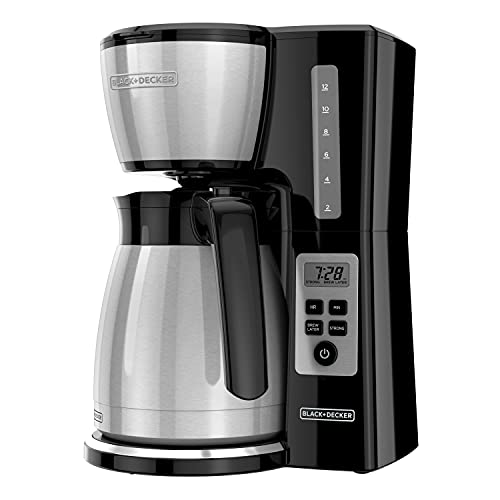
BLACK+DECKER 12 Cup Thermal Programmable, CM2046S
Badge: Best Value Large Brewer
Strengths
- Full 12-cup thermal carafe for households and gatherings
- Brew strength control and VORTEX showerhead aim for an even pot
- Programmable start makes a large pot ready on a schedule
Trade-offs
- Thermal carafe pours more slowly than glass and needs lid care
- Value-tier materials compared with premium brands
- No single-serve option for the one-cup moment
Key specs (from the verified listing)
- Capacity: 12 cup thermal carafe
- Features: Programmable, brew strength control
- Technology: VORTEX Technology
- Model: CM2046S
- Finish: Black/steel
A large coffee maker earns its name at the carafe, and this BLACK+DECKER starts with the full 12-cup thermal format. The thermal carafe is the right call for big pots: coffee held insulated keeps its flavour better than coffee parked on a hot plate, and a household that brews at seven and drinks until ten will taste the difference.
Brew strength control and the VORTEX showerhead address the classic big-pot weakness, uneven extraction, by spreading water more evenly and letting drinkers push the pot bolder. The honest notes are tier and focus: finishes are value-grade, and there is no single-serve escape hatch. As a dedicated large pot brewer, though, it covers the brief completely.
For a large-pot household on a value tier, this BLACK+DECKER is the sensible default: full capacity, thermal keeping and the controls a pot actually needs.
Best for: Households and offices brewing full pots daily on a value tier / Not suited for: Solo drinkers or pod users

Cuisinart PerfecTemp 12-Cup Thermal Drip, DCC-3400NAS
Badge: Best Premium Large Brewer
Strengths
- 12-cup double-wall stainless thermal carafe
- PerfecTemp hotter brewing targets fuller extraction in big pots
- Brew strength control lets one pot serve different tastes
Trade-offs
- Premium tier in the drip class
- Stainless carafe is heavier, especially full
- Drip-only: no pods, no espresso, no single-serve side
Key specs (from the verified listing)
- Capacity: 12-cup
- Carafe: Double-wall stainless steel thermal
- Features: PerfecTemp hotter brewing, brew strength control
- Model: DCC-3400NAS
- Finish: Silver
Cuisinart’s PerfecTemp is the premium expression of the large drip idea in this pool: a 12-cup double-wall stainless thermal carafe and brewing pitched hotter under the PerfecTemp name, with strength control to tune the pot. Large pots punish weak extraction more than small ones, so the hotter-brewing emphasis is aimed at a real problem.
Ownership notes are practical. A full stainless thermal carafe has satisfying heft and pours like it means it, which some wrists will notice. And like every pick here, it is a pot machine only. Within that brief, it is the choice for drinkers who want their big morning pot to taste deliberate rather than merely plentiful.
The PerfecTemp is the large format with its standards raised, the pot you brew when guests judge your coffee and you intend to pass.
Best for: Quality-first households brewing a full pot every morning / Not suited for: Anyone wanting pod or single-serve flexibility

BLACK+DECKER CaféCraft 12-Cup Thermal, Hot & Iced
Badge: Best Hot-and-Iced Large Brewer
Strengths
- 12-cup thermal capacity for family pots
- Hot and iced modes stretch one machine across seasons
- Programmable routine fits set morning schedules
Trade-offs
- Iced mode still works in pot format, not single glasses on demand
- Fewer fine controls than the premium picks
- Thermal carafe needs regular lid and seal cleaning
Key specs (from the verified listing)
- Capacity: 12-cup thermal
- Modes: Hot and iced, programmable
- Brand line: CaféCraft
The CaféCraft takes the large format and adds the seasonal twist: a 12-cup thermal pot brewer that also handles iced coffee in pot format, on a programmable schedule. For households whose summer afternoons run on a pitcher of iced coffee in the fridge, that second mode earns its place.
Set expectations correctly and it satisfies: iced mode here means brewing for a batch, not a single tall glass at the press of a button. The large-pot identity stays intact. Buyers who want both a morning pot and a summer batch machine, without a second appliance, are exactly who this design serves.
CaféCraft stretches the large idea across the calendar: the same big pot that warms January brews the batch that fills July’s fridge pitcher.
Best for: Families that batch both hot pots and iced coffee / Not suited for: Single-glass iced coffee drinkers

Cuisinart 12-Cup PerfecTemp Thermal, White
Badge: Best for Small-Pot Days
Strengths
- 12-cup thermal carafe scales from weekday pots to weekend crowds
- 1-4 cup setting tunes brewing for small pots on quiet days
- Brew strength control and brew pause add daily flexibility
Trade-offs
- White finish shows coffee splashes and needs wiping
- Brew pause can unbalance a pot if the carafe stays out too long
- Premium-tier drip machine without pod options
Key specs (from the verified listing)
- Capacity: 12-cup
- Settings: 1-4 cup setting, brew strength control, brew pause
- Carafe: Thermal carafe
- Finish: Stainless steel, white
This white PerfecTemp variant solves the large brewer’s weekday dilemma: a 12-cup machine is right for weekends and guests, but many Tuesdays need only a few cups. Its 1-4 cup setting exists for those days, adjusting the brew for a small pot instead of forcing a full carafe or a second machine.
Brew pause adds the familiar grab-a-cup-early convenience, best used briefly so the pot’s balance survives. The white finish is the ownership footnote: it looks fresh in light kitchens and shows every splash, so a wipe-down habit comes with the territory. For variable-size households, this is the most adaptable large pot here.
This white PerfecTemp variant is the large machine for variable households, honest about the fact that Tuesday’s pot and Saturday’s pot are different sizes.
Best for: Households whose pot size changes between weekdays and weekends / Not suited for: Set-and-forget drinkers who always brew the same full pot

BUNN Speed Brew Platinum Thermal, CSB3T
Badge: Best for Speed
Strengths
- 10-cup thermal pot from a brand built around fast brewing
- Stainless steel build with an insulated carafe
- Large-format pot without a long wait for the first cup
Trade-offs
- 10 cups is a step below the 12-cup picks for the biggest households
- Speed-first design offers fewer programmable frills
- Drip-only format like the rest of this roundup
Key specs (from the verified listing)
- Capacity: 10-cup
- Carafe: Thermal
- Model: 55200 CSB3T
- Finish: Stainless steel, black
BUNN built its name on pace, and the Speed Brew Platinum brings that identity to the large thermal class: a 10-cup stainless machine whose promise is a full pot without the long drip wait. In households where the coffee needs to be ready before the school run, minutes are a feature.
The trade is capacity and programmability. Ten cups is large by most standards but a step below the 12-cup machines here, and the design spends its budget on speed rather than scheduling tricks. If your mornings are a race and your household is mid-size, that is the right exchange.
BUNN’s entry reframes large as a time promise: ten cups, fast, for households whose mornings cannot wait on a slower pot.
Best for: Time-pressed households that want a fast full pot / Not suited for: The largest households, which should take the 12-cup picks
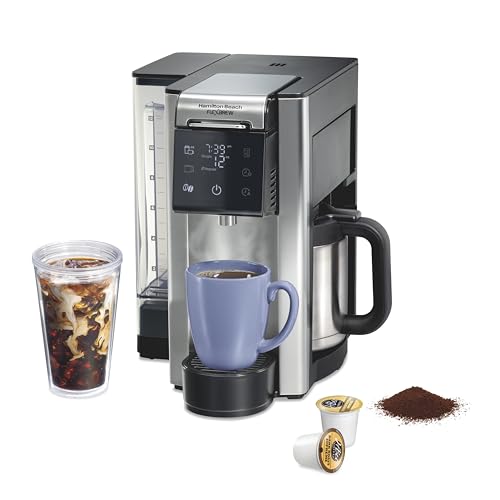
Hamilton Beach FlexBrew Advanced 5-in-1
Badge: Most Versatile Large Brewer
Strengths
- 12-cup thermal programmable drip side covers the large-pot brief
- Single-serve side takes pods and grounds for one-cup moments
- Removable 60 oz reservoir and hot and iced modes widen the routine
Trade-offs
- Largest footprint in this roundup
- Two formats mean more parts and more cleaning touchpoints
- Pure pot households pay for a single-serve side they may ignore
Key specs (from the verified listing)
- Drip side: 12 cup thermal, programmable
- Single-serve side: Pods and grounds
- Reservoir: Removable 60 oz reservoir
- Modes: Hot and iced
The FlexBrew 5-in-1 is the large brewer for households that refuse to choose: a programmable 12-cup thermal drip side for the pot drinkers, a single-serve side for pods and grounds, and hot and iced modes across the routine, fed by a removable 60 oz reservoir. On paper and in practice it is the widest brief in this roundup.
Width has a price in counter space and upkeep. Two brew paths mean two sets of parts to rinse and a bigger chassis to house. Households that genuinely split formats weekly will call that a bargain; households that brew pots and only pots should take one of the dedicated machines above and enjoy the simplicity.
The FlexBrew closes the set by refusing the premise that large means only large: a full pot when the house is full, a single cup when it is not.
Best for: Mixed-format households that need a big pot and single cups / Not suited for: Dedicated pot-only kitchens short on counter space
Comparison Table
Capacity and carafe type lead the table. The interesting columns are the second ones, strength control, small-pot settings, speed and formats, where the six philosophies separate.
| Pick | Badge | Key attribute | Check |
|---|---|---|---|
| BLACK+DECKER 12 Cup Thermal Programmable, CM2046S | Best Value Large Brewer | 12 cup thermal carafe | Check on Amazon |
| Cuisinart PerfecTemp 12-Cup Thermal Drip, DCC-3400NAS | Best Premium Large Brewer | 12-cup | Check on Amazon |
| BLACK+DECKER CaféCraft 12-Cup Thermal, Hot & Iced | Best Hot-and-Iced Large Brewer | 12-cup thermal | Check on Amazon |
| Cuisinart 12-Cup PerfecTemp Thermal, White | Best for Small-Pot Days | 12-cup | Check on Amazon |
| BUNN Speed Brew Platinum Thermal, CSB3T | Best for Speed | 10-cup | Check on Amazon |
| Hamilton Beach FlexBrew Advanced 5-in-1 | Most Versatile Large Brewer | 12 cup thermal, programmable | Check on Amazon |
How to Choose a Large Coffee Maker
Large brewers are chosen on rhythm before features. Count the pots your household brews in a week and their sizes, note how long a pot lives before the last cup, and be honest about whether a single-serve need is hiding inside your household disguised as a second, smaller machine on the counter. Pod households in the family can also read 6 Best Italian Coffee Makers Moka Pots And Stovetop 2026.
Thermal carafes unite this entire pool, and rightly: at 10 to 12 cups, the gap between the first and last cup is measured in hours, and insulation protects flavour across that whole span in a way a warming plate cannot. Within that shared wisdom, the factors below separate the six.
Capacity: 10 or 12 cups is a household census
Twelve cups serves big households, offices-in-miniature and entertainers without a second brew. Ten cups, the BUNN’s format, serves most families with less carafe to wash and, in that machine’s case, a speed advantage. Count drinkers and their refills, not the carafe’s optimism.
How long the pot lives
A pot finished within the hour barely tests a thermal carafe. A pot stretched across a work-from-home morning tests it completely. All six picks insulate, but your drinking window decides how much retention matters and whether brewing two half pots would serve you better than one full one.
Strength control and showerhead design
Big baskets risk uneven extraction, so strength controls and showerhead designs like the VORTEX system in this pool are functional, not decorative. Households split between bold and mild drinkers should treat strength control as a headline feature.
Small-pot behaviour on quiet days
The best large machines admit that not every day is large. A 1-4 cup setting, as on one Cuisinart here, tunes the brew for a small pot instead of spreading a thin dose across a big basket. Variable households should weigh this factor heavily; metronome households can ignore it.
When a second format earns its footprint
Only one pick here adds single-serve, and it is the right buy only when single cups are a weekly reality alongside pots. Otherwise the dedicated pot machines are smaller, simpler and easier to clean, and the unused format is just cabinet-filling good intentions.
How to Brew a Large Pot That Tastes Like a Small One
The large pot’s enemy is dilution of care: a big basket brewed with small-pot habits. Dose for the full pot, use fresh water to the mark, and let the brew complete before the first pour so the carafe’s strength is uniform from first cup to last. If looks matter in a big kitchen, browse 6 Best Iced Coffee Makers Brewers And Cold Brew Pitchers 2026.
Pre-warming the thermal carafe with a hot rinse is the large brewer’s cheapest upgrade, because a cold steel vessel taxes the first cups for heat they should keep. Seal the lid between pours, and the pot will hold its flavour and temperature across the morning it was brewed for.
- Rinse the thermal carafe with hot water to pre-warm it while you prepare the brew.
- Fit a fresh filter and dose grounds for the full pot size you are brewing, not a habitual scoop count.
- Fill the reservoir with fresh cold water exactly to the pot’s mark.
- Select strength for the drinkers the pot must serve, and start the brew, using the timer if it was set the night before.
- Wait for the brew to finish completely before pouring the first cup.
- Seal the carafe lid between pours, and wash carafe, lid and basket at day’s end.
Problem: The pot tastes weak despite a full dose → the grind is too coarse or the coffee is stale. Check freshness first, then grind, before adding more coffee.
Problem: First cups are strong, last cups thin → the pot was poured mid-brew or not allowed to equalise. Let the brew finish and give the carafe a gentle swirl before serving.
Problem: Coffee is lukewarm by mid-morning → the carafe started cold or stood open. Pre-warm it and keep the lid sealed between pours.
The Thermal Carafe Consensus, Explained
Every machine in this pool, across four brands and every tier, keeps its pot in an insulated carafe instead of on a hot plate. Class-wide agreement like that is data: at large-pot scale, where the last cup may be poured hours after the first, reheating is the enemy and insulation is the answer. The plate survives in small, fast-turnover contexts; the large pot has voted with its steel. Another useful companion is 6 Best Highend Coffee Makers Drip Espresso Auto 2026.
The consensus shifts the buyer’s question from whether thermal to which thermal. Carafe capacity, lid design, pour behaviour and how the vessel washes become the real comparison points, and they are the points this guide’s reviews spend their words on.
Brewing for a Crowd Without Losing the Plot
The large brewer’s finest hour is the gathering: brunch, the holiday morning, the work crew. Crowd brewing rewards preparation over improvisation: grounds measured the night before, carafe pre-warmed, cups and the strength question settled before the first guest is awake. A programmable model set the evening before converts the host’s morning from production to hospitality. You may also enjoy 6 Best Grind And Brew Drip Coffee Makers 2026.
It also rewards a second-pot plan. A 12-cup carafe empties faster than hosts expect when coffee is good, so know your machine’s full cycle time and start the second pot when the first is half down, not empty. The BUNN’s speed is the extreme answer to that problem; for the others, timing is the answer, and it is free.
Water, Filters and the Big Basket
Large baskets amplify small inputs. A full pot brewed with tired water tastes tired at scale, and a filter that collapses or overflows in a big basket ruins twelve cups at once instead of four. Use fresh water every pot, seat filters carefully in the larger baskets these machines use, and treat the reservoir’s weekly rinse as part of the recipe rather than as maintenance trivia.
Grind consistency matters more as pots grow, because uneven grounds extract unevenly across a wide bed. Households that grind at home should grind for the pot size brewed, and households buying pre-ground should buy at drinking pace so the last pot of the bag is not a shadow of the first.
Filters, Baskets and the Unglamorous End of Extraction
Paper filters, permanent baskets and basket geometry decide more of a drip pot’s character than most buyers expect. Paper gives the cleanest cup and the easiest cleanup, trapping oils and fines; permanent baskets let more body through and ask for a rinse discipline in exchange for zero consumables. Either can be right. What is never right is a filter that does not fit its basket, because an ill-fitting filter folds, channels the water and leaves part of the bed unbrewed while another part drowns.
Showerhead design belongs in the same conversation. Systems in this pool that spread water across the bed, rather than dripping it in one spot, exist to solve the big basket’s core problem: an unevenly wetted bed extracts unevenly, and the pot averages the crime. When comparing drip machines, treat water distribution as a first-class feature, because at twelve cups it is one.
Coffee Storage for Households That Brew by the Pot
Pot households move through coffee at a pace that changes the storage rules. Beans or grounds bought in very large quantities stale before the bag ends, so the generous pot brewer should buy at the pace of roughly two to three weeks of brewing, store the coffee airtight in a cool, dark cupboard, and resist the freezer’s reputation, which suits long, sealed storage of whole beans better than the daily in-and-out of a working kitchen supply.
Grinding at home repays pot households more than anyone, because the dose is large and the difference between fresh-ground and week-old grounds is multiplied across the carafe. A consistent medium grind, ground for the pot being brewed, is the single largest flavour upgrade available to every machine in this guide, and it costs no counter space at all.
The Night-Before Ritual: Programming Without Regret
Programmable brewing is often sold as waking to coffee, but its deeper value is decision removal: the morning’s first task is already done, correctly, by yesterday’s calmer self. The ritual that makes it work is unglamorous: carafe rinsed and seated, filter fitted, dose measured, water filled, strength chosen, timer set. Five minutes in the evening, in exchange for a morning that starts with pouring. Households that build the ritual keep the feature; households that wing it abandon the timer within a month.
One honest caveat belongs here: grounds measured the night before sit in the basket for hours, and purists will note a small freshness cost against grinding at dawn. The trade is real and worth making for most households, because the alternative is often not dawn grinding but no coffee until the kettle of chaos boils over. Programme the pot, and let the weekend be the time for ceremony.
Carafe Care: Lids, Seals and the Taste of Old Coffee
A thermal carafe is a thermos with a social life, and its lid is where old coffee goes to hide. Coffee oils coat the lid’s channels and the pour spout, and a carafe that is merely rinsed will slowly season every fresh pot with the ghost of the last one. The fix is a daily hot, soapy wash that includes the lid taken apart as far as its design allows, and a weekly soak for the vessel itself when the morning’s pot has been sitting long.
Seals deserve the same respect. A lid that no longer seals is a carafe that no longer keeps heat, whatever the steel walls promise, and most heat complaints in this class trace back to a lid left ajar, a seal fouled with grounds, or a carafe that started cold. The pre-warm rinse, the sealed lid and the weekly deep clean are the whole liturgy; machines in this guide ask for nothing more.
Water Temperature and Why Hotter Brewing Claims Exist
Several machines in and around this pool advertise hotter brewing, and the claim addresses a genuine weakness of home drip: water that arrives at the grounds too cool under-extracts, leaving the pot sour and thin no matter the dose. Properly hot water, evenly distributed, is what turns a large basket from a lottery into a system. This is also why pre-heating matters at the other end: a thermal carafe that starts cold steals the heat the brewer worked to deliver.
The buyer’s translation is simple. Treat hotter-brewing designs and good showerheads as extraction insurance, especially at twelve cups where the bed is wide and the stakes are a whole pot. Then do your part with fresh coffee, a right dose and a warm carafe, and the class of machines in this guide will show you why the thermal drip format endures.
The Golden Ratio, Translated for a Full Pot
Brewing ratios are usually taught for single cups and then abandoned at the carafe, which is backwards: the larger the pot, the more a sloppy dose costs, because the error is multiplied by twelve cups instead of one. The working principle is simple proportion. Coffee and water scale together, so a pot twice the size wants twice the coffee, ground a touch coarser to keep the drawdown civilised. Households that weigh or measure their dose for one week usually keep the habit, because the improvement in consistency is larger than any single feature difference between the machines in this guide.
Strength settings complicate the picture helpfully. A strength control adjusts the brew’s intensity, but it is not a substitute for dose; it tunes a correctly dosed pot rather than rescuing an underdosed one. Set the dose right first, then let the strength setting arbitrate between the bold and mild drinkers at the table, which is the job it was designed for.
Grounds Freshness for the Basket Side of the Machine
The grounds side of a combo is a small drip brewer wearing a shared coat, and it obeys drip rules: fresh coffee, a medium grind, and a dose matched to the cup or pot being brewed. Because combo users alternate formats, their grounds often sit longer between uses than a drip household’s do, which makes storage the quiet decider: an airtight container in a cool cupboard, bought at drinking pace, keeps the grounds side tasting like a choice rather than a compromise.
Basket hygiene completes the picture. A reusable grounds basket that is emptied and rinsed after each use brews cleanly for years; the same basket left loaded between formats will season the next pod-side day with stale oils through the shared water path’s neighbourhood. The rinse takes twenty seconds and is the cheapest quality insurance the grounds format offers.
Counter Layout for a Machine With Two Jobs
A combo machine earns a workstation, not a parking spot: pods in a drawer or caddy on one side, grounds and their scoop on the other, cups above, and the bin for spent pods and grounds within a step. Laying the station out by format prevents the morning fumble where the pod drinker moves the grounds gear and the grounds drinker buries the pods, a small domestic friction that good layout deletes permanently.
Height and swing deserve the tape measure before the machine arrives. Lids, levers and carafe paths all need their clearance, and a dual-format machine is the widest guest most counters will host. Households that measure once, including the open-lid height, report the machine as furniture; households that guess report it as an obstacle, with the same machine in both stories.
Pod Inventory Without the Stale Drawer
Combo households hold two inventories, pods and grounds, and each stales by its own clock. The pod rule is rotation: a tight selection of favourites, bought at drinking pace, oldest at the front. The failure mode is the novelty drawer, twelve open varieties ageing together, which converts the pod side’s variety advantage into a freshness liability and quietly teaches the household to prefer the grounds side for the wrong reason.
A monthly five-minute audit keeps both inventories honest: pods counted and rotated, grounds checked for aroma and age, the shopping list written from evidence rather than from memory at the shop. It is the smallest possible bureaucracy, and it is what separates households that love their combo in year two from households that drifted back to a single format and a drawer of regrets.
Brew Baskets and Bed Depth: Why Dose Shape Matters
A drip basket is a small landscape, and coffee extraction is its weather. A dose spread too thin lets water race through channels and under-extract; a dose mounded too deep drowns at the edges and starves in the middle. Large baskets widen the landscape and therefore the risk, which is why the showerhead systems and strength controls in this pool matter, and why the humble act of levelling the bed before brewing is worth more than most accessories.
The practical ritual is ten seconds: dose, level with a gentle shake, check that the filter sits cleanly against the basket walls, and brew. Households that adopt it stop experiencing the mysterious alternation of strong and weak pots from the same machine and the same coffee, because the variable was never the machine. It was the landscape, and it is now level.
The Office Pot and the Household Pot Are Different Animals
A large brewer in an office lives a harder life than its household twin: more pots, more hands, more anonymous neglect, and a drinking window stretched across the whole working day. Office buyers should weight durability of routine over delicacy of features: a thermal carafe that survives being left on a desk, a lid that seals under casual handling, and controls simple enough that nobody needs to be trained. The machines in this guide were assessed as household appliances, and an office shortlist should start from the same names with those weights adjusted.
Household pots have the opposite luxury: they can be optimised for flavour rituals an office would never sustain, the pre-warmed carafe, the levelled bed, the strength set for known drinkers. Recognising which animal you are buying prevents the twin errors of an over-delicate office machine and an over-industrial home one.
Glass Versus Thermal, Settled for the Large Pot
The glass carafe survives in drip coffee for honest reasons: it is light, it pours beautifully, it shows the coffee level at a glance and it is cheap to replace. Its partner, the warming plate, is where the trouble lives, because a plate’s job is to keep adding heat to a drink that finished brewing an hour ago. Small pots drunk quickly can live with that bargain. Large pots, whose last cup may be poured at midday, cannot, which is why every machine in this programme’s large and thermal guides insulates instead.
Thermal ownership has its own small print, and this guide has been consistent about it: pre-warm the vessel, seal the lid, wash the lid’s channels, and accept a slow cooling curve as the price of uncooked flavour. Buyers who accept that print get the better last cup, which, across a year of large pots, is hundreds of better cups, a return no single feature badge can match.
Teaching the Household the Two Rituals
A combo machine asks its household to learn two small rituals instead of one, and the households that thrive with combos teach both explicitly in the first week: the pod ritual, seat, close, brew, eject, and the grounds ritual, fill the basket level, brew, empty, rinse. Written nowhere and assumed everywhere, the second ritual is the one that decays, which is how grounds baskets end up discovered, loaded and stale, by a horrified weekend user.
The teaching device can be as small as a note inside the cupboard door. What matters is that both formats have an owner’s manual written by the household itself, in its own quantities and timings. Machines do not create habits; households do, and a combo simply doubles the number of habits worth creating.
The Second Pot Problem at Gatherings
Every host knows the moment: the carafe that seemed generous is suddenly light, guests are mid-conversation, and the second pot exists only as a possibility. Large brewers answer the moment in two currencies, speed and foresight. The BUNN in this pool is the speed answer, built to turn the second pot from an intermission into a pause. The programmable and thermal picks answer with foresight: a first pot brewed generously, kept honestly hot in its carafe, and the second started when the first is half down rather than empty.
The arithmetic hosts should internalise is that a gathering drinks roughly a pot per five or six coffee drinkers per hour of lingering. Plan carafes against that rate and the second pot stops being a problem at all; it becomes a scheduled event, like the meal itself, and the large brewer’s capacity turns into hospitality’s quiet infrastructure.
Hard Water and the Large Brewer
Scale scales with the pot: a large brewer moves more water per week than a small one, so hard-water households meet mineral build-up sooner and feel it across more cups when it dulls the brew. The defences are the familiar ones, executed at large-machine frequency: filtered water for the reservoir where the supply is very hard, descaling on the maker’s schedule rather than on symptoms, and a weekly rinse of the carafe and basket so mineral film never becomes part of the flavour.
The encouraging truth is that large thermal machines forgive more than they are credited with, because their brew paths are simple and their parts are accessible. A household that keeps the descale appointment will get years of honest pots from any machine in this guide; a household that skips it will blame, in turn, the coffee, the filters and the machine, in that order, all innocents.
Common Buying Mistakes
- Brewing a full pot for a two-cup morning. Stale surplus is not thrift. Use a small-pot setting or brew the size the morning actually drinks.
- Pouring mid-brew as a habit. The first runnings are the strongest; stealing them unbalances the whole carafe. Wait for the finish.
- Skipping the carafe pre-warm. Cold steel taxes hot coffee. Twenty seconds of hot rinse protects the first cups.
- Dosing by habit instead of by pot size. Large baskets need deliberate doses. Measure for the pot you are brewing today.
- Buying a dual-format machine for pot-only life. The extra format is footprint and cleaning unless single cups are a weekly reality.
Final Recommendation
For the classic large-pot brief, start with the Cuisinart PerfecTemp for premium extraction and thermal keeping, or the BLACK+DECKER CM2046S where value leads. Variable households should favour the white PerfecTemp’s small-pot setting, rushed households the BUNN’s speed, summer households the CaféCraft’s iced mode, and genuinely mixed households the FlexBrew 5-in-1. Our linked shortlist to start from: BLACK+DECKER 12 Cup Thermal Programmable, CM2046S, Cuisinart PerfecTemp 12-Cup Thermal Drip, DCC-3400NAS, BLACK+DECKER CaféCraft 12-Cup Thermal, Hot & Iced. Before deciding, see 6 Best Espresso Coffee Makers For Home.
All six are honest versions of the same generous idea, so the deciding evidence is your own week: pot sizes, drinking windows and whether a single cup ever truly happens. Match the machine to that evidence and the big pot will taste like a deliberate choice every morning.
Frequently Asked Questions
How many cups should a large coffee maker brew?
For most households, 12 cups is the large standard, covering families and guests in one brew. The 10-cup BUNN in this pool suits slightly smaller households and trades the last two cups for speed.
Why do all these large brewers use thermal carafes?
Because a large pot is drunk over hours, and insulation holds flavour better than a warming plate, which keeps cooking the coffee. Thermal keeping is the class consensus for exactly that reason.
Can a large coffee maker brew a good small pot?
The white Cuisinart PerfecTemp here includes a 1-4 cup setting designed for that job. On machines without one, dose carefully and expect the best results nearer the carafe’s intended range.
Which large brewer is fastest?
The BUNN Speed Brew Platinum is the pool’s speed specialist, built around fast pot brewing in a 10-cup thermal format. It trades a little capacity and some programmability for pace.
Is the FlexBrew a true large coffee maker?
Yes on its drip side: a programmable 12-cup thermal brewer. Its single-serve side for pods and grounds is an addition for mixed households, not a reduction of the pot side.
How do I keep a big pot tasting fresh to the last cup?
Pre-warm the carafe, let the brew finish before pouring, seal the lid between pours and wash the carafe and lid daily. Those four habits protect the last cup almost completely.


