Disclosure: topratedkitchenware.com is reader-supported. When you buy through links on our site, we may earn an affiliate commission from Amazon and other retailers, at no extra cost to you.
Where to buy
The six models below are the verified picks for this guide to the best low cost smokers. “Low cost” here is judged the honest way: not by a headline number we refuse to print — prices move too often for that to help you — but by what a smoker costs to own and feed over years of cooking, and by how much genuine smoking capacity each tier of spending buys. The list deliberately mixes electric cabinets and pellet grills, because the cheapest honest route to smoked food depends on which fuel fits your life. Each name links to its Amazon listing, where you can check the latest price on Amazon, confirm the current configuration, and read the newest owner feedback before you decide.
- EAST OAK 30-Inch Electric Smoker with Meat Probe and Mobility Stand, Polar Night — Check on Amazon
- Royal Gourmet SE2805 28-Inch Electric Smoker
- Traeger Pro 22 Wood Pellet Grill and Smoker
- Pit Boss 700 Carbon Series Wood Pellet Grill and Smoker
- Pit Boss 500 Carbon Series Wood Pellet Grill and Smoker
- Pit Boss 850 Navigator Series WiFi Wood Pellet Grill and Smoker
Read the full guide ↓ for the total-cost reasoning behind the order, the honest limitation of every pick, and the spending traps that make “cheap” smokers expensive.
Everyone searching for the best low cost smokers is really asking two questions. What is the least I can spend and still get real smoked food? And where is the line below which a smoker stops being a bargain and starts being a recurring expense? This guide answers both. The first answer is encouraging: the entry tier of this category is genuinely good now. Simple electric cabinets with analog or basic digital control will smoke ribs, chicken, salmon, and pork shoulder that most families will happily eat for years, and their fuel — a bag of wood chips now and then — is the cheapest smoke there is. The second answer matters just as much. The false economies in smoking are well known: cabinets so small you outgrow them in a season, thin construction that leaks the heat you paid to make, and controls so crude that you waste food learning them. A smoker you replace in year two costs more than a smoker you keep for a decade.
So this guide ranks six verified picks by value in the fullest sense: purchase tier, fuel cost, capacity per tier, build features that extend working life, and the cost of the extras each design quietly requires. Two are electric cabinets, four are pellet grills, and the comparison between those fuels is a large part of the value story — pellets cost more to burn than chips but buy stronger smoke flavor and grill versatility, while electrics are the cheapest possible way to hold a low temperature all day. We also explain how to read any smoker listing through a low-cost lens, how to keep running costs down once you own one, and the mistakes that turn a budget buy into a money pit.
Key Takeaways
- Judge low cost by total ownership cost — purchase tier plus fuel, extras, and working life — not by the sticker alone.
- Electric cabinets are the cheapest smokers to buy and to run: wood chips cost very little, and there is no auger or igniter system to maintain.
- The Royal Gourmet SE2805 is the true budget entry: a compact 28-inch electric with analog control and the smallest footprint in the guide.
- The EAST OAK Polar Night is the best overall value — full 725-square-inch capacity, a built-in probe, and a mobility stand at an entry-friendly tier.
- Pit Boss’s Carbon and Navigator pellet grills deliver the most cooking space per tier; the 850 Navigator is the buy-once option that ends upgrade spending.
- The Traeger Pro 22 sits at a higher tier, and earns its place here only for buyers whose “low cost” means one durable purchase instead of two cheap ones.
In this guide
Quick Picks
| Pick | Badge | Why it earns its place | Amazon |
|---|---|---|---|
| EAST OAK 30-Inch Electric Smoker, Polar Night | Best Overall Value | 725 sq in, built-in meat probe, side chip loader, mobility stand — full-size features at an entry tier | Check on Amazon |
| Royal Gourmet SE2805 28-Inch Electric Smoker | Best Budget Pick | Compact 454 sq in cabinet, 1350W element, analog control, three grates — the lowest-cost honest start | Check on Amazon |
| Traeger Pro 22 Wood Pellet Grill and Smoker | Best Buy-Once Pellet Pick | 572 sq in, 18 lb hopper, meat probe, six-way versatility from an established pellet brand | Check on Amazon |
| Pit Boss 700 Carbon Series Pellet Grill and Smoker | Best Capacity for the Money | 718 sq in of cooking space and a digital controller at a value tier | Check on Amazon |
| Pit Boss 500 Carbon Series Pellet Grill and Smoker | Best Compact Pellet Value | 543 sq in, digital control, and a 13.5 lb hopper in the smallest pellet footprint here | Check on Amazon |
| Pit Boss 850 Navigator Series Pellet Grill and Smoker | Best Long-Term Value | 932 sq in, WiFi and Bluetooth, 30 lb hopper — buy it once and stop shopping | Check on Amazon |
How These Picks Were Chosen
This is a research-led guide. We did not cook on these six machines side by side, and no hands-on testing is claimed anywhere in it. Every pick was verified against Amazon’s own product data through the Creators API, so the model names, capacities, and features quoted here come from the manufacturers’ listings rather than from roundup sites copying each other. We then compared the verified listings through a value lens: cooking area relative to tier, control type, fuel system and its running cost, included equipment that saves a separate purchase — probes, stands, loaders — and design features that predict a long working life.
Two honesty rules shaped the list. First, no invented prices: smoker prices shift with seasons and sales, so this guide positions each pick qualitatively — entry tier, value tier, buy-once tier — and sends you to the listing for the current figure. Second, no pick was allowed to hide its fuel economics. An electric smoker and a pellet grill can sit in similar purchase tiers while costing very different amounts to run for five years, and a low-cost guide that ignores that is not doing its job. If your budget thinking starts from fuel rather than hardware, the propane comparison in Best Lp Smokers and the wood-fired angle in Best Lp Wood Smokers round out the picture. Badges were assigned after the comparison and are used consistently in the Quick Picks table and the detailed reviews below.
The 6 Best Low Cost Smokers
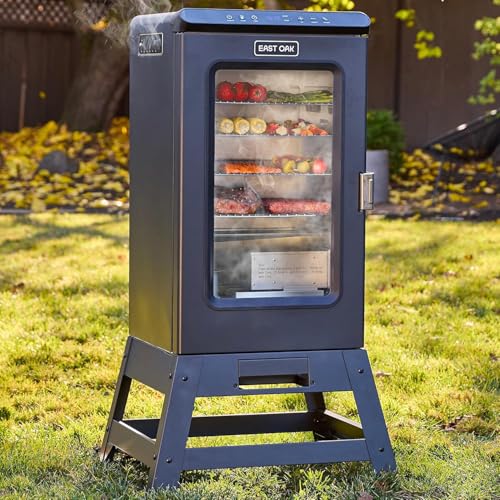
EAST OAK 30-Inch Electric Smoker with Meat Probe and Mobility Stand, Polar Night
Badge: Best Overall Value
Strengths
- Full-size 725-square-inch cooking area means you are not buying a starter size you will outgrow in a season.
- The built-in meat probe removes the separate thermometer purchase that most budget smokers quietly require.
- The side chip loader stretches one load of chips across up to six times longer uninterrupted smoking, cutting both refill hassle and chip waste.
Trade-offs
- Electric smoke flavor is mild; buyers chasing deep bark-heavy results will eventually look at pellet or charcoal as well.
- The mobility stand and cabinet together claim real patio space compared with the compact budget pick below.
- A single built-in probe still leaves multi-rack cooks wanting a second thermometer for the other cuts.
Mini spec box
- Format: 30-inch electric smoker
- Cooking area: 725 square inches
- Monitoring: built-in meat probe
- Chip loading: side chip loader, up to 6x longer uninterrupted smoke per load
- Stand: mobility stand included
- Finish: Polar Night
Value is features divided by tier, and by that measure this EAST OAK leads the guide. Start with what it saves you from buying twice. Its 725 square inches match the largest electric cabinets in this market, so the classic budget trap — a cheap small smoker replaced by a bigger one within a year — never springs. The built-in probe saves a separate purchase and, more importantly, saves food: internal temperature is the difference between a shoulder pulled at the right moment and one cooked into stringiness, and ruined meat is the most expensive line item in any smoking budget. The mobility stand means no separate cart or table purchase, and it makes the cabinet easy to move for cleaning and storage, which quietly extends its life.
The running costs are where the electric format shines. Wood chips are the cheapest smoke fuel in the category, a modest bag lasts many cooks, and the side loader’s extended burn per load stretches them further. There is no auger to jam, no igniter rod to replace, and the electricity draw of a cabinet element across a long cook is a minor household expense next to bags of pellets burned by the pound. The honest limitation is flavor intensity: this is clean, gentle smoke. For the overwhelming majority of family cooking that is a virtue, and it is why this model, rather than a pellet grill, is the best overall value for most households.
Best for: households wanting one full-size smoker that covers years of cooking without a follow-up purchase / Not suited for: cooks whose priority is the strongest possible smoke flavor above all else.

Royal Gourmet SE2805 28-Inch Electric Smoker
Badge: Best Budget Pick
Strengths
- The lowest entry tier in this guide, with an honest feature set: 1350W element, three cooking grates, and adjustable analog heat.
- At 454 square inches in a 28-inch vertical cabinet, it fits small patios and balconies where full-size models cannot go.
- Analog control means almost nothing electronic to fail, keeping long-term repair costs near zero.
Trade-offs
- The capacity ceiling is real: this is a household-of-few smoker, and large gatherings will outgrow it.
- Analog heat control requires your own thermometer and some practice to hold precise temperatures.
- No built-in probe, no side loader — chip refills mean opening the door and paying the heat-loss tax.
Mini spec box
- Format: 28-inch vertical electric smoker
- Cooking area: 454 square inches
- Power: 1350W
- Control: analog temperature control, adjustable heat
- Grate count: 3 cooking grates
- Finish: black
Every low-cost guide needs a true floor — the least you can spend while still buying a real smoker — and the SE2805 is it. Royal Gourmet kept the essentials and cut the ceremony: a 1350W element that is properly sized for the cabinet, three grates across 454 square inches, and an analog dial. For a single person, a couple, or a small family smoking ribs, wings, chicken, and salmon, that is not a compromise at all; it is the correct size, and smaller cabinets heat quickly and use less electricity reaching temperature. Its compact vertical footprint also makes it the only pick here that genuinely suits a small balcony, subject to your building’s rules.
The value case rests on simplicity. Analog smokers are the cockroaches of the appliance world — there is almost nothing in them to break, and what does wear, like racks and pans, is generic and cheap to replace. You will spend a little on a probe thermometer, and you should count that in the true entry cost, because cooking without one wastes more money in overcooked meat than the thermometer costs. What this model cannot do is grow with you. If your smoking ambitions are already expanding — whole briskets, multiple shoulders, party batches — skip the floor and start with the EAST OAK above; buying the SE2805 and then its replacement is the most expensive path of all. Buyers weighing build quality as a long-term cost will also appreciate the construction discussion in Best Made Smokers.
Best for: first-time smokers, small households, and tight spaces that need the lowest honest entry cost / Not suited for: large batches, big gatherings, or anyone who already knows they will smoke in quantity.

Traeger Pro 22 Wood Pellet Grill and Smoker
Badge: Best Buy-Once Pellet Pick
Strengths
- Six-in-one versatility — grill, smoke, bake, roast, braise, and barbecue — means one machine replaces several purchases.
- The 18 lb hopper is generously sized for its class, stretching time between pellet refills on long cooks.
- An included meat probe and a maximum temperature of 450°F cover both low-and-slow and everyday grilling duties.
Trade-offs
- It sits at a higher purchase tier than the value picks here; its low-cost case is about longevity, not entry price.
- Pellets cost more to burn than electric chips, so running costs exceed the electric picks on every long cook.
- At 572 square inches it is mid-sized — ample for families, not the choice for very large batches.
Mini spec box
- Format: wood pellet grill and smoker
- Cooking area: 572 square inches
- Temperature range: up to 450°F maximum
- Hopper capacity: 18 lb
- Monitoring: meat probe included
- Versatility: grill, smoke, bake, roast, braise, barbecue
What is a Traeger doing in a low-cost guide? Making the buy-once argument, which is a legitimate form of low cost. Traeger effectively created the pellet category, and the Pro 22 is its classic household model: a 572-square-inch grill that also smokes, bakes, and roasts, from a brand with deep parts and support infrastructure. The cheap-smoker trap is buying twice — an entry machine, then the machine you actually wanted. For a buyer who already knows they want pellet flavor and grill versatility, going directly to a proven mid-tier model can be the lowest total spend of their smoking life, especially when the alternative is a budget pellet grill whose controller or auger gives up early.
Be clear-eyed about the running costs, though. Pellets are a real recurring expense, burned by the pound on long cooks, and they must be kept dry or they swell and jam. The 18 lb hopper softens the refill rhythm, and the included probe saves the thermometer purchase, but over five years this machine will cost noticeably more to feed than either electric pick. Its place in this guide is for the buyer whose definition of low cost is “one durable purchase, honestly specced, that ends the shopping.” If your definition is “lowest entry and running cost,” the electrics above serve you better.
Best for: committed pellet buyers who want one established, versatile machine instead of a cheap first step / Not suited for: strict entry budgets or anyone minimizing fuel costs.

Pit Boss 700 Carbon Series Wood Pellet Grill and Smoker
Badge: Best Capacity for the Money
Strengths
- 718 square inches of cooking space is the second-largest figure in this guide, delivered at a value tier.
- An LCD digital controller with a 180°F to 500°F range covers gentle smoking through genuine grilling heat.
- A meat probe is included, saving the separate thermometer purchase.
Trade-offs
- The 13.5 lb hopper is smaller than the Traeger’s, so very long cooks need a mid-cook top-up.
- Pellet running costs apply in full — cheaper per cook than eating out, dearer than electric chips.
- Its footprint is a full-size grill’s; measure your patio before assuming it fits a tight space.
Mini spec box
- Format: wood pellet grill and smoker, Carbon Series
- Cooking area: 718 square inches
- Temperature range: 180°F to 500°F
- Control: LCD digital controller
- Hopper capacity: 13.5 lb
- Monitoring: meat probe included
- Finish: black
Pit Boss built its name on exactly this proposition: more cooking space per tier than the premium brands offer, and the 700 Carbon is the clearest example in this guide. At 718 square inches it out-sizes the Traeger above while sitting in a friendlier tier, and the specification does not read like a cut-down model — an LCD digital controller, a wide 180°F to 500°F range that reaches true grilling heat, and an included meat probe. For a family that cooks for gatherings, capacity is money: a grill that fits the whole party’s food in one batch saves the second cook, the second fuel load, and the hour of your afternoon that both would have consumed.
The compromises are honest ones. The 13.5 lb hopper is adequate rather than generous; an overnight brisket will likely want a top-up, which is a small chore rather than a flaw. And like every pellet machine, it burns a purchased fuel at a rate the electrics never approach. The value judgment is therefore about what you are buying: if you want pellet flavor and real capacity without paying the premium-brand tier, this is the sweet spot of the pellet market, and the model we would point most pellet-curious budget buyers toward first.
Best for: families and entertainers who want maximum pellet capacity at a value tier / Not suited for: buyers minimizing fuel costs or cooking in very small spaces.

Pit Boss 500 Carbon Series Wood Pellet Grill and Smoker
Badge: Best Compact Pellet Value
Strengths
- The same Carbon Series formula in a smaller footprint: LCD digital control, 180°F to 500°F range, and an included meat probe.
- 543 square inches suits couples and small families without paying for unused capacity.
- The 13.5 lb hopper matches its bigger sibling’s, so refill rhythm is better than its size suggests.
Trade-offs
- Capacity is the ceiling: party-size batches will need cooking in stages.
- Pellet fuel costs are the same per hour as larger models; small size does not mean cheap running.
- No WiFi — monitoring happens at the grill or with your own thermometer setup.
Mini spec box
- Format: wood pellet grill and smoker, Carbon Series
- Cooking area: 543 square inches
- Temperature range: 180°F to 500°F
- Control: LCD digital controller
- Hopper capacity: 13.5 lb
- Monitoring: meat probe included
- Finish: black
The 500 Carbon is the 700’s argument scaled to smaller households: why pay for 718 square inches you will fill twice a year? For a couple or a small family, 543 square inches holds a brisket, a couple of chickens, or a generous rack layout for a weekend cook, and the specification parity with its sibling is the point — same digital controller, same temperature range, same hopper size, same included probe. Nothing about the cooking experience is downgraded; only the sheet metal is smaller. That makes it one of the cleanest value decisions in this guide for buyers who have honestly assessed their batch sizes.
The caution is the mirror image of the budget electric’s caution: size honestly. If your near future includes smoking for extended family, holiday turkeys plus sides, or meal-prep batches, the step up to the 700 costs less than replacing the 500 later. And remember that a pellet grill’s running costs do not shrink with its footprint — pellets burn by the hour regardless of cabinet size — so the 500’s savings are in purchase tier and space, not in fuel. Judged on those terms, it is the right pellet entry for small households that want real smoke flavor without the premium tier.
Best for: couples and small families wanting pellet flavor and digital control at the lowest sensible tier / Not suited for: large-batch cooking or buyers expecting small size to mean small fuel bills.

Pit Boss 850 Navigator Series WiFi Wood Pellet Grill and Smoker
Badge: Best Long-Term Value
Strengths
- 932 square inches is the largest cooking space in this guide by a wide margin — capacity you will never outgrow.
- The 30 lb hopper is built for genuinely long cooks without refills, and WiFi plus Bluetooth monitoring protects expensive meat from neglect.
- A flame broiler adds direct-heat searing that most smokers cannot offer at any tier.
Trade-offs
- It carries the highest purchase tier in this guide; the value case is long-term, not entry-level.
- A big grill burns more pellets heating its larger space, so running costs top the list here too.
- WiFi features depend on your home network reaching the patio reliably.
Mini spec box
- Format: wood pellet grill and smoker, Navigator Series
- Cooking area: 932 square inches
- Temperature range: 180°F to 500°F
- Control: LCD digital controller with WiFi and Bluetooth
- Hopper capacity: 30 lb
- Monitoring: meat probe included
- Extra: flame broiler for direct-heat cooking
- Finish: black
The Navigator is the guide’s buy-once, cry-once pick, and its inclusion in a low-cost roundup needs the reasoning stated plainly: the most expensive smoker is the one you buy third. A committed cook who starts small, upgrades for capacity, then upgrades again for features will spend far more across a decade than one who buys the full specification once. The 850 makes that single purchase credible — 932 square inches ends the capacity question permanently, the 30 lb hopper ends the refill question, WiFi monitoring ends the tethered-to-the-patio question, and the flame broiler ends the “smokers can’t sear” objection by adding direct heat for finishing steaks and burgers.
None of that makes it cheap, and this guide will not pretend otherwise. It is the highest tier here, it burns the most pellets, and its electronics are the most complex in the list. The low-cost claim is strictly about total spend across years for a specific buyer: the one who already knows smoking is their hobby, cooks in quantity, and would otherwise climb the upgrade ladder. For that buyer, the Navigator is not the expensive option — it is the last option. Everyone else should start lower on this list and let their actual cooking habits, not their ambitions, decide whether they ever need it. Shoppers who lean electric for the long term may also want to compare the construction-first angle in Best Made Stainless Steel Electric Smokers.
Best for: committed cooks who cook in quantity and want one purchase to end all future upgrades / Not suited for: beginners, strict budgets, or anyone unsure smoking will become a habit.
Comparison Table
| Pick | Badge | Fuel | Cooking area | Control | Value logic | Amazon |
|---|---|---|---|---|---|---|
| EAST OAK Polar Night | Best Overall Value | Electric / wood chips | 725 sq in | Electric with built-in probe | Full size, probe and stand included, cheapest fuel | Check on Amazon |
| Royal Gourmet SE2805 | Best Budget Pick | Electric / wood chips | 454 sq in | Analog | Lowest entry tier, near-zero repair complexity | Check on Amazon |
| Traeger Pro 22 | Best Buy-Once Pellet Pick | Wood pellets | 572 sq in | Digital pellet controller, probe included | Established brand, six-way versatility, one durable purchase | Check on Amazon |
| Pit Boss 700 Carbon | Best Capacity for the Money | Wood pellets | 718 sq in | LCD digital, probe included | Most space per tier in the pellet class | Check on Amazon |
| Pit Boss 500 Carbon | Best Compact Pellet Value | Wood pellets | 543 sq in | LCD digital, probe included | Full pellet specification in a smaller, cheaper footprint | Check on Amazon |
| Pit Boss 850 Navigator | Best Long-Term Value | Wood pellets | 932 sq in | LCD digital with WiFi and Bluetooth | Buy-once capacity, hopper, and monitoring | Check on Amazon |
How to Choose a Low Cost Smoker Without Buying Twice
Begin with total cost of ownership, written out honestly. The purchase is only the first line. Add fuel for a realistic season — chips for an electric are a minor expense, pellets for a grill are a steady one. Add the extras the design requires: a probe thermometer for any model without one, a cover if the unit lives outdoors, and storage for fuel. Then divide by the years you realistically expect the machine to serve. A slightly higher tier with sturdy construction and included equipment routinely wins that arithmetic against a rock-bottom model that needs accessories immediately and replacement soon. This is also why this guide refuses to print prices: the figure that matters is your five-year total, and no listing snapshot can compute it for you.
Size is the second calculation, and the expensive error runs in both directions. Too small is the famous one — the cabinet that cannot fit a holiday turkey or a full party batch forces either a second purchase or years of cooking in stages. But too large has a cost too, especially with pellet grills: a big firebox burns more fuel to heat empty space on every small weeknight cook. Match the machine to your eightieth-percentile cook — the big-but-normal batch — not to the single largest meal of your year, which can be split across two sessions or supplemented by the oven.
Fuel choice is the third calculation, and it is a lifestyle question wearing a price tag. Electric is the cheapest smoke there is and the mildest; it suits households that smoke often and value convenience. Pellets cost more per cook and deliver stronger flavor plus true grilling range; they suit households that want one machine for everything. Construction is the final check. Look for even door seals, sturdy racks, and a controller from a maker with parts support — qualities the brand-focused research in Best Masterbuilt Electric Smokers explores for the electric side. A low-cost smoker is not the one with the smallest number attached; it is the one still cooking, without drama or replacement, years after the receipt is forgotten.
How to Smoke Well on a Budget: Setup, Running Costs, and Care
Setup that saves money from day one. Season any new smoker with an empty run before food goes in — it burns off manufacturing residue and teaches you the machine’s behavior for the price of a handful of chips or pellets. Place the unit out of the wind; a sheltered smoker holds temperature with less fuel and less element or auger work. Verify cabinet temperature against a thermometer you trust during the first cooks, because cooking at an unintended temperature wastes both fuel and food.
Running a cook cheaply. Batch your smoking. A cabinet or grill that is already hot should rarely hold a single item: add the beans, the extra chicken, tomorrow’s salmon, or a tray of vegetables to the same session, since the marginal fuel cost of a fuller smoker is tiny compared with a second full cook. Keep the door closed — every look spends heat you already paid for. For pellet grills, keep pellets dry and sealed; moisture-swollen pellets jam augers and burn poorly, turning cheap fuel into wasted fuel. For electrics, use the chip loader rather than the door, and measure chips modestly — more chips than the smoke can use is money literally going up in smoke.
Care that extends working life. Empty ash and chip residue after cooks, wipe grease before it hardens into a project, and keep water pans and drip trays from becoming corrosion sources. Store the unit covered or under shelter; weather is the main tax on budget appliances, and a cover is the cheapest insurance in the category. Inspect door seals and cords or hopper parts each season, and fix small issues while they are small.
Troubleshooting.
- Problem: food keeps coming out overcooked or dry → you are cooking by time instead of temperature; use the built-in probe or add an inexpensive thermometer and pull food at its target internal temperature.
- Problem: pellet grill temperatures swing or the fire goes out → check for damp or dusty pellets and clear the hopper and auger path; old, moisture-damaged fuel is the most common cause and the cheapest to fix.
- Problem: electric smoker struggles to hold temperature on cold or windy days → shelter the unit from wind, preheat longer, keep the door closed, and avoid overfilling the water pan, which can shield the element.
Where the Money Goes: The Real Cost Anatomy of Smoking
Understanding where smoking money actually goes helps every later decision. The meat is the largest recurring cost of the hobby — which is precisely why temperature control and a probe are value features rather than luxuries: one saved brisket funds a lot of chips. Fuel is second, and here the fuels diverge sharply. Wood chips for an electric smoker are closer to a seasoning budget than a fuel budget. Pellets are a genuine consumable line, bought by the bag across the season. Neither is unreasonable; they simply reward different habits, and the frequent smoker feels the difference most.
Accessories are the third cost, and the one listings hide best. A smoker without a probe needs one. A smoker stored outdoors needs a cover. A smoker without a stand may need a table or cart. When you compare two models, compare them fully dressed — the machine plus everything required to use it properly — because a lower-tier model that needs three additions can cost more, fully dressed, than the higher-tier model that included them. The picks in this guide were ranked with that arithmetic in mind: included probes, stands, and loaders are not garnish, they are avoided purchases. Finally, time is a cost. A smoker whose design fights you — door-loaded chips, tiny hoppers, no monitoring — taxes every cook in minutes and attention, and a hobby that feels expensive in time gets abandoned, which wastes the entire purchase. The cheapest smoker, in the end, is the one you use constantly and replace rarely.
How to Read Any Smoker Listing Through a Low-Cost Lens
Listings are written to sell features; a budget buyer should translate them into costs and savings. When a listing headlines cooking area, ask what the racks look like — usable, well-spaced racks are capacity, while a big number across cramped shelves is marketing. When it headlines a controller, ask whether it replaces something you would otherwise buy: a controller with a built-in probe readout saves a thermometer purchase, while a controller whose only trick is a novelty mode saves nothing. When it headlines versatility — the six-way cooking claim on the Traeger in this guide is the honest version — ask whether those extra modes genuinely replace another appliance in your kitchen, because a smoker that also grills, bakes, and roasts can retire a separate grill purchase, while versatility you never use is just weight.
Apply the same translation to what listings omit. No probe mentioned usually means no probe included, so add one to your mental total. No stand, legs, or wheels mentioned means the unit sits low or stays put, which may mean a table purchase or a lifetime of bending. No loader mentioned on an electric means door refills, which cost heat on every long cook. Fuel appetite is rarely stated plainly either: for pellet grills, hopper size hints at refill rhythm but not consumption, so judge running cost by the class — big fireboxes burn more — rather than by any single figure. None of this requires cynicism. It requires reading a listing the way an accountant reads a brochure: every feature is either a saving, a cost, or a decoration, and low-cost buying is simply the discipline of paying only for the first kind.
Stretching Fuel: Habits That Cut the Cost of Every Cook
Once the smoker is home, habits decide the fuel bill. The single biggest saver is batching, covered in the how-to section above: a hot smoker should almost never cook one item. The second is preheating discipline — bring the cabinet or grill to temperature once, load everything promptly, and keep the door shut, because reheating after long door openings is pure waste. The third is weather awareness: a smoker fighting wind and cold burns noticeably more fuel to hold the same temperature, so a sheltered spot and, in winter, a little patience with longer preheats beat cranking the controller and overshooting.
Fuel storage is the quiet fourth habit. Pellets that absorb moisture swell, crumble, and burn inefficiently; kept sealed and dry, the same bag delivers its full value. Wood chips are hardier but still stale when left open to humid air. Buy fuel in the quantity your cooking rhythm actually uses rather than in bulk quantities that outlast their freshness, unless your storage is genuinely airtight. Finally, maintain the machine’s efficiency: clean ash and residue so airflow and heat transfer stay as designed, and keep door seals honest, because a leaking seal is a meter running on every cook. None of these habits requires spending anything — which is exactly why they are the truest low-cost advice in this guide.
Common Buying Mistakes
- Shopping by sticker alone. Ignoring fuel, required accessories, and expected lifespan produces the most expensive outcomes in this category.
- Buying too small to save money. An outgrown smoker is not a saving; it is the first installment on two smokers.
- Buying too large for the same reason in reverse. Oversized pellet grills burn extra fuel on every small cook, quietly taxing you for years.
- Skipping the thermometer to save a little. One ruined large cut costs more than the probe that would have saved it.
- Storing pellets or chips carelessly. Damp fuel burns badly, jams augers, and turns a cheap consumable into waste.
- Leaving a budget smoker unprotected outdoors. Weather ages entry-tier appliances fastest; a simple cover is the highest-return accessory there is. Fish smokers on a budget face the same arithmetic — see Best Mackrel Smokers for that niche’s value picks.
Final Recommendation
For most households, the EAST OAK Polar Night is the best low-cost answer: full-size capacity, an included probe and stand, and the cheapest fuel in the category, all at an entry-friendly tier. If your budget is truly at the floor, the Royal Gourmet SE2805 is the honest minimum — buy it with a thermometer and a clear-eyed view of its size. For pellet flavor at the best capacity-per-tier, choose the Pit Boss 700 Carbon, or its 500 sibling for smaller households. Choose the Traeger Pro 22 if brand depth and versatility justify a higher tier, and the Pit Boss 850 Navigator only if you are certain smoking is a long-term, high-volume hobby — in which case it is the cheapest ending to the upgrade story. Spend on size, control, and included equipment; save on everything else.
Frequently Asked Questions
What is the cheapest type of smoker to run?
Electric smokers are the cheapest to run. Their fuel is a modest amount of wood chips per cook, and their heating elements draw household electricity at appliance levels. Pellet grills burn a purchased fuel continuously, and charcoal and propane sit between the two depending on local prices and cook length.
Is a cheap smoker worth it, or should I save for a better one?
A well-chosen entry smoker is absolutely worth it — the electric picks in this guide produce genuinely good food for years. The false economy is not buying entry tier; it is buying the wrong size or a design that needs immediate accessories and early replacement. Match size to your real cooking and the entry tier serves you well.
What hidden costs should I budget for with a first smoker?
A probe thermometer if the smoker lacks one, a cover if it will live outdoors, fuel for the season, and basic cleaning supplies. Compare models fully dressed — machine plus required extras — because included probes, stands, and loaders can erase an apparent price gap.
Electric or pellet: which is better value?
Electric wins on purchase tier and running cost, and its smoke is milder. Pellet costs more to buy and feed but delivers stronger smoke flavor and doubles as a grill across a wide temperature range. Value depends on which of those profiles matches your cooking; this guide’s top pick is electric because most households smoke more often than they need high-heat versatility.
How long should a budget smoker last?
With basic care — cleaning, covered storage, dry fuel — a simple electric cabinet can serve for many years because it has few moving or electronic parts. Pellet grills have augers, fans, and controllers that may need attention over a long life, which is part of why brand parts support matters in their value calculation.
Can a low cost smoker handle a whole brisket or turkey?
The full-size picks can: the 725-square-inch EAST OAK cabinet and the larger Pit Boss grills are built for exactly those cooks. The compact budget picks cannot do so comfortably, which is why honest sizing — not the sticker — is the first decision in this guide.


