Disclosure: topratedkitchenware.com is reader-supported. When you buy through links on our site, we may earn an affiliate commission from Amazon and other retailers, at no extra cost to you.
Where to buy
The six faucets below are the verified picks for this guide to best made kitchen faucets ada. Each name links to its Amazon listing, where you can check the latest price on Amazon, confirm the current configuration, and read the newest owner feedback before you decide. One boundary governs everything below: none of the six listings states ADA compliance in its title, so this guide claims no certification for any pick. What it can do honestly is rank the ease-of-operation features the listings do state — single-lever control, hands-free activation, swivel and sprayer design — for readers whose hands need a faucet to ask less of them.
- WEWE Touchless Kitchen Faucet with Soap Dispenser Set
- GIMILI Matte Black Touchless Kitchen Faucet
- LUFG Brushed Nickel Kitchen Faucet with Pull Down Sprayer
- Moen Adler Pulldown Kitchen Faucet 87233SRS
- Lufeidra Kitchen Faucet with Pull-Down Sprayer
- FEELSO Kitchen Faucet with Pull Down Sprayer
Read the full guide ↓ for the ranking logic, the honest limitations of every pick, and the checks that matter more than any headline claim.
Shoppers searching for the best made kitchen faucets ada usually need something specific and practical: a faucet that a hand with limited grip strength, arthritis, an injury or a simple armful of groceries can operate without a fight. The honest difficulty is that “ADA” names a compliance standard, and compliance lives in documentation, not in adjectives. None of the six verified listings in this guide states ADA compliance in its title, and this guide will not pretend otherwise for any of them.
What a listing can state — and what this guide ranks — are the operating features that determine daily effort: a single lever that one hand, one wrist or even a forearm can move; touchless activation that asks for no grip at all; a pull-down sprayer that brings the water to the pot instead of asking the cook to lift the pot to the water; and swivel ranges that reduce reaching. Those features are not a certification, and the reviews say so for every pick. They are, however, the real substance behind most accessibility-motivated purchases, and they can be compared honestly. The general build-quality ranking behind these picks is in Best Made Kitchen Faucets.
If formal ADA documentation is a hard requirement for your project — a regulated workplace, a care facility, a permitted renovation with an accessibility specification — treat this guide as a shortlist of operating designs, then verify compliance documentation directly with the maker for the exact model before specifying it. If your requirement is a home kitchen that is simply easier for the hands that use it, the feature ranking below is the right tool, used with clear eyes.
Key Takeaways
- No pick in this guide is claimed as ADA certified: none of the six verified titles states ADA compliance, and certification must be verified with the maker for an exact model.
- For grip-limited hands, the effort ranking is clear: touchless activation asks for no grip, a single lever asks for one easy push, and any design needing a tight grasp or a two-handed twist asks the most.
- A pull-down sprayer is an accessibility feature in disguise: it moves the water to heavy pots instead of asking the cook to move heavy pots to the water.
- Full swivel (360 degrees where stated) reduces reaching and repositioning, which matters as much as handle effort across a whole day of cooking.
- Single-handle faucets with deck-plate flexibility also install more simply, which matters when the installer is working around an existing accessible kitchen layout.
In this guide
Quick Picks
Six faucets are reviewed for best made kitchen faucets ada, ranked by stated ease-of-operation features — never by a certification none of them states. All six are linked so you can verify documentation on the listing; the table gives the short version.
| Pick | Badge | Why it stands out | Listing |
|---|---|---|---|
| WEWE Touchless Kitchen Faucet with Soap Dispenser Set | Easiest Operation: Hands-Free | Touchless activation removes grip from the task entirely, over an SUS 304 body with a ceramic cartridge and full swivel. | Check on Amazon |
| GIMILI Matte Black Touchless Kitchen Faucet | Best Hands-Free Spring Design | Motion-sensor, hands-free control with a spring pull-down sprayer — and a manual single handle as the stated fallback. | Check on Amazon |
| LUFG Brushed Nickel Kitchen Faucet with Pull Down Sprayer | Best Lever Control with Certified Build | A single lever over an SUS 304 body with three named certifications and a full-swivel spout. | Check on Amazon |
| Moen Adler Pulldown Kitchen Faucet 87233SRS | Best Supported Lever Pick | A numbered, widely stocked Moen model — the easiest pick here to service, adjust and find documentation for. | Check on Amazon |
| Lufeidra Kitchen Faucet with Pull-Down Sprayer | Best Classic Lever Alternative | SUS304 and a ceramic cartridge under a classic form, fitting 1- or 3-hole decks — traditional looks without two-valve effort. | Check on Amazon |
| FEELSO Kitchen Faucet with Pull Down Sprayer | Best High-Arc Lever Pick | Stated single-handle control and a high arc over a lead-free NSF certified stainless body. | Check on Amazon |
How These Picks Were Chosen
The method for this guide differs from a standard build ranking, and the difference is disclosed rather than buried. Picks were scored on operating effort as evidenced by their titles: activation type (touchless versus lever), handle count and style as stated, sprayer format, and swivel range as stated. Construction evidence — stainless grades, certifications for water contact — was scored second, because a faucet that cannot be operated comfortably fails its primary test for this readership no matter how well it is built.
Badges therefore describe operating strengths: hands-free operation, easiest lever control, best sprayer assistance, and so on. Every review carries the same explicit sentence in substance: the listing does not state ADA compliance. Repetition of that point is deliberate. Accessibility is a topic where a guide’s honesty is the product, and a reader who finishes this page should know exactly what has and has not been claimed.
This remains research-led guidance from verified listing data. We did not measure handle torque or lever force, because the listings do not state it and inventing figures would betray the guide’s own rule. Where effort truly matters for a specific medical need, the maker’s documentation and, where relevant, an occupational therapist’s advice outrank any buying guide — including this one.
The 6 Best Picks for Best Made Kitchen Faucets Ada, Reviewed in Detail
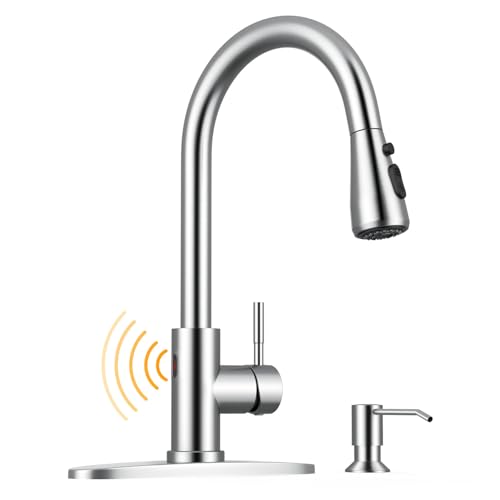
WEWE Touchless Kitchen Faucet with Soap Dispenser Set
Badge: Easiest Operation: Hands-Free
Strengths
- Touchless activation: no grasping, twisting or lever force needed to start water
- SUS 304 construction and a ceramic cartridge keep the build evidence strong behind the convenience
- 360-degree swivel plus a pull-down hose minimises reaching and pot-lifting
Trade-offs
- The listing does not state ADA compliance; hands-free operation is a feature, not a certification
- Sensor operation depends on power (batteries or adapter, per the listing details) and adds a failure mode a lever never has
- A bundled soap dispenser uses a deck hole and counter space some kitchens cannot spare
Key specifications from the listing
- Activation: Touchless, as stated
- Body: SUS 304 stainless steel
- Cartridge: Ceramic cartridge
- Movement: 360-degree swivel; pull-down hose; 3-mode sprayer
- Extras: Soap dispenser set; 1- or 3-hole fit; easy-clean nozzles
For a hand that cannot grip, every lever is a negotiation. Touchless activation ends the negotiation: water starts and stops without grasp, twist or pinch, which is why this pick leads an ease-of-operation ranking despite the guide’s refusal to call it — or any pick here — ADA certified. Its listing does not state ADA compliance, and that sentence belongs in the first paragraph of its review, not a footnote. What the listing does state is a serious faucet underneath the sensor: SUS 304 construction, a ceramic cartridge, a 360-degree swivel, three spray modes and easy-clean nozzles.
The supporting features compound the ease case. A pull-down hose brings water to a pot sitting in the basin, the full swivel covers a wide sink without the cook repositioning, and the bundled soap dispenser puts soap at the same hands-free station. The costs are the known costs of electronics at a sink: a power source to maintain, a sensor that can be triggered by a passing pan, and more components than a lever faucet has. For the reader this guide is written for, that trade is usually worth it — but it should be chosen knowingly, and readers who prefer purely mechanical operation will find the counter-argument fully aired in Best Manual Kitchen Faucets.
Best for: cooks with grip, strength or dexterity limits who want water control with no handle effort at all / Not suited for: buyers who need documented ADA compliance, or who refuse battery- or sensor-dependent operation at the sink
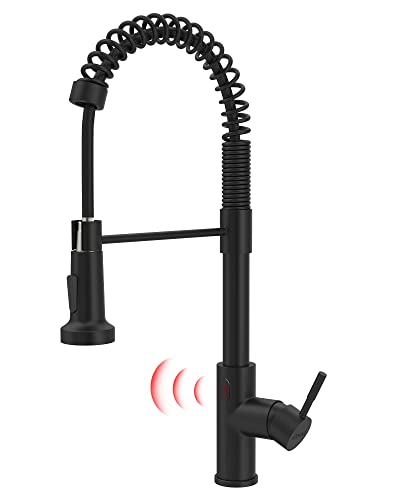
GIMILI Matte Black Touchless Kitchen Faucet
Badge: Best Hands-Free Spring Design
Strengths
- Motion sensor activation with hands-free control stated plainly in the title
- A single handle is also stated, so manual control exists alongside the sensor
- Spring sprayer parks high and pulls down to the work, reducing lifting and aiming effort
Trade-offs
- The listing does not state ADA compliance; sensor operation is not a certification
- Single-hole installation only, per the title — the narrowest fit in this guide
- No body material or cartridge type is stated in the title, so build evidence is thin
Key specifications from the listing
- Activation: Motion sensor, hands free, as stated
- Handle: Single handle (manual control also stated)
- Spout: Spring pull-down sprayer
- Mounting: Single hole installation
- Finish: Matte black
The GIMILI states its accessibility-relevant feature in the most explicit language in this guide: motion sensor activated, hands free. Like the WEWE above, it removes grip from starting and stopping water; unlike the WEWE, it pairs the sensor with a spring sprayer, whose high parked position and flexible pull-down suit cooks who fill and rinse at varied heights. Its title also states a single handle, which matters more than it may appear: a manual path exists when the sensor is off, unpowered or simply not wanted. Its listing does not state ADA compliance, and no hands-free claim in this guide should be read as one.
The compromises are fit and documentation. Single-hole installation is the narrowest mounting claim here, so owners of 3-hole decks without a workable plate arrangement should look at the WEWE instead. The title states no body material and no cartridge type, leaving its construction the least evidenced in this guide. Its matte black finish, finally, is a decisive style statement that suits modern farmhouse kitchens and clashes with traditional ones. Rank it second for operation, with eyes open about the rest.
Best for: single-hole sinks where hands-free sensor control and a spring sprayer solve daily effort problems / Not suited for: 3-hole decks, documentation-first buyers, or anyone needing a stated ADA compliance claim
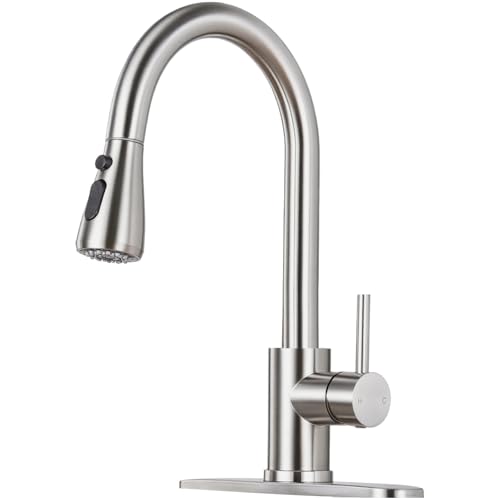
LUFG Brushed Nickel Kitchen Faucet with Pull Down Sprayer
Badge: Best Lever Control with Certified Build
Strengths
- Single-handle control: one lever governs flow and temperature with a push in any direction
- Full 360-degree swivel reduces reaching across wide or double basins
- NSF372, NSF61 and cUPC are named — the strongest waterway documentation in this guide
Trade-offs
- The listing does not state ADA compliance, and lever effort itself is not quantified anywhere in the title
- Cartridge type is not stated, so the smoothness and force of the lever action cannot be judged from the title
- Three spray modes are counted but not described individually
Key specifications from the listing
- Handle: Single handle
- Body: SUS 304 stainless steel
- Certifications: NSF372, NSF61, cUPC, as stated
- Movement: 360-degree swivel spout; 3 spray modes; pull-down
- Mounting: Deck plate included in the listing concept
Among lever faucets, the single-handle layout is the accessibility workhorse: one control, movable by a palm, a wrist or the side of a hand, blending temperature and flow in a single motion instead of asking two hands to balance two valves. The LUFG pairs that layout with the strongest construction paperwork in this guide — SUS 304 stainless and three certifications named by standard — and a full-swivel spout that lets the water come to the cook. Its listing does not state ADA compliance, and lever effort is a physical quantity no title here quantifies; both limits are stated plainly because this guide’s credibility depends on them.
Who should choose it over the touchless pair? Cooks who want easier operation without electronics: no batteries, no sensor behaviour to learn, nothing to fail in a power cut, and a control style every household member and guest already understands. The deck plate in its listing concept also helps retrofits in older kitchens, where deck layouts vary. Judged as a lever faucet for effort-conscious buyers, it is the most completely evidenced pick in this guide.
Best for: buyers who want single-lever ease with certified construction and no electronics to maintain / Not suited for: buyers who need zero-effort activation, or documented ADA compliance for a specified project

Moen Adler Pulldown Kitchen Faucet 87233SRS
Badge: Best Supported Lever Pick
Strengths
- A stable model number (87233SRS) makes maker documentation and parts findable — essential when verifying any compliance paperwork
- Wide retail stocking means in-person help and fast parts for adjustments
- Pulldown format brings water to the pot, reducing lifting at the sink
Trade-offs
- The listing title does not state ADA compliance, handle style detail, or lever effort — all must be checked in maker documentation
- Body material and cartridge type are likewise unstated in the title
- Spot Resist finish is a maintenance virtue, not an operating-ease feature
Key specifications from the listing
- Model: 87233SRS, as stated
- Finish: Spot Resist Stainless
- Sprayer: Pulldown sprayer
- Brand: Moen Adler line
The Adler’s accessibility case is procedural, and for some buyers it will be the strongest case here. Verifying anything about a faucet — compliance documentation, handle options, replacement parts, adjustment guidance — begins with identifying the exact model, and the Adler is the most exactly identified pick in this guide: a numbered model in a long-running, widely stocked line. Its listing does not state ADA compliance, and this guide claims none for it; what it offers is the shortest path to the maker’s own documentation, which is where any compliance question must ultimately be answered. The manufacturer-evidence question is developed further in Best Manufacturers Of Kitchen Faucets.
In daily operation it is a conventional pulldown: the sprayer does the accessibility work by travelling to heavy pots, and the finish resists the spotting that makes a busy accessible kitchen look unkempt. Handle specifics are not in the title, so a buyer for whom lever shape and effort are decisive should handle the question in the maker’s documentation or in a store, where this line is commonly stocked. That verifiability — in person, by number — is its quiet advantage.
Best for: buyers who want to verify documentation, handle options and parts for an exact numbered model / Not suited for: buyers who need operating features and compliance claims stated in the listing itself


Lufeidra Kitchen Faucet with Pull-Down Sprayer
Badge: Best Classic Lever Alternative
Strengths
- Ceramic cartridge construction is associated with smooth, consistent lever action over time
- SUS304 stainless body states its material by grade
- Fits 1- or 3-hole decks, suiting retrofits in older, accessibility-remodelled kitchens
Trade-offs
- The listing does not state ADA compliance, and the title does not even state the handle count — verify the control layout on the listing
- No swivel range or spray-mode detail is stated
- Classic pot-filler styling is a strong aesthetic commitment
Key specifications from the listing
- Body: SUS304 stainless steel
- Cartridge: Ceramic cartridge
- Mounting: Fits 1- or 3-hole
- Style: Classic pot filler form, pull-down sprayer
- Finish: Brushed nickel
The Lufeidra is included for a specific household: one remodelling a traditional kitchen for easier use, unwilling to accept a hyper-modern faucet as the price of comfort. Its construction evidence is respectable — SUS304 stainless, a stated ceramic cartridge — and a ceramic cartridge matters to this readership beyond longevity, because consistent, predictable lever movement is easier for a weak hand than a valve whose effort changes as it wears. Its listing does not state ADA compliance. More than that, its title does not state the handle configuration at all, so the control layout must be confirmed on the listing page before this pick can be recommended for a specific hand — an unusual caveat, stated deliberately.
Its stated fit across 1- or 3-hole decks suits the older sinks common in accessibility retrofits, and the pull-down sprayer performs the familiar pot-filling assistance. Treat this pick as a verify-first option: the bones are stated and good, the operating layout needs one listing-page confirmation, and the classic styling will either delight its kitchen or fight it. There is no middle ground with a pot-filler silhouette, and the review will not pretend there is.
Best for: traditional kitchens being made easier to use, after confirming the control layout on the listing / Not suited for: buyers who need handle configuration and operating features fully stated before shortlisting

FEELSO Kitchen Faucet with Pull Down Sprayer
Badge: Best High-Arc Lever Pick
Strengths
- Single handle is stated explicitly — one-lever control without ambiguity
- High arc lets the tallest pots sit in the basin under the sprayer instead of being lifted to a counter filler
- Lead-free, NSF certified stainless construction states its waterway claim plainly
Trade-offs
- The listing does not state ADA compliance; single-handle ease is a feature judgement, not a certification
- Neither the specific NSF standard nor the cartridge type is named in the title
- No swivel range is stated, so basin coverage needs listing confirmation
Key specifications from the listing
- Handle: Single handle, as stated
- Body: Stainless steel, lead-free NSF certified, as stated
- Spout: High arc with pull-down sprayer
- Mounting: 1 or 3 hole
- Finish: Brushed nickel
FEELSO’s contribution to this ranking is clarity about the two things an effort-conscious buyer asks first. The handle is stated: single. The arc is stated: high. Together they describe a faucet where one lever runs the water and the geometry lets heavy vessels stay in the basin — filled by the pull-down sprayer, emptied without a lift-and-tip at counter height. Its body claim, lead-free NSF certified stainless steel, is stated in the same plain style. Its listing does not state ADA compliance, and this guide’s judgement that its layout is easier to operate is exactly that — a judgement about features, clearly labelled.
The documentation gaps mirror its sibling picks: the NSF standard goes unnumbered, the cartridge unnamed, the swivel range unstated. A buyer comparing it with the LUFG is choosing between the LUFG’s fuller paperwork and full swivel, and the FEELSO’s explicit high-arc geometry. For a household whose daily strain is lifting stockpots rather than reaching across a wide basin, that trade can reasonably favour the FEELSO. Accessibility is personal; the ranking gives the reasoning, and the right answer follows the hand it serves.
Best for: households whose main strain is lifting tall, heavy pots, wanting stated single-lever control / Not suited for: buyers who want standards numbered, cartridge named and swivel range stated up front
Comparison Table
Read this table as an effort map, not a certification chart — because no certification is stated for any row. The touchless pair remove grip from activation; the single-lever picks reduce operation to one push-and-blend control; the sprayer and swivel columns decide how much lifting and reaching remains after the water is running. The right row is the one whose remaining effort matches the hands in your kitchen.
| Pick | Badge | Defining traits from the listing | Listing |
|---|---|---|---|
| WEWE Touchless Kitchen Faucet with Soap Dispenser Set | Easiest Operation: Hands-Free | Touchless activation, SUS 304, ceramic cartridge, 360-degree swivel, soap dispenser set | Check on Amazon |
| GIMILI Matte Black Touchless Kitchen Faucet | Best Hands-Free Spring Design | Motion sensor hands-free control, single handle, spring pull-down, single hole, matte black | Check on Amazon |
| LUFG Brushed Nickel Kitchen Faucet with Pull Down Sprayer | Best Lever Control with Certified Build | Single handle, SUS 304, NSF372 / NSF61 / cUPC stated, 360-degree swivel, deck plate | Check on Amazon |
| Moen Adler Pulldown Kitchen Faucet 87233SRS | Best Supported Lever Pick | Moen Adler 87233SRS, Spot Resist Stainless, pulldown, numbered widely stocked model | Check on Amazon |
| Lufeidra Kitchen Faucet with Pull-Down Sprayer | Best Classic Lever Alternative | SUS304 body, ceramic cartridge, classic pot-filler form, fits 1- or 3-hole; handle layout unstated in title | Check on Amazon |
| FEELSO Kitchen Faucet with Pull Down Sprayer | Best High-Arc Lever Pick | Single handle stated, high arc, lead-free NSF certified stainless, 1 or 3 hole fit | Check on Amazon |
How to Choose Best Made Kitchen Faucets Ada
Start by naming your actual requirement, because two different purchases hide inside this keyword. If a project specification, a care setting or a permit requires ADA documentation, the purchase process is documentary: shortlist designs you like, then obtain the maker’s compliance documentation for the exact model and configuration. No buying guide can substitute for that paper, and any guide that implies otherwise is misleading you. The picks here can start that shortlist; they cannot finish it.
If the requirement is a home kitchen that asks less of the hands that use it — the more common case — shop by effort. Activation effort first: touchless asks least, a single lever asks little and predictably, and anything requiring a firm grasp or two-handed balancing asks most. Then lifting effort: a pull-down sprayer and a high arc keep heavy vessels in the basin. Then reaching effort: swivel range and spout reach decide how much leaning and repositioning a day of cooking accumulates. The material and certification questions still matter — Best Material For Kitchen Faucets covers them — but for this purchase they rank after effort.
Handle shape deserves a thought of its own. Lever-style controls that present a flat paddle to the hand are generally easier for limited grip than small round knobs, because they can be moved with a palm or wrist. Where a title does not describe the handle — two picks here are silent or partial on the point — resolve it on the listing page or in person before ordering. Effort is physical; a photograph of the handle tells you more than a paragraph can.
Finally, plan the installation around the user, not the plumbing alone. Lever position, spout height over the basin and sprayer docking all interact with seated use, limited reach and one-handed cooking in ways a standard install ignores. If the kitchen serves a wheelchair user or someone with a specific reach envelope, an installer experienced in accessible kitchens is worth more than any single product feature in this guide.
How to Set Up an Easier-to-Use Kitchen Faucet: Installation Choices That Affect Effort
Installation decides more about daily effort than buyers expect. The same faucet can be easy or awkward depending on lever orientation, hose routing and what lives under the sink. These steps assume a standard owner installation of a single-lever or touchless model from this guide, with effort — not just watertightness — as the goal.
- Before mounting, sit or stand at the sink as the primary user does and decide which side the lever should favour; most single-lever faucets allow orientation choices at install time that are annoying to change later.
- Mount the faucet and deck plate per the maker’s sequence, then test lever travel through its full arc before tightening everything finally — the lever must clear backsplashes and window sills at every temperature position.
- Route the pull-down hose in a wide, clear loop and place its weight so the sprayer docks firmly without a tug; docking effort is set here, permanently.
- For touchless models, position the sensor power pack where its batteries can be changed without emptying the whole cabinet or lying on the floor — future maintenance effort is part of accessibility.
- Restore water slowly, test activation from the user’s actual position (including seated, if relevant), and adjust before declaring the job done.
- Leave the under-sink cabinet’s front zone clear of stored items that block the hose loop or the power pack; accessibility includes the space below the deck.
Live with the setup for a week before final judgement. Effort problems reveal themselves in routines — the morning kettle, the heavy pasta pot — and small adjustments to hose weight position or lever orientation in that first week pay back for years.
Troubleshooting: three problems owners actually meet
Problem: the lever is easy to lift but hard to nudge for temperature → the cartridge may be new and stiff, or debris from installation is in the valve. Cycle the lever gently through its range, flush per the maker’s guidance, and allow a short bedding-in period before judging the faucet’s effort.
Problem: a touchless sensor triggers when nobody wants water → reflective surfaces, steam or a passing pan are in its field. Re-aim or reposition per the maker’s instructions, and remember the manual handle path exists on models that state one — use it during sensor adjustments.
Problem: the sprayer docks weakly and needs a push → the hose weight has shifted or stored items crowd the loop. Clear the loop, reposition the weight, and confirm the dock from the user’s seated or standing position, not from above.
Why This Guide Claims No Certifications — and Why That Is the Helpful Choice
It would be easy, and wrong, to decorate this page with compliance language the listings do not contain. ADA compliance for a faucet involves operable-part requirements — force, grasping, reach — assessed for a specific product in a specific installation. A buying guide working from listing titles cannot assess an installation it has never seen, and for these six models the titles themselves make no compliance claim to repeat. The most useful thing this guide can do is say exactly that, rank the operating features that are stated, and point documentary buyers to the maker’s documentation for the exact model.
That restraint also protects home buyers. A household that purchases a “certified-sounding” faucet and later discovers the claim was decorative has been harmed twice: once in money, once in trust. A household that purchases a touchless or single-lever faucet knowing precisely which features it is getting has bought honestly. Accessibility deserves the second kind of transaction.
Designing the Whole Sink for Easier Use, Beyond the Faucet
A faucet is one element of an easier kitchen. Basin depth decides how far hands travel to the work; a very deep basin under a high arc suits standing cooks and can strain seated ones. Lever-side clearance decides whether a wrist can travel the full temperature arc. Even the soap dispenser bundled with the leading pick here participates: soap at the faucet station is one less bottle to grip with wet hands. When you evaluate the picks above, evaluate them inside your sink’s whole geometry, ideally with the primary user present for the decision.
And keep the receipts of your reasoning. If a future remodel, a care assessment or a resale raises accessibility questions, a note of which features you chose and why — sensor activation, lever control, sprayer assistance — is worth more than any badge a listing could have printed.
Effort, Measured Honestly: What We Can and Cannot Say About Force
Readers comparing these picks will reasonably ask the quantitative question: how much force does each lever actually take? The honest answer is that the verified listings do not state operating force for any of the six, and this guide will not estimate it. Force figures depend on the cartridge, the lever’s length and geometry, water pressure and the individual unit, and a number invented for this page would be worse than no number — it would send a buyer with a specific medical constraint shopping on fiction. What can be compared without fiction is the architecture of effort: how many motions an operation requires, whether grip is involved at all, and whether the motion can be performed by a palm, a wrist or a forearm rather than by fingers closing on a control.
By that architectural measure the ranking in this guide is robust even without a single force figure. Touchless activation requires zero grip motions. A single lever requires one pushing motion that large joints can perform. The pull-down sprayer converts lifting into pulling along the hose’s path. The full swivel converts repositioning into rotation at the spout rather than carrying at the basin. Each step down that ladder is a real reduction in the day’s accumulated effort, and a household can feel the difference within the first evening of cooking — no laboratory required, and none claimed.
Where a specific force limit genuinely governs — a post-surgical hand, a progressive condition, a care plan — the route is the maker’s technical documentation for the exact model and, where possible, hands on the physical product in a showroom. Two picks in this guide, the numbered Moen and the widely retailed lines, make that physical verification unusually practical. A guide that respects its readers will say, as this one does, that its architectural ranking is the beginning of that verification and not a substitute for it.
When the Accessible Choice Is Also the Universal One
There is a quieter argument running under this whole guide: the features ranked here for effort-limited hands are the same features every cook wants by the third hour of a big cooking day. The parent holding a toddler opens the lever with a wrist. The baker with dough to the elbows blesses the sensor. The cook moving a full canning pot blesses the sprayer that comes to the pot. Designing for the most constrained user in the household turns out to design for every user at their most constrained moment, which in a kitchen is most of the time.
That universality has a practical consequence for households negotiating a purchase. The accessible option rarely needs to be framed as a concession or a medical purchase; the touchless WEWE and the single-lever LUFG are simply good faucets whose operating effort happens to be low, and the FEELSO’s high arc serves the tall-pot cook and the seated cook with the same geometry. Families can therefore choose on effort without choosing a clinical aesthetic — every pick in this guide is a mainstream kitchen faucet first, judged here on the effort it asks.
Hold on to the guide’s boundary all the same. Universal usefulness is not certification, and the sentence bears repeating because it protects real projects: none of these six listings states ADA compliance, and any setting that requires compliance documentation must obtain it for the exact model from the maker. Within that boundary, buy the effort your household needs, enjoy that everyone else in the kitchen benefits too, and let the ranking above — features stated, claims exactly as strong as their evidence — be the model for every accessibility purchase that follows this one.
A Note for Carers, Partners and Adult Children Buying for Someone Else
Many readers of this guide are not buying for their own hands. If that is you, three courtesies double as good method. First, let the user rank the efforts: the hand that cooks knows whether grip, reach or lifting is its true tax, and a well-meant guess can optimise the wrong one. Second, trial the gesture before the purchase where you can — a showroom lever pushed with a wrist teaches more than any description, including this guide’s. Third, install for the routine, not the reveal: lever side, hose weight and battery access set quietly, without ceremony, so the kitchen simply becomes easier and stays that way. Accessibility bought with dignity lasts; accessibility bought as a surprise often gets politely worked around.
And when the choice is made, write down which effort you bought for — activation, lifting or reaching — alongside the model. Kitchens change, hands change, and that one honest sentence will explain this faucet to whoever adapts the room next, better than any badge could.
Common Buying Mistakes
Mistake one: treating “touchless” or “lever” as synonyms for “ADA compliant.” They are operating features. Compliance is documentation for an exact model and installation, and none of the six titles here states it.
Mistake two: choosing for a hand you have not watched cook. Effort is specific — grip, reach, seated height, one-handed habits. Observe the actual routines before ranking activation types, or the ranking in this guide will optimise for a stranger.
Mistake three: forgetting the maintenance effort of electronics. A touchless faucet whose battery pack is buried behind stored paint cans will, in practice, become a manual faucet with a dead sensor. Install for the battery change, not just the first day.
Mistake four: ignoring lever clearance. A lever that strikes the backsplash at full hot is an accessibility failure installed with good intentions. Test the full arc before final tightening.
Final Recommendation
For the least operating effort, choose the WEWE Touchless: sensor activation removes grip from the task, and its stated SUS 304 construction, ceramic cartridge and full swivel make it a complete faucet behind the convenience. Choose the GIMILI instead for a single-hole sink where its spring sprayer and stated manual handle fallback fit better.
Check on Amazon · Check on Amazon · Check on Amazon
For lever control without electronics, choose the LUFG — single lever, full swivel, the strongest certification paperwork here — or the FEELSO where high-arc geometry answers a lifting problem. Choose the Moen Adler when verifiable documentation and parts for an exact model matter most, and the Lufeidra for a traditional kitchen after confirming its control layout. And hold the guide’s central line: no pick here is presented as ADA certified, because none states it. What each pick offers is stated, comparable operating ease — which, chosen knowingly, is what most kitchens searching this keyword actually need.
Frequently Asked Questions
Are any of these faucets ADA certified?
This guide claims no ADA certification for any pick, because none of the six verified listing titles states ADA compliance. Certification and compliance documentation are issued for exact models and configurations by the maker. If you need that documentation, request it from the maker for the specific model number before specifying or purchasing.
What faucet features genuinely help hands with limited grip?
Touchless activation removes gripping from starting and stopping water. A single lever reduces control to one push that a palm, wrist or forearm can perform. A pull-down sprayer reduces lifting by bringing water to vessels in the basin. Those three features, all ranked in this guide, address the most common effort complaints at a kitchen sink.
Is a touchless faucet always the best accessibility choice?
Not always. It removes activation effort but adds power maintenance, sensor behaviour to learn, and a failure mode a lever never has. Some users prefer the predictability of a lever they can feel. The right answer depends on the specific hands, which is why this guide ranks both paths rather than crowning one.
Why does the guide repeat that listings do not state ADA compliance?
Because accessibility is a topic where implied claims can mislead buyers into skipping verification they genuinely need — for a regulated project, that can have legal and safety consequences; for a home, financial ones. Repetition is the price of clarity, and this guide pays it deliberately.
Can a single-lever faucet be operated with one hand?
Yes — that is the layout’s defining virtue. One lever blends flow and temperature, so one hand (or a wrist or forearm) runs the faucet while the other holds a pot, a pan or a rail. Two-handle designs, by contrast, ask both hands to balance hot and cold separately.
What should I verify on the listing before buying for accessibility?
The handle’s shape and position, the activation type and its power source if touchless, the swivel range, the sprayer’s docking style, and — if compliance matters to your project — the maker’s documentation for the exact model. The reviews flag which of these each title states and which it leaves for you to confirm.