Disclosure: topratedkitchenware.com is reader-supported. When you buy through links on our site, we may earn an affiliate commission from Amazon and other retailers, at no extra cost to you.
Where to buy
Shoppers comparing the best manual coffee makers will find all six shortlisted machines linked below, each one a genuine fit for the brief. The short answer is in this box; the full reasoning, including who should skip each pick and why, is in the detailed reviews further down.
- Secura French Press Coffee Maker, 34 oz — Best Overall; check the latest price on Amazon
- Utopia Kitchen French Press, 34 oz — Best Filtration; check the latest price on Amazon
- MuellerLiving French Press Coffee Maker, 34 oz — Best Everyday Pick; check the latest price on Amazon
- AgcKuzt French Press, 34 oz — Best for Camping; check the latest price on Amazon
- Ziruma French Press, 34 oz — Best Plastic-Free Pick; check the latest price on Amazon
- Secura French Press Coffee Maker, 50 oz — Best for Groups; check the latest price on Amazon
Read the full guide ↓
The best manual coffee makers ask something of you that no other category does: your participation. There is no timer, no pump, no element, just hot water, ground coffee, a vessel, and four minutes of your attention, and in exchange the manual method offers the most control per dollar in all of coffee, plus a machine that cannot really break. This roundup is devoted to the manual method’s most enduring instrument, the french press, and specifically to its modern stainless form: every pick is a steel press, most in the versatile 34 oz size, one in a group-sized 50 oz, all insulated, all built to outlast the glass presses that taught most of us the method and then broke in the sink.
Within that shared form, the picks argue about the press’s two historic weaknesses. Sediment is the first, and three picks attack it with multi-level or multi-layer filtration systems designed to leave the cup cleaner while keeping the press’s signature body. Heat is the second, answered everywhere here by double-wall insulation, so the second cup is a pleasure rather than a penance. Around those arguments sit the practical virtues: spare screens included with several models, dishwasher-safe construction, one press built explicitly to travel to a campsite, and one that removes plastic from the build entirely for drinkers who want coffee that only ever touches steel.
Readers comparing nearby formats often also look at How To Clean A French Press And Keep It Fresh Smelling.
A manual guide should be honest about the trade at its heart. You are the machine’s motor, timer, and thermostat, which means your technique is a specification: grind size, water temperature, steep time, and the discipline to decant. The how-to section in this guide is therefore not an accessory but the main event, and a reader willing to learn a four-minute ritual will get more from the least expensive pick here than a careless reader gets from any automatic machine at any price.
Key Takeaways
- Every pick is a stainless, insulated press: no glass to break, no element to scale, no electronics to fail.
- Three picks attack sediment with multi-level filtration; the classic-screen picks keep maximum body.
- 34 oz is the sweet spot for one to four drinkers; the 50 oz Secura serves a full table in one plunge.
- Spare screens included with several picks are the quiet value feature: the screen is the press’s one wear part.
- Technique is the specification: coarse grind, four minutes, a slow plunge, and decant what you will not drink at once.
In this guide
Quick Picks
Six french presses, six different answers to the same search. The badge under each name is the fastest honest summary in this guide: it tells you the job that pick does best, and the detailed reviews below hold it to that claim. A related shortlist worth your time is French Press Buying Guide Size Material And Plunger Design.
| Pick | Badge | Best for | Link |
|---|---|---|---|
| Secura French Press Coffee Maker, 34 oz | Best Overall | daily press drinkers who want durability and heat retention in the standard size | Check on Amazon |
| Utopia Kitchen French Press, 34 oz | Best Filtration | press drinkers who love the method but hate sediment in the last sip | Check on Amazon |
| MuellerLiving French Press Coffee Maker, 34 oz | Best Everyday Pick | everyday press users who want a clean cup and simple dishwasher care | Check on Amazon |
| AgcKuzt French Press, 34 oz | Best for Camping | campers and home users who want one tough press for both places | Check on Amazon |
| Ziruma French Press, 34 oz | Best Plastic-Free Pick | drinkers who want coffee that only ever touches steel | Check on Amazon |
| Secura French Press Coffee Maker, 50 oz | Best for Groups | families, offices, and hosts brewing press coffee for a group | Check on Amazon |
How These Picks Were Chosen
This is a research-led guide, and it is honest about what that means: no laboratory, no invented hands-on testing, and no scores conjured from thin air. The shortlist for best manual coffee makers was built from the verified product pool for this category, with every linked product cross-checked against its manufacturer listing data on 2026-11-20: the name, the format, the capacity, and the features claimed in these reviews all trace back to that verified record. Anything a listing did not state, a dimension, a power figure, a material, is simply not claimed here.
The second filter was fit. Every pick had to match the core of the search, its product type and defining attributes, not merely the broad category, and all six pool products passed for this brief, which is why all six are linked. Where a pick in this roundup is the weakest fit for a particular household, its review says so directly rather than hiding behind the badge. If your search widens, the natural next read is Best French Presses Coffee Makers. That discipline, naming the reader each pick is not for, is applied the same way in every guide in this series.
Finally, the ordering is an argument, not a ranking of worth: picks are arranged so the strongest general answer comes early, with specialists and narrower fits later, and each badge is used identically in the Quick Picks table, the detailed review, and the comparison table, so you can follow one pick through the whole guide without translating between vocabularies.
Detailed Reviews: The best manual coffee makers, Pick by Pick
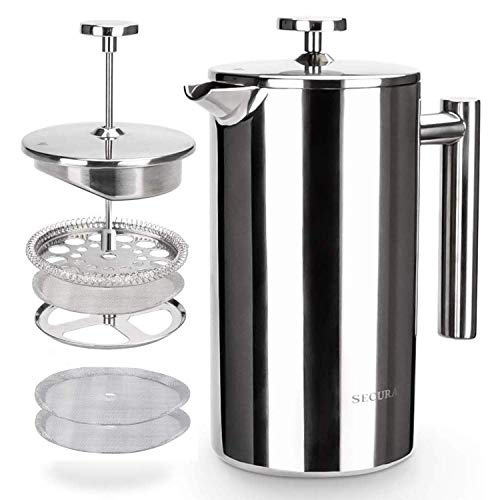
Secura French Press Coffee Maker, 34 oz
Badge: Best Overall
Strengths
- Stainless body removes the broken-glass failure mode of classic presses
- Insulation keeps a second cup warm while the first is drunk
- Spare screens included from day one stretch the press’s working life
Trade-offs
- 34 oz is roughly four mugs, so big groups need the 50 oz size
- Steel body hides the brew level from view
- Heavier than a glass press of the same size
Key specs (from the verified listing)
- Capacity: 34 oz (1 litre)
- Material: 304-grade stainless steel
- Construction: insulated double wall (per listing)
- Extras: 2 extra screens included
- Finish: Silver
The case for Secura French Press Coffee Maker, 34 oz starts with its defining choice: it is a 304-grade stainless insulated press with two extra screens included. A french press is the simplest coffee maker in any kitchen, grounds and hot water and time, and because there is so little machinery, the quality of the few parts that exist is the whole story: the steel, the screen, the seal of the plunger, and how the filter stack comes apart for cleaning.
Brewing with it follows the ritual described in the how-to section, and the cup it produces is the classic press cup: heavy-bodied, rounded, and forgiving of slightly imperfect technique, which is why the press remains the recommendation for people who find drip thin and espresso fussy. This model’s filtration and insulation choices nudge that classic cup in its own direction, cleaner or hotter-keeping, and the strengths and trade-offs above name exactly which direction that is.
Where a press earns its keep over years is maintenance, and this design’s story is simple: rinse or dishwasher the parts, keep the screen clean, and replace the screen when its edges fray. There is no pump to fail, no element to scale, no electronics to obsolesce. A press bought well is close to a lifetime object, and the included spares and dishwasher-safe construction listed for this model are the details that make that realistic rather than romantic.
The honest limitation is inherent to the method. Press coffee carries more fine sediment than paper-filtered coffee, and it keeps extracting if it sits on the grounds, so the last cup punishes anyone who leaves it standing. Drinkers who want a crystalline, filtered cup should look at pour-over or drip; drinkers who want body and simplicity will not care at all.
For a manual brief, the measure of the machine is how faithfully it supports the ritual and then gets out of its way, because in this category the brewer and the drinker are the same person.
Best for: daily press drinkers who want durability and heat retention in the standard size / Not suited for: groups of five or more drinking at the same time
Check on Amazon — check the latest price on Amazon for the Secura French Press Coffee Maker, 34 oz.
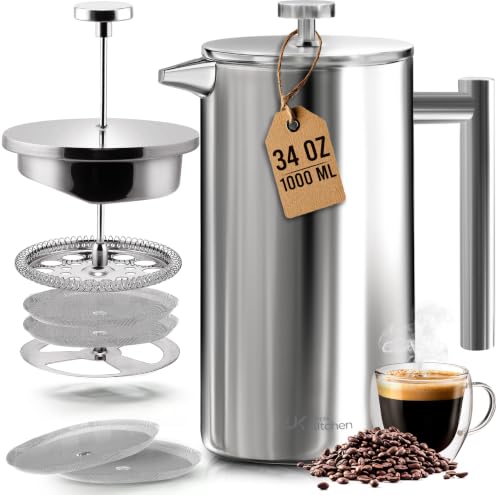
Utopia Kitchen French Press, 34 oz
Badge: Best Filtration
Strengths
- 4-level filtration is aimed squarely at a cleaner, less silty cup
- Double-wall insulation protects the second serving’s heat
- Dishwasher-safe, rust-free build keeps upkeep minimal
Trade-offs
- Extra filtration can slow the plunge if grounds are very fine
- Steel walls hide how much coffee remains
- Same 34 oz ceiling as most of this group
Key specs (from the verified listing)
- Capacity: 34 oz
- Material: 304-grade stainless steel
- Filtration: 4-level filtration system, 2 extra filters included
- Construction: double wall insulated
- Care: dishwasher safe, rust-free (per listing)
Brewing with it follows the ritual described in the how-to section, and the cup it produces is the classic press cup: heavy-bodied, rounded, and forgiving of slightly imperfect technique, which is why the press remains the recommendation for people who find drip thin and espresso fussy. This model’s filtration and insulation choices nudge that classic cup in its own direction, cleaner or hotter-keeping, and the strengths and trade-offs above name exactly which direction that is.
Where a press earns its keep over years is maintenance, and this design’s story is simple: rinse or dishwasher the parts, keep the screen clean, and replace the screen when its edges fray. There is no pump to fail, no element to scale, no electronics to obsolesce. A press bought well is close to a lifetime object, and the included spares and dishwasher-safe construction listed for this model are the details that make that realistic rather than romantic.
The honest limitation is inherent to the method. Press coffee carries more fine sediment than paper-filtered coffee, and it keeps extracting if it sits on the grounds, so the last cup punishes anyone who leaves it standing. Drinkers who want a crystalline, filtered cup should look at pour-over or drip; drinkers who want body and simplicity will not care at all.
The case for Utopia Kitchen French Press, 34 oz starts with its defining choice: it is a double-wall stainless press with a 4-level filtration system and two extra filters. A french press is the simplest coffee maker in any kitchen, grounds and hot water and time, and because there is so little machinery, the quality of the few parts that exist is the whole story: the steel, the screen, the seal of the plunger, and how the filter stack comes apart for cleaning.
For a manual brief, the measure of the machine is how faithfully it supports the ritual and then gets out of its way, because in this category the brewer and the drinker are the same person.
Best for: press drinkers who love the method but hate sediment in the last sip / Not suited for: backpackers counting every gram of kit weight
Check on Amazon — check the latest price on Amazon for the Utopia Kitchen French Press, 34 oz.
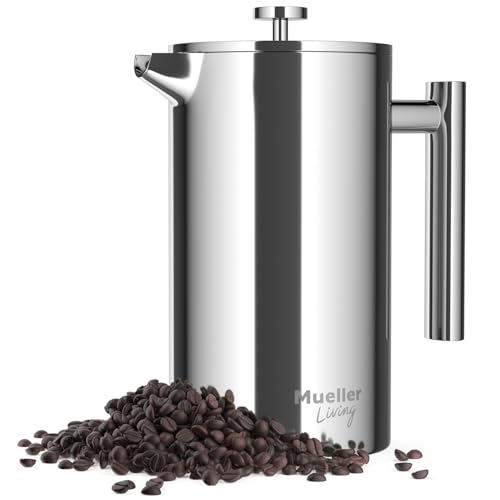
MuellerLiving French Press Coffee Maker, 34 oz
Badge: Best Everyday Pick
Strengths
- 4-filter stack targets the same clean-cup goal as the best presses here
- Double insulation holds heat between first and second cups
- Food-grade, rust-free steel suits daily use without fuss
Trade-offs
- Fine grounds plus a 4-filter stack can make plunging firm work
- No included spare screens are listed, unlike some rivals
- 34 oz serves a small household, not a crowd
Key specs (from the verified listing)
- Capacity: 34 oz
- Material: stainless steel, food grade (per listing)
- Filtration: 4 filter system (per listing)
- Construction: double insulated, heat resistant
- Care: dishwasher safe, rust-free (per listing)
Where a press earns its keep over years is maintenance, and this design’s story is simple: rinse or dishwasher the parts, keep the screen clean, and replace the screen when its edges fray. There is no pump to fail, no element to scale, no electronics to obsolesce. A press bought well is close to a lifetime object, and the included spares and dishwasher-safe construction listed for this model are the details that make that realistic rather than romantic.
The honest limitation is inherent to the method. Press coffee carries more fine sediment than paper-filtered coffee, and it keeps extracting if it sits on the grounds, so the last cup punishes anyone who leaves it standing. Drinkers who want a crystalline, filtered cup should look at pour-over or drip; drinkers who want body and simplicity will not care at all.
The case for MuellerLiving French Press Coffee Maker, 34 oz starts with its defining choice: it is a stainless press with a 4-filter system and double insulation. A french press is the simplest coffee maker in any kitchen, grounds and hot water and time, and because there is so little machinery, the quality of the few parts that exist is the whole story: the steel, the screen, the seal of the plunger, and how the filter stack comes apart for cleaning.
Brewing with it follows the ritual described in the how-to section, and the cup it produces is the classic press cup: heavy-bodied, rounded, and forgiving of slightly imperfect technique, which is why the press remains the recommendation for people who find drip thin and espresso fussy. This model’s filtration and insulation choices nudge that classic cup in its own direction, cleaner or hotter-keeping, and the strengths and trade-offs above name exactly which direction that is.
For a manual brief, the measure of the machine is how faithfully it supports the ritual and then gets out of its way, because in this category the brewer and the drinker are the same person.
Best for: everyday press users who want a clean cup and simple dishwasher care / Not suited for: large households brewing for a full table
Check on Amazon — check the latest price on Amazon for the MuellerLiving French Press Coffee Maker, 34 oz.

AgcKuzt French Press, 34 oz
Badge: Best for Camping
Strengths
- Full stainless build travels to a campsite without a glass worry
- Spare filters included keep it working longer between orders
- Double walls help outdoors, where coffee cools fastest
Trade-offs
- Listing is lighter on fine detail than the established brands here
- 34 oz is four cups, so a big tent group brews twice
- Steel press is not the lightest camping option in absolute terms
Key specs (from the verified listing)
- Capacity: 34 oz (4 cups per listing)
- Material: full stainless steel, food grade (per listing)
- Construction: upgraded double-walled insulation
- Extras: 2 more filters included (per listing)
- Care: dishwasher safe
The honest limitation is inherent to the method. Press coffee carries more fine sediment than paper-filtered coffee, and it keeps extracting if it sits on the grounds, so the last cup punishes anyone who leaves it standing. Drinkers who want a crystalline, filtered cup should look at pour-over or drip; drinkers who want body and simplicity will not care at all.
The case for AgcKuzt French Press, 34 oz starts with its defining choice: it is a full stainless press with upgraded double walls and two extra filters, pitched for kitchen and camping. A french press is the simplest coffee maker in any kitchen, grounds and hot water and time, and because there is so little machinery, the quality of the few parts that exist is the whole story: the steel, the screen, the seal of the plunger, and how the filter stack comes apart for cleaning.
Brewing with it follows the ritual described in the how-to section, and the cup it produces is the classic press cup: heavy-bodied, rounded, and forgiving of slightly imperfect technique, which is why the press remains the recommendation for people who find drip thin and espresso fussy. This model’s filtration and insulation choices nudge that classic cup in its own direction, cleaner or hotter-keeping, and the strengths and trade-offs above name exactly which direction that is.
Where a press earns its keep over years is maintenance, and this design’s story is simple: rinse or dishwasher the parts, keep the screen clean, and replace the screen when its edges fray. There is no pump to fail, no element to scale, no electronics to obsolesce. A press bought well is close to a lifetime object, and the included spares and dishwasher-safe construction listed for this model are the details that make that realistic rather than romantic.
For a manual brief, the measure of the machine is how faithfully it supports the ritual and then gets out of its way, because in this category the brewer and the drinker are the same person.
Best for: campers and home users who want one tough press for both places / Not suited for: ultralight campers or glass-press traditionalists
Check on Amazon — check the latest price on Amazon for the AgcKuzt French Press, 34 oz.
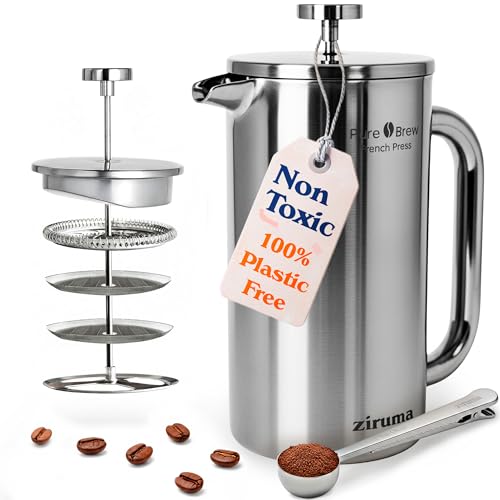
Ziruma French Press, 34 oz
Badge: Best Plastic-Free Pick
Strengths
- No-plastic construction answers the material concern head-on
- Measure marks make repeatable ratios easier without a scale
- 4-layer filter aims at a cleaner cup like the other multi-filter presses
Trade-offs
- Material purity focus may not matter to every drinker
- 34 oz capacity is the group standard, not the largest
- Steel body hides brew level despite the measure marks
Key specs (from the verified listing)
- Capacity: 34 oz
- Material: surgical-grade steel, no plastic or heavy metals (per listing)
- Filtration: 4-layer filter
- Construction: double-wall insulated
- Extras: measure marks; portable; dishwasher safe (per listing)
The case for Ziruma French Press, 34 oz starts with its defining choice: it is a plastic-free, surgical-grade steel press with a 4-layer filter and measure marks. A french press is the simplest coffee maker in any kitchen, grounds and hot water and time, and because there is so little machinery, the quality of the few parts that exist is the whole story: the steel, the screen, the seal of the plunger, and how the filter stack comes apart for cleaning.
Brewing with it follows the ritual described in the how-to section, and the cup it produces is the classic press cup: heavy-bodied, rounded, and forgiving of slightly imperfect technique, which is why the press remains the recommendation for people who find drip thin and espresso fussy. This model’s filtration and insulation choices nudge that classic cup in its own direction, cleaner or hotter-keeping, and the strengths and trade-offs above name exactly which direction that is.
Where a press earns its keep over years is maintenance, and this design’s story is simple: rinse or dishwasher the parts, keep the screen clean, and replace the screen when its edges fray. There is no pump to fail, no element to scale, no electronics to obsolesce. A press bought well is close to a lifetime object, and the included spares and dishwasher-safe construction listed for this model are the details that make that realistic rather than romantic.
The honest limitation is inherent to the method. Press coffee carries more fine sediment than paper-filtered coffee, and it keeps extracting if it sits on the grounds, so the last cup punishes anyone who leaves it standing. Drinkers who want a crystalline, filtered cup should look at pour-over or drip; drinkers who want body and simplicity will not care at all.
For a manual brief, the measure of the machine is how faithfully it supports the ritual and then gets out of its way, because in this category the brewer and the drinker are the same person.
Best for: drinkers who want coffee that only ever touches steel / Not suited for: anyone who prefers watching the brew through glass
Check on Amazon — check the latest price on Amazon for the Ziruma French Press, 34 oz.
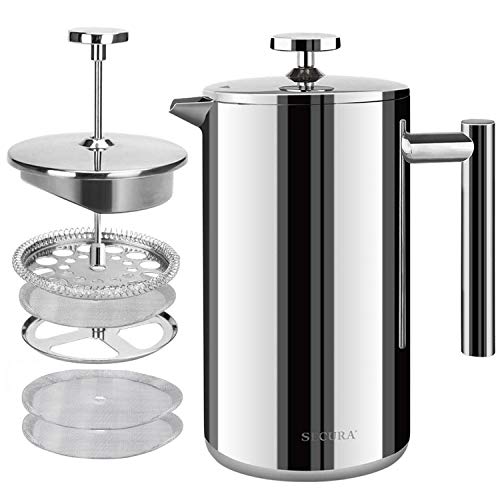
Secura French Press Coffee Maker, 50 oz
Badge: Best for Groups
Strengths
- 50 oz serves a full table in one plunge, the only size here that can
- Same insulated stainless build as the 34 oz Secura
- Spare screens included protect a long working life
Trade-offs
- A full 50 oz of coffee can over-extract if it sits on the grounds
- Bigger and heavier to pour, especially when full
- Oversized for a solo drinker’s daily cup
Key specs (from the verified listing)
- Capacity: 50 oz (1.5 litre)
- Material: 304-grade stainless steel
- Construction: insulated double wall (per listing)
- Extras: 2 extra screens included
- Finish: Silver
Brewing with it follows the ritual described in the how-to section, and the cup it produces is the classic press cup: heavy-bodied, rounded, and forgiving of slightly imperfect technique, which is why the press remains the recommendation for people who find drip thin and espresso fussy. This model’s filtration and insulation choices nudge that classic cup in its own direction, cleaner or hotter-keeping, and the strengths and trade-offs above name exactly which direction that is.
Where a press earns its keep over years is maintenance, and this design’s story is simple: rinse or dishwasher the parts, keep the screen clean, and replace the screen when its edges fray. There is no pump to fail, no element to scale, no electronics to obsolesce. A press bought well is close to a lifetime object, and the included spares and dishwasher-safe construction listed for this model are the details that make that realistic rather than romantic.
The honest limitation is inherent to the method. Press coffee carries more fine sediment than paper-filtered coffee, and it keeps extracting if it sits on the grounds, so the last cup punishes anyone who leaves it standing. Drinkers who want a crystalline, filtered cup should look at pour-over or drip; drinkers who want body and simplicity will not care at all.
The case for Secura French Press Coffee Maker, 50 oz starts with its defining choice: it is the 50 oz big sibling: 304-grade stainless, insulated, with two extra screens. A french press is the simplest coffee maker in any kitchen, grounds and hot water and time, and because there is so little machinery, the quality of the few parts that exist is the whole story: the steel, the screen, the seal of the plunger, and how the filter stack comes apart for cleaning.
For a manual brief, the measure of the machine is how faithfully it supports the ritual and then gets out of its way, because in this category the brewer and the drinker are the same person.
Best for: families, offices, and hosts brewing press coffee for a group / Not suited for: solo drinkers who make one mug at a time
Check on Amazon — check the latest price on Amazon for the Secura French Press Coffee Maker, 50 oz.
Comparison Table
One table, six french presses, and the attributes that separate them. Badges match the Quick Picks and the detailed reviews exactly. For a neighbouring corner of the same category, see 9 Best French Presses Glass And Stainless Steel 2026.
| Pick | Badge | Headline spec | Best for | Link |
|---|---|---|---|---|
| Secura French Press Coffee Maker, 34 oz | Best Overall | Capacity: 34 oz (1 litre) | daily press drinkers who want durability and heat retention in the standard size | Check on Amazon |
| Utopia Kitchen French Press, 34 oz | Best Filtration | Capacity: 34 oz | press drinkers who love the method but hate sediment in the last sip | Check on Amazon |
| MuellerLiving French Press Coffee Maker, 34 oz | Best Everyday Pick | Capacity: 34 oz | everyday press users who want a clean cup and simple dishwasher care | Check on Amazon |
| AgcKuzt French Press, 34 oz | Best for Camping | Capacity: 34 oz (4 cups per listing) | campers and home users who want one tough press for both places | Check on Amazon |
| Ziruma French Press, 34 oz | Best Plastic-Free Pick | Capacity: 34 oz | drinkers who want coffee that only ever touches steel | Check on Amazon |
| Secura French Press Coffee Maker, 50 oz | Best for Groups | Capacity: 50 oz (1.5 litre) | families, offices, and hosts brewing press coffee for a group | Check on Amazon |
How to Choose the Right One for Your Kitchen
Material is the first and biggest decision
Every pick in this roundup is stainless steel, and that is a deliberate shortlist, not an accident. A steel press cannot shatter in the sink, in a dishwasher rack, or in a camping box, and double-wall steel holds heat in a way single-wall glass never will. What you give up is theatre: you cannot watch the grounds bloom and swirl, and you cannot see at a glance how much coffee is left. For a daily press that will be used for years, durability and heat retention win for most people. If the ritual view matters more than either, a glass press is a legitimate choice, but it is a different product from everything reviewed here.
Capacity: a press ounce is an honest ounce
Unlike drip machines and their small nominal cups, press capacity is stated in real ounces. A 34 oz press makes about four ordinary mugs once you leave room for grounds and the plunge, and a 50 oz press serves a table. Buy for your real routine: a solo drinker with a 50 oz press brews small volumes in a big vessel, which works but wastes heat and coffee, while a family squeezing a 34 oz press brews twice and the first round sits too long. The 34 oz size dominates this roundup because it is the genuine sweet spot for one to four drinkers.
Filtration decides how clean your cup is
The classic press criticism is sediment, and filtration is the counterattack. A standard mesh screen leaves the full, heavy body that press lovers want, along with some fine silt in the last sip. Multi-level and multi-layer filter systems, which several picks here advertise, catch more of those fines and produce a noticeably cleaner cup, at the cost of a firmer plunge and more parts to rinse. Neither is objectively better: choose the standard screen for maximum body, and the multi-layer designs if you love press flavor but have always wished the cup were cleaner.
Insulation changes how the second cup tastes
Coffee keeps extracting while it sits on the grounds, and it keeps cooling while it sits at all. Double-wall insulation, standard across this roundup, slows the cooling so a second cup twenty minutes later is still properly hot. It does not stop extraction, which is why the serving advice in the how-to section matters: decant what you will not drink immediately into a mug or a second vessel, insulated or not, so the coffee you return to is hot without being over-drawn and bitter.
Screens, spares, and the long game
The screen is the one wear part on a press: its edges fray over months of daily use and start letting grounds slip past. Picks that include spare screens in the box are quietly cheaper to own over years, because the first replacement is already in your drawer. Also check how the filter assembly comes apart: designs that disassemble fully can be cleaned properly, and coffee oils trapped in a screen you cannot open will eventually flavor every cup. Dishwasher-safe construction, listed for most picks here, makes that deep clean a non-event.
Shoppers who cross-shop this category frequently land on 6 Best French Presses Glass And Steel Coffee Presses 2026.
How to Brew With a French Press, Step by Step
- Boil fresh water and let it sit for about half a minute off the boil; water at a rolling boil scorches grounds and exaggerates bitterness.
- Add coarse-ground coffee to the empty press. A practical starting ratio is about one tablespoon per four ounces of water, adjusted over several brews rather than all at once.
- Pour the water over the grounds in a steady spiral so everything is wetted, then start a four-minute timer. A crust of grounds will form on top, which is normal.
- At four minutes, break the crust with a spoon and skim off the foam and floating bits if you want a cleaner cup; this small step removes much of what becomes sediment later.
- Place the plunger on top and press down slowly and evenly until the screen sits just above the grounds. Forcing it fast or hard churns fines back into the coffee.
- Pour and serve immediately. Whatever you will not drink within a few minutes should be decanted into another vessel, because coffee left sitting on the grounds keeps extracting and turns bitter.
- To clean, knock the grounds out (never down a reluctant drain in quantity), disassemble the filter stack, and wash or run it through the dishwasher where the listing allows. Dry the screens fully before reassembling.
- Replace the screen when its edges fray or the plunge starts feeling gritty; included spares make this a two-minute job rather than a shopping trip.
Troubleshooting
Problem: the last cup is full of sediment: grind coarser, skim after breaking the crust, and pour gently without tilting the press to chase the final ounce. A multi-layer filter model also helps if this is your standing complaint.
Problem: the coffee tastes bitter and heavy: it sat too long, either before plunging or in the press after. Shorten the steep toward four minutes total and decant leftovers instead of letting them sit on the grounds.
Problem: the plunger is very hard to push: the grind is too fine or the dose is too high. Never force a stuck plunger down; pull it back up slowly, stir, and plunge again gently, then adjust the grind next brew.
Another useful comparison in the same cluster is 6 Best French Presses For Coffee Lovers 2026.
Why the Press Survives Every Coffee Fashion
The french press has outlived percolator nostalgia, pod revolutions, and several generations of smart machines, and its survival is not sentimentality. It is the only common method that steeps coffee in full immersion, extracting evenly from every particle at once, which makes it forgiving of imperfect grinders and technique in a way pour-over never is. It produces a cup with body, the quality drinkers describe as richness, because nothing is filtered through paper and the coffee’s oils reach the cup. And it does all this with a parts count you can enumerate on one hand, none of which can become obsolete.
The stainless generation in this roundup fixed the classic press’s two genuine flaws, fragility and fast cooling, without touching the method itself. That restraint is the story of the category: the ritual stayed, the materials grew up. A drinker choosing among these six is not choosing a method, the method chose them the first time they tasted a press cup and wanted that cup every morning. They are choosing which version of a very old, very good idea will live in their kitchen, and the differences that matter, filtration philosophy, size, spares, and material purity, are exactly the ones the reviews are organized around.
Press Coffee Beyond the Morning Mug
A press earns extra keep in ways automatic machines cannot imitate. It is the household’s best loose-leaf tea brewer, straining a pot as happily as it strains coffee. Steeped cold for many hours and plunged, it makes a smooth cold brew concentrate that dilutes into days of iced coffee. Taken camping, the stainless models here brew for a tent or a picnic table with nothing but a kettle’s worth of hot water, no outlet, no pods, no waste to pack out beyond grounds. It even froths warm milk respectably with a few brisk plunges, a trick that rescues a latte craving in a kitchen with no steam wand.
These second lives matter to the buying decision more than they appear to. A single-purpose machine must justify its shelf every day; a press justifies its drawer on the mornings it makes tea, the weekends it travels, and the summers it makes cold brew, as well as every ordinary morning in between. When two picks in this roundup otherwise tie, and several come close, the tiebreaker is often which second lives your household will actually use.
Common Buying Mistakes
Using fine-ground coffee
Fine grounds slip through screens, clog filters, and over-extract into bitterness. The press wants a coarse, even grind; this single change fixes most disappointing press coffee.
Leaving the brewed coffee in the press
The most common press mistake of all. The coffee keeps extracting on the grounds and the second cup is a different, worse drink. Decant what you will not drink right away.
Pressing the plunger like a pump
Fast, hard plunging forces fines through the screen and can surge hot coffee up the sides. Slow and steady is both safer and better tasting.
Ignoring the screen until the cup turns gritty
Screens are wear parts. A frayed screen quietly ruins an otherwise good press, and several picks here include spares precisely so this never becomes an excuse.
Buying the biggest press for a solo habit
A 50 oz press for one mug wastes coffee and heat every single morning. Match the vessel to the routine, not to the rare guest day.
Final Recommendation
The 34 oz Secura is the first choice for most readers: 304-grade stainless, insulated, spare screens in the box, and the standard size executed without a weak point. It is the press to buy when you want the question settled. Choose the Utopia Kitchen or the MuellerLiving instead if sediment is your standing complaint, since their multi-level filtration is aimed at precisely that cup, and choose the Ziruma if keeping plastic out of the brew path entirely is the point of the purchase.
Take the AgcKuzt if one press must serve kitchen and campsite alike, and take the 50 oz Secura if your table regularly holds five or six coffee drinkers, because no 34 oz press, however good, can be in two mugs at once. Whichever you choose, learn the four-minute ritual in the how-to section; in a manual category, that knowledge is the real product, and the press is its very durable souvenir.
The linked first choices, for convenience:
- Secura French Press Coffee Maker, 34 oz — check the latest price on Amazon
- Utopia Kitchen French Press, 34 oz — check the latest price on Amazon
- MuellerLiving French Press Coffee Maker, 34 oz — check the latest price on Amazon
Frequently Asked Questions
How coarse should the grind be for a french press?
Coarse and even, roughly like raw sugar crystals. If your grinder’s output feels like sand with powder mixed in, the powder is what will end up in your cup, so a consistent coarse grind matters more than hitting an exact setting.
How long should coffee steep in a press?
About four minutes is the classic starting point, including the pour. Go a little shorter for a lighter cup and a little longer for a heavier one, but change by thirty seconds at a time so you can actually taste what the change did.
Does a stainless press change the taste versus glass?
The brewing is identical; the differences are heat retention and durability. Steel keeps the coffee hotter for longer and cannot break, while glass lets you watch the brew. Any taste difference drinkers report usually traces to temperature, not the material itself.
Can I make tea or cold brew in a french press?
Yes to both. The press is an excellent loose-leaf tea strainer, and coarse coffee steeped cold in the press for many hours, then plunged, makes a smooth cold brew concentrate you can dilute to taste.
Why is my press coffee muddy even with a good filter?
Usually the pour, not the filter: the final ounce holds most of the fines, and tipping the press hard to get it guarantees a muddy cup. Leave the last swallow behind and the cup cleans up noticeably.
How do I stop press coffee from going bitter in the pot?
Decant it. Once plunged, pour everything you will not drink immediately into a mug or separate vessel. Off the grounds, the flavor holds; on the grounds, extraction continues and bitterness builds.
Is a french press really better than a drip machine?
It is different rather than better: fuller body and more control, in exchange for your four minutes of participation and a cup with more fine sediment. Households that value the ritual and the body choose the press; households that value waking up to a finished pot choose drip. Many kitchens, sensibly, keep both, which the press’s price and size make easy.


