Disclosure: topratedkitchenware.com is reader-supported. When you buy through links on our site, we may earn an affiliate commission from Amazon and other retailers, at no extra cost to you.
Where to buy
This roundup of the best measuring spoons ever takes the long view, and the shopping is simple: all six sets below are current, verified listings, each with a direct link so you can check the latest price on Amazon before ordering. The six are the Rena Chris 6-Piece Heavy Duty Stainless Steel Measuring Spoons for a classic heavy-gauge set, the Spring Chef Magnetic Measuring Spoons Set of 8 for dual-sided magnetic nesting, the TILUCK Stainless Steel Measuring Cups and Spoons Set for a complete cups-and-spoons system, the TILUCK Measuring Cups and Spoons Set of 6 with Coffee Scoop for coffee and daily baking, the THLHKD 6-Piece Measuring Spoons Set for clear markings and small sizes, and the Spring Chef Nesting Measuring Spoons Set of 7 for narrow rectangular bowls that fit inside spice jars. If you want one set to judge the rest against, start with the Rena Chris set — Check on Amazon, then read the full guide below.
Read the full guide ↓
Introduction: What “Ever” Has to Mean for a Tool This Simple
Calling any set the best measuring spoons ever is a bold claim for a tool that is, at bottom, six small bowls on handles. But that simplicity is exactly why the claim can be judged honestly. A measuring spoon has one job — deliver the same volume today that it delivered last year — and a short list of ways to fail at it: bowls that bend, markings that wear away, handles too short for the jar, shapes too wide for the spice tin, and rings that scatter the set across three drawers. The best measuring spoons ever are simply the ones that refuse to fail in any of those ways, year after year, while asking nothing of you but a rinse. Every set in this roundup is stainless steel, because for this tool the material question was settled long ago: steel does not stain, does not hold odors, does not melt against a hot pan rim, and can be dropped, scrubbed, and dishwashed for decades.
Within that steel consensus, though, real differences remain, and they are the subject of this guide. Dual-sided spoons double the sizes without doubling the storage. Magnetic nesting keeps a set together as one object instead of a jangling ring. Rectangular bowls walk into narrow spice jars that round bowls cannot enter. A leveler turns a heaped, guessed spoonful into a flat, repeatable one. And the humble matter of engraved, readable size markings decides whether you can identify the half teaspoon at a glance or must hold it to the light and squint. We compare six current sets across exactly those differences, then step back into the buying guide and how-to sections to cover the technique that matters more than any brand: how you fill and level a spoon decides your accuracy far more than which of these well-made sets you own.
Key Takeaways
- Stainless steel is the settled material for a buy-it-for-life set: it resists stains, odors, heat, and bending in ways plastic never will.
- The Rena Chris set is the classic reference here — heavy duty, six pieces, with US and metric measurements for dry and liquid ingredients.
- Dual-sided designs like the Spring Chef Magnetic set of 8 effectively double your size range and add a leveler for repeatable measures.
- Narrow rectangular bowls, as on the Spring Chef set of 7, are the difference between measuring spices from the jar and shaking them out into your palm first.
- Small sizes matter: the THLHKD set runs from 1/8 teaspoon upward, the range where recipes and supplements actually live.
- Technique beats hardware — a leveled spoon from any set here beats a heaped spoon from the finest set ever made.
- Judge any candidate set as an instrument of the standard sizes: complete in range, legible in markings, rigid in the bowl, and fluent in both US and metric measures.
In this guide
Quick Picks
| Pick | Badge | Set | Standout trait from its listing | Link |
|---|---|---|---|---|
| Rena Chris Measuring Spoons | Best Overall | 6-piece stainless steel | Heavy duty build, US and metric measurements, for dry and liquid ingredients | Check on Amazon |
| Spring Chef Magnetic Measuring Spoons | Most Versatile | Set of 8, dual sided, with leveler | Magnetic nesting, dual-sided bowls for dry and liquid, dishwasher safe | Check on Amazon |
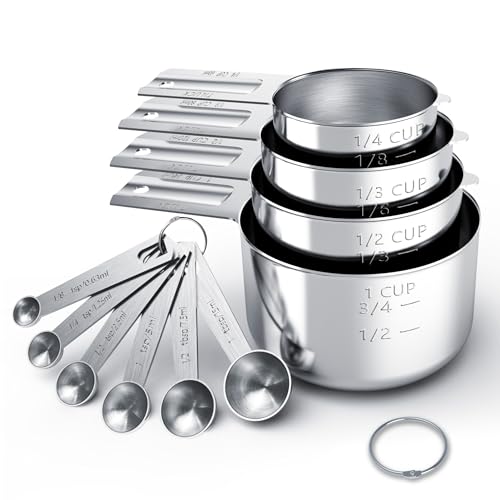
| TILUCK Measuring Cups and Spoons Set | Best Complete System | Cups and spoons, 10 pieces | Nesting stainless steel cups and spoons for cooking and baking in one system | Check on Amazon |
| TILUCK Cups and Spoons Set of 6 | Best for Coffee and Daily Baking | Set of 6 with coffee scoop spoon | Stainless steel set with a coffee scoop for daily drinks and baking | Check on Amazon |
| THLHKD Measuring Spoons Set | Best Small Measures | 6 pieces, 1/8 tsp to 1 tbsp | Clear size markings, sized for coffee, spices, and protein powder | Check on Amazon |
| Spring Chef Nesting Measuring Spoons | Best for Spice Jars | Set of 7 with leveler | Rectangular bowls fit in spice jars, long handles, nesting storage | Check on Amazon |
How These Picks Were Chosen
This is a research-led roundup based on verified product listings, not a laboratory test, and for a keyword that says “ever” we want to explain what that filter did to the shortlist. We required stainless steel construction, because a set that aspires to be the last one you buy cannot be made of a material that stains, warps, or absorbs the smell of last month’s curry powder. We required real size markings as a design feature, because a measuring tool you cannot read is a guessing tool. And we required each set to bring at least one considered answer to the classic frustrations of the category — jar access, storage, leveling, small sizes, or the cups that spoons so often get separated from.
We then compared the six on the attributes their own listings support: piece count and size range where stated, bowl shape, whether a leveler is included, how the set stores, and what measuring systems are marked. Specifications in the mini spec boxes come only from those listings; where a listing does not state a detail, we leave it out rather than inventing it. Two of the six are cups-and-spoons systems rather than spoons alone, and they are included deliberately and labeled clearly, because many households searching for a definitive spoon set actually need the matched cups as well — a point the dedicated comparison at Best Measuring Spoons Set explores in more depth. As throughout this site, there are no fixed prices and no invented performance figures; a spoon set proves itself over years of drawers and dishwashers, and the honest evidence for that is design and material, not decimals.
The 6 Best Measuring Spoons Ever

Rena Chris Measuring Spoons, 6-Piece Set
Badge: Best Overall
Strengths
- Heavy duty stainless steel construction aimed squarely at longevity.
- Marked with both US and metric measurements, for dry and liquid ingredients.
- A straightforward six-piece range covering the sizes everyday recipes use.
Trade-offs
- No leveler is included in the listing, so leveling is done with a knife or finger.
- Round-bowl format is not the specialist answer for the narrowest spice jars.
- Six pieces means fewer intermediate sizes than the eight-piece dual-sided set here.
Mini spec box
- Material: Stainless steel, heavy duty
- Pieces: 6
- Markings: US and metric measurements
- Use: Dry and liquid ingredients
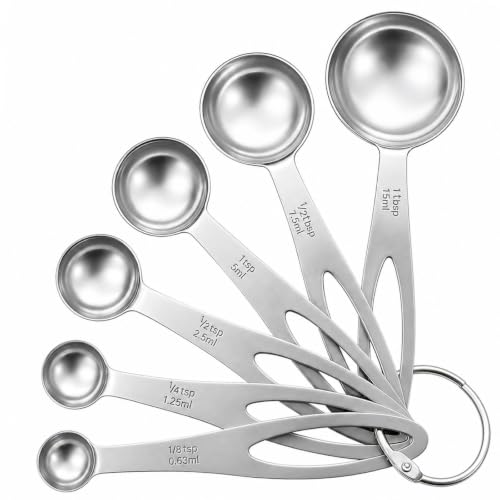
If the phrase “best ever” points at one set in this roundup, it points at the Rena Chris, because this is the design with the fewest ideas and the best execution of them. Six heavy duty stainless steel spoons, marked in both US and metric, made for dry and liquid ingredients alike. There is no mechanism to break, no coating to wear, no gimmick to tire of — just bowls thick enough not to flex when you dig into packed brown sugar and handles that will not bend when the set is inevitably used to pry, stir, and scrape in ways its maker never intended. This is the set a grandparent’s kitchen and a first apartment can share without either feeling shortchanged.
Its trade-offs are the trade-offs of purity. Without a leveler in the box, your leveling tool is the back of a knife, which works perfectly well but is one more thing to reach for. Without narrow rectangular bowls, the smallest spice jars will still ask you to shake spice into the spoon or onto a pinch dish. And cooks who bake with metric recipes will appreciate the dual markings, while cooks who need the in-between sizes will notice the six-piece range. None of these are flaws so much as boundaries, and within them this is the reference set: the one against which every cleverer design in this list has to justify its cleverness. Readers who measure a lot of fine powders, where small sizes and repeatability dominate, should also see how this set’s philosophy compares in Best Measuring Spoons For Nootropics.
Best for: Anyone who wants one classic, heavy-gauge set to keep for decades / Not suited for: Cooks who need a built-in leveler or narrow-jar rectangular bowls

Spring Chef Magnetic Measuring Spoons, Set of 8
Badge: Most Versatile
Strengths
- Dual-sided bowls — one side for dry ingredients, one for liquids — double the working range.
- Magnetic nesting keeps all eight spoons together as a single stack.
- Includes a leveler for flat, repeatable measures, and the set is dishwasher safe.
Trade-offs
- Dual-sided bowls take a week of use before flipping between sides feels automatic.
- Magnetic stacks still need a home; they solve scattering, not drawer organization entirely.
- The black finish is a style choice some traditionalists will skip.
Mini spec box
- Material: Stainless steel
- Pieces: Set of 8, dual sided
- Storage: Magnetic nesting
- Extras: Leveler included
- Care: Dishwasher safe
- Color: Black
The Spring Chef Magnetic set is the strongest argument that “ever” can include a little ingenuity. Its dual-sided design gives each spoon two bowls — a rounder side suited to liquids and a narrower side suited to dry ingredients and to entering jars — so eight physical spoons cover a range that would otherwise need a much larger set. The magnets make the set nest into one calm stack instead of a loose ring that catches on everything in the drawer, and the included leveler addresses the single largest source of measuring error in home baking, the heaped spoon. Add dishwasher-safe stainless steel and you have a set designed around how kitchens actually behave, not how they behave in photographs.
The adjustments it asks of you are minor but real. Flipping between bowl sides mid-recipe takes a little practice, and cooks who measure by pure habit may initially grab the wrong side for a liquid. Magnetic nesting keeps the set together but the stack is still a loose object in a drawer unless you give it a corner of its own. And the black finish, while handsome, will show flour dust more readily than plain steel. For bakers who measure many ingredients per session — the people for whom the leveler alone justifies the set — these are trivial costs. It is the most complete answer here to the question of what a modern classic looks like, and the community discussions gathered in Best Measuring Spoons Reddit return to this dual-sided pattern again and again for good reason.
Best for: Bakers who measure many ingredients and want a leveler and maximum size range / Not suited for: Purists who want single-purpose round bowls and a plain steel finish

TILUCK Stainless Steel Measuring Cups and Spoons Set (10)
Badge: Best Complete System
Strengths
- Cups and spoons in one matched stainless steel system of 10 pieces.
- Nesting design keeps the whole system compact in storage.
- One purchase outfits a kitchen for both cooking and baking measures.
Trade-offs
- If you only need spoons, you are buying cups as well.
- A 10-piece system needs a drawer corner of its own to stay together.
- The listing gives fewer spoon-specific details than the spoon-only sets here.
Mini spec box
- Material: Stainless steel
- Pieces: 10, cups and spoons
- Storage: Nesting
- Use: Cooking and baking
The TILUCK 10-piece set makes a systems argument: measuring tools fail households most often not by breaking but by being incomplete — spoons in one drawer, cups in another, the quarter cup missing entirely. Buying cups and spoons as one matched, nesting stainless steel system ends that fragmentation. Everything is the same material, the same finish, and the same storage footprint, and a kitchen equipped this way simply stops having measuring emergencies. For a first home, a rental reset, or a wedding-registry-style fresh start, that completeness is worth more than any single clever feature elsewhere in this roundup.
The boundaries are obvious and honest. A cook who already owns beloved cups is paying for duplication, and a cook who only ever measures spoon quantities is carrying five pieces they will rarely touch. The listing also speaks about the system as a whole rather than detailing the spoons’ individual traits, so shoppers who care about bowl shape or the smallest size offered should compare carefully against the spoon-only sets here. Judged on its own terms, though — one box, whole problem solved, in a material that will outlast the kitchen it lands in — it earns its place in any serious conversation about the best measuring tools a home can own.
Best for: New kitchens and anyone replacing a mismatched drawer of measures with one system / Not suited for: Cooks who already own cups they love and only need spoons

TILUCK Stainless Steel Measuring Cups and Spoons Set of 6
Badge: Best for Coffee and Daily Baking
Strengths
- Includes a coffee scoop spoon, the measure many households use most.
- Stainless steel cups and spoons sized for daily cooking and baking.
- A smaller six-piece system that suits compact kitchens.
Trade-offs
- Six pieces is a tighter range than the 10-piece system above.
- The coffee focus is wasted on households that do not brew at home.
- Like its sibling, the listing describes the set more than the individual spoons.
Mini spec box
- Material: Stainless steel
- Pieces: Set of 6, cups and spoons
- Extra: Coffee scoop spoon
- Use: Cooking and baking
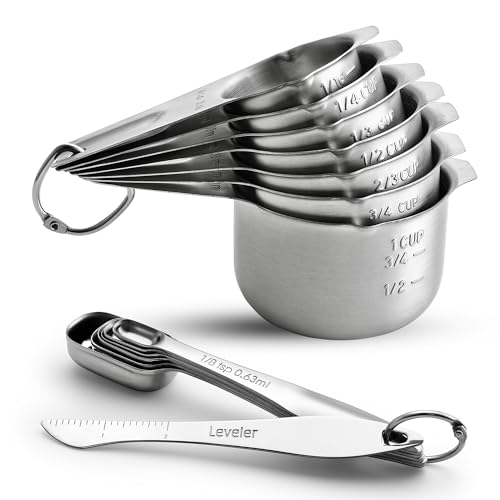
The smaller TILUCK set is the daily-driver version of the same idea. Six stainless steel pieces, cups and spoons together, with a coffee scoop spoon included — and that scoop is a shrewd inclusion, because for a huge number of households the most frequent measuring act of the day is not baking at all but making coffee the same way every morning. A dedicated scoop that lives with the set turns a bleary guess into a repeatable routine, and repeatability is the entire point of measuring tools. Around that anchor, the cups and spoons cover the ordinary run of cooking and baking without the drawer commitment of the larger system.
Choose between the two TILUCK sets by honesty about your habits. If you bake in volume and measure cups several times a week, the 10-piece system is the better buy-it-once answer. If your measuring life is coffee, the occasional sauce, and weekend baking, this six-piece set covers it with less to store. Either way the material decision — stainless steel throughout — is the one that will matter in ten years, long after the piece count debate is forgotten. Households whose measuring revolves around sticky ingredients face a different version of this choice, and Best Measuring Spoons For Peanut Butter looks at spoon shapes and materials from that angle specifically.
Best for: Coffee drinkers and everyday cooks who want a compact matched set / Not suited for: High-volume bakers who need the full cup range of the larger system

THLHKD Measuring Spoons Set, 6 Pieces
Badge: Best Small Measures
Strengths
- Size range runs from 1/8 teaspoon to 1 tablespoon — the small end many sets skip.
- Clear size markings address the most common daily annoyance with spoons.
- Listing names coffee, spices, and protein powder — the fine-powder jobs — directly.
Trade-offs
- Six pieces focused on the spoon range only; no cups in this set.
- No leveler is mentioned in its listing.
- Less established presentation than the Spring Chef and Rena Chris listings.
Mini spec box
- Material: Stainless steel
- Pieces: 6
- Size range: 1/8 tsp to 1 tbsp, per its listing
- Markings: Clear size markings
- Use: Dry and liquid ingredients, coffee, spices, protein powder
The THLHKD set earns its place on a detail the other sets treat as an afterthought: the small end of the range. Its sizes run from 1/8 teaspoon to 1 tablespoon, and that smallest spoon is the one that decides whether a recipe’s pinch of baking soda, a supplement scoop, or a spice blend’s fractional teaspoon gets measured or merely guessed. Paired with clear size markings — the feature its listing leads with, and the one every cook appreciates at 7 a.m. — it is a set designed for the fine end of cooking, where quantities are small and errors are proportionally large.
Its listing also names the modern uses directly: coffee, spices, and protein powder, alongside dry and liquid ingredients generally. That makes it the natural set for households whose measuring extends beyond baking into daily drinks and supplements, a theme the specialist guide at Best Measuring Spoons For Nootropics develops further for powder routines. The trade-offs are scope rather than quality: no cups, no leveler mentioned, and a presentation less polished than the bigger brands here. If your measuring life lives between an eighth of a teaspoon and a tablespoon, this is the set that was paying attention to you.
Best for: Small-quantity measuring — spices, coffee, protein powder, and fractional teaspoons / Not suited for: Cooks wanting cups included or a bundled leveler
Spring Chef Nesting Measuring Spoons, Set of 7
Badge: Best for Spice Jars
Strengths
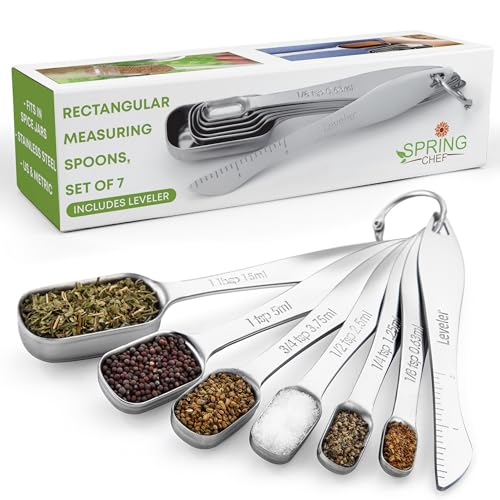
- Rectangular bowls fit inside standard spice jars — the classic round-spoon failure, solved.
- Long handles reach to the bottom of jars without knuckles in the rim.
- Includes a leveler, and the set nests for compact storage.
Trade-offs
- Rectangular bowls pour dry ingredients beautifully but feel unusual for liquids at first.
- Seven pieces is a mid-size range — fewer than the dual-sided set of 8 covers.
- Spice-jar specialists still need a separate answer for cups.
Mini spec box
- Material: Stainless steel
- Pieces: Set of 7
- Bowl shape: Rectangular, fits in spice jars
- Handles: Long handle design
- Extras: Leveler included
- Storage: Nesting
Every cook knows the small humiliation of the round tablespoon that will not enter the spice jar, and the workaround — shaking spice onto a plate, or into a palm, and then into the spoon — that adds mess and error to the simplest recipes. The Spring Chef set of 7 exists to delete that moment. Its rectangular bowls are shaped to slide into spice jars, its handles are long enough to reach the bottom of a tall jar, and the included leveler flattens the spoonful while it is still over the jar, so the excess falls back in rather than onto the counter. It is a set designed by someone who clearly cooks with spices daily.
The rectangular shape is a genuine specialization, and specialization always trades something away: the bowls feel less natural for liquids than round bowls do, and the set’s seven pieces, while well chosen, cannot match the effective range of the dual-sided magnetic set from the same brand. Think of the two Spring Chef sets as siblings with different callings — this one for the spice-heavy cook, the magnetic one for the baking-heavy cook. For households where cumin, paprika, and chili powders move weekly, this is arguably the most useful set in the entire roundup, and the testing-led perspective at Best Measuring Spoons Serious Eats reaches a similar conclusion about narrow bowls and jar access.
Best for: Spice-heavy cooking and anyone tired of shaking jars over a spoon / Not suited for: Liquid-heavy measuring or cooks wanting one set that includes cups
Comparison Table
| Set | Material | Pieces | Bowl / storage | Leveler | Link |
|---|---|---|---|---|---|
| Rena Chris | Stainless steel, heavy duty | 6 | Classic bowls, US and metric marks | Not listed | Check on Amazon |
| Spring Chef Magnetic | Stainless steel | 8, dual sided | Dual-sided bowls, magnetic nesting | Included | Check on Amazon |
| TILUCK 10-Piece | Stainless steel | 10, cups and spoons | Nesting system | Not listed | Check on Amazon |
| TILUCK Set of 6 | Stainless steel | 6, cups and spoons | Includes coffee scoop spoon | Not listed | Check on Amazon |
| THLHKD | Stainless steel | 6 | 1/8 tsp to 1 tbsp, clear markings | Not listed | Check on Amazon |
| Spring Chef Nesting | Stainless steel | 7 | Rectangular bowls, nesting, long handles | Included | Check on Amazon |
How to Choose a Measuring Spoon Set That Deserves “Ever”
Start with material, because it is the only decision you cannot undo later. Stainless steel is the answer for a permanent set: it does not absorb odors or colors, it tolerates the dishwasher and the occasional hot pan rim, and its bowls keep their shape under the pressure of packed sugar and cold butter-adjacent jobs that quietly bend lesser materials. Every set in this roundup is steel for that reason. Next, count the sizes you actually use rather than the sizes a set advertises. Most home cooking lives in five measures — quarter, half, and full teaspoons, half and full tablespoons — and a set that covers those beautifully beats a sprawling set with gaps in the middle. Then check the small end: if your cooking or your supplement routine uses fractional teaspoons, a set that reaches 1/8 teaspoon, like the THLHKD, saves you from the pinch-and-guess method forever.
Bowl shape is the third decision, and it is about your jars. Round bowls are the comfortable default and pour liquids most naturally. Narrow or rectangular bowls enter spice jars, and if your spice collection lives in standard jars, that access will please you every single week. Dual-sided bowls are the fourth option: they trade a little familiarity for a lot of range, and they suit bakers who measure many ingredients per session. Storage is the quiet fifth decision — nesting and magnetic sets stay together as one object, ring sets stay together as one jangling object, and loose sets do not stay together at all. Finally, markings: choose a set whose sizes you can read at arm’s length, in poor light, with flour on your hands. Engraved or otherwise durable, high-contrast markings are not a cosmetic feature on a measuring tool; they are the interface, and the interface is what you use every day. The editorial comparisons collected at Best Measuring Spoons Kitchn make a similar case for judging sets on these fundamentals rather than on novelty.
How to Measure Accurately: Filling, Leveling, and Caring for Your Spoons
Technique decides accuracy more than hardware does, so this layer matters for every set above. For dry ingredients, the correct fill is dip and sweep: push the spoon down into the ingredient, lift it out heaped, then sweep the excess flat with a straight edge — a leveler if your set includes one, the back of a knife if it does not. Never pack the spoon unless a recipe explicitly says “packed,” and never shake it level, because shaking settles the contents and quietly adds more. For sticky ingredients like honey or molasses, a light wipe of oil in the bowl first lets the ingredient release cleanly instead of leaving a third of the measure behind. For liquids, fill to the brim on a level surface and pour slowly; a spoon filled while held over the bowl at an angle is a guess wearing a costume.
Care is the other half of a long life. Wash steel spoons promptly after acidic or salty ingredients, dry them rather than leaving them to air-dry spotted in a rack if you care about appearance, and store the set together — the fastest way to ruin a great set is to lose its half teaspoon to a junk drawer. Check markings occasionally under good light; on quality steel they should remain legible for years, and if a marking is fading, that spoon’s retirement is a safety issue for your baking, not a cosmetic one.
Troubleshooting follows a short pattern. Problem: bakes keep coming out inconsistent → audit your leveling first, your spoon second; most inconsistency is heaped-versus-flat technique, not the tool. Problem: the teaspoon will not fit the spice jar → the bowl shape is the limit, not your technique; a narrow or rectangular set is the real fix. Problem: a spoon has bent → it was used as a pry or a scraper once too often; steel can usually be eased back true against a flat surface, but a bowl that no longer sits flat should be replaced, because its volume is no longer the volume printed on its handle.
What Makes a Spoon Set Last for Decades
Longevity in this category is not mysterious; it is the compound interest of small resistances. Thick bowls resist bending. One-piece or solidly joined construction resists the handle snap that kills cheap sets. Markings formed into the metal resist the fading that printed markings suffer in dishwashers. And a design with no coating, no hinge, and no battery has almost nothing left to fail. That is why the classic end of this roundup — the Rena Chris above all — can plausibly be handed down, and why even the cleverer sets here build their cleverness out of magnets, shapes, and included levelers rather than mechanisms.
The owner’s half of longevity is simpler still: use the spoons for measuring, mostly. Every set in every kitchen gets borrowed as a stirrer, a scraper, and a jar-opener’s assistant, and steel tolerates that better than any alternative — but the sets that survive decades are the ones whose owners eventually bought a five-dollar utility spoon for the abusive jobs and let the measuring set measure. Pair that small discipline with prompt washing and together-storage, and there is no reason any set on this page should not outlast the kitchen it is bought for.
Stainless Steel and the Alternatives You Will Meet
Shoppers comparing sets will meet plastic and silicone spoons at lower tiers, and the honest comparison is worth a paragraph. Plastic sets are light and quiet and perfectly serviceable for a year or two of gentle use; their markings, however, are usually printed or shallowly molded, their bowls flex under packed ingredients, and they stain and hold odors in ways that slowly make them unpleasant to use for spices. Silicone-tipped and silicone-bowl designs are kind to nonstick pans when a spoon doubles as a stirrer, but the bowls are too flexible to hold a true level measure of a dry ingredient under pressure. Neither material is a scandal — they are simply answers to a shorter time horizon. A keyword that asks for the best ever is asking about the long horizon, and on the long horizon steel’s boring virtues — rigidity, permanence, neutrality — win every time. That is not snobbery; it is the same reasoning that makes steel the default for the other measuring tool in your kitchen, the cups, and for the pans themselves.
A Short History of the Standard Spoon Measures
Part of what makes a “best ever” conversation possible at all is that the sizes themselves stopped changing a long time ago. The teaspoon and tablespoon began as actual tableware — you measured with the spoons you ate with — and their volumes wandered from house to house until standardized measures turned recipes into documents that could travel. The modern set descends from that standardization: a nested family of fractional sizes, each a known fraction of the next, so that a recipe written in one country can be cooked in another with nothing but the same small set of steel bowls. That is also why the in-between sizes and the small fractions matter. A set is not six unrelated scoops; it is a system of ratios, and the sets that respect the system — covering the halves, quarters, and eighths that recipes actually call for — are the ones that feel complete in the hand.
The dual markings on sets like the Rena Chris tell the other half of the story: the world’s recipes now arrive in two measurement languages at once, and a permanent set should be fluent in both. A spoon that carries US and metric markings never needs replacing because your cookbook collection changed, and a cook who measures in both systems stops doing mental arithmetic at the exact moment in a recipe when arithmetic is most likely to go wrong. When you judge any set claiming a place among the best ever, judge it as an instrument of that standard — accurate in volume, complete in range, legible in markings, and indifferent to which country’s recipe is open on the counter.
Building the Rest of the Measuring Drawer
A great spoon set is the center of a measuring drawer, not the whole of it, and the sets here point at their own companions. If you chose a spoons-only set, the matching discipline for cups is the same as for spoons: stainless steel, nesting, legible markings, bought once. If you chose one of the TILUCK systems, that decision is already made, and your remaining gaps are likely to be a good liquid measuring jug for larger volumes and a kitchen scale for the ingredients — flour above all — where volume measuring is inherently approximate no matter how fine the spoons are. None of that diminishes the spoons; it places them honestly in a hierarchy where they handle the small end with a precision cups cannot reach and a speed a scale cannot match.
Organize the drawer so the set survives its own success. Nested and magnetic sets should live as the single stack they were designed to be, in the same corner every day, because a set that must be assembled from three locations will quietly lose its smallest member — and the smallest member, the quarter teaspoon, is always the first to vanish and the most missed when it does. If your set rides on a ring, hang the ring on a hook inside a cupboard door rather than letting it tangle in the utensil crock. These are humble considerations, but “best ever” is a title earned across ten thousand ordinary mornings, and ordinary mornings are exactly where drawers, hooks, and habits decide what lasts.
Common Buying Mistakes
The most common mistake is buying piece count instead of coverage — a large set that somehow still lacks the size you use weekly, while a smaller set with the right range sits ignored. The second is ignoring bowl shape until the first spice jar refuses the tablespoon, a frustration entirely predictable from your own pantry shelves. Third, shoppers treat markings as decoration and end up with a beautiful set they cannot read in real kitchen light. Fourth, buyers of cups-and-spoons systems sometimes duplicate what they already own instead of filling the actual gap in their drawer. And finally, do not let any “best ever” framing, including this page’s, talk you out of the technique: the finest set here will still betray you if you heap its spoons, and the plainest set will serve you beautifully if you level them.
Final Recommendation
For the single most defensible answer to this keyword, choose the Rena Chris 6-Piece Set: heavy duty stainless steel, dual US and metric markings, and nothing to break. If you bake constantly and want range and repeatability, choose the Spring Chef Magnetic Set of 8 with its dual-sided bowls and leveler. Spice-heavy cooks should go to the rectangular Spring Chef Set of 7, small-measure households to the THLHKD, and anyone outfitting a whole kitchen to one of the two TILUCK systems. Every set here is steel, every set here can plausibly be the last measuring set you buy for your kitchen — the differences are about your jars, your recipes, and your drawer, in that order.
Whichever set you bring home, give it the one-week test that actually predicts a lifetime: cook from it daily, wash it the way you really wash things, and notice whether you reach for it without thinking by the end of the week. A set that disappears into your habits — found instantly, read at a glance, leveled without fuss, and put back in one motion — has passed the only examination the phrase “best ever” has ever honestly required. The six sets above were chosen because each of them can pass it in the right kitchen; the guide’s job was only to help you see which kitchen is yours.
Frequently Asked Questions
Why is stainless steel considered the best material for measuring spoons?
Because it wins on every long-term axis at once: the bowls keep their shape under pressure, the surface does not stain or hold odors from spices, it tolerates dishwashers and heat, and markings formed in metal stay readable for years. Plastic and silicone sets have their place for short-term or travel use, but for a permanent set, steel is the settled answer.
How many measuring spoons does a set actually need?
Most cooking uses five core sizes constantly — quarter, half, and full teaspoons plus half and full tablespoons. Sets here range from six pieces to a dual-sided eight that covers far more. Judge a set by whether it covers your weekly sizes and reaches the small end if you need it, not by raw piece count.
What is a leveler and do I need one?
A leveler is a straight bar or edge used to sweep a heaped spoon flat, turning a variable scoop into a repeatable measure. Two sets here include one. If your set does not, the back of a table knife does the same job — what matters is the sweeping habit, not the tool, especially for baking soda, baking powder, and salt, where small errors change results.
Do rectangular measuring spoons really make a difference?
Yes, in one specific and frequent situation: standard spice jars. Round bowls often cannot enter the jar mouth at all, forcing you to shake spice out and guess. Rectangular bowls slide in and level off at the jar’s rim. If your cooking is spice-heavy, it is the single most practical shape difference in this category.
Can I use the same spoons for liquids and dry ingredients?
Yes — every set here is listed for both. Fill liquids to the brim on a level surface and pour slowly, and use the dip-and-sweep method for dry ingredients. Dual-sided designs dedicate one bowl shape to each job, which some cooks find tidier, but a single well-made bowl handles both perfectly well.
Should I keep a second, inexpensive set for messy jobs?
Many experienced cooks do exactly that, and it is a strategy this guide quietly endorses. A permanent set like the ones above deserves to spend its life measuring; the stirring of a reducing sauce, the scraping of a jar’s last corner, and the prying of a stuck lid are jobs for a utility spoon that costs almost nothing and can be mourned for almost nothing. Keeping the good set for measuring alone is the simplest longevity habit there is, and it costs less than replacing one bent tablespoon from a set you actually love.
How do I keep the size markings readable?
Choose markings formed into the metal rather than printed on it, wash promptly after acidic ingredients, and avoid abrasive scouring directly across the markings. On quality stainless steel, legible markings should last as long as the spoons themselves — and legibility matters, because a measuring tool you cannot read is no longer measuring anything.