Disclosure: topratedkitchenware.com is reader-supported. When you buy through links on our site, we may earn an affiliate commission from Amazon and other retailers, at no extra cost to you.
Where to buy
The six models below are the verified picks for this guide to the best meat probe thermometers. Each name links to its Amazon listing, where you can check the latest price on Amazon and confirm the current configuration before you decide. Every pick here is a handheld probe instrument — a sensing tip on a probe you insert into the food — judged on the things that decide probe quality: stated response speed, stated accuracy evidence, display design, and sealing.
- ThermoMaven Professional Meat Thermometer Digital — Best Overall Probe Thermometer
- ThermoWorks Thermapen ONE — Best Premium Probe
- ThermoMonster Instant Read Meat Thermometer, Black — Best Fast Probe
- TempPro TempSwift Digital Meat Thermometer — Best Versatile Probe
- ThermoMaven Digital Meat Thermometer, Bright LED — Best Bright-Screen Probe
- TempPro TempSwift Instant Read Thermometer, Rotating Display — Best Rotating-Display Probe
Read the full guide ↓ for how a probe thermometer actually senses temperature, the insertion technique that makes any of these picks read true, and the honest limitations of every model.
The best meat probe thermometers all share one idea: the truth about your food lives at the tip of a probe, in the thermal centre of the thickest part, and everything else — the display, the electronics, the handle — exists to carry that truth to your eyes quickly and legibly. This guide compares six verified handheld probe models on the evidence their listings provide: stated response times from half a second to one second, stated accuracy figures where given, certifications where named, waterproof ratings where claimed, and display designs from bright LED to fully rotating. It is a close field, deliberately: probe thermometers have matured into a category where several makers do the core job well, so the differences that matter are the ones this guide isolates — how the probe senses, how fast the whole act of reading takes, and how the instrument survives a wet, hot, one-handed working life.
A word on what “probe thermometer” means in this guide, because the term covers cousins. These are handheld spot-check instruments: you insert the probe, read, and withdraw. They are not leave-in probes that sit in a roast while a cable runs to a counter unit, and not wireless in-meat probes that report to a phone across a long smoke — those families have their own guides, including Best Meat Thermometers For Smoking for the long-cook world and Best Meat Thermometers Timers for probe-and-timer combinations. The handheld probe is the universal instrument, the one that works on a steak, a chicken, a candy pot, and a fryer with equal indifference, and mastering it — placement, depth, patience for the settle — matters more than any single specification below.
One more distinction is worth drawing before the rankings, because it shapes how every specification below should be read. A probe thermometer’s specifications describe an instrument; your results will describe a partnership between that instrument and your technique. The fastest sensor cannot correct a tip resting against a bone, and the most certified accuracy cannot rescue a reading taken at the surface. This guide therefore spends as many words on placement, settling, washing, and verification as on the products themselves — not as filler, but because in this category the how-to genuinely is half the product. Readers who absorb the technique sections will get excellent results from any of the six picks; readers who skip them may be disappointed by all six, and no badge in the Quick Picks table can prevent that.
Key Takeaways
- All six picks state response times of one second or faster in their listings, except the premium reference pick, whose supplied title states no figure and is credited with none.
- Accuracy evidence peaks with the two ThermoMaven models, whose listings state ±0.5°F figures with NIST and NSF certification named.
- Probe technique beats probe price: correct depth, correct spot, and waiting for the settle decide whether any of these instruments reads true.
- Waterproof sealing is stated on most picks — IP67 on several — and it is a core probe feature, because probes are washed after every raw-meat check.
- Rotating and auto-rotating displays (TempPro and ThermoMaven designs here) solve the left-hand and low-angle reading problems that fixed displays cannot.
- Check the latest price on Amazon for each pick, and run an ice-water verification on delivery day, whatever you buy.
In this guide
Quick Picks
| Pick | Badge | Why it earns its place | Listing |
|---|---|---|---|
| ThermoMaven Professional | Best Overall Probe Thermometer | Stated 0.5-second response, ±0.5°F accuracy, NIST and NSF certified, IP67, auto-rotating backlit display. | Check on Amazon |
| ThermoWorks Thermapen ONE | Best Premium Probe | The category’s reference instrument, in Cayenne Pepper Red; bought for track record and single-purpose design. | Check on Amazon |
| ThermoMonster, Black | Best Fast Probe | Stated 0.5-second response with NIST-referenced ±0.5°F precision in the listing. | Check on Amazon |
| TempPro TempSwift | Best Versatile Probe | Stated 1-second response, backlit, NSF certified, listed for grill, smoker, oil, fry, candy, turkey, and milk. | Check on Amazon |
| ThermoMaven, Bright LED | Best Bright-Screen Probe | Stated 1-second response, ±0.5°F accuracy, NIST and NSF certified, auto-rotate bright LED screen, IP67. | Check on Amazon |
| TempPro TempSwift, Rotating | Best Rotating-Display Probe | Stated 1-second response with a 180° rotating display and IP67 waterproofing. | Check on Amazon |
How These Picks Were Chosen
This is a research-led guide, not a hands-on laboratory test. Every pick was verified against its current Amazon listing data, and only models whose probe configuration and core details could be confirmed were allowed a link — all six here are handheld digital probe thermometers for meat and general cooking. The ranking then weighed the evidence a probe buyer can actually check: stated response time, stated accuracy and the traceability behind it (a figure alone, a figure referenced to a standard, or a figure backed by named certification), display design, and stated sealing. Two models from one maker appear, and that is treated as a fact to explain rather than hide: the ThermoMaven pair share an evidence style — stated figures with certifications named — while differing in stated speed and screen design, and their reviews separate them on exactly those points.
Where a listing is silent, the review is silent too. The premium pick’s supplied title states no response or accuracy figure, so its review claims none and rests on reputation and design philosophy, clearly labelled as such. That discipline matters more in this category than most, because probe thermometers are safety instruments: a guide that invents a figure for a famous name teaches its readers to accept invented figures everywhere. Everything claimed below can be traced to the listing data quoted in the accompanying sources file, and everything important can be re-verified at home with ice, water, and two minutes.
The 6 Best Meat Probe Thermometers

ThermoMaven Professional Meat Thermometer Digital
Badge: Best Overall Probe Thermometer
Strengths
- The most complete stated evidence in the group: 0.5-second response and ±0.5°F accuracy.
- NIST and NSF certification named in the listing — traceability a buyer can check.
- IP67 waterproofing and an auto-rotating backlit display complete the working specification.
Trade-offs
- Its credential-forward positioning exceeds what a casual burger-checker needs.
- The listing title is light on repertoire detail beyond BBQ and cooking generally.
- Home verification still applies — certification describes the model, the ice test describes your unit.
Mini spec box (from listing data)
- Stated response: 0.5 seconds
- Stated accuracy: ±0.5°F
- Certification: NIST and NSF certified (per listing)
- Waterproof: IP67; display auto-rotating, backlit; colours red and grey
A probe thermometer should be judged as a chain — sensor, speed, display, sealing — and this model is the only pick whose listing states a strong figure for every link. The half-second response means the reading settles while the meat is still in the state you meant to measure; the stated half-degree accuracy, backed by two named certifications, means the settled number deserves your trust; the rotating backlit display means you can actually see that number from the angle a grill imposes; and IP67 sealing means the wash after a raw-chicken check is a rinse, not a worry. Chains fail at their weakest link, and on stated evidence this probe has no weak one.
Who it suits: cooks who probe constantly — grillers working mixed loads, precision cooks, anyone who has lost faith in a vaguer instrument. The honest limitation is proportionality: if your probing is a weekly burger, the simpler picks below will serve you for the same dinners. But as the complete, verifiable answer to the category’s core question, this is the probe this guide hands over first, and the standard the method-focused reader will also meet in Best Meat Thermometers Americas Test Kitchen.
Best for: frequent probers wanting certified speed and accuracy / Not suited for: occasional users who will never feel the precision difference

ThermoWorks Thermapen ONE
Badge: Best Premium Probe
Strengths
- The reference instrument of the instant-read probe category, carried by professionals who verify tools for a living.
- A single-purpose design philosophy: a probe, a display, and nothing competing for your attention.
- Presented in its listing as an instant-read thermometer in Cayenne Pepper Red.
Trade-offs
- The supplied listing title states no response, accuracy, or sealing figures to quote.
- Premium positioning: you pay for track record and refinement, not for the longest feature list.
- Its case in this guide rests on reputation, clearly labelled — figure-shoppers should choose elsewhere.
Mini spec box (from listing data)
- Type: instant-read probe thermometer (per listing)
- Colour: Cayenne Pepper Red
- Figures stated in title data: none quoted — see listing for full specification
Some instruments are bought on evidence and some on lineage, and an honest guide should know which transaction it is describing. The Thermapen ONE is the lineage purchase in this group: the probe that professional kitchens treat as the default, refined over generations of the same single idea. This review claims no figures for it, because the listing data provided states none — and that restraint is itself a recommendation of the guide’s method, because the moment a writer invents a specification for a famous name, every other specification in the document becomes suspect. What can be said: buyers choose this probe for the maker’s professional track record, for a design that does one thing without ornament, and for the confidence that comes from using the same instrument as the people who cook for a living.
Who it suits: serious home cooks and professionals who buy reference tools once and keep them for years. The honest limitation is the evidence gap in the supplied title — a buyer who wants every number in writing before purchase is better served by the ThermoMaven picks, whose listings state their figures outright. Choose this probe the way you would choose any reference tool: on the maker’s standing and your own verification on delivery day.
Best for: buy-once cooks who value the category’s reference name / Not suited for: buyers who require stated figures before purchase


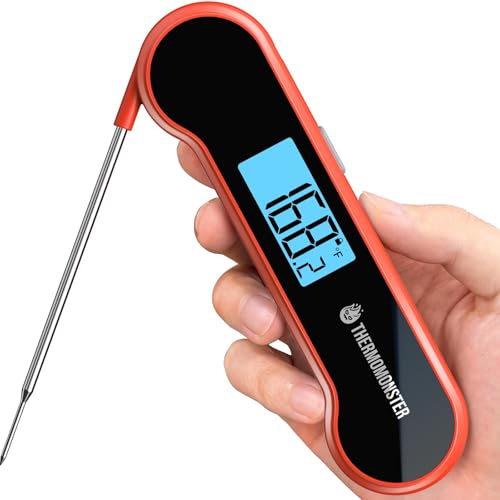
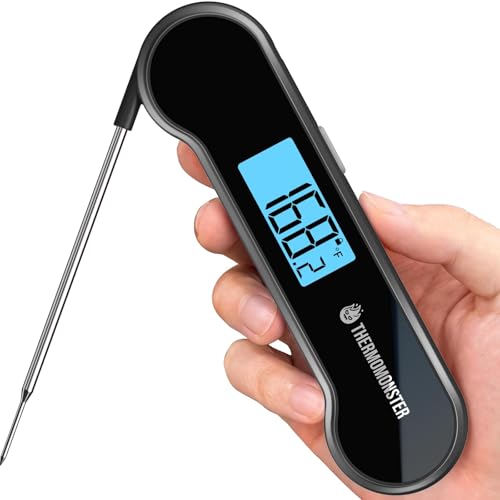
ThermoMonster Instant Read Meat Thermometer, Black
Badge: Best Fast Probe
Strengths
- Joint-fastest stated response in the group: 0.5 seconds.
- Stated ±0.5°F precision referenced to NIST in the listing.
- Listed for oven, grill, candy, and BBQ work — a broad probing repertoire.
Trade-offs
- No waterproof rating is stated in the title data.
- No rotating display is claimed; reading angle is yours to manage.
- Its black finish is handsome and marginally harder to spot in a dark drawer than the red variant.
Mini spec box (from listing data)
- Stated response: 0.5 seconds
- Stated precision: ±0.5°F, NIST-referenced (per listing)
- Colour: black
- Listing highlights: oven, grill, candy, BBQ use
Speed is a probe virtue with a specific address: the thin cut, the searing pan, the grill loaded with pieces finishing at different moments. In those seconds, a half-second instrument is not showing off — it is the difference between measuring the meat and measuring the meat a moment later, after it has already changed. The ThermoMonster pairs that stated speed with a stated, standard-referenced precision figure, which is the combination that matters: fast and documented. Its listed repertoire — oven checks, grill work, candy, BBQ — describes the generalist life a household probe actually leads, from a roast’s centre to a sugar syrup’s stage.
Who it suits: fast-moving cooks, candy and fryer workers, and anyone whose probing happens in batches. The honest limitation is the unstated sealing: the title data names no waterproof rating, so sink-side habits should be correspondingly careful, and buyers for whom a stated IP rating is decisive should take the ThermoMaven or TempPro rotating picks. On the two figures a speed shopper cares about, nothing in this group states a stronger hand.
Best for: rapid batch probing with documented precision / Not suited for: buyers who need a stated waterproof rating
TempPro TempSwift Digital Meat Thermometer
Badge: Best Versatile Probe
Strengths
- The broadest stated repertoire in the group: grill, smoker, BBQ, oil, fry, candy, turkey, and milk.
- Stated 1-second response with a backlit display.
- NSF certification named in the listing.
Trade-offs
- No numerical accuracy figure is stated in the title data.
- No waterproof rating or rotating display is claimed in the title.
- Versatility is its argument; precision-paper-trail shoppers should look above.
Mini spec box (from listing data)
- Stated response: 1 second
- Display: backlit
- Certification: NSF certified (per listing)
- Listing highlights: grill, smoker, BBQ, oil fry, candy, turkey, milk
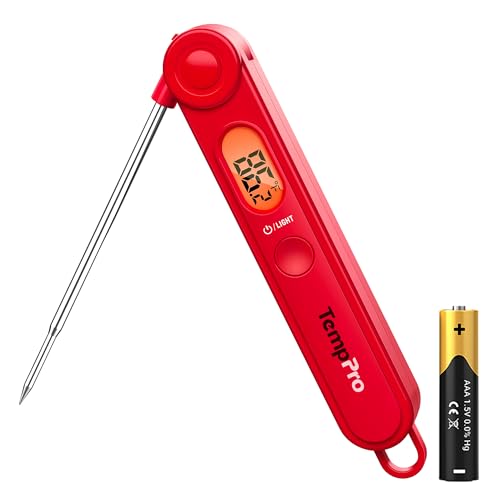
Most household probes lead double and triple lives, and this TempPro is the pick that admits it in writing. Its listing names the full circuit — the grill and smoker, the fryer and the oil pot, candy work, the holiday turkey, even milk for the cook scalding or culturing at the stove — and backs the versatility with an NSF certification and a one-second stated response. A probe that moves between raw meat and hot oil and dairy must be washed constantly and trusted in liquids as well as solids; the certification is the relevant evidence, and the backlit display keeps readings legible over a steaming pot as readily as over a grill.
Who it suits: the true generalist kitchen, where one probe serves meat, frying, candy, and dairy in the same week. The honest limitation is the absence of a stated accuracy figure in the title data — the certification speaks to standards compliance, but a buyer comparing numerical precision should weigh the ThermoMaven pair, and everyone should ice-test on arrival. For range of honest work, this is the group’s most versatile instrument, and the natural companion pick to the folding designs in Best Meat Thermometers With Folding Probe.
Best for: one-probe kitchens spanning meat, oil, candy, and dairy / Not suited for: buyers comparing stated accuracy figures

ThermoMaven Digital Meat Thermometer, Bright LED Screen
Badge: Best Bright-Screen Probe
Strengths
- A bright LED screen that auto-rotates — the strongest readability specification in the group.
- Stated ±0.5°F accuracy with NIST and NSF certification named.
- IP67 waterproofing and a stated 1-second response.
Trade-offs
- Its stated response is a step behind the half-second picks, including its own sibling.
- Two ThermoMaven models in one guide demand careful comparison — see the sibling note in its review.
- Credential-forward positioning again exceeds casual needs.
Mini spec box (from listing data)
- Stated response: 1 second
- Stated accuracy: ±0.5°F
- Certification: NIST and NSF certified (per listing)
- Display: auto-rotate bright LED screen; waterproof IP67; colour black
Readability is where probe readings go to die — in steam, in glare, in the dark corner of a smoker — and this ThermoMaven is specified like it knows it. A bright LED screen, auto-rotating so the number is upright from either hand, sits on top of the same certified accuracy foundation as the group leader: a stated half-degree figure with two certifications named, inside an IP67 body. The honest sibling comparison belongs in the open: against the leading ThermoMaven, you trade a half-second of stated response for the brighter, rotating LED presentation. Cooks who read in difficult light should take that trade happily; cooks who probe thin cuts against the clock should not.
Who it suits: low-light grillers, smoker cooks, left-handed readers, and anyone whose last probe failed them at the display rather than the sensor. The honest limitation is that single half-second: in rapid batch work on thin cuts, the group’s two half-second picks state the faster hand. Everywhere else — accuracy evidence, sealing, legibility — this model matches the leader, and for many kitchens it will be the more usable of the two.
Best for: difficult-light, any-angle reading with certified accuracy / Not suited for: the fastest thin-cut batch work
TempPro TempSwift Instant Read Thermometer, Rotating Display
Badge: Best Rotating-Display Probe
Strengths
- A 180° rotating display, stated in the listing — readable from above, below, and either side.
- Stated 1-second response and IP67 waterproofing.
- Listed across deep fry, smoker, grill, and BBQ work.
Trade-offs
- No accuracy figure or certification is stated in the title data.
- Rotation serves reading angles; it does not speed the sensor.
- Buyers wanting backlit-plus-rotation in one stated package should compare the ThermoMaven LED pick.
Mini spec box (from listing data)
- Stated response: 1 second
- Display: 180° rotating
- Waterproof: IP67 (per listing)
- Listing highlights: deep fry, smoker, grill, BBQ
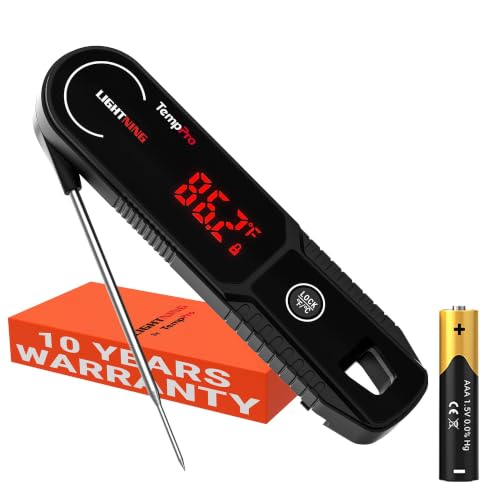
The closing pick makes one argument completely: the display should come to you. A 180° rotating screen means the number is upright when you probe downward into a roast, sideways into a chop, or upward from a low smoker shelf — the three postures that turn fixed-display readings into neck-craning guesses. Around that argument sit a stated one-second response and IP67 sealing, the working credentials of a probe meant for fryers and smokers as much as grills. It is a focused instrument, and its focus is the moment of reading itself.
Who it suits: cooks whose probing happens at awkward angles — low smokers, deep pots, oven racks — and left-handed readers above all. The honest limitation is the missing paper trail: no stated accuracy figure or certification appears in the title data, so this pick asks for your ice-water verification in place of documentation, a fair bargain at its position in the group as long as you know you are making it. As a readability-first probe with real sealing, it closes the list on merit.
Best for: awkward-angle and left-handed probing / Not suited for: certification-first shoppers
Comparison Table
| Pick | Badge | Stated response | Accuracy evidence | Listing |
|---|---|---|---|---|
| ThermoMaven Professional | Best Overall Probe | 0.5 sec | ±0.5°F; NIST and NSF certified; IP67 | Check on Amazon |
| ThermoWorks Thermapen ONE | Best Premium Probe | Not stated in title data | Not stated in title data | Check on Amazon |
| ThermoMonster, Black | Best Fast Probe | 0.5 sec | ±0.5°F, NIST-referenced (per listing) | Check on Amazon |
| TempPro TempSwift | Best Versatile Probe | 1 sec | NSF certified (per listing); no figure stated | Check on Amazon |
| ThermoMaven, Bright LED | Best Bright-Screen Probe | 1 sec | ±0.5°F; NIST and NSF certified; IP67 | Check on Amazon |
| TempPro, Rotating Display | Best Rotating-Display Probe | 1 sec | No figure stated in title data; IP67 | Check on Amazon |
How to Choose a Meat Probe Thermometer
Choose in the order a reading actually happens. First, the sensing claim: prefer a stated accuracy figure, and prefer it traceable — referenced to a standard, or backed by named certification, as the ThermoMaven picks and the ThermoMonster provide in different degrees. Second, stated response, matched to your food: thin-cut and batch cooks benefit from the half-second claims; roast and poultry cooks, whose readings change slowly, lose nothing at one second. Third, the display, matched to your postures: bright backlighting for steam and shade, rotation for left hands and low angles, auto-rotation if you switch hands mid-cook. Fourth, sealing, matched to your washing reality: a probe that checks raw chicken gets washed constantly, and a stated IP67 rating, carried by several picks here, converts that washing from a risk into a routine. Fifth, repertoire honesty: if your probe will live in oil, candy, and dairy as well as meat, the TempPro versatile pick’s stated range of work is the relevant evidence.
Then apply the discount every honest guide applies: technique outweighs specification. A perfectly placed one-second probe outperforms a carelessly placed half-second one on every cook, because the sensor can only report the temperature of the spot it occupies. Buy the strongest evidence your budget of attention supports, then invest the real effort in the insertion habits in the next section — they are the same habits whether the probe in your hand is the certified leader or the rotating closer.
Probe Technique: How to Take a Reading That Tells the Truth
Find the thermal centre and put the tip in it. For a roast or a whole bird, that means the thickest part, reached from the top or side, with the tip buried in the middle of the muscle — away from bone, which conducts heat and lies; away from fat seams, which read differently from meat; and away from the surface, which is always hotter or cooler than the centre. For thin cuts — chops, burgers, fillets, chicken breasts pounded flat — insert from the side so the tip travels through the thin dimension and sits in its middle; a probe pushed down through a thin cut mostly measures the pan. Insert far enough that the sensing region, near the tip, is fully inside the food, then wait for the settle: watch the number stop climbing or falling, not merely slow down. On large pieces, take a second reading in another spot; a roast’s centre is a neighbourhood, and two agreeing readings are worth more than one heroic one.
Pull temperatures follow your recipe and current food-safety guidance — the reference points used across American kitchens are 165°F for poultry, 160°F for ground meats, and 145°F with a rest for whole cuts of beef, pork, and lamb — and remember that thick cuts rise as they rest, so the probe’s job includes judging the pull, not just the serve. Between checks, rinse or wipe the probe, especially between raw and cooked food. Troubleshooting follows the pattern. Problem: the reading will not settle → the tip is likely in fat, against bone, or half out of a thin cut; reposition and reinsert from the side. Problem: two spots disagree wildly → the piece is cooking unevenly or one probe placement touched the grate; trust the lower reading’s location and give that zone more time. Problem: your ice-water check reads off → restir the slurry, keep the tip off the glass, and retest before concluding anything; a persistent error means calibration if supported, or replacement.
Anatomy of a Probe Reading: Tip, Shaft, and the Physics of Settling
A probe thermometer senses at its tip, where the temperature-sensitive element sits, and the rest of the shaft is a road the heat must travel — which is why insertion depth and tip placement dominate accuracy in practice. The sensing region needs to be surrounded by the food whose temperature you want; a tip half in a fat pocket reports the pocket. Settling is physics, not hesitation: the tip must reach the food’s temperature, and it approaches that value quickly at first, then asymptotically, which is why stated response figures describe a maker’s defined test rather than a universal instant. Thin tips settle faster and suit thin cuts; they are also the part of the instrument that suffers most in drawers and dish racks, so storage is a performance feature in disguise. Understanding this anatomy converts the specifications in this guide into expectations you can manage: the half-second picks genuinely settle sooner, the one-second picks genuinely suffice for slow-changing food, and every pick in the group reads only the spot you choose — choose it like it matters, because it is the whole measurement.
Probe Care: Washing, Storage, and the Ice-Water Habit
A probe thermometer’s life is measured in washings. It touches raw meat, then cooked meat, then — if you are careless — the drawer. Wash or sanitise the probe between raw and cooked checks without exception; the sealed picks here make that a rinse under the tap, while unrated models deserve a careful wipe and a wash that respects their unstated limits. Never leave a handheld probe sitting in a hot pan or resting against a grate between checks — it is a spot-check instrument, and sustained heat exposure is the fastest way to age its sensor and its housing. Store it with the tip protected, deployed or stowed as its design intends, away from the knife-drawer scrum. And keep the verification habit: an ice-water slurry — crushed ice, water to fill the gaps, a stir, a minute to stabilise — should read at the freezing point of water, and checking it on delivery day, after any drop, and before any important cook takes two minutes and converts trust from a hope into a fact. Instruments that are washed, stored, and verified this way tend to be replaced out of boredom rather than failure, whichever badge they carry.
Matching a Probe to the Protein: A Working Tour
Walk the probe through a week of cooking and the picks sort themselves by task. Monday’s chicken breasts, pounded to uneven thickness, punish shallow probing: come in from the side, take two readings, and let the half-second picks earn their speed claim, because each breast finishes on its own schedule. Wednesday’s burgers are a batch problem — eight patties, four doneness preferences, one cook — where deployment speed and a legible display matter as much as sensor speed, and the rotating and auto-rotating models quietly win. Friday’s thick ribeyes, reverse-seared, are a precision problem: the centre moves slowly and the pull temperature decides everything, which is certified-accuracy territory, ThermoMaven ground. Sunday’s roast is a patience problem — probe twice, in two spots, and rest it properly — where any pick here serves and technique is the entire story. Add the week’s incidentals: oil for fries, a caramel that must not overshoot, milk for yoghurt, each handled by the versatile pick’s stated repertoire. No single badge covers that week, which is why this guide ranks by evidence type rather than by a single championship metric: your protein rotation, read honestly, is the real buying guide, and the comparison table is its scoresheet.
When a Handheld Probe Is Not Enough — and What to Pair It With
Honesty about a category includes its edges. A handheld probe cannot watch a brisket for you across a twelve-hour smoke; it visits, reads, and leaves, and the cook who needs continuous monitoring should pair it with a leave-in or wireless system from the neighbouring guides rather than asking a spot-check tool to be a sentinel. It also cannot judge what it cannot reach: the centre of a very large roast benefits from a second reading angle, and delicate fish rewards the gentlest insertion you can manage. What the handheld probe does better than any rival is universality — one instrument, every food, every vessel, no setup, no pairing, no battery-hungry transmitter — and instant verification of the other systems’ claims. Many experienced cooks treat the handheld as the court of final appeal: the leave-in probe raises the suspicion, the handheld delivers the verdict. Buy it in that spirit, as the instrument that settles arguments, and its place in the kitchen justifies itself weekly regardless of which badge you choose.
The Two-Thermometer Kitchen: Why Pros Own a Spare
Ask cooks who probe daily how many thermometers they own and the honest answer is often two — not from extravagance but from workflow. A second probe ends the wash-and-wait bottleneck when raw and cooked checks alternate rapidly, covers the cook when the first instrument’s battery dies mid-service, and provides the cross-check that settles a suspicious reading: two probes agreeing in the same roast end all argument, and two disagreeing tell you one needs verification, which is information a single instrument can never give you. The sensible pairing is complementary rather than identical — a certified precision pick as the primary and a rotating-display or versatile model as the second, or the premium reference instrument backed by a fast, documented deputy. This guide does not insist on it; a single well-chosen probe serves most households completely. But if your cooking scales up — bigger gatherings, a smoker habit, a second cook in the kitchen — the second probe is the cheapest professional upgrade in this entire category, and the picks above were reviewed with their pairing potential in mind.
Common Buying Mistakes
- Judging a probe by its handle. The measurement happens at the tip; buy the sensing evidence first and the ergonomics second.
- Assuming a famous name comes with stated figures. The premium pick’s supplied title states none; a guide that respects you will say so, as this one does.
- Probing beside the bone and trusting the number. Placement errors defeat certified accuracy every time; learn the thermal centre first.
- Skipping the wash between raw and cooked checks. The probe is a utensil that travels between foods; treat its hygiene as part of the recipe.
- Leaving a spot-check probe in the heat. These are handheld instruments for momentary readings, not leave-in monitors; sustained exposure shortens their lives.
- Ignoring the display’s working conditions. Steam, glare, and left-handed angles are where readings fail; match the screen design to your kitchen’s reality.
Final Recommendation
For most cooks, the first choice is the ThermoMaven Professional Meat Thermometer Digital — the only pick whose listing states top-tier figures for speed, accuracy, certification, sealing, and display at once. Buy-once cooks should take the ThermoWorks Thermapen ONE for the category’s reference name, and rapid batch cooks the ThermoMonster Instant Read Meat Thermometer for its stated half-second, standard-referenced hand. The versatile TempPro serves the widest repertoire, the bright-LED ThermoMaven serves difficult light, and the rotating TempPro serves awkward angles. Probe well, verify in ice water, and any of the six will tell you the truth — which is the entire job. If you take one habit from this page, take the verification ritual: crushed ice, a little water, a stirred minute, a settled reading at the freezing point. It costs nothing, it takes less time than preheating a pan, and it converts every claim in every listing — including the ones this guide has weighed so carefully — into a fact about the instrument in your own hand. That is what separates a kitchen that owns a probe thermometer from a kitchen that trusts one, and trust, in the end, is the product all six of these makers are really selling.
Batteries, Displays, and the Small Print of Daily Use
Two ownership details rarely headline a listing and constantly shape daily satisfaction. The first is power behaviour: instruments that wake on motion or on unfolding, as several designs here are built to do, remove the dead-button moment at the grill, but they also make battery discipline your responsibility — a spare cell kept with the thermometer is the professional habit, adopted cheaply. The second is display behaviour in the wild: backlighting that helps in a dark kitchen can wash out in direct sun, and a rotating display that saves a left-handed reading can feel busy to a cook who always reads from above. None of this is knowable from a specification table, which is why this guide’s delivery-day advice matters: deploy the probe, take a dozen practice readings on water at different temperatures and angles, in your light, with your hands, before the first real cook. Ten minutes of rehearsal will tell you whether the instrument fits your kitchen’s reality — and if it does not, you will know while the return is still simple, which is the last consumer-protection habit this category teaches.
Frequently Asked Questions
What is the difference between a probe thermometer and a leave-in thermometer?
A handheld probe thermometer, like all six picks here, is a spot-check instrument: you insert it, read, and withdraw. A leave-in thermometer’s probe stays in the food during cooking, connected by cable or wirelessly to a display outside the heat. Spot-check probes are universal and precise at the moment of checking; leave-in systems monitor a long cook continuously. Many serious kitchens own both, using each where it belongs.
How deep should the probe go?
Deep enough that the sensing tip sits in the thermal centre of the thickest part — fully surrounded by meat, away from bone, fat seams, and surfaces. For thin cuts, insert from the side so the tip rests in the middle of the thin dimension. A reading taken with the tip near a surface or a bone is a measurement of that surface or bone, not of dinner.
How do I verify my probe thermometer at home?
Use an ice-water slurry: crushed ice in a glass, cold water just filling the gaps, stirred and left a minute. Insert the tip without touching the glass; a truthful probe settles at or very near the freezing point of water. Verify on delivery day, after drops, and before important cooks. A boiling-water check, adjusted for altitude, verifies the upper range.
Does a faster stated response actually matter?
For slow-changing food — roasts, whole birds — a second either way is irrelevant. For thin cuts and batch work, where each piece needs a verdict while others wait, the half-second picks here genuinely tighten the whole process, and the total reading time also depends on deployment and display, which is why the rotating and motion-friendly designs earn their places.
Can one probe thermometer handle candy, frying, and dairy too?
Yes, within its stated repertoire — the versatile TempPro pick lists oil, fry, candy, turkey, and milk work explicitly, and the ThermoMonster lists candy among its uses. Wash the probe thoroughly between food types, respect each model’s stated limits on its listing, and remember that a meat probe is a general temperature instrument whose speciality is simply where it is marketed.
Should I buy the fastest probe or the most accurate one?
Match the evidence to your cooking’s bottleneck. If your readings happen on thin, fast-changing food — chops, burgers, batch grilling — stated response is the figure that protects you, and the half-second picks lead. If your cooking turns on fine doneness judgements in thick, slow food, stated accuracy and its certification protect you, and the ThermoMaven pair leads. Most kitchens contain both situations across a week, which is why the overall pick in this guide is the model whose listing states both kinds of evidence at the top level.
How long should a good probe thermometer last?
This guide will not invent a lifespan figure, because longevity depends on the life the instrument leads: washed promptly, stored with its tip protected, kept out of sustained heat, and verified regularly, a well-built probe serves for years of regular cooking. The stated evidence that predicts that life is build evidence — sealing ratings, certification-backed manufacture, and a maker with a track record — which is why the reviews weight those details rather than promising a number of years no one can guarantee.
Is a folding probe better than a fixed probe?
Folding designs, the format most picks here follow, store safely with the tip protected against the body and deploy with one hand — the safer drawer citizen and the faster instrument to bring to bear. Fixed probes read just as honestly but demand sheath discipline in storage. Judge by your kitchen’s habits; the sensing evidence matters more than the hinge, provided the hinge you choose still feels tight and smooth after its first week of deployments.
Why do two picks come from the same maker?
Because the verified pool for this keyword contained two ThermoMaven models with genuinely different stated profiles — one optimised for stated response, one for a bright auto-rotating LED screen — sharing a certified accuracy foundation. Their reviews compare them directly and honestly, including where the sibling is the better choice, so you can pick between them on the criterion that matters to your kitchen.