Disclosure: topratedkitchenware.com is reader-supported. When you buy through links on our site, we may earn an affiliate commission from Amazon and other retailers, at no extra cost to you.
Where to buy
The three genuine mini-cup picks in this guide to the best mini cup coffee makers are listed on Amazon, where you can check the latest price on Amazon, confirm brew sizes and fuel, and read the current listing before ordering. The three Keurig K-Express reservoir models in the pool are reviewed in prose only, for the reason each of their reviews states plainly.
- Best Pod-Free Mini-Cup: Elite Gourmet Single-Serve Coffee Maker (14 oz) — Check on Amazon
- Keurig K-Mini Mate Single Serve K-Cup Coffee Maker — Check on Amazon
- Tastyle Mini Single Serve Coffee Maker (Hot and Iced) — Check on Amazon
Also reviewed below, without a purchase link: Keurig K-Express Single Serve K-Cup Coffee Maker, Black, Keurig K-Express Single Serve K-Cup Coffee Maker, Warm Stone, Keurig K-Express Single Serve K-Cup Coffee Maker, Evergreen. Those models are covered in prose only, for the honest reason explained in each review — they do not genuinely match what this keyword asks for, so we describe them for comparison rather than sending you to a listing as if they did.
Read the full guide ↓
The best mini cup coffee makers are built around a simple unit: one cup, made fresh, by a machine small enough to live where the cup is drunk. Not a pot, not a reservoir station — a mini. This guide evaluates the verified pool on that unit. Three picks are genuine mini-cup machines and are linked: the Elite Gourmet, a grounds-based 14-ounce single-serve; the Keurig K-Mini Mate, the compact K-Cup brewer; and the Tastyle Mini, which takes pods or grounds across a 6-to-14-ounce range, hot or iced. The remaining three pool picks are the Keurig K-Express in three colours — single-serve, yes, but built around a 42-ounce reservoir, which is a countertop station rather than a mini, and therefore reviewed in prose only, without links or images.
The mini-cup idea has a discipline to it that this guide respects: the machine should be smaller than the ritual around it. It should fit the dorm shelf, the desk corner, the RV counter and the small kitchen without negotiation, brew its one cup quickly, and clean up in seconds. Every judgement below — fuel, brew-size range, mug clearance, cleanup — is made against that discipline, because a mini that fails at smallness has failed at its only job.
If your coffee life is actually a household pot each morning, this class will frustrate you and the guide’s final section will point you onward; the reservoir machines reviewed in prose, and the wider drip world in 6 Best Coffee Makers For Large Families Big Pots 2026 coverage, exist for that life. But for the one-cup drinker — still the most common coffee drinker in the country — the mini is not the compromise option. It is the correct one, and the next sections sort its three genuine contenders.
Key Takeaways
- Mini-cup means one fresh cup from a genuinely small machine: three picks here qualify, three reservoir models do not.
- The Tastyle Mini is the most flexible mini-cup brewer: 6–14 oz, pods or grounds, hot and iced.
- The Elite Gourmet is the pod-free mini: a reusable filter, one touch, and a full 14 oz pour.
- The K-Mini Mate is the compact pod machine: K-Cup convenience at the smallest size in this guide.
- The K-Express trio (42 oz reservoirs) are prose-only — single-serve stations, not minis.
- Measure mug clearance before buying: the travel mug is this category’s most common compatibility failure.
In this guide
Quick Picks
Linked rows are the genuine minis; prose-only rows are the reservoir K-Express in its three colours, kept for honest comparison. Badges match the detailed reviews.
| Pick | Badge | Standout point | Check |
|---|---|---|---|
| Elite Gourmet Single-Serve Coffee Maker (14 oz) | Best Pod-Free Mini-Cup | 14 oz of your own grounds through a reusable filter | Check on Amazon |
| Keurig K-Mini Mate Single Serve K-Cup Coffee Maker | Best Compact Pod Machine | K-Cup convenience in the mini format | Check on Amazon |
| Tastyle Mini Single Serve Coffee Maker (Hot and Iced) | Best All-Round Mini-Cup | Pods or grounds, 6–14 oz, hot and iced | Check on Amazon |
| Keurig K-Express Single Serve K-Cup Coffee Maker, Black | Reservoir Alternative — Prose Only | 42 oz reservoir station in black, three sizes, Strong Brew | Prose-only — see review |
| Keurig K-Express Single Serve K-Cup Coffee Maker, Warm Stone | Reservoir Alternative — Prose Only | The 42 oz station in Warm Stone | Prose-only — see review |
| Keurig K-Express Single Serve K-Cup Coffee Maker, Evergreen | Reservoir Alternative — Prose Only | The 42 oz station in Evergreen | Prose-only — see review |
Choose by fuel before anything else: grounds, pods, or both. In a machine this small, fuel decides the daily ritual — measuring and rinsing, or inserting and binning — and the ritual, repeated hundreds of times a year, is the real product being bought.
Then choose by cup. The mini-cup class spans a 6-ounce small strong cup to a 14-ounce travel mug pour. Drinkers whose cup never changes can buy the fixed-pour Elite Gourmet happily; drinkers whose cup varies by day need the Tastyle’s range or the pod system’s sizes.
How These Picks Were Chosen
These picks were chosen by research from the verified pool, not by hands-on testing, and no testing is claimed. Each model’s format, fuel and brew sizes were confirmed against its verified Amazon listing title. The first judgement was the keyword’s own: is this genuinely a mini cup coffee maker — a compact machine whose unit of work is one cup? Three picks passed. The K-Express models, for all their single-serve nature, are organised around a 42-ounce reservoir and a countertop footprint; they failed the mini test and were moved to prose-only coverage, as the assignment’s own note anticipated.
That split is the guide’s spine, and it is maintained in the open: prose-only picks get full descriptive reviews, an explicit reason, and no purchase link or product image. Presenting a reservoir station as a mini would be a small dishonesty with a long tail — a reader in a dorm or an RV would discover it at the worst possible moment, when the box was opened.
Within the genuine minis, the comparison weighed fuel flexibility, brew-size range, footprint honesty, and the small practicalities — mug clearance, shut-off behaviour, filter rinsing — that decide whether a mini is loved in month six. Context came from 6 Best Coffee Makers For Home Offices Desk Brewers 2026 and 6 Best Coffee Makers Programmable And Precise 2026 coverage, for landscape only; every specification here is from the verified pool.
The Best Mini Cup Coffee Makers, Reviewed
Three linked minis first — grounds, pods, and both — followed by the three prose-only reservoir models, clearly marked.

Elite Gourmet Single-Serve Coffee Maker (14 oz)
Badge: Best Pod-Free Mini-Cup
Strengths
- Reusable filter ends the pod question entirely — any grounds, no consumables
- One-touch brewing and auto shut-off fit dorm and desk life
- A full 14 oz pour fills the big mug in one cycle
Trade-offs
- Fixed pour size — no small-cup option
- Grounds ritual: measuring in, rinsing out
- Single cups only; a pair of drinkers brew in turns
Key specs from the verified listing:
- Brew size: 14 oz single serve (per listing title)
- Power: 600W (per listing title)
- Operation: one-touch (per listing title)
- Filter: reusable filter for grounds and loose-leaf tea (per listing title)
- Features: auto shut-off; dishwasher-safe parts per listing title; travel mug included in the offer description
The Elite Gourmet defines the grounds end of the mini-cup class: a 600-watt, one-touch machine that brews 14 ounces through a reusable filter, for grounds or loose-leaf tea. In a category drifting toward proprietary pods, that filter is a small declaration of independence — the coffee is yours, the dose is yours, and the running cost is whatever your favourite bag works out to per scoop.
Its pour is its personality: 14 ounces, every time, no menu. For the drinker whose cup is a constant — the big mug, the travel tumbler — that fixed generosity is a feature disguised as a limitation. One touch, one full cup, auto shut-off afterwards: the ritual compresses to the minimum a fresh cup allows.
What it asks in return is the grounds ritual itself — a scoop measured, a filter rinsed — and patience with single-file brewing when a second drinker appears. For the pod-free mini buyer, those terms are the point of the purchase, and no machine in this pool states them more cleanly.
Best for: pod-free drinkers with one consistent, generous cup / Not suited for: varied-size drinkers and pod households
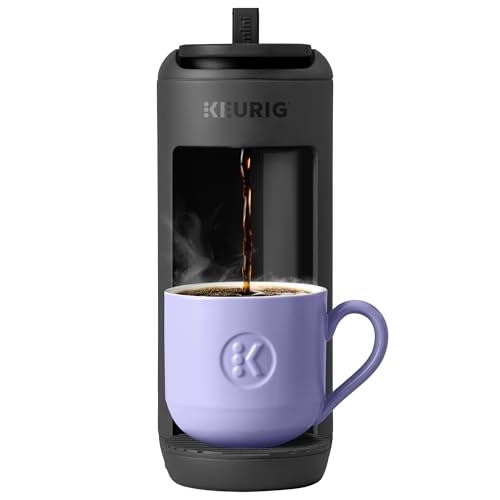
Keurig K-Mini Mate Single Serve K-Cup Coffee Maker
Badge: Best Compact Pod Machine
Strengths
- The smallest honest pod machine in this guide — compact and portable per its listing
- Pod ritual at its simplest: insert, brew, drink
- Up to 12 oz covers the standard mug range
Trade-offs
- Pod cost and pod waste, every cup, by design
- No grounds route for your own coffee
- 12 oz ceiling sits below its linked rivals’ 14 oz
Key specs from the verified listing:
- Brew size: up to a 12 oz cup (per listing title)
- Format: compact, portable, for small spaces, dorms and offices (per listing title)
- Pods: K-Cup single serve (per listing title)
- Colour: black (per listing title)
- Water: fill per cup — no large reservoir in this mini format
The K-Mini Mate is what the mini-cup idea looks like in the pod world: a compact K-Cup machine, listed for small spaces, dorms and offices, brewing up to a 12-ounce cup. It carries the pod system’s whole catalogue into spaces a reservoir machine cannot enter, and it does so with the fill-per-cup freshness that standing reservoirs give up.
Its daily virtue is cognitive as much as physical. No measuring, no dose decisions, no filter — the pod is the recipe, and the cup is the same on the hundredth morning as the first. For students, desk drinkers and anyone whose mornings are already full, that removal of variables is the product, and this machine delivers it at the class’s smallest scale.
The pod trades are stated here as plainly as in this guide’s other reviews: cost per cup, waste per cup, and no home for loose coffee. A drinker who accepts those terms — many do, gladly — gets in the Mate the purest mini-cup pod machine in the pool, linked here precisely because, unlike its K-Express cousins, it is genuinely mini.
Best for: pod drinkers in small spaces, dorms and offices / Not suited for: grounds drinkers and reservoir seekers
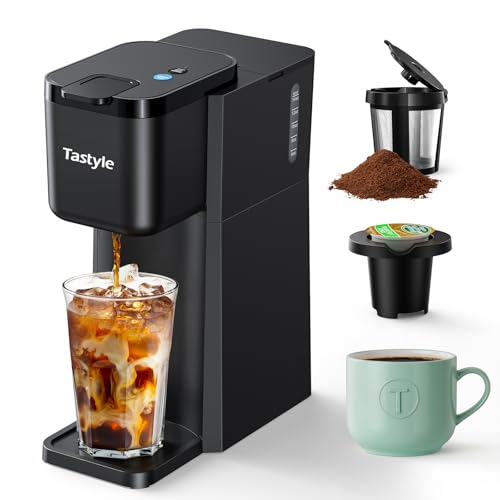
Tastyle Mini Single Serve Coffee Maker (Hot and Iced)
Badge: Best All-Round Mini-Cup
Strengths
- Both fuels in one mini: the pod morning and the grounds morning, same machine
- 6–14 oz range covers the small strong cup and the tall iced glass
- Hot and iced coffee from one mini footprint, with a recipe book to encourage both
Trade-offs
- Dual systems mean neither ritual is quite as stripped-down as a purist machine’s
- A newer name beside the category’s established pod brand
- Versatility can be surplus for a drinker with one fixed cup
Key specs from the verified listing:
- Brew sizes: 6 to 14 oz (per listing title)
- Compatibility: K-Cup pods and ground coffee (per listing title)
- Drinks: hot and iced coffee (per listing title)
- Extras: recipe book included (per listing title)
- Power: 120V; aimed at home, travel, RV, office and dorm use (per listing title)
The Tastyle Mini takes this guide’s first recommendation by being the mini-cup machine that answers the most versions of the question. Its listing offers 6-to-14-ounce brews, K-Cup pods and ground coffee, hot and iced drinks, and a recipe book — a specification that reads like a deliberate refusal to make the buyer choose a camp before the first cup.
In daily life that refusal is practical, not decorative. Households argue about pods; mornings vary between rushed and slow; summers turn hot coffee drinkers into iced coffee drinkers. A machine that absorbs all of that variation inside one mini footprint — one that its listing aims at home, travel, RV, office and dorm alike — removes the most common reason mini purchases get regretted and replaced.
The purist’s caveat stands: a dedicated pod machine is a simpler pod ritual, a dedicated grounds machine a simpler grounds one. But mini-cup buying is usually a household negotiation rather than a solo manifesto, and the Tastyle is the negotiator’s machine — the one least likely to be wrong for anyone who uses it.
Best for: mixed households, experimenters, travellers and iced-coffee drinkers / Not suited for: single-ritual purists
Keurig K-Express Single Serve K-Cup Coffee Maker, Black
Badge: Reservoir Alternative — Prose Only
Prose-only pick — no Amazon link and no product image, because its 42-ounce removable reservoir, three brew sizes and Strong Brew button make it a full countertop single-serve station — a good machine, but not a mini brewer, so it is covered in prose only, with no purchase link and no product image.
Strengths
- Reservoir convenience: cups in succession without refilling
- Strong Brew button answers the thin-pod-cup complaint
- Three brew sizes over one pod system
Trade-offs
- Not a mini-cup machine — the reason for this prose-only review
- Standing reservoir water versus fill-per-cup freshness
- Countertop footprint sized for a station, not a shelf
Key specs from the verified listing:
- Reservoir: 42 oz removable reservoir (per listing title)
- Brew sizes: 3 (per listing title)
- Features: Strong Brew button; travel mug friendly (per listing title)
- Pods: works with all K-Cup pods (per listing title)
- Colour: black
The black K-Express is the most capable non-mini in this pool: a 42-ounce removable reservoir, three brew sizes, a Strong Brew button and travel-mug friendliness, working with all K-Cup pods per its listing. its 42-ounce removable reservoir, three brew sizes and Strong Brew button make it a full countertop single-serve station — a good machine, but not a mini brewer, so it is covered in prose only, with no purchase link and no product image. Households brewing several pod cups in a row will feel that reservoir as a daily kindness, and the Strong Brew control is a real answer to a real complaint.
Its prose-only status is a classification, not a punishment. ‘Mini cup’ names a size class, and a guide that blurred it would send dorm and RV buyers a countertop station in a mini’s clothing. Described honestly instead, the K-Express can be chosen by the readers it actually fits — those whose pattern is succession, not smallness.
In black it is the trio’s neutral default; the Warm Stone and Evergreen reviews below describe the identical machine in its other finishes.
Best for: households brewing pod cups in quick succession / Not suited for: mini-cup shoppers — see the linked picks above
Keurig K-Express Single Serve K-Cup Coffee Maker, Warm Stone
Badge: Reservoir Alternative — Prose Only
Prose-only pick — no Amazon link and no product image, because its 42-ounce removable reservoir, three brew sizes and Strong Brew button make it a full countertop single-serve station — a good machine, but not a mini brewer, so it is covered in prose only, with no purchase link and no product image.
Strengths
- Warm Stone finish suits kitchens avoiding black appliances
- Identical reservoir rhythm and Strong Brew control to its siblings
- Three sizes across the full K-Cup catalogue
Trade-offs
- Not mini, whatever the colour
- Pod economics unchanged: cost and waste per cup
- Finish is the only variable — choose it for the room, not the brew
Key specs from the verified listing:
- Reservoir: 42 oz removable reservoir (per listing title)
- Brew sizes: 3 (per listing title)
- Features: Strong Brew button; travel mug friendly (per listing title)
- Pods: works with all K-Cup pods (per listing title)
- Colour: Warm Stone
Warm Stone is the finish this reservoir machine wears into kitchens that plan their palettes, and the machine beneath it is the same one reviewed above: its 42-ounce removable reservoir, three brew sizes and Strong Brew button make it a full countertop single-serve station — a good machine, but not a mini brewer, so it is covered in prose only, with no purchase link and no product image. The listing’s specification — reservoir, three sizes, Strong Brew, all K-Cup pods — does not vary with the colourway, and neither does this guide’s classification of it.
It receives a full prose review because every pool pick deserves description on equal terms, and because a countertop resident’s colour is a years-long decision, not a trivial one. Readers choosing between the three K-Express finishes should choose entirely on the room the machine will live in; readers choosing between classes should return to the linked minis above.
That two-level honesty — equal description, clear classification — is the standard this guide applies to every prose-only pick, this one included.
Best for: reservoir seekers in Warm Stone kitchens / Not suited for: mini-cup shoppers — see the linked picks above
Keurig K-Express Single Serve K-Cup Coffee Maker, Evergreen
Badge: Reservoir Alternative — Prose Only
Prose-only pick — no Amazon link and no product image, because its 42-ounce removable reservoir, three brew sizes and Strong Brew button make it a full countertop single-serve station — a good machine, but not a mini brewer, so it is covered in prose only, with no purchase link and no product image.
Strengths
- Evergreen makes the coffee station a deliberate colour accent
- Same reservoir, sizes and Strong Brew specification as its siblings
- Full K-Cup compatibility per its listing
Trade-offs
- Not a mini-cup machine — prose-only by classification
- Bold finishes date faster than neutrals; buy it because you love it
- Pod-only fuel, with the standing per-cup cost
Key specs from the verified listing:
- Reservoir: 42 oz removable reservoir (per listing title)
- Brew sizes: 3 (per listing title)
- Features: Strong Brew button; travel mug friendly (per listing title)
- Pods: works with all K-Cup pods (per listing title)
- Colour: Evergreen
Evergreen closes the pool: the same 42-ounce reservoir station in the finish that refuses to be background. its 42-ounce removable reservoir, three brew sizes and Strong Brew button make it a full countertop single-serve station — a good machine, but not a mini brewer, so it is covered in prose only, with no purchase link and no product image. As with its siblings, the brewing specification is unchanged — three sizes, Strong Brew, the full pod catalogue — and so is the reason it stands in the prose-only section of a mini-cup guide.
There is a genuine buyer here: the household that brews pod cups in succession, wants the reservoir’s rhythm, and treats its appliances as part of the kitchen’s colour story. That buyer loses nothing by this guide’s classification and gains the certainty that the machine’s size was chosen, not discovered.
For everyone whose search truly said mini — the dorm shelf, the RV counter, the desk corner — the three linked machines above are the guide’s answer, and this green boundary marker is the guarantee that the answer means what it says.
Best for: reservoir seekers who want the Evergreen accent / Not suited for: mini-cup shoppers — see the linked picks above
Comparison Table
The table below compares all six picks on the attributes that matter most for this keyword. Linked picks carry a check link; prose-only picks are marked as such.
| Pick | Badge | Key attribute | Second attribute | Check |
|---|---|---|---|---|
| Elite Gourmet Single-Serve Coffee Maker (14 oz) | Best Pod-Free Mini-Cup | 14 oz single serve | 600W, reusable filter, grounds-based | Check on Amazon |
| Keurig K-Mini Mate Single Serve K-Cup Coffee Maker | Best Compact Pod Machine | Up to 12 oz per brew | K-Cup pods, compact mini format | Check on Amazon |
| Tastyle Mini Single Serve Coffee Maker (Hot and Iced) | Best All-Round Mini-Cup | 6–14 oz brew sizes | Pods or grounds, hot and iced | Check on Amazon |
| Keurig K-Express Single Serve K-Cup Coffee Maker, Black | Reservoir Alternative — Prose Only | 42 oz reservoir | 3 brew sizes, Strong Brew | Prose-only |
| Keurig K-Express Single Serve K-Cup Coffee Maker, Warm Stone | Reservoir Alternative — Prose Only | 42 oz reservoir | 3 brew sizes, Strong Brew | Prose-only |
| Keurig K-Express Single Serve K-Cup Coffee Maker, Evergreen | Reservoir Alternative — Prose Only | 42 oz reservoir | 3 brew sizes, Strong Brew | Prose-only |
How to Choose the Best Mini Cup Coffee Makers
Start where the machine will live, with a tape measure. Mini-cup machines serve dorms, desks, RVs, spare rooms and small kitchens, and their footprints and heights differ by enough to matter under a cabinet or on a shelf. Measure the space, then measure your tallest mug against spout clearance — the two measurements that decide whether a mini integrates into a life or becomes a small daily annoyance.
Fuel is the second decision, and it is really three budgets at once: money per cup, seconds per cup, and waste per cup. Grounds win the first, pods win the second, and the reusable-filter grounds route wins the third. The Tastyle’s dual format lets a household pay each budget on different days — pods when rushed, grounds when not — which is why dual-format machines have become the thoughtful default in this class. Solo drinkers with a fixed ritual should simply pick their ritual’s fuel and buy the simplest machine that burns it.
Brew-size range matters in proportion to your cup variety. A single fixed pour — the Elite Gourmet’s 14 ounces — is a virtue when your cup is a constant: one touch, no decisions, the same generous mug every day. A range — the Tastyle’s 6 to 14 ounces — earns its place when the household’s cups vary from a small strong morning cup to an iced afternoon glass. Pod machines sit between: the pod fixes the dose, the size button fixes the strength, and a smaller brew over the same pod is the stronger cup.
Finally, weigh the reservoir question without prejudice. A fill-per-cup mini keeps water fresh and the footprint tiny, at the cost of adding water every time. A reservoir station — the prose-only K-Express class — removes that step and adds size and standing water. Neither is a defect; they are different mornings. This guide links the minis because ‘mini cup’ is the question asked, and describes the stations honestly because for some readers they are the answer anyway. Desk setups in particular benefit from the thinking in 6 Best Coffee Makers For A Home Office Compact Picks 2026 roundups.
How to Get the Best Cup From a Mini Coffee Maker
A mini has fewer variables than a big machine, which means each one matters more. These habits are the difference between a mini that delights and one that merely functions.
- Use fresh water for every brew, especially in fill-per-cup machines — their no-standing-water design is a freshness feature only if the water you add is fresh.
- Warm the mug. A small brew into a cold mug loses degrees it cannot spare; a hot-water rinse of the mug while the machine heats closes the gap.
- Keep the grounds dose identical every day. In a single-cup machine, one scoop’s difference is a large percentage of the recipe.
- For pods, match brew size to strength honestly: the same pod at a smaller size is the stronger cup; at a larger size, a thinner one. Choose, do not drift.
- For iced coffee, brew the small, strong size over a full glass of ice — the Tastyle is listed for exactly this — rather than brewing a large cup and diluting it.
- Rinse the filter or clear the pod after the session, and run a plain-water cycle weekly. Minis reward small, regular care and punish neglect quickly.
Placement is a brewing variable too. A mini on the counter, stocked and ready, makes a better cup than a superior machine in a cupboard, because it gets used with care instead of haste. Give the mini its corner, keep its fuel beside it, and the one-cup ritual becomes the calmest minute of the morning.
Descaling deserves a calendar note rather than a crisis. Small machines show scale early — slower brews, sputtering, off flavours. Follow the maker’s guidance for your water hardness at sensible intervals, and a mini will hold its first-month performance for years.
Troubleshooting
Problem: the cup tastes weak or watery → what to do: for grounds, check the dose and use the full scoop; for pods, brew a smaller size. Weakness in a mini is almost always ratio, not machinery.
Problem: coffee is not hot enough → what to do: warm the mug first, brew immediately after the machine signals ready, and keep the path from spout to desk short. Small volumes cool fast; manage the vessel, not just the machine.
Problem: the brew sputters or slows over time → what to do: descale. Mineral build-up is the mini’s most common ailment and the most curable — follow the maker’s routine for your water.
The One-Cup Household Is the Normal Household
It is easy to read ‘mini’ as a limitation, but the demographics of coffee run the other way: most cups are drunk by one person, at one moment, to one taste. The carafe is the special case — a gathering technology — while the single cup is the daily reality for students, desk workers, early risers whose partners sleep, and anyone whose second cup happens at a different hour from their first. The mini-cup class exists because manufacturers finally noticed, and its best machines, including the three linked here, are designed for that reality rather than shrunk from a bigger idea.
That is also why this guide polices the mini boundary against the reservoir stations in its own pool. A 42-ounce reservoir serves the gathering pattern — several cups in quick succession — inside a single-serve format. It is a good pattern, honestly reviewed below, but it is not the one-cup pattern, and the reader in a dorm room deserves a guide that knows the difference.
Iced Coffee and the Mini Renaissance
The mini class’s second wind is iced coffee. A small, strong brew over ice is precisely what a mini makes best: no carafe of hot coffee to chill, no batch to store, just a fresh cup at the size the glass needs. The Tastyle’s listing makes the point explicitly by offering hot and iced in a 6-to-14-ounce span, and its recipe book suggests the maker expects the machine to be played with, not just operated.
Home experimentation is the broader story: small machines lower the cost of trying a new coffee, a new ratio or a new style to a single cup. The grounds route in the Elite Gourmet and the dual route in the Tastyle both serve that playfulness; the pod route serves its opposite virtue, the guarantee of the known cup. A good guide, like a good mini, makes room for both temperaments — and 6 Best Coffees For Drip Coffee Makers Ground Picks 2026 coverage can stock the grounds side of the experiment.
The Mini in the Wild: Dorms, Desks, RVs and Spare Rooms
Listings for this class name its habitats so consistently — dorm, office, RV, small home — that the habitats deserve a section of their own, because each one reorders the buying criteria. The dorm values shut-off safety, a footprint that survives a shared shelf, and a fuel system a student budget can feed: grounds economics or pod simplicity, honestly chosen. The desk values quiet routine and mug clearance under a spout that lives beside a keyboard. The RV values everything at once — size, water discipline, a machine that tolerates motion and storage — and adds the constraint that every centimetre is borrowed from something else. The spare room values a guest’s ability to operate the machine half-asleep, which is a usability test no specification sheet captures.
Run your own habitat through that list before choosing among the three linked minis. The Tastyle’s listed settings read like the whole paragraph in miniature, which is part of its first-choice case; the K-Mini Mate’s compact pod format is the dorm-and-desk specialist; the Elite Gourmet’s filter-and-mug simplicity is the RV’s friend, where consumables are cargo. Habitat first, machine second — the mini class punishes the reverse order more than most, because its entire value is fit.
One Cup, Well Made: A Small Manifesto
There is a temptation, in a category built on scale, to treat the single cup as a diminished thing — a pot that failed to happen. The mini-cup class is the rebuttal. A single cup, brewed fresh at the moment of drinking, dosed for one person’s taste, in a machine sized to the act, is not a compromise serving; it is the purest form of the drink, the one every larger format approximates. The carafe’s fifth cup wishes it were this cup. The reservoir’s third standing hour wishes it were this water.
That is why this guide has policed its category boundary with such stubbornness. The mini-cup idea deserves machines that are actually mini and a guide that says which ones are. The three linked picks honour the idea in three dialects — grounds, pods, and both — and the reader who chooses among them is not settling for small. They are choosing the size at which coffee is most itself.
Cleaning a Mini: The Five-Minute Weekly Protocol
Mini machines are often sold as maintenance-free, which is a pleasant fiction this guide will not repeat. They are maintenance-light, and the lightness is real only if the small jobs are done on schedule. Daily: the filter rinsed or the pod cleared, the drip area wiped, the mug path kept honest. Weekly: a plain-water brew cycle, an exterior wipe, and a look at the parts that meet coffee — the filter’s mesh, the pod holder, the spout’s hidden underside where old coffee goes to become other people’s flavour notes. Periodically, by water hardness: the descaling routine the maker prescribes, done before the sputtering starts rather than after.
Five minutes a week is the whole budget, and it buys the thing minis are actually for: a first-month cup, repeated for years. Neglect inverts the bargain with unusual speed, because small pathways foul faster than large ones and small machines have nowhere for yesterday’s coffee to hide except in today’s. The protocol above is deliberately boring. In appliance care, boring is the sound of a machine outliving its warranty by a factor of three.
A Last Word on Small
Small, done properly, is not a lesser category of appliance — it is a more honest one. A mini-cup machine knows its unit, its user and its place, and it spends nothing on pretending otherwise. The three linked picks in this guide honour that honesty in three different fuels, and the three prose-only machines honour it by contrast, showing exactly where small ends and station begins. Whichever side of that boundary your mornings live on, buy the machine that matches them, measure the mug, warm the cup, and enjoy the most personal drink in the kitchen: one cup, made once, made properly.
One More Consideration: The Second Mini
Households that adopt the mini-cup life often discover, a season in, that one mini was the beginning rather than the end: a second appears at the desk, in the spare room, in the RV that the first one keeps being borrowed into. That pattern is worth anticipating at the first purchase, because it changes what ‘best’ means. A first mini bought for versatility — the Tastyle’s dual fuels and wide range — becomes the household’s reference machine, and the second can be a specialist: the pure pod ritual for the desk, the pure grounds ritual for the road. Bought in the reverse order, the specialist first can leave the household still needing its generalist. Sequence, in other words, is a buying criterion too, and the versatile-first order this guide recommends is chosen with the second mini already in mind.
Common Buying Mistakes
The classic mini mistake is buying by footprint photo alone. Machines photograph small at every size; only measurements tell the truth. A reservoir station bought as a ‘mini’ for an RV counter is the expensive version of this lesson, and it is why this guide separates its pool so explicitly.
Second, forgetting the mug. The beloved travel mug that does not fit under the spout turns a one-touch ritual into a two-vessel decant, every day, forever. Measure the mug, not just the machine.
Third, starving the dose. Single-cup machines are honest about ratios: a shy scoop or an oversized brew over one pod produces a thin cup that gets blamed on the machine. Keep the dose constant and the size deliberate.
Fourth, letting a mini’s water sit. Fill-per-cup designs exist to keep water fresh; defeating them by pre-filling for days, or never running a plain-water cycle, hands the freshness advantage back.
Finally, expecting a gathering machine. A mini serves a table one cup at a time, gracefully, but a brunch for six is a queue. Households that gather should buy for the gathering — the prose-only reservoir class is this guide’s own signpost to that decision.
Final Recommendation
The first choice among the best mini cup coffee makers is the Tastyle Mini: the widest brew range in the class, both fuels, hot and iced, in a format that is mini by design rather than by marketing. The Elite Gourmet is the recommendation for grounds drinkers who want one generous, pod-free cup with the simplest ritual, and the K-Mini Mate for pod drinkers who want the K-Cup catalogue at the smallest size. The K-Express trio stands as the honestly-labelled alternative for readers whose real pattern is several cups in succession from a reservoir.
Check the current listing for your pick on Amazon, confirm the fuel and brew sizes in the title, and measure your mug and your space before ordering. In the mini class, the right centimetres matter as much as the right machine.
First choice — Elite Gourmet Single-Serve Coffee Maker (14 oz): Check on Amazon. The alternative we recommend most often — Keurig K-Mini Mate Single Serve K-Cup Coffee Maker: Check on Amazon.
Frequently Asked Questions
What is a mini cup coffee maker?
A compact single-serve machine whose unit of work is one cup: it brews a single serving — here, between 6 and 14 ounces depending on the model — in a footprint sized for dorms, desks, RVs and small kitchens. The defining trait is the combination of one-cup brewing and genuine smallness, which is why reservoir machines, however convenient, are classed separately in this guide.
Why are the Keurig K-Express models prose-only here?
Because their 42-ounce removable reservoir makes them countertop single-serve stations, not mini-cup machines. They are reviewed fully and fairly in prose — many readers will prefer them — but linking them as minis would misstate the size class this keyword asks for. All three colours receive the same treatment for the same reason.
Which mini is best for a dorm or RV?
The Tastyle Mini and the K-Mini Mate are both listed with exactly those settings in mind — the Tastyle names home, travel, RV, office and dorm in its listing. Choose the Tastyle for fuel flexibility and iced coffee, the Mate for the pure pod ritual. The Elite Gourmet suits a dorm with a grounds habit and a mug that matches its generous pour.
Can a mini coffee maker make a strong cup?
Yes, by ratio rather than by machinery: a full dose of grounds, or a pod brewed at a smaller size, produces a strong cup in any of the linked minis. The reservoir K-Express adds a dedicated Strong Brew button — noted in its prose reviews — but strength is available in the mini class to any drinker who manages dose and size deliberately.
How do I keep a mini coffee maker tasting fresh?
Fresh water per brew, a rinsed filter or cleared pod after each session, a weekly plain-water cycle, and descaling at sensible intervals for your water. Minis have small pathways, so small habits have large effects — in both directions. Five minutes of care a week is the whole maintenance budget of this class.
Is one cup at a time wasteful compared with a pot?
It depends on the household’s drinking pattern. For cups drunk in sequence, a mini wastes nothing — no stale half-pot, no reheating — and each cup is fresh. For cups drunk together, a pot is more efficient in time and energy. The honest comparison is per household, which is why this guide describes both patterns instead of crowning one.


