Disclosure: topratedkitchenware.com is reader-supported. When you buy through links on our site, we may earn an affiliate commission from Amazon and other retailers, at no extra cost to you.
Where to buy
These are the verified picks for this guide to best natural gas gas grills. Each linked name goes to its Amazon listing, where you can check the latest price on Amazon and confirm the current fuel configuration before you decide — in the natural gas category, that confirmation step matters more than any other on this page. Picks shown without a link are reviewed in full below and appear prose-only for the reason stated in their review.
- Char-Broil Performance Series 4-Burner Gas Grill Cabinet
- Nexgrill 4-Burner Propane Gas Grill with Side Burner
- IdeaMaxx 3-Burner Propane Gas Grill with Cast Iron Grates
- Weber Spirit E-425 Gas Grill
- Nexgrill 4-Burner Propane Gas Grill with Stainless Steel Lid
- AMERLIFE 6-Burner Propane Gas Grill with Side Burner
Start with our top linked pick: Check on Amazon. Read the full guide ↓ for the detailed reviews, the sizing and fuel guidance, and the how-to layer.
Shoppers who type a doubled phrase like best natural gas gas grills usually want one simple thing: a gas grill that never needs a propane tank again. The appeal of natural gas is easy to state — the grill connects to the home’s gas supply through a hose and quick-disconnect fitting, fuel never runs out mid-cookout, and there are no tank swaps, no refills and no guessing whether the spare cylinder is full. For households that grill several times a week, that convenience quietly changes behaviour: you grill more, because starting is effortless.
This guide is built on a disclosure that matters, so here it is up front. The verified pick pool for this keyword consists of full-size gas grills whose current Amazon listings are configured for propane, or — in one case — do not state the fuel variant in the listing title at all. None of the six listings states that it is a natural gas model as sold. Rather than hide that, the guide reviews each grill honestly as a format: burner layout, cooking area, grate material and build, with the verified fuel stated in every spec box. The buying-guide layer then explains exactly how natural gas buying works — factory natural gas models, manufacturer-approved conversion kits, and the line installation itself — so you can match the format you like here to a correctly fuelled version of it.
Why not simply list different grills? Because format is what you live with for a decade, while fuel hardware is a configuration decision made once, at purchase. A four-burner cabinet grill with cast iron grates cooks the same way whether the gas arrives from a tank or a wall outlet; what changes is the orifice sizing, the hose and the regulator arrangement — which is precisely why conversions must only ever use the grill manufacturer’s own approved kit, fitted according to its instructions, and why many buyers are better served ordering the factory natural gas version of a format they like. Keep that frame in mind and the six reviews below will read clearly.
Readers comparing this format with the wider cluster often continue to Best Natural Gas Barbecue Grills for the neighbouring angle on the same decision.
Key Takeaways
- Natural gas means unlimited fuel and no tank swaps — the grill connects to a home gas line via a quick-disconnect hose.
- Every pick below is reviewed as a format; the verified fuel configuration is stated in each spec box, and most listings here are propane as sold.
- Only ever convert a grill with the manufacturer’s own approved kit — orifice size differs between propane and natural gas, and improvisation is a safety hazard.
- Four burners is the sweet spot for most households: a hot zone, a medium zone and a holding zone at once.
- Budget for the installation, not just the grill: a licensed gas fitter runs the line, and that work is part of the real purchase.
- Cast iron grates sear hardest; porcelain-enameled cast iron keeps most of that heat with easier upkeep.
In this guide
Quick Picks
| Pick | Badge | Headline facts (from verified listing) |
|---|---|---|
| Char-Broil Performance Series 4-Burner Gas Grill Cabinet | Best Overall | Burners: 4 main burners plus a side burner; Format: cabinet-style cart grill, black finish |
| Nexgrill 4-Burner Propane Gas Grill with Side Burner | Best Large Four-Burner | Burners: 4 main burners plus a side burner; Total output stated: 60,000 BTU |
| IdeaMaxx 3-Burner Propane Gas Grill with Cast Iron Grates | Best for Small Spaces | Burners: 3; Output stated: 38,200 BTU |
| Weber Spirit E-425 Gas Grill | Best Premium Pick | Burners: 4; Sear Zone with Boost Burners (from listing title) |
| Nexgrill 4-Burner Propane Gas Grill with Stainless Steel Lid | Best Balanced Family Pick | Burners: 4 plus a side burner; Total output stated: 52,000 BTU |
| AMERLIFE 6-Burner Propane Gas Grill with Side Burner | Best for Crowds | Burners: 6 plus a side burner; Total output stated: 60,000 BTU |
The table is the short version; the reviews below are the honest one. Note in particular the fuel column of each spec box that follows — in a guide to best natural gas gas grills, the configuration a listing actually sells is part of the product, and it is printed for every pick rather than left for you to discover at checkout.
How These Picks Were Chosen
This guide is research-led, and it says so plainly: no laboratory testing is claimed, and no hands-on verdicts are invented. Each format was assessed from its verified listing data — burner count, stated output, stated cooking area, grate material, body construction and fuel configuration — cross-checked against the manufacturer’s positioning for the family it belongs to. Only products confirmed through the verified pick pool for this keyword appear here, and only with the specifications their listings actually state.
Three filters did most of the work. The first was format honesty: does this grill’s layout genuinely serve the cooking this keyword is about? The second was fuel transparency: the verified configuration of every pick is printed in its spec box, because in the natural gas category a hidden fuel assumption is the most expensive mistake a buyer can make. The third was ownership logic: parts availability, grate care burden and build materials were weighed as decade-long costs, not as showroom impressions.
Where a pick falls short of the keyword’s ideal — a propane configuration in a natural gas guide, a portable in a plumbed-grill lineup, a charcoal smoker at the category’s edge — the review says so in its trade-offs and verdict rather than quietly rounding the product up to the brief. A guide you can trust about mismatches is a guide you can trust about matches.
If your shortlist is still forming, the companion guide at Best Natural Gas Bbq Grills covers the adjacent version of this search.
The 6 Best Picks Reviewed in Full: Best natural gas gas grills

Char-Broil Performance Series 4-Burner Gas Grill Cabinet
Badge: Best Overall
Strengths
- Cabinet body hides the tank and storage clutter, which suits a permanent patio spot
- Four burners plus a side burner cover weeknight dinners and sauce work at the same time
- Performance Series is a widely stocked family, so covers and replacement parts are easy to source
Trade-offs
- The listing title does not confirm a natural gas variant — a factory NG model or an approved conversion path must be verified first
- No BTU or cooking-area figure is stated in the verified title, so output comparisons rely on the listing page
- Black painted finish shows pollen and dust more than bare stainless steel
At a glance: Burners: 4 main burners plus a side burner; Format: cabinet-style cart grill, black finish; Model: 463253925 (from listing title); Fuel variant: not stated in the listing title — verify before buying. Fuel note: Gas — the listing title does not state the fuel variant, so confirm propane vs natural gas configuration on the listing before ordering.
The Char-Broil Performance Series cabinet grill is the shape most people picture when they upgrade from a basic two-burner cart: four main burners under a lidded cooking box, a side burner for beans, sauces and corn, and a closed cabinet that swallows the tank and keeps the patio looking tidy. In a natural gas household that cabinet matters more than it first appears, because a plumbed grill tends to stay in one place for years, and the cabinet keeps hoses, tools and the quick-disconnect hardware out of sight and out of the weather.
As a cooking platform it is a generalist. Four burners let you run a hot sear zone on one side and a gentle holding zone on the other, which is the single most useful skill in gas grilling. The side burner earns its shelf space on weeknights — it is where the baked beans, the chimichurri pan and the pot of corn live while the main box is full. Nothing in the verified listing title promises a headline BTU number, so judge this grill on layout and burner count rather than on a spec-sheet arms race.
For the natural gas shopper, judge the Char-Broil Performance Series 4-Burner Gas Grill Cabinet first as a format — burners, space and grates — and then do the fuel homework its spec box points to: a factory natural gas version where one exists, or the manufacturer’s approved conversion kit and nothing else. A plumbed grill is a ten-year appliance, so the format decision deserves more weight than the fuel fitting that a professional installs once.
Best for: families who want a tidy four-burner cabinet grill as the anchor of a permanent patio setup / Not suited for: buyers who need the listing itself to guarantee a factory natural gas configuration without checking

Nexgrill 4-Burner Propane Gas Grill with Side Burner
Badge: Best Large Four-Burner
Strengths
- The largest stated cooking space in this pool alongside the six-burner — 626 sq in swallows party loads
- 60,000 BTU across four burners gives genuine two-zone flexibility
- Double-door cabinet and stainless body suit a fixed, plumbed-in patio position
Trade-offs
- Listed and configured for propane — it is not a natural gas grill as sold here
- Stainless panels need regular wiping to keep water spots and fingerprints in check
- At this size it is a two-person assembly and a committed footprint
At a glance: Burners: 4 main burners plus a side burner; Total output stated: 60,000 BTU; Cooking space stated: 626 sq in; Body: stainless steel with double-door cabinet; Ignition: electronic; built-in thermometer. Fuel note: Propane as listed — not a natural gas model as configured; treat it as a format reference and verify any NG version or approved conversion before planning a gas-line install.
This Nexgrill is the big stainless four-burner that anchors a lot of American patios: 626 square inches of stated cooking space, 60,000 BTU of total output, a side burner, and a double-door cabinet underneath. Numbers like those describe a grill that can cook burgers for a crowd on the left while vegetables finish gently on the right, and still leave the side burner free for a skillet of peppers and onions.
For a natural gas shopper, the honest framing is that this exact listing is a propane configuration. Its value in this guide is as a size-and-layout benchmark: if your patio plan calls for a plumbed line, use this grill’s footprint, burner layout and cabinet format as the template, then confirm — on the listing and with the manufacturer — whether a factory natural gas version or an approved conversion kit exists for it. Never assume a propane grill can be re-jetted safely without the manufacturer’s own kit and instructions.
For the natural gas shopper, judge the Nexgrill 4-Burner Propane Gas Grill with Side Burner first as a format — burners, space and grates — and then do the fuel homework its spec box points to: a factory natural gas version where one exists, or the manufacturer’s approved conversion kit and nothing else. A plumbed grill is a ten-year appliance, so the format decision deserves more weight than the fuel fitting that a professional installs once.
Best for: hosts who cook for crowds and want the four-burner layout, cabinet storage and output headroom this class offers / Not suited for: anyone who needs a natural gas grill out of the box with no conversion questions to resolve

IdeaMaxx 3-Burner Propane Gas Grill with Cast Iron Grates
Badge: Best for Small Spaces
Strengths
- Cast iron grates hold heat and lay down strong sear marks for a three-burner
- Foldable side shelves shrink the footprint when the grill is parked
- Three burners still allow a hot zone and a cooler zone for most family meals
Trade-offs
- Propane configuration only as listed — no natural gas variant is stated
- Smaller burner count means less true multi-zone cooking than the four- and six-burner picks
- Foldable shelves trade some prep stability for the compact parked size
At a glance: Burners: 3; Output stated: 38,200 BTU; Grates: cast iron; Side shelves: foldable; Intended use in title: portable outdoor, patio and camping. Fuel note: Propane as listed — not a natural gas model as configured.
The IdeaMaxx is the compact counterpoint in this lineup: three burners, 38,200 BTU, cast iron grates and side shelves that fold down when the cooking is done. For a small patio or a balcony-adjacent setup, that folding detail is the whole ballgame — the grill works like a full-size cooker on Saturday and parks like a much smaller one on Sunday.
Cast iron grates are the other reason to look twice. They store heat, so the surface recovers faster after a cold steak lands on it, and they produce the deep, dark sear marks that thin wire grates struggle to match. The trade is maintenance: cast iron wants a light oil wipe after cooking and a little respect in wet weather. As listed, this is a propane grill, so natural gas households should read it as the compact-format option and verify fuel options before committing.
For the natural gas shopper, judge the IdeaMaxx 3-Burner Propane Gas Grill with Cast Iron Grates first as a format — burners, space and grates — and then do the fuel homework its spec box points to: a factory natural gas version where one exists, or the manufacturer’s approved conversion kit and nothing else. A plumbed grill is a ten-year appliance, so the format decision deserves more weight than the fuel fitting that a professional installs once.
Best for: small patios and campers who want cast iron searing in a three-burner footprint that folds away / Not suited for: large-crowd hosts, or natural gas buyers unwilling to verify a conversion path first

Weber Spirit E-425 Gas Grill
Badge: Best Premium Pick
Strengths
- A dedicated Sear Zone with Boost Burners is built for steakhouse crusts
- Porcelain-enameled cast iron grates combine cast iron’s heat with easier care
- Weber’s dealer and parts network is the deepest in this pool, which matters for a grill you plan to keep for years
Trade-offs
- Listed here in propane configuration — confirm the natural gas version before planning a line install
- Premium-tier positioning within this pool
- Accessory rails invite extra purchases that are easy to over-buy
At a glance: Burners: 4; Sear Zone with Boost Burners (from listing title); Grates: porcelain-enameled cast iron; Accessory system: Weber Works rails; Fuel as listed: propane. Fuel note: Propane as listed — the Spirit family is the one to check first for a factory natural gas sibling model.
The Weber Spirit E-425 is the refinement pick. Four burners, a Sear Zone with Boost Burners for concentrated steak heat, porcelain-enameled cast-iron grates, and the Weber Works rail system for snap-on prep accessories. Where several grills in this pool compete on raw size, the E-425 competes on control: the sear zone gets properly fierce while the remaining burners hold gentler temperatures for chicken, vegetables and finishing.
Weber is also the brand in this pool where the natural gas question is most worth asking directly, because the Spirit line is a mainstream family with broad retail distribution — check the listing and Weber’s own channels for the natural gas configuration of this format rather than assuming the propane listing converts. Long-term ownership is the quiet argument here: burners, igniters, grates and flavorizer bars for popular Weber families stay available for years, and a plumbed grill is exactly the kind of appliance you want to repair rather than replace.
For the natural gas shopper, judge the Weber Spirit E-425 Gas Grill first as a format — burners, space and grates — and then do the fuel homework its spec box points to: a factory natural gas version where one exists, or the manufacturer’s approved conversion kit and nothing else. A plumbed grill is a ten-year appliance, so the format decision deserves more weight than the fuel fitting that a professional installs once.
Best for: quality-first buyers who sear often and plan to keep one grill for a long time / Not suited for: shoppers chasing the largest cooking area per purchase, or anyone who will not verify the fuel version
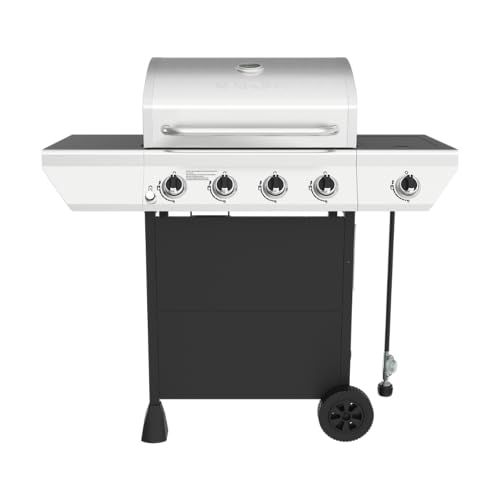
Nexgrill 4-Burner Propane Gas Grill with Stainless Steel Lid
Badge: Best Balanced Family Pick
Strengths
- 526 sq in and four burners hit the family-size sweet spot without the six-burner footprint
- Matte cast iron grates sear well and hide seasoning wear gracefully
- Side burner and built-in thermometer cover the everyday extras without add-ons
Trade-offs
- Propane as listed, so natural gas use needs a verified factory version or approved kit
- Mid-pack output — very large, thick cuts benefit from a longer preheat
- Stainless lid still needs a cover in harsh weather to stay looking new
At a glance: Burners: 4 plus a side burner; Total output stated: 52,000 BTU; Cooking space stated: 526 sq in; Grates: matte-finish cast iron; Ignition: electronic; built-in thermometer; stainless steel lid. Fuel note: Propane as listed — not a natural gas model as configured.
This second Nexgrill trades a little of its sibling’s stainless theatre for a practical matte-black-and-steel look: four burners, 52,000 BTU, 526 square inches of cooking space and matte-finish cast iron grates. That is family arithmetic done right — enough room for a dozen burgers with a vegetable zone to spare, without demanding the patio depth of the biggest carts in this guide.
The matte cast iron grates deserve a word. Cast iron’s heat retention is what makes recovery searing possible after the lid has been open, and the matte finish is forgiving about the mottled seasoning look that glossy grates advertise. As with the other propane listings here, the natural gas shopper’s job is verification: this format — mid-size four-burner with side burner — is precisely what most households should plumb for, but the fuel hardware itself must come from a factory NG model or a manufacturer-approved conversion.
For the natural gas shopper, judge the Nexgrill 4-Burner Propane Gas Grill with Stainless Steel Lid first as a format — burners, space and grates — and then do the fuel homework its spec box points to: a factory natural gas version where one exists, or the manufacturer’s approved conversion kit and nothing else. A plumbed grill is a ten-year appliance, so the format decision deserves more weight than the fuel fitting that a professional installs once.
Best for: families who want the balanced four-burner format with cast iron grates and a side burner / Not suited for: buyers who need stated natural gas configuration from the listing itself

AMERLIFE 6-Burner Propane Gas Grill with Side Burner
Badge: Best for Crowds
Strengths
- The largest stated cooking area in this pool at 650 sq in, plus a warming rack
- Six burners allow three distinct temperature zones at once
- Cast iron grates across a very wide box suit batch cooking and big gatherings
Trade-offs
- Propane configuration as listed — the natural gas question must be resolved before purchase
- The widest footprint here; small patios will feel it
- More burners mean more parts to clean, inspect and eventually service
At a glance: Burners: 6 plus a side burner; Total output stated: 60,000 BTU; Cooking area stated: 650 sq in; Grates: cast iron; warming rack fitted; Built-in thermometer and regulating valve (from listing title). Fuel note: Propane as listed — not a natural gas model as configured.
The AMERLIFE is the maximalist entry: six burners, 60,000 BTU, a stated 650 square inches of cooking area, cast iron grates and a warming rack, plus a side burner for the pan work. Six burners change what is possible — a fierce sear zone, a medium zone for chicken and sausages, and a low zone for holding and toasting, all running at once without lid-opening negotiations.
That capacity is aimed at a specific household: the one that hosts. Graduation weekends, double-family cookouts, a whole pack of ribs next to a tray of corn — this is the grill that does not make you cook in shifts. The honest costs are footprint and upkeep. Six burners mean six burners to brush around, inspect and keep clear, and as listed this is a propane grill, so a natural gas installation starts with verifying a factory NG option or an approved conversion — never with improvisation.
For the natural gas shopper, judge the AMERLIFE 6-Burner Propane Gas Grill with Side Burner first as a format — burners, space and grates — and then do the fuel homework its spec box points to: a factory natural gas version where one exists, or the manufacturer’s approved conversion kit and nothing else. A plumbed grill is a ten-year appliance, so the format decision deserves more weight than the fuel fitting that a professional installs once.
Best for: frequent hosts who regularly cook for a crowd and want three heat zones at once / Not suited for: small patios, minimalist cooks, or buyers who need a stated natural gas model
Comparison Table
| Pick | Badge | Format | Fuel as listed | Listing |
|---|---|---|---|---|
| Char-Broil Performance Series 4-Burner Gas Grill Cabinet | Best Overall | Burners: 4 main burners plus a side burner | Gas | Check on Amazon |
| Nexgrill 4-Burner Propane Gas Grill with Side Burner | Best Large Four-Burner | Burners: 4 main burners plus a side burner | Propane as listed | Check on Amazon |
| IdeaMaxx 3-Burner Propane Gas Grill with Cast Iron Grates | Best for Small Spaces | Burners: 3 | Propane as listed | Check on Amazon |
| Weber Spirit E-425 Gas Grill | Best Premium Pick | Burners: 4 | Propane as listed | Check on Amazon |
| Nexgrill 4-Burner Propane Gas Grill with Stainless Steel Lid | Best Balanced Family Pick | Burners: 4 plus a side burner | Propane as listed | Check on Amazon |
| AMERLIFE 6-Burner Propane Gas Grill with Side Burner | Best for Crowds | Burners: 6 plus a side burner | Propane as listed | Check on Amazon |
Read the fuel column as the table’s most important data. It is the column most grill comparisons omit, and in the natural gas category it is the difference between a smooth installation and an expensive surprise. The same format questions are examined from another direction in Best Natural Gas Cast Iron Grills, which many readers pair with this guide.
How to Choose the Right Grill for natural gas gas grills
Start with fuel, because fuel is the decision everything else hangs on. A natural gas grill connects to your home’s supply through a line and quick-disconnect hose installed by a licensed gas fitter. The grill itself must be configured for natural gas: either a factory natural gas model or a propane model converted with its manufacturer’s own approved kit. The two fuels use different orifice sizes, so this is never a mix-and-match exercise. Every pick in this guide states its verified configuration; use the format you love here to identify the exact model whose NG configuration you will then confirm.
Size the cooking area to your real life. Stated cooking areas in this pool run from 360 to 650 square inches. As a planning figure, allow roughly 70 to 90 square inches per person for a mixed load. A household of four cooking dinner fits comfortably in the 360–526 range; regular hosts should be looking at 526 and above, or at a warming rack used intelligently. Remember that area only becomes useful when burners divide it — four burners across 526 square inches cook more flexibly than the same area over fewer burners.
Choose grates by the life you want to live. Bare cast iron sears hardest and demands oiling discipline. Porcelain-enameled cast iron keeps most of the thermal mass with a fraction of the fuss and is the default recommendation for plumbed grills that live outdoors. Porcelain-coated steel is the low-maintenance, lower-mass option in the compact class. None is wrong; mismatching the material to your maintenance temperament is what goes wrong.
Value the unglamorous systems. A side burner earns its keep weekly. A cabinet hides the hardware a permanent grill accumulates. Electronic ignition and a lid thermometer are table stakes at this level. Above all, weigh the parts ecosystem: burners, diffusers, igniters and grates are consumables on a decade timeline, and the brands that stock them longest make the cheapest long-term owners.
For the related cut of this category, see Best Natural Gas Grills 42 Inch before you finalise a model number.
How to Set Up, Use and Maintain a Natural Gas Grill
Commissioning a natural gas grill. Once a licensed fitter has run the line and fitted the quick-disconnect, connect the grill’s hose until the coupling clicks and locks, open the shutoff, and leak-check every joint with soapy water — bubbles mean stop and call the fitter. Light the grill with the lid open, confirm each burner lights and burns with a steady, mostly blue flame, and run the empty grill on high for fifteen minutes to burn off manufacturing residues before food ever touches the grates.
The two-zone habit. Set one side of the grill hot and the other low or off. Sear over the hot zone, finish over the gentle zone, and hold cooked food at the far edge. This single layout handles everything from steaks (sear, then finish) to chicken (finish, then crisp) to vegetables (gentle, then char). Preheat with the lid down for ten to fifteen minutes — longer in cold or wet weather — and oil the grates lightly once they are hot.
Cleaning rhythm. Brush the grates while hot after every cook. Empty the grease tray before it becomes a fire risk — on a plumbed grill that never moves, tray discipline is the owner’s job, not the tank-swap’s side effect. Wipe exterior stainless with the grain. Once a season, lift the grates, brush the diffuser bars, check burner ports for blockages and confirm the hose and quick-disconnect are clean and undamaged.
Troubleshooting.
Problem: one burner lights weakly or not at all → check the burner ports for debris or a spider web in the venturi tube, clean gently with a brush or pipe cleaner, and retest; if the whole grill is weak, confirm the shutoff is fully open and the quick-disconnect is fully seated.
Problem: yellow, lazy flames and soot on the grates → the air shutters or burner ports need cleaning, or the grill’s fuel configuration does not match the supply; stop and have the configuration verified — never adjust orifices yourself.
Problem: hot spots that burn food in stripes → preheat longer so the grates and diffusers even out, rotate food between zones, and check that diffuser bars are seated flat and not corroded through.
The First Year With a Plumbed Grill: What Owners Learn
The honeymoon is real, and it is logistical. New natural gas owners consistently report the same first-month discovery: they grill more, on weeknights, for smaller reasons — two sausages, a single skewer, corn for the pot — because starting costs nothing. No tank check, no ‘is it worth lighting for just this’. A plumbed grill behaves like a stove that happens to live outside, and cooking behaviour follows within weeks. Plan your format choice for that future self: the household that grills four times a week needs the balanced four-burner, not the party machine it uses twice a year.
Safety becomes routine, and routine is the point. The ownership habits that matter are few and dull: a soapy-water leak check whenever a connection is disturbed, a shutoff you close for long absences, a coupling kept clean, and a grill that is never — ever — used indoors or in a closed garage, because combustion needs open air and produces carbon monoxide. None of this is burdensome; all of it is the ordinary respect a plumbed appliance deserves, and owners fold it into the same rhythm as brushing the grates.
The seasons teach the maintenance calendar. Spring asks for the deep inspection: burners, diffusers, igniter, hose. Summer asks only for grease discipline and grate care. Autumn asks for the cover to go on clean and dry. Winter, for those who keep cooking, asks for longer preheats and lid discipline — and rewards them with the plumbed supply’s finest hour, an empty-tank failure that can never happen. Owners who run that calendar describe their grill the way people describe a good roof: it is simply never a problem.
Resale and renovation reality. A gas outlet on a patio is a small but real asset — outdoor kitchens are planned around exactly such infrastructure. If you sell, the line stays and the next owner’s grill plugs into your foresight. If you renovate, the outlet’s position, chosen well at install time, anchors the new layout instead of fighting it. This is the final argument for placing the outlet thoughtfully and choosing a format worth plumbing to: both decisions outlive the grill itself.
Natural Gas vs Propane: What Actually Changes at the Grill
Chemically the two fuels are cousins, but at the grill they behave like different supplies. Propane arrives from a pressurised tank and is energy-dense per cubic foot; natural gas arrives from the municipal line at lower pressure and carries less energy per cubic foot. That is why the same burner design uses a larger orifice for natural gas — the hardware must pass more gas to make the same heat. It is also why a grill set up for one fuel must never simply be connected to the other: wrong orifices mean wrong flames, soot, overheating or dangerous under-firing.
In daily cooking, a correctly configured natural gas grill is indistinguishable from its propane twin — same preheat ritual, same zones, same results. The differences live outside the cooking box: no tank to refill or exchange, no running dry with guests waiting, and a hose tether that fixes the grill’s home position. Operating cost comparisons depend on local utility pricing, which varies too much to generalise honestly here; the durable advantages are convenience and permanence, not a universal price claim.
One more practical difference: portability. A propane cart can roll to the driveway for a party or into the garage for winter. A natural gas grill lives where the outlet is. Most owners happily trade the wheels for the endless supply, but renters and frequent rearrangers should think about the tether before falling in love with the idea.
How a Natural Gas Grill Installation Actually Works
A typical installation has three parts. First, a licensed gas fitter taps the home’s gas line — often in the basement, a utility room or an exterior wall — and runs a line to the patio location, ending in a shutoff valve and a quick-disconnect outlet. Second, the grill connects with a flexible hose, commonly around ten to twelve feet, which defines the small radius the grill can move within. Third, the whole run is pressure-tested and inspected under local code before the first cook.
Permits and codes vary by city and county, which is why this guide deliberately avoids quoting universal rules: your fitter and your local authority are the sources that count. What is universal is the division of labour — homeowners buy the grill and the hose; licensed professionals touch the house line. If a quote for the line run surprises you, get a second one, and ask whether an existing outdoor line (for a fire pit or pool heater) can shorten the route.
Position the outlet with the grill’s working life in mind: close enough that the hose is never stretched, far enough that the grill sits level with room to open the lid and stand at the shelves, and sheltered enough that the quick-disconnect stays clean. A surprising number of grilling frustrations trace back to a badly placed outlet, not a badly chosen grill.
Shoppers who started here frequently cross-check against Best Natural Gas Grills At Home Depot when the shortlist narrows to two formats.
Common Buying Mistakes
Buying the fuel you wish you had. The category’s cardinal error: falling for a grill’s looks and assuming the fuel will sort itself out. Propane and natural gas configurations are different hardware. Confirm the configuration of the exact model number before money moves.
Converting by improvisation. Drilled orifices, mystery kits and forum folklore have no place near a gas appliance. Factory NG models or manufacturer-approved kits, fitted to instructions — those are the only two doors into natural gas.
Skipping the fitter. Running or extending a home gas line is licensed work in most jurisdictions for good reason. The installation is part of the purchase; budget it, permit it and let a professional own it.
Buying party size for a weeknight life. A six-burner heated for two burgers is slow, wasteful and quietly annoying. Match the format to your median cook, and let the warming rack handle the exceptions.
Neglecting the grease tray because the grill never moves. Portable grills get emptied by travel; plumbed grills get emptied by discipline or by flare-up. Put the tray on the calendar.
Judging by BTU alone. Output totals scale with burner count and say little about evenness or control. Zones, grates and build decide how a grill cooks; BTU merely decides how fast it heats.
A useful companion read at this stage is Best Natural Gas Grills At Lowes, which approaches the same pool from a different priority.
Final Recommendation
Start with the Char-Broil Performance Series 4-Burner Gas Grill Cabinet. It earns the first look in this pool for the balance its review lays out — the format fits the widest range of households shopping for best natural gas gas grills, and its strengths survive the trade-offs that follow them. Confirm its natural gas configuration path exactly as its spec box directs, and you have the safest pair of hands in this guide.
Choose the Nexgrill 4-Burner Propane Gas Grill with Side Burner instead if its badge matches your life more closely — the badges in this guide were written to be shopped, not admired. Hosts with genuine crowd volume should read the AMERLIFE 6-Burner Propane Gas Grill with Side Burner review twice before deciding; its capacity argument is real, and so is its footprint. And whichever format wins, close the purchase the way this guide has insisted from the first section: model number verified, fuel configuration confirmed, licensed fitter booked. A natural gas grill bought that way is not a purchase — it is patio infrastructure, and it will cook like it for a decade.
Frequently Asked Questions
Is a natural gas grill weaker than a propane grill?
A correctly configured natural gas grill cooks with the same authority as its propane counterpart. The fuels differ in energy per cubic foot, which is why natural gas models use larger orifices — the hardware compensates, and the cooking evens out. Weak performance almost always traces to a configuration mismatch or blocked burners, not to the fuel itself.
What does it cost to run a natural gas line to a patio?
Costs vary too much by region, distance and local labour to quote responsibly in a guide, and any figure printed here would mislead as many readers as it helped. The reliable method is two quotes from licensed local gas fitters once you know where the grill will stand — and to budget that figure into the purchase from the start, as this guide’s buying sections advise.
Can a natural gas grill be moved after installation?
Within the radius of its hose, yes — the quick-disconnect exists precisely so the grill can be uncoupled for cleaning, servicing or patio work. Beyond that radius it is a fixed appliance, which is the honest trade for unlimited fuel. Choose the spot as if it were permanent, because functionally it is.
Do I need a special cover or accessories for a natural gas grill?
The grill itself uses standard accessories — cover, brush, tools — sized to its format. The natural-gas-specific items are the hose and quick-disconnect hardware supplied for the installation, plus keeping that coupling clean and capped. A fitted, vented cover matters more than usual because a plumbed grill lives outdoors in one spot all year.
How long should a plumbed gas grill last?
With the maintenance rhythm in this guide — hot brushing, grease discipline, spring inspections and timely burner or igniter replacement — a well-built format from a brand with a deep parts channel is a decade-plus appliance. Longevity is mostly a parts-availability question, which is why brand ecosystems are weighted so heavily in the reviews above.
Can I convert one of these propane grills to natural gas myself?
Only with the grill manufacturer’s own approved conversion kit, fitted exactly to its instructions — and many owners sensibly have a professional do it. The orifices, and sometimes the regulator arrangement, differ between fuels. Never drill orifices, never use third-party guesswork kits, and never connect a propane-configured grill to a natural gas line unconverted: the flame will be wrong and the setup unsafe.
Does natural gas grill food taste different from propane?
No meaningful difference reaches the plate. Both fuels burn cleanly and the flavour of grilled food comes from the food, the grates and the drippings vaporising on the heat diffusers — not from the gas itself. What changes with natural gas is logistics: endless supply, no tank management, and a fixed grill position.


