Disclosure: topratedkitchenware.com is reader-supported. When you buy through links on our site, we may earn an affiliate commission from Amazon and other retailers, at no extra cost to you.
Where to buy
The six verified picks for best new grills are listed below. Each name links to its Amazon listing, where you can check the latest price on Amazon, confirm the exact configuration, and read recent owner feedback before you decide. New in this guide means the current generation of grill design on sale now — judged by features stated in each product’s own verified specification, such as sear systems, electronic ignition, cast-iron grate options, and folding storage formats — and never by an invented launch date or model year, because those are not facts a buyer can verify.
- Charbroil Performance Series 4-Burner Gas Grill Cabinet with Side Burner
- Nexgrill Propane 4 Burner Gas Grill with Side Burner
- IdeaMaxx 3-Burner Propane Gas Grill with Cast Iron Grates
- Weber Spirit E-425 Gas Grill
- Nexgrill Propane 4-Burner Gas Grill with Side Burner and Stainless Steel Lid
- Monument Grills 4 Burner Propane Gas Grill with Advanced Broil Zone
Read the full guide ↓ for which household each grill genuinely fits, the upgrade logic behind the ranking, and the ownership costs nobody puts on the box.
Ask a dozen households what the best new grills are and you will get a dozen different answers, because the honest answer depends on who is cooking, where the grill will live, and what it replaces. A first grill for a townhouse patio, a replacement for a rusted-out cart that served a decade of birthdays, and a deliberate upgrade for a cook who has outgrown a basic two-burner are three different purchases wearing the same search query. This guide is organized around that reality. Rather than pretending one ranking serves everyone, it assigns each pick to the household archetype it serves best — the entertainer, the big family, the small-space cook, the premium long-term owner, the mid-size upgrader, and the impatient weeknight cook — and then explains the decision framework so you can re-rank the list for your own life.
One disclosure about the pool itself, made plainly because it shapes the guide: all six verified picks in this set are propane gas cart grills. That is not an editorial preference imposed on the category; it reflects where the current mainstream of new grill design actually concentrates. Gas carts are what most households buy, what most current design innovation targets — sear zones, boost burners, broil zones, folding storage, accessory rails — and what the verified catalog data for this guide contains. Charcoal, pellet, and plumbed-gas designs each have their own dedicated guides, and the buying-guide section below tells you honestly when one of those categories, rather than any pick here, is the right answer for your situation. Within the gas mainstream, though, these six are genuinely different machines, and the differences matter more than the shared fuel suggests.
What unites the current generation, across all six picks, is a shift in what manufacturers compete on. Raw burner counts and headline output figures have stopped being the argument. The argument now is systems: how fast the grill is ready (one pick here is specified to reach cooking temperature in minutes, by design), how it sears (dedicated broil and sear hardware appears on two picks), how it stores (folding shelves appear on two more), and how it lives with you (cabinets, accessory rails, thermometer and ignition quality). Read the reviews that follow with those four questions in mind — readiness, searing, storage, and daily livability — and the ranking will read less like a contest and more like a map.
Key Takeaways
- Best Overall: Charbroil Performance Series 4-Burner Cabinet — the complete, tidy, mainstream station that fits the widest range of households in this guide.
- Match the grill to the household, not the headline: each pick here owns an archetype — entertainer, big family, small space, premium owner, upgrader, weeknight cook — and the right choice is the one whose archetype is yours.
- Most powerful: the Nexgrill four-burner pairs the highest stated output in the set with the largest stated cooking space, for households that load the whole grate.
- Best Premium: the Weber Spirit E-425, whose Sear Zone with Boost Burners and accessory-rail system make it the long-term owner’s pick.
- Speed is a current-generation feature: the Monument Mesa II is specified to reach 500°F in 5 minutes — readiness, not just maximum heat, is what weeknight cooking runs on.
- All six picks are propane gas carts: this guide says so openly and explains, in the buying guide, when charcoal, pellet, or plumbed designs are the better answer instead.
In this guide
Quick Picks
Six verified picks for best new grills, each with a badge used consistently through the detailed reviews, the comparison table, and the final recommendation.
| Pick | Badge | Household it fits | Stated output / area | Listing |
|---|---|---|---|---|
| Charbroil Performance Series 4-Burner Gas Grill Cabinet | Best Overall | The entertainer | Not stated in title | Check on Amazon |
| Nexgrill Propane 4 Burner Gas Grill with Side Burner | Most Powerful | The big family | 60,000 BTU / 626 sq. in. | Check on Amazon |
| IdeaMaxx 3-Burner Propane Gas Grill with Cast Iron Grates | Best Compact | The small-space cook | 38,200 BTU / area not stated | Check on Amazon |
| Weber Spirit E-425 Gas Grill | Best Premium | The long-term owner | Not stated in title | Check on Amazon |
| Nexgrill Propane 4-Burner Gas Grill, Stainless Steel Lid | Best Mid-Size | The upgrader | 52,000 BTU / 526 sq. in. | Check on Amazon |
| Monument Grills Mesa II 4 Burner with Advanced Broil Zone | Best Fast Heat | The weeknight cook | 500°F in 5 mins (per title) / area not stated | Check on Amazon |
How These Picks Were Chosen
This guide is research-led. We compared verified catalog data and manufacturer-stated specifications across the current grill market, weighed recurring owner-feedback patterns, and ranked on the factors that decide satisfaction over years of ownership: cooking format and zone layout, stated output and area where published, grate material, speed-to-temperature design, storage format, and brand support depth. We did not run a laboratory test program, and we do not claim hands-on testing we did not do. The comparisons are specification-first, and every pick’s limitation is stated in its own review rather than saved for a footnote.
Every linked pick comes from a verified product pool checked against Amazon catalog data on 2026-11-20. Only products with a confident catalog match carry an Amazon link and a product image, and specifications are quoted only from that verified data. Where a title does not state a figure — two picks here publish neither output nor area — the review flags the gap and directs you to the listing, because a guide that fills gaps with estimates teaches you to trust numbers nobody verified.
The word new received the strictest handling in this guide, because the keyword invites invention. No pick is credited with a launch date, a model year, or a redesign story. Each pick instead demonstrates current-generation design through verifiable features in its own title: a Sear Zone with Boost Burners, an Advanced Broil Zone with a stated heat-up specification, matte-finish cast-iron grates, foldable side shelves engineered into two different formats, electronic ignition, and an accessory rail system. Where the category you actually need sits outside this propane pool — automated pellet cooking is the clearest case, surveyed in Best New Pellet Grills — the guide says so rather than stretching a pick to fit.
Ranking weighed four things in order. First, archetype fit: how completely the grill serves the household it is designed for. Second, cooking credibility: zone layout, grate material, and stated performance where published. Third, daily livability: ignition, temperature feedback, tank access, storage, and cleaning reach. Fourth, ownership depth: parts availability and brand support over a multi-year horizon.
Best new grills — the six detailed reviews

Charbroil Performance Series 4-Burner Gas Grill Cabinet with Side Burner
Badge: Best Overall
Strengths
- The complete mainstream format: four burners, a side burner, and an enclosed cabinet that hides the tank and stores the tools.
- Performance Series is a core Charbroil line, which supports the deepest practical parts availability in this guide.
- Cabinet styling lets the grill live in the social space of the patio without looking like equipment.
Trade-offs
- The verified title states neither output nor cooking area — confirm both on the listing before purchase.
- Longest assembly in the set, as cabinet formats always are.
- Black finish shows dust and pollen between cleans.
Mini spec box
- Fuel: gas, 4 burners plus side burner
- Format: cabinet-style cart, black finish
- Model reference in title: 463253925
- Output and cooking area: not stated in title — verify on the listing
Best Overall in a guide organized by households goes to the grill with the fewest situations it handles badly, and that is the Performance cabinet. The archetype is the entertainer, but the truth is broader: this is the grill for any household that wants one station to cook, stage, store, and serve without the patio looking like a workshop. Four burners give the zone map mixed menus require; the side burner keeps the sauce inside the workflow; the cabinet swallows the tank, the tools, and the visual clutter in a single gesture. It is the grill your guests will stand around, which is a genuine functional test most spec sheets ignore.
Charbroil’s mainstream position is the ownership argument. A grill is a multi-year appliance whose grates, burners, and igniter will eventually need replacement, and the probability that those parts are listed, priced sanely, and still available in year six is highest in exactly this part of the market. The review’s caveat is by now familiar in this guide: the verified title publishes no output or area figures, so the listing check is part of the purchase, not an optional extra. Do it, confirm the cabinet fits your space, and what remains is the most defensible all-round purchase in this set. Check on Amazon
Best for: entertainers and households wanting one complete station / Not suited for: buyers who need every specification printed in the title

Nexgrill Propane 4 Burner Gas Grill with Side Burner
Badge: Most Powerful
Strengths
- Highest stated output in the guide at 60,000 BTU, paired with the largest stated cooking space at 626 square inches.
- Electronic ignition, a built-in thermometer, and a stainless steel body complete the current-generation checklist.
- Double-door cabinet makes tank access and storage genuinely easy.
Trade-offs
- Low-temperature finesse takes practice on a grill that can run this hot.
- Largest footprint in the set — measure the patio and the storage corner.
- The deepest cleaning routine here, across four burners, a side burner, and cabinet surfaces.
Mini spec box
- Fuel: propane gas, 4 burners plus side burner
- Output: 60,000 BTU (total, per title)
- Cooking space: 626 sq. in.
- Features: built-in thermometer, electronic ignition, stainless steel body, double-door cabinet
The big-family archetype cooks differently from everyone else: the grate is rarely half empty, the menu is rarely one item, and the failure mode is a grill that fades when loaded — burners that cannot recover after twenty cold burgers land at once, corners that never quite cook. The Nexgrill is specified against exactly that failure. Its stated output is the highest in this guide and its stated cooking space the largest, and the pairing matters more than either figure alone, because heat density under load is what separates searing from steaming when the whole family plus guests is waiting.
Around that core, the daily-interaction details are right: electronic ignition that starts the grill without ritual, a thermometer where your eyes already are, and a double-door cabinet that turns the mid-season tank swap into a standing, one-minute job. The discipline it asks in return is zone discipline — one side hot, one side gentle — and a willingness to learn where its true low sits before trusting it with delicate food. Households shopping under a strict brand-and-band brief will find this grill’s family examined under that narrower lens in Best Nexgrill Propane Bbq Grills Under $300. Check on Amazon
Best for: big families and hosts who cook with a fully loaded grate / Not suited for: small patios or cooks who want the gentlest learning curve

IdeaMaxx 3-Burner Propane Gas Grill with Cast Iron Grates
Badge: Best Compact
Strengths
- Foldable side shelves shrink the stored footprint — the feature that decides whether a small-space grill gets kept or abandoned.
- Cast iron grates store heat and mark food properly, refusing the usual compact-grill compromise.
- Stated 38,200 BTU is strong output for a three-burner, aimed at fast preheats and real sears.
Trade-offs
- Cast iron needs oiling and dry habits; neglect turns to rust faster than on coated grates.
- No cooking area is stated in the verified title — check grate dimensions on the listing.
- Portable positioning means a lighter build than the cabinet models.
Mini spec box
- Fuel: propane gas, 3 burners
- Output: 38,200 BTU (per title)
- Grates: cast iron
- Shelves: foldable; portable outdoor and camping positioning per title
The small-space archetype — apartment balcony, townhouse patio, the garage corner of a house whose yard is mostly spoken for — is failed by most grills in a specific way: they cook acceptably and store terribly, so they end up living in the weather, rusting, and being used less each season. The IdeaMaxx attacks the storage half of that problem directly. Its side shelves fold down, collapsing the grill’s footprint to something a small space can actually absorb between cooks, while the cooking half refuses the usual apology: cast iron grates with real heat mass and assertive three-burner output, so the food that comes off it carries proper marks and a proper crust.
The fit is best for cooks of two to four who grill often and briefly — weeknight steaks, chops, skewers, vegetables — and who will keep cast iron oiled as a matter of routine. If you know you will not oil grates, choose a coated-grate pick instead and be honest about it now rather than disappointed later. And as the spec box notes, the title publishes no cooking area, so judge capacity by the grate dimensions on the listing, not by the burner count. Check on Amazon
Best for: balconies, townhouses, and small patios that still want a real sear / Not suited for: zero-maintenance owners or large households

Weber Spirit E-425 Gas Grill
Badge: Best Premium
Strengths
- Sear Zone with Boost Burners: dedicated high-heat hardware that gives gas grilling a genuine steak crust.
- Porcelain-enameled cast-iron grates combine heat mass with manageable care.
- Weber Works rails make the grill a platform, and Weber’s support network is the category benchmark.
Trade-offs
- Top of this guide’s qualitative tier structure — premium positioning is the point, and the price of entry reflects it.
- The verified title states neither total output nor cooking area; confirm both on the listing.
- More grill than a small household will use at full stretch.
Mini spec box
- Fuel: propane gas, 4 burners
- Sear hardware: Sear Zone with Boost Burners
- Grates: porcelain-enameled cast-iron
- System: Weber Works rails; black finish
The long-term owner’s archetype buys differently: the question is not what the grill costs this spring but what it costs per year across a decade, and whether it will still be supported, accessorized, and pleasant in year eight. The Spirit E-425 is built for that buyer. Its Sear Zone with Boost Burners is the current generation’s answer to gas grilling’s oldest weakness, concentrating dedicated high heat where a steak needs it while the rest of the grate cooks at normal temperatures. The porcelain-enameled cast-iron grates hold that heat in heavy metal and then forgive you at cleaning time, which is the combination serious cooks actually want.
The Weber Works rails extend the logic: the grill becomes a platform whose prep and storage accessories mount to a system, so it grows with your cooking instead of being replaced by it. Behind all of it sits the deepest parts network in the category — the unglamorous asset that decides decade-long ownership more than any feature. The caveats are the tier itself and the familiar data gap: the title publishes no headline output or area, so do the listing check. For the household that grills weekly and keeps appliances, this is the pick whose premium is easiest to justify in cost-per-year terms. Check on Amazon
Best for: committed weekly grillers buying for the long term / Not suited for: occasional cooks or tight qualitative budgets
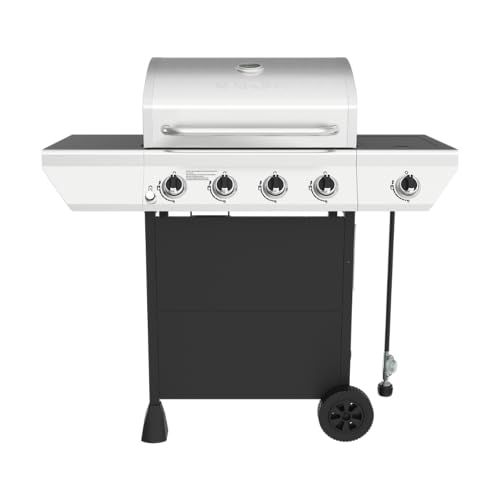
Nexgrill Propane 4-Burner Gas Grill with Side Burner and Stainless Steel Lid
Badge: Best Mid-Size
Strengths
- Fully published specification: 52,000 BTU and 526 square inches are both stated, making honest comparison easy.
- Matte finish cast iron grates bring real heat mass and sear marks to the mid-size class.
- Electronic ignition, a built-in thermometer, and a side burner complete the everyday feature set.
Trade-offs
- Cast iron grates need the oiling routine described in the how-to section.
- Portable positioning in the title signals a lighter build than the full cabinet models.
- Sits between the compact and maximum picks — households at either extreme should choose those instead.
Mini spec box
- Fuel: propane gas, 4 burners plus side burner
- Output: 52,000 BTU (per title)
- Cooking space: 526 sq. in.
- Grates: matte finish cast iron; stainless steel lid; built-in thermometer; electronic ignition
The upgrader’s archetype is the most common in the entire grill market: a household whose first grill taught it what it actually cooks, and whose second purchase is a correction. Usually the correction is size — the old grill was almost big enough — and grate quality, because the first grill’s thin coated grates were where the cooking felt cheap. This Nexgrill answers both corrections precisely. At a stated 526 square inches it is the true mid-size of this guide, large enough for family-plus-friends cooking without the maximum model’s footprint, and its matte-finish cast-iron grates put genuine heat mass under the food, which is the upgrade your hands notice on the first steak.
It also earns trust the boring way: its title publishes both headline figures, so the comparison you are making is a real one. The supporting features — side burner for the sauce work upgraders always end up wanting, electronic ignition, a lid thermometer — complete a specification with no obvious hole. The trade-offs are the cast-iron care routine and a build positioned as portable rather than cabinet-heavy. For the household stepping up from a basic cart and intending to keep the next grill for years, this is the most precisely aimed pick in the guide. Check on Amazon
Best for: upgraders correcting a too-small first grill / Not suited for: buyers who want either the smallest footprint or the maximum format

Monument Grills Mesa II 4 Burner Propane Gas Grill with Advanced Broil Zone
Badge: Best Fast Heat
Strengths
- Specified to reach 500°F in 5 minutes — readiness engineered as a headline feature, which is what weeknight cooking actually runs on.
- Advanced Broil Zone gives the four-burner layout a dedicated high-heat area for finishing and searing.
- Foldable side shelves and a fast-assembly design reduce both the storage footprint and the setup friction.
Trade-offs
- No cooking area is stated in the verified title — verify grate dimensions on the listing.
- Fast, hot systems reward attention; delicate food needs the cooler zones used deliberately.
- Stainless steel surfaces need regular wiping to keep their finish.
Mini spec box
- Fuel: propane gas, 4 burners
- Heat-up: 500°F in 5 minutes (per title)
- Sear hardware: Advanced Broil Zone
- Format: stainless steel Mesa II (410FBZ), foldable side shelves, fast assembly per title
The weeknight cook’s archetype has one scarce resource, and it is not money or space — it is the twenty minutes between arriving home and dinner needing to exist. Most grills tax that window with a long, vague preheat. The Mesa II is specified against the tax directly: 500°F in 5 minutes, stated in its own title, is a readiness claim of the kind this guide can repeat because the manufacturer published it. In practice it changes behavior: a grill that is ready before the food is prepped gets used on Tuesdays, and a grill that gets used on Tuesdays is the one that earns its patio space.
The Advanced Broil Zone extends the same philosophy to the cooking itself — a dedicated high-heat area for the finish, the crust, the cheese melt — while the four-burner layout keeps gentler zones available beside it. Foldable shelves acknowledge that weeknight households often store the grill tight against a wall, and the fast-assembly positioning respects the same scarce resource at setup. The honest caveat is the missing area figure: check the grate dimensions on the listing and judge capacity by them. For time-poor cooks who refuse to give up a full-size format, this is the most thoughtfully aimed pick here. Check on Amazon
Best for: weeknight cooks who need heat fast in a full-size format / Not suited for: buyers who comparison-shop on published area figures alone
Comparison Table
| Pick | Badge | Burners | Stated output / area | Signature feature | Listing |
|---|---|---|---|---|---|
| Charbroil Performance Cabinet | Best Overall | 4 plus side burner | Not stated / not stated | Enclosed cabinet base | Check on Amazon |
| Nexgrill 4-Burner, 60,000 BTU | Most Powerful | 4 plus side burner | 60,000 BTU / 626 sq. in. | Double-door cabinet, electronic ignition | Check on Amazon |
| IdeaMaxx 3-Burner | Best Compact | 3 | 38,200 BTU / not stated | Foldable shelves, cast iron grates | Check on Amazon |
| Weber Spirit E-425 | Best Premium | 4 with Sear Zone | Not stated / not stated | Sear Zone with Boost Burners, Works rails | Check on Amazon |
| Nexgrill 4-Burner, Stainless Lid | Best Mid-Size | 4 plus side burner | 52,000 BTU / 526 sq. in. | Matte cast iron grates | Check on Amazon |
| Monument Mesa II | Best Fast Heat | 4 | 500°F in 5 mins / not stated | Advanced Broil Zone, foldable shelves | Check on Amazon |
How to Choose a New Grill: The Decision Framework Behind This Ranking
Begin with the space, measured honestly. Note the grill’s footprint with shelves up and down, the clearance your local safety guidance requires from walls and railings, and where the grill will live in winter. More purchases fail on storage than on cooking: a grill that fits the patio but not the garage corner spends its life in the weather, and weather is what ages grills. The two folding-shelf picks in this guide exist because manufacturers have finally started designing for that reality; if your space is tight, weight storage format as heavily as burner count.
Next, size by your ordinary headcount, not your record crowd. Working math of roughly 70 to 90 square inches of main grate per person, in a single cooking wave, places most households of four to six between the mid-size and maximum picks here, and smaller households happily in the compact three-burner class — especially if cooking in two relaxed waves is acceptable. Then decide your heat philosophy. If steaks are the centerpiece of your grilling, dedicated sear hardware — the Weber’s Sear Zone, the Monument’s Broil Zone — earns its tier. If speed is the centerpiece, a stated fast heat-up specification is the feature that changes your week. If neither is, a well-proportioned standard four-burner is the rational buy, and the money difference is better spent on the ownership layer: a fitted cover, a second propane tank, an instant-read thermometer, and the brush that suits your grate material.
Finally, know when the right answer is not in this guide at all. If you want automated, set-and-forget temperature holding for long cooks, that is the pellet category, covered in Best New Pellet Grills. If your home has a plumbed gas line and the grill will never move, plumbed models are their own category with their own shortlists at several tiers, including Best Ng Grills and Best Ng Grills Under $2000. If live-fire flavor is the point of the exercise, charcoal is a different guide’s subject. Choosing the correct category is worth more than choosing the correct model inside the wrong one, and a guide that will not tell you that is selling rather than advising.
How to Get the First Season Right: Setup, Habits, and Care
Assemble slowly and completely, on a level surface, and finish with the two checks that protect everything after: the soapy-water leak test on every gas connection, and a full empty burn-off to clear manufacturing oils and teach you the grill’s heat map. During that first session, toast plain bread slices across the whole grate to reveal hot and cool corners while the lesson is free — every grill has a personality, and the owners who learn theirs in week one cook better all year than the owners still guessing in year two.
Build three habits early. First, zone cooking: one area hot, one gentle, food moving between them rather than burning in place. Second, lid discipline: down for thick cuts and roasting, up for thin cuts you are watching, and never opened idly every minute, because each opening is heat leaving and time added. Third, the two-minute close-down: brush the grates warm, check the grease tray, and confirm the tank valve is closed. That tiny ritual, repeated, is the difference between a grill that needs a rescue cleaning each spring and one that simply needs its burners checked. Keep cast-iron grates lightly oiled after cooking while they are still warm; wipe porcelain coatings with a soft brush so the surface survives; and clear burner ports at the start of each season or whenever a burner lights unevenly.
Troubleshooting, in the pattern worth memorizing. Problem: the grill lights weakly right after a tank swap → the regulator’s flow limiter has likely tripped; close everything, disconnect and reconnect, open the tank valve slowly, and relight one burner at a time. Problem: food cooks unevenly across the grate → you are seeing the grill’s heat map, not a defect; rotate food between zones deliberately, and confirm the heat tents above the burners are intact and seated. Problem: temperatures will not climb on a cold, windy day → wind is stripping heat from the firebox; reposition the grill so the wind hits its back, keep the lid down, and allow a longer preheat rather than running every burner at maximum for the whole cook.
First Grill, Replacement, or Upgrade: Reading Your Own Situation
First-time buyers should weight forgiveness highest: coated or enameled grates, a simple zone map, and a size matched to the household they have now. Every pick in this guide can serve as a first grill, but the compact and mid-size picks forgive the most while teaching the fastest. Replacement buyers — the largest group in any season — should name the specific failure of the old grill before shopping: if it rusted, weight coatings and storage; if it cooked unevenly, weight grate mass and burner design; if it was simply outgrown, weight area honestly this time. Upgrade buyers should be the most skeptical of all, because an upgrade that only adds size adds nothing you will feel; the upgrades that register daily are sear hardware, heat-up speed, ignition reliability, and storage format, which is why this guide’s premium and fast-heat picks are specified around exactly those things. Whatever your situation, write down the old grill’s one unforgivable flaw and check your shortlist against it — that single sentence is the most useful buying tool in this entire article.
The Real Cost of Owning a Grill: Thinking in Years, Not Receipts
A grill’s purchase price is the first payment, not the cost. Across a realistic ownership span, the running total includes propane, a cover, replacement grates, at least one igniter or burner intervention on hard-used models, cleaning supplies, and the occasional hose or regulator. None of those items is large, but together they reward the buyer who thinks in cost per year rather than cost at checkout. This is the arithmetic that quietly justifies the premium pick for a weekly griller: a grill that stays supported, keeps its coatings, and holds its value in daily pleasure across a decade can cost less per year than a cheaper grill replaced twice in the same span. It is equally the arithmetic that condemns over-buying: a maximum-format grill purchased for a two-person household burns more fuel on every preheat, needs more cleaning across more burners, and returns its premium only in the currency of unused capacity.
Fuel deserves its own honest paragraph, because it is the cost owners feel most often. Propane consumption scales with how much grate you heat and for how long, which is another practical argument for zone discipline: heating two burners for a two-person dinner instead of four is not frugality theater, it is roughly half the gas for the same meal. Preheat length matters the same way — the fast-heat design in this guide is, among other things, a fuel feature, because minutes of full-burner preheat are the purest waste in grilling. Charcoal households run the same calculation in bags rather than tanks, and pellet households in pounds per hour; every fuel has a meter running, and the cooks who enjoy their grills longest are the ones who know roughly what a session costs and have decided it is worth it. None of this requires a spreadsheet. It requires one moment of honesty at purchase — how often will I cook, for how many, at what size — which is the same moment this guide’s archetype system is built to force.
Reading a Grill Listing Like an Inspector
Because several picks in this guide publish incomplete headline figures, the listing itself becomes part of the product you are evaluating, and it rewards a disciplined read. Start with the dimension block, not the marketing copy: assembled width with shelves up, depth with the lid open if it is stated, and the main grate’s length and width, from which you compute true cooking area yourself in ten seconds. Next, find the grate material stated in the specifications rather than the photographs, because photographs flatter everything. Then locate the parts story: a brand that lists replacement burners, grates, heat tents, and igniters for the exact model is telling you it expects the grill to be repaired rather than replaced, and that expectation is the strongest available predictor of a long service life.
Read owner feedback for patterns rather than verdicts. A single report of a dented panel is shipping luck; a recurring theme about ignition, uneven heat, or a shelf that sags is design information. Weight recent feedback more heavily for current models, and discount any comment — positive or negative — that describes a visibly different configuration, because grill lines are revised and listings accumulate history across revisions. Finally, check the unglamorous logistics before ordering: whether the grill ships in one heavy box or several, what the assembly is realistically estimated to involve, and whether the seller’s return terms contemplate an assembled grill at all. Ten minutes of this inspector’s reading, applied to whichever pick your archetype selected, will do more for your satisfaction than another hour of comparing headline numbers — and it is the same discipline this guide applied when it refused to print a single figure it could not verify.
Warranty terms deserve the same inspector’s read, with one caution: compare coverage by component rather than by the headline duration, because grill warranties are written in layers. Burners, grates, fireboxes, and lids commonly carry different terms from each other, and a long headline figure that applies only to a lid tells you less than a moderate figure that covers the burners — the parts that actually wear. Note also what the terms ask of you: many assume the grill is covered or sheltered, cleaned on a reasonable schedule, and used with the fuel it was built for. None of that is onerous, and all of it aligns with the care routine in this guide’s how-to section, but the time to learn it is before the first cook, not at the first claim. Keep the manual, the receipt, and a note of the model reference together; on the day a part is needed, that small folder is worth more than any extended promise made at a checkout screen.
Common Buying Mistakes
- Shopping the headline instead of the household. The best grill for a big family is a burden on a balcony. Start from your archetype and let the badges route you.
- Ignoring the storage position. Measure where the grill will live in winter, with shelves in their stored position, before you fall for a format your space cannot absorb.
- Assuming every figure is published. Several excellent picks here state no area or no output in their titles. Check the listing; never let a guide — including this one — rank on numbers it cannot show you.
- Buying sear hardware you will not use, or skipping it when steaks are your whole menu. Premium features pay only when they match your cooking. Be honest about your menu.
- Forgetting the ownership layer in the budget. Cover, spare tank, thermometer, and the right brush are part of the purchase. A grill without them ages faster and cooks worse.
- Choosing the wrong category confidently. Pellet automation, plumbed supply, and live-fire charcoal are separate categories with separate guides, such as Best Ng Grills Under $1500. Category fit beats model ranking.
Final Recommendation
If you want the single most defensible purchase in this guide, take the Charbroil Performance Cabinet: the complete station, the mainstream support, the fewest situations handled badly. Big families should take the Nexgrill 60,000 BTU four-burner for its verified power-and-space pairing, and long-term owners the Weber Spirit E-425 for its sear system and support depth. Upgraders will find their correction in the mid-size Nexgrill, small spaces in the folding IdeaMaxx, and weeknight cooks in the fast-heating Monument. None of these is a consolation prize; each is the best answer to a different household’s question, which is what a new-grills guide should actually tell you.
Frequently Asked Questions
Why are all six picks in this guide gas grills?
Because the verified pool for this guide consists of propane gas cart grills, which is also where most current design development concentrates. Rather than disguise that, the guide states it openly and points charcoal, pellet, and plumbed-gas shoppers to their dedicated categories in the buying-guide section.
What makes a grill part of the current generation?
Verifiable features in its own specification: dedicated sear or broil hardware, electronic ignition, quality grate materials such as cast iron or porcelain-enameled cast iron, storage-conscious formats like folding shelves, and enclosed cabinets. We do not use launch dates or model years, which manufacturers rarely publish in checkable form.
How big a grill does a household of six need?
At roughly 70 to 90 square inches of main grate per person for one-wave cooking, a household of six sits in the 450-to-550-square-inch class — the mid-size pick’s territory — or the 626-square-inch maximum pick if guests are frequent and everything must finish together.
Is fast heat-up a real feature or a gimmick?
Real, when the manufacturer states it in the specification, as the Monument pick does with its 500°F in 5 minutes figure. Readiness decides whether a grill gets used on weeknights, and weeknight use is where a grill earns its space.
Should I buy the premium pick if I only grill occasionally?
Probably not. Premium money buys sear hardware, support depth, and longevity, which pay back across frequent cooks and long ownership. Occasional cooks are better served by the overall or mid-size picks, with the difference spent on the ownership layer of cover, tools, and a spare tank.
What should I check on the listing before ordering any pick here?
The full specification where the title is silent — cooking area and output for the picks that do not state them — plus the assembled dimensions, the stored dimensions if shelves fold, and confirmation that replacement grates and burners for the exact model are listed parts.
When is a different category the better buy?
When you want automated temperature holding for long cooks (pellet), an endless plumbed supply for a grill that never moves (plumbed gas), or live-fire flavor as the centerpiece (charcoal). The buying-guide section links those categories; choosing the right category outweighs choosing the right model in the wrong one.


