Disclosure: topratedkitchenware.com is reader-supported. When you buy through links on our site, we may earn an affiliate commission from Amazon and other retailers, at no extra cost to you.
Where to buy
Short on time? These are the six options covered in this guide to the best niche coffee makers. Linked picks go straight to their Amazon listing so you can check the latest price on Amazon; picks marked prose-only are described for comparison and carry no link, for the honest reason given in their review. Read the full guide ↓ for the reasoning, the trade-offs, and who each machine actually suits.
- BLACK+DECKER 12-Cup Thermal Programmable CM2046S — Best Programmable Thermal Pick.
- Cuisinart PerfecTemp 12-Cup Thermal DCC-3400NAS — Best for Hotter Brewing.
- BLACK+DECKER CaféCraft 12-Cup Thermal Hot & Iced — Best for Hot-and-Iced Households.
- Cuisinart 12-Cup PerfecTemp Thermal, White — Best for Small Batches in a Big Machine.
- BUNN Speed Brew Platinum Thermal CSB3T — Best for Speed.
- Hamilton Beach FlexBrew Advanced 5-in-1 — Most Versatile.
If you are searching for the best niche coffee makers, you are probably not looking for the most advertised machine on the shelf — you are looking for the one that fits a specific job in your kitchen. This guide is built around niche needs inside ordinary drip brewing, and it is deliberately honest about fit. Every pick below was checked against the verified pool for this category, its strengths and trade-offs are stated plainly, and anything that does not genuinely match the keyword is labelled prose-only rather than dressed up as a recommendation. By the end you will know which of these six options deserves your counter space, which ones solve a narrower problem well, and which ones you can cross off in the first minute.
The coffee maker market rewards buyers who start with the routine, not the feature list. How many people are you serving? How often will the machine run — daily, weekly, or only when guests arrive? How much cleaning will you honestly tolerate on a busy morning? Those three answers narrow this field faster than any specification sheet. A household that preps the night before needs something different from a household that decides at the last second, and a machine that is perfect for one of those homes can be a daily irritation in the other. Keep your own routine in mind as you read the detailed reviews, because the verdict lines are written for specific households, not for an imaginary average buyer. Readers comparing adjacent formats may also find our notes on Best Drip Pot Coffee Makers useful background before they commit.
One more promise before the picks: nothing in this guide invents a specification, a price, or a test result. Where a detail comes from the verified product listing, it appears in the spec box. Where a judgement is ours, it is framed as guidance based on the design, the format, and how machines of this type behave in real kitchens. That distinction matters, because buying guides that blur it send people home with the wrong appliance and a receipt they regret.
Key Takeaways
- BLACK+DECKER 12-Cup Thermal Programmable CM2046S — Best Programmable Thermal Pick: strongest for programmable thermal brewing for households that brew once and drink over an hour or two.
- Cuisinart PerfecTemp 12-Cup Thermal DCC-3400NAS — Best for Hotter Brewing: strongest for hotter, strength-adjustable thermal drip brewing.
- BLACK+DECKER CaféCraft 12-Cup Thermal Hot & Iced — Best for Hot-and-Iced Households: strongest for one programmable thermal machine that covers both hot coffee and iced coffee.
- Cuisinart 12-Cup PerfecTemp Thermal, White — Best for Small Batches in a Big Machine: strongest for small-batch flexibility inside a full-size programmable thermal brewer.
- BUNN Speed Brew Platinum Thermal CSB3T — Best for Speed: strongest for very fast thermal drip brewing for impatient mornings.
- Hamilton Beach FlexBrew Advanced 5-in-1 — Most Versatile: strongest for dual drip and single-serve flexibility for mixed households.
- Start with serving count and routine, then choose the format; features only matter once the format fits your life.
- Cleaning effort, not headline power, is what decides whether a coffee maker still gets used six months after purchase.
In this guide
Quick Picks
Here is the whole field at a glance. Badges are used consistently here and in the detailed reviews, so you can jump straight to the section for the pick that matches your situation.
| Pick | Badge | Best for | Check |
|---|---|---|---|
| BLACK+DECKER 12-Cup Thermal Programmable CM2046S | Best Programmable Thermal Pick | programmable thermal brewing for households that brew once and drink over an hour or two | Check on Amazon |
| Cuisinart PerfecTemp 12-Cup Thermal DCC-3400NAS | Best for Hotter Brewing | hotter, strength-adjustable thermal drip brewing | Check on Amazon |
| BLACK+DECKER CaféCraft 12-Cup Thermal Hot & Iced | Best for Hot-and-Iced Households | one programmable thermal machine that covers both hot coffee and iced coffee | Check on Amazon |
| Cuisinart 12-Cup PerfecTemp Thermal, White | Best for Small Batches in a Big Machine | small-batch flexibility inside a full-size programmable thermal brewer | Check on Amazon |
| BUNN Speed Brew Platinum Thermal CSB3T | Best for Speed | very fast thermal drip brewing for impatient mornings | Check on Amazon |
| Hamilton Beach FlexBrew Advanced 5-in-1 | Most Versatile | dual drip and single-serve flexibility for mixed households | Check on Amazon |
How These Picks Were Chosen
This guide is research-led. We compared the verified pool for this category on format, capacity, controls, included accessories, cleaning demands, and how each design answers the specific angle of this keyword. We read manufacturer listings carefully, separated confirmed specifications from marketing language, and weighted the factors that change daily use — not the factors that merely photograph well. We did not run laboratory tests on these machines, and we do not claim hands-on scores we do not have; where long-term behaviour is discussed, it is discussed as the known behaviour of the design type, stated as guidance rather than as a measured result.
Brand honesty is part of the method. When the pool contained a capable machine from the wrong brand family for this keyword, we kept it in the guide as a clearly labelled prose-only comparison instead of linking it as if it qualified. That is why some sections below carry no Amazon link and no product image: the machine is real, the description is fair, but it does not meet the brief you typed into a search box, and pretending otherwise would waste your money. Shoppers weighing neighbouring categories often cross-check Best Dual Brew Coffee Makers as well, and the same honesty standard applies there — match the machine to the job first, and let the brand shortlist follow from that, not the other way round.
Finally, we weighted regret. Most appliance disappointment is not about a machine failing; it is about a machine succeeding at the wrong job — too big, too slow to clean, too small for the household, or too specialised for a routine that changed. Each review therefore ends with an explicit best-for and not-suited-for verdict, and the comparison table puts the practical differences side by side so the trade-offs are visible before you spend anything.
The 6 Best Options for best niche coffee makers, Reviewed in Detail
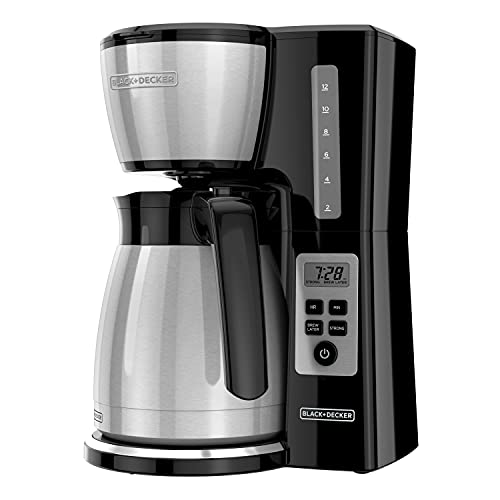
BLACK+DECKER 12-Cup Thermal Programmable CM2046S
Badge: Best Programmable Thermal Pick
Strengths
- Thermal carafe holds heat without a warming plate, so the last cup tastes less cooked than the first
- Programmable start suits households that want coffee ready on a schedule rather than on demand
- VORTEX showerhead is designed to saturate the grounds evenly instead of channeling water down the middle
Trade-offs
- Thermal carafes pour more slowly than glass and need a deliberate tilt to empty fully
- It is a full-size drip machine, so the niche here is heat retention, not a small footprint
- Brew strength control helps, but it cannot turn a drip brewer into an espresso or pour-over ritual
| Capacity | 12 cups |
|---|---|
| Carafe | Thermal carafe |
| Controls | Programmable, with brew strength selection |
| Brewing feature | VORTEX Technology showerhead |
| Finish | Black/Steel |
The BLACK+DECKER 12-Cup Thermal Programmable CM2046S earns its place through programmable thermal brewing for households that brew once and drink over an hour or two. That focus shapes everything about how it should be judged. Set it up where it will actually live, run the first brew as a rinse-through with plain water, and pay attention to the unglamorous details: how the carafe pours, how the lid feels when your hands are still half asleep, and whether the controls make sense without the manual open on the counter. Machines in this class live or die on those small interactions, repeated hundreds of times a year, far more than on any single headline feature.
In daily use, think about water and grounds discipline. Fresh water in the reservoir, a consistent grounds dose for the batch size you actually brew, and a carafe rinsed the same day rather than left overnight will do more for cup quality than any upgrade in this price class of equipment. This model rewards that discipline because its defining features — the ones in the spec box above — are aimed at consistency: the same routine produces the same cup, morning after morning, which is exactly what a household brewer is for. Where it asks something of you in return is footprint and routine: give it the counter space and the brief daily care it expects, and it stops feeling like an appliance and starts feeling like infrastructure.
The honest limitation is scope. This is a drip platform with a clear speciality, not a café. It will not pull espresso shots, it will not replicate a slow manual pour-over ritual, and it will not rescue poor-quality beans or stale grounds. Buy it for the job in its badge and it is a satisfying, durable answer; buy it hoping it will quietly become a different kind of machine and you will be shopping again within the year. That clarity — knowing precisely which job a machine is for — is the difference between a purchase that settles a kitchen question and one that merely postpones it.
Best for: readers whose priority is programmable thermal brewing for households that brew once and drink over an hour or two / Not suited for: buyers who need the opposite format, a different brand family, or a job this design was never built to do.

Cuisinart PerfecTemp 12-Cup Thermal DCC-3400NAS
Badge: Best for Hotter Brewing
Strengths
- PerfecTemp positioning is aimed at hotter extraction, which many drinkers find brings out more from medium and dark roasts
- Double-wall stainless carafe protects heat and is more forgiving than glass if it gets knocked on a counter
- Brew Strength control gives a simple lever when a household splits between milder and bolder cups
Trade-offs
- Hotter brewing is a preference, not a universal win — delicate light roasts can taste harsher when pushed
- Stainless carafes hide the coffee level, so you judge what remains by weight rather than by sight
- Full 12-cup thermal format is more machine than a one-cup household needs
| Capacity | 12 cups |
|---|---|
| Carafe | Double-wall stainless steel thermal carafe |
| Brewing feature | PerfecTemp hotter brewing |
| Controls | Brew Strength control |
| Finish | Silver |
The Cuisinart PerfecTemp 12-Cup Thermal DCC-3400NAS earns its place through hotter, strength-adjustable thermal drip brewing. That focus shapes everything about how it should be judged. Set it up where it will actually live, run the first brew as a rinse-through with plain water, and pay attention to the unglamorous details: how the carafe pours, how the lid feels when your hands are still half asleep, and whether the controls make sense without the manual open on the counter. Machines in this class live or die on those small interactions, repeated hundreds of times a year, far more than on any single headline feature.
In daily use, think about water and grounds discipline. Fresh water in the reservoir, a consistent grounds dose for the batch size you actually brew, and a carafe rinsed the same day rather than left overnight will do more for cup quality than any upgrade in this price class of equipment. This model rewards that discipline because its defining features — the ones in the spec box above — are aimed at consistency: the same routine produces the same cup, morning after morning, which is exactly what a household brewer is for. Where it asks something of you in return is footprint and routine: give it the counter space and the brief daily care it expects, and it stops feeling like an appliance and starts feeling like infrastructure.
The honest limitation is scope. This is a drip platform with a clear speciality, not a café. It will not pull espresso shots, it will not replicate a slow manual pour-over ritual, and it will not rescue poor-quality beans or stale grounds. Buy it for the job in its badge and it is a satisfying, durable answer; buy it hoping it will quietly become a different kind of machine and you will be shopping again within the year. That clarity — knowing precisely which job a machine is for — is the difference between a purchase that settles a kitchen question and one that merely postpones it.
Best for: readers whose priority is hotter, strength-adjustable thermal drip brewing / Not suited for: buyers who need the opposite format, a different brand family, or a job this design was never built to do.

BLACK+DECKER CaféCraft 12-Cup Thermal Hot & Iced
Badge: Best for Hot-and-Iced Households
Strengths
- Hot-and-iced flexibility is a genuine niche: one machine covers winter mornings and summer afternoons
- Thermal carafe keeps the hot batch warm without a plate while the iced mode handles the cold side
- Programmable timing keeps it useful as an everyday family brewer, not just a seasonal novelty
Trade-offs
- Iced output from a drip platform will not match a long cold-brew steep for smoothness
- A dual-role machine asks you to learn two routines and keep ice on hand for the second one
- Thermal carafe care matters more when sweetened iced drinks are involved — rinse promptly
| Capacity | 12 cups |
|---|---|
| Carafe | Thermal carafe |
| Modes | Hot and iced coffee |
| Controls | Programmable |
The BLACK+DECKER CaféCraft 12-Cup Thermal Hot & Iced earns its place through one programmable thermal machine that covers both hot coffee and iced coffee. That focus shapes everything about how it should be judged. Set it up where it will actually live, run the first brew as a rinse-through with plain water, and pay attention to the unglamorous details: how the carafe pours, how the lid feels when your hands are still half asleep, and whether the controls make sense without the manual open on the counter. Machines in this class live or die on those small interactions, repeated hundreds of times a year, far more than on any single headline feature.
In daily use, think about water and grounds discipline. Fresh water in the reservoir, a consistent grounds dose for the batch size you actually brew, and a carafe rinsed the same day rather than left overnight will do more for cup quality than any upgrade in this price class of equipment. This model rewards that discipline because its defining features — the ones in the spec box above — are aimed at consistency: the same routine produces the same cup, morning after morning, which is exactly what a household brewer is for. Where it asks something of you in return is footprint and routine: give it the counter space and the brief daily care it expects, and it stops feeling like an appliance and starts feeling like infrastructure.
The honest limitation is scope. This is a drip platform with a clear speciality, not a café. It will not pull espresso shots, it will not replicate a slow manual pour-over ritual, and it will not rescue poor-quality beans or stale grounds. Buy it for the job in its badge and it is a satisfying, durable answer; buy it hoping it will quietly become a different kind of machine and you will be shopping again within the year. That clarity — knowing precisely which job a machine is for — is the difference between a purchase that settles a kitchen question and one that merely postpones it.
Best for: readers whose priority is one programmable thermal machine that covers both hot coffee and iced coffee / Not suited for: buyers who need the opposite format, a different brand family, or a job this design was never built to do.

Cuisinart 12-Cup PerfecTemp Thermal, White
Badge: Best for Small Batches in a Big Machine
Strengths
- The 1-4 cup setting is the niche feature: it adjusts the cycle for small batches in a full-size brewer
- Brew Pause lets an impatient first drinker pull a cup mid-cycle without waiting for the full pot
- White stainless finish suits lighter kitchens where black appliances dominate the counter visually
Trade-offs
- Small-batch settings improve a short brew, but very small amounts in a large basket still need careful dosing
- Brew Pause is a convenience, not a habit to lean on — pulling early changes the strength of what remains
- White finishes show coffee splashes sooner and reward a quick wipe after brewing
| Capacity | 12 cups, with a 1-4 cup setting |
|---|---|
| Carafe | Thermal carafe |
| Brewing feature | PerfecTemp |
| Controls | Brew Strength control and Brew Pause |
| Finish | Stainless steel, white |
The Cuisinart 12-Cup PerfecTemp Thermal, White earns its place through small-batch flexibility inside a full-size programmable thermal brewer. That focus shapes everything about how it should be judged. Set it up where it will actually live, run the first brew as a rinse-through with plain water, and pay attention to the unglamorous details: how the carafe pours, how the lid feels when your hands are still half asleep, and whether the controls make sense without the manual open on the counter. Machines in this class live or die on those small interactions, repeated hundreds of times a year, far more than on any single headline feature.
In daily use, think about water and grounds discipline. Fresh water in the reservoir, a consistent grounds dose for the batch size you actually brew, and a carafe rinsed the same day rather than left overnight will do more for cup quality than any upgrade in this price class of equipment. This model rewards that discipline because its defining features — the ones in the spec box above — are aimed at consistency: the same routine produces the same cup, morning after morning, which is exactly what a household brewer is for. Where it asks something of you in return is footprint and routine: give it the counter space and the brief daily care it expects, and it stops feeling like an appliance and starts feeling like infrastructure.
The honest limitation is scope. This is a drip platform with a clear speciality, not a café. It will not pull espresso shots, it will not replicate a slow manual pour-over ritual, and it will not rescue poor-quality beans or stale grounds. Buy it for the job in its badge and it is a satisfying, durable answer; buy it hoping it will quietly become a different kind of machine and you will be shopping again within the year. That clarity — knowing precisely which job a machine is for — is the difference between a purchase that settles a kitchen question and one that merely postpones it.
Best for: readers whose priority is small-batch flexibility inside a full-size programmable thermal brewer / Not suited for: buyers who need the opposite format, a different brand family, or a job this design was never built to do.

BUNN Speed Brew Platinum Thermal CSB3T
Badge: Best for Speed
Strengths
- Speed is the whole point: the Speed Brew approach keeps hot water ready so the wait for a pot shrinks dramatically
- Thermal carafe pairs that fast start with heat retention after the brew finishes
- Ten-cup capacity is a sensible middle size for households that found 12 cups wasteful
Trade-offs
- A ready-hot reservoir design uses standby energy to buy that speed — the trade is explicit
- Ten cups may be small for entertaining, where a 12-cup machine refills less often
- The niche is velocity and consistency, not programmability tricks or iced modes
| Capacity | 10 cups |
|---|---|
| Carafe | Thermal carafe |
| Format | Speed Brew platform |
| Finish | Stainless steel, black |
| Model | 55200 CSB3T |
The BUNN Speed Brew Platinum Thermal CSB3T earns its place through very fast thermal drip brewing for impatient mornings. That focus shapes everything about how it should be judged. Set it up where it will actually live, run the first brew as a rinse-through with plain water, and pay attention to the unglamorous details: how the carafe pours, how the lid feels when your hands are still half asleep, and whether the controls make sense without the manual open on the counter. Machines in this class live or die on those small interactions, repeated hundreds of times a year, far more than on any single headline feature.
In daily use, think about water and grounds discipline. Fresh water in the reservoir, a consistent grounds dose for the batch size you actually brew, and a carafe rinsed the same day rather than left overnight will do more for cup quality than any upgrade in this price class of equipment. This model rewards that discipline because its defining features — the ones in the spec box above — are aimed at consistency: the same routine produces the same cup, morning after morning, which is exactly what a household brewer is for. Where it asks something of you in return is footprint and routine: give it the counter space and the brief daily care it expects, and it stops feeling like an appliance and starts feeling like infrastructure.
The honest limitation is scope. This is a drip platform with a clear speciality, not a café. It will not pull espresso shots, it will not replicate a slow manual pour-over ritual, and it will not rescue poor-quality beans or stale grounds. Buy it for the job in its badge and it is a satisfying, durable answer; buy it hoping it will quietly become a different kind of machine and you will be shopping again within the year. That clarity — knowing precisely which job a machine is for — is the difference between a purchase that settles a kitchen question and one that merely postpones it.
Best for: readers whose priority is very fast thermal drip brewing for impatient mornings / Not suited for: buyers who need the opposite format, a different brand family, or a job this design was never built to do.
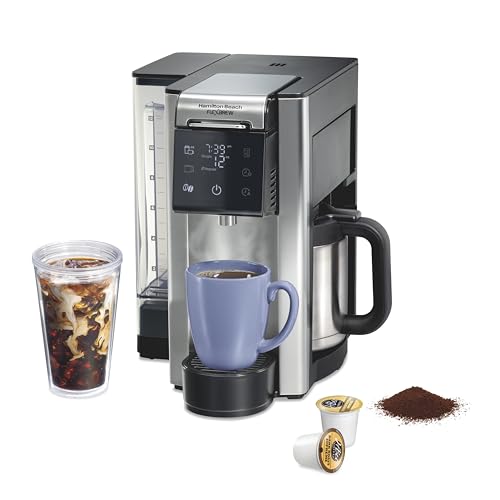
Hamilton Beach FlexBrew Advanced 5-in-1
Badge: Most Versatile
Strengths
- Five-in-one flexibility is the clearest niche in this guide: pot, single cup, pods, grounds, hot or iced in one footprint
- A removable 60 oz reservoir feeds both sides and refills at the sink instead of with a jug over the machine
- Households split between pot drinkers and pod drinkers stop needing two separate machines
Trade-offs
- Jack-of-all-trades machines ask more cleaning discipline — two brew paths mean two places for residue
- Counter footprint and height grow with the dual format, so measure under-cabinet clearance
- If you only ever brew one way, you are carrying complexity you will never use
| Capacity | 12-cup drip side, plus single serve |
|---|---|
| Modes | Drip and single serve; hot and iced |
| Inputs | Pods and grounds |
| Reservoir | Removable 60 oz reservoir |
| Carafe | Thermal, programmable drip side |
| Finish | Black |
The Hamilton Beach FlexBrew Advanced 5-in-1 earns its place through dual drip and single-serve flexibility for mixed households. That focus shapes everything about how it should be judged. Set it up where it will actually live, run the first brew as a rinse-through with plain water, and pay attention to the unglamorous details: how the carafe pours, how the lid feels when your hands are still half asleep, and whether the controls make sense without the manual open on the counter. Machines in this class live or die on those small interactions, repeated hundreds of times a year, far more than on any single headline feature.
In daily use, think about water and grounds discipline. Fresh water in the reservoir, a consistent grounds dose for the batch size you actually brew, and a carafe rinsed the same day rather than left overnight will do more for cup quality than any upgrade in this price class of equipment. This model rewards that discipline because its defining features — the ones in the spec box above — are aimed at consistency: the same routine produces the same cup, morning after morning, which is exactly what a household brewer is for. Where it asks something of you in return is footprint and routine: give it the counter space and the brief daily care it expects, and it stops feeling like an appliance and starts feeling like infrastructure.
The honest limitation is scope. This is a drip platform with a clear speciality, not a café. It will not pull espresso shots, it will not replicate a slow manual pour-over ritual, and it will not rescue poor-quality beans or stale grounds. Buy it for the job in its badge and it is a satisfying, durable answer; buy it hoping it will quietly become a different kind of machine and you will be shopping again within the year. That clarity — knowing precisely which job a machine is for — is the difference between a purchase that settles a kitchen question and one that merely postpones it.
Best for: readers whose priority is dual drip and single-serve flexibility for mixed households / Not suited for: buyers who need the opposite format, a different brand family, or a job this design was never built to do.
Comparison Table
| Pick | Badge | Format highlights | Check |
|---|---|---|---|
| BLACK+DECKER 12-Cup Thermal Programmable CM2046S | Best Programmable Thermal Pick | Capacity: 12 cups; Carafe: Thermal carafe; Controls: Programmable, with brew strength selection | Check on Amazon |
| Cuisinart PerfecTemp 12-Cup Thermal DCC-3400NAS | Best for Hotter Brewing | Capacity: 12 cups; Carafe: Double-wall stainless steel thermal carafe; Brewing feature: PerfecTemp hotter brewing | Check on Amazon |
| BLACK+DECKER CaféCraft 12-Cup Thermal Hot & Iced | Best for Hot-and-Iced Households | Capacity: 12 cups; Carafe: Thermal carafe; Modes: Hot and iced coffee | Check on Amazon |
| Cuisinart 12-Cup PerfecTemp Thermal, White | Best for Small Batches in a Big Machine | Capacity: 12 cups, with a 1-4 cup setting; Carafe: Thermal carafe; Brewing feature: PerfecTemp | Check on Amazon |
| BUNN Speed Brew Platinum Thermal CSB3T | Best for Speed | Capacity: 10 cups; Carafe: Thermal carafe; Format: Speed Brew platform | Check on Amazon |
| Hamilton Beach FlexBrew Advanced 5-in-1 | Most Versatile | Capacity: 12-cup drip side, plus single serve; Modes: Drip and single serve; hot and iced; Inputs: Pods and grounds | Check on Amazon |
How to Choose the best niche coffee makers for Your Kitchen
Start with the carafe question, because it quietly decides the daily experience. Thermal carafes keep coffee tasting fresh by holding heat in insulated steel rather than cooking it on a warming plate, which is why every pick in this guide uses one. The cost of that choice is visibility and pour speed: you cannot see how much coffee remains, and the last cup needs a fuller tilt. If your household drinks a pot within twenty minutes, that trade barely matters. If your household drinks across a whole morning, it is the single most important decision in this guide, and it points firmly at thermal.
Next, match capacity to the real batch, not the biggest batch you can imagine. A 12-cup machine brewed at four cups every day wastes counter space and often brews less evenly than it does at its designed volume — unless it carries a dedicated small-batch setting like one of the picks above. Count the mugs your household actually fills on a weekday, add one for the person who always wants a top-up, and buy for that number. Entertaining capacity is a poor reason to oversize the machine you use three hundred mornings a year; guests can wait for a second brew.
Then decide which niche is genuinely yours. Programmability serves households with fixed wake times. Speed serves households whose mornings are chaotic. Hot-and-iced range serves households whose coffee habits change with the seasons. Dual drip-and-single-serve serves households split between pot drinkers and pod drinkers. Each niche in this guide is a real answer to a real pattern — and a distraction if the pattern is not yours. Readers exploring the wider drip field, including Best Dual Function Coffee Makers, will notice the same principle: the best machine is the one whose speciality matches a routine you already have, not a routine you imagine adopting.
Finally, budget your attention, not just your money. Every feature in this category is paid for twice: once at purchase and once in daily operation, in rinsing, descaling, and learning. A simpler machine that you clean without thinking will out-taste a sophisticated machine that you neglect. Choose the most capable option you will still happily maintain in February, on a dark morning, when the novelty is long gone.
How to Brew, Clean, and Descale a Thermal Drip Coffee Maker
Daily brewing routine. Fill the reservoir with fresh water to the level of the batch you actually want. Add grounds in a consistent dose — the same scoop count for the same batch size, every time, until you know your household ratio by heart. Start the brew and leave the carafe alone until the cycle finishes; pulling the carafe early interrupts the extraction of everything still brewing. Serve, return the carafe to the machine, and rinse it the same day. Coffee oils left overnight in thermal steel are the main source of the stale, metallic note people later blame on the machine.
Weekly and monthly care. Wash the carafe, lid, and brew basket with warm soapy water weekly, paying attention to the carafe rim and the basket corners where oils collect. Descale on the schedule your water hardness demands — sooner with hard water, where scale insulates the heating element, lengthens brew times, and drags brew temperature down. Run the descale cycle or a plain-water rinse cycle as the manufacturer directs, then brew a full reservoir of plain water and discard it before making coffee again. Wipe the exterior and the area under the carafe, where drips dry unnoticed.
Troubleshooting. Problem: coffee tastes weak and watery → check the grounds dose first, then confirm you are not under-filling the basket for a large batch setting, and descale if brew times have stretched. Problem: coffee tastes bitter or harsh → reduce the dose slightly, avoid the strongest setting with dark roasts, and make sure old oils are not the culprit by deep-cleaning the carafe. Problem: the machine brews slowly or gurgles → scale is the usual cause; descale fully before assuming a fault, and check that the carafe lid is seated so the brew-through mechanism opens correctly.
What Counts as a Niche in Drip Coffee, Honestly
Let us be candid about the word niche. None of the machines in this guide is an exotic rarity — there is no siphon tower, no lever espresso machine, no hand-built pour-over station in the verified pool, and this guide will not pretend otherwise. What the pool does contain is a set of drip brewers each built around one well-defined speciality: heat retention, hotter extraction, hot-and-iced range, small-batch adjustment, outright speed, and dual-format flexibility. For most households, that is the useful meaning of niche — not an unusual machine, but a machine whose one special thing matches the one thing your household actually cares about.
That framing also protects you from the opposite mistake: buying a genuinely exotic brewer for a routine that never materialises. Specialty equipment demands specialty habits — grinding to order, weighing doses, learning a technique — and households that want those habits usually know it already. If that is you, treat this guide as the everyday-brewer chapter of a bigger setup and explore formats such as Best Dual Purpose Coffee Makers for the ritual side of the counter. If it is not you, one of the six specialities above, honestly matched, will make better coffee in your real life than a trophy machine ever will.
Matching the Machine to Your Household, Day After Day
Households are not static, and the wisest buyers leave a little room for the routine they are growing into. A single person who hosts monthly needs a different margin from a family of five with a daily habit, and a machine bought exactly at today’s requirement can feel undersized within a year. But margin should be bought in the dimension that is actually growing — servings, frequency, or range — not spread thinly across every feature at once. The detailed verdicts above are written to make that judgement easy: each one names the household the machine flatters and the household it frustrates.
It also helps to separate the weekday machine from the weekend machine in your mind, even when they turn out to be the same appliance. Weekday use values speed, simplicity, and forgiveness. Weekend use values range and the pleasure of doing something properly. A pick that covers both without excelling at either can still be the right purchase for a small kitchen — counter space is a real constraint, and one good-enough machine that is always ready often serves a household better than two excellent machines that are always in each other’s way. Related reading in Best Dual Use Coffee Makers and Best Drop Coffee Makers explores neighbouring formats for households still deciding where their own balance sits.
Common Buying Mistakes
- Buying the format for an imaginary routine. The most expensive mistake in this category is purchasing for the household you wish you were — daily batch prep, elaborate weekend projects — instead of the one that shows up on Tuesday morning.
- Judging by headline power or capacity alone. Big numbers describe a maximum, not an experience. Circulation, loading, container shape, and cleaning decide what the machine is like to live with.
- Ignoring the cleaning tax. Every design charges it differently. If the honest answer is that you will not wash a complicated assembly daily, choose the format whose cleaning you will actually do.
- Skipping the brand check. When a keyword names a brand, verify the badge on the machine matches it — this guide labels non-matching machines prose-only for exactly that reason.
- Overfilling to save a second batch. One overloaded blend is slower, rougher, and harder on the machine than two properly sized ones. Work within the stated capacity.
Final Recommendation
For most readers, start with the BLACK+DECKER 12-Cup Thermal Programmable CM2046S — its badge, Best Programmable Thermal Pick, reflects the strongest match between format, focus, and everyday practicality in this guide. For most readers, start with the Cuisinart PerfecTemp 12-Cup Thermal DCC-3400NAS — its badge, Best for Hotter Brewing, reflects the strongest match between format, focus, and everyday practicality in this guide. For most readers, start with the BLACK+DECKER CaféCraft 12-Cup Thermal Hot & Iced — its badge, Best for Hot-and-Iced Households, reflects the strongest match between format, focus, and everyday practicality in this guide.
Choose differently when your household points differently. If the second or third pick’s badge describes your routine more precisely — a smaller household, a portable habit, a specialist job — follow the badge, not the ranking; the order in this guide reflects breadth of appeal, not a quality ladder. And if the prose-only comparisons taught you that your real brief is a different brand or a commercial format, act on that knowledge rather than forcing this shortlist to fit. A well-matched machine bought once is the cheapest outcome available in this category.
Frequently Asked Questions
How many cups should a household coffee maker hold?
Count the mugs filled on an ordinary weekday, add one spare, and buy for that number. Oversizing for rare entertaining usually means brewing below the machine’s designed volume every day, which is the worst trade in this category.
Is a thermal carafe better than a glass carafe on a warming plate?
For flavour across a long morning, yes: insulated steel holds heat without continuing to cook the coffee. Glass wins on visibility and pour speed. Every pick in this guide is thermal, so the choice here is about which thermal speciality fits you.
What does a small-batch setting actually do?
It adjusts the brew cycle — typically flow and contact behaviour — so a short brew extracts more evenly in a basket designed for a full pot. It improves small batches noticeably, though dosing the grounds correctly still matters.
How often should I descale?
It depends on your water. Hard water can demand descaling every few weeks; soft water stretches that considerably. Lengthening brew times, gurgling, and a duller cup are the practical signals that scale has built up.
Can a drip machine make good iced coffee?
A hot-and-iced model brews a concentrate-style batch intended to be served over ice, which works well for everyday iced coffee. It is a different drink from slow cold brew — brighter and quicker, less mellow — and households often enjoy having both methods available.
Why does my coffee taste stale even with fresh beans?
Usually the carafe, not the beans. Coffee oils coat thermal steel and turn stale between brews. A same-day rinse and a weekly soapy wash remove most of the problem before it reaches the cup.


