Disclosure: topratedkitchenware.com is reader-supported. When you buy through links on our site, we may earn an affiliate commission from Amazon and other retailers, at no extra cost to you.
Where to buy
This guide to the best no maintenance rv 12 volt battery options links two true 12-volt sealed batteries and reviews four 24-volt batteries in full as prose-only entries. The promise in the keyword is specific: an RV house battery you never water, never check, and never think about between trips — a sealed battery, in a 12-volt system, sized for RV duty. Two picks in this verified pool meet the whole description. Four meet the sealed description beautifully and fail the voltage line completely, and in an RV — where the battery lives in a compartment you open twice a year — buying the wrong voltage is the most expensive form of maintenance there is.
- yeagulch 12.8V 100Ah LiFePO4 Lithium Battery, Group 31
- ABKPOWER 12V 20Ah LiFePO4 Battery
- dumfume 24V 100Ah LiFePO4 Lithium Battery — prose-only, a 24-volt unit, not a 12-volt RV battery
- Qwenoer 22.2V-24V 10Ah Lithium Battery — prose-only, a small 24-volt project pack, not an RV house battery
- Xeanerol 24V 5Ah Lithium Battery — prose-only, a 24-volt project pack, not an RV house battery
- yeagulch 24V 100Ah LiFePO4 Lithium Battery — prose-only, a 24-volt unit, not a 12-volt RV battery
Read the full guide ↓ for the detailed reviews, the honest definition of “no maintenance,” and the storage discipline that makes an RV battery last through seasons of being ignored — which is, after all, the point.
Every RVer knows the flooded battery ritual, because every RVer has performed it in a cramped compartment with a flashlight in their teeth: pop the caps, squint at the electrolyte, top up the low cells with distilled water, wipe the acid film off the top, and wonder how long the terminals have looked like that. The best no maintenance rv 12 volt battery is the one that deletes that ritual from your life. Sealed batteries — AGM, gel, and in the modern era lithium iron phosphate — have no caps to pop and no water to lose. You install them, connect them, and the compartment stays closed until you have a reason that is not a chore.
The two linked picks here are both sealed LiFePO4 batteries, and they divide the RV’s electrical life between them the way this guide will keep dividing it: the 100Ah Group 31 block is the house battery, the reservoir that runs lights, fans, pumps, and devices through the night; the 20Ah compact is the auxiliary, the dedicated little supply for electronics and light loads that an RVer adds once they discover how much nicer life is when the house bank is not asked to do everything. Both are genuinely no-maintenance in construction. Neither will ever ask you for water.
The four prose-only reviews are the guide’s other lesson, and it is a voltage lesson. All four are sealed 24V products — two of them serious 100Ah storage batteries that would star in a 24V guide — and an RV’s 12V system cannot use any of them as its house battery. They are reviewed in full, without links or images, so that the exclusion is transparent: you can see the quality being turned away, and the single specification line that turns it. In a category where the battery hides in a compartment, the most dangerous purchase is the one that looks right until the moment it is wired — which is why this guide spends as many words on its exclusions as on its recommendations, and considers that a feature rather than an apology.
Key Takeaways
- No maintenance means sealed: no watering, no electrolyte checks, no acid film — delivered here by LiFePO4 construction.
- Two picks are linked: a 100Ah Group 31 house battery and a 20Ah compact auxiliary, both true 12V class.
- Four picks are prose-only on voltage alone — all are 24V products, and an RV house system is a 12V system.
- The 100Ah pick states a deep-cycle count in the fifteen-thousand-plus range and low-temperature protection: longevity for a battery bought to be ignored.
- The 20Ah pick is an auxiliary for electronics and light loads — honest sizing matters more than the no-maintenance label, in this guide and in every battery purchase you will ever make.
- Sealed removes rituals, not physics: correct charging, storage state, and sound connections still decide lifespan — the shortest maintenance list in the RV, and still a list.
In this guide
Quick Picks
| Pick | Badge | Why it is here | Link |
|---|---|---|---|
| yeagulch 12.8V 100Ah LiFePO4, Group 31 | Best Overall | The house battery: sealed, 1280Wh stated, low-temperature protection, huge stated cycle ambition. | Check on Amazon |
| ABKPOWER 12V 20Ah LiFePO4 | Best Compact Auxiliary | Sealed auxiliary power for electronics, lighting, and light loads, with a 20A BMS. | Check on Amazon |
| dumfume 24V 100Ah LiFePO4 | Best for True 24V Systems | A serious sealed 24V unit with a stated waterproof rating — for 24V systems, not RV 12V. | Prose-only — 24 volts, not 12 |
| Qwenoer 22.2V-24V 10Ah Lithium Battery | Best for Small 24V Projects | A compact sealed project pack with charger — a bench battery, not a house battery. | Prose-only — 24 volts, not 12 |
| Xeanerol 24V 5Ah Lithium Battery | Best 24V Pack With Charger | A tiny sealed 24V system-in-a-box for projects and LED work. | Prose-only — 24 volts, not 12 |
| yeagulch 24V 100Ah LiFePO4 | Best 24V House Capacity | Full-size sealed 24V storage with a 100A BMS — admirable, and unusable here. | Prose-only — 24 volts, not 12 |
How These Picks Were Chosen
This guide is research-led, and it applied the keyword’s two promises as two gates. Gate one is the maintenance promise: only sealed batteries qualify — no flooded battery that needs watering could ever be linked under a no-maintenance title, and every pick in this pool, linked or not, is in fact sealed. Gate two is the system promise: an RV house battery in this keyword is a 12-volt battery, so only the 12V class — 12V or 12.8V nominal, the same LiFePO4 class under both labels — may be linked. Four picks fail gate two and are prose-only; the guide says so in their reviews rather than quietly dropping products a shopper will meet in the wild.
Within the linked pair, the evaluation weighted the things a neglected battery needs. For the house battery: capacity in the proven 100Ah class, protection against the cold-charge scenario that stored RVs face every winter, and declared cycle endurance, because a battery bought to be ignored must survive being ignored for years. For the auxiliary: honest small-scale sizing, a BMS matched to light loads, and explicit naming of its duties in its own title. One absence is recorded plainly: this slice contains no AGM battery, the traditional no-maintenance chemistry — the pool’s Renogy AGM anchors sibling guides but is not in this slice, so the linked answer here is lithium, with the reasoning shown. Readers who arrived via the common misspelling Best No Maintenenace 12 Volt Rv Battery will find this is the guide that search was looking for. No prices or fixed ratings are printed anywhere; stated cycle figures are manufacturer claims, reported as such.
The 6 Best No Maintenance RV 12 Volt Battery Candidates, Reviewed
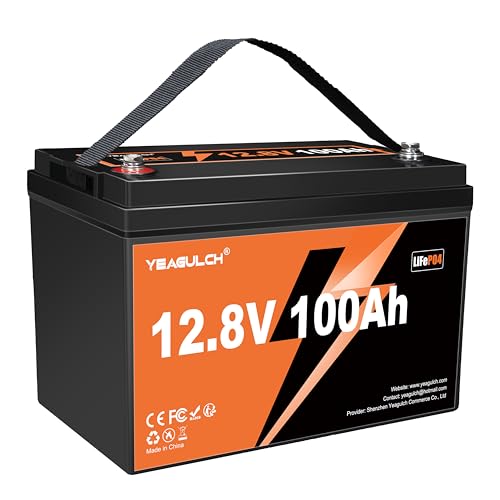
yeagulch 12.8V 100Ah LiFePO4 Lithium Battery, Group 31
Badge: Best Overall
Strengths
- Sealed LiFePO4: the no-maintenance promise kept completely — no water, no caps, no acid, ever.
- Stated deep-cycle count in the fifteen-thousand-plus range, the endurance a forgotten battery needs.
- Low-temperature protection guards the stored RV’s battery against its most dangerous ordinary event: a freezing charge.
Trade-offs
- The title states no expansion configuration, so paralleling for a bigger house bank should be confirmed with the manufacturer.
- Group 31 is the full-size footprint; smaller RV compartments should measure before ordering.
- It asks for a lithium-profile charging setup to live its best life — the converter conversation is part of any lithium RV conversion.
Key specs (from manufacturer title): Voltage: 12.8V nominal (12V class); Capacity: 100Ah; Stated energy: 1280Wh; Group size: 31; BMS: 100A; Stated deep cycles: 15000+; Protection: low temperature.
This is the house battery the keyword describes, and its specification reads like a list of answers to an RVer’s specific anxieties. Capacity: 100Ah and a stated 1280Wh, the proven overnight class for lights, fans, water pump, device charging, and a furnace blower’s duty cycle. Maintenance: none — the battery is sealed LiFePO4, and the compartment ritual is abolished rather than reduced. Endurance: a stated deep-cycle ambition at the top of the range, because a battery bought to be ignored must be built to be ignored for years, not seasons. Protection: a low-temperature cutoff standing guard over the exact scenario — a stored RV, a freezing night, an automatic charger doing its faithful job — that quietly ruins unprotected lithium.
Its honest limitations are the two recorded above, and neither is hidden in the fine print of this review. The expansion silence matters only to owners planning a multi-battery bank today; the single-battery majority can proceed on the specification as it stands, and bank builders have a short, free conversation with the manufacturer ahead of them. The Group 31 footprint is the standard the RV world is built around, which is a virtue in most compartments and a measurement in the rest. As the centre of a no-maintenance RV electrical life, this is the guide’s clear first choice — the battery you install in spring and greet, with mild surprise that you ever worried, in autumn. The same endurance logic prices itself out in our Best Quality 12 Volt Deep Cycle Batteries guide, where this class of block is judged on quality alone.
Best for: The RV house role — overnight loads, stored seasons, and owners done with the watering ritual. / Not suited for: Compartments too small for Group 31, or bank builders who need expansion stated in the title.

ABKPOWER 12V 20Ah LiFePO4 Battery
Badge: Best Compact Auxiliary
Strengths
- Sealed and maintenance-free, in a format that fits the spaces a house battery cannot.
- RV use is named in its title, alongside fish finders, solar, and lighting — its auxiliary brief is explicit.
- A 20A BMS and a stated 6000+ cycle design give light loads a properly engineered supply.
Trade-offs
- 256Wh is auxiliary energy: it will not run a house bank’s night, and this review will not pretend otherwise.
- Owners who buy it as a house battery by mistake will be disappointed by arithmetic, not by the product.
- Its value depends on being assigned the right job — electronics, lighting, fans, device charging.
Key specs (from manufacturer title): Voltage: 12V; Capacity: 20Ah; Stated energy: 256Wh; BMS: 20A; Stated cycles: 6000+; Named uses include RV, fish finder, solar, marine, home backup, lighting.
Every experienced RVer eventually discovers the auxiliary battery: the small, dedicated supply that runs the things the house bank should not be bothered with — the CPAP’s neighbour loads, the lighting circuit in a campervan conversion, the fans, the device-charging station, the electronics that prefer their own clean source. This ABKPOWER is that battery in its modern sealed form: twenty amp-hours of LiFePO4 that asks for nothing, weighs almost nothing, and carries a stated cycle design in the thousands because even auxiliaries live the charge-discharge rhythm daily.
The review’s duty is sizing honesty, and it cuts in the buyer’s favour both ways. As a house battery, 256Wh is an evening of lights, not a night of RV — anyone who installs it in the house role has bought a disappointment that arithmetic predicted. As an auxiliary, it is close to perfect: sealed, forgettable, and correctly engineered for its loads, with a 20A ceiling that covers the light-load world comfortably. Buy it for the second job and it will be the least troublesome battery you own; the guide’s badge names it accordingly. Owners trimming small outdoor-equipment batteries will recognise the same right-sizing virtue celebrated in our Best Prices On 12 Volt Mower Batteries coverage, where the correct small battery beats the impressive wrong one every season.
Best for: RV auxiliary duty — electronics, lighting, fans, and device charging in campers and conversions. / Not suited for: The house battery role, which belongs to the 100Ah pick above.
dumfume 24V 100Ah LiFePO4 Lithium Battery
Badge: Best for True 24V Systems
Strengths
- A complete sealed 24V storage specification: 2560Wh, built-in 100A BMS, low-temperature cutoff.
- Its title states an IP65 waterproof rating — a genuinely marine-flavoured touch.
- Stated certifications and a fifteen-thousand deep-cycle ambition suit serious systems.
Trade-offs
- 24 volts in a 12V RV: the mismatch is total, and no adapter narrative fixes it.
- An RV would need a redesigned electrical system to use it — a project, not a purchase.
- Its excellence is real and entirely addressed to a different reader.
Key specs (from manufacturer title): Voltage: 24V; Capacity: 100Ah; Stated energy: 2560Wh; BMS: built-in 100A; Stated deep cycles: 15000; Rating stated: IP65 waterproof; Certifications stated: UN38.3, UL1973.
Meet the most capable battery in this article, and the first of four that cannot be linked in it. The dumfume is a sealed 24V LiFePO4 storage battery with the full modern specification and a stated waterproof rating that acknowledges where batteries live. In a 24V system — a big trolling setup, a serious off-grid build — it is a first-rank candidate, and nothing in its prose-only status should be read as a quality judgement.
In an RV, it is a category error with excellent credentials. The house system is 12 volts from the converter to the last LED; a 24V battery does not join that system, it demands a different one. It is reviewed here, in full, because shoppers meet it constantly while hunting this keyword — the capacity and the rating draw the eye — and because a guide that quietly omitted it would leave its readers to discover the voltage line alone, possibly after delivery. Read the voltage first. It is the whole review, and it is why the two linked picks above are the shortlist.
Best for: Deliberate 24V marine and off-grid systems. / Not suited for: RV house duty in any 12V system.
Qwenoer 22.2V-24V 10Ah Lithium Battery
Badge: Best for Small 24V Projects
Strengths
- A complete sealed 24V project package with its own charger included.
- Bare-leads flexibility suits the DIY wiring its title describes.
- Named uses — ride-on cars, projects, LED strips, CCTV — are honestly scaled to 10Ah.
Trade-offs
- Wrong voltage, wrong scale, wrong format: it fails every element of the RV house description at once.
- Bare-leads project construction has no place in an RV’s battery compartment.
- Its 10Ah is bench energy; an RV night is measured in the 100Ah class.
Key specs (from manufacturer title): Voltage: 22.2V-24V; Capacity: 10Ah; Charger: 25.2V 2A included; Format: bare leads wire with cable connector; Chemistry: Li-ion.
Some reviews exist to draw a map’s edge, and this tidy little project pack draws ours. It is a sealed 24V lithium-ion battery with bare leads and a wall charger, made for ride-on toys, LED installations, cameras, and the honourable world of the workbench. On that bench it is a good product. In an RV battery compartment it is a non sequitur in three dimensions at once — voltage, capacity, and construction all point somewhere else.
It earns its paragraphs because it genuinely appears in the search neighbourhood of this keyword, trailing a familiar voltage number and an attractive compactness. Let its review do its work quickly: an RV house battery is a sealed, terminalled, deep-cycle unit in the system voltage, sized in the 100Ah class for the main role or the 20Ah class for auxiliary duty. The two linked picks are what that description looks like. The project pack returns to the bench, where it belongs and where it serves well.
Best for: 24V DIY projects, ride-on cars, LED and CCTV work. / Not suited for: RVs — in any role, at any scale of wishful thinking.
Xeanerol 24V 5Ah Lithium Battery
Badge: Best 24V Pack With Charger
Strengths
- Sealed, complete, and self-contained: battery, fast charger, and connector in one purchase.
- Its stated world — RC, LED strips, CCTV, DIY — is exactly its scale.
- As a maintenance-free object it is flawless; there is simply nothing to maintain.
Trade-offs
- 24 volts and 5Ah: the furthest point in this article from an RV house battery.
- Project format and project current limits throughout.
- Included for boundary education, not for candidacy.
Key specs (from manufacturer title): Voltage: 24V; Capacity: 5Ah; Chemistry: rechargeable Li-ion; Included: 2A fast charger, cable connector; Named uses: DIY projects, RC car, LED light strip, CCTV camera.
The smallest battery in the guide is the purest maintenance-free object in it — a sealed pack with its own charger that a hobbyist can own for years without a single maintenance thought — and it is also, by an enormous margin, the least suitable RV battery imaginable. Five amp-hours at 24 volts is a camera’s evening or a model’s afternoon. An RV’s evening is a hundred-amp-hour conversation. The two numbers do not argue; they simply live in different worlds.
Its review completes the pattern the prose-only section teaches: sealed construction earns a battery a hearing in a no-maintenance guide, and then voltage and scale decide its fate. Four batteries have now had that hearing and met that fate, each for the same stated reason. What remains — and what the comparison table formalises — is a two-name shortlist that actually fits an RV, which is the most useful thing a guide with six candidates and two answers can give you.
Best for: 24V RC, LED, CCTV, and DIY projects. / Not suited for: RVs, boats, or any storage-scale application.
yeagulch 24V 100Ah LiFePO4 Lithium Battery
Badge: Best 24V House Capacity
Strengths
- The full-size sealed 24V storage specification: 2560Wh with a built-in 100A BMS.
- Low-temperature cutoff and stated certifications suit unattended 24V systems.
- Trolling, off-grid, solar, RV, and marine are named in its title — at 24 volts.
Trade-offs
- That final phrase is the review: at 24 volts. An RV’s 12V system cannot use it.
- Its title’s mention of RVs refers to 24V RV systems, a small and deliberate minority.
- Quality is not the question; architecture is.
Key specs (from manufacturer title): Voltage: 24V; Capacity: 100Ah; Stated energy: 2560Wh; BMS: built-in 100A; Stated deep cycles: 15000+; Protection: low-temperature cutoff; Certifications stated: UN38.3, UL1973.
The last prose-only review is the subtlest trap in the article, because this battery’s title actually says “RV” — and an unwary shopper could stop reading there. Read on: the RVs it serves are 24-volt systems, the deliberate minority built around 24V architectures, and for those owners this sealed, protected, high-endurance unit is a genuinely strong house battery. For the overwhelming majority of RVs, whose house systems are 12 volts from end to end, it is the wrong battery wearing one right word.
That is why it closes the prose-only section: it proves that even a title match on the application word cannot rescue a voltage mismatch, and that the only safe reading of any listing is the whole listing. The guide’s linked shortlist — one house battery, one auxiliary, both sealed, both 12V class — is short because the gates are honest. Owners who do run a 24V RV system have just been handed a recommendation, in prose, with respect. Everyone else: the two linked picks are your article, and the sections that follow are about making them last.
Best for: The deliberate minority of 24V RV and off-grid systems. / Not suited for: Any standard 12V RV house system.
Comparison Table
| Pick | Voltage | Sealed / no maintenance | Capacity | RV verdict | Link |
|---|---|---|---|---|---|
| yeagulch Group 31 | 12.8V | Yes — LiFePO4 | 100Ah | Linked — the house battery | Check on Amazon |
| ABKPOWER | 12V | Yes — LiFePO4 | 20Ah | Linked — the auxiliary | Check on Amazon |
| dumfume | 24V | Yes — LiFePO4 | 100Ah | Prose-only — wrong voltage | Prose-only |
| Qwenoer pack | 24V | Yes — Li-ion | 10Ah | Prose-only — project pack | Prose-only |
| Xeanerol pack | 24V | Yes — Li-ion | 5Ah | Prose-only — project pack | Prose-only |
| yeagulch 24V | 24V | Yes — LiFePO4 | 100Ah | Prose-only — 24V systems only | Prose-only |
How to Choose a No-Maintenance Battery for Your RV
Start with the compartment, because the RV decides more of this purchase than the catalogue does. Measure the battery box in three dimensions, note the cable entry and the venting arrangement the old flooded battery needed — sealed batteries forgive the venting question that flooded ones insist on — and confirm the house system’s voltage, which in the standard RV world is 12 volts end to end. Then size the house role honestly: a night of lights, fans, pump, and devices in a typical RV lives comfortably in the 100Ah lithium class, most of whose capacity is usable; owners whose nights are heavier — furnace-heavy winter camping, larger device loads — should think in parallel pairs, with the manufacturer conversation the Best Overall review describes.
Assign the auxiliary role deliberately rather than by leftovers. Electronics, lighting circuits, and device charging are happier on their own small sealed supply, and the 20Ah pick exists for exactly that assignment. Then run the storage audit, because an RV battery’s hardest months are the parked ones: low-temperature protection for the wintered rig, a storage state-of-charge habit, and a parasitic-load check before the cover goes on. The value framework in our Best Pricesgolf Cart 12 Volt Battery Prices guide — cost per usable energy per year — applies to RV banks word for word, since carts and RVs share the same sealed-battery economics. Choose for the parked months as carefully as for the travelling ones, and the no-maintenance promise will survive contact with your actual calendar.
How to Install, Store, and Ignore an RV House Battery — Properly
Installation is the last time this battery should need your attention for a long while, so spend it well: secured mounting, protected terminals, correct cable gauge, hardware torqued and then protected against corrosion. Charge it fully once with the correct lithium profile so the management system can balance, and note the date somewhere you will find it in five years. After that, the regime is a short list of non-events:
- Recharge after trips rather than storing the bank discharged; lithium rests best at a partial charge for long storage.
- Before winter storage, set the maker’s recommended state of charge and disconnect or switch off parasitic loads — the clock, the detector, the sleeping electronics that sip all winter.
- Let low-temperature protection do its job: if the battery refuses a freezing charge, it is protecting itself, and the correct response is warmth, not override.
- Glance at the terminals when the compartment is open for other reasons; sealed batteries still have hardware, and hardware still appreciates a glance.
- Use a state-of-charge monitor rather than a voltmeter to judge the bank; lithium’s flat curve makes voltage a polite liar.
Troubleshooting the ignored battery is mostly storage forensics. Problem: the bank is flat in spring despite a full autumn charge → a parasitic load drank it slowly; find the sip before blaming the cells. Problem: capacity seems reduced after winter → check connections and confirm the charger completed a full lithium-profile charge before suspecting the battery. Problem: the charger and battery disagree in the cold → temperature protection is the likely peacemaker; warm the compartment and retry. The same absence audit governs the solar world of our Best Agm 12 Volt 200 Ah Solar Battery comparisons, where sealed batteries also earn their living unattended.
What “No Maintenance” Does Not Mean
A sealed battery abolishes a ritual, not a relationship, and the distinction is worth one clear section. No maintenance means: no watering, no electrolyte checks, no acid handling, no equalisation chores. It does not mean: no correct charger, no storage discipline, no sound connections, no attention to temperature. The owners who get a decade from a sealed bank are not the ones who never think about it; they are the ones who think about it four times a year, briefly, on purpose — a glance at the terminals, a storage charge set correctly, a monitor read with understanding. The owners who get two years are the ones who read “no maintenance” as “no physics.” This guide’s linked picks are engineered to reward the first group extravagantly. Be the first group; it costs almost nothing, which is rather the point of the category.
The Converter Question: Charging Lithium in an Older RV
One conversion topic deserves direct treatment because it decides whether a lithium house battery lives its specified life in an older rig. Many RV converter-chargers were built for lead-acid profiles: their charging stages, finishing behaviour, and float habits assume flooded or AGM chemistry. A lithium battery on such a converter may charge incompletely, sit at a state of charge the chemistry dislikes, or miss the finishing behaviour its management system expects. The responsible paths are a converter with a lithium profile, a dedicated lithium charger for the house bank, or a charging arrangement your battery’s maker endorses — chosen before the battery is installed, not discovered after the first flat morning. Newer rigs increasingly ship lithium-ready, which removes the question; older rigs reward asking it. Either way, the charger belongs in the same budget conversation as the battery, a habit the amp-hour auditors in our Best 75 Amp 12 Volt Battery guide would recognise as the category’s universal rule.
Sizing the House Bank for Real RV Nights
The most useful exercise in RV electrics takes ten minutes and a pencil: list everything the house bank feeds between dinner and breakfast, with its draw and its hours. Lights are modest; fans are honest workers; the water pump is brief and strong; device charging is a steady sip; a furnace blower on a cold night is the heavyweight that surprises everyone. Sum the amp-hours and you have your night’s true size. Against that figure, a 100Ah lithium battery offers most of its stated capacity as working energy — a fundamentally different proposition from the lead-acid bank it may replace, where prudent owners planned around half the rating and still woke to dim lights in year three.
If your honest sum approaches the single battery’s comfortable output, the correct responses are architectural, not hopeful: a second battery in parallel (after the manufacturer conversation about expansion), load discipline on the heavy items, or both. What the sealed lithium era has genuinely changed is the margin: the same compartment that once held a lead-acid bank at half-usable capacity now holds lithium at nearly full-usable capacity, which is why so many RVers describe the conversion as gaining a second battery they never installed. Size by your worst regular night — the cold one, with the furnace cycling — and the ordinary nights will feel like abundance.
Solar on the Roof: The Sealed Battery’s Best Friend
No pairing in the RV world is more natural than a sealed house battery and a roof of solar. The battery asks for nothing; the panels ask for nothing; together they quietly abolish the two sounds of the old RV night — the generator and the worry. A modest array will not refill a hard-used 100Ah bank in a winter day, and this guide will not pretend otherwise, but it will hold a stored bank at its preferred state of charge indefinitely, offset the auxiliary loads entirely on a sunny day, and stretch every boondocking stay by the margin that matters. The engineering courtesies are the familiar ones: a charge controller with a lithium profile, wiring sized for the run, and the same cold-charge respect the battery’s own protection enforces.
For the stored rig, solar’s gift is subtler and arguably greater: the parked months stop being a slow discharge toward a spring disappointment. A small panel keeping a sealed bank at its storage charge converts winter from a battery risk into a non-event — which is, once more, the entire philosophy of this keyword. No maintenance was never really about the battery alone; it is about an RV that is ready when you are, and solar plus sealed lithium is the closest the technology has come to keeping that promise literally.
From Flooded to Sealed: What the Conversion Day Actually Looks Like
Owners contemplating the switch often imagine a project; the reality is closer to an errand with good hygiene. The old bank comes out — carefully, because flooded batteries are heavy, acid-bearing, and owed a proper recycling path. The compartment gets the cleaning it has probably wanted for years: neutralise the acid film, inspect the tray and hold-downs, and retire any cable whose insulation or lugs have suffered in the damp. The sealed battery goes in at a fraction of the weight, the terminals land clean and tight, and the vent tube that the flooded bank required becomes a souvenir — sealed batteries do not ask the compartment to breathe for them.
The two genuine decisions of the day are electrical, and this guide has flagged both already: the charging profile, settled in the converter section, and the state-of-charge gauge, settled by accepting that a voltmeter will no longer tell you the truth and fitting a monitor that counts energy instead. Make those two decisions well and the conversion is complete in an afternoon, after which the compartment’s story changes genre — from a place you visit with a jug of distilled water to a place you open, years later, mostly to confirm that nothing has happened. Nothing happening, reliably, for years: that is the product. Everything in this guide — the gates, the sizing, the storage habits — exists to protect that beautiful uneventfulness.
Common Buying Mistakes
- Stopping at the word “RV” in a title. One prose-only pick names RVs and is a 24V battery. Read the whole listing — voltage first.
- Buying an auxiliary as a house battery. 256Wh is an evening of lights, not a night of RV; assign roles by arithmetic.
- Reading “no maintenance” as “no physics.” Storage state, parasitic loads, and cold charging still apply.
- Keeping a lead-acid converter profile by default. Lithium deserves its charging profile; budget the question.
- Storing the rig with the bank connected and forgotten. Sleeping electronics sip all winter; disconnect or manage them.
- Judging the bank by its voltmeter. Lithium’s flat curve hides state of charge; count energy instead.
Final Recommendation
Build the RV’s electrical life around the yeagulch 12.8V 100Ah LiFePO4 Lithium Battery, Group 31 — sealed, protected, and engineered for the years of benign neglect that are the entire point of this keyword — and give the electronics their own quiet supply with the ABKPOWER 12V 20Ah LiFePO4 Battery. Leave the four 24V products to the systems they serve. Then close the compartment, set the storage habits once, and let the battery do the thing you bought it to do: disappear, faithfully, for season after season of trips that start with everything working. That disappearance is a discipline as much as a product — the right voltage, the right role, the right charger, the right storage state — and this guide has tried to hand you the whole discipline alongside the shortlist, because a no-maintenance battery in a maintained system is the closest thing RV ownership has to a free lunch.
Related guides
Frequently Asked Questions
What makes a battery “no maintenance”?
Sealed construction. A maintenance-free battery has no accessible electrolyte to check or top up: in lead-acid terms that means AGM or gel; in the modern RV world it increasingly means sealed lithium iron phosphate, like both linked picks here. What you are buying is the abolition of the watering ritual — no caps, no distilled water, no acid film — while the ordinary duties of correct charging and sound connections remain, as they do for every battery ever made. It is also worth knowing what you are not buying: a battery that forgives being wired at the wrong voltage, stored flat for a year, or charged by any profile that happens to be plugged in. Sealed construction forgives neglect of rituals, not neglect of systems.
Why are four batteries in this guide not linked?
All four are 24-volt products, and an RV house system is a 12-volt system. Two are serious 24V storage batteries, two are small 24V project packs; none can serve as a 12V house or auxiliary battery. They are reviewed in full so the exclusion is transparent — you can see exactly what was turned away and the single specification that turned it — rather than discovering the voltage line after a delivery.
Can a 20Ah battery run my RV?
Not the house role — and it is not sold here as doing so. Twenty amp-hours, a stated 256Wh, is auxiliary energy: lighting, fans, electronics, device charging, the loads that are happier on their own supply. The house night — the full set of RV loads until morning — belongs to the 100Ah class. Assigning each battery its honest role is the difference between a system that delights and a purchase that disappoints by arithmetic.
Do I need to change my RV’s converter for a lithium house battery?
In many older rigs, you should plan on it — or on a dedicated lithium charger for the house bank. Lead-acid converter profiles charge lithium incompletely and finish it incorrectly, which quietly taxes the battery you bought for a decade. Newer lithium-ready converters remove the question. Either way, settle the charging arrangement before installation; it is part of the battery purchase in every way that matters to the battery.
How should I store my RV’s battery over winter?
Charge it to the manufacturer’s storage guidance — for lithium, typically a partial charge rather than full or empty — disconnect parasitic loads so sleeping electronics cannot sip it flat, and let its low-temperature protection guard any charging in freezing conditions. In spring, complete a full charge and check the terminals. That short ritual, twice a year, is the entire maintenance regime of a sealed RV battery. Compare it honestly with the flooded battery’s calendar — monthly level checks, seasonal equalisation, terminal corrosion patrol, and the distilled water jug living permanently in the pass-through — and the meaning of this keyword stops being a marketing phrase and becomes a schedule you get back.
Can I run a sealed lithium battery alongside my old lead-acid one?
Not in the same bank, and not on the same charging profile — the two chemistries disagree about charging voltages, resting behaviour, and what a full battery looks like, and a shared bank forces each to live by the other’s rules, to both their detriments. The clean architectures are a full conversion of the house bank to one chemistry, or genuinely separate systems with their own charging — the house bank converted, for instance, while an unrelated starting battery stays lead-acid on its own circuit. What never works is the halfway bank: mixed chemistries age unevenly, charge unevenly, and fail confusingly. If the budget argues for stages, convert by system, not by half-bank, and let each stage be complete in itself.
Is lithium really maintenance-free compared with AGM?
Both are sealed and both abolish watering — AGM is the traditional no-maintenance chemistry and a perfectly respectable one. Lithium adds three practical freedoms: it can be used across most of its capacity without the longevity penalty lead-acid charges for deep use, it weighs a fraction as much in the compartment, and its cycle design is measured in far larger numbers. Its own asks — a lithium charging profile and respect for cold-charge protection — are the asks this guide repeats, because they are the whole of its fine print.
