Disclosure: topratedkitchenware.com is reader-supported. When you buy through links on our site, we may earn an affiliate commission from Amazon and other retailers, at no extra cost to you.
Where to buy
Shopping for the best non electric smokers? Every pick in this guide cooks with fire alone — charcoal and wood, no heating element, no auger motor, no cord. That is the whole point of the category, and this guide enforces it strictly: the five linked picks below are charcoal and wood smokers only. One electric model from the wider pool is discussed later, in a clearly marked exclusion section, only to explain why it is not a pick here.
- Royal Gourmet CC1830S BBQ Charcoal Grill and Offset Smoker — Check on Amazon
- Oklahoma Joe’s Laredo Series 1100 Offset Charcoal Smoker and Grill
- Dyna-Glo Wide Body Vertical Offset Charcoal Smoker
- Realcook Charcoal Grill with Offset Smoker
- Oklahoma Joe’s Longhorn Offset Charcoal Smoker and Grill
Read the full guide ↓
The best non electric smokers make a promise that plug-in cooking cannot: barbecue anywhere fire is allowed, for as long as you have charcoal and wood, with nothing between you and the heat but your own skill. No outlet, no element, no controller board — a firebox, a chamber, dampers and a cook. This guide ranks five linked smokers that keep that promise in five different shapes: two grill-and-offset combos, two large traditional offsets and one vertical offset, all charcoal-fired. The phrase best non electric smokers is treated as a hard filter here, not a theme: if a model needs electricity to cook, it is not in the rankings, whatever else it does well.
Why choose fire-only in a decade of convenient appliances? The reasons are practical as often as romantic. Non-electric smokers work at campsites, tailgates, cabins and yards without outdoor power; they work through outages; they have no electronics to fail in rain, heat or storage; and they put the cook in direct conversation with the fire, which is where barbecue’s deepest flavor and deepest satisfaction both live. The cost is symmetric: nobody holds your temperature but you. This guide is written for readers who count that cost as tuition.
A note on what ‘non-electric’ excludes, because the boundary does real work in this article. Pellet smokers are excluded: their augers and controllers run on electricity, however wood-fired their heat feels. Electric cabinet smokers are excluded by definition. One such model — an EAST OAK 30-inch electric smoker from the wider verified pool — is examined in a dedicated section below, not as a pick, not with a link or an image, but as the worked example of the exclusion, so readers cross-shopping it can see exactly which side of the line it sits on and why. The five picks themselves need no such caveats: charcoal in, smoke out, nothing plugged in.
Specifications come only from verified listing titles — stated areas of 783, 800, 1,060 and 1,100 square inches where given, formats, and the Royal Gourmet’s enumerated working features. Fire behavior is described as established charcoal practice, and this guide claims no hands-on testing. Readers who want the automatic alternative argued fairly can find it in Best Smokers Electric Or Gas coverage; this article’s loyalty is to the unplugged format, argued on its merits.
Key Takeaways
- All five picks cook on charcoal and wood alone — no element, no auger, no cord — and work anywhere fire is permitted, including off-grid.
- The Laredo (1,100 sq. in.) and Longhorn (1,060 sq. in.) are the large traditional offsets; the Highland-class loads fit them without batching.
- The Royal Gourmet combo adds the band’s richest stated working features — tables, adjustable charcoal pan, side door, lid thermometer — across 783 sq. in.
- The Dyna-Glo vertical offset stacks non-electric capacity into a narrow footprint; the Realcook’s 800 sq. in. combo is the party-and-travel shape.
- Pellet smokers are not non-electric: their augers and controllers plug in. An electric model from the wider pool is discussed in the exclusion section, not ranked.
- The trade is explicit: total independence from power, paid for with total responsibility for the fire.
In this guide
Quick Picks
| Pick | Badge | Best for | Link |
|---|---|---|---|
| Royal Gourmet CC1830S BBQ Charcoal Grill and Offset Smoker | Best Value Non-Electric | Mixed grill-and-smoke days with no outlet required | Check on Amazon |
| Oklahoma Joe’s Laredo Series 1100 Offset Charcoal Smoker and Grill | Best Large Non-Electric | Large loads cooked entirely on charcoal and wood | Check on Amazon |
| Dyna-Glo Wide Body Vertical Offset Charcoal Smoker | Best Vertical Non-Electric | Stacked loads in a narrow yard, off-grid | Check on Amazon |
| Realcook Charcoal Grill with Offset Smoker | Best Party Non-Electric | Gatherings where the cooker travels or the power is out | Check on Amazon |
| Oklahoma Joe’s Longhorn Offset Charcoal Smoker and Grill | Best Traditional Non-Electric | Classic horizontal offset cooking at scale | Check on Amazon |
Five picks, three shapes. The combos (Royal Gourmet, Realcook) pair an offset smoker with a direct-heat grill for mixed menus and mobile cooking. The traditional barrels (Laredo, Longhorn) maximize horizontal chamber for dedicated low-and-slow work. The vertical Dyna-Glo stacks its load where yards are narrow. All five share the only specification this keyword truly cares about: the complete absence of an electrical requirement, which the comparison table states row by row so the filter stays visible.
Because the field is five rather than six, the table is a shape-choosing tool more than a ranking ladder. Decide your shape by menu and setting — mixed or dedicated, flat or stacked, stationary or traveling — and the size decision inside that shape is usually obvious from your signature load. The exclusion section after the reviews then handles the question every reader of this keyword eventually asks: what about the convenient electric cabinet I keep seeing? It answers with a specific model and a clear line.
How These Picks Were Chosen
Selection began with the filter the keyword demands: a pick must cook without electricity. That removed every electric cabinet and every pellet model from contention — pellet heat is wood, but pellet feeding and control are electric, and honesty about that distinction is this article’s foundation. The survivors from the verified pool were charcoal offset and combo smokers, five in number, and all five are linked. There are no prose-only picks in the rankings; the single electric model discussed appears outside the pick structure entirely, in an exclusion section, without link or image.
Ranking among the five weighted non-electric virtues: independence (all tie — none needs power), capacity for fire-cooked loads, working design for a cook who is also the thermostat, and portability of format for the off-grid settings this category serves. The Royal Gourmet’s stated furniture — tables, pan, door, thermometer — weighs heavily under that third criterion, because a non-electric cook performs every adjustment manually and benefits from a workstation designed for hands.
Method honesty: this is research-based guidance from verified titles plus established charcoal practice. No pick’s title states a runtime, a fuel consumption or a temperature stability figure, so none is claimed; the how-to sections teach the manual techniques — coal-bed management, damper discipline, rotation — on which those outcomes actually depend in any fire-only cooker. Where a title omits a detail, the guide sends you to the listing rather than filling the silence.
The five were also checked as a set against the non-electric buyer’s real contexts: the yard without an outlet, the campsite, the tailgate, the outage weekend, the cabin. Each pick owns at least one of those contexts outright, and together they cover all of them — which, for a category defined by where electricity is not, is the correct completeness test.
The 5 Best Non Electric Smokers, Reviewed

Royal Gourmet CC1830S BBQ Charcoal Grill and Offset Smoker
Badge: Best Value Non-Electric
Strengths
- Grill-plus-offset combo: direct and indirect fire cooking in one unplugged station
- Front and side tables, adjustable charcoal pan, side door and lid thermometer all stated
- 783 sq. in. for family loads and mixed menus
- No power needed for either side — the whole station travels
Trade-offs
- Smallest chamber here; gathering loads will sequence
- Manual everything: the grill side’s pan and the smoker’s fire both answer to you
- Lid thermometer is a guide; grate truth needs a probe
At a glance:
- Cooking area: 783 sq. in.
- Format: barrel charcoal grill + offset smoker
- Power required: none
- Stated features: front and side table, adjustable charcoal pan, side door, lid thermometer
The Royal Gourmet is the non-electric idea in its most complete everyday form: one barrel station, charcoal only, that both grills and offset-smokes, with the working furniture a manual cook actually uses stated right in its title. Tables front and side hold the tray traffic of a cook who is also the thermostat. The adjustable charcoal pan manages the grill side’s heat by distance — the oldest temperature control there is. The side door turns fire and ash work into a rhythm. And nothing, anywhere in the design, asks for an outlet.
That completeness makes it the natural base camp of this category. At a cabin, a campsite or a yard whose outdoor power is a extension-cord fantasy, the Royal Gourmet runs a full menu: ribs traveling slowly through the offset chamber while the grill side handles corn, sausages and the cook’s own lunch. Its 783 square inches suit family scale honestly, and its dual role means the non-electric commitment does not feel like a deprivation — it feels like a well-equipped fire kitchen.
Its limits are scale and automation, and only one of those is a real limit. Automation it simply refuses, by category. Scale is the genuine consideration: hosts cooking for crowds will sequence loads or step up to the big barrels in this guide. For the household whose non-electric life is family-sized and mixed-menu, this is the pick that will be lit most often — and in fire cooking, the cooker that gets lit is the cooker that gets learned, which is where all the flavor lives.
Best for: families wanting one unplugged station for grilling and smoking / Not suited for: crowd-scale hosts, who need the large barrels below

Oklahoma Joe’s Laredo Series 1100 Offset Charcoal Smoker and Grill
Badge: Best Large Non-Electric
Strengths
- 1,100 sq. in.: the largest fire-only chamber in this guide
- Traditional horizontal offset layout for the full signature repertoire
- Laredo Series smoker and grill: gathering scale without a watt
- Zone cooking along a long chamber, managed entirely by damper and placement
Trade-offs
- Largest footprint and charcoal appetite here
- Its size is a gathering tool; small loads waste its fire
- Accessory specifics are the listing’s to confirm
At a glance:
- Cooking area: 1,100 sq. in.
- Format: offset charcoal smoker and grill
- Power required: none
- Series: Laredo Series 1100
The Laredo is the proof that non-electric does not mean small, simple or limited. Eleven hundred stated square inches of traditional horizontal offset — brisket in the calm middle, ribs along the line, chickens toward the warmth — all of it cooked by a charcoal and wood fire that the cook builds, feeds and reads personally. For the off-grid gathering, the rural property, the competition-adjacent backyard with no interest in cords, this is barbecue at full scale with full independence: if you have fuel and a match, you have a kitchen.
There is a particular confidence in cooking a large load on fire alone. No element can trip, no controller can fault, no outage can reach you; the failure modes are all human and therefore all learnable — fuel sizing, damper patience, rotation timing. Experienced fire cooks trust big offsets precisely because everything the cook needs to know is visible in the fire and the smoke. The Laredo’s chamber gives that visibility a large canvas, and its traditional layout keeps the craft exactly where tradition put it.
The costs are the familiar large-barrel ones, intensified by the format’s honesty: more charcoal to hold a bigger chamber, more yard to house it, more skill demanded because no electronics will smooth a beginner’s afternoon. Buy it when the gatherings are real and the commitment to fire craft is genuine. In return, it offers the purest version of this keyword: the biggest cooking here, with the shortest possible list of things that can break.
Best for: large gatherings cooked entirely on fire, off-grid properties / Not suited for: beginners, or anyone who wants temperature held for them
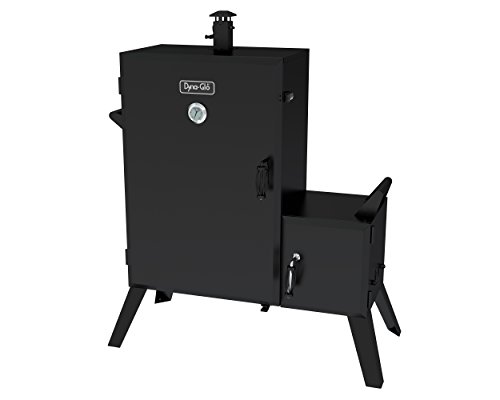
Dyna-Glo Wide Body Vertical Offset Charcoal Smoker
Badge: Best Vertical Non-Electric
Strengths
- Vertical offset stacking: serious fire-only capacity in a narrow footprint
- Offset firebox keeps smoke indirect — no element, no fan, just draw
- Wide-body levels suit many-item loads: chicken, sausages, ribs cut to fit
- Fits yards and sites where a horizontal barrel cannot go
Trade-offs
- Long flat cuts are not its geometry; brisket belongs to the barrels
- Levels cook unevenly by height — rotation is part of every cook
- No area is stated in its title; judge capacity by rack dimensions
At a glance:
- Format: wide body vertical offset charcoal smoker
- Power required: none
- Brand line: Dyna-Glo DGO1890BDC-D
- Color stated: Black
The Dyna-Glo brings the non-electric format to the narrow yard and the tight campsite corner. Its firebox sits offset from a wide-body vertical chamber, so the cooking is true offset work — indirect smoke from a real charcoal fire, drawn upward through stacked levels of food. Nothing plugs in; the draw is physics, the heat is fire, and the cook’s instruments are dampers and judgment. For stacked menus — chicken halves, sausage coils, ribs trimmed to the racks, layered sides — it converts a small footprint into a serious amount of barbecue.
Vertical fire cooking has its own craft, distinct from the barrels’: heat rises, so levels run at different intensities, and the cook rotates food between them the way an oven cook rotates trays — except here the rotation also moves food through smoke of different densities. Cooks who enjoy that active shelving find the format absorbing; it is the most hands-on shape in this guide, which for the non-electric audience is usually praise.
Its boundary is geometry, stated once more without apology: a whole brisket lying flat is a horizontal event. If that event is your signature, the barrels in this guide are your picks and this one is not. If your signature is abundance in layers — many items, small spaces, no power — the Dyna-Glo is not the compromise option. It is the only shape here that does your exact job.
Best for: narrow yards, campsites and stacked many-item menus / Not suited for: brisket-first cooks needing long flat chamber space

Realcook Charcoal Grill with Offset Smoker
Badge: Best Party Non-Electric
Strengths
- 800 sq. in. barrel combo titled for parties, weekend barbecues and gatherings
- One fire station for the slow centerpiece and the fast grill traffic
- Travels well in spirit: no power needs wherever it lands
- The social shape of non-electric cooking
Trade-offs
- A working host is part of the design — the fire will not tend itself
- Fewer working features are enumerated in its title than the Royal Gourmet’s
- Very large gatherings will still sequence loads
At a glance:
- Cooking space: 800 sq. in.
- Format: barrel charcoal grill with offset smoker
- Power required: none
- Stated use: backyard parties, weekend barbecues, gatherings
The Realcook is the non-electric format as a social instrument. Its title aims it at backyard parties, weekend barbecues and gatherings, and its 800-square-inch barrel combo is built for the way those events actually eat: a slow centerpiece traveling through the offset side from early in the day, and a grill side that comes alive at eating hour for the fast, sociable food. Because nothing in the station needs power, the party can happen where the people are — a field, a lakeside, a yard mid-renovation — rather than where the outlet is.
That mobility is the non-electric category’s underrated virtue, and the combo shape maximizes it. One station, one fuel, two temperatures of cooking, zero infrastructure. The host who cooks on a Realcook is performing the oldest version of hospitality there is: a fire, tended visibly, feeding a gathering. Guests gather around fire in a way they never gather around an appliance, and more than one owner of this format will tell you the cooker’s real output is the circle that forms around it.
The honest terms are the category’s terms: the host works. Fire management across a long smoke plus a grill service is a job with no autopilot, and a host who wants to be a guest at their own party should choose an automatic format without a shred of shame — just not from this guide. For the host who wants the fire, the Realcook is the party shape of the unplugged life, and its title’s confidence about its occasions is well placed.
Best for: hosts and travelers who cook for gatherings away from power / Not suited for: hosts who want to mingle rather than tend

Oklahoma Joe’s Longhorn Offset Charcoal Smoker and Grill
Badge: Best Traditional Non-Electric
Strengths
- 1,060 sq. in. of classic horizontal offset chamber
- Longhorn traditional format: smoker and grill, fire only
- Near-ceiling capacity for the dedicated traditionalist
- A decades-shaped purchase: no electronics to obsolesce
Trade-offs
- Large footprint and fuel appetite
- Title states format and area; accessories are a listing check
- Pure manual operation on every cook, forever — by design
At a glance:
- Cooking area: 1,060 sq. in.
- Format: offset charcoal smoker and grill
- Power required: none
- Series: Longhorn
The Longhorn closes the rankings as the traditionalist’s large fire-only barrel: 1,060 stated square inches in the classic horizontal offset arrangement, presented as a smoker and grill with no electrical anything. Its proposition to the non-electric buyer is permanence. A cooker with no controller, no element and no auger has no electronic generation to fall behind; maintained against rust and ash, its service life is measured in the owner’s patience rather than in product cycles. For buyers tired of appliances that age out, that is a profound kind of value.
As a cooking tool it mirrors the Laredo’s large-chamber virtues with a few dozen fewer square inches: whole signature loads in one layer, a gradient to cook along, zones for finishing and holding. The choice between the two big barrels is properly made on current listing details and the small area difference; the experience both promise is identical in kind — a large fire, a long chamber, and a cook whose skill is the only software involved.
Its limitations are the format’s manifesto read from the other side: it will never hold a temperature for you, never alert you, never forgive a neglected fire. The non-electric buyer does not experience those as limitations, and that is the precise self-knowledge this keyword exists to test. If reading this review feels like a description of your ideal Saturday, the Longhorn — or its Laredo sibling — is your pick, and no plug-in cooker at any feature level is a substitute.
Best for: committed traditionalists cooking large loads on fire alone / Not suited for: anyone who wants automation, alerts or set-and-forget cooking
Comparison Table
| Pick | Fuel / type | Cooking space or format | Standout detail from its listing title | Link |
|---|---|---|---|---|
| Royal Gourmet CC1830S BBQ Charcoal Grill and Offset Smoker | Charcoal / wood, no power | 783 sq. in. | Combo with the most stated working features | Check on Amazon |
| Oklahoma Joe’s Laredo Series 1100 Offset Charcoal Smoker and Grill | Charcoal / wood, no power | 1,100 sq. in. | Largest fire-only chamber | Check on Amazon |
| Dyna-Glo Wide Body Vertical Offset Charcoal Smoker | Charcoal, no power, vertical | Not stated in title | Wide-body stacked format | Check on Amazon |
| Realcook Charcoal Grill with Offset Smoker | Charcoal / wood, no power | 800 sq. in. | Party-framed barrel combo | Check on Amazon |
| Oklahoma Joe’s Longhorn Offset Charcoal Smoker and Grill | Charcoal / wood, no power | 1,060 sq. in. | Traditional large barrel, Longhorn | Check on Amazon |
Every row states its power requirement the same way — none — because that uniformity is the article’s thesis. Within it, the differences are shape and scale: combos for mixed menus, barrels for dedicated volume, a vertical for stacked loads in tight spaces. A comparison table for this keyword that mixed in a plug-in model for ‘balance’ would have failed its only job; the electric discussion lives in the exclusion section below, where it can be examined without being ranked.
Areas are stated where titles state them and flagged where they do not. For the Dyna-Glo, compare rack dimensions at the listing against your typical load’s footprint; vertical capacity is honestly measured in levels and rack size, not in a borrowed headline number.
How to Choose a Non Electric Smoker
Confirm the category first, because the market blurs it. A non-electric smoker cooks with fuel alone: charcoal, wood, or both. If a model has a heating element, it is electric; if it has an auger and a controller, it is a pellet appliance that plugs in, however traditional its smoke tastes. Both are legitimate categories — they are simply not this one. The five picks here pass the strict test, and the exclusion section shows the test being applied to a popular electric model so you can apply it anywhere.
Choose your shape by menu and setting together. Mixed menus and mobile cooking point to the combos; dedicated low-and-slow volume points to the traditional barrels; stacked menus in tight or off-grid spaces point to the vertical. Then choose size by signature load, with the same rule as every smoker guide in this program: the smallest chamber that takes your typical large load in one layer, because fire-only cooking punishes both crowding and waste — an oversized chamber burns real charcoal to heat real air, and you are the one carrying both.
Weight working design heavily, because in this category you are the control system. Tables, doors, pans and thermometer provision — the features the Royal Gourmet’s title enumerates — are not accessories on a manual cooker; they are the interface. Where a title does not enumerate them, verify them at the listing, and picture the cook: where does the tray go, how does ash leave, how do you read the chamber at a glance while your hands are full? The cooker that answers those questions smoothly is the one whose fire you will manage best.
Finally, choose with your settings in mind. List the places this cooker will actually burn: the yard, the campsite, the cabin, the tailgate lot. A non-electric smoker’s home is wherever fire is allowed, and models differ in how gracefully they travel and store. The buyer who matches shape, size, interface and setting has made the whole decision; everything after that is learning the fire, which is the part this category’s owners call the fun. For the contrasting philosophy — and a fair one — Best Smokers Gas Or Electric discussions frame what automation gives back in exchange for the cord. And for readers whose fire craft deepens toward its purest form, Best Small Stick Burner Smokers coverage shows where the charcoal path in this guide eventually leads: smaller fireboxes, split wood, and nothing else at all.
How to Cook Without Power: Fire Management as the Whole Skill
On a non-electric smoker, technique is not a section of the manual — it is the manual. The workflow below is the complete control system: fuel, air, placement, patience.
- Build a coal bed, not a bonfire. Start charcoal in a chimney, spread it in the firebox once ashed over, and add wood for smoke. A steady bed is your thermostat’s foundation.
- Set temperature with air. Intake damper open feeds the fire; closed starves it. Make small changes and wait — a fire-only chamber answers slowly and overshoots punish impatience.
- Preheat and settle before food. Let the chamber find its cruising state on your damper settings; food added to a still-climbing cooker cooks on a moving target.
- Place food by the heat map. Offset chambers grade from the firebox; verticals grade by height. Put each item where its needs match the zone, with space for smoke to move.
- Feed little and often. Small fuel additions keep the coal bed even and the smoke clean; a large late addition smothers first and surges later.
- Rest with the same discipline. No appliance will hold your brisket for you — wrap it, insulate it in a cooler, and let time finish what fire started.
Your instruments are simple and sufficient: a probe thermometer for the meat and ideally one at grate level, since a lid reading is a neighborhood rather than an address. Everything else — the look of the smoke, the sound of the fire, the feel of a brisket’s bend — is learned by repetition, and a cook log accelerates it: fuel amounts, damper positions, weather, results. Three logged cooks on a fire-only smoker teach more than a season of guessing on an automatic one, because every variable was yours.
Weather is your co-cook and deserves respect in the plan. Wind feeds or steals fire depending on direction; cold lengthens everything; rain on a hot lid is a temperature event. Position the cooker with wind in mind — firebox neither blasted nor starved — and start earlier than the optimistic schedule. Non-electric cooking rewards the planner and exposes the improviser, which is most of its charm and all of its difficulty.
Fuel selection deserves the same planning as the cook itself. Lump charcoal burns hotter and less predictably; briquettes burn steadier and longer, which is why many fire-only cooks build their base from briquettes and add wood for flavor. Whatever you choose, consistency is the virtue: the same fuel, bought in quantity and stored dry, behaves the same way cook after cook, and that repeatability is what lets your damper instincts become reliable. A non-electric cook who changes fuel every cook is relearning the fire every cook — sometimes that is exploration, but in the first season it is mostly noise. Settle your fuel, learn it deeply, and let variety arrive later as a deliberate experiment rather than a standing condition.
Troubleshooting
Problem: temperature keeps climbing past target → the fire is too large or the intake too open; close the intake in small steps, and next cook start with a smaller coal bed — you cannot un-burn fuel.
Problem: temperature fades mid-cook → ash is choking the firebox or the bed has burned down; clear air paths through the side door if your model has one, and add fuel before the bed dies, not after.
Problem: harsh, bitter smoke flavor → the fire is smoldering from oversized or damp wood; burn smaller, drier fuel with more air and let the smoke run thin and clean.
Excluded by Design: The Electric Cabinet, Examined Honestly
This section exists so the exclusion is a decision you can inspect, not a sleight of hand. The wider verified pool for smokers includes the EAST OAK 30-inch electric smoker — a vertical cabinet whose title describes a built-in meat probe, a clear viewing window, a side chip loader for longer uninterrupted smoking and 725 square inches of cooking area, in a Mist Silver finish. As an electric smoker, that is a coherent, appealing design: steady element heat, chip smoke added without opening the door, a window and probe for feedback, all in a compact footprint. If it were competing in an electric guide, it would be reviewed there on those merits, in full.
It is not a pick here, for one sufficient reason: it cooks with electricity. Its heat is an element’s, its operation requires an outlet, and the keyword of this article — non electric — is a promise that every ranked model works where power does not. Ranking it would break the promise in the act of making it, so it appears in this section only: no link, no image, no badge, no comparison-table row. The same logic excludes pellet smokers from these rankings, since their augers and controllers are electric even though their fuel is wood — a distinction this guide maintains even when marketing blurs it.
Let the example calibrate your own shopping. When a ‘non-electric’ list anywhere includes a model with a cord, a plug-in element or an auger motor, the list has failed its title. When an electric model appeals to you — and this EAST OAK’s window-and-probe package legitimately might — the honest move is to shop it in its own category, where the full electric field competes and its merits can actually win. Categories are not insults; they are how comparisons stay true.
Where Non-Electric Cooking Wins: Off-Grid, Outages and the Long Life
The strongest case for fire-only cooking is a list of places: the campsite with no hookup, the cabin at the end of a dirt road, the tailgate lot, the rural property where the yard’s far end has no outlet, and — the case nobody plans for — the home during an outage, when a non-electric smoker is not a hobby but the household’s most capable kitchen. In each place the five picks in this guide work at full ability, because their ability was never borrowed from a grid. That portability of competence is a feature no specification table captures, and for many owners it is the deciding one.
The second case is longevity. A fire-only smoker is a simple machine — steel, grates, dampers — with no electronic generation to age out and no control board to discontinue. Maintained against ash and weather, the barrels in this guide can serve for as long as their owners care to cook, and their skills compound in parallel: a decade of fire management is a permanent personal asset that transfers to every cooker, hearth and campfire the cook ever meets. Automation rents convenience; this category builds capability. Buyers who feel that distinction in their gut are this article’s true audience, and the picks above are ranked for them. For gift contexts, the same logic explains why a fire-only smoker is the rare present that teaches its recipient something — a point the discussions around Best Smokers Gifts return to often.
There is also a sensory case, harder to quantify and easy to mock until you have stood in it: a fire you built behaves like weather you understand. The smell of the coal bed catching, the color of the smoke thinning as the fire cleans up, the sound of fat meeting heat — a non-electric cook receives a continuous stream of information that no dashboard summarizes, and learns to read it the way a sailor reads water. Owners describe this as the difference between operating a smoker and cooking with one. It is not a reason that survives a spreadsheet, and it does not need to: it is the reason this category’s owners, surveyed by their own behavior, almost never migrate to plug-in cooking once the craft has taken hold. They add automatic cookers sometimes, for weeknights and convenience — and keep the fire cooker for the cooks that matter, which tells you exactly where the non-electric format sits in a mature cooking life: not as the compromise, but as the original.
Common Buying Mistakes
The category mistake comes first: buying a pellet or electric model under the impression that wood fuel makes it non-electric. If it plugs in, it is electric-assisted, and it will not cook in an outage or at an unpowered site. Read for cords the way the WiFi shopper reads for radios — in the exact model’s own description.
Second, underestimating the fire commitment: a non-electric smoker held to automatic standards will always disappoint, because its temperature is a practice, not a setting. Buyers should choose this category for the practice or not at all. Third, neglecting airflow basics — choked ash, closed exhaust, damp oversized wood — then blaming the cooker for swings and bitterness that technique caused. Fourth, skipping the grate-level probe: manual cooking does not mean unmeasured cooking, and the cook’s judgment calibrates fastest against honest numbers.
Fifth, choosing size by gathering fantasy rather than typical load, which in a charcoal cooker is paid for in fuel on every single cook. The fire-only format is honest about costs; be as honest in the buying as the cooking will require you to be.
Final Recommendation
Start with the Royal Gourmet CC1830S BBQ Charcoal Grill and Offset Smoker if its size and fuel style match your yard; it is the pick this guide would send most readers to first.
The runner-up worth a serious second look is the Oklahoma Joe’s Laredo Series 1100 Offset Charcoal Smoker and Grill, especially if the first choice is larger or smaller than your usual cook actually needs.
Choose by the shape of your unplugged life. Mixed menus and a family base camp: the Royal Gourmet, the most completely equipped manual station here. Gatherings at full scale on fire alone: the Laredo, or the Longhorn for the same tradition a step smaller. Parties that travel: the Realcook. Stacked loads in tight, powerless places: the Dyna-Glo. Each keeps the category’s one promise completely — charcoal and wood in, barbecue out, no cord anywhere in the story.
And keep the exclusion in mind as a compliment to your own clarity: the electric models you passed over are good machines in their category, and passing over them knowingly is what buying the best non electric smokers actually means. Check the latest price on Amazon for your pick, stock dry charcoal and wood, and schedule your first cook on a forgiving pork shoulder — the fire will teach you the rest, and it will keep teaching for as long as you keep showing up to learn.
Frequently Asked Questions
Are pellet smokers considered non-electric?
No. A pellet smoker’s heat comes from wood pellets, but its auger, fan and controller all run on electricity, and it stops cooking when the power does. This guide’s picks cook with fuel alone — charcoal and wood managed by dampers — which is the strict and useful meaning of non-electric.
Why is the EAST OAK electric smoker mentioned but not ranked?
Because readers cross-shop it, and its exclusion teaches the category line. It is a coherent electric cabinet — probe, window, chip loader — discussed in a dedicated section with no link, image or ranking. It belongs to the electric category, and this article’s promise is that every ranked pick works without power.
Can a non-electric smoker hold a steady temperature?
Steadily enough for excellent barbecue, in practiced hands: a right-sized coal bed, small damper adjustments and patience produce long, stable cruises. It will never match an electronic controller’s indifference, and it should not be bought by anyone who needs that indifference.
What fuel do these smokers use?
Charcoal as the dependable heat base, with wood chunks or splits for smoke flavor — the classic offset combination. Fuel quality matters more here than in any automatic format: dry, consistent charcoal and dry wood are the difference between a calm cook and a wrestling match.
Are non-electric smokers good for beginners?
They are good for beginners who want to learn barbecue as a craft, starting with forgiving cuts like pork shoulder. They are a poor choice for beginners who want the appliance to guarantee the result. The category teaches fast because every outcome traces to a decision the cook made.
Where can I use a non-electric smoker that I cannot use an electric one?
Anywhere fire is permitted and power is absent or unreliable: unpowered campsites, cabins, tailgate lots, rural yards, and home during outages. Local fire rules still govern — non-electric means independent of the grid, not exempt from common sense or regulations.
How long will a non-electric smoker last?
The format’s honest answer is: as long as its steel is maintained. With no electronics to fail or discontinue, service life is governed by ash removal, dry covered storage and ordinary care. That longevity is one of the category’s core arguments, and a reason traditional barrels are often bought as decade-scale purchases.


